Brasília, 05 a 06/05/2013
The FIBRE Project
http://www.fibre.org.br
Antônio Abelém - UFPA
INDEX
• Introduction
• FIBRE at a glance
• Objectives
• FIBRE Members
• Project structure
• Major results
• Overall Progress
• Development of infrastructure/substrate
• The FIBRE Workflow
• Final Considerations
2
3
Introduction
Context
• The architecture of TCP / IP (Internet) is a huge
success since its adoption 30 years ago:
– Adopted in 1985 by the NSF as architecture for the
NSFNET network
– Extended to the commercial world from 1999 (created
the "bubble" of 2000)
– Continues to expand to control almost all digital
communications in the world
– Due to the high flexibility of the architecture
– Facilitates the incorporation of new means of transport
4
Context
5
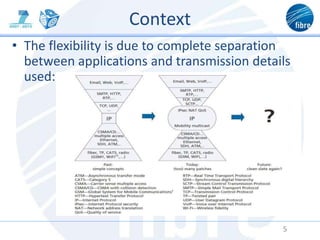
• The flexibility is due to complete separation
between applications and transmission details
used:
Context
• However it introduces difficulties to the
modification of network abstraction used:
– prevents differential treatment for applications that
require special QoS
– A single terminal equipment has multiple IP
addresses, if it has a redundant connectivity
– Handsets (not always connected) cause “difficulties”
between transparency and mobility
– Security "came after", and became essential for
almost all activities today
6
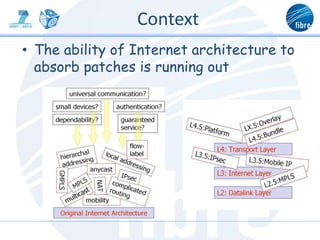
• The ability of Internet architecture to
absorb patches is running out
Context
Future Internet
• Overcoming this limitation requires changing this architecture
through the design called Future Internet (FI)
• Research FI consists of:
– Discuss how the new architecture will be developed for the
Internet;
– Evaluate alternative proposals for this new architecture;
– Develop procedures to adopt the new architecture.
8
Future Internet
• FI triggered a race for development testbeds to experimentally
evaluate alternative solutions for the Future Internet;
• Europe, the United States, Japan and Brazil (among others)
have been developing proposals:
– GENI (U.S.) www.geni.net
– FIRE (E U) www.ict-fire.eu/home
– Akari (Japan) http://akari-project.nict.go.jp/eng
9
Future Internet
• Providing environments for large scale experimentation
requires:
– Coexistence with the network traffic of production;
– Environment should be flexible and programmable (software
defined network) so that researchers can quickly define and
validate their proposals
10
11
FIBRE at a Glance
FIBRE objectives
Create a common space between the EU and Brazil
for
Future Internet (FI) experimental research
into
network infrastructure and distributed applications,
by
building and operating a federated EU-Brazil Future internet
experimental facility.
The project will design, implement and validate a shared Future Internet research
facility between Brazil and Europe, supporting the joint Future Internet
experimentation of European and Brazilian researchers
12
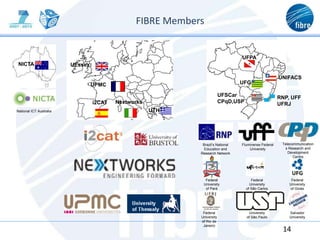
FIBRE Members
14
UEssex
UPMC
i2CAT Nextworks
UTH
UFPA
UFG
UFSCar
CPqD,USP
NICTA
UNIFACS
RNP, UFF
UFRJ
Brazil’s National
Education and
Research Network
Fluminense Federal
University
Telecommunication
s Research and
Development
Centre
Federal
University
of Pará
Federal
University
of Goiás
Federal
University
of São Carlos
Federal
University
of Rio de
Janeiro
University
of São Paulo
Salvador
University
National ICT Australia
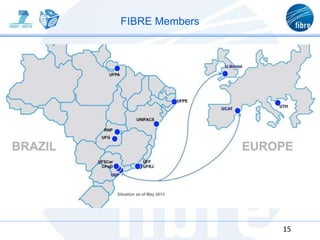
FIBRE Members
15
16
Major Results
17
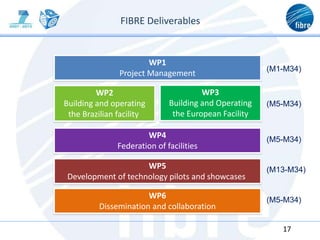
WP1
Project Management
WP2
Building and operating
the Brazilian facility
WP3
Building and Operating
the European Facility
WP4
Federation of facilities
WP5
Development of technology pilots and showcases
WP6
Dissemination and collaboration
(M1-M34)
(M5-M34)
(M5-M34)
(M5-M34)
(M13-M34)
FIBRE Deliverables
Major results
June 2011-April 2013
Technical Achievements until M23
• User requirements for the experimental facility D2.1, D3.1
• Use case requirements analysis and pilots design D3.1, MS15
• Analysis of federation requirements D4.1, MS12
• Specifications of the facility operation D2.2, D2.3, D2.4 e D2.5
• Technical requirements and topology for each facility D3.2, D2.3
MS15
Major results
June 2011-April 2013
Technical Achievements until M23
• Partial deployment and testing of individual facilities D2.2,
D2.3, D3.2,M2.1, MS2.2, MS 2.3
• Operation of the facility MS8
• Enhancement of OCF MS 6
• Enhancement of OMF MS7
Major results
June 2011-April 2013
Technical Achievements until M23
• Links between Brazil and Europe as well between European
islands has been set up MS12
• Project dissemination D6.1, D6.2, D6.3, MS19, MS20
• Project management D1.1, D1.2, D1.3, MS1, MS2
Development of infrastructure/substrate
• In order to define and develop the FIBRE-BR infrastructure
we worked on:
• Specification of technical requirements ( network and
computer) to purchase the equipment
• Acquisition of network and computer equipment
• Defining the topology for each island based on the local
infrastructure
• Design of network connections for integrating the islands
to one another
• Define a strategy plan to deploy the testbed
• Deployment and testing of individual facilities
21
SPECIFICATION OF TECHNICAL REQUIREMENT
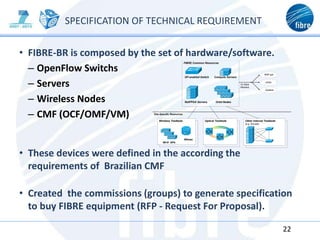
• FIBRE-BR is composed by the set of hardware/software.
– OpenFlow Switchs
– Servers
– Wireless Nodes
– CMF (OCF/OMF/VM)
• These devices were defined in the according the
requirements of Brazilian CMF
• Created the commissions (groups) to generate specification
to buy FIBRE equipment (RFP - Request For Proposal).
22
Optical Testbeds
Optical Testbeds
Wireless Testbeds
Wi-fi APs
Wimax
OF-enabled Switch
NetFPGA Servers
Compute Servers
FIBRE Common Resources
Orbit Nodes
Other Internal Testbeds
(e.g. Emulab)
Site-Specific Resources
To Fibre
Partners
RNP Ipê
GIGA
Kyatera
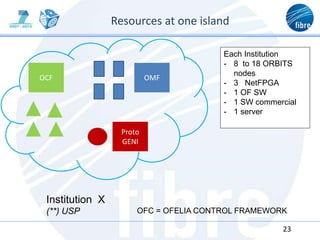
Resources at one island
23
Institution X
(**) USP
OMF
OCF
Proto
GENI
Each Institution
- 8 to 18 ORBITS
nodes
- 3 NetFPGA
- 1 OF SW
- 1 SW commercial
- 1 server
OFC = OFELIA CONTROL FRAMEWORK
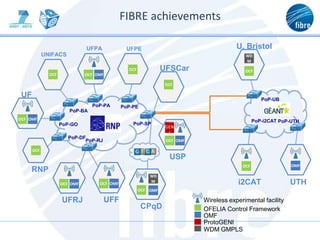
Wireless experimental facility
OFELIA Control Framework
OMF
ProtoGENI
WDM GMPLS
UFRJ UFF
RNP
PoP-RJ
PoP-DF
PoP-GO
PoP-BA
PoP-PA PoP-PE
UFPE
OMF
OCF
UFPA
UNIFACS
OMF
OCF
UF
G
OCF
OMF
OCF
OMF
OCF
UFSCar
OCF
USP
Proto
GEN
I
OMF
OCF
PoP-SP
i2CAT
OCF
U. Bristol
OCF
UTH
OMF
WD
M
PoP-i2CAT PoP-UTH
PoP-UB
CPqD
OMF
OCF
WD
M
OCF
OCF
FIBRE achievements
DEFINING THE TOPOLOGY FOR EACH
FACILITY
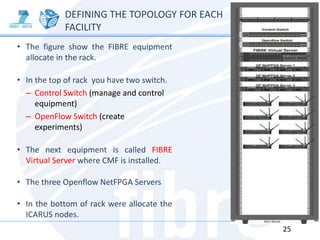
• The figure show the FIBRE equipment
allocate in the rack.
• In the top of rack you have two switch.
– Control Switch (manage and control
equipment)
– OpenFlow Switch (create
experiments)
• The next equipment is called FIBRE
Virtual Server where CMF is installed.
• The three Openflow NetFPGA Servers
• In the bottom of rack were allocate the
ICARUS nodes.
25
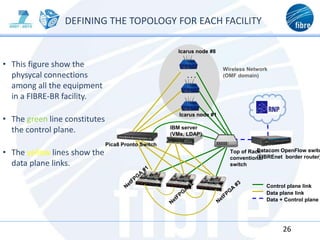
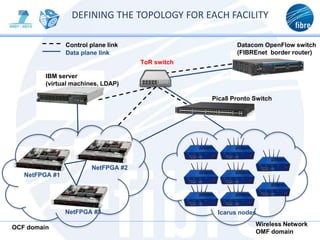
DEFINING THE TOPOLOGY FOR EACH FACILITY
• This figure show the
physycal connections
among all the equipment
in a FIBRE-BR facility.
• The green line constitutes
the control plane.
• The yellow lines show the
data plane links.
26
Pica8 Pronto Switch
IBM server
(VMs, LDAP)
Datacom OpenFlow switc
(FIBREnet border router)
. . .
Icarus node #1
Icarus node #8
Wireless Network
(OMF domain)
Top of Rack
conventional
switch
Data plane link
Control plane link
Data + Control plane
NetFPGA #1
NetFPGA #2
NetFPGA #3 Icarus nodes
IBM server
(virtual machines, LDAP)
Pica8 Pronto Switch
Datacom OpenFlow switch
(FIBREnet border router)
Wireless Network
OMF domain
ToR switch
Data plane link
Control plane link
OCF domain
DEFINING THE TOPOLOGY FOR EACH FACILITY
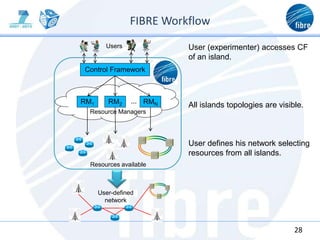
FIBRE Workflow
28
Control Framework
RM1
Users
Resource Managers
...
Resources available
RM2 RMN
User-defined
network
User (experimenter) accesses CF
of an island.
All islands topologies are visible.
User defines his network selecting
resources from all islands.
FIBRE Use Cases
30
Final Considerations
• FIBRE is a showcase project in international collaboration in
Future Internet
– Demonstrate local capacity to collaborate with leading
European projects in this important area
– Provide local experimental facilities for validating and
demonstrating new FI proposals
– Provide opportunity for extension to and participation by
researchers from other Latin American countries
– Promote involvement of and technology transfer to the
industrial sector, to prepare for Future Internet needs,
especially involving OpenFlow and SDN approaches.
Benefits
Expected Results
• Intercontinental slices of heterogeneous infrastructure to network
researchers.
• A federated infrastructure automatically controlled by one or more CMFs
• High speed intercontinental links connecting the European and the
Brazilian parts of the joint facility.
• Enhanced OFELIA Control Framework software
• Enhanced OMF and OML software
• Federation software and tools
• Experimental network application software
• Network of contacts between Brazilian and European partners
• Internal and external links with similar initiatives
32
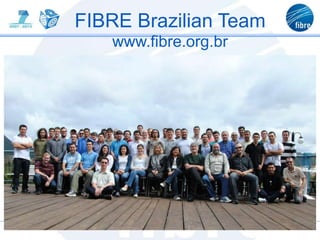
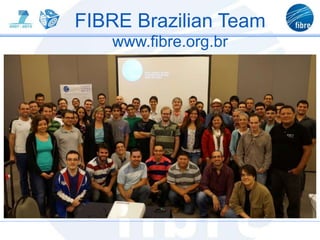
FIBRE Brazilian Team
www.fibre.org.br
FIBRE Brazilian Team
www.fibre.org.br
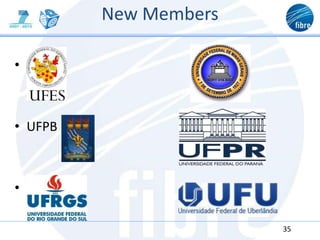
New Members
• UFES
• UFPB
• UFRGS
35
Thank you
abelem@ufpa.br
www.gercom.ufpa.br
twitter.com/FIBRE_project
www.facebook.com/fibre.project
www.fibre-ict.eu

FIBRE project updates

  • 1.
    Brasília, 05 a06/05/2013 The FIBRE Project http://www.fibre.org.br Antônio Abelém - UFPA
  • 2.
    INDEX • Introduction • FIBREat a glance • Objectives • FIBRE Members • Project structure • Major results • Overall Progress • Development of infrastructure/substrate • The FIBRE Workflow • Final Considerations 2
  • 3.
  • 4.
    Context • The architectureof TCP / IP (Internet) is a huge success since its adoption 30 years ago: – Adopted in 1985 by the NSF as architecture for the NSFNET network – Extended to the commercial world from 1999 (created the "bubble" of 2000) – Continues to expand to control almost all digital communications in the world – Due to the high flexibility of the architecture – Facilitates the incorporation of new means of transport 4
  • 5.
    Context 5 • The flexibilityis due to complete separation between applications and transmission details used:
  • 6.
    Context • However itintroduces difficulties to the modification of network abstraction used: – prevents differential treatment for applications that require special QoS – A single terminal equipment has multiple IP addresses, if it has a redundant connectivity – Handsets (not always connected) cause “difficulties” between transparency and mobility – Security "came after", and became essential for almost all activities today 6
  • 7.
    • The abilityof Internet architecture to absorb patches is running out Context
  • 8.
    Future Internet • Overcomingthis limitation requires changing this architecture through the design called Future Internet (FI) • Research FI consists of: – Discuss how the new architecture will be developed for the Internet; – Evaluate alternative proposals for this new architecture; – Develop procedures to adopt the new architecture. 8
  • 9.
    Future Internet • FItriggered a race for development testbeds to experimentally evaluate alternative solutions for the Future Internet; • Europe, the United States, Japan and Brazil (among others) have been developing proposals: – GENI (U.S.) www.geni.net – FIRE (E U) www.ict-fire.eu/home – Akari (Japan) http://akari-project.nict.go.jp/eng 9
  • 10.
    Future Internet • Providingenvironments for large scale experimentation requires: – Coexistence with the network traffic of production; – Environment should be flexible and programmable (software defined network) so that researchers can quickly define and validate their proposals 10
  • 11.
  • 12.
    FIBRE objectives Create acommon space between the EU and Brazil for Future Internet (FI) experimental research into network infrastructure and distributed applications, by building and operating a federated EU-Brazil Future internet experimental facility. The project will design, implement and validate a shared Future Internet research facility between Brazil and Europe, supporting the joint Future Internet experimentation of European and Brazilian researchers 12
  • 13.
    FIBRE Members 14 UEssex UPMC i2CAT Nextworks UTH UFPA UFG UFSCar CPqD,USP NICTA UNIFACS RNP,UFF UFRJ Brazil’s National Education and Research Network Fluminense Federal University Telecommunication s Research and Development Centre Federal University of Pará Federal University of Goiás Federal University of São Carlos Federal University of Rio de Janeiro University of São Paulo Salvador University National ICT Australia
  • 14.
  • 15.
  • 16.
    17 WP1 Project Management WP2 Building andoperating the Brazilian facility WP3 Building and Operating the European Facility WP4 Federation of facilities WP5 Development of technology pilots and showcases WP6 Dissemination and collaboration (M1-M34) (M5-M34) (M5-M34) (M5-M34) (M13-M34) FIBRE Deliverables
  • 17.
    Major results June 2011-April2013 Technical Achievements until M23 • User requirements for the experimental facility D2.1, D3.1 • Use case requirements analysis and pilots design D3.1, MS15 • Analysis of federation requirements D4.1, MS12 • Specifications of the facility operation D2.2, D2.3, D2.4 e D2.5 • Technical requirements and topology for each facility D3.2, D2.3 MS15
  • 18.
    Major results June 2011-April2013 Technical Achievements until M23 • Partial deployment and testing of individual facilities D2.2, D2.3, D3.2,M2.1, MS2.2, MS 2.3 • Operation of the facility MS8 • Enhancement of OCF MS 6 • Enhancement of OMF MS7
  • 19.
    Major results June 2011-April2013 Technical Achievements until M23 • Links between Brazil and Europe as well between European islands has been set up MS12 • Project dissemination D6.1, D6.2, D6.3, MS19, MS20 • Project management D1.1, D1.2, D1.3, MS1, MS2
  • 20.
    Development of infrastructure/substrate •In order to define and develop the FIBRE-BR infrastructure we worked on: • Specification of technical requirements ( network and computer) to purchase the equipment • Acquisition of network and computer equipment • Defining the topology for each island based on the local infrastructure • Design of network connections for integrating the islands to one another • Define a strategy plan to deploy the testbed • Deployment and testing of individual facilities 21
  • 21.
    SPECIFICATION OF TECHNICALREQUIREMENT • FIBRE-BR is composed by the set of hardware/software. – OpenFlow Switchs – Servers – Wireless Nodes – CMF (OCF/OMF/VM) • These devices were defined in the according the requirements of Brazilian CMF • Created the commissions (groups) to generate specification to buy FIBRE equipment (RFP - Request For Proposal). 22 Optical Testbeds Optical Testbeds Wireless Testbeds Wi-fi APs Wimax OF-enabled Switch NetFPGA Servers Compute Servers FIBRE Common Resources Orbit Nodes Other Internal Testbeds (e.g. Emulab) Site-Specific Resources To Fibre Partners RNP Ipê GIGA Kyatera
  • 22.
    Resources at oneisland 23 Institution X (**) USP OMF OCF Proto GENI Each Institution - 8 to 18 ORBITS nodes - 3 NetFPGA - 1 OF SW - 1 SW commercial - 1 server OFC = OFELIA CONTROL FRAMEWORK
  • 23.
    Wireless experimental facility OFELIAControl Framework OMF ProtoGENI WDM GMPLS UFRJ UFF RNP PoP-RJ PoP-DF PoP-GO PoP-BA PoP-PA PoP-PE UFPE OMF OCF UFPA UNIFACS OMF OCF UF G OCF OMF OCF OMF OCF UFSCar OCF USP Proto GEN I OMF OCF PoP-SP i2CAT OCF U. Bristol OCF UTH OMF WD M PoP-i2CAT PoP-UTH PoP-UB CPqD OMF OCF WD M OCF OCF FIBRE achievements
  • 24.
    DEFINING THE TOPOLOGYFOR EACH FACILITY • The figure show the FIBRE equipment allocate in the rack. • In the top of rack you have two switch. – Control Switch (manage and control equipment) – OpenFlow Switch (create experiments) • The next equipment is called FIBRE Virtual Server where CMF is installed. • The three Openflow NetFPGA Servers • In the bottom of rack were allocate the ICARUS nodes. 25
  • 25.
    DEFINING THE TOPOLOGYFOR EACH FACILITY • This figure show the physycal connections among all the equipment in a FIBRE-BR facility. • The green line constitutes the control plane. • The yellow lines show the data plane links. 26 Pica8 Pronto Switch IBM server (VMs, LDAP) Datacom OpenFlow switc (FIBREnet border router) . . . Icarus node #1 Icarus node #8 Wireless Network (OMF domain) Top of Rack conventional switch Data plane link Control plane link Data + Control plane
  • 26.
    NetFPGA #1 NetFPGA #2 NetFPGA#3 Icarus nodes IBM server (virtual machines, LDAP) Pica8 Pronto Switch Datacom OpenFlow switch (FIBREnet border router) Wireless Network OMF domain ToR switch Data plane link Control plane link OCF domain DEFINING THE TOPOLOGY FOR EACH FACILITY
  • 27.
    FIBRE Workflow 28 Control Framework RM1 Users ResourceManagers ... Resources available RM2 RMN User-defined network User (experimenter) accesses CF of an island. All islands topologies are visible. User defines his network selecting resources from all islands.
  • 28.
  • 29.
  • 30.
    • FIBRE isa showcase project in international collaboration in Future Internet – Demonstrate local capacity to collaborate with leading European projects in this important area – Provide local experimental facilities for validating and demonstrating new FI proposals – Provide opportunity for extension to and participation by researchers from other Latin American countries – Promote involvement of and technology transfer to the industrial sector, to prepare for Future Internet needs, especially involving OpenFlow and SDN approaches. Benefits
  • 31.
    Expected Results • Intercontinentalslices of heterogeneous infrastructure to network researchers. • A federated infrastructure automatically controlled by one or more CMFs • High speed intercontinental links connecting the European and the Brazilian parts of the joint facility. • Enhanced OFELIA Control Framework software • Enhanced OMF and OML software • Federation software and tools • Experimental network application software • Network of contacts between Brazilian and European partners • Internal and external links with similar initiatives 32
  • 32.
  • 33.
  • 34.
    New Members • UFES •UFPB • UFRGS 35
  • 35.