Using Future Internet
testbed in the classroom
Iara Machado - RNP
TICAL 2015
Viña del Mar – 03/07/2015
1
About Future Internet
• Overcoming limitations of today’s Internet requires changing
this architecture through the design called Future Internet (FI)
• Research FI consists of:
– Discuss how the new architecture will be developed for the
Internet;
– Evaluate alternative proposals for this new architecture;
– Develop procedures to adopt the new architecture.
2
About Future Internet
• Providing environments for large scale
experimentation requires:
• Coexistence with the network traffic of
production;
• Environment should be flexible and programmable
(software defined network) so that researchers
can quickly define and validate their proposals
3
Testbeds for Future Internet
• Purpose
• Experimental research into network infrastructure
and distributed applications
• Above Layer 2
• Programmable network environment
• Characteristics:
• Wide set of technologies and scale
• Faithful to the scale and heterogeneity of the real environment
• Wireless and sensor networks, routers, switches, end-hosts…
• Dedicated networks
• Isolated from the production Internet and from each other
• Use of virtual routers and multiplexing links between them
• Monitoring and Instrumentation of experiments
FIBRE: a large-scale Future Internet testbed
facility
• Studies began in 2008, inspired by GENI (USA) and by the FIRE
(Future Internet Research and Experimentation) program of the EU
• Funding provided 2011-2014 by Coordinated Call in ICT between
Brazil and the EU, supporting FIBRE (FI testbed/experimentation
between Brazil and Europe).
• FIBRE project includes 10 nodes in Brazil and 3 in the EU.
• The follow-on FIBRE2 project is being funded in Brazil to support
the operation, maintenance and expansion of the existing testbed,
for use by research and education until 2018.
• On-going conversations were initiated in 2013 to promote the
international federation of the FI testbeds
• In 2015 AmLight deployed a Fibre island in Miami federated to
FIBRE.
6
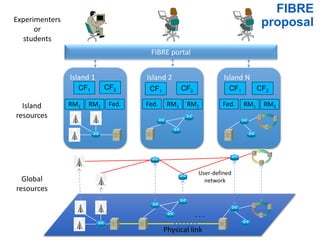
Island 1
RM1 RM2 Fed.
Island 2
RM1 RM2Fed.
User-defined
network
Island
resources
Physical link
Island N
RM1 RM2Fed.
. . .
Global
resources
Experimenters
or
students
FIBRE portal
CF1 CF2 CF2CF1 CF1 CF2
FIBRE
proposal
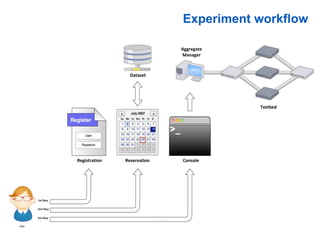
Experiment workflow
Dataset
Aggregate
Manager
Testbed
ConsoleReservationRegistration
FIBRE rack deployed at each institution
8
Datacom OpenFlow switch
(FIBREnet border router)
Data plane link
Control plane link
Data + Control plane
NetFPGA #1
Pica8 Pronto Switch
IBM server
(VMs, LDAP)
OMF domain
(Wireless)
Switch
Top of Rack
NetFPGA #2
NetFPGA #3
OCF domain
PerfSONAR
Wireless nodes
Local testbed (island) @ institution PoP
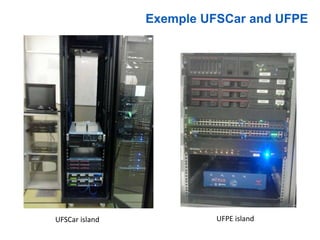
Exemple UFSCar and UFPE
UFSCar island UFPE island
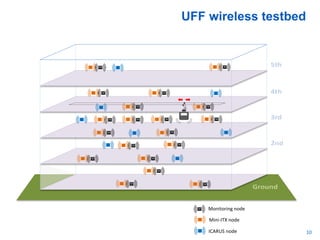
UFF wireless testbed
10
MM
M
M
M
M
M
M
M
M
M
M
M
M
M
M
M
MM
Mini-ITX node
ICARUS node
M Monitoring node
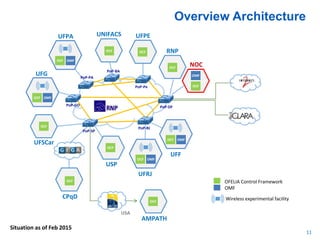
Wireless experimental facility
OFELIA Control Framework
OMF
UFRJ
UFF
RNP
UFPEUFPA UNIFACS
OMFOCF
UFG
OMFOCF
UFSCar
USP
CPqD
OMFOCF
OMFOCF
PoP-BA
PoP-PA
PoP-GO PoP-DF
PoP-RJ
PoP-Pe
PoP-SP
NOC
OMF
OCF
OCFOCF
OCF
OCF
USA
OCF
OCF
AMPATH
OCF
Overview Architecture
11
Situation as of Feb 2015
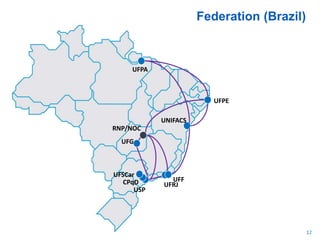
Federation (Brazil)
12
UFF
UFSCar
UNIFACS
UFPE
UFG
UFPA
RNP/NOC
USP
CPqD UFRJ
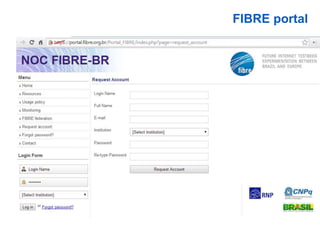
FIBRE portal
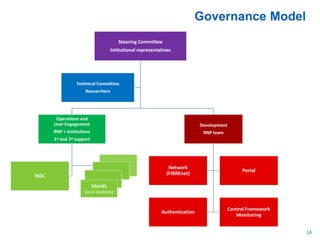
Steering Committee
Intitutional representatives
Operations and
User Engagement
RNP + institutions
1ª and 2ª support
Island n...
NOC
Development
RNP team
Network
(FIBREnet)
Portal
Authentication
Control Framework
Monitoring
Technical Committee
Researchers
Islands
(local testbeds)
Governance Model
14
FIBRE in the classroom – Why?
• The use of a large-scale testbed give students first-hand experience to a
real-world situation, instead of using software tools
to simulate networks in the laboratory.
• With the use of Future Internet testbeds in computer-network classes,
we believe the next generation of researchers will be more
capable of dealing with architectural experiments and of continuously
evolving the current Internet architecture
• But this is not a new idea…
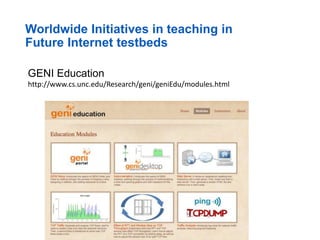
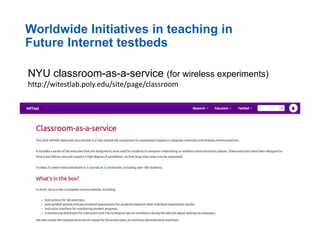
Worldwide Initiatives in teaching in
Future Internet testbeds
GENI Education
http://www.cs.unc.edu/Research/geni/geniEdu/modules.html
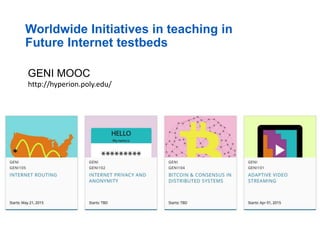
Worldwide Initiatives in teaching in
Future Internet testbeds
GENI MOOC
http://hyperion.poly.edu/
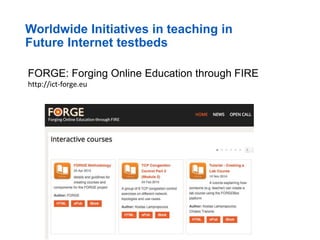
Worldwide Initiatives in teaching in
Future Internet testbeds
FORGE: Forging Online Education through FIRE
http://ict-forge.eu
Worldwide Initiatives in teaching in
Future Internet testbeds
NYU classroom-as-a-service (for wireless experiments)
http://witestlab.poly.edu/site/page/classroom
Our plans in the medium-term
1. To select hands-on exercises used by professors to teach network
classes
• Based on Mininet and other tools
• Based on OpenFlow
2. To deploy selected exercises in the FIBRE infrastructure and generate
step-by-step instructions and video-lessons.
3. To create an online repository of teaching material for professors.
We welcome ideas of exercises/experiments to be ported to FIBRE
• Through FIBRE’s experimental facilities, researchers
can validate and demonstrate new FI proposals
• Project is in its final steps
• Small adjustments and tweakings in the infrastructure
• Needs more experiments to validate the testbed
• Get access to FIBRE testbed!
https://portal.fibre.org.br/
info@fibre.org.br
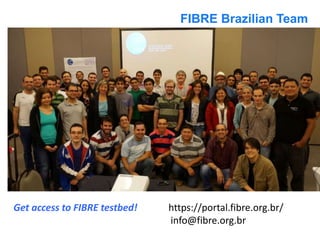
FIBRE Brazilian Team
Get access to FIBRE testbed! https://portal.fibre.org.br/
info@fibre.org.br
Thank you / Obrigado
Iara Machado (RNP)
www.facebook.com/fibre.project
www.fibre.org.br

Using Future Internet testbeds in the classroom

  • 1.
    Using Future Internet testbedin the classroom Iara Machado - RNP TICAL 2015 Viña del Mar – 03/07/2015 1
  • 2.
    About Future Internet •Overcoming limitations of today’s Internet requires changing this architecture through the design called Future Internet (FI) • Research FI consists of: – Discuss how the new architecture will be developed for the Internet; – Evaluate alternative proposals for this new architecture; – Develop procedures to adopt the new architecture. 2
  • 3.
    About Future Internet •Providing environments for large scale experimentation requires: • Coexistence with the network traffic of production; • Environment should be flexible and programmable (software defined network) so that researchers can quickly define and validate their proposals 3
  • 4.
    Testbeds for FutureInternet • Purpose • Experimental research into network infrastructure and distributed applications • Above Layer 2 • Programmable network environment • Characteristics: • Wide set of technologies and scale • Faithful to the scale and heterogeneity of the real environment • Wireless and sensor networks, routers, switches, end-hosts… • Dedicated networks • Isolated from the production Internet and from each other • Use of virtual routers and multiplexing links between them • Monitoring and Instrumentation of experiments
  • 5.
    FIBRE: a large-scaleFuture Internet testbed facility • Studies began in 2008, inspired by GENI (USA) and by the FIRE (Future Internet Research and Experimentation) program of the EU • Funding provided 2011-2014 by Coordinated Call in ICT between Brazil and the EU, supporting FIBRE (FI testbed/experimentation between Brazil and Europe). • FIBRE project includes 10 nodes in Brazil and 3 in the EU. • The follow-on FIBRE2 project is being funded in Brazil to support the operation, maintenance and expansion of the existing testbed, for use by research and education until 2018. • On-going conversations were initiated in 2013 to promote the international federation of the FI testbeds • In 2015 AmLight deployed a Fibre island in Miami federated to FIBRE.
  • 6.
    6 Island 1 RM1 RM2Fed. Island 2 RM1 RM2Fed. User-defined network Island resources Physical link Island N RM1 RM2Fed. . . . Global resources Experimenters or students FIBRE portal CF1 CF2 CF2CF1 CF1 CF2 FIBRE proposal
  • 7.
  • 8.
    FIBRE rack deployedat each institution 8 Datacom OpenFlow switch (FIBREnet border router) Data plane link Control plane link Data + Control plane NetFPGA #1 Pica8 Pronto Switch IBM server (VMs, LDAP) OMF domain (Wireless) Switch Top of Rack NetFPGA #2 NetFPGA #3 OCF domain PerfSONAR Wireless nodes Local testbed (island) @ institution PoP
  • 9.
    Exemple UFSCar andUFPE UFSCar island UFPE island
  • 10.
  • 11.
    Wireless experimental facility OFELIAControl Framework OMF UFRJ UFF RNP UFPEUFPA UNIFACS OMFOCF UFG OMFOCF UFSCar USP CPqD OMFOCF OMFOCF PoP-BA PoP-PA PoP-GO PoP-DF PoP-RJ PoP-Pe PoP-SP NOC OMF OCF OCFOCF OCF OCF USA OCF OCF AMPATH OCF Overview Architecture 11 Situation as of Feb 2015
  • 12.
  • 13.
  • 14.
    Steering Committee Intitutional representatives Operationsand User Engagement RNP + institutions 1ª and 2ª support Island n... NOC Development RNP team Network (FIBREnet) Portal Authentication Control Framework Monitoring Technical Committee Researchers Islands (local testbeds) Governance Model 14
  • 15.
    FIBRE in theclassroom – Why? • The use of a large-scale testbed give students first-hand experience to a real-world situation, instead of using software tools to simulate networks in the laboratory. • With the use of Future Internet testbeds in computer-network classes, we believe the next generation of researchers will be more capable of dealing with architectural experiments and of continuously evolving the current Internet architecture • But this is not a new idea…
  • 16.
    Worldwide Initiatives inteaching in Future Internet testbeds GENI Education http://www.cs.unc.edu/Research/geni/geniEdu/modules.html
  • 17.
    Worldwide Initiatives inteaching in Future Internet testbeds GENI MOOC http://hyperion.poly.edu/
  • 18.
    Worldwide Initiatives inteaching in Future Internet testbeds FORGE: Forging Online Education through FIRE http://ict-forge.eu
  • 19.
    Worldwide Initiatives inteaching in Future Internet testbeds NYU classroom-as-a-service (for wireless experiments) http://witestlab.poly.edu/site/page/classroom
  • 20.
    Our plans inthe medium-term 1. To select hands-on exercises used by professors to teach network classes • Based on Mininet and other tools • Based on OpenFlow 2. To deploy selected exercises in the FIBRE infrastructure and generate step-by-step instructions and video-lessons. 3. To create an online repository of teaching material for professors. We welcome ideas of exercises/experiments to be ported to FIBRE
  • 21.
    • Through FIBRE’sexperimental facilities, researchers can validate and demonstrate new FI proposals • Project is in its final steps • Small adjustments and tweakings in the infrastructure • Needs more experiments to validate the testbed • Get access to FIBRE testbed! https://portal.fibre.org.br/ info@fibre.org.br
  • 22.
    FIBRE Brazilian Team Getaccess to FIBRE testbed! https://portal.fibre.org.br/ info@fibre.org.br
  • 23.
    Thank you /Obrigado Iara Machado (RNP) www.facebook.com/fibre.project www.fibre.org.br