mathematics
The term MATHEMATICS is
derived from two Greek
words ‘manthanein’ which
means learning and ‘techne’
which means an art of
technique. Therefore
mathematics means the art
of learning related to
disciplines.
Mathematics is
defined as the
science of quantity,
measurement and
special relations.
The area of study is known as the history of mathematics is
primarily an investigation in to origin of discoveries of
mathematics and, to a lesser extent, an investigation in to the
mathematical methods notation of the past.
Chinese mathematics made early contributions including a place
value system .
The origin of mathematical thoughts lie in the concepts of
number and magnitude.
Nature of Mathematics
Mathematics is a Science of Discovery
Mathematics is an Intellectual Game
Mathematics is a tool subject
Mathematics involves an intuitive method
Mathematics has its own symbols and
language
Mathematics is an Abstract Science
Mathematics is Logic
Mathematics deals with art of drawing
conclusions
PRACTICAL VALUES
1. Numbers and Calculating
2. Algebra, Geometry, functions,
analysis etc.
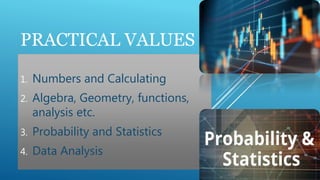
3. Probability and Statistics
4. Data Analysis
DISCIPLINARY VALUES
1. Finding new solutions to
problems of a kind that have
not been seen before
2. Proof simple theorems using
logics
CULTURAL VALUES
1. Puzzles, Number Theory,
Combinatorics etc.
2. Biographies
3. History of mathematics
4. Unsolved problems
CONTRIBUITION OF
SRINIVASA
He worked on divergent series.
1729 is a very famous Ramanujan number. It is the
smallest number which can be expressed as the sum
of cubes in two different ways.
Results in definite integrals
And many more.
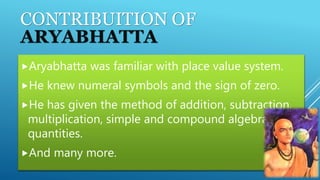
CONTRIBUITION OF
ARYABHATTA
Aryabhatta was familiar with place value system.
He knew numeral symbols and the sign of zero.
He has given the method of addition, subtraction,
multiplication, simple and compound algebraic
quantities.
And many more.
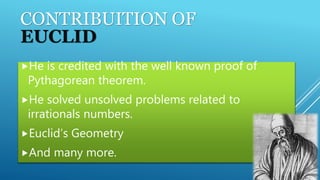
CONTRIBUITION OF
EUCLID
He is credited with the well known proof of
Pythagorean theorem.
He solved unsolved problems related to
irrationals numbers.
Euclid’s Geometry
And many more.
CONTRIBUITION OF
PYTHAGORAS
The discovery of irrationals numbers.
Pythagoreans theorem
Many mathematical terms like parabola, ellipse
etc. can be attributed to Pythagoras.
And many more
Mathematics
Mathematics

Mathematics

  • 1.
  • 2.
    The term MATHEMATICSis derived from two Greek words ‘manthanein’ which means learning and ‘techne’ which means an art of technique. Therefore mathematics means the art of learning related to disciplines.
  • 3.
    Mathematics is defined asthe science of quantity, measurement and special relations.
  • 4.
    The area ofstudy is known as the history of mathematics is primarily an investigation in to origin of discoveries of mathematics and, to a lesser extent, an investigation in to the mathematical methods notation of the past. Chinese mathematics made early contributions including a place value system . The origin of mathematical thoughts lie in the concepts of number and magnitude.
  • 5.
  • 6.
    Mathematics is aScience of Discovery Mathematics is an Intellectual Game Mathematics is a tool subject
  • 7.
    Mathematics involves anintuitive method Mathematics has its own symbols and language Mathematics is an Abstract Science
  • 8.
    Mathematics is Logic Mathematicsdeals with art of drawing conclusions
  • 14.
    PRACTICAL VALUES 1. Numbersand Calculating 2. Algebra, Geometry, functions, analysis etc. 3. Probability and Statistics 4. Data Analysis
  • 15.
    DISCIPLINARY VALUES 1. Findingnew solutions to problems of a kind that have not been seen before 2. Proof simple theorems using logics
  • 16.
    CULTURAL VALUES 1. Puzzles,Number Theory, Combinatorics etc. 2. Biographies 3. History of mathematics 4. Unsolved problems
  • 20.
    CONTRIBUITION OF SRINIVASA He workedon divergent series. 1729 is a very famous Ramanujan number. It is the smallest number which can be expressed as the sum of cubes in two different ways. Results in definite integrals And many more.
  • 21.
    CONTRIBUITION OF ARYABHATTA Aryabhatta wasfamiliar with place value system. He knew numeral symbols and the sign of zero. He has given the method of addition, subtraction, multiplication, simple and compound algebraic quantities. And many more.
  • 22.
    CONTRIBUITION OF EUCLID He iscredited with the well known proof of Pythagorean theorem. He solved unsolved problems related to irrationals numbers. Euclid’s Geometry And many more.
  • 23.
    CONTRIBUITION OF PYTHAGORAS The discoveryof irrationals numbers. Pythagoreans theorem Many mathematical terms like parabola, ellipse etc. can be attributed to Pythagoras. And many more