MATHEMATICS IN THE
MODERN WORLD
MODULE #2
RECOGNIZING PATTERNS IN NATURE AND
CONFIGURATIONS IN THE WORLD
MATH PATTERNS IN NATURE
*FRACTAL
*SPIRAL
*VORONOI
FRACTAL
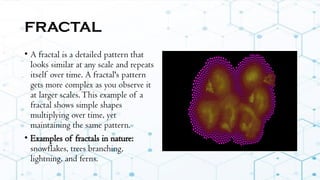
• A fractal is a detailed pattern that
looks similar at any scale and repeats
itself over time. A fractal's pattern
gets more complex as you observe it
at larger scales.This example of a
fractal shows simple shapes
multiplying over time, yet
maintaining the same pattern.
• Examples of fractals in nature:
snowflakes, trees branching,
lightning, and ferns.
SPIRAL
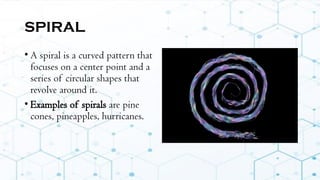
• A spiral is a curved pattern that
focuses on a center point and a
series of circular shapes that
revolve around it.
• Examples of spirals are pine
cones, pineapples, hurricanes.
VORONOI
• AVoronoi pattern provides clues to
nature’s tendency to favor efficiency:
the nearest neighbor, shortest path,
and tightest fit. Each cell in a
Voronoi pattern has a seed point.
• Examples of Voronoi patterns are
the skin of a giraffe, corn on the
cob, honeycombs, foam bubbles, the
cells in a leaf, and a head of garlic.
PATTERNS:
Watch:
https://vimeo.com/9953368
FIBONACCI SEQUENCE
FIBONACCI SEQUENCE
The Fibonacci sequence named after the
Italian mathematician Leonardo Fibonacci
of PIsa. His real name was Leonardo
Pisano Bogollo, and he lived between 1170
and 1250 in Italy.
"Fibonacci" was his nickname, which
roughly means "Son of Bonacci", who in
1202 introduced the sequence. It turns out
that simple equations involving the
Fibonacci numbers can describe most of
the complex spiral growth patterns found
in nature.
RULE OF FIBONACCI SEQUENCE
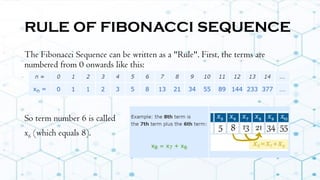
The Fibonacci Sequence can be written as a "Rule". First, the terms are
numbered from 0 onwards like this:
So term number 6 is called
x6 (which equals 8).
RULE OF FIBONACCI SEQUENCE
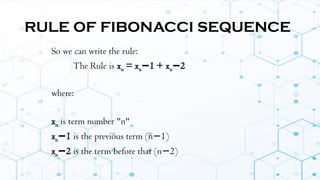
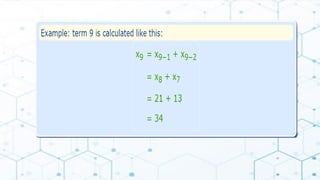
So we can write the rule:
The Rule is xn = xn 1 + x
− n 2
−
where:
xn is term number "n"
xn 1
− is the previous term (n 1)
−
xn 2
− is the term before that (n 2)
−
MAKE A SPIRAL
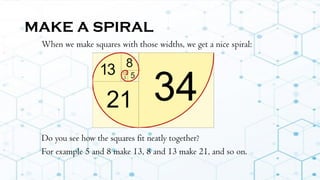
When we make squares with those widths, we get a nice spiral:
Do you see how the squares fit neatly together?
For example 5 and 8 make 13, 8 and 13 make 21, and so on.
REFERENCES:
• https://www.fi.edu/math-patterns-nature
• https://www.mathsisfun.com/numbers/fibonacci-sequence.html

MATHEMATICS IN THE MODERN WORLD Module 2.pptx

  • 1.
    MATHEMATICS IN THE MODERNWORLD MODULE #2 RECOGNIZING PATTERNS IN NATURE AND CONFIGURATIONS IN THE WORLD
  • 2.
    MATH PATTERNS INNATURE *FRACTAL *SPIRAL *VORONOI
  • 3.
    FRACTAL • A fractalis a detailed pattern that looks similar at any scale and repeats itself over time. A fractal's pattern gets more complex as you observe it at larger scales.This example of a fractal shows simple shapes multiplying over time, yet maintaining the same pattern. • Examples of fractals in nature: snowflakes, trees branching, lightning, and ferns.
  • 4.
    SPIRAL • A spiralis a curved pattern that focuses on a center point and a series of circular shapes that revolve around it. • Examples of spirals are pine cones, pineapples, hurricanes.
  • 5.
    VORONOI • AVoronoi patternprovides clues to nature’s tendency to favor efficiency: the nearest neighbor, shortest path, and tightest fit. Each cell in a Voronoi pattern has a seed point. • Examples of Voronoi patterns are the skin of a giraffe, corn on the cob, honeycombs, foam bubbles, the cells in a leaf, and a head of garlic.
  • 6.
  • 7.
  • 8.
    FIBONACCI SEQUENCE The Fibonaccisequence named after the Italian mathematician Leonardo Fibonacci of PIsa. His real name was Leonardo Pisano Bogollo, and he lived between 1170 and 1250 in Italy. "Fibonacci" was his nickname, which roughly means "Son of Bonacci", who in 1202 introduced the sequence. It turns out that simple equations involving the Fibonacci numbers can describe most of the complex spiral growth patterns found in nature.
  • 9.
    RULE OF FIBONACCISEQUENCE The Fibonacci Sequence can be written as a "Rule". First, the terms are numbered from 0 onwards like this: So term number 6 is called x6 (which equals 8).
  • 10.
    RULE OF FIBONACCISEQUENCE So we can write the rule: The Rule is xn = xn 1 + x − n 2 − where: xn is term number "n" xn 1 − is the previous term (n 1) − xn 2 − is the term before that (n 2) −
  • 12.
    MAKE A SPIRAL Whenwe make squares with those widths, we get a nice spiral: Do you see how the squares fit neatly together? For example 5 and 8 make 13, 8 and 13 make 21, and so on.
  • 13.