

Mobile IT, the State of the 
Nation 
Harrison O’Hara 
BIM4Mobility and Costain
Agenda 
• Introduction 
• Research aims and objectives 
• Methodology 
• Result highlights 
• Dissemination of findings 
• COMIT collaboration projects 
• Q&A
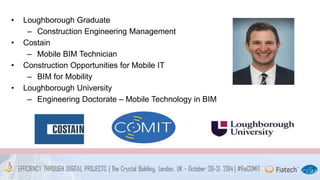
• Loughborough Graduate 
– Construction Engineering Management 
• Costain 
– Mobile BIM Technician 
• Construction Opportunities for Mobile IT 
– BIM for Mobility 
• Loughborough University 
– Engineering Doctorate – Mobile Technology in BIM
4
5
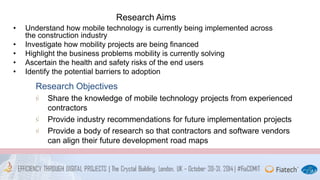
Research Aims 
• Understand how mobile technology is currently being implemented across 
the construction industry 
• Investigate how mobility projects are being financed 
• Highlight the business problems mobility is currently solving 
• Ascertain the health and safety risks of the end users 
• Identify the potential barriers to adoption 
Research Objectives 
Share the knowledge of mobile technology projects from experienced 
contractors 
Provide industry recommendations for future implementation projects 
Provide a body of research so that contractors and software vendors 
can align their future development road maps
Methodology 
• Conducted an initial pilot study to review the 
questions 
• Launched an on-line survey open to the whole 
construction industry 
• https://www.survey.lboro.ac.uk/mobileconstruction 
• Face to face and telephone interviews with COMIT 
member to achieve an in depth understanding
Survey Responses
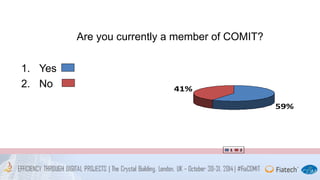
1. Yes 
2. No 
Are you currently a member of COMIT? 
59% 
41% 
1 2
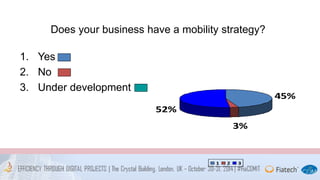
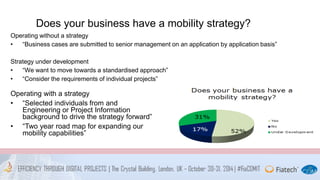
Does your business have a mobility strategy? 
1. Yes 
2. No 
3. Under development 
45% 
3% 
52% 
1 2 3
Does your business have a mobility strategy? 
Operating without a strategy 
• “Business cases are submitted to senior management on an application by application basis” 
Strategy under development 
• “We want to move towards a standardised approach” 
• “Consider the requirements of individual projects” 
Operating with a strategy 
• “Selected individuals from and 
Engineering or Project Information 
background to drive the strategy forward” 
• “Two year road map for expanding our 
mobility capabilities”
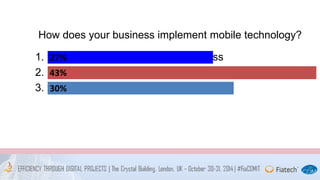
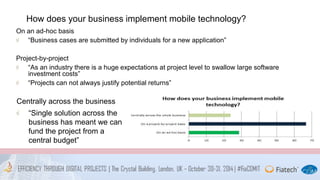
How does your business implement mobile technology? 
1. 27% 
Centrally across the whole business 
2. 43% 
On a project-by-project basis 
3. On an ad-hoc basis 
30%
How does your business implement mobile technology? 
On an ad-hoc basis 
“Business cases are submitted by individuals for a new application” 
Project-by-project 
“As an industry there is a huge expectations at project level to swallow large software 
investment costs” 
“Projects can not always justify potential returns” 
Centrally across the business 
“Single solution across the 
business has meant we can 
fund the project from a 
central budget”
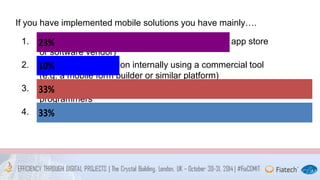
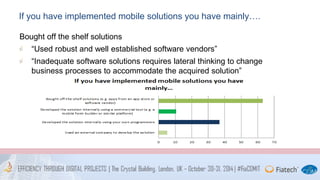
If you have implemented mobile solutions you have mainly…. 
23% 
1. Bought off-the-shelf solutions (e.g. apps from an app store 
or software vendor) 
10% 
2. Developed the solution internally using a commercial tool 
(e.g. a mobile form builder or similar platform) 
33% 
3. Developed the solution internally using your own 
programmers 
33% 
4. Used an external company to develop the solution
If you have implemented mobile solutions you have mainly…. 
Bought off the shelf solutions 
“Used robust and well established software vendors” 
“Inadequate software solutions requires lateral thinking to change 
business processes to accommodate the acquired solution”
If you have implemented mobile solutions you have mainly…. 
Developed the internally using a commercial tool 
“Initially developed a solution using a commercial tool and developed an in house 
solution with our own developers” 
Developed the solution internally using your own programmers 
“In house development team that captures the requirements from the users” 
“Agile development capabilities to respond to our business needs” 
“We can tailor the solution to integrate with already existing business systems” 
Used an external company to develop the solution 
“We don’t want to have to rely on an external company for on-going maintenance of an 
internal solution”
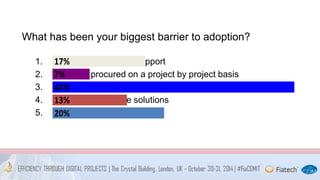
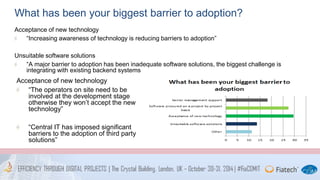
What has been your biggest barrier to adoption? 
17% 
1. Senior management support 
2. Software 7% 
procured on a project by project basis 
3. Acceptance 43% 
of new technology 
4. Unsuitable 13% 
software solutions 
5. Other 
20%
What has been your biggest barrier to adoption? 
Acceptance of new technology 
“Increasing awareness of technology is reducing barriers to adoption” 
Unsuitable software solutions 
“A major barrier to adoption has been inadequate software solutions, the biggest challenge is 
integrating with existing backend systems 
Acceptance of new technology 
“The operators on site need to be 
involved at the development stage 
otherwise they won’t accept the new 
technology” 
“Central IT has imposed significant 
barriers to the adoption of third party 
solutions”
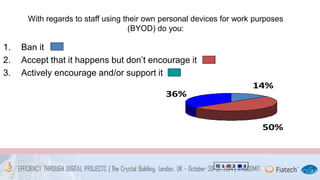
With regards to staff using their own personal devices for work purposes 
(BYOD) do you: 
1. Ban it 
2. Accept that it happens but don’t encourage it 
3. Actively encourage and/or support it 
14% 
50% 
36% 
1 2 3
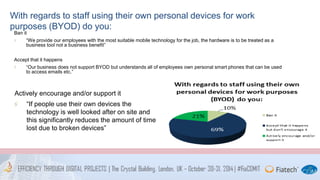
With regards to staff using their own personal devices for work 
purposes (BYOD) do you: 
Ban it 
“We provide our employees with the most suitable mobile technology for the job, the hardware is to be treated as a 
business tool not a business benefit” 
Accept that it happens 
“Our business does not support BYOD but understands all of employees own personal smart phones that can be used 
to access emails etc.” 
Actively encourage and/or support it 
“If people use their own devices the 
technology is well looked after on site and 
this significantly reduces the amount of time 
lost due to broken devices”
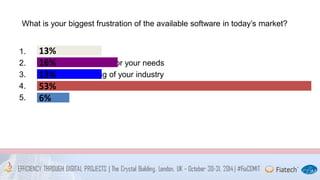
What is your biggest frustration of the available software in today’s market? 
13% 
1. Price 
2. Inadequate 16% 
solutions for your needs 
3. Poor 13% 
understanding of your industry 
4. Interoperability 53% 
of third party software 
5. Other 
6%
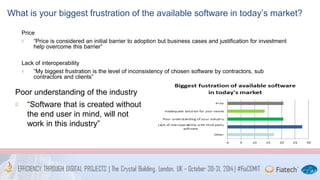
What is your biggest frustration of the available software in today’s market? 
Price 
“Price is considered an initial barrier to adoption but business cases and justification for investment 
help overcome this barrier” 
Lack of interoperability 
“My biggest frustration is the level of inconsistency of chosen software by contractors, sub 
contractors and clients” 
Poor understanding of the industry 
“Software that is created without 
the end user in mind, will not 
work in this industry”
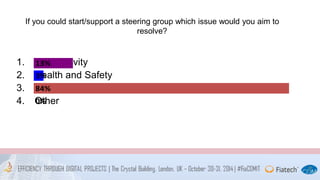
If you could start/support a steering group which issue would you aim to 
resolve? 
1. Connectivity 
13% 
2. Health 3% 
and Safety 
3. Interoperability 84% 
of software 
4. Other 
0%
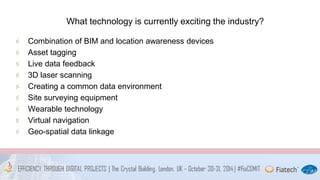
What technology is currently exciting the industry? 
Combination of BIM and location awareness devices 
Asset tagging 
Live data feedback 
3D laser scanning 
Creating a common data environment 
Site surveying equipment 
Wearable technology 
Virtual navigation 
Geo-spatial data linkage
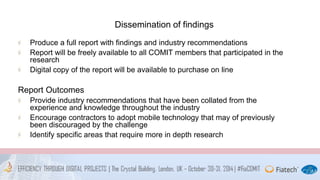
Dissemination of findings 
Produce a full report with findings and industry recommendations 
Report will be freely available to all COMIT members that participated in the 
research 
Digital copy of the report will be available to purchase on line 
Report Outcomes 
Provide industry recommendations that have been collated from the 
experience and knowledge throughout the industry 
Encourage contractors to adopt mobile technology that may of previously 
been discouraged by the challenge 
Identify specific areas that require more in depth research
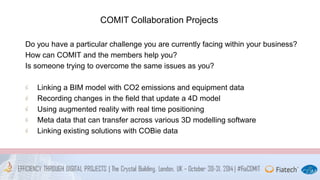
COMIT Collaboration Projects 
Do you have a particular challenge you are currently facing within your business? 
How can COMIT and the members help you? 
Is someone trying to overcome the same issues as you? 
Linking a BIM model with CO2 emissions and equipment data 
Recording changes in the field that update a 4D model 
Using augmented reality with real time positioning 
Meta data that can transfer across various 3D modelling software 
Linking existing solutions with COBie data
Thank you 
Contact: Harrison O’Hara 
Email: H.Ohara@lboro.ac.uk 
Twitter: @HarrisonOHara1 
Mobile: 07881108741

Fia comit the_state_of_the_nation

  • 1.
    Mobile IT, theState of the Nation Harrison O’Hara BIM4Mobility and Costain
  • 2.
    Agenda • Introduction • Research aims and objectives • Methodology • Result highlights • Dissemination of findings • COMIT collaboration projects • Q&A
  • 3.
    • Loughborough Graduate – Construction Engineering Management • Costain – Mobile BIM Technician • Construction Opportunities for Mobile IT – BIM for Mobility • Loughborough University – Engineering Doctorate – Mobile Technology in BIM
  • 4.
  • 5.
  • 6.
    Research Aims •Understand how mobile technology is currently being implemented across the construction industry • Investigate how mobility projects are being financed • Highlight the business problems mobility is currently solving • Ascertain the health and safety risks of the end users • Identify the potential barriers to adoption Research Objectives Share the knowledge of mobile technology projects from experienced contractors Provide industry recommendations for future implementation projects Provide a body of research so that contractors and software vendors can align their future development road maps
  • 7.
    Methodology • Conductedan initial pilot study to review the questions • Launched an on-line survey open to the whole construction industry • https://www.survey.lboro.ac.uk/mobileconstruction • Face to face and telephone interviews with COMIT member to achieve an in depth understanding
  • 8.
  • 9.
    1. Yes 2.No Are you currently a member of COMIT? 59% 41% 1 2
  • 10.
    Does your businesshave a mobility strategy? 1. Yes 2. No 3. Under development 45% 3% 52% 1 2 3
  • 11.
    Does your businesshave a mobility strategy? Operating without a strategy • “Business cases are submitted to senior management on an application by application basis” Strategy under development • “We want to move towards a standardised approach” • “Consider the requirements of individual projects” Operating with a strategy • “Selected individuals from and Engineering or Project Information background to drive the strategy forward” • “Two year road map for expanding our mobility capabilities”
  • 12.
    How does yourbusiness implement mobile technology? 1. 27% Centrally across the whole business 2. 43% On a project-by-project basis 3. On an ad-hoc basis 30%
  • 13.
    How does yourbusiness implement mobile technology? On an ad-hoc basis “Business cases are submitted by individuals for a new application” Project-by-project “As an industry there is a huge expectations at project level to swallow large software investment costs” “Projects can not always justify potential returns” Centrally across the business “Single solution across the business has meant we can fund the project from a central budget”
  • 14.
    If you haveimplemented mobile solutions you have mainly…. 23% 1. Bought off-the-shelf solutions (e.g. apps from an app store or software vendor) 10% 2. Developed the solution internally using a commercial tool (e.g. a mobile form builder or similar platform) 33% 3. Developed the solution internally using your own programmers 33% 4. Used an external company to develop the solution
  • 15.
    If you haveimplemented mobile solutions you have mainly…. Bought off the shelf solutions “Used robust and well established software vendors” “Inadequate software solutions requires lateral thinking to change business processes to accommodate the acquired solution”
  • 16.
    If you haveimplemented mobile solutions you have mainly…. Developed the internally using a commercial tool “Initially developed a solution using a commercial tool and developed an in house solution with our own developers” Developed the solution internally using your own programmers “In house development team that captures the requirements from the users” “Agile development capabilities to respond to our business needs” “We can tailor the solution to integrate with already existing business systems” Used an external company to develop the solution “We don’t want to have to rely on an external company for on-going maintenance of an internal solution”
  • 17.
    What has beenyour biggest barrier to adoption? 17% 1. Senior management support 2. Software 7% procured on a project by project basis 3. Acceptance 43% of new technology 4. Unsuitable 13% software solutions 5. Other 20%
  • 18.
    What has beenyour biggest barrier to adoption? Acceptance of new technology “Increasing awareness of technology is reducing barriers to adoption” Unsuitable software solutions “A major barrier to adoption has been inadequate software solutions, the biggest challenge is integrating with existing backend systems Acceptance of new technology “The operators on site need to be involved at the development stage otherwise they won’t accept the new technology” “Central IT has imposed significant barriers to the adoption of third party solutions”
  • 19.
    With regards tostaff using their own personal devices for work purposes (BYOD) do you: 1. Ban it 2. Accept that it happens but don’t encourage it 3. Actively encourage and/or support it 14% 50% 36% 1 2 3
  • 20.
    With regards tostaff using their own personal devices for work purposes (BYOD) do you: Ban it “We provide our employees with the most suitable mobile technology for the job, the hardware is to be treated as a business tool not a business benefit” Accept that it happens “Our business does not support BYOD but understands all of employees own personal smart phones that can be used to access emails etc.” Actively encourage and/or support it “If people use their own devices the technology is well looked after on site and this significantly reduces the amount of time lost due to broken devices”
  • 21.
    What is yourbiggest frustration of the available software in today’s market? 13% 1. Price 2. Inadequate 16% solutions for your needs 3. Poor 13% understanding of your industry 4. Interoperability 53% of third party software 5. Other 6%
  • 22.
    What is yourbiggest frustration of the available software in today’s market? Price “Price is considered an initial barrier to adoption but business cases and justification for investment help overcome this barrier” Lack of interoperability “My biggest frustration is the level of inconsistency of chosen software by contractors, sub contractors and clients” Poor understanding of the industry “Software that is created without the end user in mind, will not work in this industry”
  • 23.
    If you couldstart/support a steering group which issue would you aim to resolve? 1. Connectivity 13% 2. Health 3% and Safety 3. Interoperability 84% of software 4. Other 0%
  • 24.
    What technology iscurrently exciting the industry? Combination of BIM and location awareness devices Asset tagging Live data feedback 3D laser scanning Creating a common data environment Site surveying equipment Wearable technology Virtual navigation Geo-spatial data linkage
  • 25.
    Dissemination of findings Produce a full report with findings and industry recommendations Report will be freely available to all COMIT members that participated in the research Digital copy of the report will be available to purchase on line Report Outcomes Provide industry recommendations that have been collated from the experience and knowledge throughout the industry Encourage contractors to adopt mobile technology that may of previously been discouraged by the challenge Identify specific areas that require more in depth research
  • 26.
    COMIT Collaboration Projects Do you have a particular challenge you are currently facing within your business? How can COMIT and the members help you? Is someone trying to overcome the same issues as you? Linking a BIM model with CO2 emissions and equipment data Recording changes in the field that update a 4D model Using augmented reality with real time positioning Meta data that can transfer across various 3D modelling software Linking existing solutions with COBie data
  • 27.
    Thank you Contact:Harrison O’Hara Email: H.Ohara@lboro.ac.uk Twitter: @HarrisonOHara1 Mobile: 07881108741