1
GOOD MORNING
FUNCTIONA
LLY
GENERATED
PATH
TECHNIQUE
PRESENTED BY –
DR. AYUSH KUMAR
JR III
contents
✔Introduction
✔History
✔Uses
✔Technique for Bilateral Recording
✔FGP for Single tooth restoration
✔FGP for Quadrant dentistry
✔FGP for Implant supported prosthesis
✔Conclusion
✔References
3
4
INTRODUCTION
Registration of the paths of movement of the occlusal surfaces of teeth or
occlusal rims of one dental arch in plastic, wax, or other medium attached to
the teeth or occlusal rims of the opposing arch.
GPT-10
Morgano SM, VanBlarcom CW, Ferro KJ, Bartlett DW. The history of the glossary of prosthodontic terms.
Journal of Prosthetic Dentistry. Oct 2023.
5
HISTORY
MC COLLUMN AND
STUART
1955
Navyadeepthi M, Srikanth L, Purnapriya B, Mounica Y, Soni S, Agrawal P. An Insight In to Functionally
Generated Pathway: A Review Article. International Journal Of Drug Research And Dental Science. 2021 Dec
20;3(4):1-7.
Gnathological concept
Incisal guidance is an independent entity
and is independent of condylar guidance
Condylar path or posterior guidance is a fixed entity
6
VON SPEE
1890
Vertical overlap ''overbite'' of
the cuspids
1915: Masticating functions of the teeth, and he was
the first to describe the scheme of canine-protected
occlusion.
Navyadeepthi M, Srikanth L, Purnapriya B, Mounica Y, Soni S, Agrawal P. An Insight In to Functionally
Generated Pathway: A Review Article. International Journal Of Drug Research And Dental Science. 2021 Dec
20;3(4):1-7.
HISTORY
HISTORY
MEYER
1959
‘’FUNCTIONAL OCCLUSAL
PATH’’
Pankey and Mann: “Functionally generated path”
record in the fabrication of maxillary restorations
Navyadeepthi M, Srikanth L, Purnapriya B, Mounica Y, Soni S, Agrawal P. An Insight In to Functionally
Generated Pathway: A Review Article. International Journal Of Drug Research And Dental Science. 2021 Dec
20;3(4):1-7.
HISTORY
7
8
FACTS
Dawson PE. Evaluation, diagnosis, and treatment planning of occlusal problems. St Louis: CV
Mosby Co. 1989:56-71.
1. Border pathways of
the lower posterior
teeth are dictated by
two different
determinants:
a. The anatomic limits of
movement of the
condyle-disk
assemblies (posterior
determinant)
b. The anterior guidance
( anterior determinant).
2. Functionally
generated path
procedures, properly
used on upper
posterior teeth, record
directly all possible
border pathways of the
lower posterior teeth.
Dawson and Shillingburg et al
Presence of optimal occlusion
Correct anterior guidance
Absence/elimination of posterior
interferences
Adequate opposing occlusal
surfaces
No significant rotations, no carious lesions, no
deficient restorations.
9
Schillingburg HT Jr., Hobo S, The functionally generated path. In Schillingburg HT Jr., Hobo S, Whitsett LD et
al (eds): Fundamentals of Fixed Prosthodontics (ed 3). Carol Stream, IL, Quintessence, 1997, pp. 355-364
USES:
A. Oral rehabilitation cases
B. Single-unit indirect
restorations
C. Tooth-supported fixed
dental prosthesis
D. Implant-supported FDPs
E. CAD/CAM restorations
10
Navyadeepthi M, Srikanth L, Purnapriya B, Mounica Y, Soni S, Agrawal P. An Insight In to Functionally
Generated Pathway: A Review Article. International Journal Of Drug Research And Dental Science. 2021 Dec
20;3(4):1-7.
11
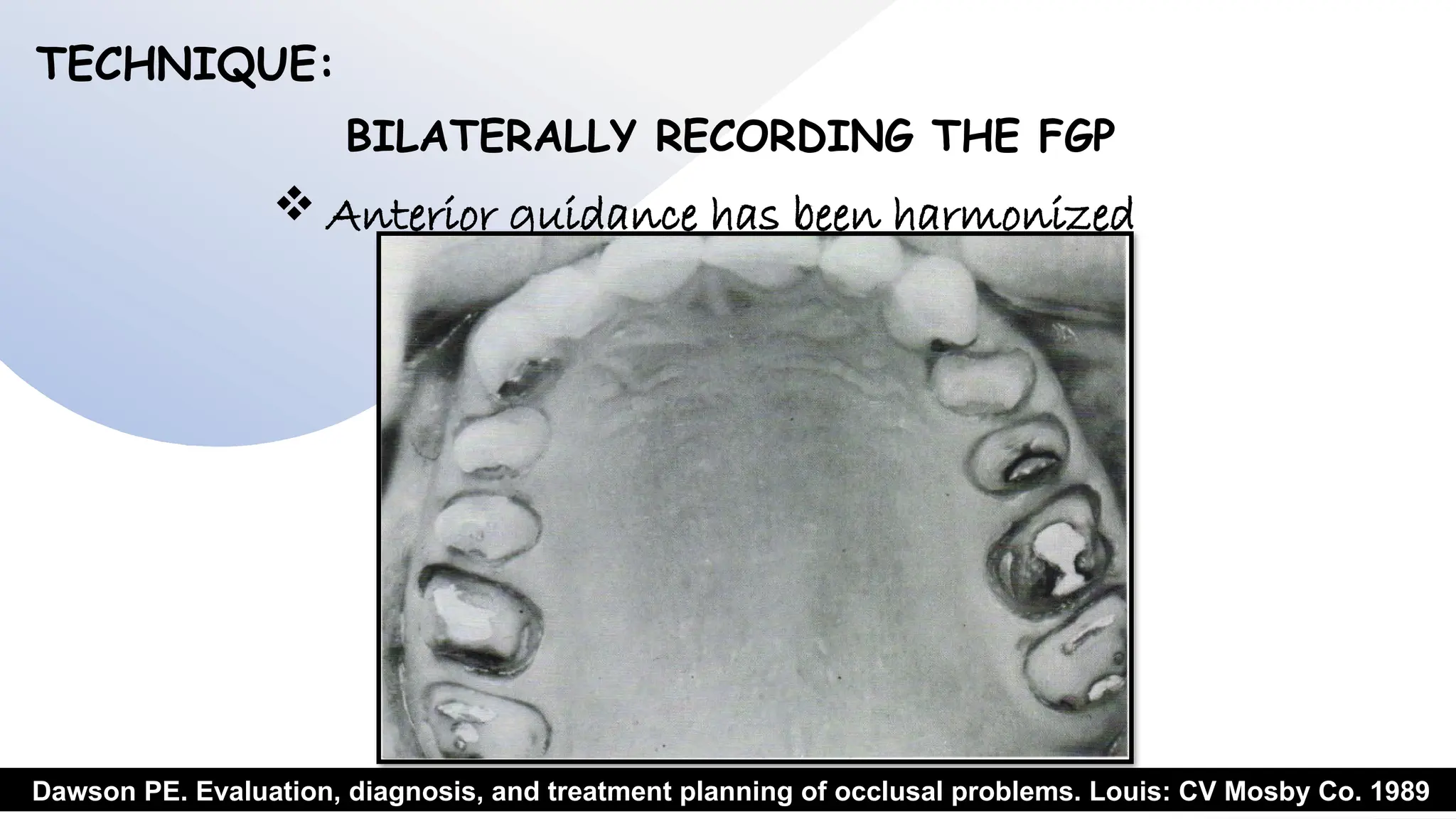
TECHNIQUE:
BILATERALLY RECORDING THE FGP
 Anterior guidance has been harmonized
Dawson PE. Evaluation, diagnosis, and treatment planning of occlusal problems. Louis: CV Mosby Co. 1989
Massive
X
presentation
to
DesignBall
team
Massive
X
12
b
C
c
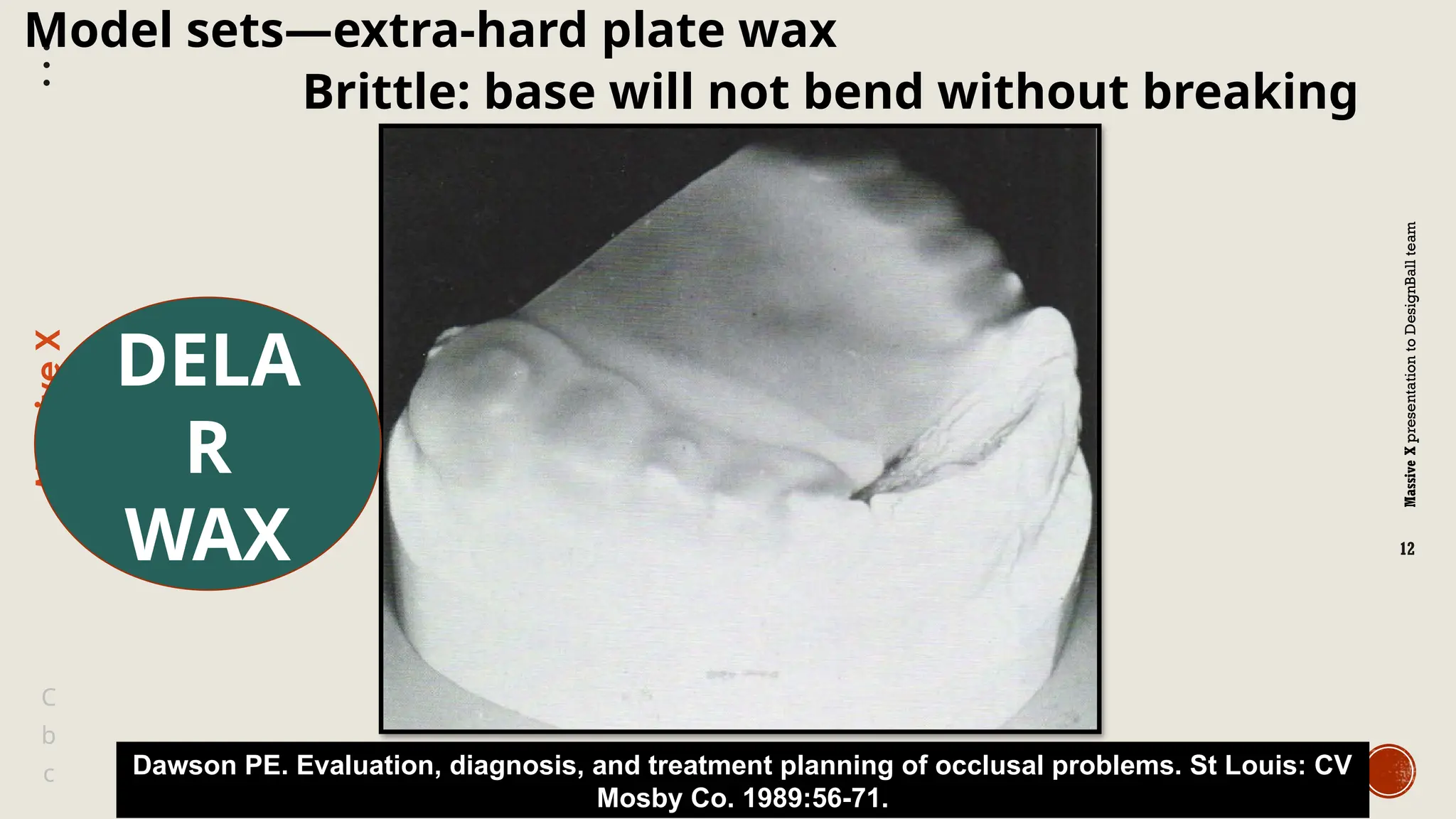
Model sets—extra-hard plate wax
Dawson PE. Evaluation, diagnosis, and treatment planning of occlusal problems. St Louis: CV
Mosby Co. 1989:56-71.
Brittle: base will not bend without breaking
DELA
R
WAX
13
Chilled base is inserted into the mouth; stable.
No tooth contact on the base; checked by articulating
paper.
Contacts in all excursions as well as centric relation
should be checked.
No interferences that restrict anterior guidance from
functioning in normal manner.
Dawson PE. Evaluation, diagnosis, and treatment planning of occlusal problems. St Louis: CV
Mosby Co. 1989:56-71.
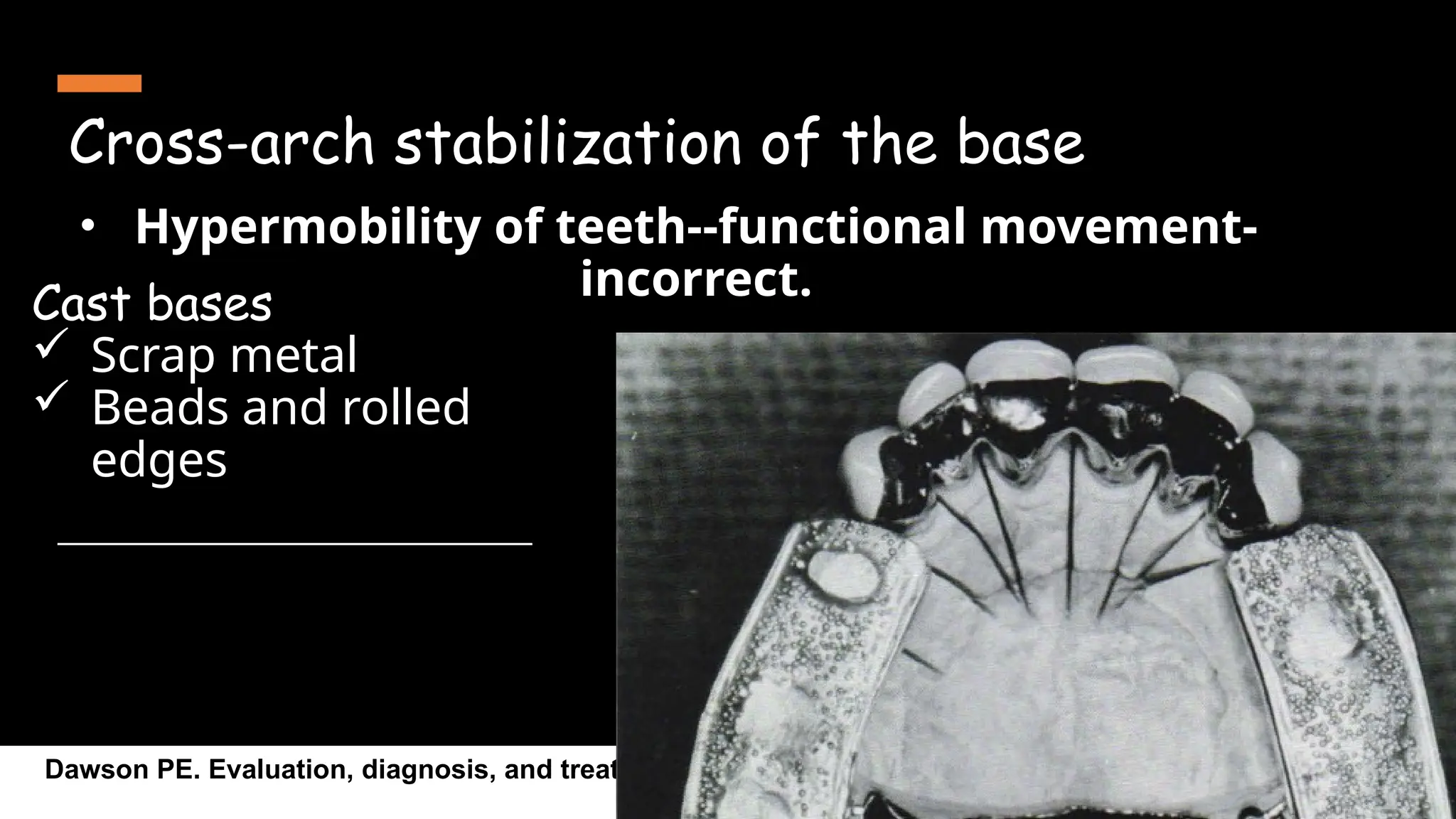
Cross-arch stabilization of the base
14
• Hypermobility of teeth--functional movement-
incorrect.
Dawson PE. Evaluation, diagnosis, and treatment planning of occlusal problems. St Louis: CV Mosby Co.
1989:56-71.
Cast bases
 Scrap metal
 Beads and rolled
edges
Massive
X
presentation
to
DesignBall
team
Massive
X
15
b
C
c
Dawson PE. Evaluation, diagnosis, and treatment planning of occlusal problems. St Louis: CV Mosby Co.
1989:56-71.
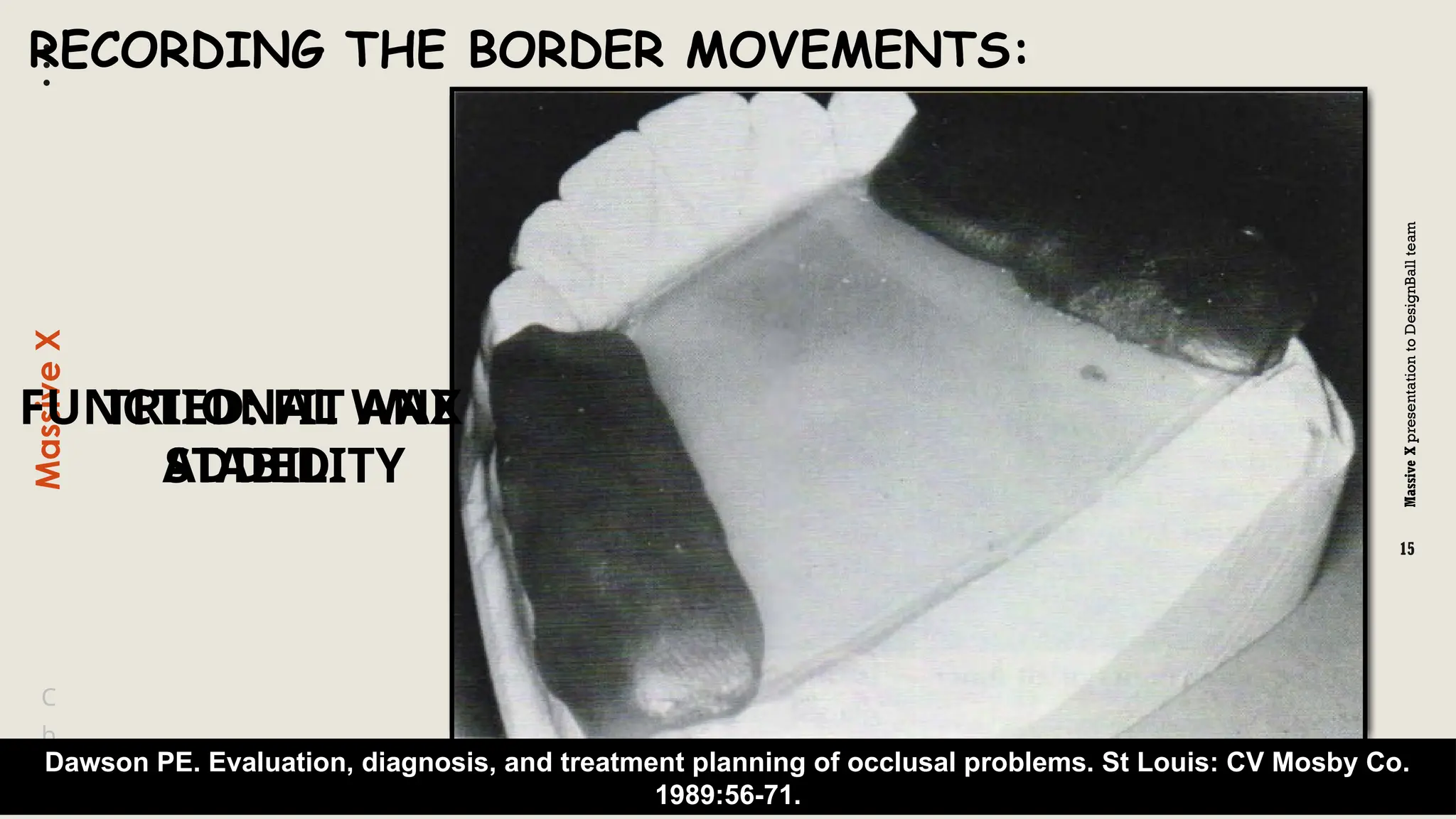
RECORDING THE BORDER MOVEMENTS:
TRIED: FIT AND
STABILITY
FUNCTIONAL WAX
ADDED
Functional
pathways..
Accurately and maintains accuracy.
Inlay wax or sticky wax
- can harden during pathways generation.
IDEAL: Bosworth’s Synthetic Tacky
Wax
- working qualities
- Ideal plasticity.
Dawson PE. Evaluation, diagnosis, and treatment planning of occlusal problems. St Louis: CV
Mosby Co. 1989:56-71.
Bilaterally recording the FGP
17
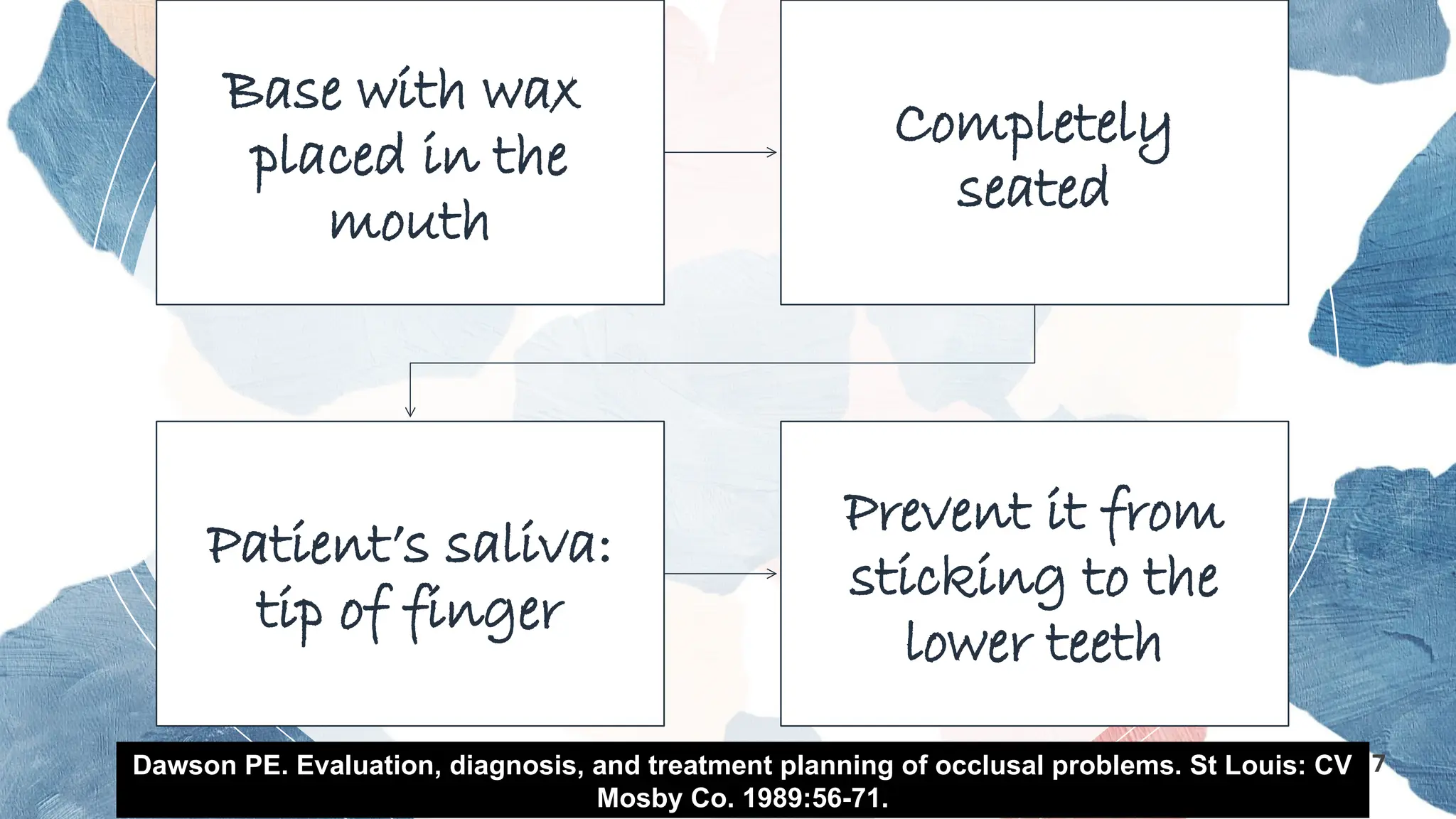
Base with wax
placed in the
mouth
Completely
seated
Patient’s saliva:
tip of finger
Prevent it from
sticking to the
lower teeth
Dawson PE. Evaluation, diagnosis, and treatment planning of occlusal problems. St Louis: CV
Mosby Co. 1989:56-71.
18
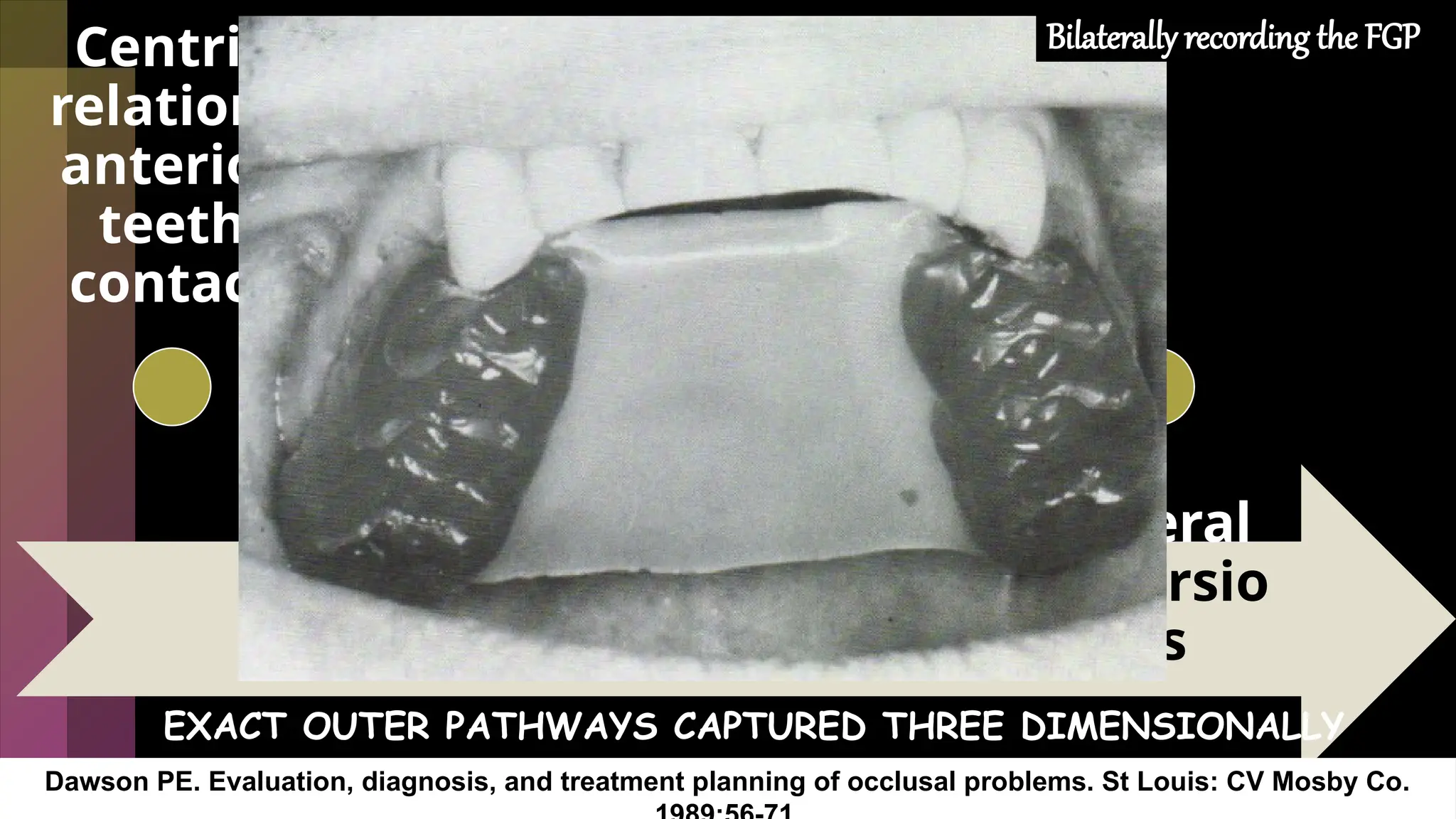
Centric
relation :
anterior
teeth
contact
Slide
forward:
end to end
Close
back to
centric
relation
Lateral
excursio
ns
EXACT OUTER PATHWAYS CAPTURED THREE DIMENSIONALLY
Dawson PE. Evaluation, diagnosis, and treatment planning of occlusal problems. St Louis: CV Mosby Co.
Bilaterally recording the FGP
Massive
X
presentation
to
DesignBall
team
Massive
X
19
b
C
c
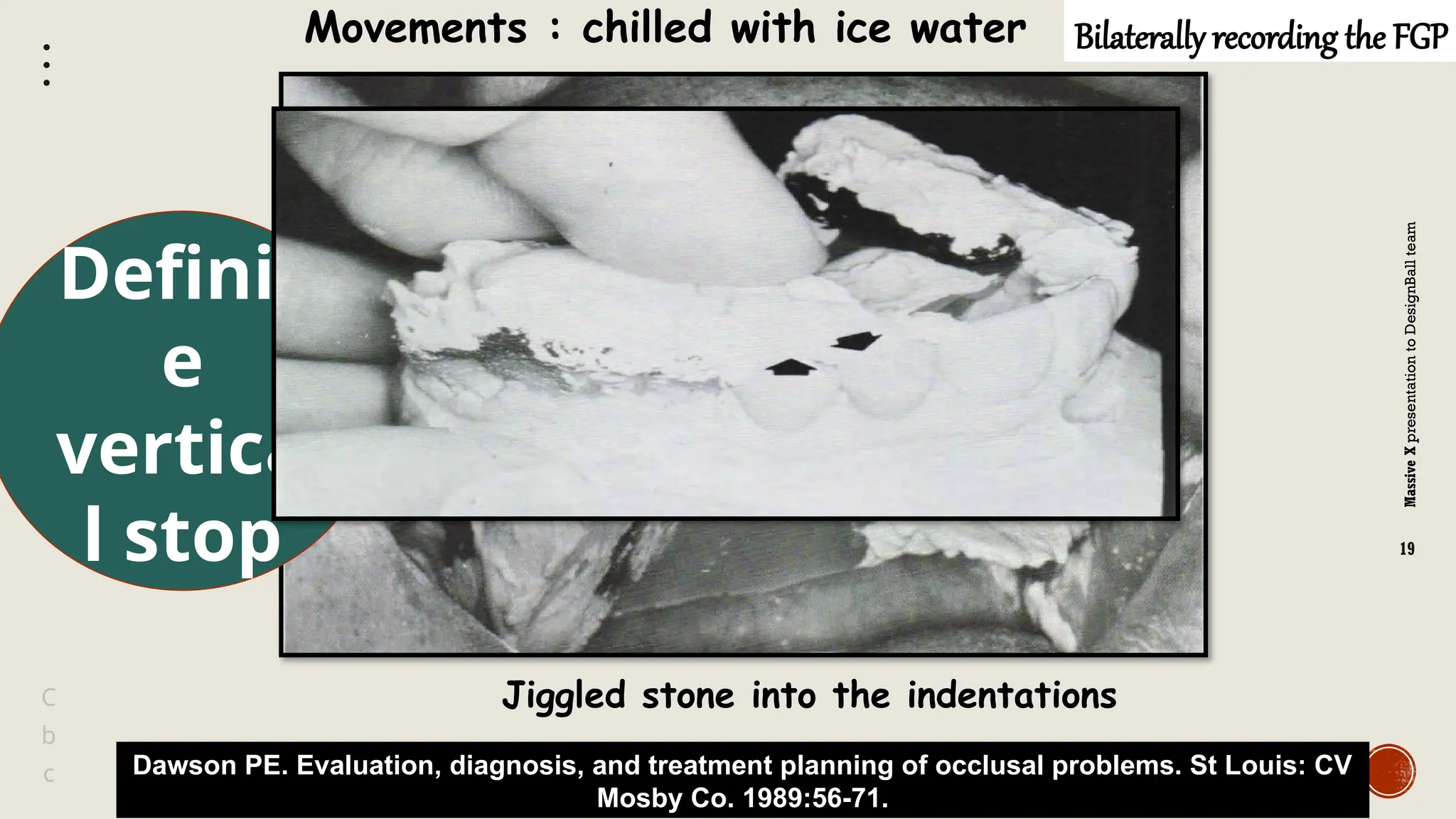
Bilaterally recording the FGP
Jiggled stone into the indentations
Movements : chilled with ice water
Dawson PE. Evaluation, diagnosis, and treatment planning of occlusal problems. St Louis: CV
Mosby Co. 1989:56-71.
Definit
e
vertica
l stop
20
L A B O R AT O R Y
P R O C E D U R E S
 Upper master die model is
mounted.
 Articulated against lower model.
 Anatomic model : double check
on accuracy.
 Centric relation closure : contact
without interference against
functional and anatomic model.
 Interference : indicates an error.
Dawson PE. Evaluation, diagnosis, and treatment planning of occlusal problems. St Louis: CV Mosby Co.
Bilaterally recording the FGP
Mounting the FGP…
Opposing anatomic model is removed; FGP base is
placed
Discrepancy – soft-tissue interference
FGP is removed – wax is trimmed
Dawson PE. Evaluation, diagnosis, and treatment planning of occlusal problems. St Louis: CV
Mosby Co. 1989:56-71.
Bilaterally recording the FGP
Massive
X
presentation
to
DesignBall
team
Massive
X
22
b
C
c
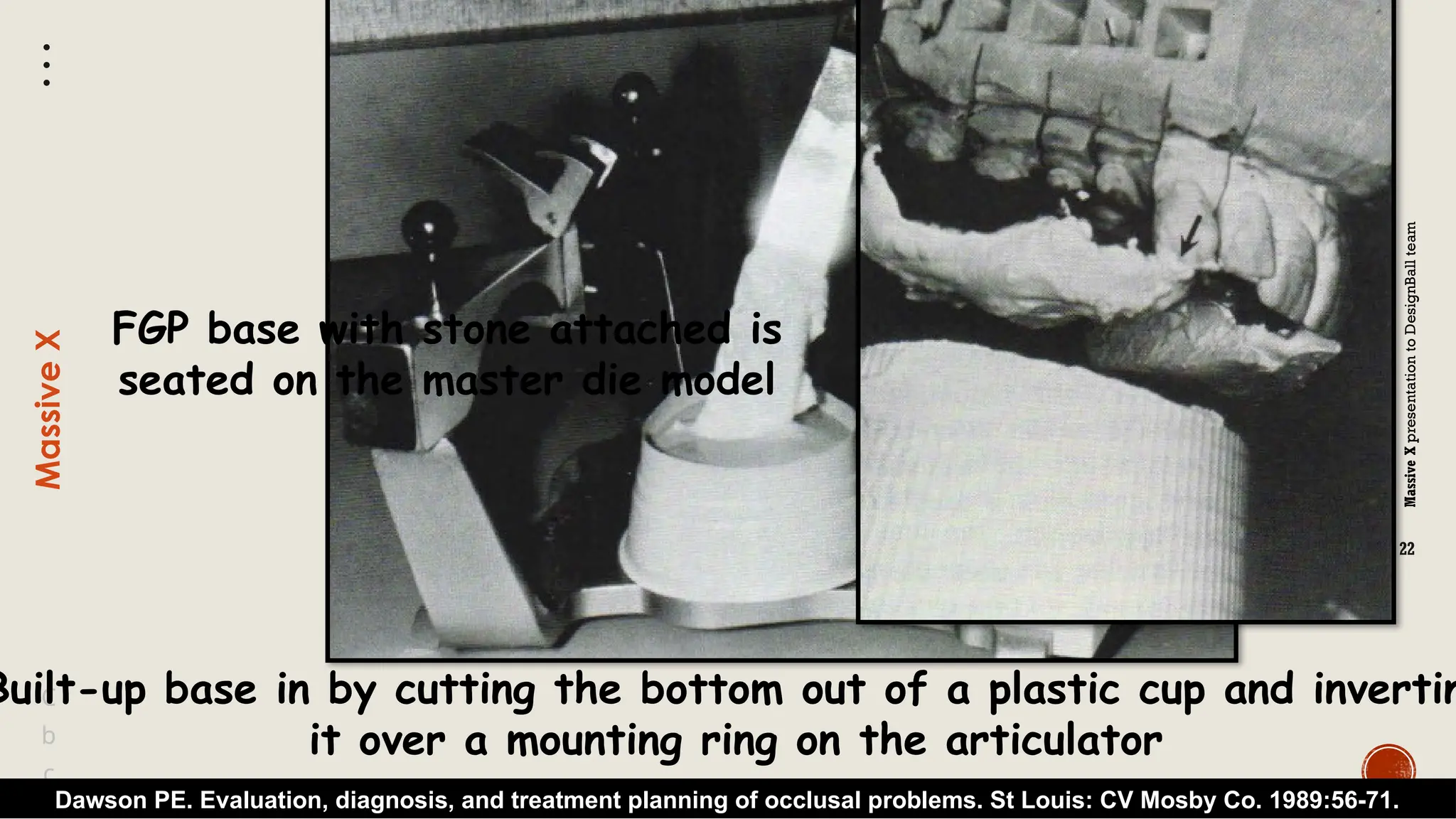
Built-up base in by cutting the bottom out of a plastic cup and invertin
it over a mounting ring on the articulator
Dawson PE. Evaluation, diagnosis, and treatment planning of occlusal problems. St Louis: CV Mosby Co. 1989:56-71.
FGP base with stone attached is
seated on the master die model
Massive
X
presentation
to
DesignBall
team
Massive
X
23
b
C
c
Dawson PE. Evaluation, diagnosis, and treatment planning of occlusal problems. St Louis: CV Mosby Co.
1989:56-71.
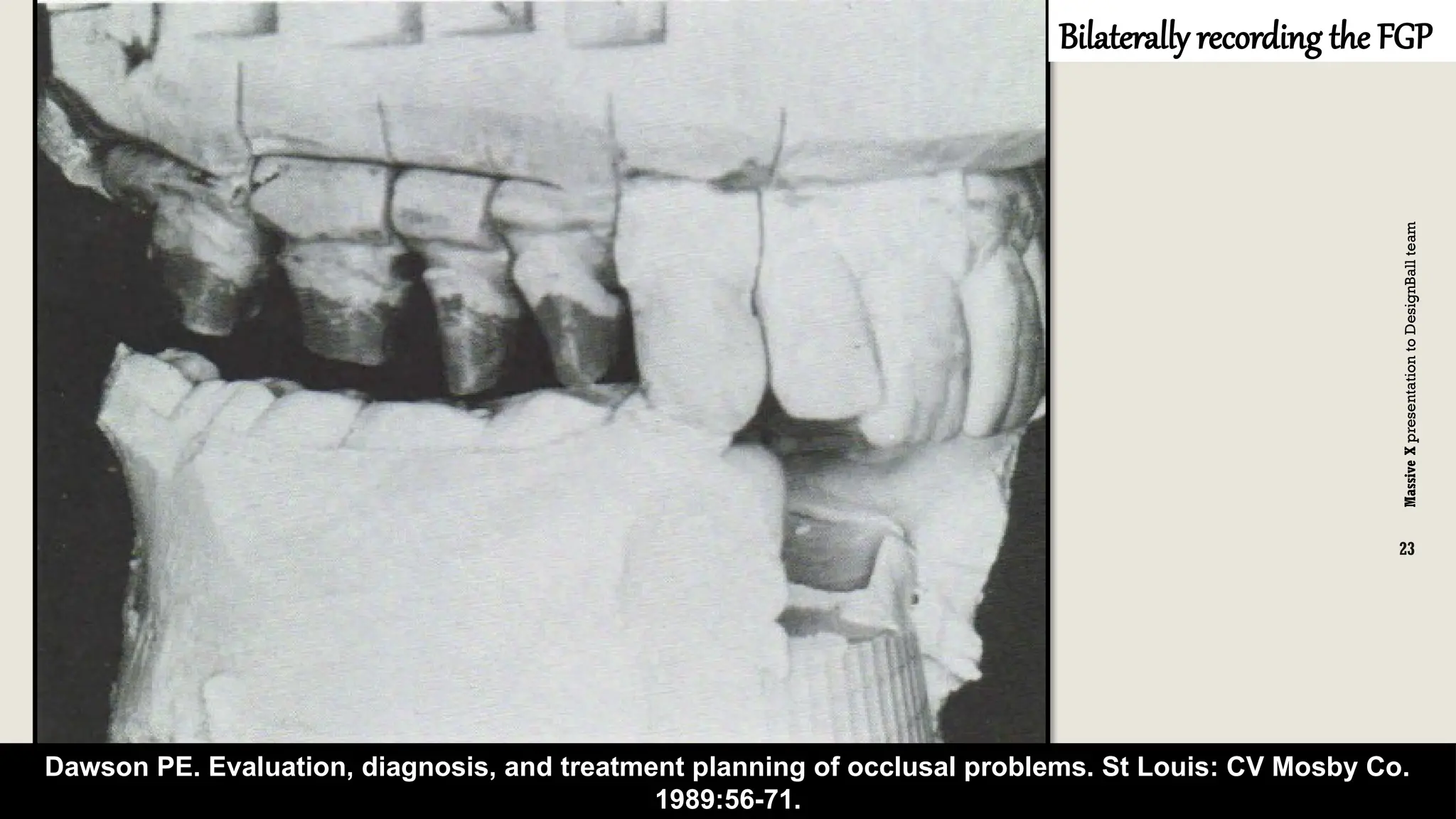
Bilaterally recording the FGP
Accuracy
Upper die model is removed; wax is trimmed
—occlusal edge
Upper model is
closed back—check
for the space
Die model doesn’t seat – knocking off lower
ring and redoing the mounting.
Bilaterally recording the FGP
Dawson PE. Evaluation, diagnosis, and treatment planning of occlusal problems. St Louis: CV Mosby Co.
1989:56-71.
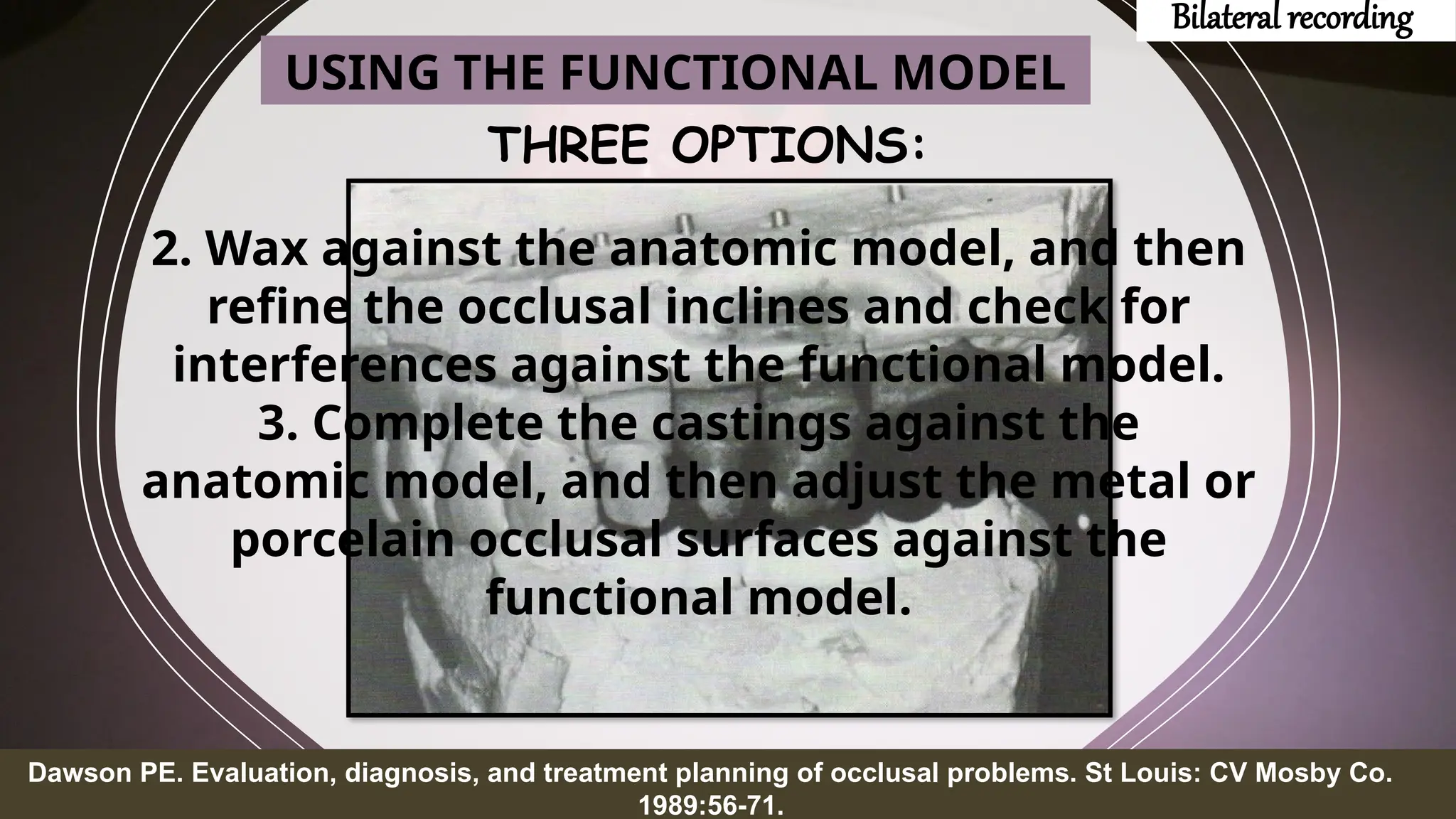
THREE OPTIONS:
25
Dawson PE. Evaluation, diagnosis, and treatment planning of occlusal problems. St Louis: CV Mosby Co.
1989:56-71.
2. Wax against the anatomic model, and then
refine the occlusal inclines and check for
interferences against the functional model.
3. Complete the castings against the
anatomic model, and then adjust the metal or
porcelain occlusal surfaces against the
functional model.
USING THE FUNCTIONAL MODEL
Bilateral recording
MAKING ADJUSTMENTS AGAINST THE FUNCTIONAL
MODEL:
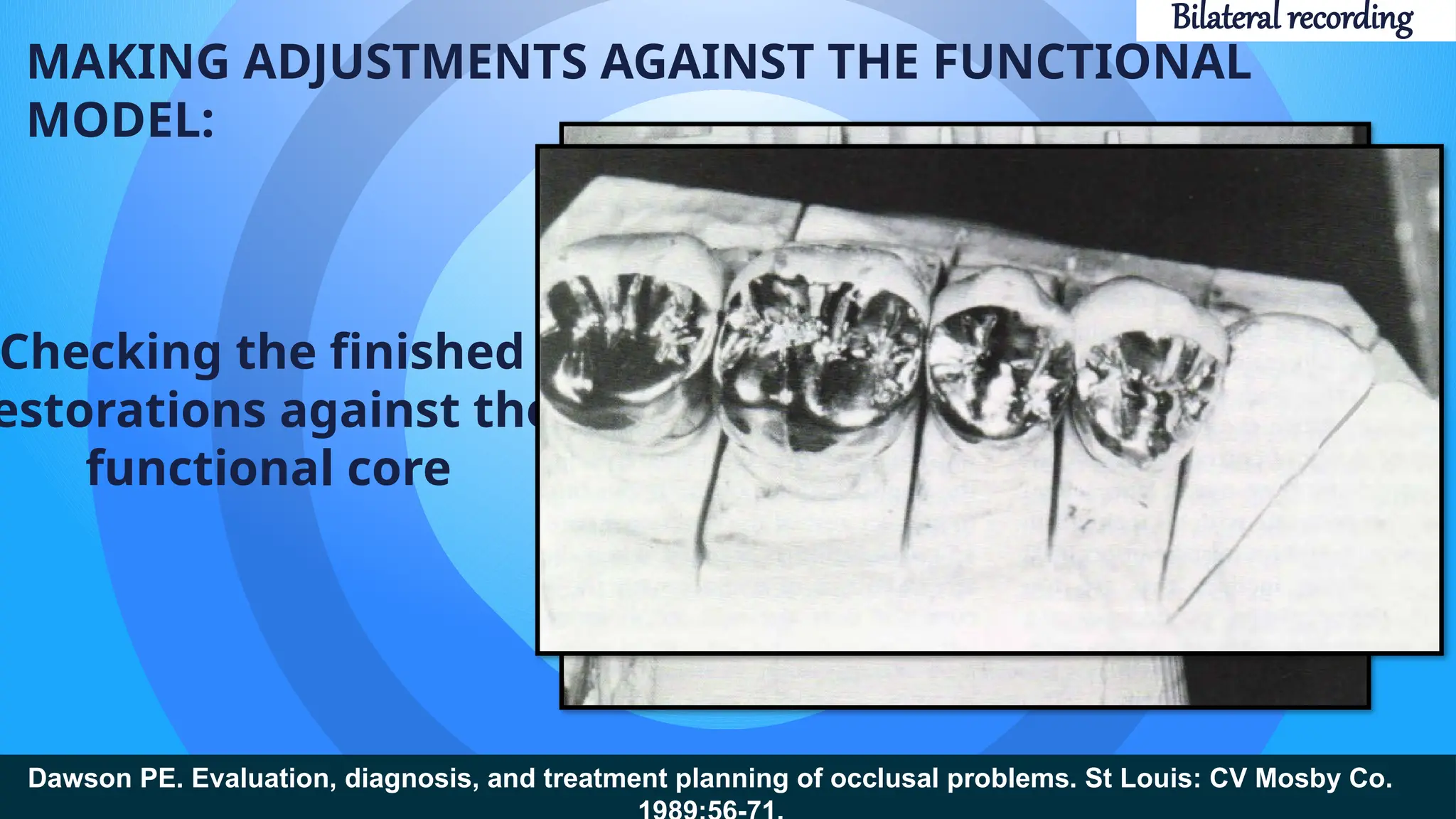
Checking the finished
estorations against the
functional core
Dawson PE. Evaluation, diagnosis, and treatment planning of occlusal problems. St Louis: CV Mosby Co.
Bilateral recording
MAKING ADJUSTMENTS AGAINST THE FUNCTIONAL
MODEL:
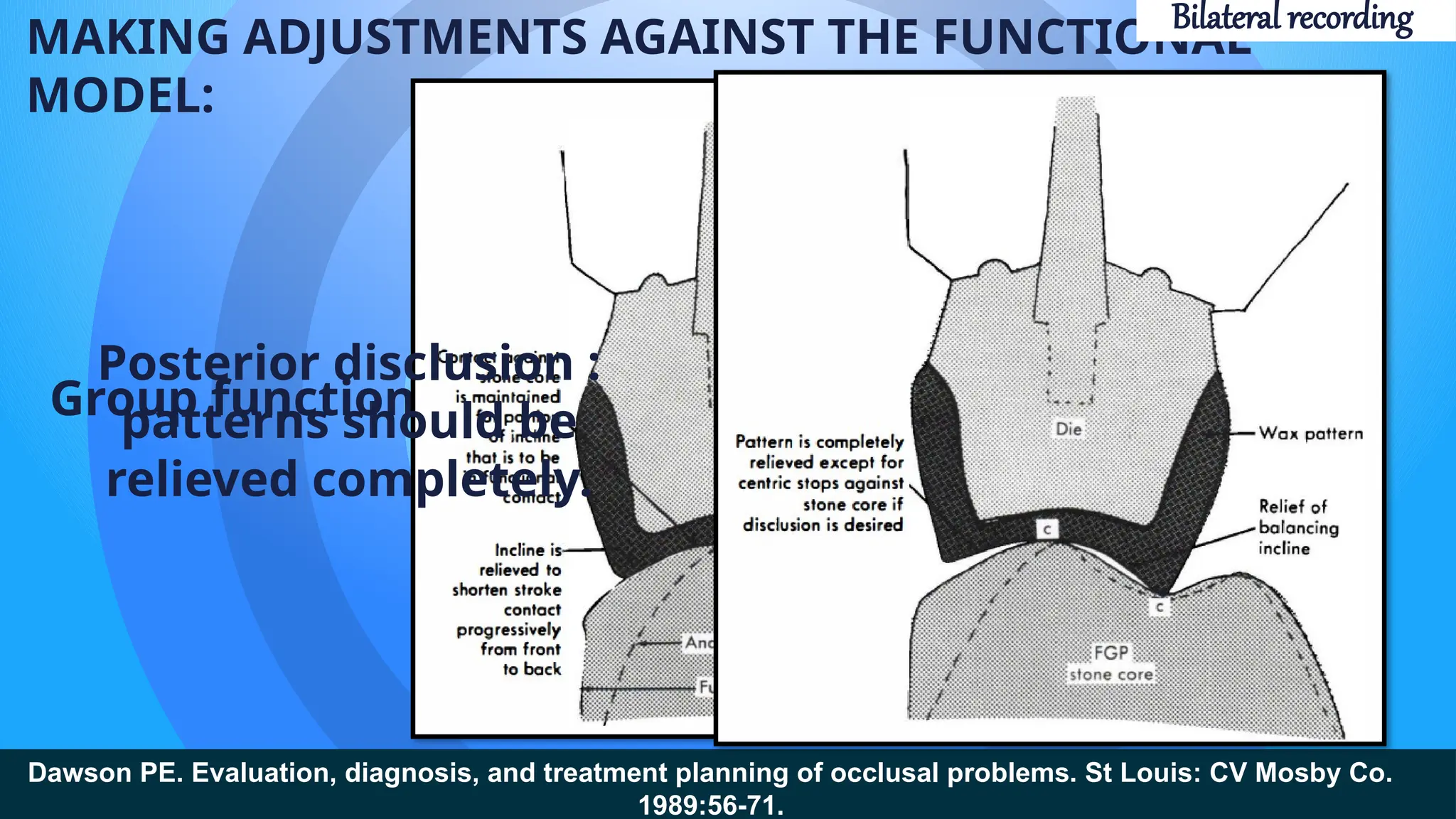
Group function
Dawson PE. Evaluation, diagnosis, and treatment planning of occlusal problems. St Louis: CV Mosby Co.
1989:56-71.
Posterior disclusion :
patterns should be
relieved completely.
Bilateral recording
Balancing inclines..
Balancing side contact – Undesirable
Wax pattern adjustment : white shoe polish
Articulating
papers
Talcum powder
causes porosity.
Tyagi M, kusum C. Full mouth rehabilitation of the patient with severely mutilated dentition: a case report. Int J
Community Med Public Health. 2022 Jul;9(7):3010-3013
Bilateral recording
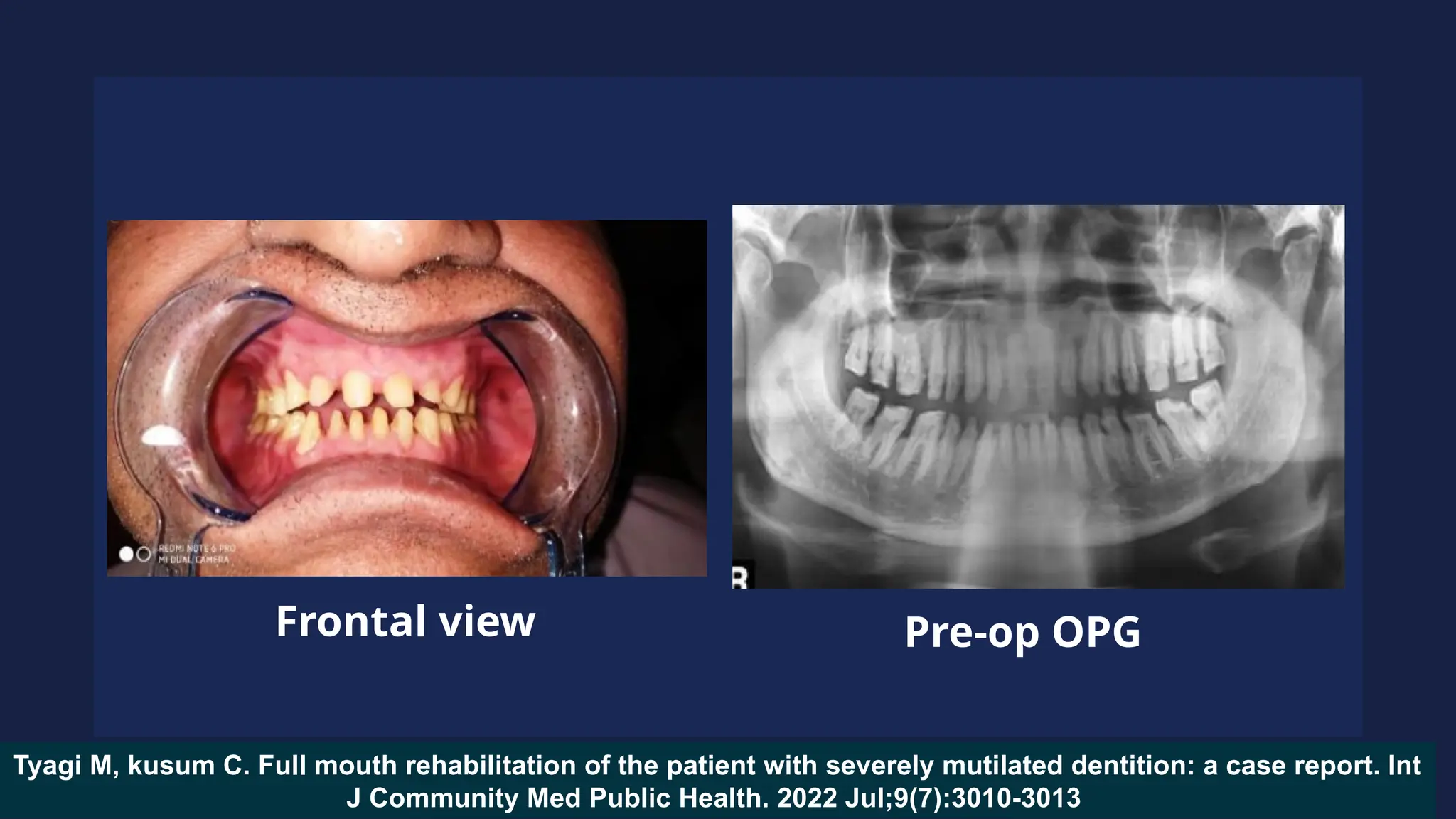
Frontal view Pre-op OPG
Tyagi M, kusum C. Full mouth rehabilitation of the patient with severely mutilated dentition: a case report. Int
J Community Med Public Health. 2022 Jul;9(7):3010-3013
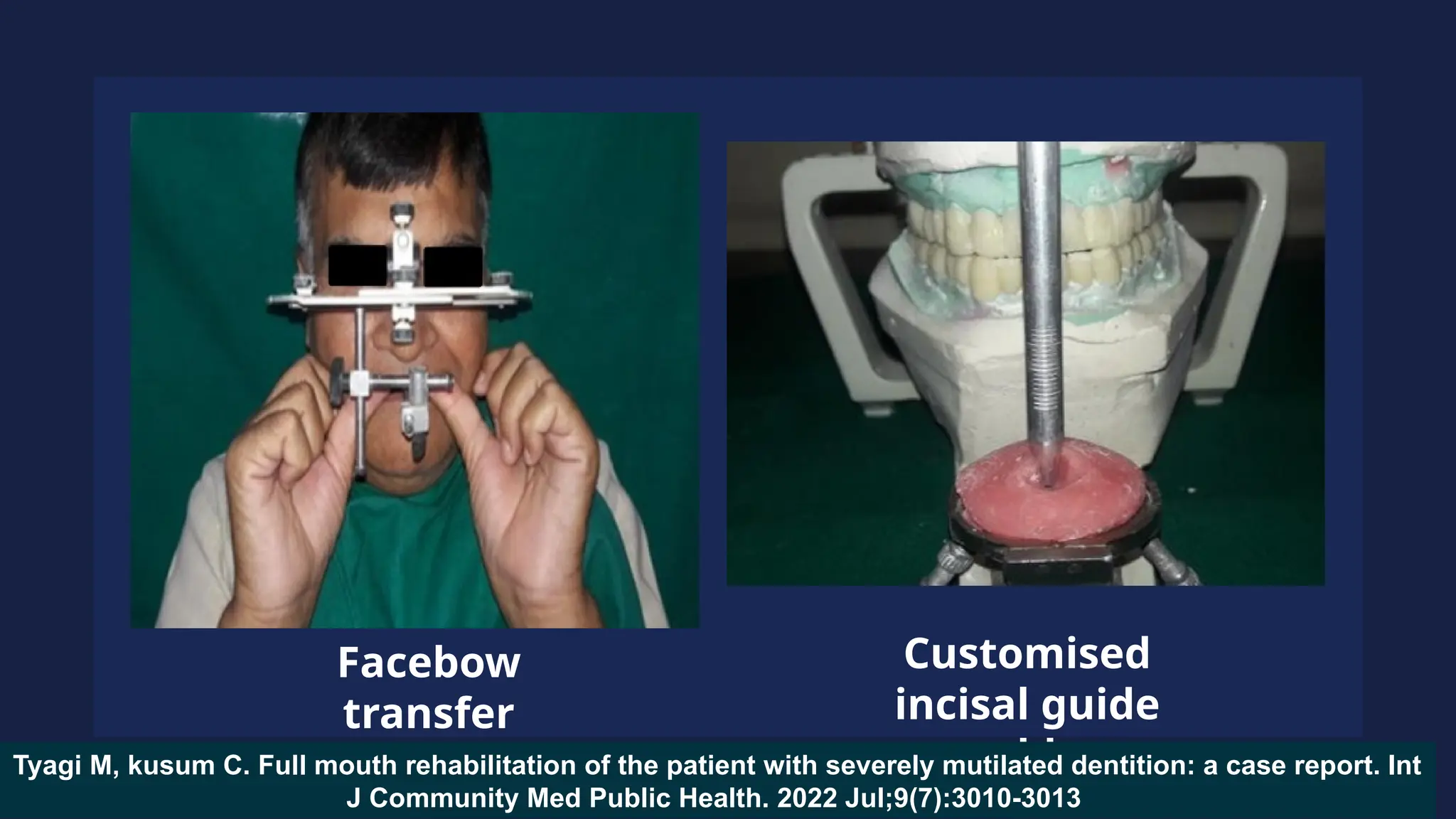
Facebow
transfer
Customised
incisal guide
table
Tyagi M, kusum C. Full mouth rehabilitation of the patient with severely mutilated dentition: a case report. Int
J Community Med Public Health. 2022 Jul;9(7):3010-3013
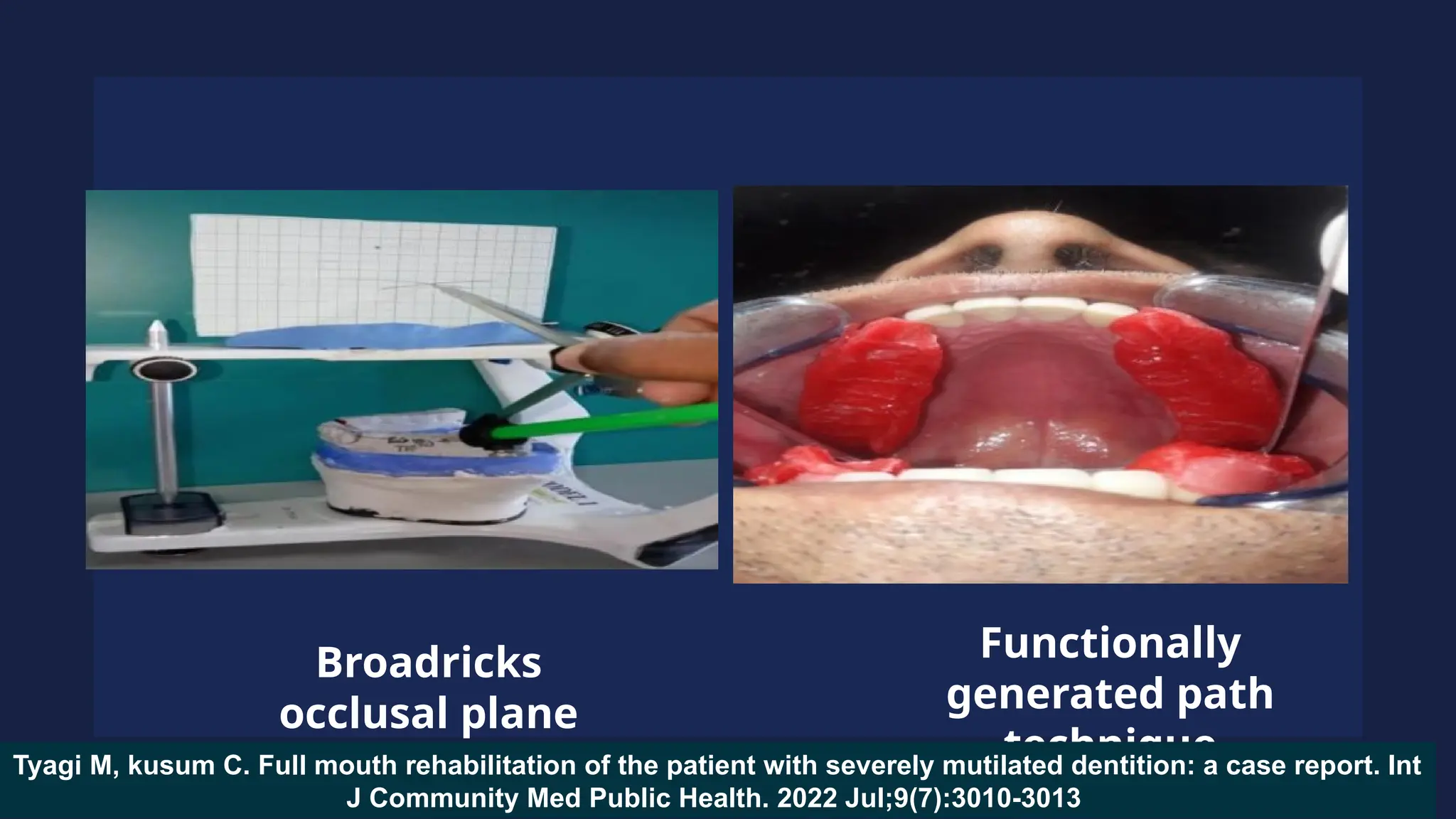
Broadricks
occlusal plane
analysis
Functionally
generated path
technique
Tyagi M, kusum C. Full mouth rehabilitation of the patient with severely mutilated dentition: a case report. Int
J Community Med Public Health. 2022 Jul;9(7):3010-3013
Tyagi M, kusum C. Full mouth rehabilitation of the patient with severely mutilated dentition: a case report. Int
J Community Med Public Health. 2022 Jul;9(7):3010-3013
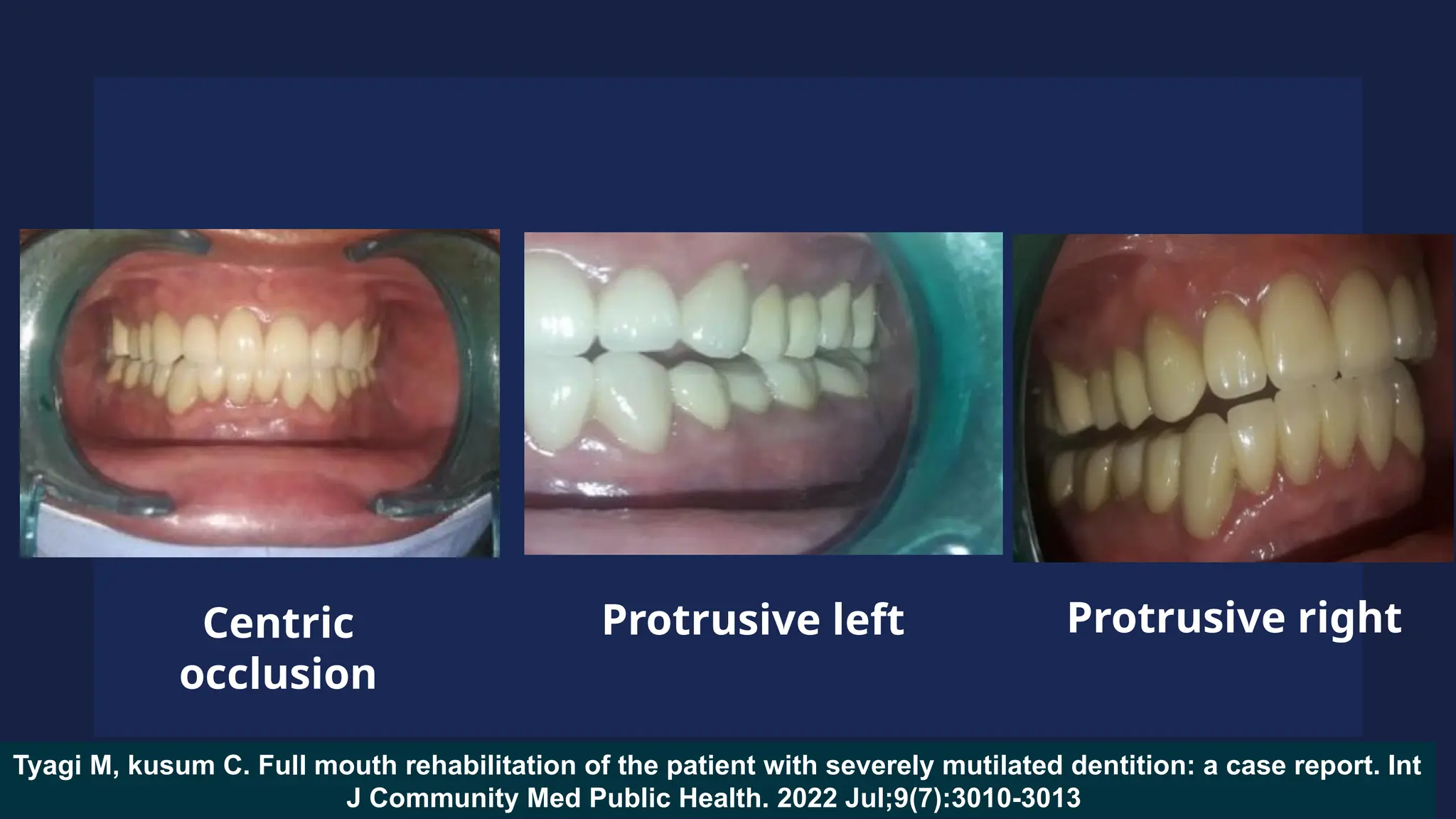
Centric
occlusion
Protrusive right
Protrusive left
33
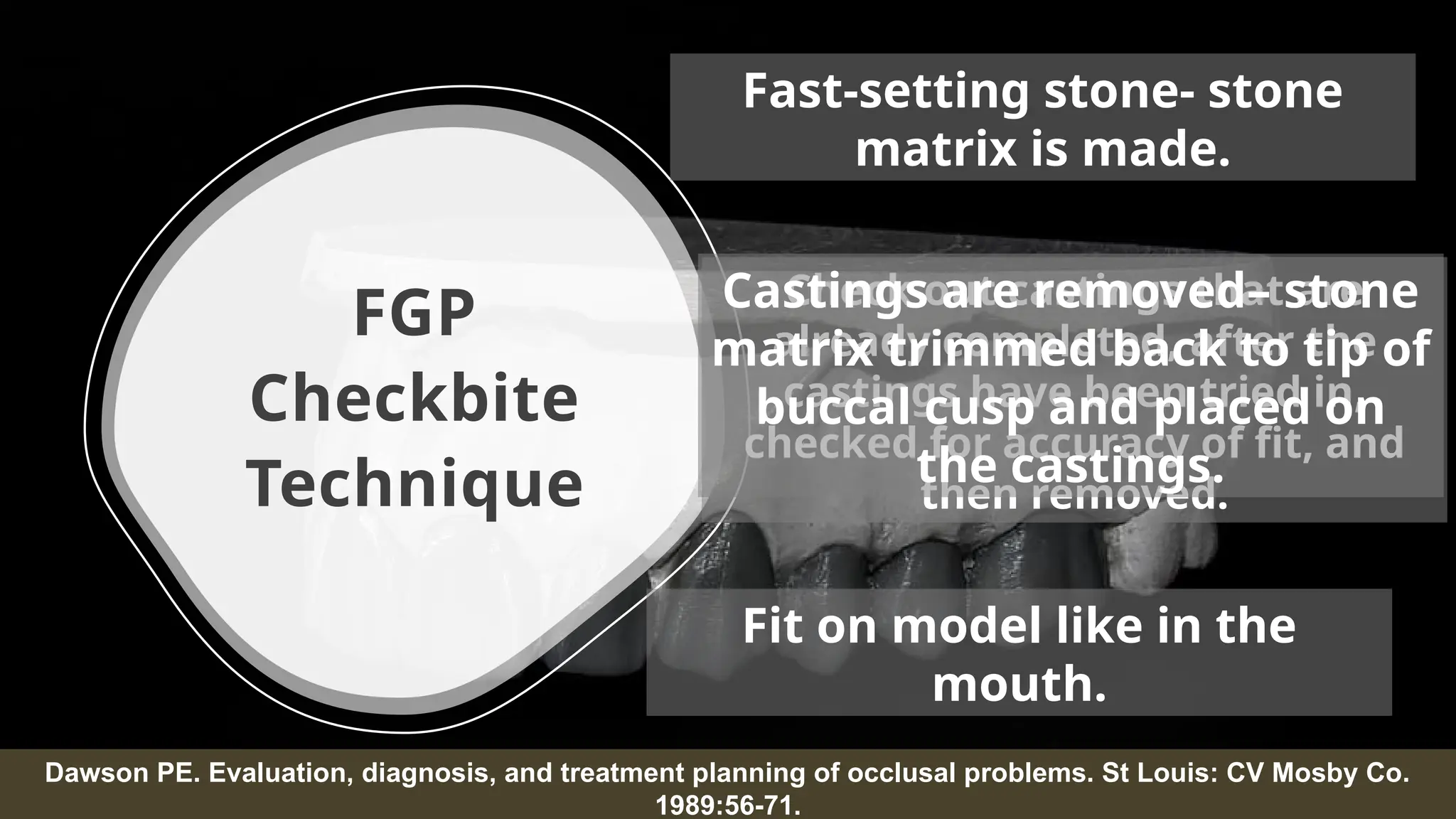
FGP
Checkbite
Technique
Check out castings that are
already completed, after the
castings have been tried in,
checked for accuracy of fit, and
then removed.
Fast-setting stone- stone
matrix is made.
Castings are removed– stone
matrix trimmed back to tip of
buccal cusp and placed on
the castings.
Fit on model like in the
mouth.
Dawson PE. Evaluation, diagnosis, and treatment planning of occlusal problems. St Louis: CV Mosby Co.
1989:56-71.
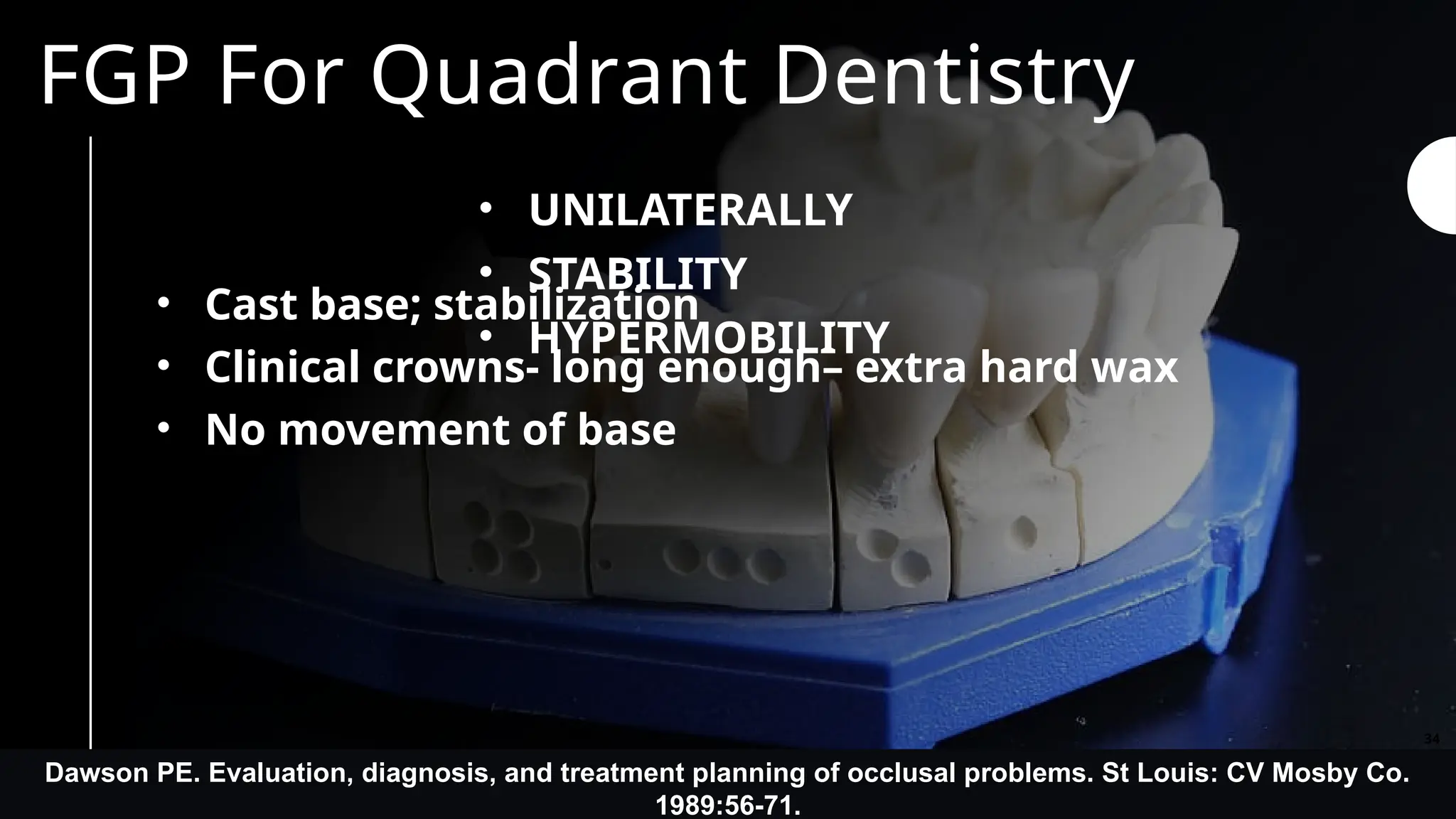
FGP For Quadrant Dentistry
• UNILATERALLY
• STABILITY
• HYPERMOBILITY
• Cast base; stabilization
• Clinical crowns- long enough– extra hard wax
• No movement of base
Dawson PE. Evaluation, diagnosis, and treatment planning of occlusal problems. St Louis: CV Mosby Co.
1989:56-71.
34
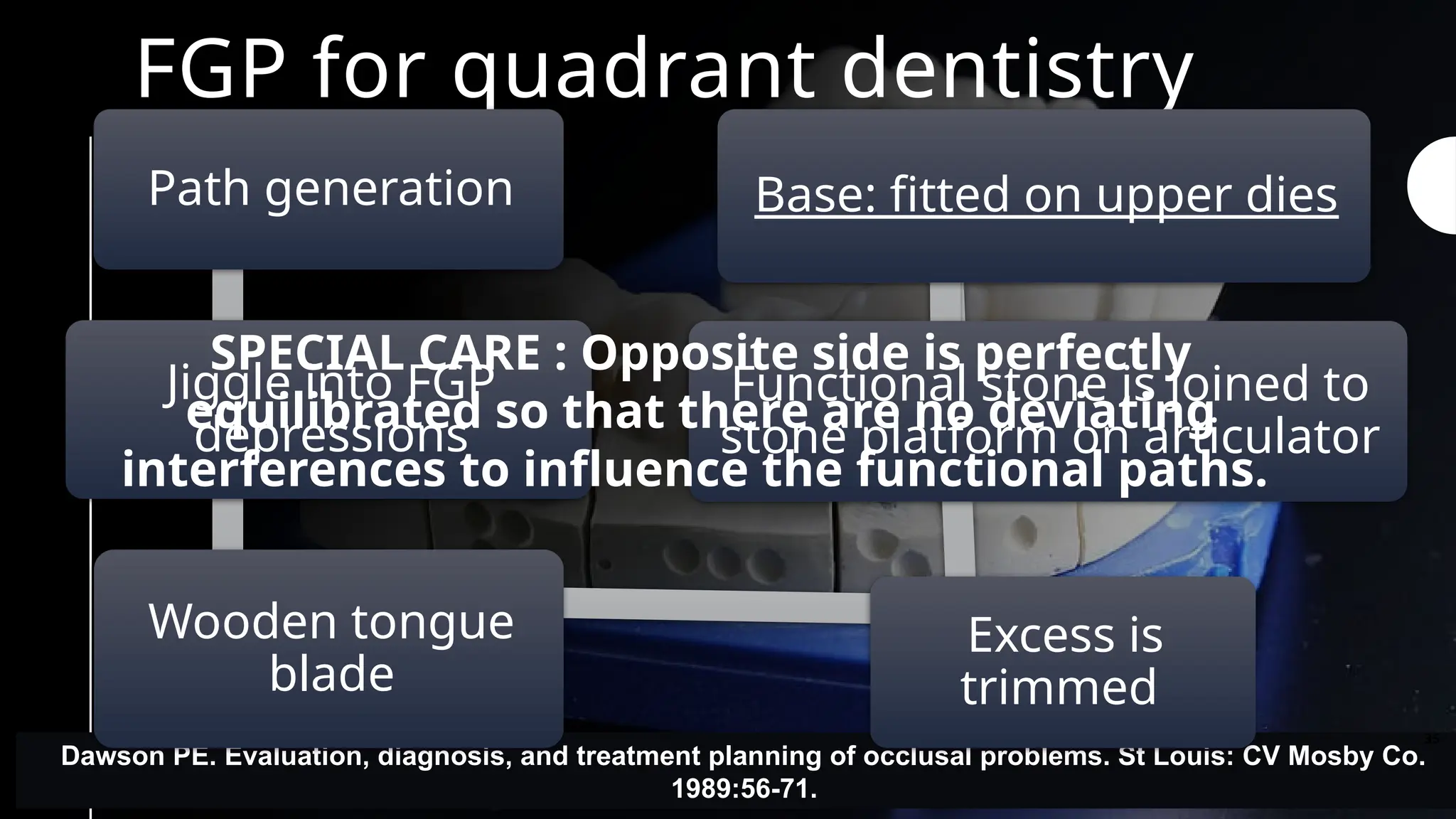
FGP for quadrant dentistry
Dawson PE. Evaluation, diagnosis, and treatment planning of occlusal problems. St Louis: CV Mosby Co.
1989:56-71.
Path generation
Jiggle into FGP
depressions
Wooden tongue
blade
Excess is
trimmed
Base: fitted on upper dies
Functional stone is joined to
stone platform on articulator
SPECIAL CARE : Opposite side is perfectly
equilibrated so that there are no deviating
interferences to influence the functional paths.
35
36
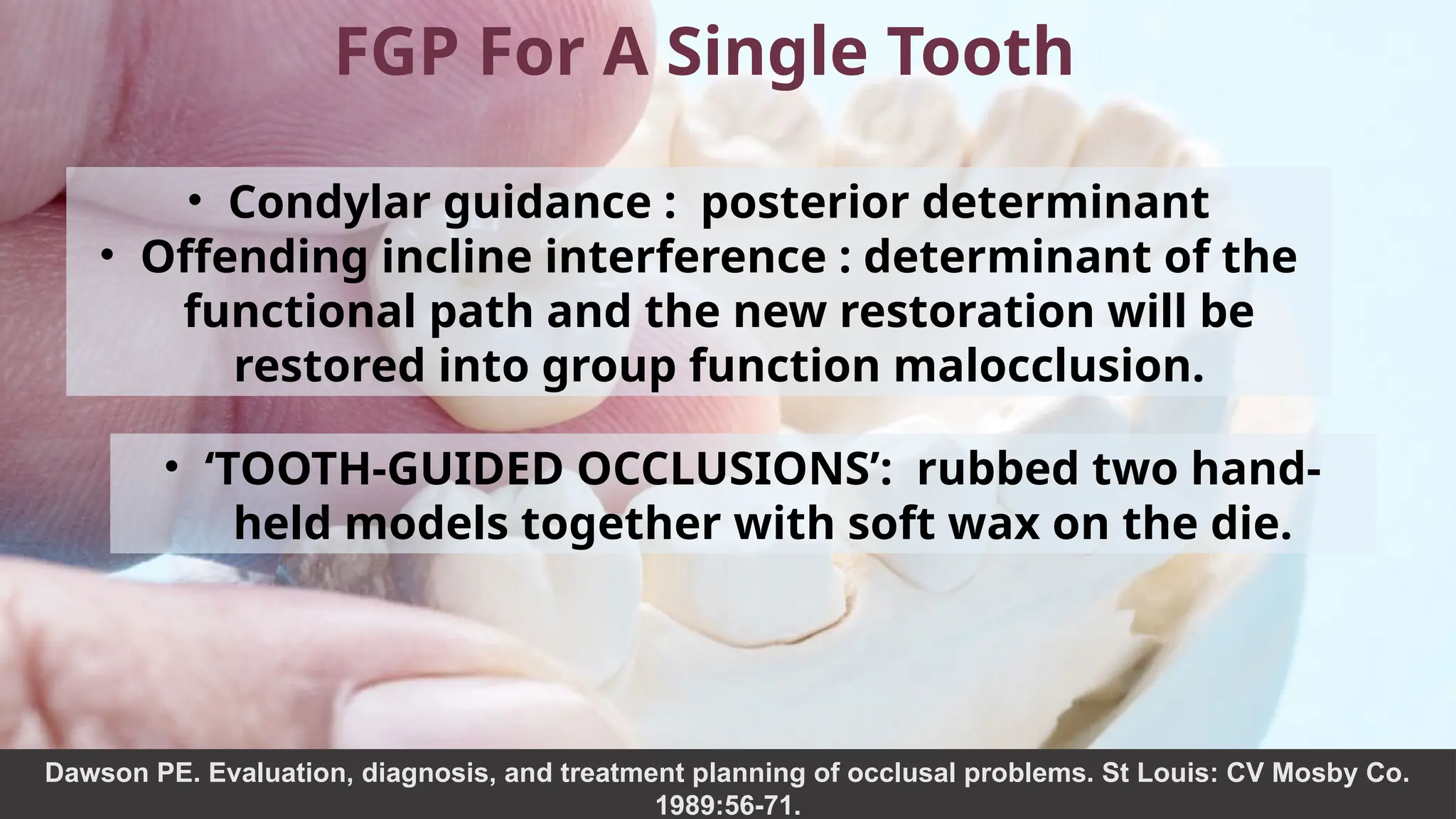
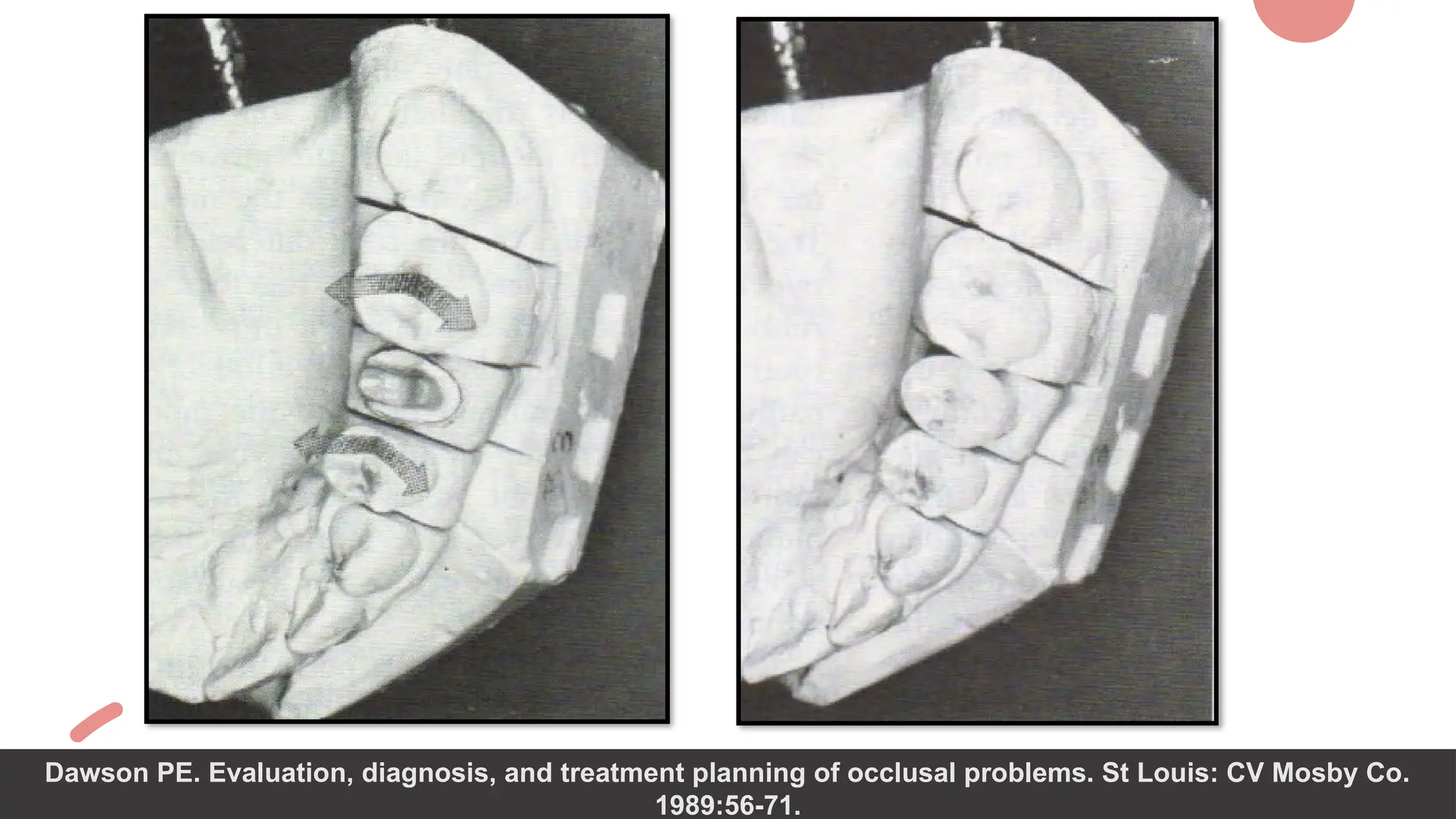
FGP For A Single Tooth
• Condylar guidance : posterior determinant
• Offending incline interference : determinant of the
functional path and the new restoration will be
restored into group function malocclusion.
• ‘TOOTH-GUIDED OCCLUSIONS’: rubbed two hand-
held models together with soft wax on the die.
Dawson PE. Evaluation, diagnosis, and treatment planning of occlusal problems. St Louis: CV Mosby Co.
1989:56-71.
37
Dawson PE. Evaluation, diagnosis, and treatment planning of occlusal problems. St Louis: CV Mosby Co.
1989:56-71.
38
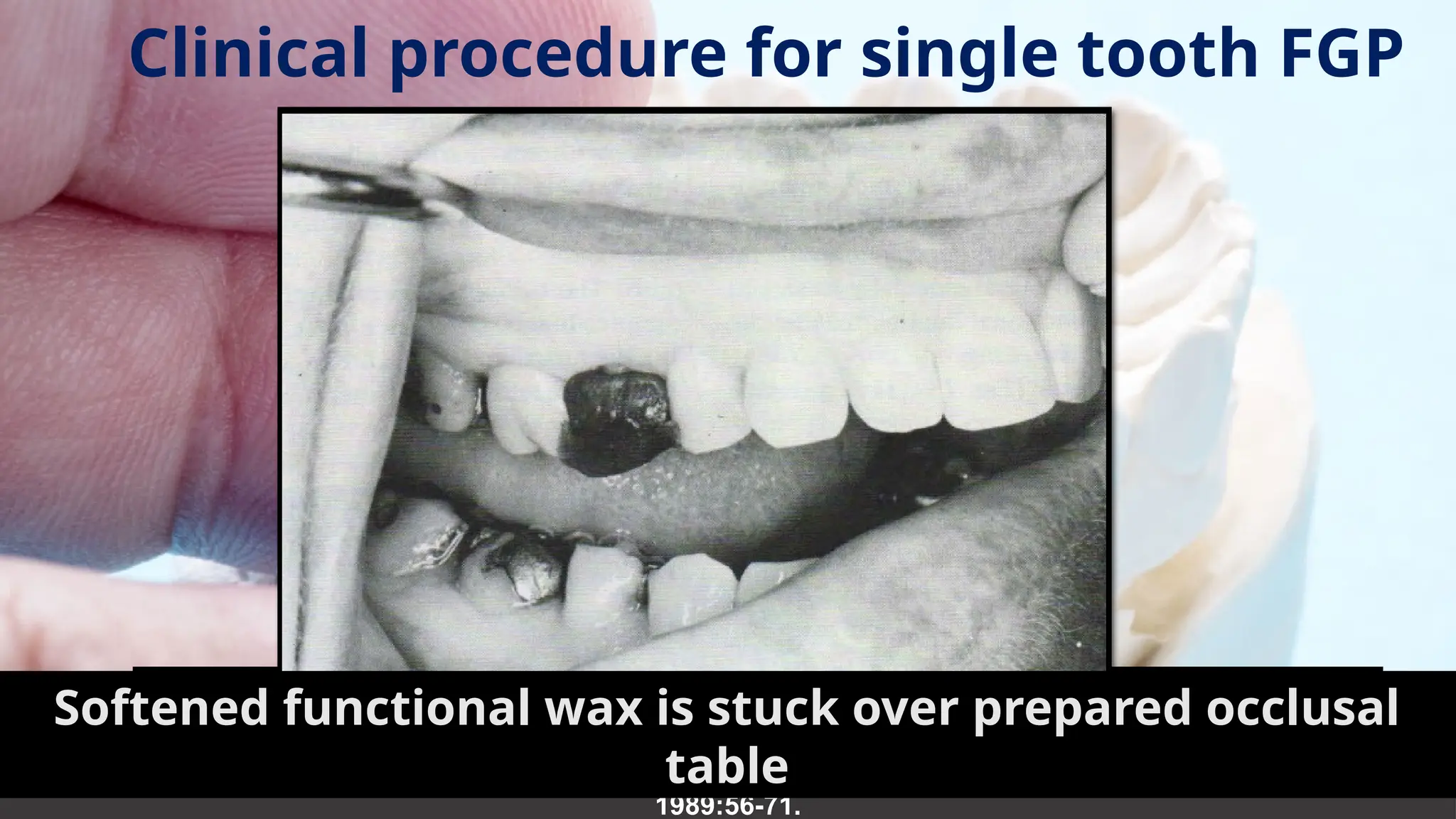
Clinical procedure for single tooth FGP
• Occlusal
reduction
Dawson PE. Evaluation, diagnosis, and treatment planning of occlusal problems. St Louis: CV Mosby Co.
1989:56-71.
Tooth stabilized with softened stick compound
Softened functional wax is stuck over prepared occlusal
table
3 9
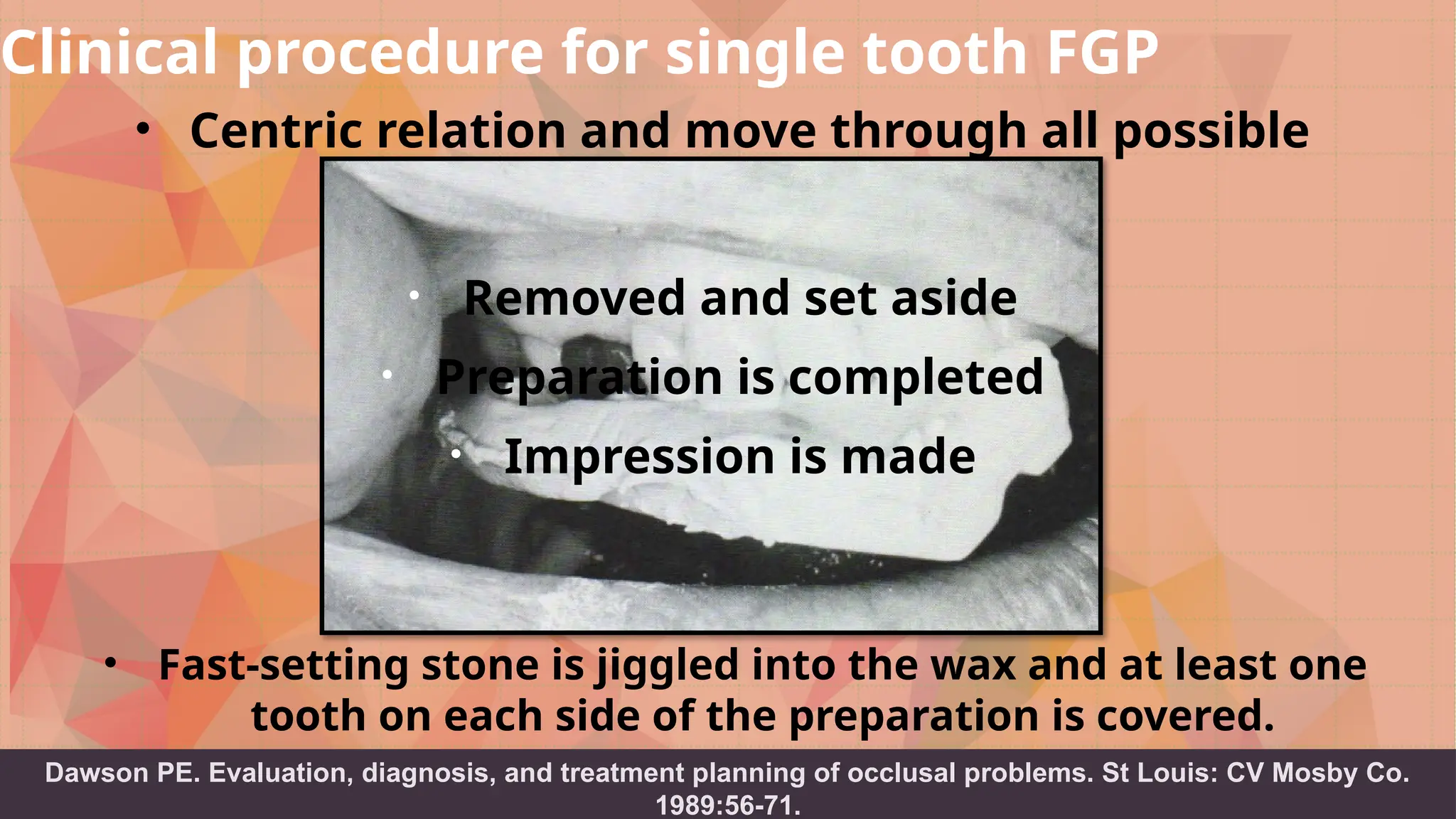
• Centric relation and move through all possible
excursions.
Clinical procedure for single tooth FGP
Dawson PE. Evaluation, diagnosis, and treatment planning of occlusal problems. St Louis: CV Mosby Co.
1989:56-71.
• Fast-setting stone is jiggled into the wax and at least one
tooth on each side of the preparation is covered.
• Removed and set aside
• Preparation is completed
• Impression is made
Dawson PE. Evaluation, diagnosis, and treatment planning of occlusal problems. St Louis: CV Mosby Co.
1989:56-71.
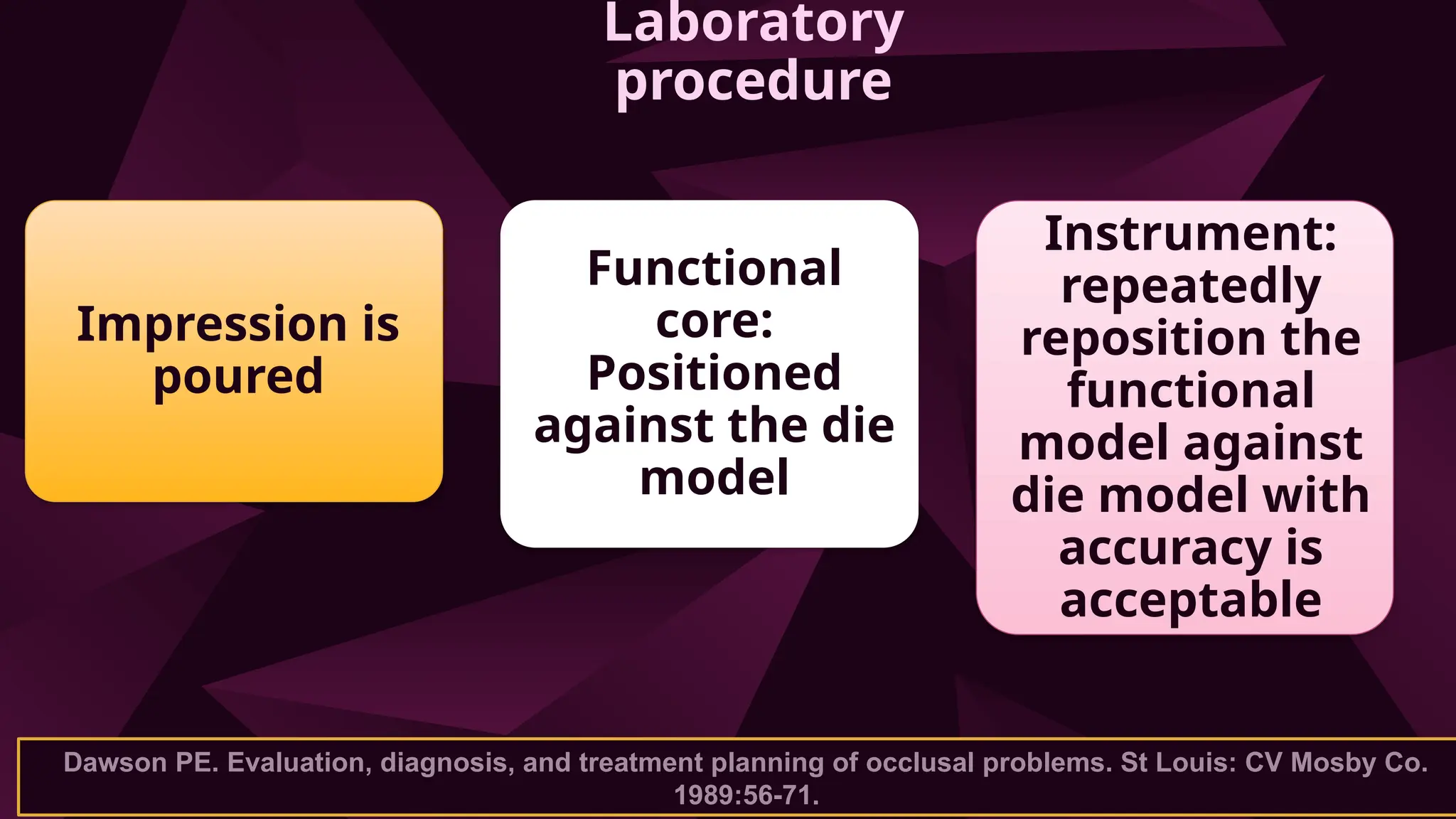
Laboratory
procedure
Impression is
poured
Functional
core:
Positioned
against the die
model
Instrument:
repeatedly
reposition the
functional
model against
die model with
accuracy is
acceptable
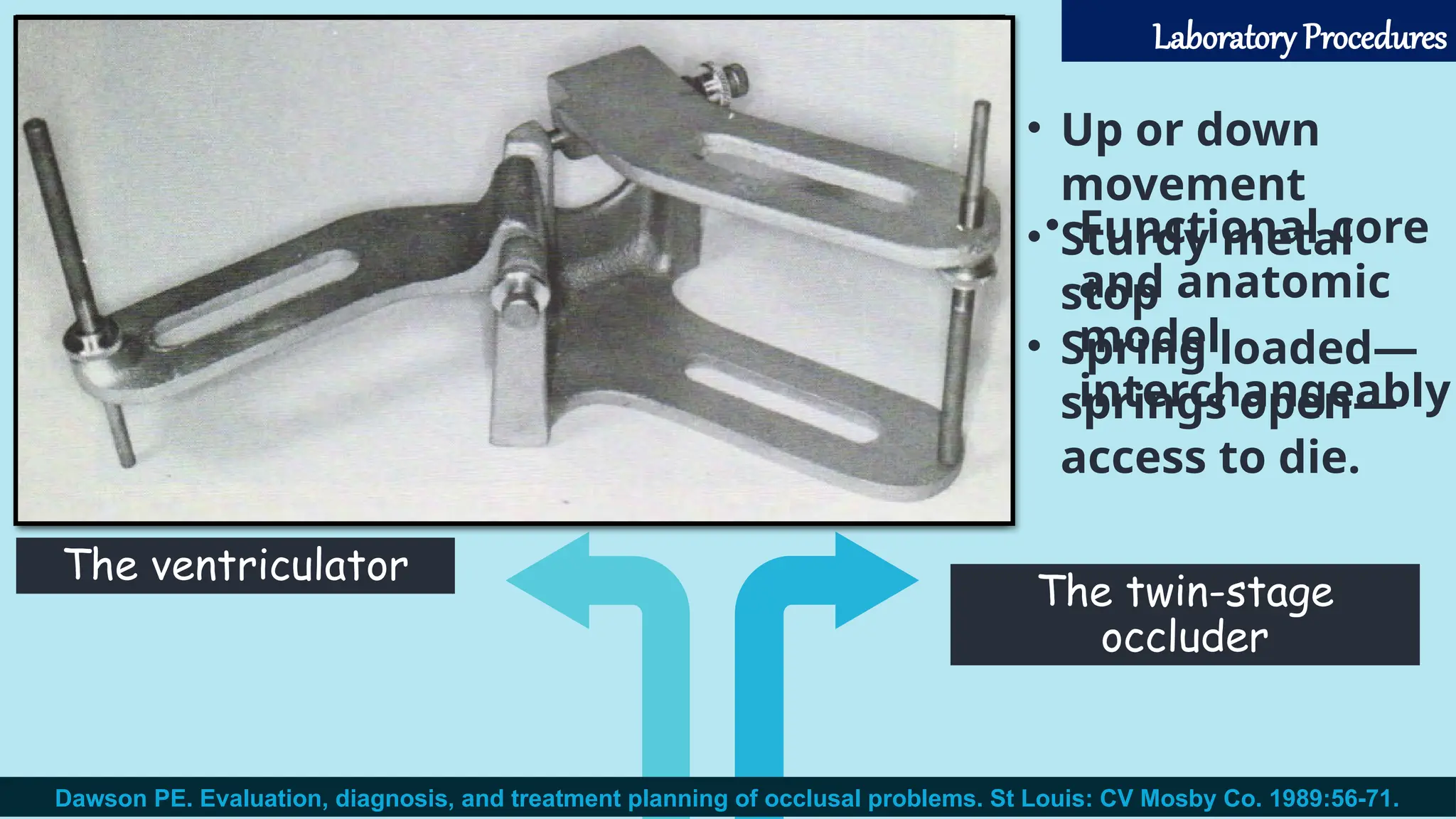
The twin-stage
occluder
The ventriculator
Dawson PE. Evaluation, diagnosis, and treatment planning of occlusal problems. St Louis: CV Mosby Co. 1989:56-71.
Laboratory Procedures
• Up or down
movement
• Sturdy metal
stop
• Spring loaded—
springs open—
access to die.
• Functional core
and anatomic
model
interchangeably
FGP for single tooth
01
Group function
02
Inclines: Discluded
• Lingual inclines
of upper buccal
cusps—
functional
model
• Reduced: no
contact
• Centric relation:
not be lost
Dawson PE. Evaluation, diagnosis, and treatment planning of occlusal problems. St Louis: CV Mosby Co. 1989:56-71.
43
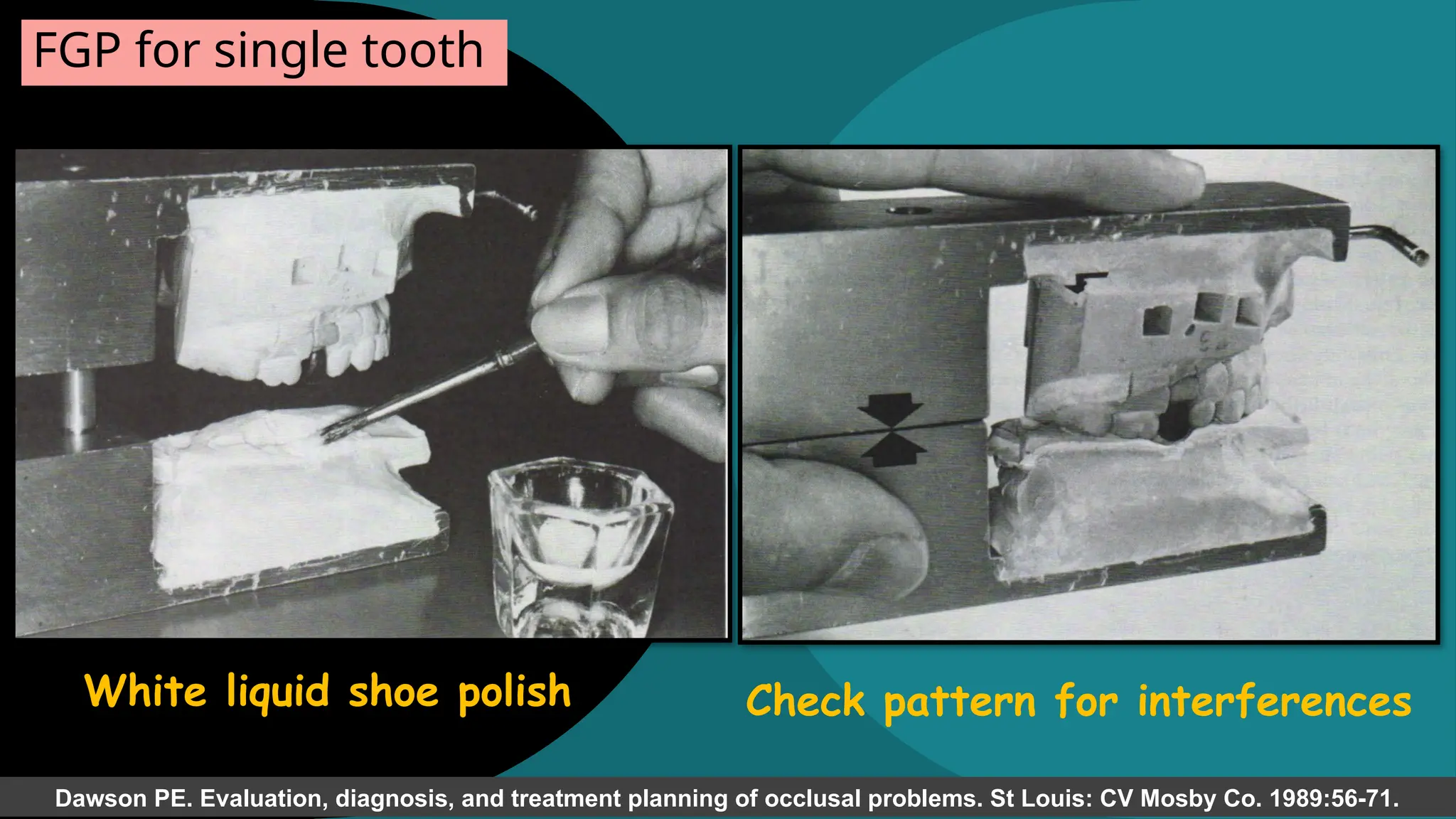
White liquid shoe polish
FGP for single tooth
Dawson PE. Evaluation, diagnosis, and treatment planning of occlusal problems. St Louis: CV Mosby Co. 1989:56-71.
Check pattern for interferences
Massive
X
presentation
to
DesignBall
team
Massive
X
44
b
C
c
FGP for single tooth
Dawson PE. Evaluation, diagnosis, and treatment planning of occlusal problems. St Louis: CV Mosby Co. 1989:56-71.
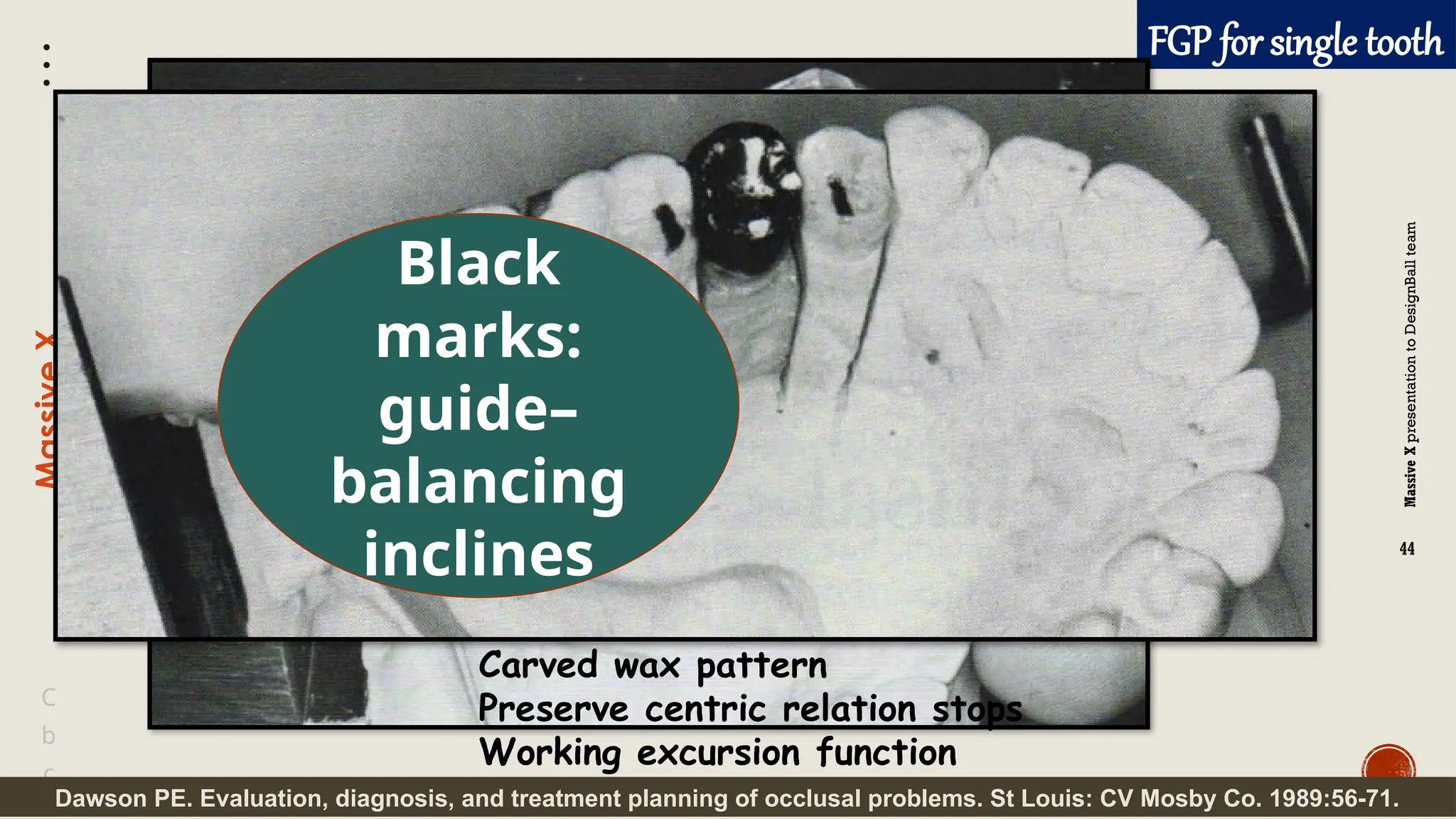
Carved wax pattern
Preserve centric relation stops
Working excursion function
Black
marks:
guide–
balancing
inclines
S
H
O
R
T
C
O
M
I
N
G
S
Hypermobilit
y
45
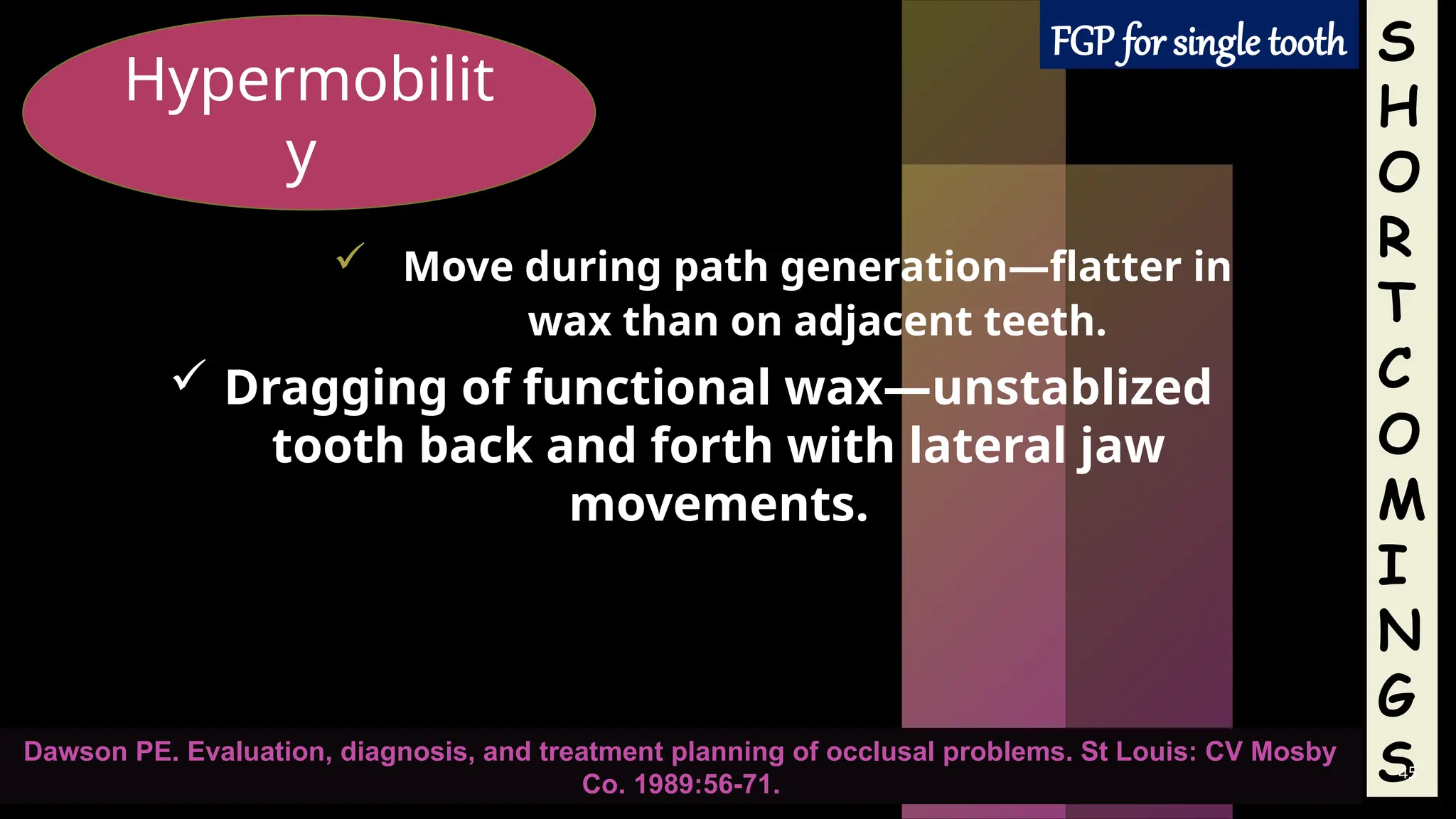
 Move during path generation—flatter in
wax than on adjacent teeth.
Dawson PE. Evaluation, diagnosis, and treatment planning of occlusal problems. St Louis: CV Mosby
Co. 1989:56-71.
 Dragging of functional wax—unstablized
tooth back and forth with lateral jaw
movements.
FGP for single tooth
46
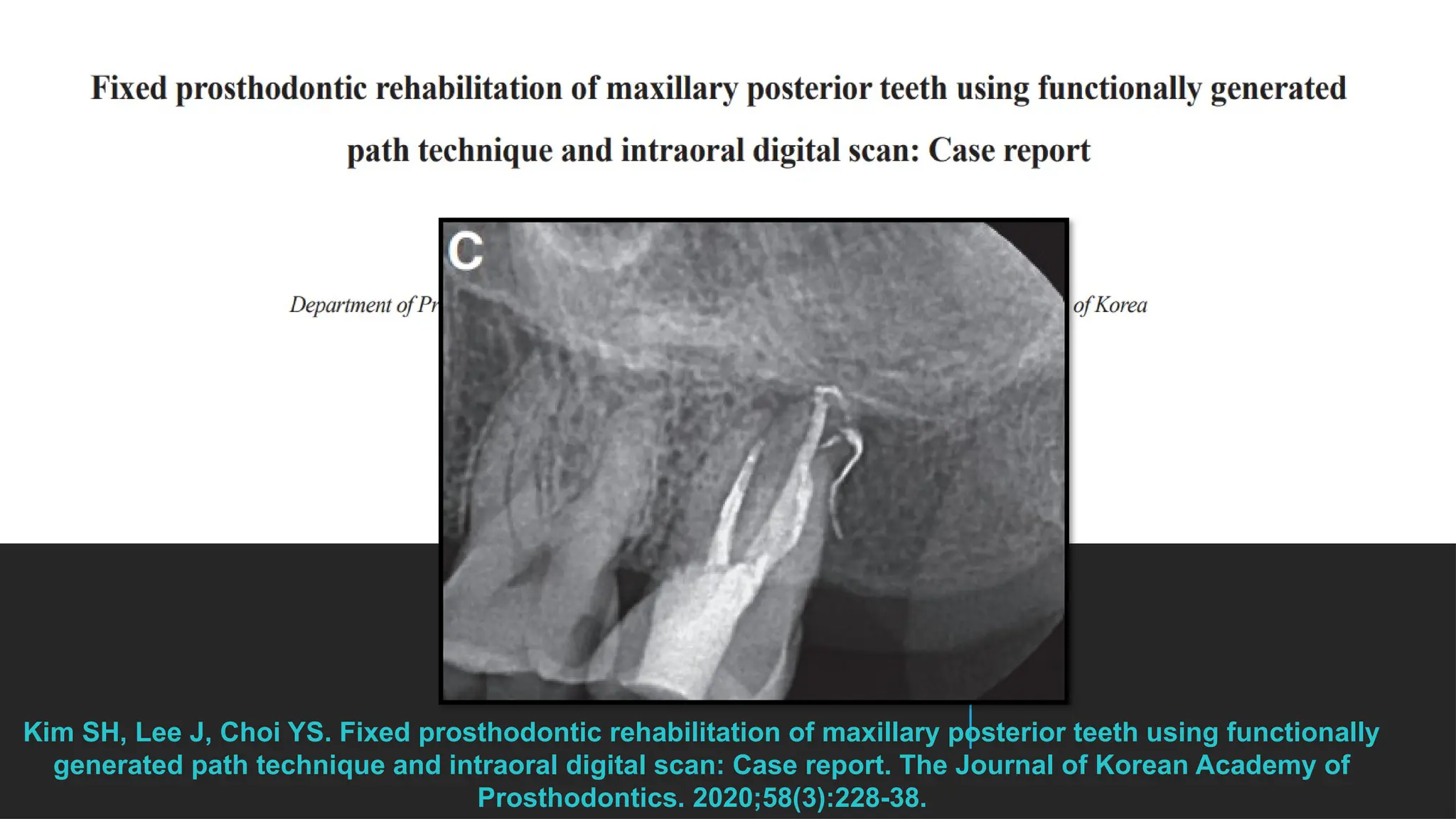
Kim SH, Lee J, Choi YS. Fixed prosthodontic rehabilitation of maxillary posterior teeth using functionally
generated path technique and intraoral digital scan: Case report. The Journal of Korean Academy of
Prosthodontics. 2020;58(3):228-38.
47
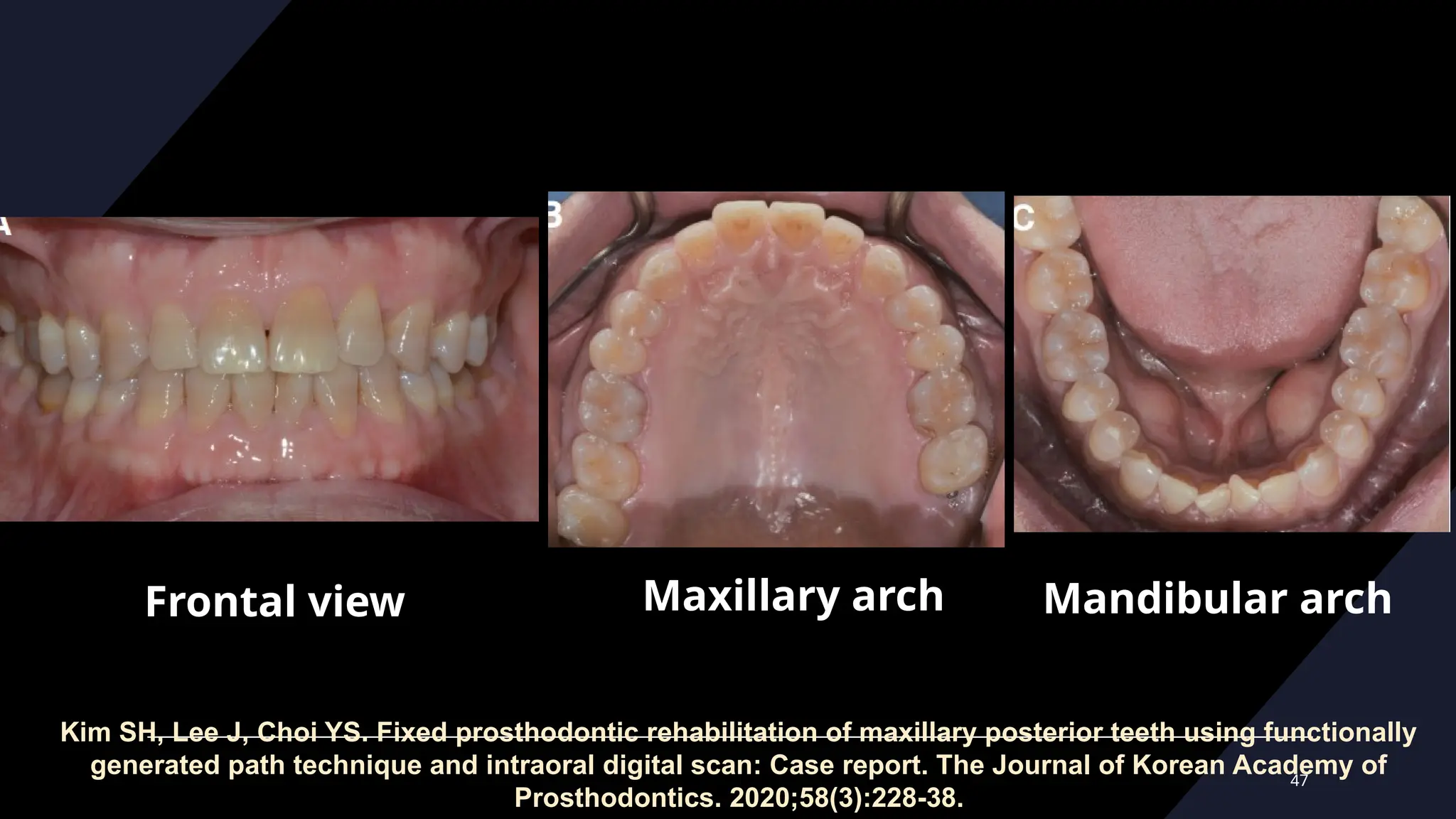
Frontal view Maxillary arch Mandibular arch
Kim SH, Lee J, Choi YS. Fixed prosthodontic rehabilitation of maxillary posterior teeth using functionally
generated path technique and intraoral digital scan: Case report. The Journal of Korean Academy of
Prosthodontics. 2020;58(3):228-38.
48
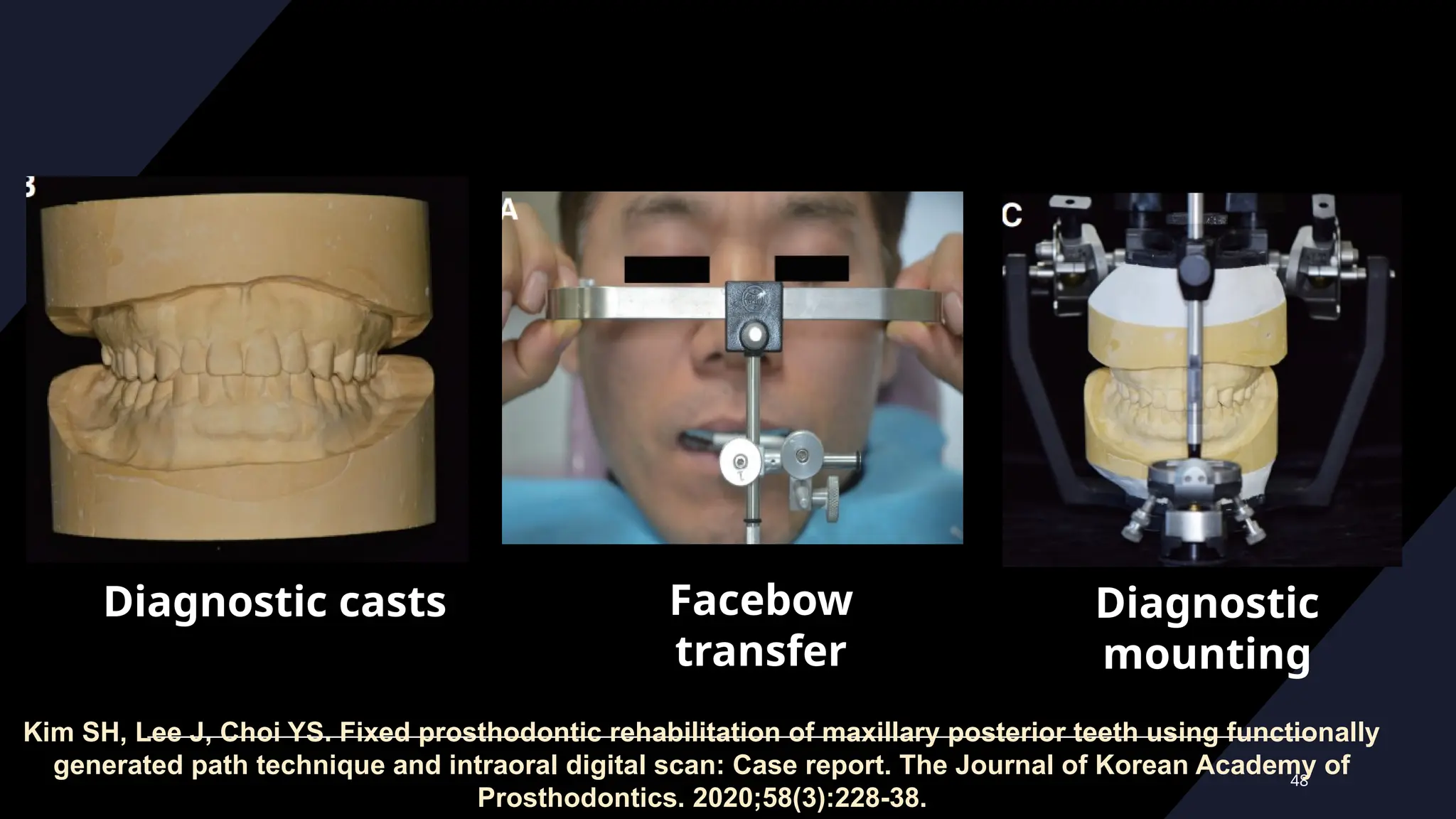
Diagnostic casts Facebow
transfer
Diagnostic
mounting
Kim SH, Lee J, Choi YS. Fixed prosthodontic rehabilitation of maxillary posterior teeth using functionally
generated path technique and intraoral digital scan: Case report. The Journal of Korean Academy of
Prosthodontics. 2020;58(3):228-38.
49
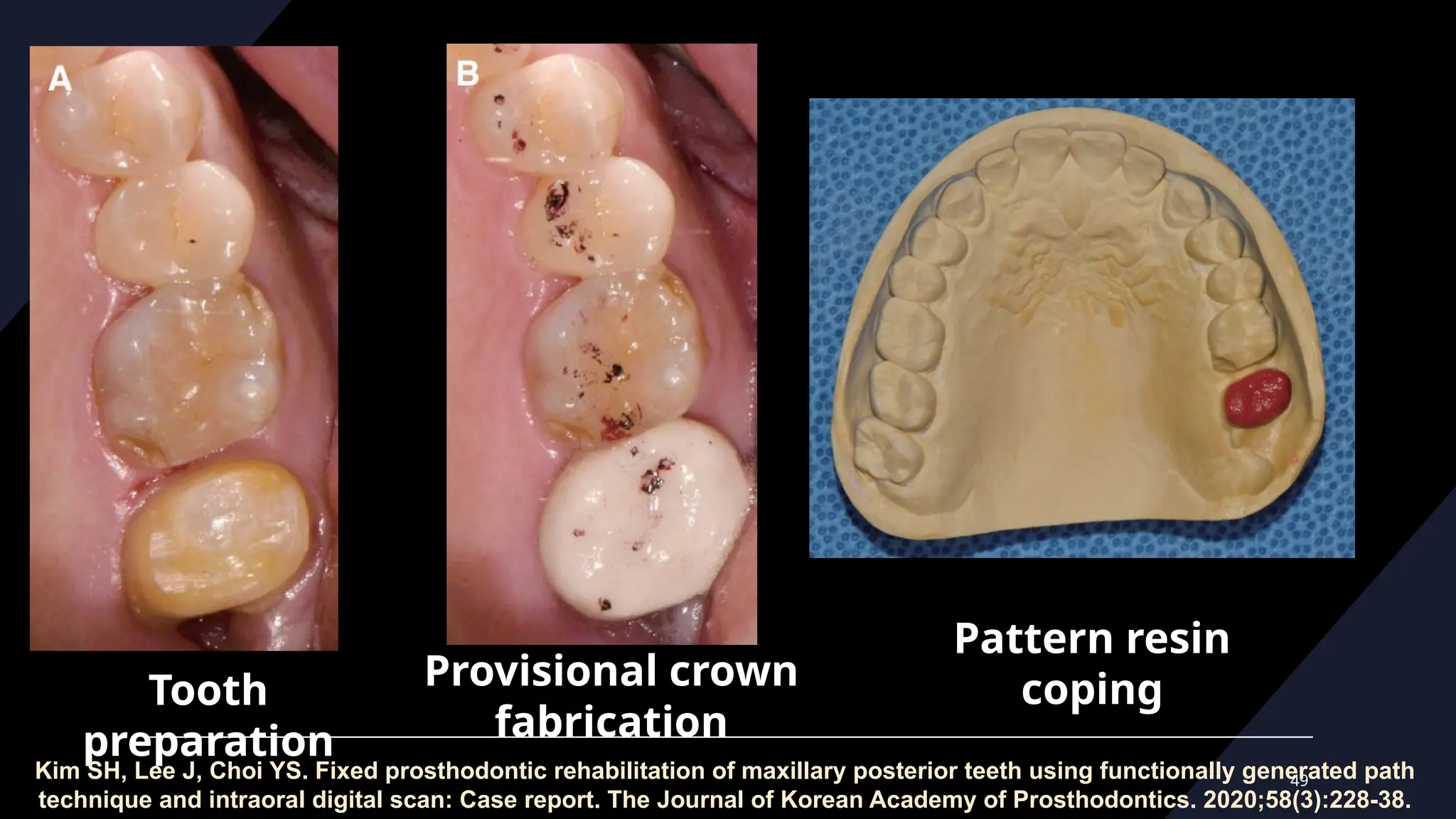
Tooth
preparation
Provisional crown
fabrication
Pattern resin
coping
Kim SH, Lee J, Choi YS. Fixed prosthodontic rehabilitation of maxillary posterior teeth using functionally generated path
technique and intraoral digital scan: Case report. The Journal of Korean Academy of Prosthodontics. 2020;58(3):228-38.
50
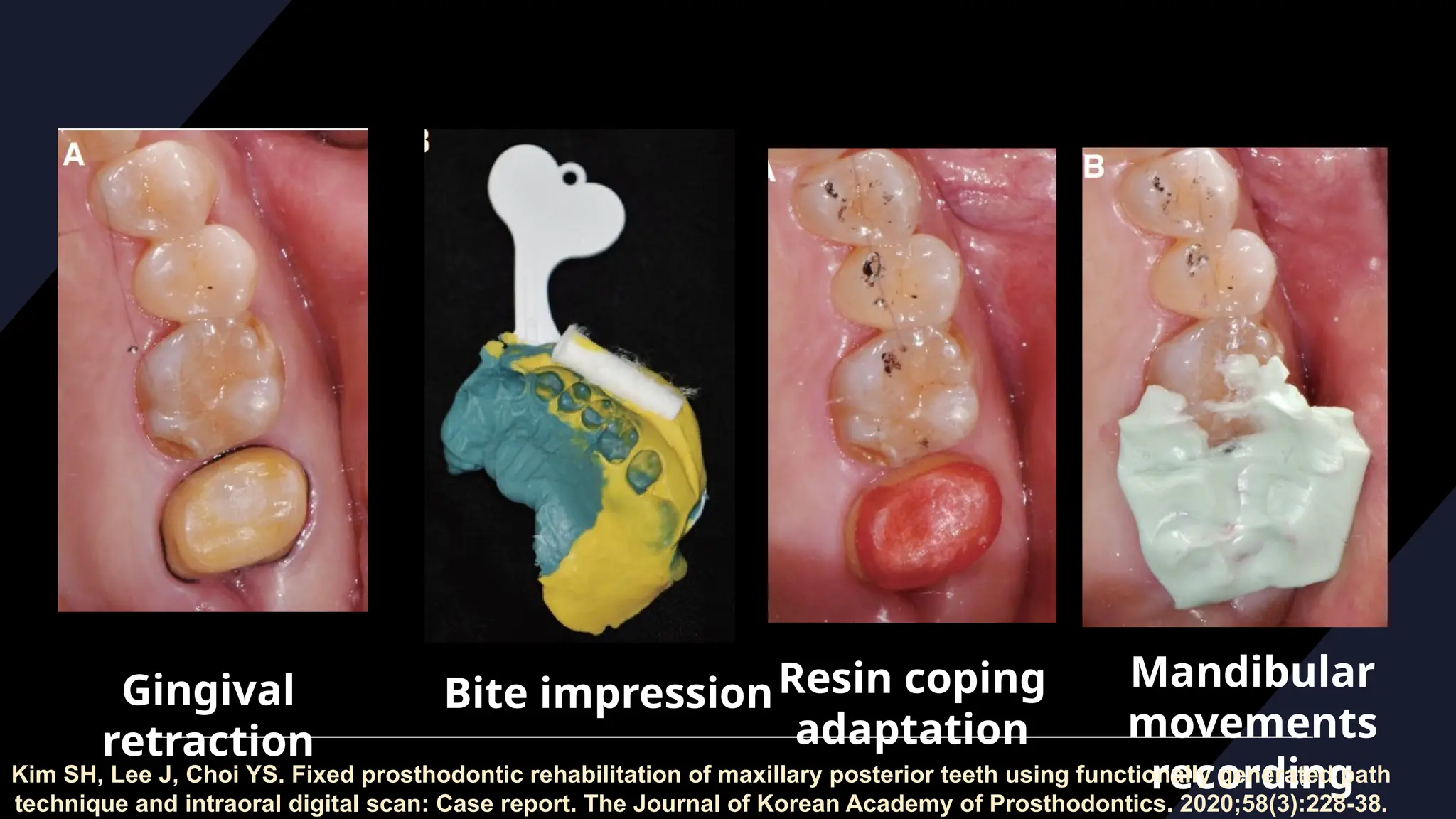
Gingival
retraction
Bite impressionResin coping
adaptation
Mandibular
movements
recording
Kim SH, Lee J, Choi YS. Fixed prosthodontic rehabilitation of maxillary posterior teeth using functionally generated path
technique and intraoral digital scan: Case report. The Journal of Korean Academy of Prosthodontics. 2020;58(3):228-38.
51
52
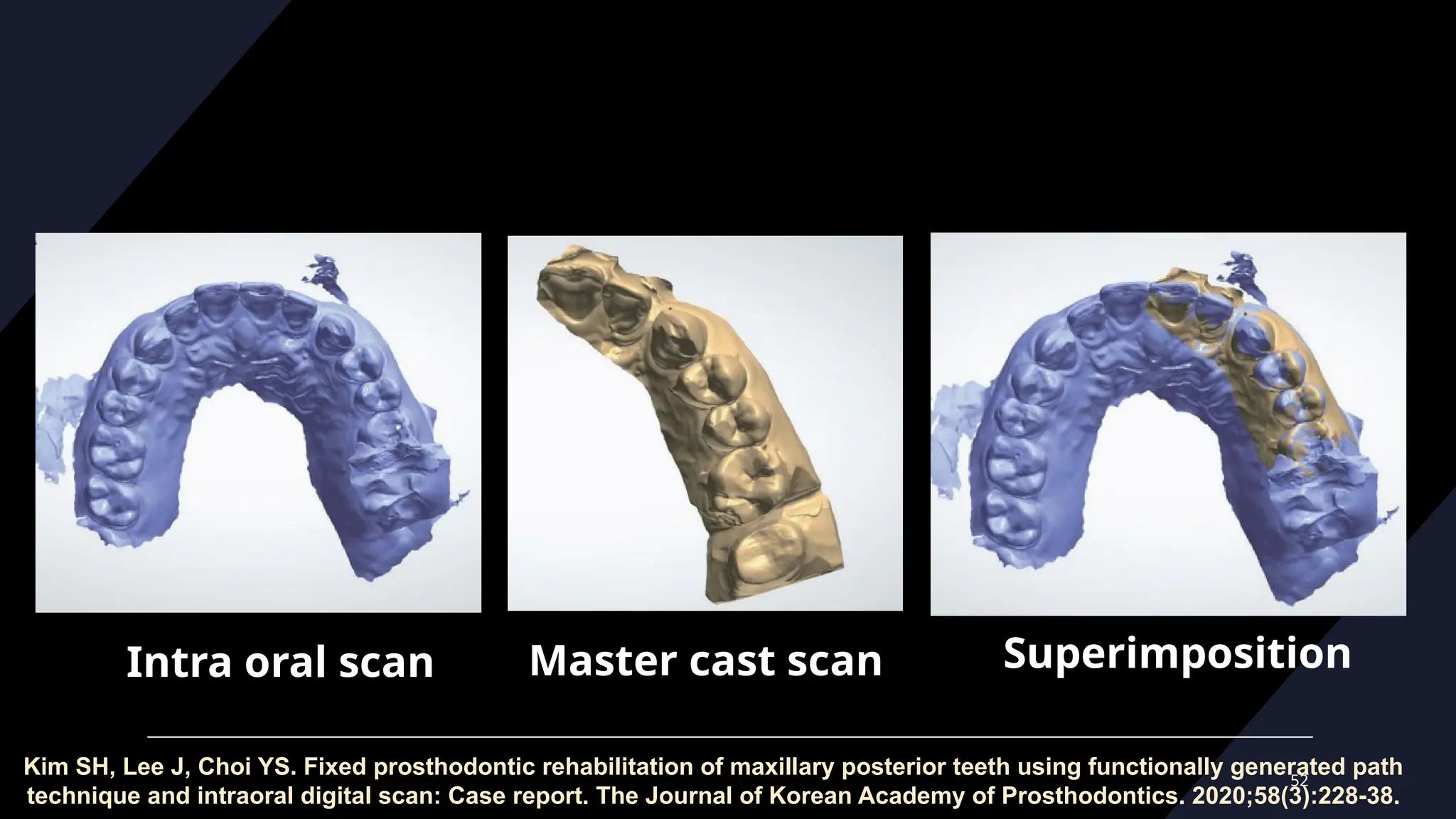
Intra oral scan Master cast scan Superimposition
Kim SH, Lee J, Choi YS. Fixed prosthodontic rehabilitation of maxillary posterior teeth using functionally generated path
technique and intraoral digital scan: Case report. The Journal of Korean Academy of Prosthodontics. 2020;58(3):228-38.
53
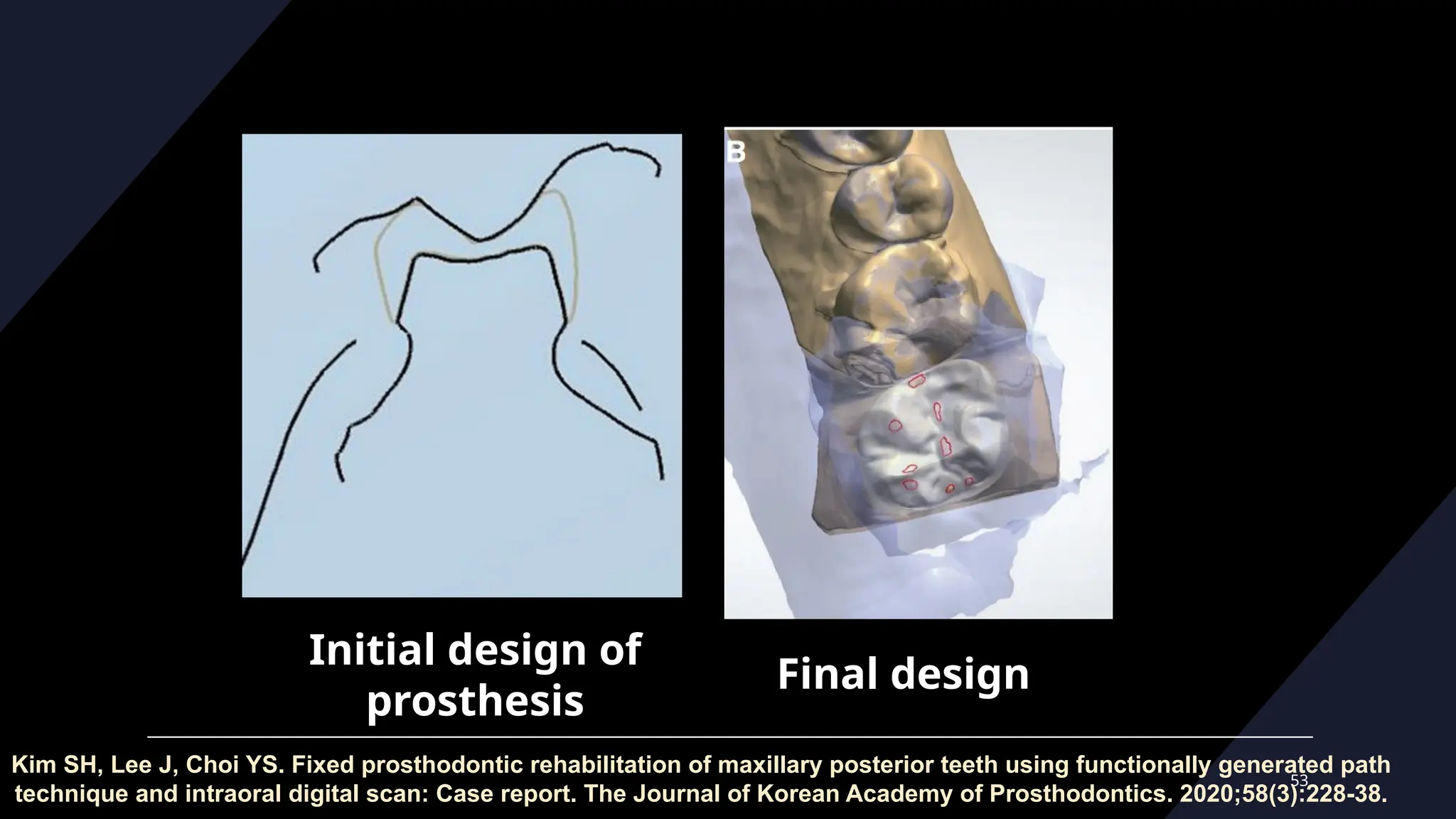
Initial design of
prosthesis
Final design
Kim SH, Lee J, Choi YS. Fixed prosthodontic rehabilitation of maxillary posterior teeth using functionally generated path
technique and intraoral digital scan: Case report. The Journal of Korean Academy of Prosthodontics. 2020;58(3):228-38.
54
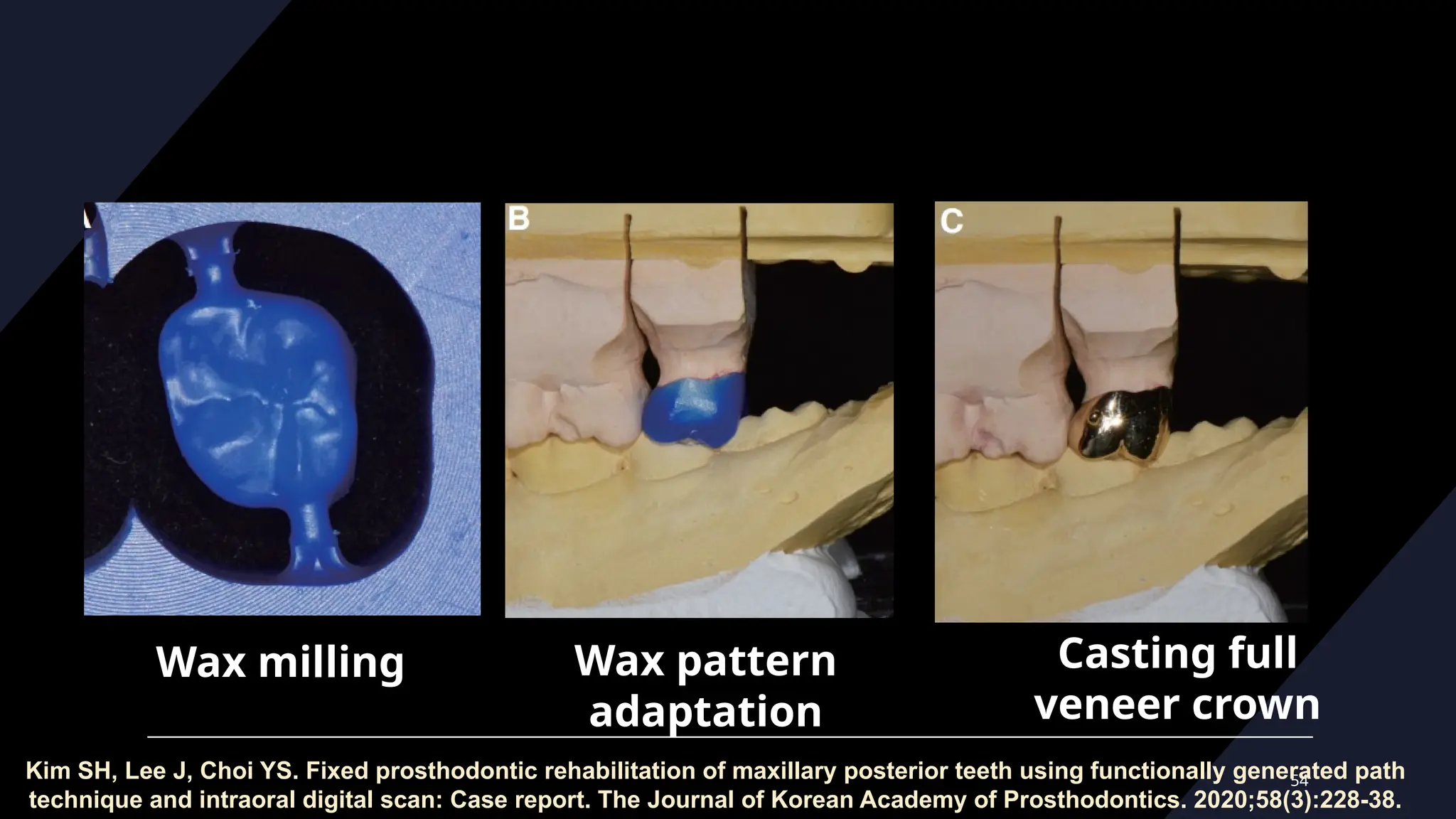
Wax milling Wax pattern
adaptation
Casting full
veneer crown
Kim SH, Lee J, Choi YS. Fixed prosthodontic rehabilitation of maxillary posterior teeth using functionally generated path
technique and intraoral digital scan: Case report. The Journal of Korean Academy of Prosthodontics. 2020;58(3):228-38.
55
FGP For LOWER TEETH
 Stone models
 Sighting down the occlusal surfaces, upper teeth can be
aligned opposite the lower preparation.
 Centric stops
 Occlusion– restoration is placed.
 Upper inclines—perfected
 Equilibration
 Lower tooth not in contact– compound/temporary
restoration
 CUSP-FOSSAE ANALYSIS.
Dawson PE. Evaluation, diagnosis, and treatment planning of occlusal problems. St Louis: CV Mosby Co. 1989:56-71.
56
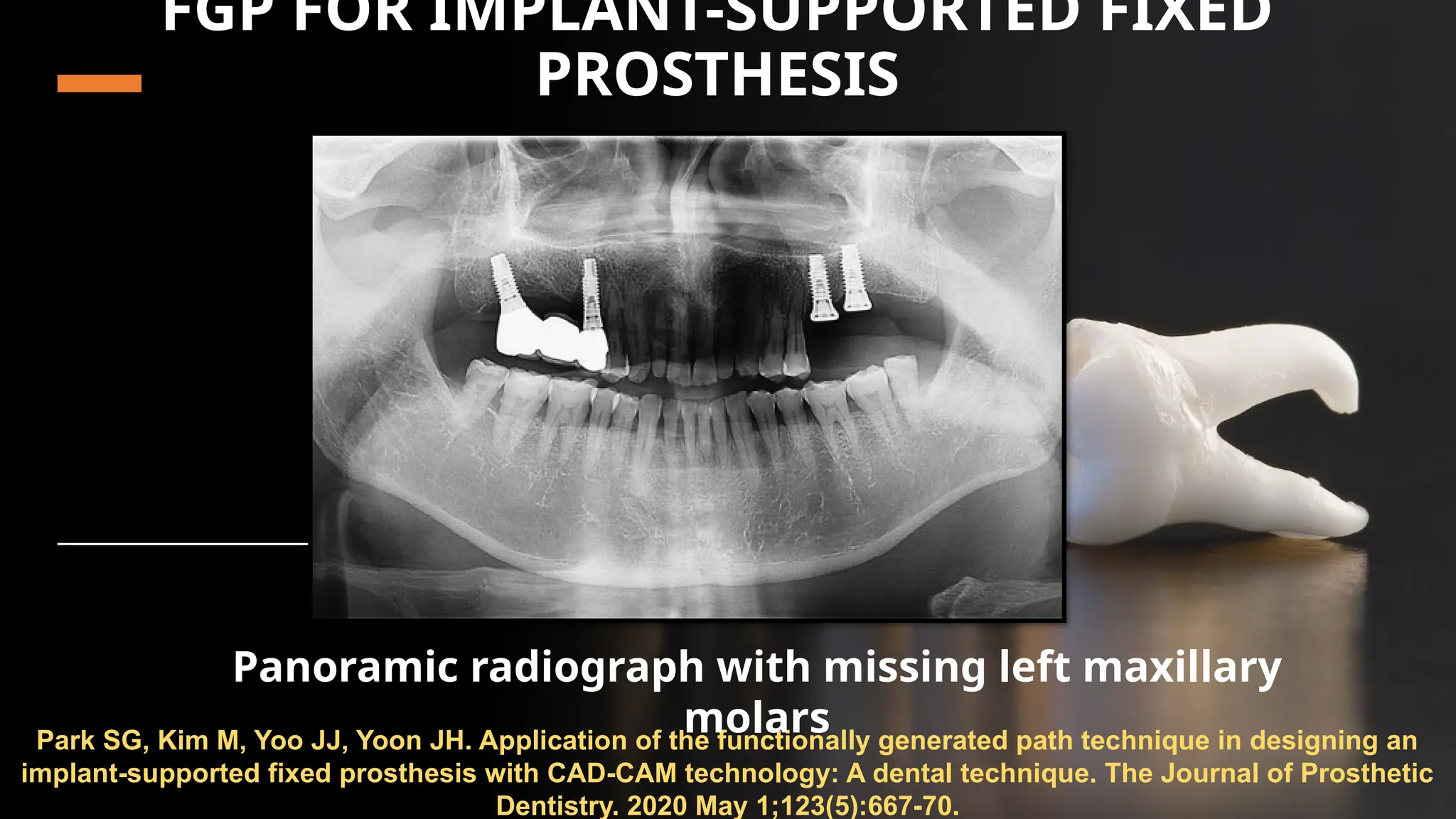
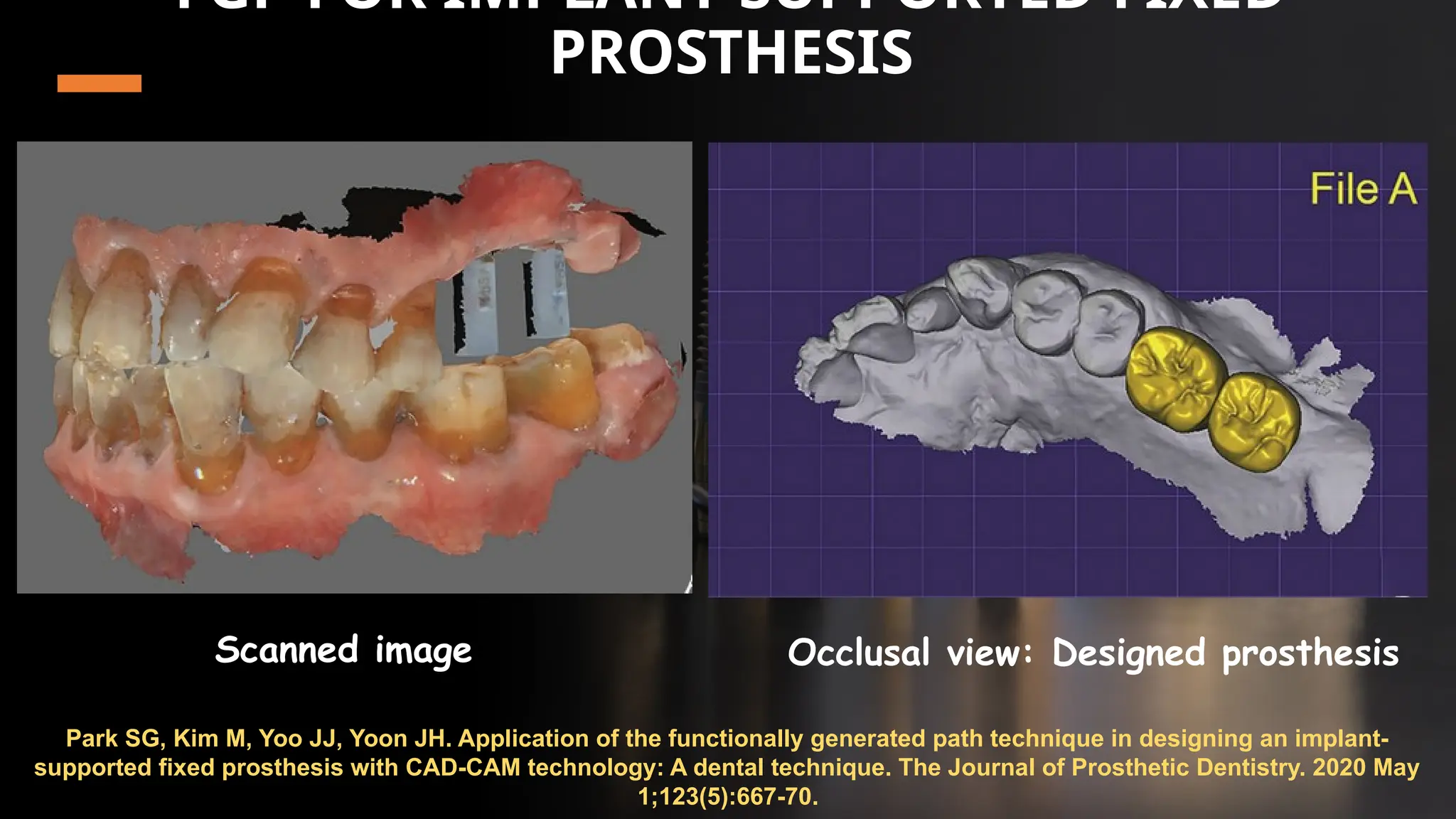
FGP FOR IMPLANT-SUPPORTED FIXED
PROSTHESIS
Park SG, Kim M, Yoo JJ, Yoon JH. Application of the functionally generated path technique in designing an
implant-supported fixed prosthesis with CAD-CAM technology: A dental technique. The Journal of Prosthetic
Dentistry. 2020 May 1;123(5):667-70.
Panoramic radiograph with missing left maxillary
molars
57
FGP FOR IMPLANT-SUPPORTED FIXED
PROSTHESIS
Park SG, Kim M, Yoo JJ, Yoon JH. Application of the functionally generated path technique in designing an implant-
supported fixed prosthesis with CAD-CAM technology: A dental technique. The Journal of Prosthetic Dentistry. 2020 May
1;123(5):667-70.
Scanned image Occlusal view: Designed prosthesis
58
FGP FOR IMPLANT-SUPPORTED FIXED
PROSTHESIS
Park SG, Kim M, Yoo JJ, Yoon JH. Application of the functionally generated path technique in designing an implant-
supported fixed prosthesis with CAD-CAM technology: A dental technique. The Journal of Prosthetic Dentistry. 2020 May
1;123(5):667-70.
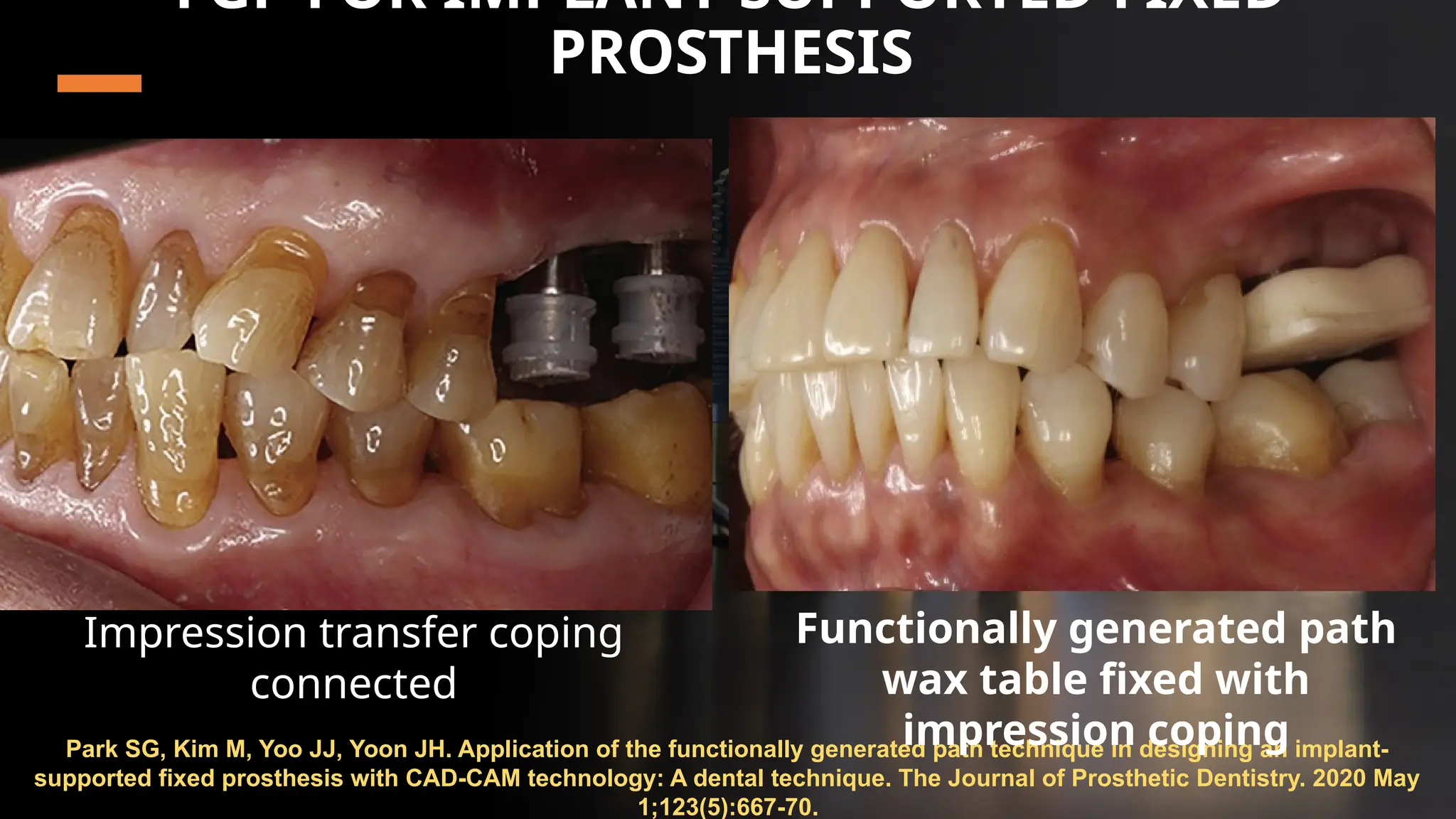
Impression transfer coping
connected
Functionally generated path
wax table fixed with
impression coping
59
FGP FOR IMPLANT-SUPPORTED FIXED
PROSTHESIS
Park SG, Kim M, Yoo JJ, Yoon JH. Application of the functionally generated path technique in designing an implant-
supported fixed prosthesis with CAD-CAM technology: A dental technique. The Journal of Prosthetic Dentistry. 2020 May
1;123(5):667-70.
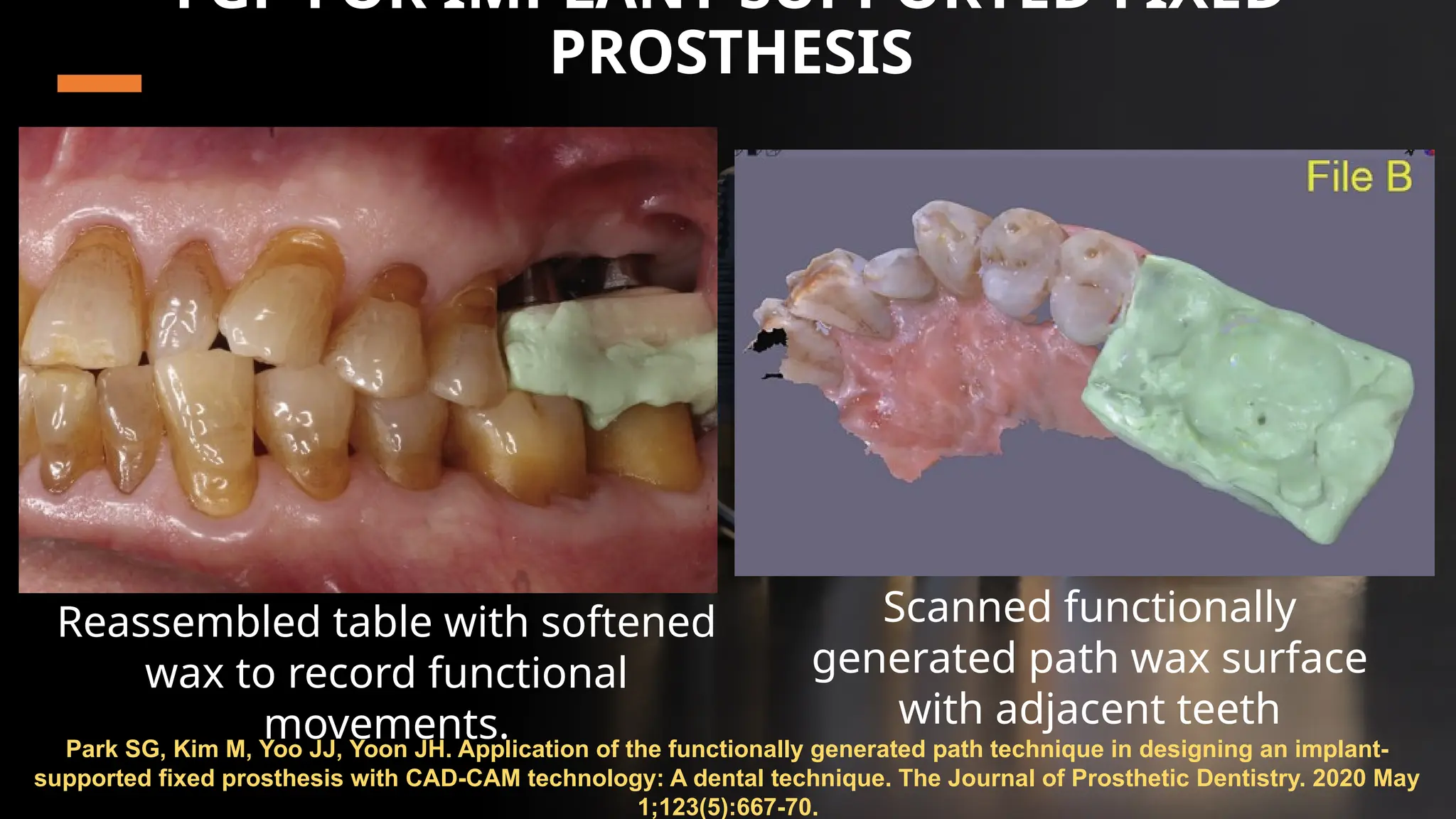
Reassembled table with softened
wax to record functional
movements.
Scanned functionally
generated path wax surface
with adjacent teeth
60
Park SG, Kim M, Yoo JJ, Yoon JH. Application of the functionally generated path technique in designing an implant-
supported fixed prosthesis with CAD-CAM technology: A dental technique. The Journal of Prosthetic Dentistry. 2020 May
1;123(5):667-70.
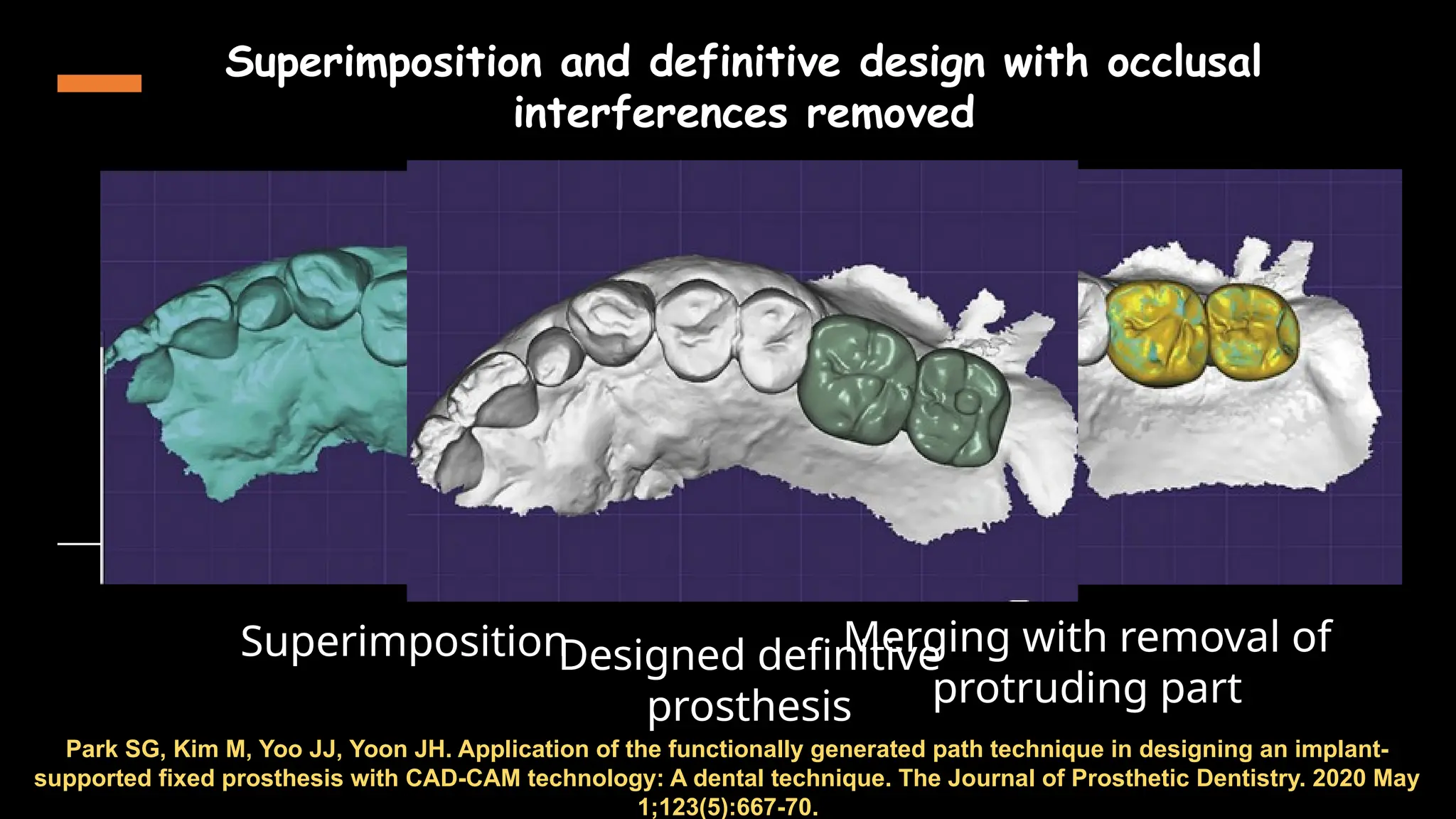
Superimposition
Superimposition and definitive design with occlusal
interferences removed
Merging with removal of
protruding part
Designed definitive
prosthesis
61
Park SG, Kim M, Yoo JJ, Yoon JH. Application of the functionally generated path technique in designing an implant-
supported fixed prosthesis with CAD-CAM technology: A dental technique. The Journal of Prosthetic Dentistry. 2020 May
1;123(5):667-70.
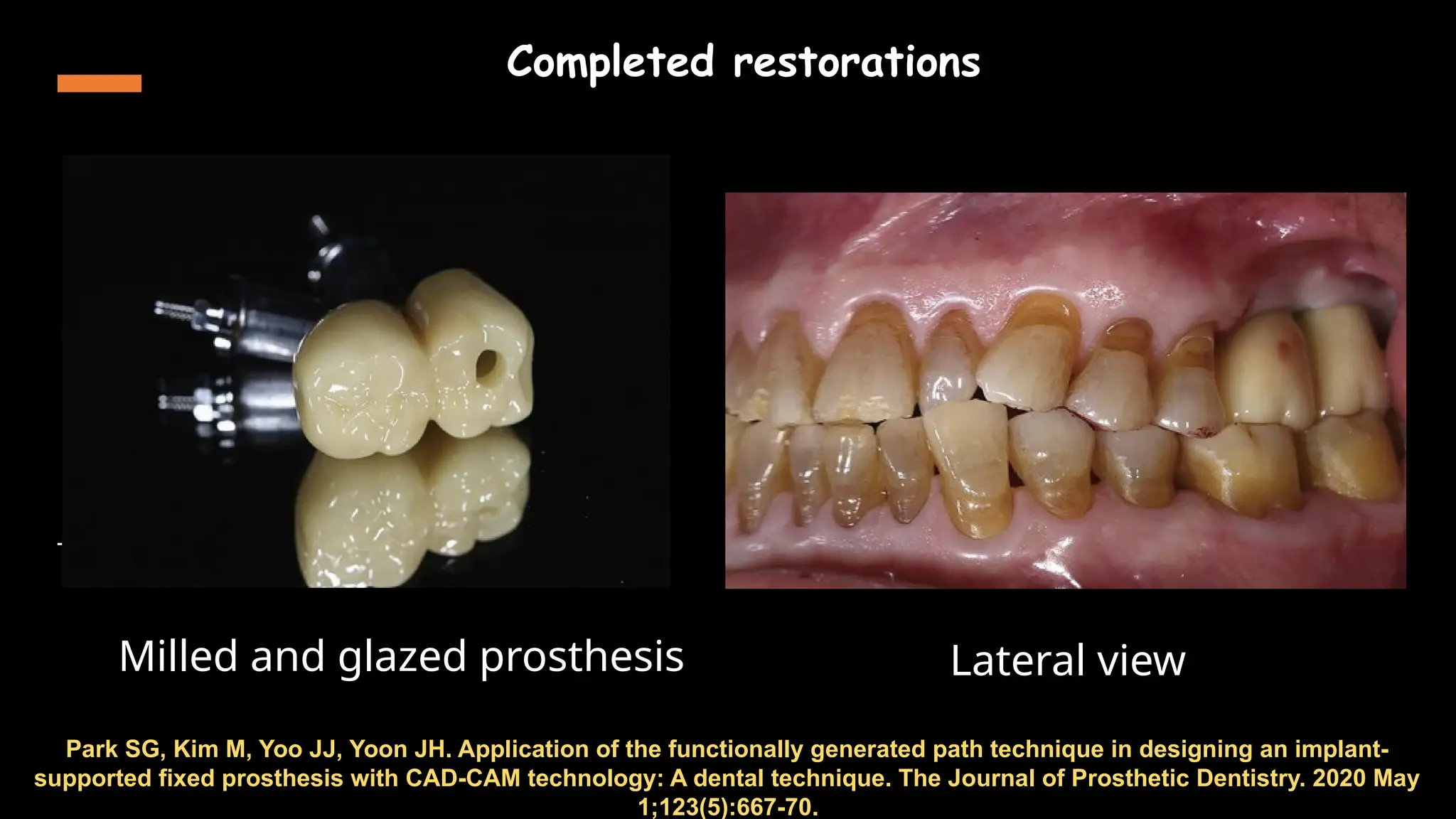
Milled and glazed prosthesis
Completed restorations
Lateral view
CONCLUSION
When simplified instrumentation is used, excessive adjustment is often
necessary at time of delivery. Fully adjustable articulators can be used,
but these are time consuming and errors can be incorporated if not
used regularly.
FGP is a simple concept capable of producing very accurate results, but
demands care and meticulous attention to detail. This technique reduces
adjustment time during delivery of the final restoration and has the
advantages of being simple, and accurate.
63
1. Morgano SM, VanBlarcom CW, Ferro KJ, Bartlett DW. The history of the glossary of
prosthodontic terms. Journal of Prosthetic Dentistry. 2018 Feb 21.
2. Navyadeepthi M, Srikanth L, Purnapriya B, Mounica Y, Soni S, Agrawal P. An Insight In
to Functionally Generated Pathway: A Review Article. International Journal Of Drug
Research And Dental Science. 2021 Dec 20;3(4):1-7.
3. Dawson PE. Evaluation, diagnosis, and treatment planning of occlusal problems. St
Louis: CV Mosby Co. 1989:56-71.
4. Schillingburg HT Jr., Hobo S, The functionally generated path. In Schillingburg HT Jr.,
Hobo S, Whitsett LD et al (eds): Fundamentals of Fixed Prosthodontics (ed 3). Carol
Stream, IL, Quintessence, 1997, pp. 355-364.
5. Carr AB, Brown DT. McCracken's removable partial prosthodontics-e-book. Elsevier
Health Sciences; 2010 Jun 22.
REFERENCES
64
6. Patil PG, Nimbalkar-Patil SP, Kulkarni RS. Functionally generated pathways to develop
occlusal scheme for removable partial denture. Journal of Interdisciplinary Dentistry. 2015 Sep
1;5(3):154.
7. Sinnukar S, Management of fractured mandibular single complete denture opposing
maxillary natural dentition by the implementation of functionally generated path technique:
a case report. International journal of dental and health sciences. 2015 Sep;2(2):158.
8. Kim SH, Lee J, Choi YS. Fixed prosthodontic rehabilitation of maxillary posterior teeth
using functionally generated path technique and intraoral digital scan: Case report. The
Journal of Korean Academy of Prosthodontics. 2020;58(3):228-38.
9. Tyagi M, kusum C. Full mouth rehabilitation of the patient with severely mutilated
dentition: a case report. Int J Community Med Public Health. 2022 Jul;9(7):3010-3013 .
REFERENCES
65
THANK YOU

FGP.pptx functional generated path semianr

  • 1.
  • 2.
  • 3.
    contents ✔Introduction ✔History ✔Uses ✔Technique for BilateralRecording ✔FGP for Single tooth restoration ✔FGP for Quadrant dentistry ✔FGP for Implant supported prosthesis ✔Conclusion ✔References 3
  • 4.
    4 INTRODUCTION Registration of thepaths of movement of the occlusal surfaces of teeth or occlusal rims of one dental arch in plastic, wax, or other medium attached to the teeth or occlusal rims of the opposing arch. GPT-10 Morgano SM, VanBlarcom CW, Ferro KJ, Bartlett DW. The history of the glossary of prosthodontic terms. Journal of Prosthetic Dentistry. Oct 2023.
  • 5.
    5 HISTORY MC COLLUMN AND STUART 1955 NavyadeepthiM, Srikanth L, Purnapriya B, Mounica Y, Soni S, Agrawal P. An Insight In to Functionally Generated Pathway: A Review Article. International Journal Of Drug Research And Dental Science. 2021 Dec 20;3(4):1-7. Gnathological concept Incisal guidance is an independent entity and is independent of condylar guidance Condylar path or posterior guidance is a fixed entity
  • 6.
    6 VON SPEE 1890 Vertical overlap''overbite'' of the cuspids 1915: Masticating functions of the teeth, and he was the first to describe the scheme of canine-protected occlusion. Navyadeepthi M, Srikanth L, Purnapriya B, Mounica Y, Soni S, Agrawal P. An Insight In to Functionally Generated Pathway: A Review Article. International Journal Of Drug Research And Dental Science. 2021 Dec 20;3(4):1-7. HISTORY
  • 7.
    HISTORY MEYER 1959 ‘’FUNCTIONAL OCCLUSAL PATH’’ Pankey andMann: “Functionally generated path” record in the fabrication of maxillary restorations Navyadeepthi M, Srikanth L, Purnapriya B, Mounica Y, Soni S, Agrawal P. An Insight In to Functionally Generated Pathway: A Review Article. International Journal Of Drug Research And Dental Science. 2021 Dec 20;3(4):1-7. HISTORY 7
  • 8.
    8 FACTS Dawson PE. Evaluation,diagnosis, and treatment planning of occlusal problems. St Louis: CV Mosby Co. 1989:56-71. 1. Border pathways of the lower posterior teeth are dictated by two different determinants: a. The anatomic limits of movement of the condyle-disk assemblies (posterior determinant) b. The anterior guidance ( anterior determinant). 2. Functionally generated path procedures, properly used on upper posterior teeth, record directly all possible border pathways of the lower posterior teeth.
  • 9.
    Dawson and Shillingburget al Presence of optimal occlusion Correct anterior guidance Absence/elimination of posterior interferences Adequate opposing occlusal surfaces No significant rotations, no carious lesions, no deficient restorations. 9 Schillingburg HT Jr., Hobo S, The functionally generated path. In Schillingburg HT Jr., Hobo S, Whitsett LD et al (eds): Fundamentals of Fixed Prosthodontics (ed 3). Carol Stream, IL, Quintessence, 1997, pp. 355-364
  • 10.
    USES: A. Oral rehabilitationcases B. Single-unit indirect restorations C. Tooth-supported fixed dental prosthesis D. Implant-supported FDPs E. CAD/CAM restorations 10 Navyadeepthi M, Srikanth L, Purnapriya B, Mounica Y, Soni S, Agrawal P. An Insight In to Functionally Generated Pathway: A Review Article. International Journal Of Drug Research And Dental Science. 2021 Dec 20;3(4):1-7.
  • 11.
    11 TECHNIQUE: BILATERALLY RECORDING THEFGP  Anterior guidance has been harmonized Dawson PE. Evaluation, diagnosis, and treatment planning of occlusal problems. Louis: CV Mosby Co. 1989
  • 12.
    Massive X presentation to DesignBall team Massive X 12 b C c Model sets—extra-hard platewax Dawson PE. Evaluation, diagnosis, and treatment planning of occlusal problems. St Louis: CV Mosby Co. 1989:56-71. Brittle: base will not bend without breaking DELA R WAX
  • 13.
    13 Chilled base isinserted into the mouth; stable. No tooth contact on the base; checked by articulating paper. Contacts in all excursions as well as centric relation should be checked. No interferences that restrict anterior guidance from functioning in normal manner. Dawson PE. Evaluation, diagnosis, and treatment planning of occlusal problems. St Louis: CV Mosby Co. 1989:56-71.
  • 14.
    Cross-arch stabilization ofthe base 14 • Hypermobility of teeth--functional movement- incorrect. Dawson PE. Evaluation, diagnosis, and treatment planning of occlusal problems. St Louis: CV Mosby Co. 1989:56-71. Cast bases  Scrap metal  Beads and rolled edges
  • 15.
    Massive X presentation to DesignBall team Massive X 15 b C c Dawson PE. Evaluation,diagnosis, and treatment planning of occlusal problems. St Louis: CV Mosby Co. 1989:56-71. RECORDING THE BORDER MOVEMENTS: TRIED: FIT AND STABILITY FUNCTIONAL WAX ADDED
  • 16.
    Functional pathways.. Accurately and maintainsaccuracy. Inlay wax or sticky wax - can harden during pathways generation. IDEAL: Bosworth’s Synthetic Tacky Wax - working qualities - Ideal plasticity. Dawson PE. Evaluation, diagnosis, and treatment planning of occlusal problems. St Louis: CV Mosby Co. 1989:56-71. Bilaterally recording the FGP
  • 17.
    17 Base with wax placedin the mouth Completely seated Patient’s saliva: tip of finger Prevent it from sticking to the lower teeth Dawson PE. Evaluation, diagnosis, and treatment planning of occlusal problems. St Louis: CV Mosby Co. 1989:56-71.
  • 18.
    18 Centric relation : anterior teeth contact Slide forward: end toend Close back to centric relation Lateral excursio ns EXACT OUTER PATHWAYS CAPTURED THREE DIMENSIONALLY Dawson PE. Evaluation, diagnosis, and treatment planning of occlusal problems. St Louis: CV Mosby Co. Bilaterally recording the FGP
  • 19.
    Massive X presentation to DesignBall team Massive X 19 b C c Bilaterally recording theFGP Jiggled stone into the indentations Movements : chilled with ice water Dawson PE. Evaluation, diagnosis, and treatment planning of occlusal problems. St Louis: CV Mosby Co. 1989:56-71. Definit e vertica l stop
  • 20.
    20 L A BO R AT O R Y P R O C E D U R E S  Upper master die model is mounted.  Articulated against lower model.  Anatomic model : double check on accuracy.  Centric relation closure : contact without interference against functional and anatomic model.  Interference : indicates an error. Dawson PE. Evaluation, diagnosis, and treatment planning of occlusal problems. St Louis: CV Mosby Co. Bilaterally recording the FGP
  • 21.
    Mounting the FGP… Opposinganatomic model is removed; FGP base is placed Discrepancy – soft-tissue interference FGP is removed – wax is trimmed Dawson PE. Evaluation, diagnosis, and treatment planning of occlusal problems. St Louis: CV Mosby Co. 1989:56-71. Bilaterally recording the FGP
  • 22.
    Massive X presentation to DesignBall team Massive X 22 b C c Built-up base inby cutting the bottom out of a plastic cup and invertin it over a mounting ring on the articulator Dawson PE. Evaluation, diagnosis, and treatment planning of occlusal problems. St Louis: CV Mosby Co. 1989:56-71. FGP base with stone attached is seated on the master die model
  • 23.
    Massive X presentation to DesignBall team Massive X 23 b C c Dawson PE. Evaluation,diagnosis, and treatment planning of occlusal problems. St Louis: CV Mosby Co. 1989:56-71. Bilaterally recording the FGP
  • 24.
    Accuracy Upper die modelis removed; wax is trimmed —occlusal edge Upper model is closed back—check for the space Die model doesn’t seat – knocking off lower ring and redoing the mounting. Bilaterally recording the FGP Dawson PE. Evaluation, diagnosis, and treatment planning of occlusal problems. St Louis: CV Mosby Co. 1989:56-71.
  • 25.
    THREE OPTIONS: 25 Dawson PE.Evaluation, diagnosis, and treatment planning of occlusal problems. St Louis: CV Mosby Co. 1989:56-71. 2. Wax against the anatomic model, and then refine the occlusal inclines and check for interferences against the functional model. 3. Complete the castings against the anatomic model, and then adjust the metal or porcelain occlusal surfaces against the functional model. USING THE FUNCTIONAL MODEL Bilateral recording
  • 26.
    MAKING ADJUSTMENTS AGAINSTTHE FUNCTIONAL MODEL: Checking the finished estorations against the functional core Dawson PE. Evaluation, diagnosis, and treatment planning of occlusal problems. St Louis: CV Mosby Co. Bilateral recording
  • 27.
    MAKING ADJUSTMENTS AGAINSTTHE FUNCTIONAL MODEL: Group function Dawson PE. Evaluation, diagnosis, and treatment planning of occlusal problems. St Louis: CV Mosby Co. 1989:56-71. Posterior disclusion : patterns should be relieved completely. Bilateral recording
  • 28.
    Balancing inclines.. Balancing sidecontact – Undesirable Wax pattern adjustment : white shoe polish Articulating papers Talcum powder causes porosity. Tyagi M, kusum C. Full mouth rehabilitation of the patient with severely mutilated dentition: a case report. Int J Community Med Public Health. 2022 Jul;9(7):3010-3013 Bilateral recording
  • 29.
    Frontal view Pre-opOPG Tyagi M, kusum C. Full mouth rehabilitation of the patient with severely mutilated dentition: a case report. Int J Community Med Public Health. 2022 Jul;9(7):3010-3013
  • 30.
    Facebow transfer Customised incisal guide table Tyagi M,kusum C. Full mouth rehabilitation of the patient with severely mutilated dentition: a case report. Int J Community Med Public Health. 2022 Jul;9(7):3010-3013
  • 31.
    Broadricks occlusal plane analysis Functionally generated path technique TyagiM, kusum C. Full mouth rehabilitation of the patient with severely mutilated dentition: a case report. Int J Community Med Public Health. 2022 Jul;9(7):3010-3013
  • 32.
    Tyagi M, kusumC. Full mouth rehabilitation of the patient with severely mutilated dentition: a case report. Int J Community Med Public Health. 2022 Jul;9(7):3010-3013 Centric occlusion Protrusive right Protrusive left
  • 33.
    33 FGP Checkbite Technique Check out castingsthat are already completed, after the castings have been tried in, checked for accuracy of fit, and then removed. Fast-setting stone- stone matrix is made. Castings are removed– stone matrix trimmed back to tip of buccal cusp and placed on the castings. Fit on model like in the mouth. Dawson PE. Evaluation, diagnosis, and treatment planning of occlusal problems. St Louis: CV Mosby Co. 1989:56-71.
  • 34.
    FGP For QuadrantDentistry • UNILATERALLY • STABILITY • HYPERMOBILITY • Cast base; stabilization • Clinical crowns- long enough– extra hard wax • No movement of base Dawson PE. Evaluation, diagnosis, and treatment planning of occlusal problems. St Louis: CV Mosby Co. 1989:56-71. 34
  • 35.
    FGP for quadrantdentistry Dawson PE. Evaluation, diagnosis, and treatment planning of occlusal problems. St Louis: CV Mosby Co. 1989:56-71. Path generation Jiggle into FGP depressions Wooden tongue blade Excess is trimmed Base: fitted on upper dies Functional stone is joined to stone platform on articulator SPECIAL CARE : Opposite side is perfectly equilibrated so that there are no deviating interferences to influence the functional paths. 35
  • 36.
    36 FGP For ASingle Tooth • Condylar guidance : posterior determinant • Offending incline interference : determinant of the functional path and the new restoration will be restored into group function malocclusion. • ‘TOOTH-GUIDED OCCLUSIONS’: rubbed two hand- held models together with soft wax on the die. Dawson PE. Evaluation, diagnosis, and treatment planning of occlusal problems. St Louis: CV Mosby Co. 1989:56-71.
  • 37.
    37 Dawson PE. Evaluation,diagnosis, and treatment planning of occlusal problems. St Louis: CV Mosby Co. 1989:56-71.
  • 38.
    38 Clinical procedure forsingle tooth FGP • Occlusal reduction Dawson PE. Evaluation, diagnosis, and treatment planning of occlusal problems. St Louis: CV Mosby Co. 1989:56-71. Tooth stabilized with softened stick compound Softened functional wax is stuck over prepared occlusal table
  • 39.
    3 9 • Centricrelation and move through all possible excursions. Clinical procedure for single tooth FGP Dawson PE. Evaluation, diagnosis, and treatment planning of occlusal problems. St Louis: CV Mosby Co. 1989:56-71. • Fast-setting stone is jiggled into the wax and at least one tooth on each side of the preparation is covered. • Removed and set aside • Preparation is completed • Impression is made
  • 40.
    Dawson PE. Evaluation,diagnosis, and treatment planning of occlusal problems. St Louis: CV Mosby Co. 1989:56-71. Laboratory procedure Impression is poured Functional core: Positioned against the die model Instrument: repeatedly reposition the functional model against die model with accuracy is acceptable
  • 41.
    The twin-stage occluder The ventriculator DawsonPE. Evaluation, diagnosis, and treatment planning of occlusal problems. St Louis: CV Mosby Co. 1989:56-71. Laboratory Procedures • Up or down movement • Sturdy metal stop • Spring loaded— springs open— access to die. • Functional core and anatomic model interchangeably
  • 42.
    FGP for singletooth 01 Group function 02 Inclines: Discluded • Lingual inclines of upper buccal cusps— functional model • Reduced: no contact • Centric relation: not be lost Dawson PE. Evaluation, diagnosis, and treatment planning of occlusal problems. St Louis: CV Mosby Co. 1989:56-71.
  • 43.
    43 White liquid shoepolish FGP for single tooth Dawson PE. Evaluation, diagnosis, and treatment planning of occlusal problems. St Louis: CV Mosby Co. 1989:56-71. Check pattern for interferences
  • 44.
    Massive X presentation to DesignBall team Massive X 44 b C c FGP for singletooth Dawson PE. Evaluation, diagnosis, and treatment planning of occlusal problems. St Louis: CV Mosby Co. 1989:56-71. Carved wax pattern Preserve centric relation stops Working excursion function Black marks: guide– balancing inclines
  • 45.
    S H O R T C O M I N G S Hypermobilit y 45  Move duringpath generation—flatter in wax than on adjacent teeth. Dawson PE. Evaluation, diagnosis, and treatment planning of occlusal problems. St Louis: CV Mosby Co. 1989:56-71.  Dragging of functional wax—unstablized tooth back and forth with lateral jaw movements. FGP for single tooth
  • 46.
    46 Kim SH, LeeJ, Choi YS. Fixed prosthodontic rehabilitation of maxillary posterior teeth using functionally generated path technique and intraoral digital scan: Case report. The Journal of Korean Academy of Prosthodontics. 2020;58(3):228-38.
  • 47.
    47 Frontal view Maxillaryarch Mandibular arch Kim SH, Lee J, Choi YS. Fixed prosthodontic rehabilitation of maxillary posterior teeth using functionally generated path technique and intraoral digital scan: Case report. The Journal of Korean Academy of Prosthodontics. 2020;58(3):228-38.
  • 48.
    48 Diagnostic casts Facebow transfer Diagnostic mounting KimSH, Lee J, Choi YS. Fixed prosthodontic rehabilitation of maxillary posterior teeth using functionally generated path technique and intraoral digital scan: Case report. The Journal of Korean Academy of Prosthodontics. 2020;58(3):228-38.
  • 49.
    49 Tooth preparation Provisional crown fabrication Pattern resin coping KimSH, Lee J, Choi YS. Fixed prosthodontic rehabilitation of maxillary posterior teeth using functionally generated path technique and intraoral digital scan: Case report. The Journal of Korean Academy of Prosthodontics. 2020;58(3):228-38.
  • 50.
    50 Gingival retraction Bite impressionResin coping adaptation Mandibular movements recording KimSH, Lee J, Choi YS. Fixed prosthodontic rehabilitation of maxillary posterior teeth using functionally generated path technique and intraoral digital scan: Case report. The Journal of Korean Academy of Prosthodontics. 2020;58(3):228-38.
  • 51.
  • 52.
    52 Intra oral scanMaster cast scan Superimposition Kim SH, Lee J, Choi YS. Fixed prosthodontic rehabilitation of maxillary posterior teeth using functionally generated path technique and intraoral digital scan: Case report. The Journal of Korean Academy of Prosthodontics. 2020;58(3):228-38.
  • 53.
    53 Initial design of prosthesis Finaldesign Kim SH, Lee J, Choi YS. Fixed prosthodontic rehabilitation of maxillary posterior teeth using functionally generated path technique and intraoral digital scan: Case report. The Journal of Korean Academy of Prosthodontics. 2020;58(3):228-38.
  • 54.
    54 Wax milling Waxpattern adaptation Casting full veneer crown Kim SH, Lee J, Choi YS. Fixed prosthodontic rehabilitation of maxillary posterior teeth using functionally generated path technique and intraoral digital scan: Case report. The Journal of Korean Academy of Prosthodontics. 2020;58(3):228-38.
  • 55.
    55 FGP For LOWERTEETH  Stone models  Sighting down the occlusal surfaces, upper teeth can be aligned opposite the lower preparation.  Centric stops  Occlusion– restoration is placed.  Upper inclines—perfected  Equilibration  Lower tooth not in contact– compound/temporary restoration  CUSP-FOSSAE ANALYSIS. Dawson PE. Evaluation, diagnosis, and treatment planning of occlusal problems. St Louis: CV Mosby Co. 1989:56-71.
  • 56.
    56 FGP FOR IMPLANT-SUPPORTEDFIXED PROSTHESIS Park SG, Kim M, Yoo JJ, Yoon JH. Application of the functionally generated path technique in designing an implant-supported fixed prosthesis with CAD-CAM technology: A dental technique. The Journal of Prosthetic Dentistry. 2020 May 1;123(5):667-70. Panoramic radiograph with missing left maxillary molars
  • 57.
    57 FGP FOR IMPLANT-SUPPORTEDFIXED PROSTHESIS Park SG, Kim M, Yoo JJ, Yoon JH. Application of the functionally generated path technique in designing an implant- supported fixed prosthesis with CAD-CAM technology: A dental technique. The Journal of Prosthetic Dentistry. 2020 May 1;123(5):667-70. Scanned image Occlusal view: Designed prosthesis
  • 58.
    58 FGP FOR IMPLANT-SUPPORTEDFIXED PROSTHESIS Park SG, Kim M, Yoo JJ, Yoon JH. Application of the functionally generated path technique in designing an implant- supported fixed prosthesis with CAD-CAM technology: A dental technique. The Journal of Prosthetic Dentistry. 2020 May 1;123(5):667-70. Impression transfer coping connected Functionally generated path wax table fixed with impression coping
  • 59.
    59 FGP FOR IMPLANT-SUPPORTEDFIXED PROSTHESIS Park SG, Kim M, Yoo JJ, Yoon JH. Application of the functionally generated path technique in designing an implant- supported fixed prosthesis with CAD-CAM technology: A dental technique. The Journal of Prosthetic Dentistry. 2020 May 1;123(5):667-70. Reassembled table with softened wax to record functional movements. Scanned functionally generated path wax surface with adjacent teeth
  • 60.
    60 Park SG, KimM, Yoo JJ, Yoon JH. Application of the functionally generated path technique in designing an implant- supported fixed prosthesis with CAD-CAM technology: A dental technique. The Journal of Prosthetic Dentistry. 2020 May 1;123(5):667-70. Superimposition Superimposition and definitive design with occlusal interferences removed Merging with removal of protruding part Designed definitive prosthesis
  • 61.
    61 Park SG, KimM, Yoo JJ, Yoon JH. Application of the functionally generated path technique in designing an implant- supported fixed prosthesis with CAD-CAM technology: A dental technique. The Journal of Prosthetic Dentistry. 2020 May 1;123(5):667-70. Milled and glazed prosthesis Completed restorations Lateral view
  • 62.
    CONCLUSION When simplified instrumentationis used, excessive adjustment is often necessary at time of delivery. Fully adjustable articulators can be used, but these are time consuming and errors can be incorporated if not used regularly. FGP is a simple concept capable of producing very accurate results, but demands care and meticulous attention to detail. This technique reduces adjustment time during delivery of the final restoration and has the advantages of being simple, and accurate.
  • 63.
    63 1. Morgano SM,VanBlarcom CW, Ferro KJ, Bartlett DW. The history of the glossary of prosthodontic terms. Journal of Prosthetic Dentistry. 2018 Feb 21. 2. Navyadeepthi M, Srikanth L, Purnapriya B, Mounica Y, Soni S, Agrawal P. An Insight In to Functionally Generated Pathway: A Review Article. International Journal Of Drug Research And Dental Science. 2021 Dec 20;3(4):1-7. 3. Dawson PE. Evaluation, diagnosis, and treatment planning of occlusal problems. St Louis: CV Mosby Co. 1989:56-71. 4. Schillingburg HT Jr., Hobo S, The functionally generated path. In Schillingburg HT Jr., Hobo S, Whitsett LD et al (eds): Fundamentals of Fixed Prosthodontics (ed 3). Carol Stream, IL, Quintessence, 1997, pp. 355-364. 5. Carr AB, Brown DT. McCracken's removable partial prosthodontics-e-book. Elsevier Health Sciences; 2010 Jun 22. REFERENCES
  • 64.
    64 6. Patil PG,Nimbalkar-Patil SP, Kulkarni RS. Functionally generated pathways to develop occlusal scheme for removable partial denture. Journal of Interdisciplinary Dentistry. 2015 Sep 1;5(3):154. 7. Sinnukar S, Management of fractured mandibular single complete denture opposing maxillary natural dentition by the implementation of functionally generated path technique: a case report. International journal of dental and health sciences. 2015 Sep;2(2):158. 8. Kim SH, Lee J, Choi YS. Fixed prosthodontic rehabilitation of maxillary posterior teeth using functionally generated path technique and intraoral digital scan: Case report. The Journal of Korean Academy of Prosthodontics. 2020;58(3):228-38. 9. Tyagi M, kusum C. Full mouth rehabilitation of the patient with severely mutilated dentition: a case report. Int J Community Med Public Health. 2022 Jul;9(7):3010-3013 . REFERENCES
  • 65.

Editor's Notes

  • #5 GOING BACK TO THE HISTORY.. They said.. Further they stated that
  • #6 described he gave..
  • #7 discussed the “functional occlusal path” as the harmonious relationship between the occlusal and cuspal paths, the condylar paths, and the neuromuscular system. Pankey and Mann adapted the principles discussed by Meyer to describe a “functionally generated path” record in the fabrication of maxillary restorations
  • #8 Accodring to Dawson, There are certain facts which needs to be understood,so as to achieve precise accurate occlusal contours. 2…. as they are influenced by both the anterior and posterior determinant
  • #9 noted the following prerequisites for use of the FGP capable of generating a functional path
  • #11 Starting with the technique for bilaterally recording the fgp.. After the anterior guidance has been harmonized according to the patient's functional, esthetic, and periodontal support requirements and after the lower posterior occlusal contours have been harmonized to the anterior guidance… Upper posterior teeth are prepared.. An impression is made of the upper prepared arch and cast is poured..
  • #12 When the model has set, extra-hard base plate wax is used to make a base for the functional wax. The wax used for this step should be brittle hard ·so that the base will not bend without breaking. Delar wax ( extra hard) is a good wax for this step. The wax is softened over a flame and folded into three layers and is adapted around each tooth on the cast. Then the wax is adapted down around each tooth to completely cover all prepared teeth down to the gingival margins. The wax wafer should not be adapted to the palate. It should go straight across. It should cover only the posterior teeth but should be extended right up to the unprepared cuspid
  • #13 1. The chilled base is inserted into the mouth and it should be perfectly stable and there should not be any soft-tissue impingement. 2. Then patient is asked to close his mouth. There should be no tooth contact on the base which can be checked by Articulating paper.. If contacts are there they can be reduced in the mouth with a discoid carver. 4. There must be no ..
  • #14 Cross-arch stabilization of the base. A common cause of error in FGP techniques is hypermobility of the teeth. If the teeth move during the functional movements, the inclines that are cut into the functional wax will be incorrect. Which can be overcome by Cross-arch stabilization.. A cast base is made if there are not enough teeth to adequately stabilize a wax base. It can be cast out of scrap metal. Beads and rolled edges are used to hold the functional wax in place.
  • #15 If a wax base is used.. after stability and clearance is checked.. softened functional wax is added only upto one-third of lower teeth for recording the FGP
  • #16 The functional pathways may be recorded in any material that records accurately and maintains that accuracy throughout all the laboratory procedures. There is an inherent problem with using any wax or material that can harden during the generation of the pathways. Bosworth's Synthetic Tacky Wax is an ideal functional wax because of its good working qualities and ideal plasticity at mouth temperatures.
  • #18 Using the technique used for recording centric relation, a closure is manipulated into the wax until the anterior teeth contact. The patient is asked to slide forward until the anterior teeth are end to end. We have to make sure that patient doesn’t open his mouth during the movements since this will make the base loose. After each opening the base should be checked to make sure it has not been dislodged. The patient should close back into centric relation and the mandible is guided into lateral excursions. With this technique, the exact outer pathways of post. Teeth are captured three dimensionally in the functional wax (Fig. 23-6). Afterwards..the patient should be allowed to slide around however he wishes. This is the step that records the movements between straight lateral and straight protrusive. If there are any interferences to any movement of the jaw, the functional wax will simply be moved out of the way to record the outer limits of all functional movements.
  • #19 Once all movements are verified..wax is chilled with ice water.. Afterthat, A creamy mix of fast-setting stone is jiggled into the indentations in the functional wax. The stone must be extended to cover at least one unprepared "key" tooth (usually the cuspid in ant. And if present atleast one distal to prepared teeth). which will serve as a definite vertical stop during lab procedures. Once it sets.. It is tried on the cast it should adapt precisely.. There should be no gap between the cast and functional core. It should be checked from distal aspect and from anterior vertical stop.. If distortion or crack is present then entire procedure should be repeated.
  • #20 In centric relation closure, the completed wax patterns should contact.. Any interference or lack of centric contact on either model indicates an error in either the FGP or the mounting of the anatomic model.
  • #21 The opposing anatomic model is removed from the articulator and the FGP base placed on the mounted master die model. It should fit perfectly without any discrepancy. If discrepancy is there, it is due to soft-tissue interference, in such case.. FGP is removed, and the wax is trimmed wherever it contacts the model. If the FGP base cannot be adapted to both models accurately, it is probable that one of the models is inaccurate.
  • #22 Stone is built up …until it almost touches the stone core. Functionally generated path base with the stone attached is seated on the master die model. The stone core is checked for fit against the key tooth.
  • #23 The stone core and the platform should be dampened and the two neatly joined together with another mix. And articulator is closed..
  • #24 The upper model is then closed back into the FGP base to see whether there is any space between the dies and the wax. If the die model does not seat perfectly into the FGP, it indicates that the functional path recordings are inaccurately related to the teeth. It can be corrected by…
  • #25 Wax the restorations directly against the functional model. Inclines that should not contact are relieved. Inclines that are to be in functional contact are not relieved.
  • #26 Adjustments are made by Checking the finished restorations against the functional core. The slight separation between the core and the key index tooth indicates that an interference which can be marked using a marking ribbon. It can then be adjusted by spot grinding.
  • #27 Group Function is attained by adjusting the lingual inclines of the upper buccal cusps to contact against the functional core. Balancing inclines should be relieved and Working inclines should remain in contact if the tooth is to be in function in working excursions. The length of the stroke contact should be shortened progressively from front to back when the pattern is relieved from the buccal edge toward the centric stop. For posterior disclusion, the pattern should be completely relieved so that only the centric stops contact the functional core.
  • #28 Since balancing-side contact is undesirable, balancing-side disclusion must be effected by reduction of balancing inclines so that they do not contact the functional stone at any point. Heavy articulating paper may be used to mark these inclines . Wax patterns can be adjusted against the functional stone by use of white shoe polish on the functional model. It will mark interferences on the wax quite well. Talcum powder should not be used to mark interferences, since it becomes incorporated into the wax and causes a porous surface to the casting.
  • #31 Pattern resin
  • #33 The FGP technique can be used as outlined to.. So for this.. They tried in and a stone matrix made using fast setting stone. The castings are then removed and returned to the die model. The stone matrix is trimmed back to the tip of the buccal cusps and placed on the castings. The matrix should fit the castings on the model as perfectly as it fit them in the mouth. Castings that have been checked in this manner can be adjusted against an FGP model with complete assurance of accuracy.
  • #34 functional paths can be recorded unilaterally if stability of the base is maintained and if hypermobility of the teeth is not an issue. In a unilateral quadrant,a cast base is fabricated in order to get enough stabilization. If the clinical crowns are long enough, it may be possible to use extra-hard wax as a base without fear of dislodgment, but we should make sure there is no movement of the base or of the teeth during generation of the path.
  • #35 After the path has been generated in the functional wax, fast-setting stone is jiggled some into the FGP depressions and then carry some more into the mouth on a wooden tongue blade. The blade is vibrated to join the two portions and then held steady until the stone sets. The base, stone, and tongue blade are removed. The tongue blade is then removed, the excess stone is trimmed with a sharp scalpel, and the base is fitted on the upper dies. The functional stone is joined to the stone platform on the articulator with a creamy mix of fastsetting stone. IMP: After preparation of one side, it is good to recheck the occlusion on the other side and to verify the correctness of the anterior guidance before proceeding with the FGP.
  • #36 FGP for a single tooth has minimal value. Instead of condylar guidance serving as the posterior determinant, the offending incline interference becomes the determinant... In such cases of "tooth-guided occlusions," FGP accomplishes nothing that could not be acheived if one simply rubbed two hand-held models together with soft wax on the die. If the occlusion has been perfected in the mouth into precise group function, working inclines on the models will be in harmony with condylar and anterior guidance.
  • #37 models permit the occlusal contours of adjacent teeth to be reproduced with maximum simplicity. If balancing inclines have been relieved on the adjacent teeth. they will be relieved on the pattern. If the working inclines are in function. they will be in function on the pattern. If the working inclines are discluded. the disclusion will be effected on the pattern. As long as the teeth on each side of the prepared tooth are in centric relation contact. there is no possibility of losing centric contact on the pattern. B. The restoration in place. C, Notice the difference in the steepness of the balancing incline on the pattern made from a functional core compared with the adjacent inclines that have been equilibrated for disclusion. Read from book.
  • #38 1.The occlusal reduction for the preparation is completed. 2. Before any proximal reduction is done, the tooth is stabilized with softened stick compound into a broader occlusal table to receive the functional wax. 3. The surface of the compound is roughened so that the functional wax will not slide off. 4. Using a flame, the wax is softened and stuck to the prepared occlusal table.
  • #39 5. The patient ‘s mandible is guided to be closed into centric relation and move through all possible excursions. Once movements are recorded, The wax is chilled with ice water. 6. A creamy mix of Fast Setting Stone is made and vibrated into the FGP indentations and to anterior and post unprepared tooth using the tongue blade. NOTE: FGP can be done on a terminal tooth if the base and the wax can be made stable. On a terminal tooth, the fast-setting stone should be extended over at least three teeth in front of the prepared tooth. 7. The hardened stone is removed and set aside. The compound and the wax are removed and discarded, and the preparation is completed. An impression of the prepared tooth is made, including all teeth that will be covered with the stone functional core.
  • #40 2. The functional core is positioned against the die model. 3. Any instrument that can repeatedly reposition the functional model against the die model with accuracy is acceptable for mounting the two models. They can be mounted in the joined position on a simple hinge articulator.
  • #41 Instruments that have been especially designed for relating the functional model to the die model include: Ventriculator: that permits only an up or down movement. There is a sturdy metal stop that permits the functional model to be struck forcefully against the die model. It is spring loaded so that with each closure it springs open to give access to the die or pattern. b. The twin-stage occlude that will articulate both a functional core and an anatomic model interchangeably against the same die model.
  • #42 If the restoration is to be in group function, the lingual inclines of the upper buccal cusps should be in continuous contact with the functional model. If the inclines are to be discluded, they must be reduced so that there is no contact, but centric relation contacts must not be lost. In all cases, the balancing inclines should be relieved from any contact with the functional core.
  • #43 White liquid shoe polish applied to the functional core for locating interferences on the wax pattern. Check the pattern for interferences by adjusting the occlusal surface until the two metal stops come into direct contact.
  • #44 We can paint the entire surface with white shoe polish and then close the articulator. The wax pattern is being carved to preserve centric relation stops and working excursion function. The white shoe polish is untouched wherever contact is desired. Black marks on adjacent balancing inclines serve as a guide to carving the balancing inclines on the pattern.
  • #45 Another d/a is,, If adjacent teeth have any hypermobility, they can move during generation of the path and the path will be flatter in the wax than it is on the adjacent teeth. The drag of the functional wax can move an unstablized tooth back and forth with the lateral jaw movements. If FGP is used, the tooth being restored must be stabilized during generation of the path.
  • #46 Here is a case report of patient with endodontically treated 28.
  • #50 bite impression was made with silicone impression material and plastic bite tray. Recording mandibular movement after placing wax on resin coping
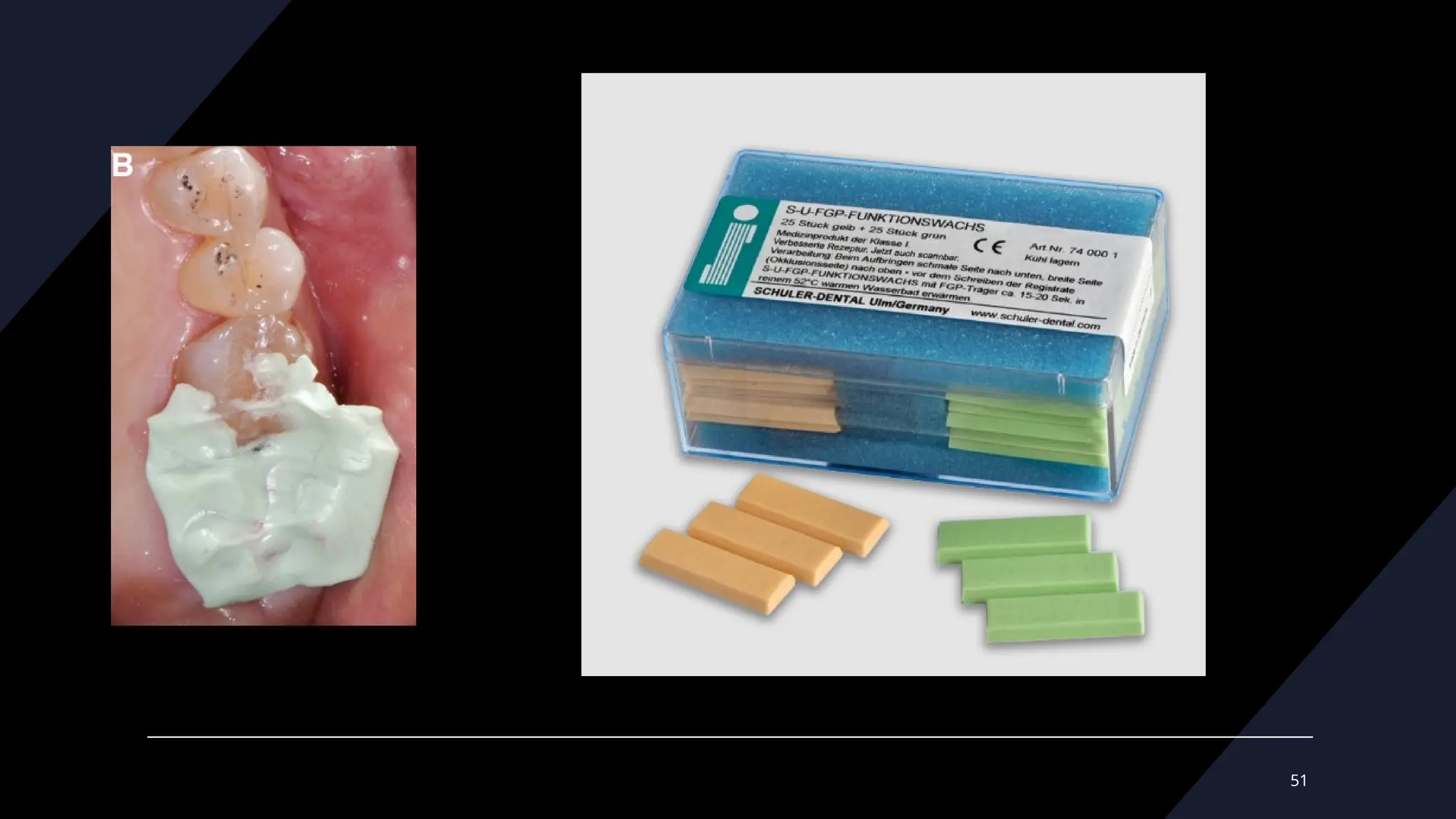
  • #51 Germany..
  • #55 Functional path procedures are not generally used on lower teeth. or FGP to work on the lower teeth, the upper inclines should be perfected first. This can be done by equilibration before the lower tooth is prepared. If the lower tooth is not in contact, it can be built up with compound or a well-made temporary restoration and the occlusion is refined. This is referred to as cusp-Fossae analysis. Cusp-fossae analysis can be accomplished on the stone models. By sighting down the occlusal surfaces, we can align the inclines on the upper teeth opposite the lower preparation with reliable accuracy and adjust them on the model before fabrication of the lower pattern. The pattern can be given good centric stops and then the occlusion can be adjusted in the mouth when the restoration is placed.
  • #56 Here is a case report of a patient with placed implants in maxillary left back tooth region..for which cement retained splinted prosthesis was planned.
  • #57 healing abutments were removed and scan bodies were tightened and scanning was performed using an intraoral scanner. 3. Design the implant-supported fixed dental prosthesis in centric occlusion using dental design software. Save the completed design file as “File A.”
  • #58 scan bodies were removed and replaced with impression copings, snap-on plastic impression copings were connected that acted as the base of the FGP wax table. Table was made of polymethyl methacrylate (PMMA) resin (Unifast Trad; GC Corp) with the impression coping, drill a hole at the appropriate location on the table and use additional PMMA resin for fixation. Once the PMMA resin has polymerized, the FGP table and the coping are bonded together 5. At this stage, instruct the patient to occlude in centric and eccentric positions and evaluate whether any space is present between the FGP table and the opposing teeth. Remove any contact by grinding the FGP table to make space for the wax (Fig. 4)
  • #59 Ask the patient to occlude in centric and eccentric positions. To ensure an accurate recording, remove the wax table complex, resoften the wax, and repeat the step. 8. After the patient’s mandibular movements have been recorded, scan the maxillary left quadrant with the FGP wax surface and save the scanned file as “File B”
  • #60 When File A and File B are optimally overlapped using the “Superimposition” function of the design software (exocad DentalCAD; exocad GmbH), any part of the occlusal surface of the prosthesis designed in the centric relation position protruding over the FGP wax surface (Fig. 7A) indicates an occlusal interference in lateral or protrusive excursion. Specify the area of the protruding part and use the “Merge” function of the design program to delete the protruding part (Fig. 7B). 11. After merging, an interference-free prosthesis has been designed. Add occlusal grooves to the nonesthetic occlusal surface using the “Substrate” function of the design software (Fig. 7C).
  • #61 Mill and glaze the definitive prosthesis from a zirconia block (Zirmon; Kuwotech) (Fig. 8A). 13. Evaluate the definitive prosthesis in the patient’s mouth (Fig. 8B).