What FGM?
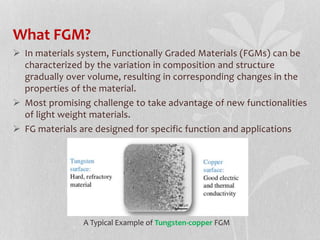
 In materials system, Functionally Graded Materials (FGMs) can be
characterized by the variation in composition and structure
gradually over volume, resulting in corresponding changes in the
properties of the material.
 Most promising challenge to take advantage of new functionalities
of light weight materials.
 FG materials are designed for specific function and applications
A Typical Example of Tungsten-copper FGM
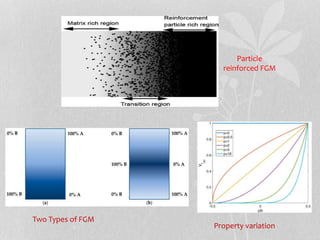
Two Types of FGM
Property variation
Particle
reinforced FGM
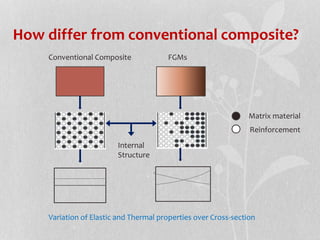
How differ from conventional composite?
Conventional Composite FGMs
Internal
Structure
Variation of Elastic and Thermal properties over Cross-section
Matrix material
Reinforcement
Performances of conventional fiber reinforced composites
are challenged in thermomechanical loading, when
development of interlaminar stresses at the interface
becomes the weakest link of the components.
Development of functionally graded materials (FGMs)
could lead to the reduction of such interlaminar failures,
especially at high temperature applications.
FGMs allow better customization and tailoring of
mechanical properties for special task.
Provides more varieties for material selection for
engineering design.
Why FGMs?
Large number of engineering structural components and tools
require material Performance by varying with location.
The body of gear must be tough, whereas its surface must be hard
and wear resistance.
A knife needs only to be hard at its cutting edge, elsewhere the
material must be strong and tough.
By functional gradation of constituents stress concentration and
thermal stress can be controlled at the critical locations.
Multi material
toothbrush
Multi material
waterproof camera
Multi material razor
Why Not Multi-Material Structure?
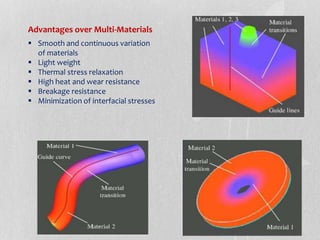
 Smooth and continuous variation
of materials
 Light weight
 Thermal stress relaxation
 High heat and wear resistance
 Breakage resistance
 Minimization of interfacial stresses
Advantages over Multi-Materials
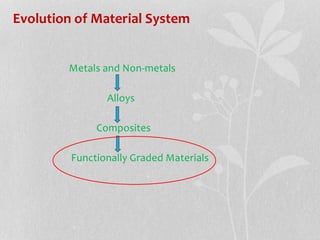
Evolution of Material System
Metals and Non-metals
Alloys
Composites
Functionally Graded Materials

FG materials.pptx

  • 1.
    What FGM?  Inmaterials system, Functionally Graded Materials (FGMs) can be characterized by the variation in composition and structure gradually over volume, resulting in corresponding changes in the properties of the material.  Most promising challenge to take advantage of new functionalities of light weight materials.  FG materials are designed for specific function and applications A Typical Example of Tungsten-copper FGM
  • 2.
    Two Types ofFGM Property variation Particle reinforced FGM
  • 3.
    How differ fromconventional composite? Conventional Composite FGMs Internal Structure Variation of Elastic and Thermal properties over Cross-section Matrix material Reinforcement
  • 4.
    Performances of conventionalfiber reinforced composites are challenged in thermomechanical loading, when development of interlaminar stresses at the interface becomes the weakest link of the components. Development of functionally graded materials (FGMs) could lead to the reduction of such interlaminar failures, especially at high temperature applications. FGMs allow better customization and tailoring of mechanical properties for special task. Provides more varieties for material selection for engineering design.
  • 5.
    Why FGMs? Large numberof engineering structural components and tools require material Performance by varying with location. The body of gear must be tough, whereas its surface must be hard and wear resistance. A knife needs only to be hard at its cutting edge, elsewhere the material must be strong and tough. By functional gradation of constituents stress concentration and thermal stress can be controlled at the critical locations.
  • 6.
    Multi material toothbrush Multi material waterproofcamera Multi material razor Why Not Multi-Material Structure?
  • 7.
     Smooth andcontinuous variation of materials  Light weight  Thermal stress relaxation  High heat and wear resistance  Breakage resistance  Minimization of interfacial stresses Advantages over Multi-Materials
  • 8.
    Evolution of MaterialSystem Metals and Non-metals Alloys Composites Functionally Graded Materials