FUNCTIONALLY GRADED
MATERIALS
CONTENTS
• What are functionally graded materials?
• Types of FGM
• Processing techniques
• Areas of application
• Advantages of FGM
• Difficulties of FGM
• Summary
What are Functionally graded materials?
In materials science, Functionally Graded Material (FGM) may be characterized by
the variation in composition and structure gradually over volume, resulting in
corresponding changes in the properties of the material. The materials can be
designed for specific function and applications.
Due to the unique graded materials properties, FGMs have attracted a great amount of
attention from researchers in many fields, including aerospace, biomaterials and
engineering among others in the past decades.
TYPES OF FGM
FGM are classified according to different criteria:
1. According to the structure:
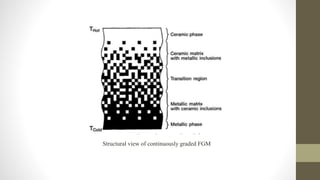
a) Continuously Structured FGM and
b) Discontinuous (Layered) FGM.
2. According to process of manufacturing:
a) Thin FGM
b) Bulk FGM
Structural view of continuously graded FGM
THIN FGM & BULK FGM
Thin FGM are manufactured with different methods like Physical Vapor Deposition
(PVD), Chemical Vapor Deposition (CVD), Self propagating High Temperature
Synthesis (SHS) method etc.
While the Bulk FGMs are manufactured by the methods like Powder Metallurgical
Technique, Centrifugal Casting method, Solid Free Form technique etc.
PROCESSING TECHNIQUES
The functionally graded materials are usually in the form of surface coatings, there are a
wide range of surface deposition processes to choose from depending on the service
requirement from the process.
A. Vapour Deposition Technique
B. Powder Metallurgy(PM)
C. Centrifugal method
D. Gel casting
E. Solid Free Form (SFF) Fabrication Method
1. Vapor Deposition Technique
Used to produce thin FGMs.
Used to deposit functionally graded surface coatings.
Gives excellent micro-structure.
Energy intensive process.
Produce poisonous gases as their by-products.
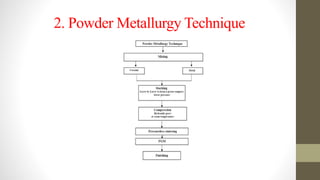
2. Powder Metallurgy Technique
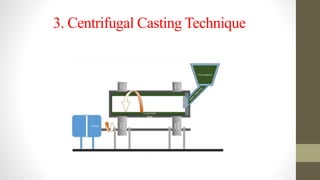
3. Centrifugal Casting Technique
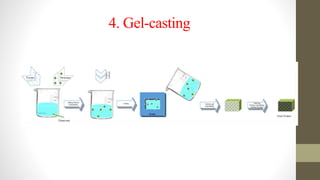
4. Gel-casting
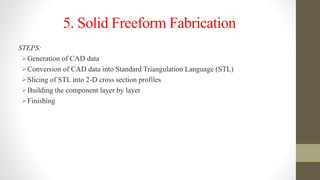
5. Solid Freeform Fabrication
STEPS:
Generation of CAD data
Conversion of CAD data into Standard Triangulation Language (STL)
Slicing of STL into 2-D cross section profiles
Building the component layer by layer
Finishing
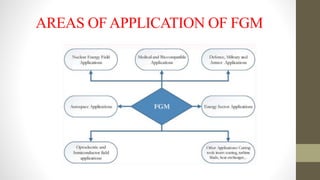
AREAS OF APPLICATION OF FGM
ADVANTAGES OF FGM
FGM as an interface layer to connect two incompatible materials can greatly enhance
the bond strength.
FGM coating and interface can be used to reduce the residual stress and thermal stress
FGM coating not only enhances the strength of the connections but can also reduce
the crack driving force.
DIFFICULTIES OF FGM
A proper database of gradient material (including material system, parameters,
material preparation and performance evaluation) is to be developed.
Still need further research and examination on the physical properties of the material
model.
Microscopic structure and the quantitative relationship between preparation
conditions to be established in order to accurately and reliably predict the physical
properties of graded materials.
SUMMARY
Functionally graded material is an excellent advanced material that will revolutionize
the manufacturing world. There are a number of hurdles for realizing this objective.
Cost is one of them, with substantial part of the cost expended on powder processing
and fabrication method.
Fabrication using advanced techniques can lead to development of multi-functional
material with enhanced mechanical, physical performance.
THANK YOU

Functional graded materials

  • 1.
  • 2.
    CONTENTS • What arefunctionally graded materials? • Types of FGM • Processing techniques • Areas of application • Advantages of FGM • Difficulties of FGM • Summary
  • 3.
    What are Functionallygraded materials? In materials science, Functionally Graded Material (FGM) may be characterized by the variation in composition and structure gradually over volume, resulting in corresponding changes in the properties of the material. The materials can be designed for specific function and applications. Due to the unique graded materials properties, FGMs have attracted a great amount of attention from researchers in many fields, including aerospace, biomaterials and engineering among others in the past decades.
  • 4.
    TYPES OF FGM FGMare classified according to different criteria: 1. According to the structure: a) Continuously Structured FGM and b) Discontinuous (Layered) FGM. 2. According to process of manufacturing: a) Thin FGM b) Bulk FGM
  • 5.
    Structural view ofcontinuously graded FGM
  • 6.
    THIN FGM &BULK FGM Thin FGM are manufactured with different methods like Physical Vapor Deposition (PVD), Chemical Vapor Deposition (CVD), Self propagating High Temperature Synthesis (SHS) method etc. While the Bulk FGMs are manufactured by the methods like Powder Metallurgical Technique, Centrifugal Casting method, Solid Free Form technique etc.
  • 7.
    PROCESSING TECHNIQUES The functionallygraded materials are usually in the form of surface coatings, there are a wide range of surface deposition processes to choose from depending on the service requirement from the process. A. Vapour Deposition Technique B. Powder Metallurgy(PM) C. Centrifugal method D. Gel casting E. Solid Free Form (SFF) Fabrication Method
  • 8.
    1. Vapor DepositionTechnique Used to produce thin FGMs. Used to deposit functionally graded surface coatings. Gives excellent micro-structure. Energy intensive process. Produce poisonous gases as their by-products.
  • 9.
  • 10.
  • 11.
  • 12.
    5. Solid FreeformFabrication STEPS: Generation of CAD data Conversion of CAD data into Standard Triangulation Language (STL) Slicing of STL into 2-D cross section profiles Building the component layer by layer Finishing
  • 13.
  • 14.
    ADVANTAGES OF FGM FGMas an interface layer to connect two incompatible materials can greatly enhance the bond strength. FGM coating and interface can be used to reduce the residual stress and thermal stress FGM coating not only enhances the strength of the connections but can also reduce the crack driving force.
  • 15.
    DIFFICULTIES OF FGM Aproper database of gradient material (including material system, parameters, material preparation and performance evaluation) is to be developed. Still need further research and examination on the physical properties of the material model. Microscopic structure and the quantitative relationship between preparation conditions to be established in order to accurately and reliably predict the physical properties of graded materials.
  • 16.
    SUMMARY Functionally graded materialis an excellent advanced material that will revolutionize the manufacturing world. There are a number of hurdles for realizing this objective. Cost is one of them, with substantial part of the cost expended on powder processing and fabrication method. Fabrication using advanced techniques can lead to development of multi-functional material with enhanced mechanical, physical performance.
  • 17.