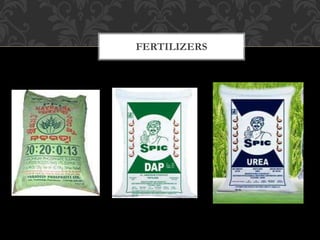
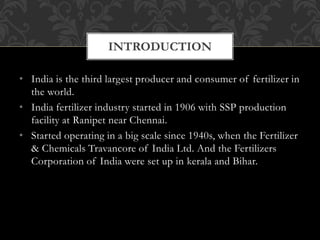
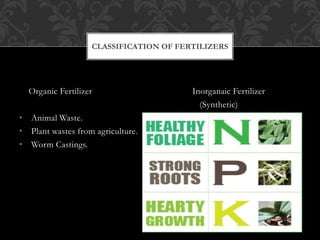
FERTILIZERS
INDUSTRY IN INDIA
FERTILIZERS
• India is the third largest producer and consumer of fertilizer in
the world.
• India fertilizer industry started in 1906 with SSP production
facility at Ranipet near Chennai.
• Started operating in a big scale since 1940s, when the Fertilizer
& Chemicals Travancore of India Ltd. And the Fertilizers
Corporation of India were set up in kerala and Bihar.
INTRODUCTION
FERTILIZERS
A Fertilizer is any material of natural or synthetic origin (other than liming
materials) that is applied to soils or to plants tissues (usually leaves to supply
one or more plant nutrients essential to the growth of plants.
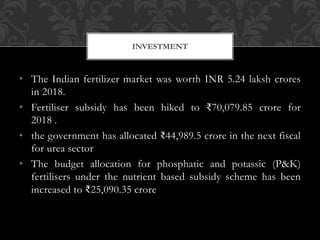
Organic Fertilizer
• Animal Waste.
• Plant wastes from agriculture.
• Worm Castings.
Inorganaic Fertilizer
(Synthetic)
CLASSIFICATION OF FERTILIZERS
• The Indian fertilizer market was worth INR 5.24 laksh crores
in 2018.
• Fertiliser subsidy has been hiked to ₹70,079.85 crore for
2018 .
• the government has allocated ₹44,989.5 crore in the next fiscal
for urea sector
• The budget allocation for phosphatic and potassic (P&K)
fertilisers under the nutrient based subsidy scheme has been
increased to ₹25,090.35 crore
INVESTMENT
• Total Production of fertilizers in India 316.5 LMT per year.
• 2017-18 Annual Turnover is 462.20 LMT.
• In urea is 292.51 LMT
• DAP (Diammanium Phosphate ) 50.52 LMT
• Complex fertilizers 119.17 LMT
PRODUCTION AND
CONSUMPTION
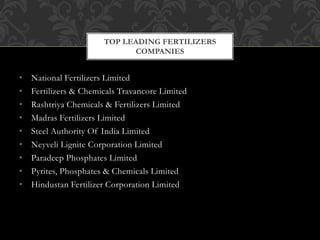
• National Fertilizers Limited
• Fertilizers & Chemicals Travancore Limited
• Rashtriya Chemicals & Fertilizers Limited
• Madras Fertilizers Limited
• Steel Authority Of India Limited
• Neyveli Lignite Corporation Limited
• Paradeep Phosphates Limited
• Pyrites, Phosphates & Chemicals Limited
• Hindustan Fertilizer Corporation Limited
TOP LEADING FERTILIZERS
COMPANIES
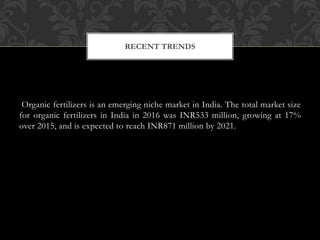
Organic fertilizers is an emerging niche market in India. The total market size
for organic fertilizers in India in 2016 was INR533 million, growing at 17%
over 2015, and is expected to reach INR871 million by 2021.
RECENT TRENDS
Fertilizers industry in india

Fertilizers industry in india

  • 1.
  • 2.
  • 3.
    • India isthe third largest producer and consumer of fertilizer in the world. • India fertilizer industry started in 1906 with SSP production facility at Ranipet near Chennai. • Started operating in a big scale since 1940s, when the Fertilizer & Chemicals Travancore of India Ltd. And the Fertilizers Corporation of India were set up in kerala and Bihar. INTRODUCTION
  • 4.
    FERTILIZERS A Fertilizer isany material of natural or synthetic origin (other than liming materials) that is applied to soils or to plants tissues (usually leaves to supply one or more plant nutrients essential to the growth of plants.
  • 5.
    Organic Fertilizer • AnimalWaste. • Plant wastes from agriculture. • Worm Castings. Inorganaic Fertilizer (Synthetic) CLASSIFICATION OF FERTILIZERS
  • 6.
    • The Indianfertilizer market was worth INR 5.24 laksh crores in 2018. • Fertiliser subsidy has been hiked to ₹70,079.85 crore for 2018 . • the government has allocated ₹44,989.5 crore in the next fiscal for urea sector • The budget allocation for phosphatic and potassic (P&K) fertilisers under the nutrient based subsidy scheme has been increased to ₹25,090.35 crore INVESTMENT
  • 7.
    • Total Productionof fertilizers in India 316.5 LMT per year. • 2017-18 Annual Turnover is 462.20 LMT. • In urea is 292.51 LMT • DAP (Diammanium Phosphate ) 50.52 LMT • Complex fertilizers 119.17 LMT PRODUCTION AND CONSUMPTION
  • 9.
    • National FertilizersLimited • Fertilizers & Chemicals Travancore Limited • Rashtriya Chemicals & Fertilizers Limited • Madras Fertilizers Limited • Steel Authority Of India Limited • Neyveli Lignite Corporation Limited • Paradeep Phosphates Limited • Pyrites, Phosphates & Chemicals Limited • Hindustan Fertilizer Corporation Limited TOP LEADING FERTILIZERS COMPANIES
  • 11.
    Organic fertilizers isan emerging niche market in India. The total market size for organic fertilizers in India in 2016 was INR533 million, growing at 17% over 2015, and is expected to reach INR871 million by 2021. RECENT TRENDS