Fertility Options Mark Perloe, M.D. Georgia Reproductive Specialists www.ivf.com
Objectives Discuss general fertility factors  Describe basic evaluation and treatment Describe  A ssisted  R eproductive  T echnology (ART) at GRS Understand fertility preservation options
Fertility Preservation Indications Chemotherapy, radiation therapy, surgery On-hold for career Haven’t found partner Criteria:  Age, Antral follicle count, AMH Success:  2-5% chance for each stored oocyte Cost:  Cryopreservation cycles: ~$9-$21,000 (1-3x) Thaw, culture & transfer: $5,000
Infertility…. Inability to conceive after an interval of unprotected intercourse One year for women under 35 Six months for women over 35 Medical history and physical findings may dictate earlier evaluation and treatment
Scope At any given time, 10% of reproductive age couples seeking conception are unable to do so 6.1 million women and their partners 15% of all reproductive age women have an infertility-related office visit each year Half of couples experiencing fertility problems never seek treatment
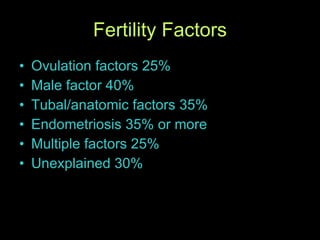
Fertility Factors Ovulation factors 25% Male factor 40% Tubal/anatomic factors 35% Endometriosis 35% or more Multiple factors 25% Unexplained 30%
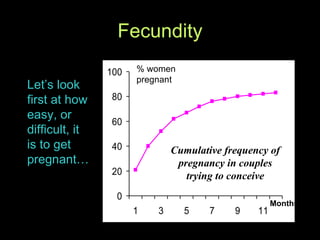
Months   % women pregnant Cumulative frequency of pregnancy in couples trying to conceive Let’s look first at how easy, or difficult, it is to get pregnant… Fecundity
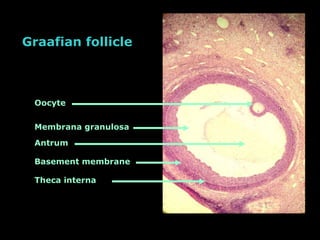
Graafian follicle Oocyte Membrana granulosa Theca   interna Basement membrane Antrum
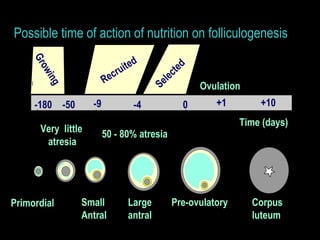
-50 -4 +10 -9 +1 -180 Time (days) 0 Very  little  atresia Ovulation Corpus luteum   Large   antral   Recruited Growing 50   - 80%   atresia Primordial   Small Antral Pre-ovulatory Possible time of action of nutrition on folliculogenesis Selected
 
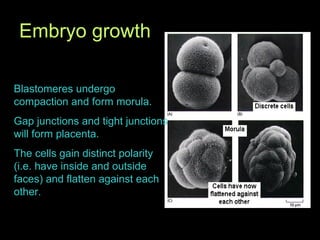
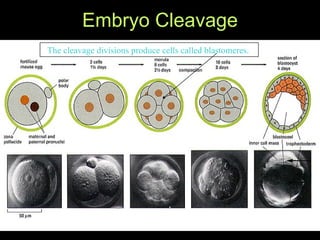
Blastomeres undergo compaction and form morula. Gap junctions and tight junctions will form placenta.  The cells gain distinct polarity (i.e. have inside and outside faces) and flatten against each other.  Embryo growth
Embryo Cleavage The cleavage divisions produce cells called blastomeres.
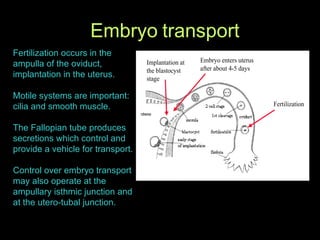
Fertilization occurs in the ampulla of the oviduct, implantation in the uterus.  Motile systems are important: cilia and smooth muscle.  The Fallopian tube produces secretions which control and provide a vehicle for transport. Control over embryo transport may also operate at the ampullary isthmic junction and at the utero-tubal junction. Embryo   transport
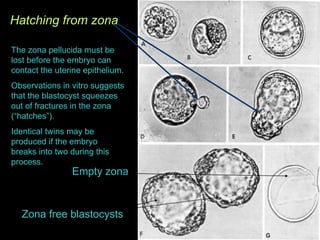
Hatching from zona The zona pellucida must be lost before the embryo can contact the uterine epithelium. Observations in vitro suggests that the blastocyst squeezes out of fractures in the zona (“hatches”). Identical twins may be produced if the embryo breaks into two during this process. Empty zona Zona free blastocysts
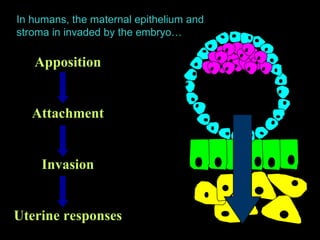
Apposition Attachment Invasion Uterine responses In humans, the maternal epithelium and stroma in invaded by the embryo…
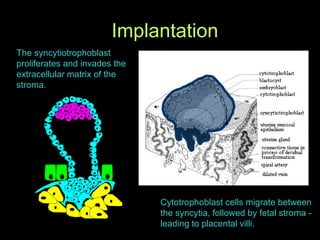
The syncytiotrophoblast proliferates and invades the extracellular matrix of the stroma. Cytotrophoblast cells migrate between the syncytia, followed by fetal stroma - leading to placental villi. Implantation
Ovulation Factors Insulin resistance PCOS,  hyperandrogenism Hypothalamic dysfunction Exercise induced, eating disorders, stress Pituitary disorders hyperprolactinemia Ovarian Failure Chemotherapy, Age, Surgery
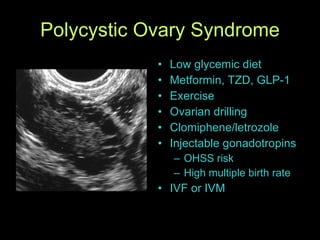
Polycystic Ovary Syndrome Low glycemic diet Metformin, TZD, GLP-1 Exercise Ovarian drilling Clomiphene/letrozole Injectable gonadotropins OHSS risk High multiple birth rate IVF or IVM
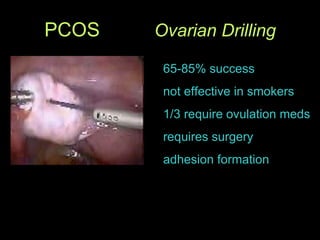
PCOS  Ovarian Drilling 65-85% success not effective in smokers 1/3 require ovulation meds requires surgery adhesion formation
Endometriosis Presence of uterine lining in locations outside the uterus 35-55% of infertile women demonstrate endometriosis at laparoscopy Not all women with endometriosis have infertility Surgical treatment and Lupron do not enhance success rates
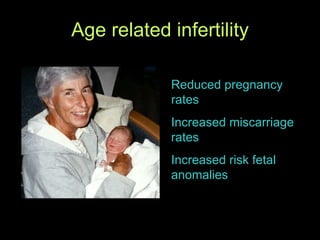
Age related infertility Reduced pregnancy rates Increased miscarriage rates Increased risk fetal anomalies
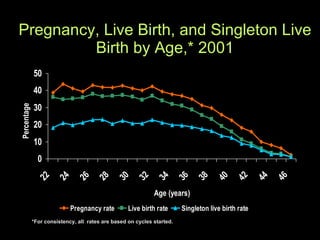
Pregnancy, Live Birth, and Singleton Live Birth by Age,* 2001 *For consistency, all  rates are based on cycles started.
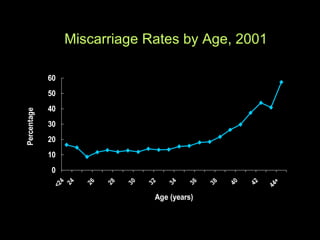
Miscarriage Rates by Age, 2001
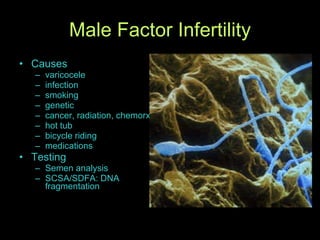
Male Factor Infertility Causes varicocele infection smoking genetic cancer, radiation, chemorx hot tub bicycle riding medications Testing Semen analysis SCSA/SDFA: DNA fragmentation
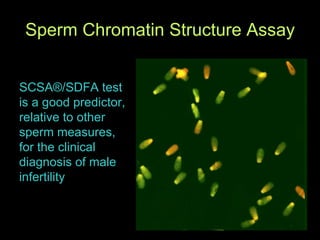
Sperm Chromatin Structure Assay SCSA®/SDFA test is a good predictor,   relative to other sperm measures, for the clinical diagnosis of male infertility
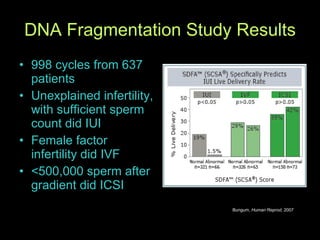
DNA Fragmentation Study Results 998 cycles from 637 patients Unexplained infertility, with sufficient sperm count did IUI Female factor infertility did IVF <500,000 sperm after gradient did ICSI Bungum,  Human Reprod , 2007
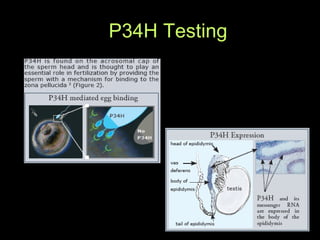
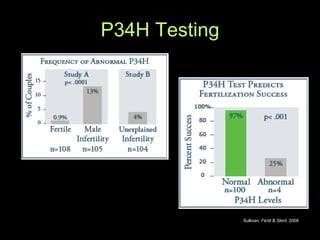
P34H Testing
P34H Testing Sullivan,  Fertil & Steril,  2006
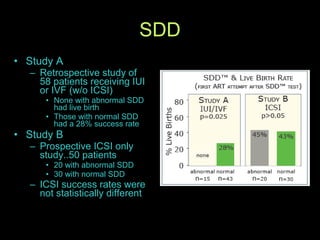
SDD Study A Retrospective study of 58 patients receiving IUI or IVF (w/o ICSI) None with abnormal SDD had live birth Those with normal SDD had a 28% success rate Study B Prospective ICSI only study..50 patients 20 with abnormal SDD 30 with normal SDD ICSI success rates were not statistically different
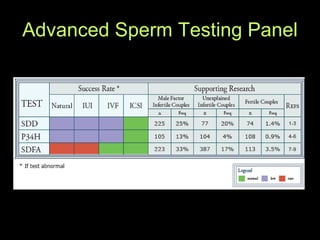
Advanced Sperm Testing Panel
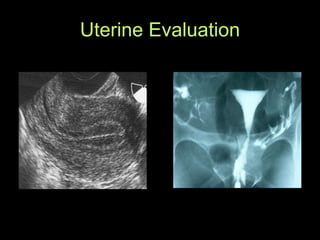
Uterine Evaluation
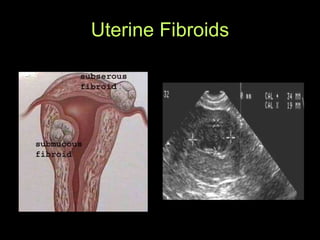
Uterine Fibroids
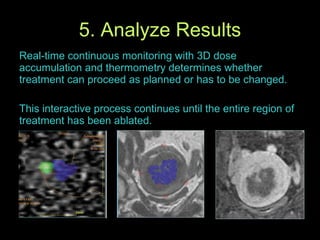
5. Analyze Results Real-time continuous monitoring with 3D dose accumulation and thermometry determines whether treatment can proceed as planned or has to be changed. This interactive process continues until the entire region of treatment has been ablated.
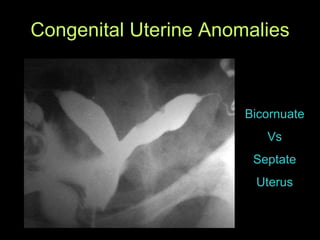
Congenital Uterine Anomalies Bicornuate Vs Septate Uterus
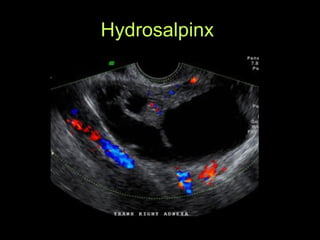
Hydrosalpinx
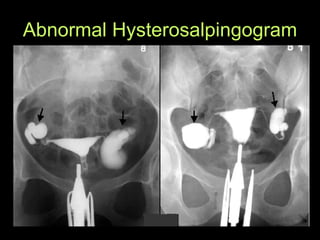
Abnormal Hysterosalpingogram
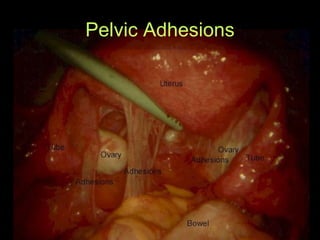
Pelvic Adhesions
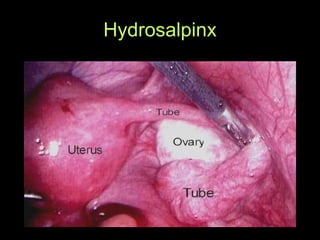
Hydrosalpinx
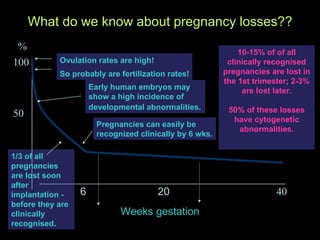
What do we know about pregnancy losses?? 6  20   40 Weeks gestation 100 50 % Pregnancies can easily be recognized clinically by 6 wks. Ovulation rates are high! So   probably are fertilization rates! Early human embryos may show a high incidence of developmental   abnormalities. 10-15% of of all clinically recognised pregnancies are lost in the 1st trimester; 2-3% are lost later. 50% of these losses have cytogenetic abnormalities. 1/3 of all pregnancies are lost soon after implantation - before they are clinically recognised.
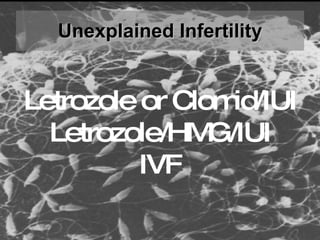
Unexplained Infertility Letrozole or Clomid/IUI Letrozole/HMG/IUI IVF
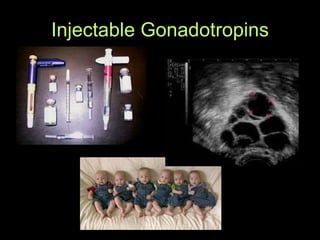
Injectable Gonadotropins
Assisted Reproductive Technology   (ART) In vivo  = inside the body In vitro  = in glass = outside the body IVF  =  in vitro  fertilization ART involves both the sperm and the egg in the laboratory Fertilization and early embryo development usually achieved  in vivo  accomplished  in vitro
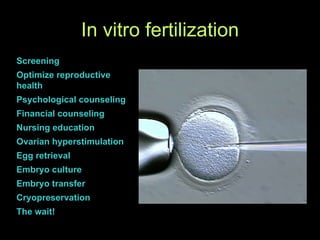
In vitro fertilization Screening Optimize reproductive health Psychological counseling Financial counseling Nursing education Ovarian hyperstimulation Egg retrieval  Embryo culture  Embryo transfer Cryopreservation The wait!
Lifestyle Smoking Up to 13% of infertility problems may be attributable to smoking Conception delay Egg depletion and diminished quality Higher miscarriage rates, ectopic pregnancies Passive smoking equivalent to active smoking Possibly lower IVF delivery rates Male smoking may pose greater risk
Emotional Support Psychological counseling requirement prior to cycle initiation; continued referral as necessary Patient support groups, AFA, INCIID, RESOLVE “Mind, Body…Baby” Program Acupuncture Massage Exercise Support
Financial Support Assisted Reproductive Technology Financial Options “ Making IVF Affordable Plan” Includes all Frozen Embryo Transfers No “Hidden Fees” for extra visits or ICSI FREE second IVF treatment cycle Shared Risk Program Refund IVF Global Fee IVF Global Frozen Embryo Transfer IVF PLUS Advanced Reproductive Care (ARC) financing 60% of patients have some degree of insurance coverage
IVF Overview Stimulation phase ~ 8-12 days Over-ride usual ovulation status Intentionally hyperstimulate ovaries with injectable hormones Monitor closely with vaginal ultrasound and blood hormone levels Anticipate 4-6 clinic visits
IVF Overview Retrieval ~ 20 minutes Outpatient minor surgery under IV sedation Vaginal ultrasound guided oocyte retrieval All visible follicles entered and aspirated Recovery ~ 1 hour in clinic, remainder of day at home Goal: multiple eggs to work with in the laboratory
IVF Overview Laboratory ~ 3-5 days Provide semen specimen Combine sperm and eggs at appropriate intervals Inject sperm into eggs as required Incubate and allow to grow for 3-5 days Embryologists update patients regarding progress
IVF Overview Transfer Plan transfer for Day 3 or 5 after retrieval Abdominal ultrasound visualization requires a FULL bladder; Valium available Transfer catheter containing embryos threaded though cervix Embryos gently injected into uterus Normal activity after transfer
IVF Overview Number of embryos transferred based on patient age and embryo quality General for Day 3: < 35 years: 2-3 embryos 35-37: 3 embryos 38-40: 3-4 embryos >40: 4-5 embryos Blastocysts (Day 5): 2 embryos up to age 40
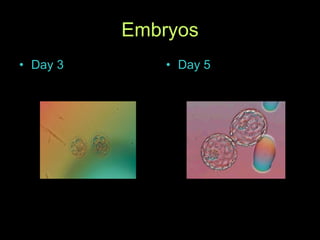
Embryos Day 3 Day 5
IVF Overview 14 days after retrieval… Check pregnancy test Progesterone supplementation from just after retrieval until outcome known Intramuscular progesterone Continues through the 10 th  week of pregnancy
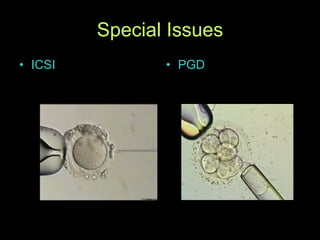
Special Issues Intracytoplasmic sperm injection (ICSI) Individual sperm can be injected into each egg Important for profound male factor Pre-implantation genetic diagnosis (PGD) Prevention of genetic disease Recurrent pregnancy loss Egg donation anonymous vs. known donor Fertility preservation
Special Issues ICSI PGD
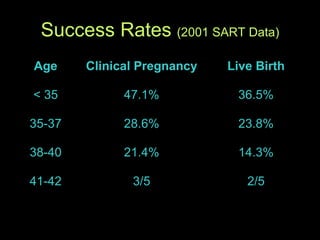
Success Rates  (2001 SART Data) Age Clinical Pregnancy Live Birth < 35 47.1% 36.5% 35-37 28.6% 23.8% 38-40 21.4% 14.3% 41-42 3/5 2/5
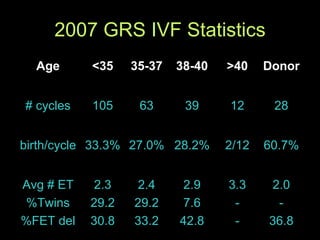
2007 GRS IVF Statistics Age <35 35-37 38-40 >40 Donor # cycles 105 63 39 12 28 birth/cycle 33.3% 27.0% 28.2% 2/12 60.7% Avg # ET %Twins %FET del 2.3 29.2 30.8 2.4 29.2 33.2 2.9 7.6 42.8 3.3 - - 2.0 - 36.8
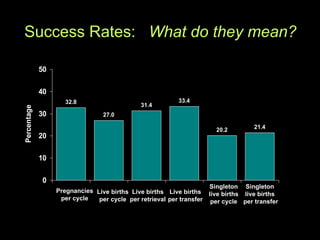
Success Rates:  What do they mean? Pregnancies per cycle Live births per retrieval Live births per cycle Live births per transfer Singleton  live births  per transfer Singleton live births per cycle
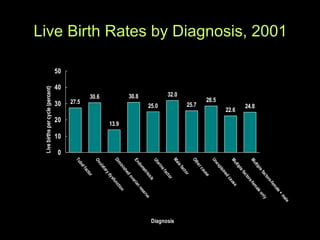
Live Birth Rates by Diagnosis, 2001
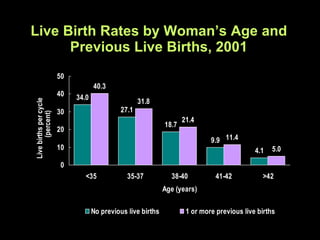
Live Birth Rates by Woman’s Age and Previous Live Births, 2001
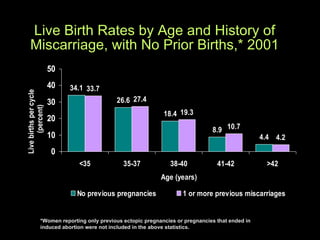
Live Birth Rates by Age and History of Miscarriage, with No Prior Births,* 2001 *Women reporting only previous ectopic pregnancies or pregnancies that ended in  induced abortion were not included in the above statistics.
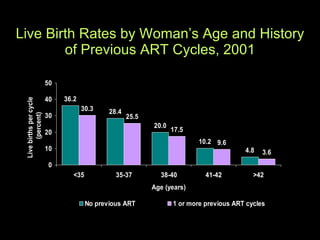
Live Birth Rates by Woman’s Age and History of Previous ART Cycles, 2001
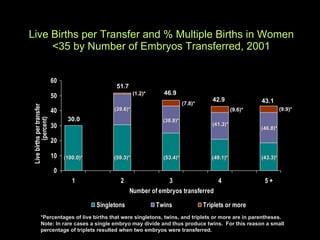
Live Births per Transfer and % Multiple Births in Women <35 by Number of Embryos Transferred, 2001 (100.0)* (59.3)* (39.6)* (53.4)* (38.8)* (7.8)* (49.1)* (41.3)* (9.6)* (43.3)* (46.8)* (9.9)* *Percentages of live births that were singletons, twins, and triplets or more are in parentheses.  Note: In rare cases a single embryo may divide and thus produce twins.  For this reason a small percentage of triplets resulted when two embryos were transferred. 30.0 51.7 46.9 42.9 43.1 (1.2)*
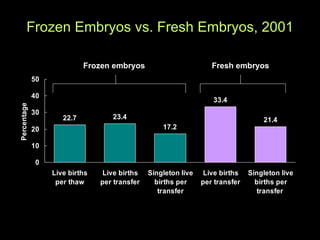
Frozen Embryos vs. Fresh Embryos, 2001 Frozen embryos Fresh embryos
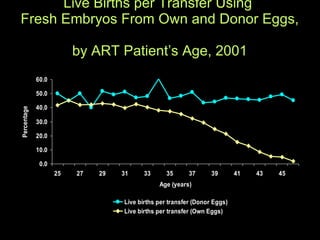
Live Births per Transfer Using  Fresh Embryos From Own and Donor Eggs,  by ART Patient’s Age, 2001
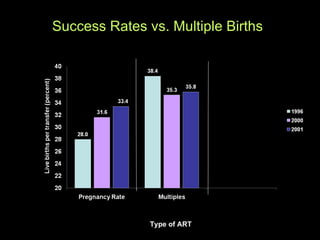
Success Rates vs. Multiple Births Type of ART
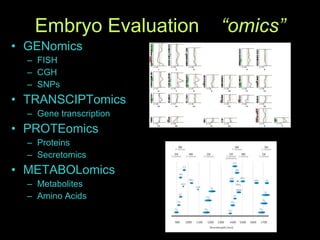
Embryo Evaluation  “omics” GENomics FISH CGH SNPs TRANSCIPTomics Gene transcription PROTEomics Proteins Secretomics METABOLomics Metabolites Amino Acids
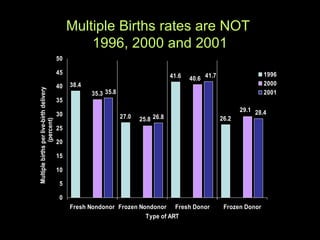
Multiple Births rates are NOT  1996, 2000 and 2001


GRS Meridian Mark Drs. Perloe, Kaplan and Singleton Alpharetta Dr. Conway DeKalb Medical Center Dr. Kaplan Please join us for a complimentary 20 minute visit…. Please join us for a complimentary 20 minute visit….
 

Fertility Options: IVF Overview

  • 1.
    Fertility Options MarkPerloe, M.D. Georgia Reproductive Specialists www.ivf.com
  • 2.
    Objectives Discuss generalfertility factors Describe basic evaluation and treatment Describe A ssisted R eproductive T echnology (ART) at GRS Understand fertility preservation options
  • 3.
    Fertility Preservation IndicationsChemotherapy, radiation therapy, surgery On-hold for career Haven’t found partner Criteria: Age, Antral follicle count, AMH Success: 2-5% chance for each stored oocyte Cost: Cryopreservation cycles: ~$9-$21,000 (1-3x) Thaw, culture & transfer: $5,000
  • 4.
    Infertility…. Inability toconceive after an interval of unprotected intercourse One year for women under 35 Six months for women over 35 Medical history and physical findings may dictate earlier evaluation and treatment
  • 5.
    Scope At anygiven time, 10% of reproductive age couples seeking conception are unable to do so 6.1 million women and their partners 15% of all reproductive age women have an infertility-related office visit each year Half of couples experiencing fertility problems never seek treatment
  • 6.
    Fertility Factors Ovulationfactors 25% Male factor 40% Tubal/anatomic factors 35% Endometriosis 35% or more Multiple factors 25% Unexplained 30%
  • 7.
    Months % women pregnant Cumulative frequency of pregnancy in couples trying to conceive Let’s look first at how easy, or difficult, it is to get pregnant… Fecundity
  • 8.
    Graafian follicle OocyteMembrana granulosa Theca interna Basement membrane Antrum
  • 9.
    -50 -4 +10-9 +1 -180 Time (days) 0 Very little atresia Ovulation Corpus luteum Large antral Recruited Growing 50 - 80% atresia Primordial Small Antral Pre-ovulatory Possible time of action of nutrition on folliculogenesis Selected
  • 10.
  • 11.
    Blastomeres undergo compactionand form morula. Gap junctions and tight junctions will form placenta. The cells gain distinct polarity (i.e. have inside and outside faces) and flatten against each other. Embryo growth
  • 12.
    Embryo Cleavage Thecleavage divisions produce cells called blastomeres.
  • 13.
    Fertilization occurs inthe ampulla of the oviduct, implantation in the uterus. Motile systems are important: cilia and smooth muscle. The Fallopian tube produces secretions which control and provide a vehicle for transport. Control over embryo transport may also operate at the ampullary isthmic junction and at the utero-tubal junction. Embryo transport
  • 14.
    Hatching from zonaThe zona pellucida must be lost before the embryo can contact the uterine epithelium. Observations in vitro suggests that the blastocyst squeezes out of fractures in the zona (“hatches”). Identical twins may be produced if the embryo breaks into two during this process. Empty zona Zona free blastocysts
  • 15.
    Apposition Attachment InvasionUterine responses In humans, the maternal epithelium and stroma in invaded by the embryo…
  • 16.
    The syncytiotrophoblast proliferatesand invades the extracellular matrix of the stroma. Cytotrophoblast cells migrate between the syncytia, followed by fetal stroma - leading to placental villi. Implantation
  • 17.
    Ovulation Factors Insulinresistance PCOS, hyperandrogenism Hypothalamic dysfunction Exercise induced, eating disorders, stress Pituitary disorders hyperprolactinemia Ovarian Failure Chemotherapy, Age, Surgery
  • 18.
    Polycystic Ovary SyndromeLow glycemic diet Metformin, TZD, GLP-1 Exercise Ovarian drilling Clomiphene/letrozole Injectable gonadotropins OHSS risk High multiple birth rate IVF or IVM
  • 19.
    PCOS OvarianDrilling 65-85% success not effective in smokers 1/3 require ovulation meds requires surgery adhesion formation
  • 20.
    Endometriosis Presence ofuterine lining in locations outside the uterus 35-55% of infertile women demonstrate endometriosis at laparoscopy Not all women with endometriosis have infertility Surgical treatment and Lupron do not enhance success rates
  • 21.
    Age related infertilityReduced pregnancy rates Increased miscarriage rates Increased risk fetal anomalies
  • 22.
    Pregnancy, Live Birth,and Singleton Live Birth by Age,* 2001 *For consistency, all rates are based on cycles started.
  • 23.
  • 24.
    Male Factor InfertilityCauses varicocele infection smoking genetic cancer, radiation, chemorx hot tub bicycle riding medications Testing Semen analysis SCSA/SDFA: DNA fragmentation
  • 25.
    Sperm Chromatin StructureAssay SCSA®/SDFA test is a good predictor, relative to other sperm measures, for the clinical diagnosis of male infertility
  • 26.
    DNA Fragmentation StudyResults 998 cycles from 637 patients Unexplained infertility, with sufficient sperm count did IUI Female factor infertility did IVF <500,000 sperm after gradient did ICSI Bungum, Human Reprod , 2007
  • 27.
  • 28.
    P34H Testing Sullivan, Fertil & Steril, 2006
  • 29.
    SDD Study ARetrospective study of 58 patients receiving IUI or IVF (w/o ICSI) None with abnormal SDD had live birth Those with normal SDD had a 28% success rate Study B Prospective ICSI only study..50 patients 20 with abnormal SDD 30 with normal SDD ICSI success rates were not statistically different
  • 30.
  • 31.
  • 32.
  • 33.
    5. Analyze ResultsReal-time continuous monitoring with 3D dose accumulation and thermometry determines whether treatment can proceed as planned or has to be changed. This interactive process continues until the entire region of treatment has been ablated.
  • 34.
    Congenital Uterine AnomaliesBicornuate Vs Septate Uterus
  • 35.
  • 36.
  • 37.
  • 38.
  • 39.
    What do weknow about pregnancy losses?? 6 20 40 Weeks gestation 100 50 % Pregnancies can easily be recognized clinically by 6 wks. Ovulation rates are high! So probably are fertilization rates! Early human embryos may show a high incidence of developmental abnormalities. 10-15% of of all clinically recognised pregnancies are lost in the 1st trimester; 2-3% are lost later. 50% of these losses have cytogenetic abnormalities. 1/3 of all pregnancies are lost soon after implantation - before they are clinically recognised.
  • 40.
    Unexplained Infertility Letrozoleor Clomid/IUI Letrozole/HMG/IUI IVF
  • 41.
  • 42.
    Assisted Reproductive Technology (ART) In vivo = inside the body In vitro = in glass = outside the body IVF = in vitro fertilization ART involves both the sperm and the egg in the laboratory Fertilization and early embryo development usually achieved in vivo accomplished in vitro
  • 43.
    In vitro fertilizationScreening Optimize reproductive health Psychological counseling Financial counseling Nursing education Ovarian hyperstimulation Egg retrieval Embryo culture Embryo transfer Cryopreservation The wait!
  • 44.
    Lifestyle Smoking Upto 13% of infertility problems may be attributable to smoking Conception delay Egg depletion and diminished quality Higher miscarriage rates, ectopic pregnancies Passive smoking equivalent to active smoking Possibly lower IVF delivery rates Male smoking may pose greater risk
  • 45.
    Emotional Support Psychologicalcounseling requirement prior to cycle initiation; continued referral as necessary Patient support groups, AFA, INCIID, RESOLVE “Mind, Body…Baby” Program Acupuncture Massage Exercise Support
  • 46.
    Financial Support AssistedReproductive Technology Financial Options “ Making IVF Affordable Plan” Includes all Frozen Embryo Transfers No “Hidden Fees” for extra visits or ICSI FREE second IVF treatment cycle Shared Risk Program Refund IVF Global Fee IVF Global Frozen Embryo Transfer IVF PLUS Advanced Reproductive Care (ARC) financing 60% of patients have some degree of insurance coverage
  • 47.
    IVF Overview Stimulationphase ~ 8-12 days Over-ride usual ovulation status Intentionally hyperstimulate ovaries with injectable hormones Monitor closely with vaginal ultrasound and blood hormone levels Anticipate 4-6 clinic visits
  • 48.
    IVF Overview Retrieval~ 20 minutes Outpatient minor surgery under IV sedation Vaginal ultrasound guided oocyte retrieval All visible follicles entered and aspirated Recovery ~ 1 hour in clinic, remainder of day at home Goal: multiple eggs to work with in the laboratory
  • 49.
    IVF Overview Laboratory~ 3-5 days Provide semen specimen Combine sperm and eggs at appropriate intervals Inject sperm into eggs as required Incubate and allow to grow for 3-5 days Embryologists update patients regarding progress
  • 50.
    IVF Overview TransferPlan transfer for Day 3 or 5 after retrieval Abdominal ultrasound visualization requires a FULL bladder; Valium available Transfer catheter containing embryos threaded though cervix Embryos gently injected into uterus Normal activity after transfer
  • 51.
    IVF Overview Numberof embryos transferred based on patient age and embryo quality General for Day 3: < 35 years: 2-3 embryos 35-37: 3 embryos 38-40: 3-4 embryos >40: 4-5 embryos Blastocysts (Day 5): 2 embryos up to age 40
  • 52.
  • 53.
    IVF Overview 14days after retrieval… Check pregnancy test Progesterone supplementation from just after retrieval until outcome known Intramuscular progesterone Continues through the 10 th week of pregnancy
  • 54.
    Special Issues Intracytoplasmicsperm injection (ICSI) Individual sperm can be injected into each egg Important for profound male factor Pre-implantation genetic diagnosis (PGD) Prevention of genetic disease Recurrent pregnancy loss Egg donation anonymous vs. known donor Fertility preservation
  • 55.
  • 56.
    Success Rates (2001 SART Data) Age Clinical Pregnancy Live Birth < 35 47.1% 36.5% 35-37 28.6% 23.8% 38-40 21.4% 14.3% 41-42 3/5 2/5
  • 57.
    2007 GRS IVFStatistics Age <35 35-37 38-40 >40 Donor # cycles 105 63 39 12 28 birth/cycle 33.3% 27.0% 28.2% 2/12 60.7% Avg # ET %Twins %FET del 2.3 29.2 30.8 2.4 29.2 33.2 2.9 7.6 42.8 3.3 - - 2.0 - 36.8
  • 58.
    Success Rates: What do they mean? Pregnancies per cycle Live births per retrieval Live births per cycle Live births per transfer Singleton live births per transfer Singleton live births per cycle
  • 59.
    Live Birth Ratesby Diagnosis, 2001
  • 60.
    Live Birth Ratesby Woman’s Age and Previous Live Births, 2001
  • 61.
    Live Birth Ratesby Age and History of Miscarriage, with No Prior Births,* 2001 *Women reporting only previous ectopic pregnancies or pregnancies that ended in induced abortion were not included in the above statistics.
  • 62.
    Live Birth Ratesby Woman’s Age and History of Previous ART Cycles, 2001
  • 63.
    Live Births perTransfer and % Multiple Births in Women <35 by Number of Embryos Transferred, 2001 (100.0)* (59.3)* (39.6)* (53.4)* (38.8)* (7.8)* (49.1)* (41.3)* (9.6)* (43.3)* (46.8)* (9.9)* *Percentages of live births that were singletons, twins, and triplets or more are in parentheses. Note: In rare cases a single embryo may divide and thus produce twins. For this reason a small percentage of triplets resulted when two embryos were transferred. 30.0 51.7 46.9 42.9 43.1 (1.2)*
  • 64.
    Frozen Embryos vs.Fresh Embryos, 2001 Frozen embryos Fresh embryos
  • 65.
    Live Births perTransfer Using Fresh Embryos From Own and Donor Eggs, by ART Patient’s Age, 2001
  • 66.
    Success Rates vs.Multiple Births Type of ART
  • 67.
    Embryo Evaluation “omics” GENomics FISH CGH SNPs TRANSCIPTomics Gene transcription PROTEomics Proteins Secretomics METABOLomics Metabolites Amino Acids
  • 68.
    Multiple Births ratesare NOT 1996, 2000 and 2001
  • 69.
  • 70.
  • 71.
  • 72.
  • 73.
  • 74.
  • 75.
  • 76.
    GRS Meridian MarkDrs. Perloe, Kaplan and Singleton Alpharetta Dr. Conway DeKalb Medical Center Dr. Kaplan Please join us for a complimentary 20 minute visit…. Please join us for a complimentary 20 minute visit….
  • 77.