Further Education Digital Student Project 
Prof Rhona Sharpe, Dr Metaxia Pavlakou 
Birmingham, 
15/10/14 
#digitalstudent http://digitalstudent.jiscinvolve.org
FEDS Project Team 
» Professor Rhona Sharpe, OCSLD 
» Dr. Greg Benfield, OCSLD 
» Dr. Elizabeth Browne, School of 
Education, 
» Dr. Metaxia Pavlakou, OCSLD 
» Marilyn Hockley, independent 
consultant 
Jisc Digital Student http://digitalstudent.jiscinvolve.org.uk 2
FEDS Literature Review: What we looked for 
Research questions: 
» what technology learners own and have access 
to when they enter FE 
» what technology learners expect to be provided 
with by their college 
» how learners make use of the technology and 
digital environments they are provided with 
» how learners’ expectations of technology use 
are formed and change during time spent in FE 
Jisc Digital Student http://digitalstudent.jiscinvolve.org.uk 3
FEDS Literature Review: Difficulties 
»Few published papers 
from FE in the academic 
literature 
»Difficulty to locate case 
studies 
»Not much research on 
learners’ experience 
Jisc Digital Student http://digitalstudent.jiscinvolve.org.uk 4
FEDS Literature Review: What we included 
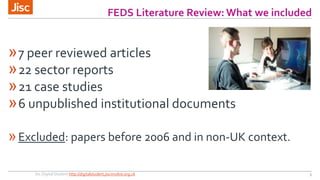
»7 peer reviewed articles 
»22 sector reports 
»21 case studies 
»6 unpublished institutional documents 
»Excluded: papers before 2006 and in non-UK context. 
Jisc Digital Student http://digitalstudent.jiscinvolve.org.uk 5
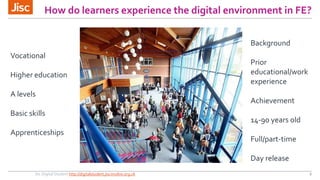
How do learners experience the digital environment in FE? 
Vocational 
Higher education 
A levels 
Basic skills 
Apprenticeships 
Background 
Prior 
educational/work 
experience 
Achievement 
14-90 years old 
Full/part-time 
Day release 
Jisc Digital Student http://digitalstudent.jiscinvolve.org.uk 6
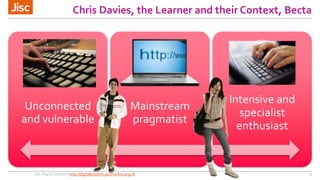
Chris Davies, the Learner and their Context, Becta 
Unconnected 
and vulnerable 
Mainstream 
pragmatist 
Intensive and 
specialist 
enthusiast 
Jisc Digital Student http://digitalstudent.jiscinvolve.org.uk 7
Overview 
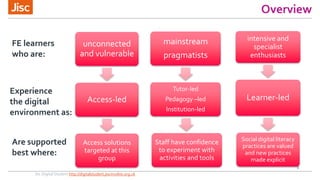
unconnected 
and vulnerable 
Access-led 
Access solutions 
targeted at this 
group 
Jisc Digital Student http://digitalstudent.jiscinvolve.org.uk 
8 
mainstream 
pragmatists 
Tutor-led 
Pedagogy –led 
Institution-led 
Staff have confidence 
to experiment with 
activities and tools 
intensive and 
specialist 
enthusiasts 
Learner-led 
Social digital literacy 
practices are valued 
and new practices 
made explicit 
FE learners 
who are: 
Experience 
the digital 
environment as: 
Are supported 
best where:
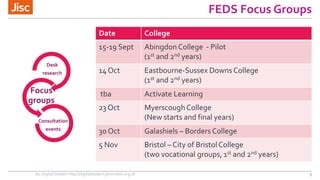
FEDS Focus Groups 
Date College 
15-19 Sept Abingdon College - Pilot 
(1st and 2nd years) 
14 Oct Eastbourne-Sussex Downs College 
(1st and 2nd years) 
tba Activate Learning 
23 Oct Myerscough College 
(New starts and final years) 
30 Oct Galashiels – Borders College 
5 Nov Bristol – City of Bristol College 
(two vocational groups, 1st and 2nd years) 
Desk 
research 
Focus 
groups 
Consultation 
events 
Jisc Digital Student http://digitalstudent.jiscinvolve.org.uk 9
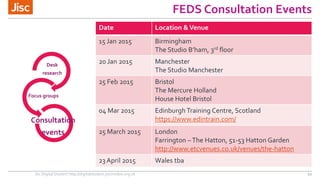
FEDS Consultation Events 
Date Location & Venue 
15 Jan 2015 Birmingham 
The Studio B’ham, 3rd floor 
20 Jan 2015 Manchester 
The Studio Manchester 
25 Feb 2015 Bristol 
The Mercure Holland 
House Hotel Bristol 
04 Mar 2015 Edinburgh Training Centre, Scotland 
https://www.edintrain.com/ 
25 March 2015 London 
Farrington – The Hatton, 51-53 Hatton Garden 
http://www.etcvenues.co.uk/venues/the-hatton 
23 April 2015 Wales tba 
Desk 
research 
Focus groups 
Consultation 
events 
Jisc Digital Student http://digitalstudent.jiscinvolve.org.uk 10
Find out more… 
Digital Student #digitalstudent 
Rhona Sharpe 
rsharpe@brookes.ac.uk 
Metaxia Pavlakou 
mpavlakou@brookes.ac.uk 
http://digitalstudent.jiscinvolve.org 
10/06/2014 Jisc Digital Student http://digitalstudent.jiscinvolve.org.uk 
Except where otherwise noted, this 
work is licensed under CC-BY-NC-ND 
11

Further Education Digital Student Project for ELESIG

  • 1.
    Further Education DigitalStudent Project Prof Rhona Sharpe, Dr Metaxia Pavlakou Birmingham, 15/10/14 #digitalstudent http://digitalstudent.jiscinvolve.org
  • 2.
    FEDS Project Team » Professor Rhona Sharpe, OCSLD » Dr. Greg Benfield, OCSLD » Dr. Elizabeth Browne, School of Education, » Dr. Metaxia Pavlakou, OCSLD » Marilyn Hockley, independent consultant Jisc Digital Student http://digitalstudent.jiscinvolve.org.uk 2
  • 3.
    FEDS Literature Review:What we looked for Research questions: » what technology learners own and have access to when they enter FE » what technology learners expect to be provided with by their college » how learners make use of the technology and digital environments they are provided with » how learners’ expectations of technology use are formed and change during time spent in FE Jisc Digital Student http://digitalstudent.jiscinvolve.org.uk 3
  • 4.
    FEDS Literature Review:Difficulties »Few published papers from FE in the academic literature »Difficulty to locate case studies »Not much research on learners’ experience Jisc Digital Student http://digitalstudent.jiscinvolve.org.uk 4
  • 5.
    FEDS Literature Review:What we included »7 peer reviewed articles »22 sector reports »21 case studies »6 unpublished institutional documents »Excluded: papers before 2006 and in non-UK context. Jisc Digital Student http://digitalstudent.jiscinvolve.org.uk 5
  • 6.
    How do learnersexperience the digital environment in FE? Vocational Higher education A levels Basic skills Apprenticeships Background Prior educational/work experience Achievement 14-90 years old Full/part-time Day release Jisc Digital Student http://digitalstudent.jiscinvolve.org.uk 6
  • 7.
    Chris Davies, theLearner and their Context, Becta Unconnected and vulnerable Mainstream pragmatist Intensive and specialist enthusiast Jisc Digital Student http://digitalstudent.jiscinvolve.org.uk 7
  • 8.
    Overview unconnected andvulnerable Access-led Access solutions targeted at this group Jisc Digital Student http://digitalstudent.jiscinvolve.org.uk 8 mainstream pragmatists Tutor-led Pedagogy –led Institution-led Staff have confidence to experiment with activities and tools intensive and specialist enthusiasts Learner-led Social digital literacy practices are valued and new practices made explicit FE learners who are: Experience the digital environment as: Are supported best where:
  • 9.
    FEDS Focus Groups Date College 15-19 Sept Abingdon College - Pilot (1st and 2nd years) 14 Oct Eastbourne-Sussex Downs College (1st and 2nd years) tba Activate Learning 23 Oct Myerscough College (New starts and final years) 30 Oct Galashiels – Borders College 5 Nov Bristol – City of Bristol College (two vocational groups, 1st and 2nd years) Desk research Focus groups Consultation events Jisc Digital Student http://digitalstudent.jiscinvolve.org.uk 9
  • 10.
    FEDS Consultation Events Date Location & Venue 15 Jan 2015 Birmingham The Studio B’ham, 3rd floor 20 Jan 2015 Manchester The Studio Manchester 25 Feb 2015 Bristol The Mercure Holland House Hotel Bristol 04 Mar 2015 Edinburgh Training Centre, Scotland https://www.edintrain.com/ 25 March 2015 London Farrington – The Hatton, 51-53 Hatton Garden http://www.etcvenues.co.uk/venues/the-hatton 23 April 2015 Wales tba Desk research Focus groups Consultation events Jisc Digital Student http://digitalstudent.jiscinvolve.org.uk 10
  • 11.
    Find out more… Digital Student #digitalstudent Rhona Sharpe rsharpe@brookes.ac.uk Metaxia Pavlakou mpavlakou@brookes.ac.uk http://digitalstudent.jiscinvolve.org 10/06/2014 Jisc Digital Student http://digitalstudent.jiscinvolve.org.uk Except where otherwise noted, this work is licensed under CC-BY-NC-ND 11

Editor's Notes

  • #3 Lets remind you the team…
  • #4 This review of the literature was driven by these main research questions:… Also interested in: what is distinctive about learners’ experience of using technology in FE the influence of the investment the college has made in technology the research methods used
  • #5 Generally there is very little published research from the FE sector in the academic literature on students’ experiences of technology (that reminds of a paper referring to the FE as the Cinderella sector in education!). Liz comments regarding the paucity of research: It is important to note that FE colleges are not HE institutions:  Staff work ( teach ) long hours and have no contractual requirement to do research BUT the sector is innovative and there is a great deal going on in relation to the use of technology as an enrichment to the learner experience.  In some respects it is not a surprise that the sector is so little researched. So, this study is timely! We had difficulties to locate relevant case studies: we searched the Excellence Gateway archive (searched case studies until 2008-2009) and the Jisc Regional Support Centres website for case studies in FE and skills sector (searched by topic using the tags or tag bundles on the Delicious bookmark listing - which do not include learners’ experience...) (available case studies for 2013 and 2014) – not possible to use keywords (only the available tags on delicious) and so we needed to read them all in order to choose. Overall feeling: not much formal evaluation methods; also not focus on student/learner experience – mostly staff perceptions on how students benefited; so, staff/practitioner focused reports and case studies and also a lot of focus on the technology used/offered.
  • #6 This is what we have included so far…all focusing on the learners’ experiences…
  • #7 DIFFERENTLY! Unsurprising given that FE colleges are such diverse places, some students attending instead of school, some doing vocational qualifications (as Liz commented: extensive nature of the vocational curriculum), some doing HE (Bhatt, 2012 p. 291). In addition, FE learners will learn in different places, come from different backgrounds, come with different prior experiences and achievements, are of different ages. (FELTAG) Liz comments: Divergent learner population from 14-90 years of age, studying part-time, full time, day release, experiencing some periods of work experience, attending evening classes, funded, self funded, sponsored, re-training, upskilling, recently unemployed, highly employable, long term unemployed, learners with learning difficulties and disabilities and those of school age who have been excluded from full time school based education.   Within this diverse environment, there is a lot of experimentation and innovation going on. We loved the Molenet reports, the excellence gateway and RSC case studies (although no easy way to search them!) Photo stolen from http://www.telegraph.co.uk/education/universityeducation/universities-and-colleges/9981664/Coleg-Sir-Gar-Carmarthenshire-College-guide.html
  • #8 You could say learners in FE are confident, positive and motivated about use of tech in college. But this is a generalisation about a majority and the picture is more complex than this. Davies et al (2010) large scale research for Becta with interviews with 132 young people and home visits with family members for 35 of them. Found 16-19 year old learners on a spectrum from intensive and specialist enthusiasts, to mainstream pragmatists (majority), and unconnected and vulnerable learners. The great majority regularly use digital technology in the home for a range of purposes. By 2010, the 3rd year of data collection, learners were less enthusiastic and more saw technology as mundane and necessary. Interviewees spoke of only being on Facebook because they had to, because everyone else was, rather than because of any enthusiasm for it. Unconnected – 1 finger typing Intensive – touch typing
  • #9  The only thing young learners seem to unanimous about enjoying through technology is gaming. They like the challenge, competition, realism and interactivity (Douch, Attewell and Dawson for MOLENET)
  • #10 So, very little from the literature/desk research, that’s why we need the data from the focus groups…
  • #12 Go to ‘View’ menu > ‘Header and Footer…’ to edit the footers on this slide (click ‘Apply’ to change only the currently selected slide, or ‘Apply to All’ to change the footers on all slides).