The Federal EEO Complaint Process:
Increased Accountability
Measures Needed
Prepared for the
U.S. Equal Employment Office Commission
Office of Federal Operations
Director Carlton M. Hadden
Prepared by
The Coalition For Change, Inc. (C4C)
May 3, 2016
The U.S. Equal Employment Opportunity Commission (EEOC)
needs to make Federal agencies and officials more accountable for
violating employment discrimination and whistleblower protection
laws. Agency EEO data, reported pursuant to the Notification and
Federal Employee Anti-discrimination and Retaliation Act (No
FEAR) of 2002, underscores a critical need for enhanced
accountability and transparency within the Federal EEO complaint
process.
The EEOC should adopt added accountability measures to combat
the chronic retaliation against employees which:
• negatively affects the government’s operational efficiency,
• increasingly puts the employee as well as the public safety at risk,
and
• annually costs the American taxpayer millions of dollars.
STATEMENT OF NEED
2
C4C STATEMENT OF CONCERN
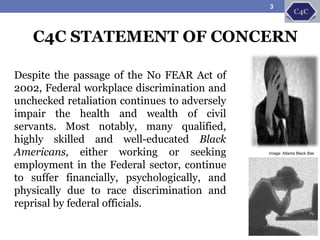
Despite the passage of the No FEAR Act of
2002, Federal workplace discrimination and
unchecked retaliation continues to adversely
impair the health and wealth of civil
servants. Most notably, many qualified,
highly skilled and well-educated Black
Americans, either working or seeking
employment in the Federal sector, continue
to suffer financially, psychologically, and
physically due to race discrimination and
reprisal by federal officials.
Image: Atlanta Black Star
3
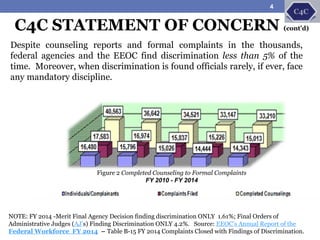
Despite counseling reports and formal complaints in the thousands,
federal agencies and the EEOC find discrimination less than 5% of the
time. Moreover, when discrimination is found officials rarely, if ever, face
any mandatory discipline.
C4C STATEMENT OF CONCERN (cont’d)
NOTE: FY 2014 -Merit Final Agency Decision finding discrimination ONLY 1.61%; Final Orders of
Administrative Judges (AJ’s) Finding Discrimination ONLY 4.2%. Source: EEOC’s Annual Report of the
Federal Workforce FY 2014 – Table B-15 FY 2014 Complaints Closed with Findings of Discrimination.
Figure 2 Completed Counseling to Formal Complaints
FY 2010 - FY 2014
4
Measure 1: Prescribe That Agencies Announce Unlawful Violations via E-Notice to
Employees (Operating Unit Level)
Measure 2: Increase Use of Sanction Authority For Agency Non-Compliance
with 29 CFR 1614 (Rule in Favor of Complainant)
Measure 3: Post Class Action Complaints on EEOC Website
Measure 4: Post Federal Violations on EEOC Homepage
Measure 5: Disband Anonymity: Identify the Discriminating Official
Measure 6: Use Certify Mail When Issuing Complainant Right To File a Civil Action
Measure 7: Support Discipline. Refer Civil Rights Violators to the Office Special
Counsel
Measure 8: Prohibit GAG Orders That May Impose Harm on Public Health or Safety
INDEX OF RECOMMENDED FEDERAL
WORKPLACE ACCOUNTABILITY
MEASURES
*NOTE: Some of the measures recommended to spur a workplace free of discrimination and retaliation The Coalition For
Change, Inc. (C4C) previously submitted in support of H.R. 1557 Federal Employee Antidiscrimination Act as
introduced by Rep. Elijah Cummings on 3/24/15.
5
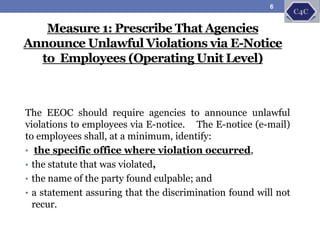
The EEOC should require agencies to announce unlawful
violations to employees via E-notice. The E-notice (e-mail)
to employees shall, at a minimum, identify:
• the specific office where violation occurred,
• the statute that was violated,
• the name of the party found culpable; and
• a statement assuring that the discrimination found will not
recur.
Measure 1: Prescribe That Agencies
Announce Unlawful Violations via E-Notice
to Employees (Operating Unit Level)
6
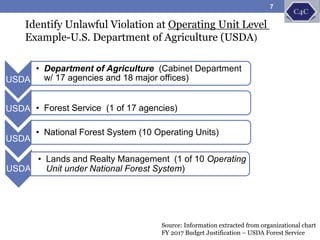
USDA
• Department of Agriculture (Cabinet Department
w/ 17 agencies and 18 major offices)
USDA • Forest Service (1 of 17 agencies)
USDA
• National Forest System (10 Operating Units)
Source: Information extracted from organizational chart
FY 2017 Budget Justification – USDA Forest Service
SDA
Identify Unlawful Violation at Operating Unit Level
Example-U.S. Department of Agriculture (USDA)
USDA
• Lands and Realty Management (1 of 10 Operating
Unit under National Forest System)
7
Measure 2: Increase Use of Sanction
Authority For Agency Non-Compliance
with 29 CFR 1614
Agencies routinely ignore provisions of 29 CFR 1614.
Agency Program To Promote Equal Employment Opportunity
The EEOC should make more effective, timely, and regular use of its
sanction authority to combat discrimination. When a Federal agency
violates an EEOC regulation governing Federal sector complaint
processing, the EEOC should enter a judgment in favor employee. For
example, when a Federal agency fails (without good cause) to timely
comply with the 180 day “EEO complaint investigative requirement,” as
prescribed in 29 CFR §1614.108 - the EEOC should enter a judgment in
favor employee.
[NOTE:-The U.S. Social Security Administration’s (SSA) No FEAR data disclosed that the agency
exceeds the prescribed days to conduct investigations. The SSA, which has on-going class complaint
activity, reported that in fiscal year 2015 it exceeded regulations. [Average Number of Days 286 for
Fiscal year of 2015.]
8
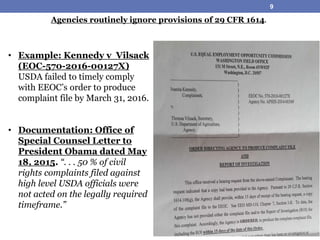
• Example: Kennedy v Vilsack
(EOC-570-2016-00127X)
USDA failed to timely comply
with EEOC’s order to produce
complaint file by March 31, 2016.
• Documentation: Office of
Special Counsel Letter to
President Obama dated May
18, 2015. “. . . 50 % of civil
rights complaints filed against
high level USDA officials were
not acted on the legally required
timeframe.”
Agencies routinely ignore provisions of 29 CFR 1614.
9
Measure 3: Post Class Action Complaints
On EEOC Website
The EEOC should post “class action” complaint data on its
website. Data should disclose:
• the name of the agency;
• the initial filing date of class complaint; and
• status of the class complaint.
10
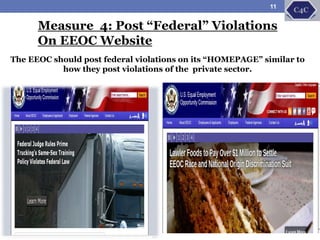
Measure 4: Post “Federal” Violations
On EEOC Website
The EEOC should post federal violations on its “HOMEPAGE” similar to
how they post violations of the private sector.
11
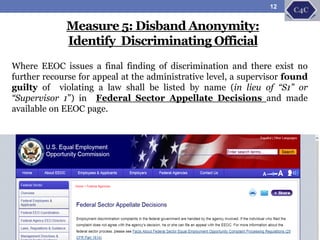
Measure 5: Disband Anonymity:
Identify Discriminating Official
Where EEOC issues a final finding of discrimination and there exist no
further recourse for appeal at the administrative level, a supervisor found
guilty of violating a law shall be listed by name (in lieu of “S1” or
“Supervisor 1”) in Federal Sector Appellate Decisions and made
available on EEOC page.
12
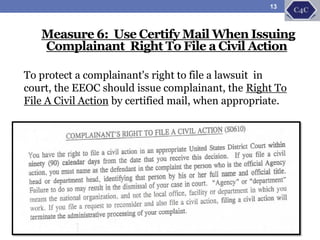
Measure 6: Use Certify Mail When Issuing
Complainant Right To File a Civil Action
To protect a complainant's right to file a lawsuit in
court, the EEOC should issue complainant, the Right To
File A Civil Action by certified mail, when appropriate.
13
Measure 7: Support Discipline.
Refer Civil Rights Violators to the Office Special
Counsel (OSC)
When a supervisor is found guilty of an unlawful violation
and the EEOC issues a finding against the supervisor/agency
and all appeal rights are exhausted--- the EEOC should at
the very least, recommend discipline and forward the
the discriminating official’s name to the OSC for
discipline.
Note: The C4C conducted a Freedom of Information Act (FOIA) inquiry to assess how often, if at all, the EEOC followed
through with its enforcement authority by referring cases to the OSC for disciplinary action when appropriate. We found
that over a ten year period and after finding retaliation in numerous cases, the EEOC referred ZERO names to OSC for
disciplinary action.
14
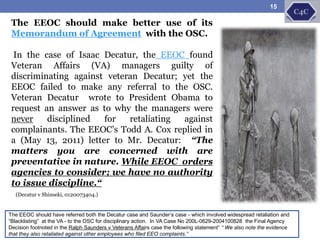
The EEOC should have referred both the Decatur case and Saunder’s case - which involved widespread retaliation and
“Blacklisting” at the VA - to the OSC for disciplinary action. In VA Case No 200L-0629-2004100828 the Final Agency
Decision footnoted in the Ralph Saunders v Veterans Affairs case the following statement” “ We also note the evidence
that they also retaliated against other employees who filed EEO complaints.”
The EEOC should make better use of its
Memorandum of Agreement with the OSC.
In the case of Isaac Decatur, the EEOC found
Veteran Affairs (VA) managers guilty of
discriminating against veteran Decatur; yet the
EEOC failed to make any referral to the OSC.
Veteran Decatur wrote to President Obama to
request an answer as to why the managers were
never disciplined for retaliating against
complainants. The EEOC’s Todd A. Cox replied in
a (May 13, 2011) letter to Mr. Decatur: “The
matters you are concerned with are
preventative in nature. While EEOC orders
agencies to consider; we have no authority
to issue discipline.“
(Decatur v Shinseki, 0120073404.)
15
The EEOC should prohibit agency use of GAG
Orders that may impose harm on public health or
safety.
At the very least, the EEOC should issue a statement
opposing a federal agency’s use of such waiver
clauses in an EEO settlement agreement (a.k.a.
GAG order) that precludes an individual right to
disclose wrong-doing to the Office of Special Counsel
where such a disclosure may represent a substantial
and specific danger to public health or safety (i.e.
Veterans Affairs’ patient waiting list abuses.)
Reference: Mitchell v Veterans Affairs [Destruction of Patient Medical
Records-System Redesign YouTube Video.]
Measure 8: Prohibit GAG Orders That May
Impose Harm on Public Health or Safety
16
Presented by:
Tanya Ward Jordan, President
The Coalition For Change, Inc. (C4C)
Attending C4C Chair Members
Arthuretta Holmes Martin-Health and Wellness Chair
David Grogan-Social Media Chair
THE FEDERAL EEO COMPLAINT PROCESS:
INCREASED ACCOUNTABILITY
MEASURES NEEDED
“Darkness Cannot Drive Out Darkness; Only Light Can Do That”--- Dr. Martin Luther King, Jr.

Federal EEO Complaint Process Increased Accountability Measures Needed

  • 1.
    The Federal EEOComplaint Process: Increased Accountability Measures Needed Prepared for the U.S. Equal Employment Office Commission Office of Federal Operations Director Carlton M. Hadden Prepared by The Coalition For Change, Inc. (C4C) May 3, 2016
  • 2.
    The U.S. EqualEmployment Opportunity Commission (EEOC) needs to make Federal agencies and officials more accountable for violating employment discrimination and whistleblower protection laws. Agency EEO data, reported pursuant to the Notification and Federal Employee Anti-discrimination and Retaliation Act (No FEAR) of 2002, underscores a critical need for enhanced accountability and transparency within the Federal EEO complaint process. The EEOC should adopt added accountability measures to combat the chronic retaliation against employees which: • negatively affects the government’s operational efficiency, • increasingly puts the employee as well as the public safety at risk, and • annually costs the American taxpayer millions of dollars. STATEMENT OF NEED 2
  • 3.
    C4C STATEMENT OFCONCERN Despite the passage of the No FEAR Act of 2002, Federal workplace discrimination and unchecked retaliation continues to adversely impair the health and wealth of civil servants. Most notably, many qualified, highly skilled and well-educated Black Americans, either working or seeking employment in the Federal sector, continue to suffer financially, psychologically, and physically due to race discrimination and reprisal by federal officials. Image: Atlanta Black Star 3
  • 4.
    Despite counseling reportsand formal complaints in the thousands, federal agencies and the EEOC find discrimination less than 5% of the time. Moreover, when discrimination is found officials rarely, if ever, face any mandatory discipline. C4C STATEMENT OF CONCERN (cont’d) NOTE: FY 2014 -Merit Final Agency Decision finding discrimination ONLY 1.61%; Final Orders of Administrative Judges (AJ’s) Finding Discrimination ONLY 4.2%. Source: EEOC’s Annual Report of the Federal Workforce FY 2014 – Table B-15 FY 2014 Complaints Closed with Findings of Discrimination. Figure 2 Completed Counseling to Formal Complaints FY 2010 - FY 2014 4
  • 5.
    Measure 1: PrescribeThat Agencies Announce Unlawful Violations via E-Notice to Employees (Operating Unit Level) Measure 2: Increase Use of Sanction Authority For Agency Non-Compliance with 29 CFR 1614 (Rule in Favor of Complainant) Measure 3: Post Class Action Complaints on EEOC Website Measure 4: Post Federal Violations on EEOC Homepage Measure 5: Disband Anonymity: Identify the Discriminating Official Measure 6: Use Certify Mail When Issuing Complainant Right To File a Civil Action Measure 7: Support Discipline. Refer Civil Rights Violators to the Office Special Counsel Measure 8: Prohibit GAG Orders That May Impose Harm on Public Health or Safety INDEX OF RECOMMENDED FEDERAL WORKPLACE ACCOUNTABILITY MEASURES *NOTE: Some of the measures recommended to spur a workplace free of discrimination and retaliation The Coalition For Change, Inc. (C4C) previously submitted in support of H.R. 1557 Federal Employee Antidiscrimination Act as introduced by Rep. Elijah Cummings on 3/24/15. 5
  • 6.
    The EEOC shouldrequire agencies to announce unlawful violations to employees via E-notice. The E-notice (e-mail) to employees shall, at a minimum, identify: • the specific office where violation occurred, • the statute that was violated, • the name of the party found culpable; and • a statement assuring that the discrimination found will not recur. Measure 1: Prescribe That Agencies Announce Unlawful Violations via E-Notice to Employees (Operating Unit Level) 6
  • 7.
    USDA • Department ofAgriculture (Cabinet Department w/ 17 agencies and 18 major offices) USDA • Forest Service (1 of 17 agencies) USDA • National Forest System (10 Operating Units) Source: Information extracted from organizational chart FY 2017 Budget Justification – USDA Forest Service SDA Identify Unlawful Violation at Operating Unit Level Example-U.S. Department of Agriculture (USDA) USDA • Lands and Realty Management (1 of 10 Operating Unit under National Forest System) 7
  • 8.
    Measure 2: IncreaseUse of Sanction Authority For Agency Non-Compliance with 29 CFR 1614 Agencies routinely ignore provisions of 29 CFR 1614. Agency Program To Promote Equal Employment Opportunity The EEOC should make more effective, timely, and regular use of its sanction authority to combat discrimination. When a Federal agency violates an EEOC regulation governing Federal sector complaint processing, the EEOC should enter a judgment in favor employee. For example, when a Federal agency fails (without good cause) to timely comply with the 180 day “EEO complaint investigative requirement,” as prescribed in 29 CFR §1614.108 - the EEOC should enter a judgment in favor employee. [NOTE:-The U.S. Social Security Administration’s (SSA) No FEAR data disclosed that the agency exceeds the prescribed days to conduct investigations. The SSA, which has on-going class complaint activity, reported that in fiscal year 2015 it exceeded regulations. [Average Number of Days 286 for Fiscal year of 2015.] 8
  • 9.
    • Example: Kennedyv Vilsack (EOC-570-2016-00127X) USDA failed to timely comply with EEOC’s order to produce complaint file by March 31, 2016. • Documentation: Office of Special Counsel Letter to President Obama dated May 18, 2015. “. . . 50 % of civil rights complaints filed against high level USDA officials were not acted on the legally required timeframe.” Agencies routinely ignore provisions of 29 CFR 1614. 9
  • 10.
    Measure 3: PostClass Action Complaints On EEOC Website The EEOC should post “class action” complaint data on its website. Data should disclose: • the name of the agency; • the initial filing date of class complaint; and • status of the class complaint. 10
  • 11.
    Measure 4: Post“Federal” Violations On EEOC Website The EEOC should post federal violations on its “HOMEPAGE” similar to how they post violations of the private sector. 11
  • 12.
    Measure 5: DisbandAnonymity: Identify Discriminating Official Where EEOC issues a final finding of discrimination and there exist no further recourse for appeal at the administrative level, a supervisor found guilty of violating a law shall be listed by name (in lieu of “S1” or “Supervisor 1”) in Federal Sector Appellate Decisions and made available on EEOC page. 12
  • 13.
    Measure 6: UseCertify Mail When Issuing Complainant Right To File a Civil Action To protect a complainant's right to file a lawsuit in court, the EEOC should issue complainant, the Right To File A Civil Action by certified mail, when appropriate. 13
  • 14.
    Measure 7: SupportDiscipline. Refer Civil Rights Violators to the Office Special Counsel (OSC) When a supervisor is found guilty of an unlawful violation and the EEOC issues a finding against the supervisor/agency and all appeal rights are exhausted--- the EEOC should at the very least, recommend discipline and forward the the discriminating official’s name to the OSC for discipline. Note: The C4C conducted a Freedom of Information Act (FOIA) inquiry to assess how often, if at all, the EEOC followed through with its enforcement authority by referring cases to the OSC for disciplinary action when appropriate. We found that over a ten year period and after finding retaliation in numerous cases, the EEOC referred ZERO names to OSC for disciplinary action. 14
  • 15.
    The EEOC shouldhave referred both the Decatur case and Saunder’s case - which involved widespread retaliation and “Blacklisting” at the VA - to the OSC for disciplinary action. In VA Case No 200L-0629-2004100828 the Final Agency Decision footnoted in the Ralph Saunders v Veterans Affairs case the following statement” “ We also note the evidence that they also retaliated against other employees who filed EEO complaints.” The EEOC should make better use of its Memorandum of Agreement with the OSC. In the case of Isaac Decatur, the EEOC found Veteran Affairs (VA) managers guilty of discriminating against veteran Decatur; yet the EEOC failed to make any referral to the OSC. Veteran Decatur wrote to President Obama to request an answer as to why the managers were never disciplined for retaliating against complainants. The EEOC’s Todd A. Cox replied in a (May 13, 2011) letter to Mr. Decatur: “The matters you are concerned with are preventative in nature. While EEOC orders agencies to consider; we have no authority to issue discipline.“ (Decatur v Shinseki, 0120073404.) 15
  • 16.
    The EEOC shouldprohibit agency use of GAG Orders that may impose harm on public health or safety. At the very least, the EEOC should issue a statement opposing a federal agency’s use of such waiver clauses in an EEO settlement agreement (a.k.a. GAG order) that precludes an individual right to disclose wrong-doing to the Office of Special Counsel where such a disclosure may represent a substantial and specific danger to public health or safety (i.e. Veterans Affairs’ patient waiting list abuses.) Reference: Mitchell v Veterans Affairs [Destruction of Patient Medical Records-System Redesign YouTube Video.] Measure 8: Prohibit GAG Orders That May Impose Harm on Public Health or Safety 16
  • 17.
    Presented by: Tanya WardJordan, President The Coalition For Change, Inc. (C4C) Attending C4C Chair Members Arthuretta Holmes Martin-Health and Wellness Chair David Grogan-Social Media Chair THE FEDERAL EEO COMPLAINT PROCESS: INCREASED ACCOUNTABILITY MEASURES NEEDED “Darkness Cannot Drive Out Darkness; Only Light Can Do That”--- Dr. Martin Luther King, Jr.