Federal Cloud Computing Initiative
            Overview
Program Status
• To support the Federal Cloud Computing Direction and Deployment
  Approach, the ITI Line of Business PMO has been refocused as the
  Cloud Computing PMO

• Building on ITI LoB Initiative
    – Infrastructure defined
        •   Consensus model
        •   Metrics
        •   Key Focus Areas
    – Key Themes: consolidation and virtualization

• Cloud Computing Initiative
    – Continue the migration towards a services-based environment that is technology
      and vendor-agnostic
    – Enable rapid deployment of technology solutions for the Federal government
      without developing stove-pipes
    – Enable scalability for existing and new capabilities
    – Increase savings through virtualization
    – Potentially reduce cost of infrastructure, buildings, power, and staffing
    – Improve the government's ability to create a transparent, open and participatory
      government

                                                                                     2
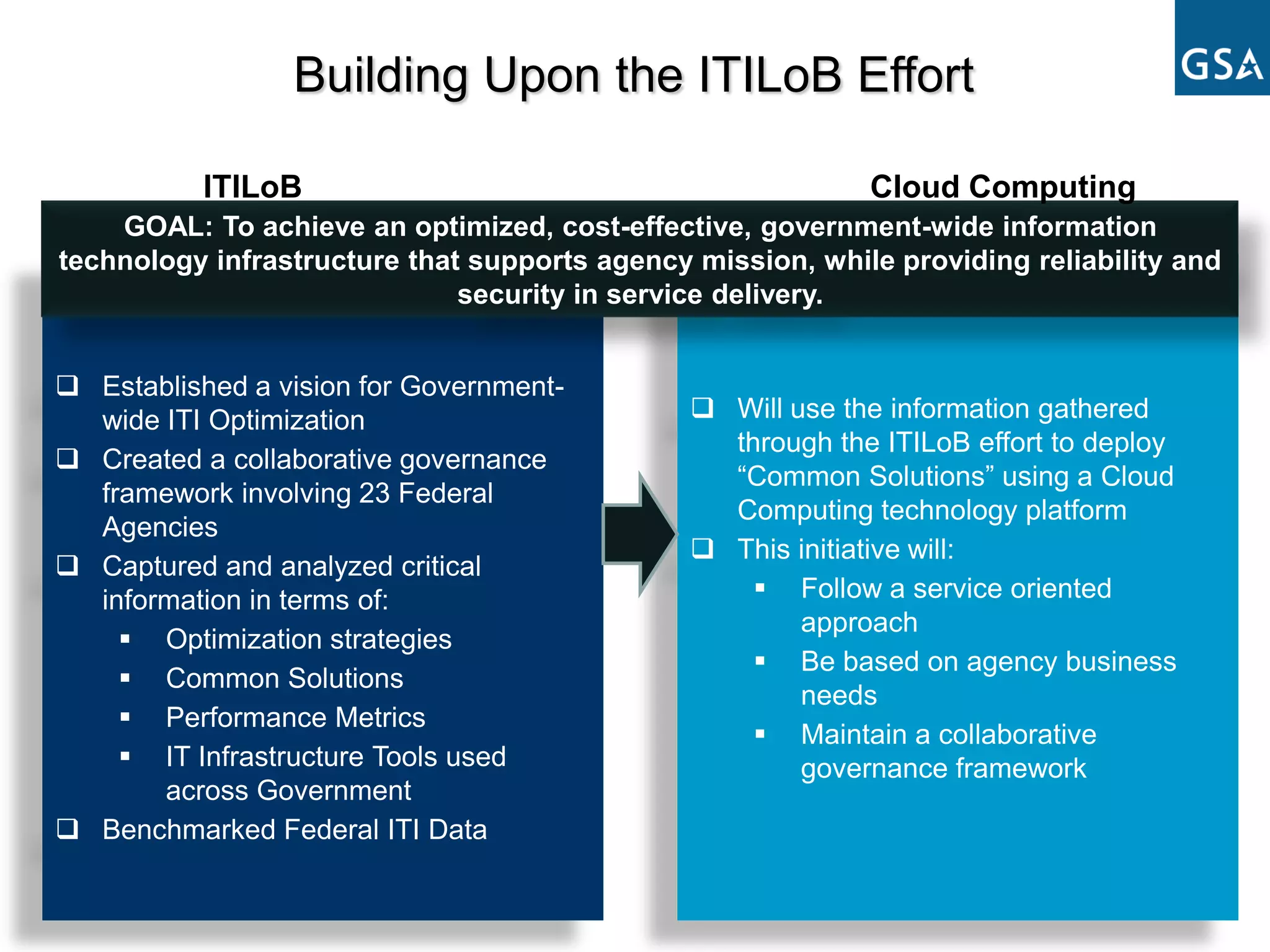
Building Upon the ITILoB Effort

           ITILoB                                           Cloud Computing
    GOAL: To achieve an optimized, cost-effective, government-wide information
technology infrastructure that supports agency mission, while providing reliability and
                              security in service delivery.


 Established a vision for Government-
  wide ITI Optimization                         Will use the information gathered
                                                 through the ITILoB effort to deploy
 Created a collaborative governance
                                                 “Common Solutions” using a Cloud
  framework involving 23 Federal
                                                 Computing technology platform
  Agencies
                                                This initiative will:
 Captured and analyzed critical
  information in terms of:                          Follow a service oriented
                                                       approach
     Optimization strategies
                                                    Be based on agency business
     Common Solutions
                                                       needs
     Performance Metrics
                                                    Maintain a collaborative
     IT Infrastructure Tools used                     governance framework
       across Government
 Benchmarked Federal ITI Data
Administration Priorities for Infrastructure
           Modernization and Cloud Computing

“The Federal technology environment requires a fundamental reexamination of
investments in technology infrastructure.”

“The Infrastructure Modernization Program will be taking on new challenges and
responsibilities. Pilot projects will be implemented to offer an opportunity to utilize more
fully and broadly departmental and agency architectures to identify enterprise-wide
common services and solutions with a new emphasis on cloud computing. “

“The Federal Government will transform its Information Technology Infrastructure by
virtualizing data centers, consolidating data centers and operations, and ultimately
adopting a cloud-computing business model.”


FY2010 Federal Budget
Analytical Perspectives
Cross Cutting Programs
http://www.whitehouse.gov/omb/budget/fy2010/assets/crosscutting.pdf
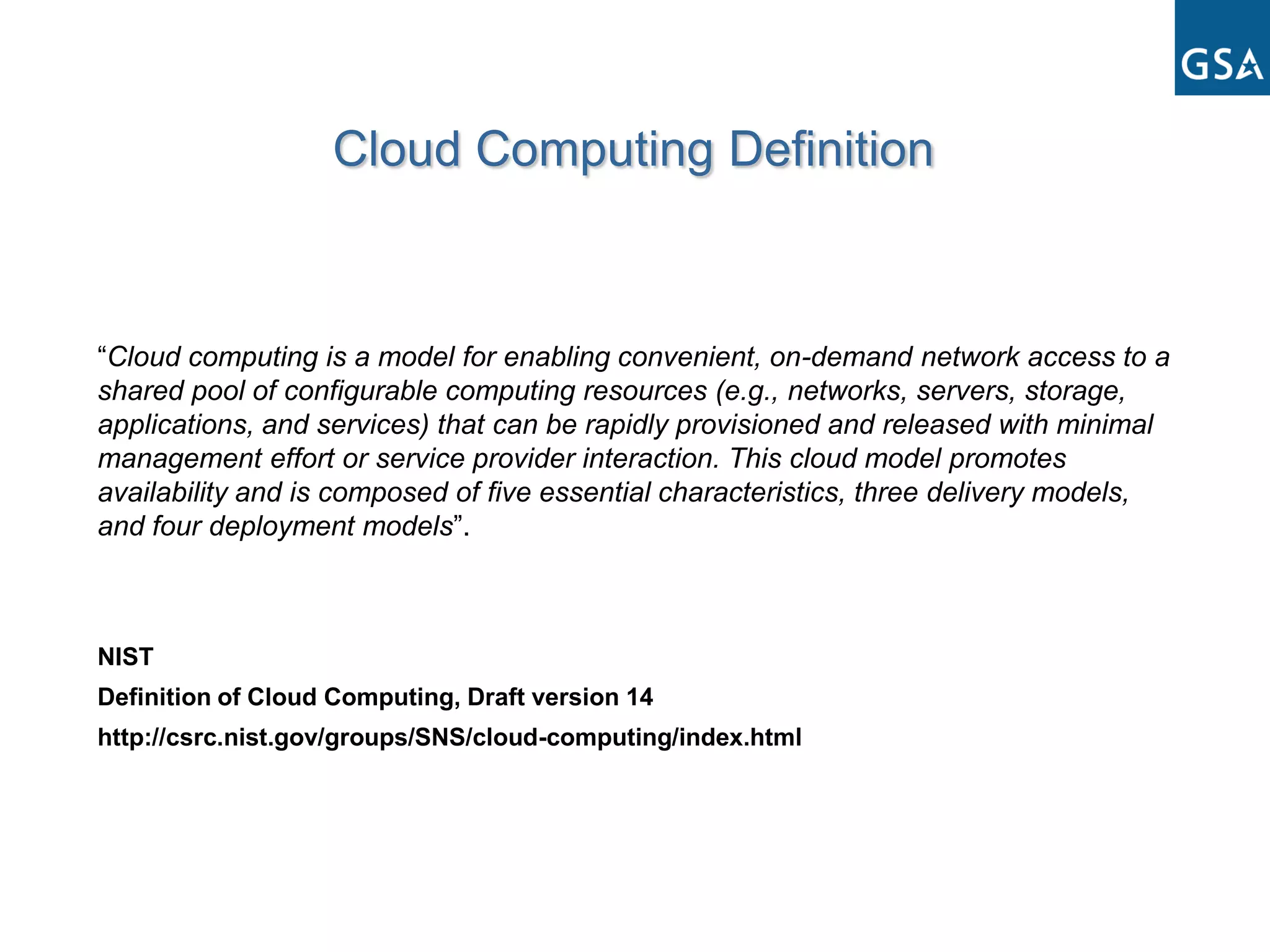
Cloud Computing Definition


“Cloud computing is a model for enabling convenient, on-demand network access to a
shared pool of configurable computing resources (e.g., networks, servers, storage,
applications, and services) that can be rapidly provisioned and released with minimal
management effort or service provider interaction. This cloud model promotes
availability and is composed of five essential characteristics, three delivery models,
and four deployment models”.


NIST
Definition of Cloud Computing, Draft version 14
http://csrc.nist.gov/groups/SNS/cloud-computing/index.html
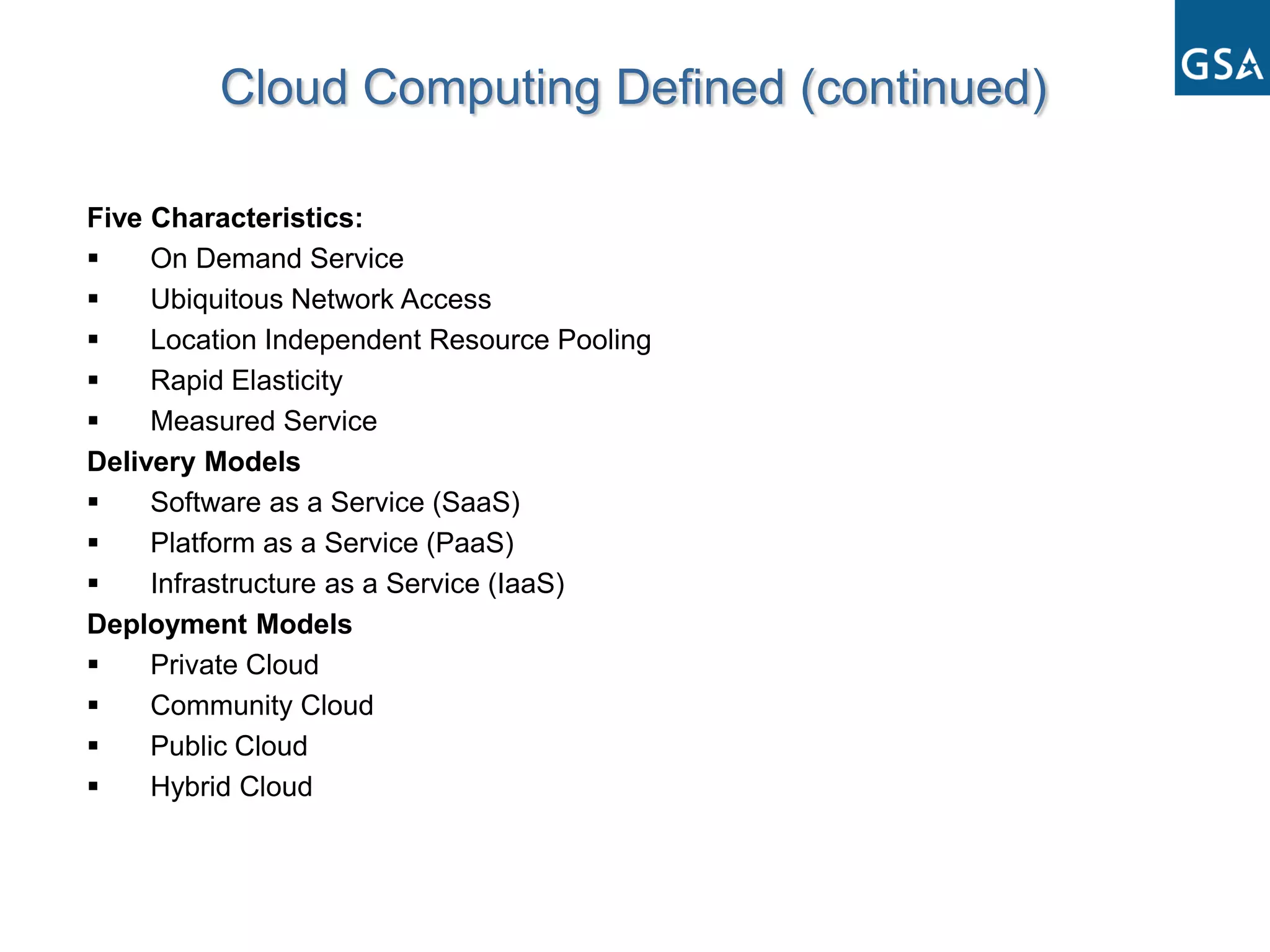
Cloud Computing Defined (continued)

Five Characteristics:
    On Demand Service
    Ubiquitous Network Access
    Location Independent Resource Pooling
    Rapid Elasticity
    Measured Service
Delivery Models
    Software as a Service (SaaS)
    Platform as a Service (PaaS)
    Infrastructure as a Service (IaaS)
Deployment Models
    Private Cloud
    Community Cloud
    Public Cloud
    Hybrid Cloud
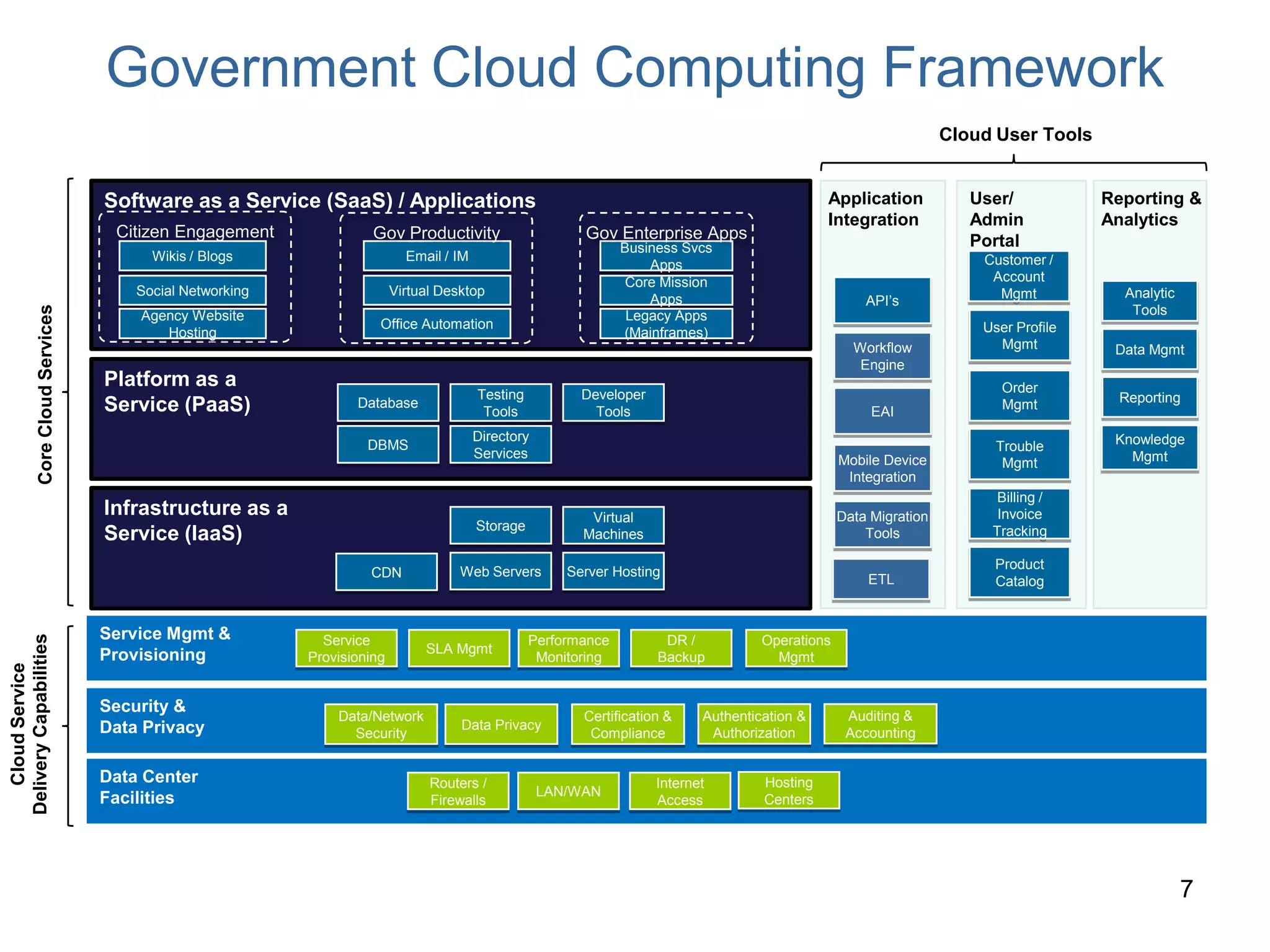
Government Cloud Computing Framework
                                                                                                                                                                      Cloud User Tools


                                    Software as a Service (SaaS) / Applications                                                                   Application            User/           Reporting &
                                                                                                                                                  Integration            Admin           Analytics
                                     Citizen Engagement                Gov Productivity                     Gov Enterprise Apps
                                                                                                                   Business Svcs                                         Portal
                                          Wikis / Blogs                       Email / IM                                                                                  Customer /
                                                                                                                       Apps
                                                                                                                    Core Mission                                           Account
                                        Social Networking                   Virtual Desktop                                                                                 Mgmt           Analytic
                                                                                                                       Apps                              API’s
              Core Cloud Services


                                        Agency Website                                                              Legacy Apps                                                             Tools
                                                                        Office Automation                                                                                 User Profile
                                           Hosting                                                                 (Mainframes)
                                                                                                                                                       Workflow             Mgmt          Data Mgmt
                                                                                                                                                        Engine
                                    Platform as a                                                                                                                            Order
                                                                                           Testing          Developer                                                                     Reporting
                                    Service (PaaS)                  Database
                                                                                            Tools             Tools                                       EAI                Mgmt

                                                                                           Directory                                                                                      Knowledge
                                                                      DBMS                                                                                                  Trouble
                                                                                           Services                                                  Mobile Device                          Mgmt
                                                                                                                                                                             Mgmt
                                                                                                                                                      Integration
                                                                                                                                                                            Billing /
                                    Infrastructure as a                                                      Virtual                                 Data Migration         Invoice
                                                                                           Storage
                                    Service (IaaS)                                                          Machines                                     Tools             Tracking

                                                                                                                                                                            Product
                                                                      CDN              Web Servers        Server Hosting
                                                                                                                                                         ETL                Catalog


                                    Service Mgmt &
Delivery Capabilities


                                                               Service                               Performance         DR /           Operations
                                    Provisioning                                 SLA Mgmt
                                                             Provisioning                             Monitoring        Backup            Mgmt
   Cloud Service


                                    Security &
                                                                 Data/Network                               Certification &    Authentication &       Auditing &
                                    Data Privacy                                       Data Privacy
                                                                   Security                                  Compliance         Authorization         Accounting


                                    Data Center                                   Routers /                             Internet        Hosting
                                                                                                       LAN/WAN
                                    Facilities                                    Firewalls                             Access          Centers


                                                                                                                                                                                                      7
                                                            DRAFT - GSA OCIO INTERNAL USE ONLY
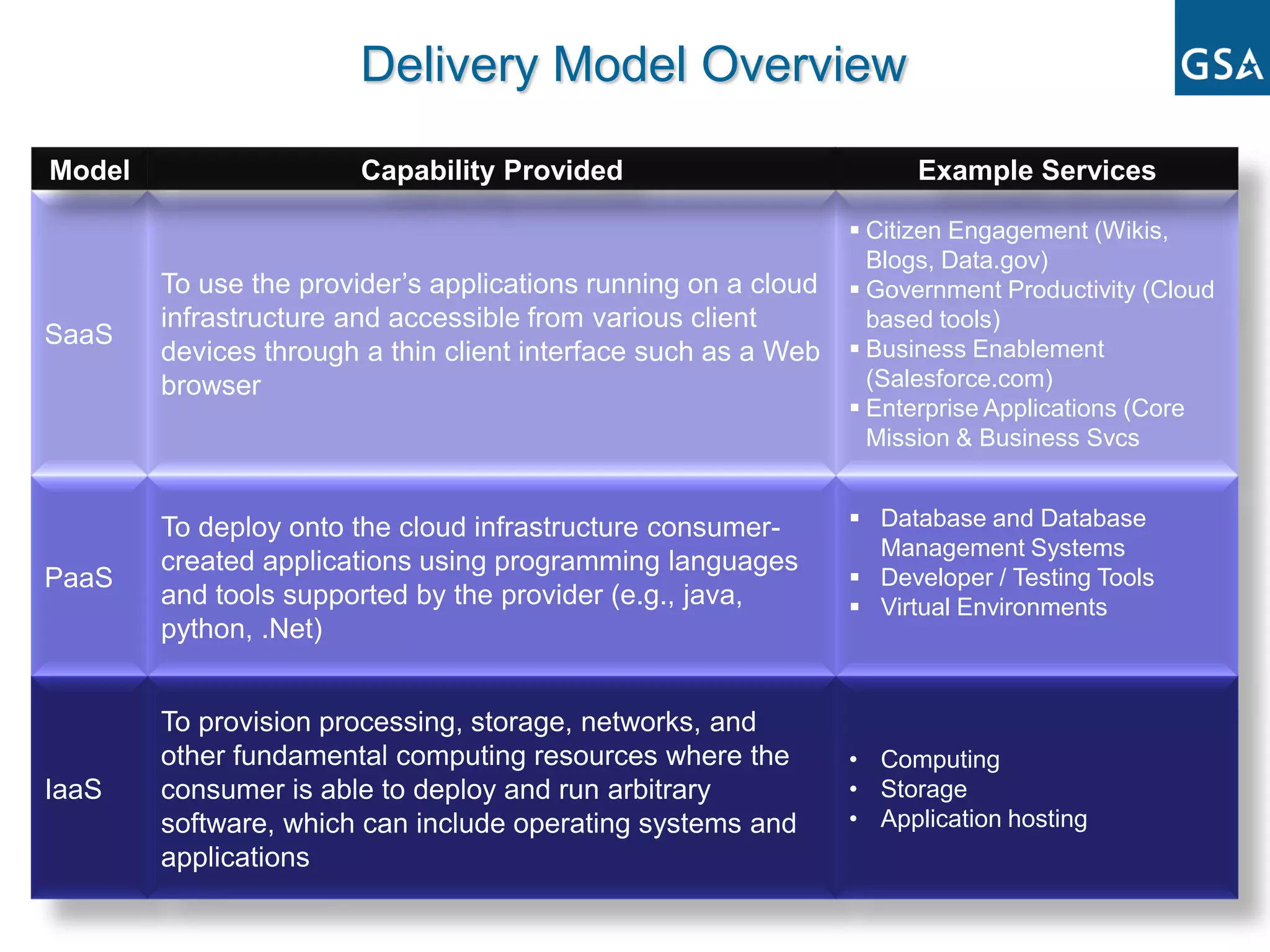
Delivery Model Overview

Model                   Capability Provided                           Example Services

                                                                 Citizen Engagement (Wikis,
                                                                  Blogs, Data.gov)
        To use the provider’s applications running on a cloud    Government Productivity (Cloud
        infrastructure and accessible from various client         based tools)
SaaS                                                             Business Enablement
        devices through a thin client interface such as a Web
        browser                                                   (Salesforce.com)
                                                                 Enterprise Applications (Core
                                                                  Mission & Business Svcs


        To deploy onto the cloud infrastructure consumer-        Database and Database
                                                                  Management Systems
        created applications using programming languages
PaaS                                                             Developer / Testing Tools
        and tools supported by the provider (e.g., java,         Virtual Environments
        python, .Net)


        To provision processing, storage, networks, and
        other fundamental computing resources where the         • Computing
IaaS    consumer is able to deploy and run arbitrary            • Storage
        software, which can include operating systems and       • Application hosting
        applications
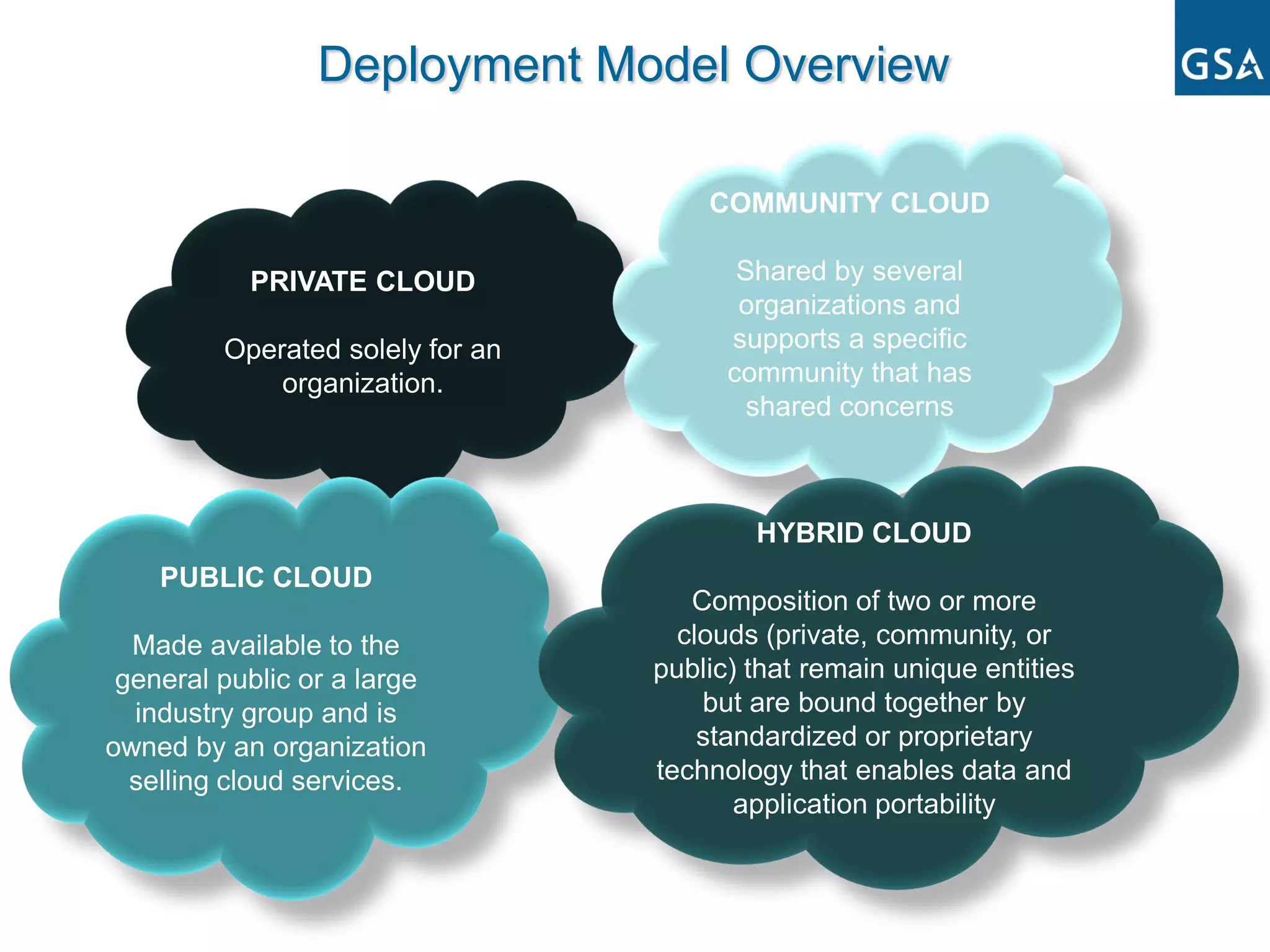
Deployment Model Overview

                                      COMMUNITY CLOUD

           PRIVATE CLOUD                 Shared by several
                                         organizations and
         Operated solely for an         supports a specific
             organization.              community that has
                                          shared concerns


                                          HYBRID CLOUD
    PUBLIC CLOUD
                                     Composition of two or more
  Made available to the             clouds (private, community, or
 general public or a large        public) that remain unique entities
  industry group and is               but are bound together by
owned by an organization              standardized or proprietary
  selling cloud services.         technology that enables data and
                                         application portability
Benefits
• Rapid provisioning and deployment of services

• On-demand scalability and elasticity for new services and
  capabilities

• Creation of a services-based environment that is interoperable and
  standards-based

• Opportunity for Cost Savings
   – Leverages economies of scale
   – Promotes innovation and service sharing
   – Allows for “Measured” Payment (Pay per Use)

• Enables agencies to reinvest in, and concentrate on, core mission
  objective


                                                                       10
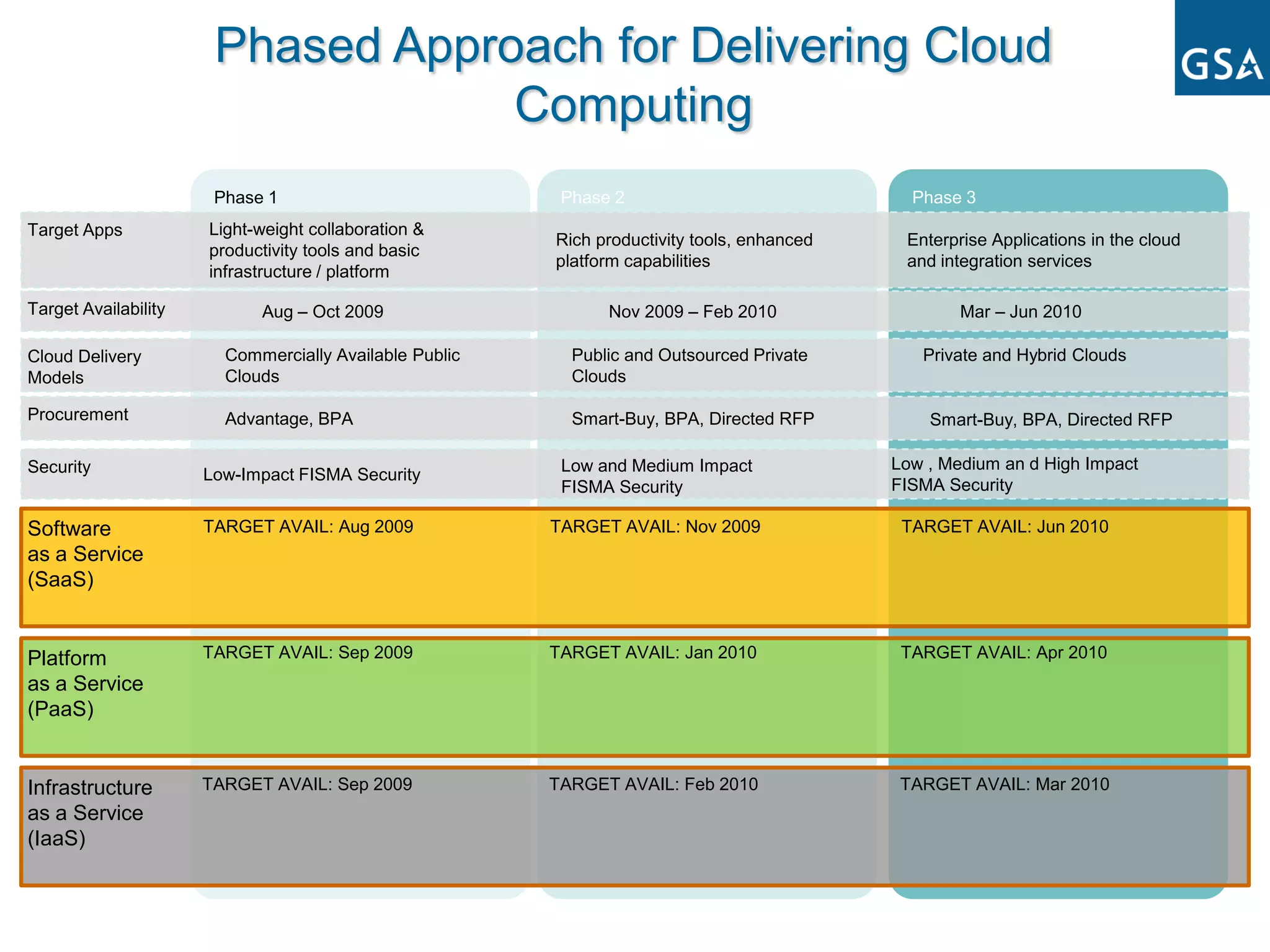
Phased Approach for Delivering Cloud
                                   Computing
                       Phase 1                           Phase 2                              Phase 3
Target Apps           Light-weight collaboration &
                                                        Rich productivity tools, enhanced    Enterprise Applications in the cloud
                      productivity tools and basic
                                                        platform capabilities                and integration services
                      infrastructure / platform

Target Availability         Aug – Oct 2009                    Nov 2009 – Feb 2010                   Mar – Jun 2010

Cloud Delivery          Commercially Available Public     Public and Outsourced Private        Private and Hybrid Clouds
Models                  Clouds                            Clouds

Procurement             Advantage, BPA                    Smart-Buy, BPA, Directed RFP          Smart-Buy, BPA, Directed RFP

Security                                                 Low and Medium Impact              Low , Medium an d High Impact
                      Low-Impact FISMA Security
                                                         FISMA Security                     FISMA Security

Software              TARGET AVAIL: Aug 2009            TARGET AVAIL: Nov 2009               TARGET AVAIL: Jun 2010
as a Service
(SaaS)


Platform              TARGET AVAIL: Sep 2009            TARGET AVAIL: Jan 2010               TARGET AVAIL: Apr 2010
as a Service
(PaaS)


Infrastructure        TARGET AVAIL: Sep 2009            TARGET AVAIL: Feb 2010               TARGET AVAIL: Mar 2010
as a Service
(IaaS)
Progress to Date

1.   Established and staffed the Cloud Computing PMO under the GSA OCIO
2.   Created a Federal Cloud Computing Executive group comprised of Federal
     Agency CIOs and Executives
3.   Attended Federal Cloud Computing Summit – sponsored by ACT/IAC
     •   Federal Cloud Computing Executive group and Executives of leading IaaS and
         SaaS service providers discussed the readiness and viability of private industry
         to accommodate Federal Government business needs and requirements.
4.   Developed a Federal Cloud Computing Technical Framework
5.   Issued an RFI for IaaS
     https://www.fbo.gov/index?s=opportunity&mode=form&id=d208ac8b8687dd9c
          6921d2633603aedb&tab=core&_cview=0&cck=1&au=&ck=
6.   Issued a data call to Federal Agencies requesting information on current
     Cloud Computing-related projects. Information will be used to:
     •   Assess projects for cross-agency use
     •   Facilitate future Federal Cloud Computing service acquisition and deployment
         planning
Progress to Date

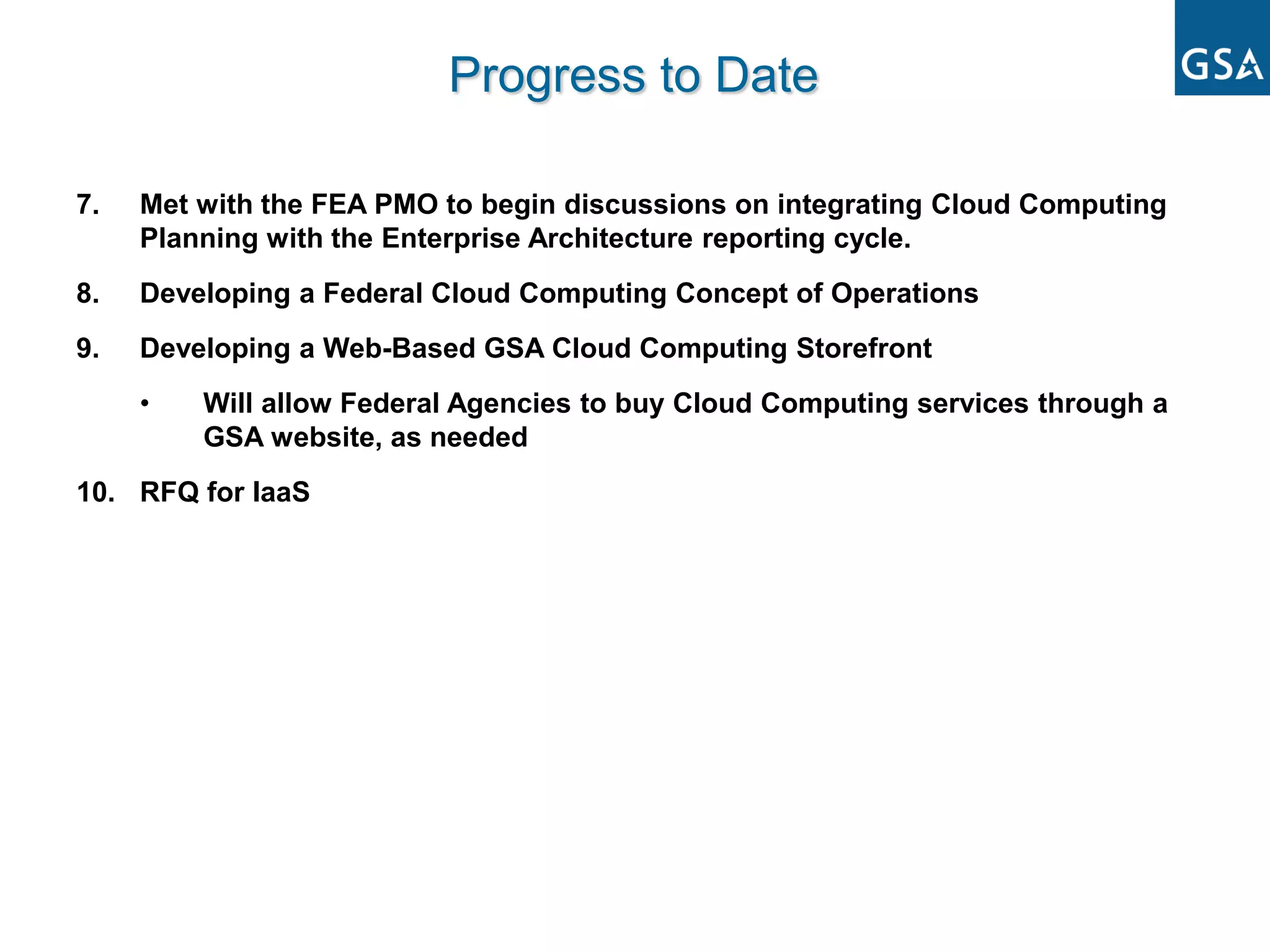
7.   Met with the FEA PMO to begin discussions on integrating Cloud Computing
     Planning with the Enterprise Architecture reporting cycle.
8.   Developing a Federal Cloud Computing Concept of Operations
9.   Developing a Web-Based GSA Cloud Computing Storefront
     •   Will allow Federal Agencies to buy Cloud Computing services through a
         GSA website, as needed
10. RFQ for IaaS
Upcoming Activities

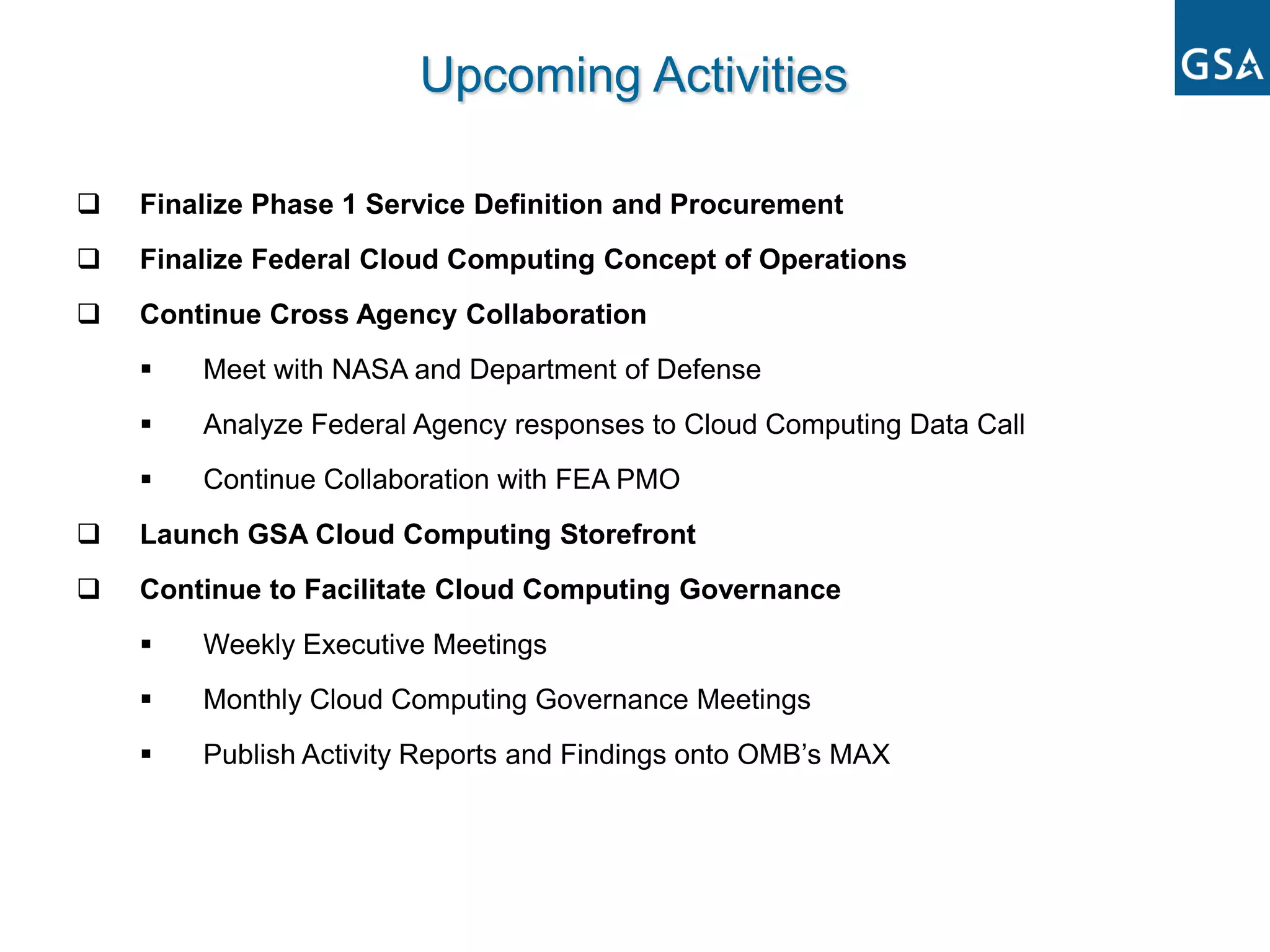
   Finalize Phase 1 Service Definition and Procurement
   Finalize Federal Cloud Computing Concept of Operations
   Continue Cross Agency Collaboration
       Meet with NASA and Department of Defense
       Analyze Federal Agency responses to Cloud Computing Data Call
       Continue Collaboration with FEA PMO
   Launch GSA Cloud Computing Storefront
   Continue to Facilitate Cloud Computing Governance
       Weekly Executive Meetings
       Monthly Cloud Computing Governance Meetings
       Publish Activity Reports and Findings onto OMB’s MAX
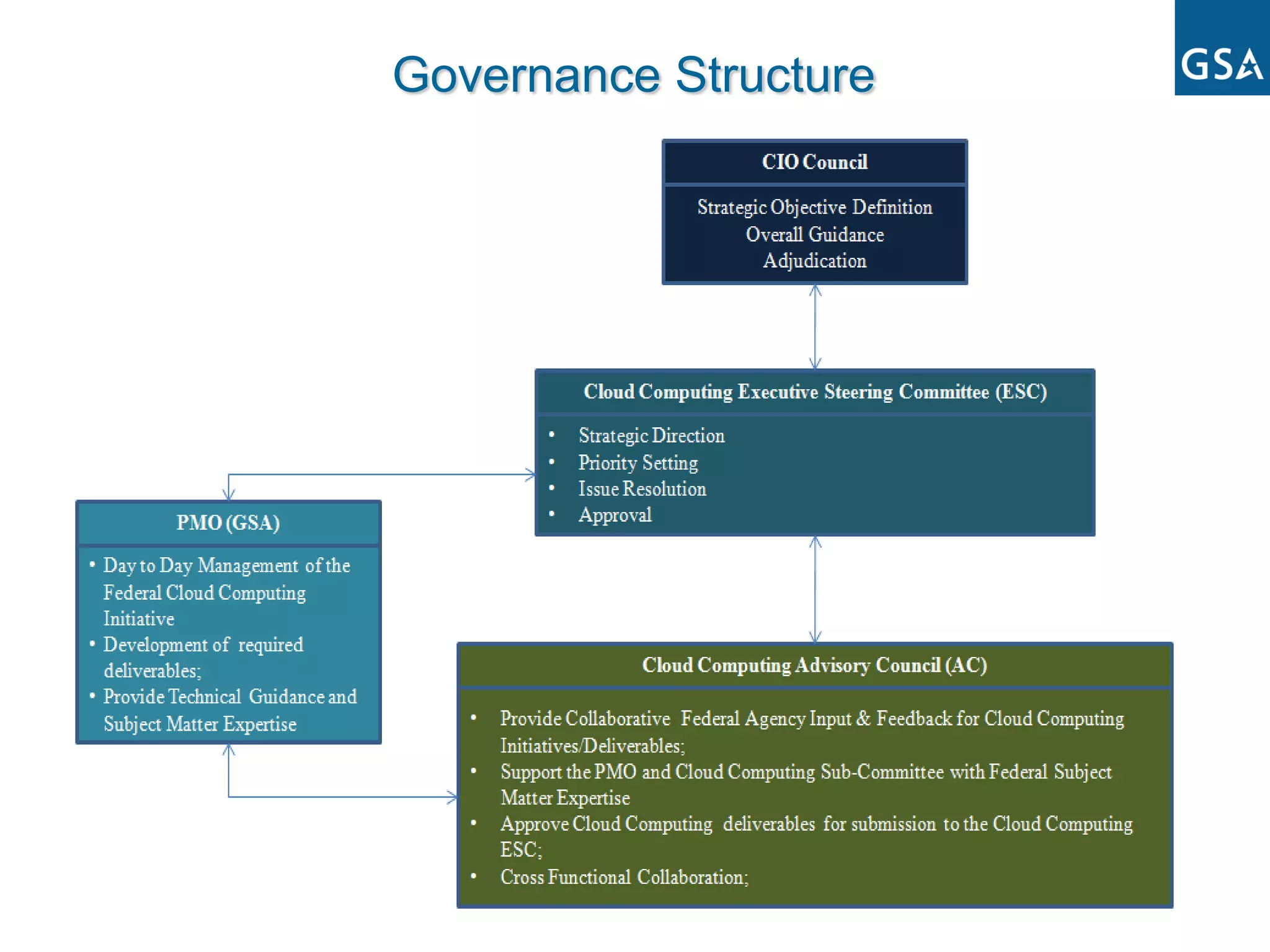
Governance Structure
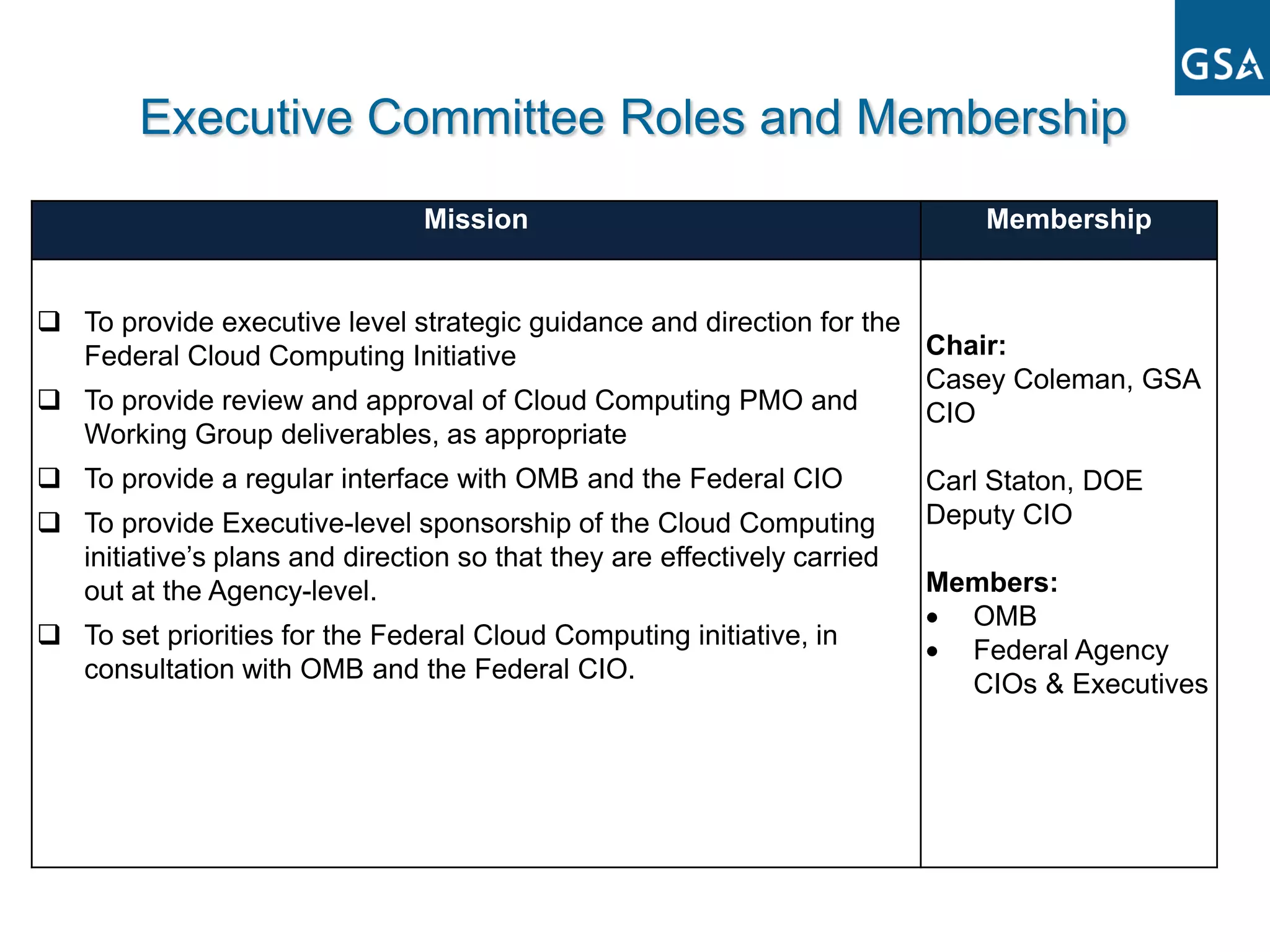
Executive Committee Roles and Membership
                                Mission                                       Membership


 To provide executive level strategic guidance and direction for the
  Federal Cloud Computing Initiative                                  Chair:
                                                                      Casey Coleman, GSA
 To provide review and approval of Cloud Computing PMO and           CIO
  Working Group deliverables, as appropriate
 To provide a regular interface with OMB and the Federal CIO             Carl Staton, DOE
 To provide Executive-level sponsorship of the Cloud Computing           Deputy CIO
  initiative’s plans and direction so that they are effectively carried
  out at the Agency-level.                                                Members:
                                                                            OMB
 To set priorities for the Federal Cloud Computing initiative, in
                                                                            Federal Agency
  consultation with OMB and the Federal CIO.
                                                                            CIOs & Executives
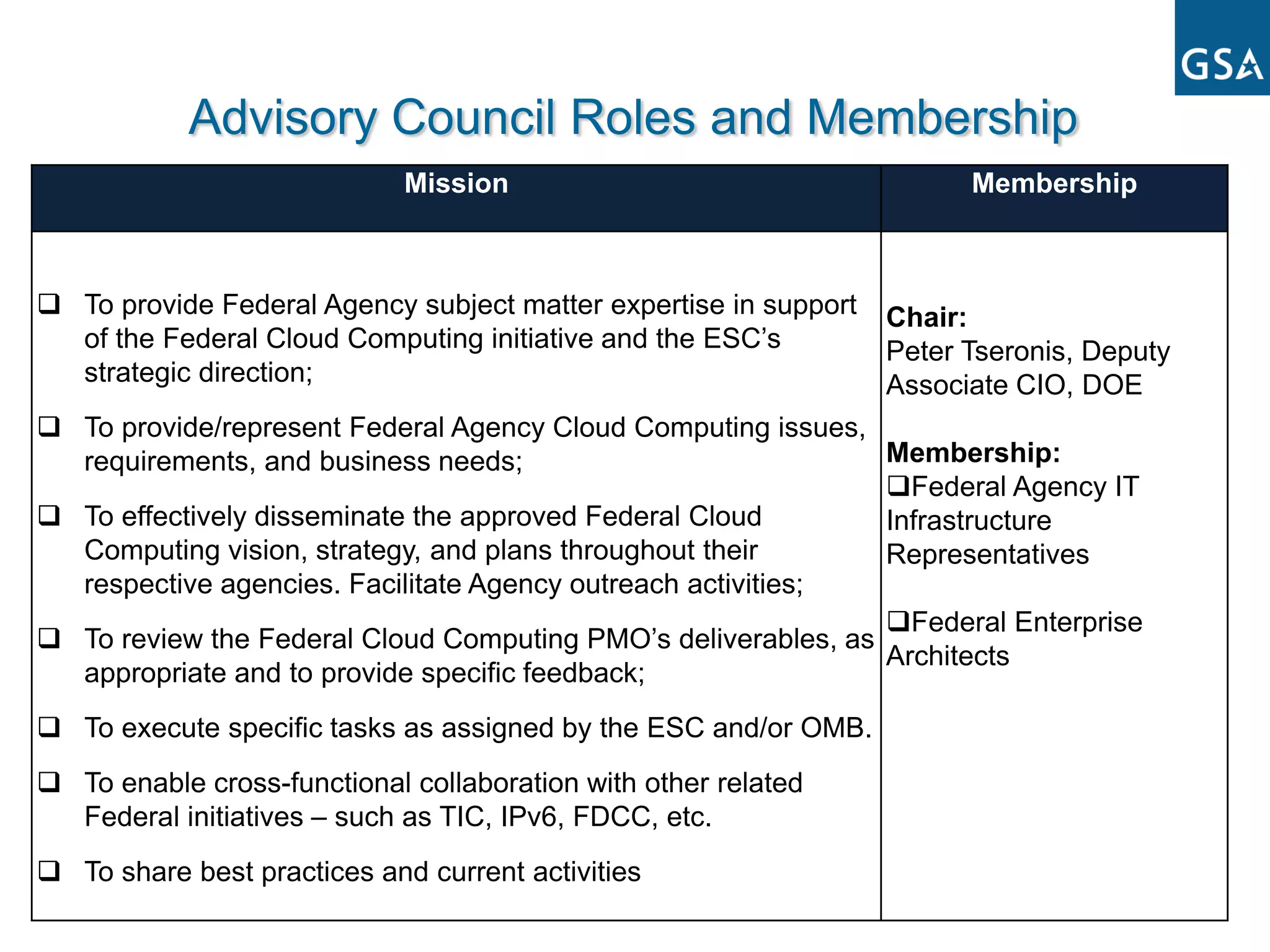
Advisory Council Roles and Membership
                             Mission                                    Membership


 To provide Federal Agency subject matter expertise in support   Chair:
  of the Federal Cloud Computing initiative and the ESC’s         Peter Tseronis, Deputy
  strategic direction;                                            Associate CIO, DOE
 To provide/represent Federal Agency Cloud Computing issues,
  requirements, and business needs;                            Membership:
                                                               Federal Agency IT
 To effectively disseminate the approved Federal Cloud        Infrastructure
  Computing vision, strategy, and plans throughout their       Representatives
  respective agencies. Facilitate Agency outreach activities;
                                                               Federal Enterprise
 To review the Federal Cloud Computing PMO’s deliverables, as
                                                               Architects
  appropriate and to provide specific feedback;
 To execute specific tasks as assigned by the ESC and/or OMB.
 To enable cross-functional collaboration with other related
  Federal initiatives – such as TIC, IPv6, FDCC, etc.
 To share best practices and current activities
Contact Information


   Katie Lewin – mary.lewin@gsa.gov
Questions / Open Discussion

Federal Cloud Computing Initiative

  • 1.
    Federal Cloud ComputingInitiative Overview
  • 2.
    Program Status • Tosupport the Federal Cloud Computing Direction and Deployment Approach, the ITI Line of Business PMO has been refocused as the Cloud Computing PMO • Building on ITI LoB Initiative – Infrastructure defined • Consensus model • Metrics • Key Focus Areas – Key Themes: consolidation and virtualization • Cloud Computing Initiative – Continue the migration towards a services-based environment that is technology and vendor-agnostic – Enable rapid deployment of technology solutions for the Federal government without developing stove-pipes – Enable scalability for existing and new capabilities – Increase savings through virtualization – Potentially reduce cost of infrastructure, buildings, power, and staffing – Improve the government's ability to create a transparent, open and participatory government 2
  • 3.
    Building Upon theITILoB Effort ITILoB Cloud Computing GOAL: To achieve an optimized, cost-effective, government-wide information technology infrastructure that supports agency mission, while providing reliability and security in service delivery.  Established a vision for Government- wide ITI Optimization  Will use the information gathered through the ITILoB effort to deploy  Created a collaborative governance “Common Solutions” using a Cloud framework involving 23 Federal Computing technology platform Agencies  This initiative will:  Captured and analyzed critical information in terms of:  Follow a service oriented approach  Optimization strategies  Be based on agency business  Common Solutions needs  Performance Metrics  Maintain a collaborative  IT Infrastructure Tools used governance framework across Government  Benchmarked Federal ITI Data
  • 4.
    Administration Priorities forInfrastructure Modernization and Cloud Computing “The Federal technology environment requires a fundamental reexamination of investments in technology infrastructure.” “The Infrastructure Modernization Program will be taking on new challenges and responsibilities. Pilot projects will be implemented to offer an opportunity to utilize more fully and broadly departmental and agency architectures to identify enterprise-wide common services and solutions with a new emphasis on cloud computing. “ “The Federal Government will transform its Information Technology Infrastructure by virtualizing data centers, consolidating data centers and operations, and ultimately adopting a cloud-computing business model.” FY2010 Federal Budget Analytical Perspectives Cross Cutting Programs http://www.whitehouse.gov/omb/budget/fy2010/assets/crosscutting.pdf
  • 5.
    Cloud Computing Definition “Cloudcomputing is a model for enabling convenient, on-demand network access to a shared pool of configurable computing resources (e.g., networks, servers, storage, applications, and services) that can be rapidly provisioned and released with minimal management effort or service provider interaction. This cloud model promotes availability and is composed of five essential characteristics, three delivery models, and four deployment models”. NIST Definition of Cloud Computing, Draft version 14 http://csrc.nist.gov/groups/SNS/cloud-computing/index.html
  • 6.
    Cloud Computing Defined(continued) Five Characteristics:  On Demand Service  Ubiquitous Network Access  Location Independent Resource Pooling  Rapid Elasticity  Measured Service Delivery Models  Software as a Service (SaaS)  Platform as a Service (PaaS)  Infrastructure as a Service (IaaS) Deployment Models  Private Cloud  Community Cloud  Public Cloud  Hybrid Cloud
  • 7.
    Government Cloud ComputingFramework Cloud User Tools Software as a Service (SaaS) / Applications Application User/ Reporting & Integration Admin Analytics Citizen Engagement Gov Productivity Gov Enterprise Apps Business Svcs Portal Wikis / Blogs Email / IM Customer / Apps Core Mission Account Social Networking Virtual Desktop Mgmt Analytic Apps API’s Core Cloud Services Agency Website Legacy Apps Tools Office Automation User Profile Hosting (Mainframes) Workflow Mgmt Data Mgmt Engine Platform as a Order Testing Developer Reporting Service (PaaS) Database Tools Tools EAI Mgmt Directory Knowledge DBMS Trouble Services Mobile Device Mgmt Mgmt Integration Billing / Infrastructure as a Virtual Data Migration Invoice Storage Service (IaaS) Machines Tools Tracking Product CDN Web Servers Server Hosting ETL Catalog Service Mgmt & Delivery Capabilities Service Performance DR / Operations Provisioning SLA Mgmt Provisioning Monitoring Backup Mgmt Cloud Service Security & Data/Network Certification & Authentication & Auditing & Data Privacy Data Privacy Security Compliance Authorization Accounting Data Center Routers / Internet Hosting LAN/WAN Facilities Firewalls Access Centers 7 DRAFT - GSA OCIO INTERNAL USE ONLY
  • 8.
    Delivery Model Overview Model Capability Provided Example Services  Citizen Engagement (Wikis, Blogs, Data.gov) To use the provider’s applications running on a cloud  Government Productivity (Cloud infrastructure and accessible from various client based tools) SaaS  Business Enablement devices through a thin client interface such as a Web browser (Salesforce.com)  Enterprise Applications (Core Mission & Business Svcs To deploy onto the cloud infrastructure consumer-  Database and Database Management Systems created applications using programming languages PaaS  Developer / Testing Tools and tools supported by the provider (e.g., java,  Virtual Environments python, .Net) To provision processing, storage, networks, and other fundamental computing resources where the • Computing IaaS consumer is able to deploy and run arbitrary • Storage software, which can include operating systems and • Application hosting applications
  • 9.
    Deployment Model Overview COMMUNITY CLOUD PRIVATE CLOUD Shared by several organizations and Operated solely for an supports a specific organization. community that has shared concerns HYBRID CLOUD PUBLIC CLOUD Composition of two or more Made available to the clouds (private, community, or general public or a large public) that remain unique entities industry group and is but are bound together by owned by an organization standardized or proprietary selling cloud services. technology that enables data and application portability
  • 10.
    Benefits • Rapid provisioningand deployment of services • On-demand scalability and elasticity for new services and capabilities • Creation of a services-based environment that is interoperable and standards-based • Opportunity for Cost Savings – Leverages economies of scale – Promotes innovation and service sharing – Allows for “Measured” Payment (Pay per Use) • Enables agencies to reinvest in, and concentrate on, core mission objective 10
  • 11.
    Phased Approach forDelivering Cloud Computing Phase 1 Phase 2 Phase 3 Target Apps Light-weight collaboration & Rich productivity tools, enhanced Enterprise Applications in the cloud productivity tools and basic platform capabilities and integration services infrastructure / platform Target Availability Aug – Oct 2009 Nov 2009 – Feb 2010 Mar – Jun 2010 Cloud Delivery Commercially Available Public Public and Outsourced Private Private and Hybrid Clouds Models Clouds Clouds Procurement Advantage, BPA Smart-Buy, BPA, Directed RFP Smart-Buy, BPA, Directed RFP Security Low and Medium Impact Low , Medium an d High Impact Low-Impact FISMA Security FISMA Security FISMA Security Software TARGET AVAIL: Aug 2009 TARGET AVAIL: Nov 2009 TARGET AVAIL: Jun 2010 as a Service (SaaS) Platform TARGET AVAIL: Sep 2009 TARGET AVAIL: Jan 2010 TARGET AVAIL: Apr 2010 as a Service (PaaS) Infrastructure TARGET AVAIL: Sep 2009 TARGET AVAIL: Feb 2010 TARGET AVAIL: Mar 2010 as a Service (IaaS)
  • 12.
    Progress to Date 1. Established and staffed the Cloud Computing PMO under the GSA OCIO 2. Created a Federal Cloud Computing Executive group comprised of Federal Agency CIOs and Executives 3. Attended Federal Cloud Computing Summit – sponsored by ACT/IAC • Federal Cloud Computing Executive group and Executives of leading IaaS and SaaS service providers discussed the readiness and viability of private industry to accommodate Federal Government business needs and requirements. 4. Developed a Federal Cloud Computing Technical Framework 5. Issued an RFI for IaaS https://www.fbo.gov/index?s=opportunity&mode=form&id=d208ac8b8687dd9c 6921d2633603aedb&tab=core&_cview=0&cck=1&au=&ck= 6. Issued a data call to Federal Agencies requesting information on current Cloud Computing-related projects. Information will be used to: • Assess projects for cross-agency use • Facilitate future Federal Cloud Computing service acquisition and deployment planning
  • 13.
    Progress to Date 7. Met with the FEA PMO to begin discussions on integrating Cloud Computing Planning with the Enterprise Architecture reporting cycle. 8. Developing a Federal Cloud Computing Concept of Operations 9. Developing a Web-Based GSA Cloud Computing Storefront • Will allow Federal Agencies to buy Cloud Computing services through a GSA website, as needed 10. RFQ for IaaS
  • 14.
    Upcoming Activities  Finalize Phase 1 Service Definition and Procurement  Finalize Federal Cloud Computing Concept of Operations  Continue Cross Agency Collaboration  Meet with NASA and Department of Defense  Analyze Federal Agency responses to Cloud Computing Data Call  Continue Collaboration with FEA PMO  Launch GSA Cloud Computing Storefront  Continue to Facilitate Cloud Computing Governance  Weekly Executive Meetings  Monthly Cloud Computing Governance Meetings  Publish Activity Reports and Findings onto OMB’s MAX
  • 15.
  • 16.
    Executive Committee Rolesand Membership Mission Membership  To provide executive level strategic guidance and direction for the Federal Cloud Computing Initiative Chair: Casey Coleman, GSA  To provide review and approval of Cloud Computing PMO and CIO Working Group deliverables, as appropriate  To provide a regular interface with OMB and the Federal CIO Carl Staton, DOE  To provide Executive-level sponsorship of the Cloud Computing Deputy CIO initiative’s plans and direction so that they are effectively carried out at the Agency-level. Members: OMB  To set priorities for the Federal Cloud Computing initiative, in Federal Agency consultation with OMB and the Federal CIO. CIOs & Executives
  • 17.
    Advisory Council Rolesand Membership Mission Membership  To provide Federal Agency subject matter expertise in support Chair: of the Federal Cloud Computing initiative and the ESC’s Peter Tseronis, Deputy strategic direction; Associate CIO, DOE  To provide/represent Federal Agency Cloud Computing issues, requirements, and business needs; Membership: Federal Agency IT  To effectively disseminate the approved Federal Cloud Infrastructure Computing vision, strategy, and plans throughout their Representatives respective agencies. Facilitate Agency outreach activities; Federal Enterprise  To review the Federal Cloud Computing PMO’s deliverables, as Architects appropriate and to provide specific feedback;  To execute specific tasks as assigned by the ESC and/or OMB.  To enable cross-functional collaboration with other related Federal initiatives – such as TIC, IPv6, FDCC, etc.  To share best practices and current activities
  • 18.
    Contact Information  Katie Lewin – mary.lewin@gsa.gov
  • 19.
    Questions / OpenDiscussion