Hurricane Prep and National
Telcom Insurance Group Risk Management Team Monthly Safety Topics:
August 2018
Common reasons, or barriers, why people don’t prepare:
1. APATHY- “It won’t happen here” or “I’ll worry about it if the
threat becomes imminent.”
2. NOT ON MY RADAR- “I just haven’t thought about it”
3. LACK OF INFO- “I don’t know how to do this”
4. FATALISM- “Whatever I do won’t really make a difference in a
big disaster”
5. LACK OF RESOURCES- “I don’t have the money or time. Or
I don’t think I’m capable of doing this”
Some Stats to Make You Think
• Nearly half (40%) of the U.S. population lives in a county that is on the coast.
That number is expected to increase by 10 million by 2020.
• Hurricanes produce severely high wind damage, flooding and can spin off
into tornadoes.
• You do not need to live in one of the coastal counties to be effected by
hurricane activity.
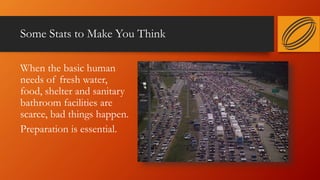
• Evacuation of entire cities poses threats to all involved. Of the 139 deaths
Rita caused, 28 were during the evacuation, 73 died before Rita even reached
Texas, and 10 people died from heat exposure-hyperthermia. That’s 111 not
caused by the storm itself.
Some Stats to Make You Think
When the basic human
needs of fresh water,
food, shelter and sanitary
bathroom facilities are
scarce, bad things happen.
Preparation is essential.
Watch vs Warning
A HURRICANE WATCH is issued when your part of the coast
indicates the possibility that you could experience hurricane
conditions within 48 HOURS with sustained winds of 74 MPH or
higher) https://oceanservice.noaa.gov/facts/watch-warning.html
This watch should trigger a review of your disaster plan.
What Should You Do in
a Warning?
Protective measures should be
initiated at this point, especially
those that require extra time
such as securing property,
sandbagging, fueling vehicles and
generators, defining key
employees, setting up a
command center, and keeping
your insurance (Telcom) contact
information close at hand.
Watch vs Warning
A HURRICANE WARNING
is issued when your part of the
coast indicates that sustained
winds of at least 74 mph are
expected within 24 HOURS
OR LESS. This is the time to
enact your preparedness plan.
In some cases, even at this
stage it is too late.
During a Warning, You Might Want to do the Following:
• Listen to a battery-operated radio or television for hurricane progress reports
• Check emergency supplies
• Fuel cars-personal and company vehicles
• Bring in outdoor objects, such as lawn furniture, toys, garden tools and any
other objects that are not anchored
• Secure buildings by closing and boarding up windows
• Turn refrigerator and freezer to coldest settings
• Store drinking water in clean bathtubs, jugs, and bottles
• Store valuables, medicines, and personal papers in a waterproof container
• Review evacuation plan-personally and for your company (remember, it’s
potentially an emergency personally for your employees too)
Things to Consider When Making Your Plan
• Discuss the type of hazards that could affect your company and
your family. We can’t forget that not just your company could be
affected, but your employee’s personally could be affected.
Know your vulnerability to storm surge, flooding and wind.
• Locate a safe room or the safest areas for each hurricane hazard.
In certain circumstances, the safest areas may not be your office
or home but within your community. In some cases, your
telecom offices maybe the communities command center.
• Determine the best evacuation routes and establish a place to
meet if you and your co-workers are separated. For your family,
have an out-of-state friend as a family contact, so all your family
members have a single point of contact. Remember, it’s easier
and more likely to go through when you text rather than to call
• Have a “Pet Plan” in place before a storm threatens. Contact
your vet or local humane society for information on preparing
your pet for an emergency.
If You Have to Evacuate…
• Leave as soon as possible
• Avoid flooded roads and watch for washed-out bridges
• Unplug appliances, turn off electricity, gas and main water valve
• Tell your designated family contact or someone outside the storm
area where you are going
• If time permits, and you live in a surge or flood zone, elevate furniture to
protect it from flooding or, if possible, move it to a higher floor.
• Take Disaster Supply Kit, warm protective clothing, medicines, blankets
and sleeping bags, and your insurance contact information to shelter
• Lock up your home and your offices
Potential Kit Items
• Water - at least 1 gallon daily per person for 3 to 7 days
• Food - at least enough for 3 to 7 days, including: non-
perishable packaged or canned food/juices; foods for
infants or the elderly; snack foods; non-electric can
opener; cooking tools/fuel; and paper plates/plastic
utensils
• Blankets/Pillows, etc.
• Clothing - seasonal/rain gear/sturdy shoes
• First Aid Kit/Medicines/Prescription Drugs
• Special Items - for babies and the elderly (‘nuff said)
• Toiletries/Hygiene items/Moisture wipes
• Flashlight/ WITH Batteries
• Radio - battery operated and NOAA weather radio
• Telephones - fully charged cell phone with extra battery
and a traditional (not cordless) telephone set (POTS
work great after all!)
Other Last Minute Items to Consider
• On a personal-level, Cash is King. For your
company, be sure you have credit-relationships
with local contractors, gas stations, etc.
• Extra sets of Keys
• If you have children, bring non-electric
entertainment, i.e., books, card games, toys.
• Any important documents you feel you may
need or can’t afford to have destroyed
• Tools in case you have vehicle trouble
• External battery pack for your cell phone that
you’ve kept charged!
• Six inches of water can physically knock you down
• One foot of water can sweep away your vehicle, so don’t drive in
any water that is rushing over a road, please. Turn around—don’t
drown
• If a chance of flash flooding is given, get to high ground
• If the water level around your car appears to be rising, but
doesn’t appear to be flowing, get out of the car and get to high
ground. If the water is moving, do not enter it as you can be
carried away
• Do not attempt to drive through areas that are still flooded
• Flood waters often erode roads and the substructure of roads; so
be cautious when heading back out afterward
• Return home/to the office only after authorities have cleared you
to do so
When it Comes to High Water Crossings:
More on Water
• Avoid standing water as downed power lines may be nearby and the water
may be highly hazardous
• Standing and receding water can carry quite a bit of pathogens and disease.
Avoid being physically in the water, if at all possible
• Snakes, rats, raccoons, etc., will also be trying to stay safe, and pose yet
another hazard to humans, so be mindful and watch where every foot and
hand is placed. In May of 2015 in Houston, Texas, thousands of calls came
into the surrounding police departments due to snakes in homes, cars,
laundry rooms, etc., due to the flooding.
• Photograph the damage. If you prepared, you may have pre-flood or pre-
hurricane pictures with which to compare
When You Get to Return Home or to the Office
• Return only after authorities advise it’s safe to do so
• Avoid loose or dangling power lines and report them immediately to the local power company, police
or the fire department
• Enter with caution; don’t forget snakes, insects, and animals are also seeking shelter from floodwaters
• Check for gas leaks: smell and listen for leaky gas connections. If you believe there is a gas leak,
immediately leave and leave the door(s) open
• Never strike a match, any size flame can spark and explosion
• Before turning the gas back on, have the gas system checked by a professional
• Look for electrical system damage, assume all wires on the ground are electrically charged, including the
cable feeds. Have a licensed electrician check your home for damage if necessary
• Check for sewage and water line damage
• Photograph damage for insurance purposes
When You Get to Return to the Office
In addition to pictures, keep track of all expenses associated with the Hurricane (work
orders are a good way to do so)
• Contractors expenses—Examples: cutting up downed trees on your lines, helping replace the
poles/lines or underground cable
• Overtime of your employees and benefits associated with W2 compensation
• Include what they worked on (Ex: poles and lines or ONTs at customer’s homes or fueling generators)
• Expenses for lodging, if they had to travel/spend the night at a hotel that had power
• Food expenses
• Customer credits for time your systems are down—usually the PUC has a guideline for this
• Extra expenses: rush shipping replacement equipment that was damaged by the hurricane or the
invoice for equipment taken from your inventory to repair/replace equipment damaged by the
hurricane, fuel for generators, etc.
Hurricanes are scary…WE ARE HERE TO HELP!
If you would like more information on Hurricanes, please contact Marilyn Blake or Craig Rapp.
6301 Ivy Lane, Suite 506
Greenbelt, MD 20770
Toll Free: 800.222.4664
Fax: 301.474.6196
www.TelcomInsGrp.com
MAB@TelcomInsGrp.com
CSR@TelcomInsGrp.com
Facebook.com/TelcomInsGrp

Hurricane prep

  • 1.
    Hurricane Prep andNational Telcom Insurance Group Risk Management Team Monthly Safety Topics: August 2018
  • 2.
    Common reasons, orbarriers, why people don’t prepare: 1. APATHY- “It won’t happen here” or “I’ll worry about it if the threat becomes imminent.” 2. NOT ON MY RADAR- “I just haven’t thought about it” 3. LACK OF INFO- “I don’t know how to do this” 4. FATALISM- “Whatever I do won’t really make a difference in a big disaster” 5. LACK OF RESOURCES- “I don’t have the money or time. Or I don’t think I’m capable of doing this”
  • 3.
    Some Stats toMake You Think • Nearly half (40%) of the U.S. population lives in a county that is on the coast. That number is expected to increase by 10 million by 2020. • Hurricanes produce severely high wind damage, flooding and can spin off into tornadoes. • You do not need to live in one of the coastal counties to be effected by hurricane activity. • Evacuation of entire cities poses threats to all involved. Of the 139 deaths Rita caused, 28 were during the evacuation, 73 died before Rita even reached Texas, and 10 people died from heat exposure-hyperthermia. That’s 111 not caused by the storm itself.
  • 4.
    Some Stats toMake You Think When the basic human needs of fresh water, food, shelter and sanitary bathroom facilities are scarce, bad things happen. Preparation is essential.
  • 5.
    Watch vs Warning AHURRICANE WATCH is issued when your part of the coast indicates the possibility that you could experience hurricane conditions within 48 HOURS with sustained winds of 74 MPH or higher) https://oceanservice.noaa.gov/facts/watch-warning.html This watch should trigger a review of your disaster plan.
  • 6.
    What Should YouDo in a Warning? Protective measures should be initiated at this point, especially those that require extra time such as securing property, sandbagging, fueling vehicles and generators, defining key employees, setting up a command center, and keeping your insurance (Telcom) contact information close at hand.
  • 7.
    Watch vs Warning AHURRICANE WARNING is issued when your part of the coast indicates that sustained winds of at least 74 mph are expected within 24 HOURS OR LESS. This is the time to enact your preparedness plan. In some cases, even at this stage it is too late.
  • 8.
    During a Warning,You Might Want to do the Following: • Listen to a battery-operated radio or television for hurricane progress reports • Check emergency supplies • Fuel cars-personal and company vehicles • Bring in outdoor objects, such as lawn furniture, toys, garden tools and any other objects that are not anchored • Secure buildings by closing and boarding up windows • Turn refrigerator and freezer to coldest settings • Store drinking water in clean bathtubs, jugs, and bottles • Store valuables, medicines, and personal papers in a waterproof container • Review evacuation plan-personally and for your company (remember, it’s potentially an emergency personally for your employees too)
  • 9.
    Things to ConsiderWhen Making Your Plan • Discuss the type of hazards that could affect your company and your family. We can’t forget that not just your company could be affected, but your employee’s personally could be affected. Know your vulnerability to storm surge, flooding and wind. • Locate a safe room or the safest areas for each hurricane hazard. In certain circumstances, the safest areas may not be your office or home but within your community. In some cases, your telecom offices maybe the communities command center. • Determine the best evacuation routes and establish a place to meet if you and your co-workers are separated. For your family, have an out-of-state friend as a family contact, so all your family members have a single point of contact. Remember, it’s easier and more likely to go through when you text rather than to call • Have a “Pet Plan” in place before a storm threatens. Contact your vet or local humane society for information on preparing your pet for an emergency.
  • 10.
    If You Haveto Evacuate… • Leave as soon as possible • Avoid flooded roads and watch for washed-out bridges • Unplug appliances, turn off electricity, gas and main water valve • Tell your designated family contact or someone outside the storm area where you are going • If time permits, and you live in a surge or flood zone, elevate furniture to protect it from flooding or, if possible, move it to a higher floor. • Take Disaster Supply Kit, warm protective clothing, medicines, blankets and sleeping bags, and your insurance contact information to shelter • Lock up your home and your offices
  • 11.
    Potential Kit Items •Water - at least 1 gallon daily per person for 3 to 7 days • Food - at least enough for 3 to 7 days, including: non- perishable packaged or canned food/juices; foods for infants or the elderly; snack foods; non-electric can opener; cooking tools/fuel; and paper plates/plastic utensils • Blankets/Pillows, etc. • Clothing - seasonal/rain gear/sturdy shoes • First Aid Kit/Medicines/Prescription Drugs • Special Items - for babies and the elderly (‘nuff said) • Toiletries/Hygiene items/Moisture wipes • Flashlight/ WITH Batteries • Radio - battery operated and NOAA weather radio • Telephones - fully charged cell phone with extra battery and a traditional (not cordless) telephone set (POTS work great after all!)
  • 12.
    Other Last MinuteItems to Consider • On a personal-level, Cash is King. For your company, be sure you have credit-relationships with local contractors, gas stations, etc. • Extra sets of Keys • If you have children, bring non-electric entertainment, i.e., books, card games, toys. • Any important documents you feel you may need or can’t afford to have destroyed • Tools in case you have vehicle trouble • External battery pack for your cell phone that you’ve kept charged!
  • 13.
    • Six inchesof water can physically knock you down • One foot of water can sweep away your vehicle, so don’t drive in any water that is rushing over a road, please. Turn around—don’t drown • If a chance of flash flooding is given, get to high ground • If the water level around your car appears to be rising, but doesn’t appear to be flowing, get out of the car and get to high ground. If the water is moving, do not enter it as you can be carried away • Do not attempt to drive through areas that are still flooded • Flood waters often erode roads and the substructure of roads; so be cautious when heading back out afterward • Return home/to the office only after authorities have cleared you to do so When it Comes to High Water Crossings:
  • 14.
    More on Water •Avoid standing water as downed power lines may be nearby and the water may be highly hazardous • Standing and receding water can carry quite a bit of pathogens and disease. Avoid being physically in the water, if at all possible • Snakes, rats, raccoons, etc., will also be trying to stay safe, and pose yet another hazard to humans, so be mindful and watch where every foot and hand is placed. In May of 2015 in Houston, Texas, thousands of calls came into the surrounding police departments due to snakes in homes, cars, laundry rooms, etc., due to the flooding. • Photograph the damage. If you prepared, you may have pre-flood or pre- hurricane pictures with which to compare
  • 15.
    When You Getto Return Home or to the Office • Return only after authorities advise it’s safe to do so • Avoid loose or dangling power lines and report them immediately to the local power company, police or the fire department • Enter with caution; don’t forget snakes, insects, and animals are also seeking shelter from floodwaters • Check for gas leaks: smell and listen for leaky gas connections. If you believe there is a gas leak, immediately leave and leave the door(s) open • Never strike a match, any size flame can spark and explosion • Before turning the gas back on, have the gas system checked by a professional • Look for electrical system damage, assume all wires on the ground are electrically charged, including the cable feeds. Have a licensed electrician check your home for damage if necessary • Check for sewage and water line damage • Photograph damage for insurance purposes
  • 16.
    When You Getto Return to the Office In addition to pictures, keep track of all expenses associated with the Hurricane (work orders are a good way to do so) • Contractors expenses—Examples: cutting up downed trees on your lines, helping replace the poles/lines or underground cable • Overtime of your employees and benefits associated with W2 compensation • Include what they worked on (Ex: poles and lines or ONTs at customer’s homes or fueling generators) • Expenses for lodging, if they had to travel/spend the night at a hotel that had power • Food expenses • Customer credits for time your systems are down—usually the PUC has a guideline for this • Extra expenses: rush shipping replacement equipment that was damaged by the hurricane or the invoice for equipment taken from your inventory to repair/replace equipment damaged by the hurricane, fuel for generators, etc.
  • 17.
    Hurricanes are scary…WEARE HERE TO HELP! If you would like more information on Hurricanes, please contact Marilyn Blake or Craig Rapp. 6301 Ivy Lane, Suite 506 Greenbelt, MD 20770 Toll Free: 800.222.4664 Fax: 301.474.6196 www.TelcomInsGrp.com MAB@TelcomInsGrp.com CSR@TelcomInsGrp.com Facebook.com/TelcomInsGrp