STAFF MEETING
2 0 T H F E B R U A R Y 2 0 1 9
OVERVIEW
• Accidents, illness and sick children – breaking the myths and getting everyone on the
same page
• New daily diary system
• Feeding back to parents
L E T S R E V I E W
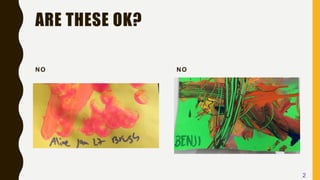
ARE THESE OK?
NO NO
2
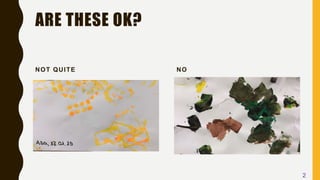
ARE THESE OK?
NOT QUITE NO
2
NAME AND DATE, TOP RIGHT, LOWER
CASE LETTERS, STARTING WITH A
CAPITAL
2
YOU MAY ADD A CLEAR DESCRIPTION TO
THE PAGE, AFTER THE CHILD HAS
FINISHED THEIR WORK
• Check your spelling
• Correct use of capitals and
grammar
• Fact and not interpretation of
the child’s work
2
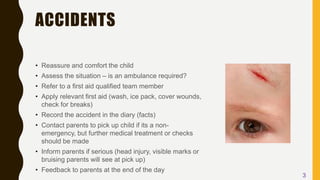
ACCIDENTS
• Reassure and comfort the child
• Assess the situation – is an ambulance required?
• Refer to a first aid qualified team member
• Apply relevant first aid (wash, ice pack, cover wounds,
check for breaks)
• Record the accident in the diary (facts)
• Contact parents to pick up child if its a non-
emergency, but further medical treatment or checks
should be made
• Inform parents if serious (head injury, visible marks or
bruising parents will see at pick up)
• Feedback to parents at the end of the day
3
TOO MANY ACCIDENTS ARE GOING
UN-NOTICED RIGHT NOW
• Be vigilant
• Notice what’s going on around you
• Check children thoroughly if they seem
unhappy, however briefly
• Take time to investigate fully ’what
happened’
• When you change children, look out for
marks and bruises that could have been
made at gan
• Make a note of these and talk to the team
leader
• Feedback to parents if you think something5
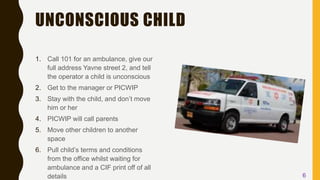
UNCONSCIOUS CHILD
1. Call 101 for an ambulance, give our
full address Yavne street 2, and tell
the operator a child is unconscious
2. Get to the manager or PICWIP
3. Stay with the child, and don’t move
him or her
4. PICWIP will call parents
5. Move other children to another
space
6. Pull child’s terms and conditions
from the office whilst waiting for
ambulance and a CIF print off of all
details 6
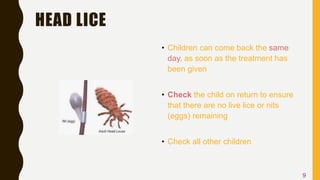
HEAD LICE
• Children can come back the same
day, as soon as the treatment has
been given
• Check the child on return to ensure
that there are no live lice or nits
(eggs) remaining
• Check all other children
9
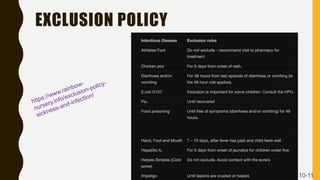
EXCLUSION POLICY
10-11
DOCTOR NOTES
• We do not ask for doctors notes as a
matter of policy
• The manager or PICWIP may ask for a
doctors note if we need further clarity about
a situation, but this would be very unusual
12
POLICY STATEMENT
When children are not well, they need to be cared for at home by their primary carers.
They need time to recover and feel better. At nursery they risk becoming more sick, and
are more vulnerable to other infections, viruses or diseases that may be carried by
others. If children have been prescribed medication, they must be home from nursery for
a minimum of 24 hours after they have begun taking medication, and longer if required
(see the Exclusion policy). Having sick children in the nursery also increases the risk of
an outbreak in the nursery and puts other children and staff at risk.
Children should usually be well for a period of two days, before returning to nursery.
13
WHEN A CHILD BECOMES ILL AT THE
NURSERY:
1. Nursery staff will provide comfort and reassurance to the child in a separate room or
space away from other children, in order to contain any illness
2. Make immediate contact with the parent/carer and where contact cannot be made
the emergency contact will be contacted
3. Parents/carers are expected to arrive within a maximum of 60 minutes to pick up sick
children and take them home or to the doctor
4. An incident record should be completed by the staff member who dealt with the
situation,
5. The incident should be reported to the team leader and manager (can be via
whatsapp)
6. The parent/carer should be advised of the exclusion period once the illness is
confirmed
7. In the interest of infection control, the area or room where the child was comforted, 15
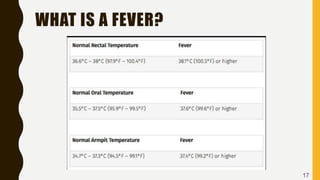
WHAT IS A FEVER?
17
WHEN A CHILD COMES TO NURSERY AND
A STAFF MEMBER SUSPECTS THEY ARE
UNWELL :
• Nursery staff will discuss their concerns with the parent/carer immediately
• If the parent/carers discloses that the child has been unwell, staff should check the
exclusion policy to see how long the child should be excluded from the provision, and
advise them accordingly
• If the parent/carer insists that the child is well, a staff member can take the child’s
temperature before admitting them to the nursery
• If the temperature is normal (37oC) the child can be admitted to the nursery, but staff
should maintain a high level of supervision, and keep a record of any concerns, if the child
becomes sick in anyway, then the child must be sent home
• Where staff have any concerns in admitting a child, they can refer to the manager, the
deputy or the Team leader
18
WHAT SHOULD YOU DO IF…
1. You suspect a child is ill when they arrive at gan
2. A child who was sent home yesterday with discharge from her eye, comes back to
gan today, but nothing seems to be coming out of her eye
3. On drop-off a parent tells you they have given their child Acamoli before gan
because he was feeling unwell from teething
4. A child’s temperature rises very high whilst they are sleeping
5. A child vomits all their lunch up, just before going to rest time
MEDICATION POLICY
• Children must have been on medication for at
least 24 hours before returning to gan (this is
to ensure there are no adverse reactions to
the medication)
• Children must ‘feel well’ enough to be in gan,
and should have had time to recover from
their illness
• Children cannot attend if they have taken non-
prescribed medication (such as Acamoli)
• A medication form must be completed for ANY
medication left at the gan which we are to
administer
• Be polite and empathetic to parents! 20
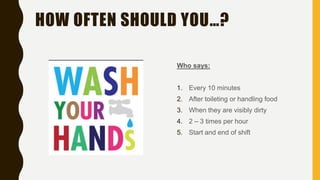
HOW OFTEN SHOULD YOU…?
Who says:
1. Every 10 minutes
2. After toileting or handling food
3. When they are visibly dirty
4. 2 – 3 times per hour
5. Start and end of shift
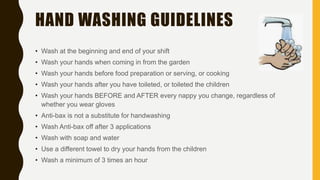
HAND WASHING GUIDELINES
• Wash at the beginning and end of your shift
• Wash your hands when coming in from the garden
• Wash your hands before food preparation or serving, or cooking
• Wash your hands after you have toileted, or toileted the children
• Wash your hands BEFORE and AFTER every nappy you change, regardless of
whether you wear gloves
• Anti-bax is not a substitute for handwashing
• Wash Anti-bax off after 3 applications
• Wash with soap and water
• Use a different towel to dry your hands from the children
• Wash a minimum of 3 times an hour
AVOID SHOCKING PARENTS
• Let parents know in advance of pick up
if there is news that might ‘shock’ them
• This could be different for different
parents
• If in doubt air on the side of caution
• Contact parents before pick-up if there
is a visible mark on a child that a
parent may see, before you have had
time to give a full explanation
22
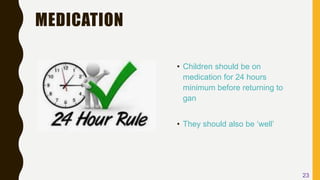
MEDICATION
• Children should be on
medication for 24 hours
minimum before returning to
gan
• They should also be ‘well’
23
NEW DAILY DIARY
• Every group will have a daily diary
• All key information from the day should
be recorded, when it happens
• Accidents, incidents, toileting
accidents, concerns, information we
receive from parents
• Not for recording developmental
progress of children
WHAT TO RECORD…
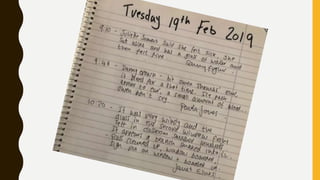
• Time
• Description of situation, including any action taken
• Fact, not opinion
• Your name
• STAR the feedback sheet if there is something in the diary that needs to be fed-back to
parents
• Biting incidents will now be recorded here, not on a biting log (biting logs to be used,
only if we are monitoring a specific child who is biting)
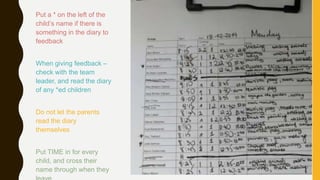
Put a * on the left of the
child’s name if there is
something in the diary to
feedback
When giving feedback –
check with the team
leader, and read the diary
of any *ed children
Do not let the parents
read the diary
themselves
Put TIME in for every
child, and cross their
name through when they
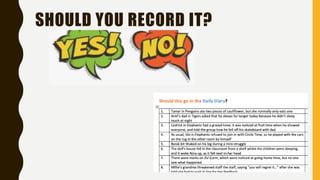
SHOULD YOU RECORD IT?
THANKS FOR LISTENING!

Feb Staff meeting 2019

  • 1.
    STAFF MEETING 2 0T H F E B R U A R Y 2 0 1 9
  • 2.
    OVERVIEW • Accidents, illnessand sick children – breaking the myths and getting everyone on the same page • New daily diary system • Feeding back to parents
  • 3.
    L E TS R E V I E W
  • 4.
  • 5.
  • 6.
    NAME AND DATE,TOP RIGHT, LOWER CASE LETTERS, STARTING WITH A CAPITAL 2
  • 7.
    YOU MAY ADDA CLEAR DESCRIPTION TO THE PAGE, AFTER THE CHILD HAS FINISHED THEIR WORK • Check your spelling • Correct use of capitals and grammar • Fact and not interpretation of the child’s work 2
  • 8.
    ACCIDENTS • Reassure andcomfort the child • Assess the situation – is an ambulance required? • Refer to a first aid qualified team member • Apply relevant first aid (wash, ice pack, cover wounds, check for breaks) • Record the accident in the diary (facts) • Contact parents to pick up child if its a non- emergency, but further medical treatment or checks should be made • Inform parents if serious (head injury, visible marks or bruising parents will see at pick up) • Feedback to parents at the end of the day 3
  • 9.
    TOO MANY ACCIDENTSARE GOING UN-NOTICED RIGHT NOW • Be vigilant • Notice what’s going on around you • Check children thoroughly if they seem unhappy, however briefly • Take time to investigate fully ’what happened’ • When you change children, look out for marks and bruises that could have been made at gan • Make a note of these and talk to the team leader • Feedback to parents if you think something5
  • 10.
    UNCONSCIOUS CHILD 1. Call101 for an ambulance, give our full address Yavne street 2, and tell the operator a child is unconscious 2. Get to the manager or PICWIP 3. Stay with the child, and don’t move him or her 4. PICWIP will call parents 5. Move other children to another space 6. Pull child’s terms and conditions from the office whilst waiting for ambulance and a CIF print off of all details 6
  • 11.
    HEAD LICE • Childrencan come back the same day, as soon as the treatment has been given • Check the child on return to ensure that there are no live lice or nits (eggs) remaining • Check all other children 9
  • 12.
  • 13.
    DOCTOR NOTES • Wedo not ask for doctors notes as a matter of policy • The manager or PICWIP may ask for a doctors note if we need further clarity about a situation, but this would be very unusual 12
  • 14.
    POLICY STATEMENT When childrenare not well, they need to be cared for at home by their primary carers. They need time to recover and feel better. At nursery they risk becoming more sick, and are more vulnerable to other infections, viruses or diseases that may be carried by others. If children have been prescribed medication, they must be home from nursery for a minimum of 24 hours after they have begun taking medication, and longer if required (see the Exclusion policy). Having sick children in the nursery also increases the risk of an outbreak in the nursery and puts other children and staff at risk. Children should usually be well for a period of two days, before returning to nursery. 13
  • 15.
    WHEN A CHILDBECOMES ILL AT THE NURSERY: 1. Nursery staff will provide comfort and reassurance to the child in a separate room or space away from other children, in order to contain any illness 2. Make immediate contact with the parent/carer and where contact cannot be made the emergency contact will be contacted 3. Parents/carers are expected to arrive within a maximum of 60 minutes to pick up sick children and take them home or to the doctor 4. An incident record should be completed by the staff member who dealt with the situation, 5. The incident should be reported to the team leader and manager (can be via whatsapp) 6. The parent/carer should be advised of the exclusion period once the illness is confirmed 7. In the interest of infection control, the area or room where the child was comforted, 15
  • 16.
    WHAT IS AFEVER? 17
  • 17.
    WHEN A CHILDCOMES TO NURSERY AND A STAFF MEMBER SUSPECTS THEY ARE UNWELL : • Nursery staff will discuss their concerns with the parent/carer immediately • If the parent/carers discloses that the child has been unwell, staff should check the exclusion policy to see how long the child should be excluded from the provision, and advise them accordingly • If the parent/carer insists that the child is well, a staff member can take the child’s temperature before admitting them to the nursery • If the temperature is normal (37oC) the child can be admitted to the nursery, but staff should maintain a high level of supervision, and keep a record of any concerns, if the child becomes sick in anyway, then the child must be sent home • Where staff have any concerns in admitting a child, they can refer to the manager, the deputy or the Team leader 18
  • 18.
    WHAT SHOULD YOUDO IF… 1. You suspect a child is ill when they arrive at gan 2. A child who was sent home yesterday with discharge from her eye, comes back to gan today, but nothing seems to be coming out of her eye 3. On drop-off a parent tells you they have given their child Acamoli before gan because he was feeling unwell from teething 4. A child’s temperature rises very high whilst they are sleeping 5. A child vomits all their lunch up, just before going to rest time
  • 19.
    MEDICATION POLICY • Childrenmust have been on medication for at least 24 hours before returning to gan (this is to ensure there are no adverse reactions to the medication) • Children must ‘feel well’ enough to be in gan, and should have had time to recover from their illness • Children cannot attend if they have taken non- prescribed medication (such as Acamoli) • A medication form must be completed for ANY medication left at the gan which we are to administer • Be polite and empathetic to parents! 20
  • 20.
    HOW OFTEN SHOULDYOU…? Who says: 1. Every 10 minutes 2. After toileting or handling food 3. When they are visibly dirty 4. 2 – 3 times per hour 5. Start and end of shift
  • 21.
    HAND WASHING GUIDELINES •Wash at the beginning and end of your shift • Wash your hands when coming in from the garden • Wash your hands before food preparation or serving, or cooking • Wash your hands after you have toileted, or toileted the children • Wash your hands BEFORE and AFTER every nappy you change, regardless of whether you wear gloves • Anti-bax is not a substitute for handwashing • Wash Anti-bax off after 3 applications • Wash with soap and water • Use a different towel to dry your hands from the children • Wash a minimum of 3 times an hour
  • 22.
    AVOID SHOCKING PARENTS •Let parents know in advance of pick up if there is news that might ‘shock’ them • This could be different for different parents • If in doubt air on the side of caution • Contact parents before pick-up if there is a visible mark on a child that a parent may see, before you have had time to give a full explanation 22
  • 23.
    MEDICATION • Children shouldbe on medication for 24 hours minimum before returning to gan • They should also be ‘well’ 23
  • 24.
    NEW DAILY DIARY •Every group will have a daily diary • All key information from the day should be recorded, when it happens • Accidents, incidents, toileting accidents, concerns, information we receive from parents • Not for recording developmental progress of children
  • 26.
    WHAT TO RECORD… •Time • Description of situation, including any action taken • Fact, not opinion • Your name • STAR the feedback sheet if there is something in the diary that needs to be fed-back to parents • Biting incidents will now be recorded here, not on a biting log (biting logs to be used, only if we are monitoring a specific child who is biting)
  • 28.
    Put a *on the left of the child’s name if there is something in the diary to feedback When giving feedback – check with the team leader, and read the diary of any *ed children Do not let the parents read the diary themselves Put TIME in for every child, and cross their name through when they
  • 29.
  • 30.