“It is far easier to design a class
to be thread-safe than to retrofit
it for thread safety later.”
-Brian Goetz
Submitted By - William john
Course - B.E.Computer
science (v sem )
Contains
• What is Java
• Aplications of Java
• Features of Java
• JDK,JRE,JVM
What is Java
• Java is a programming language and a platform.
• Java is a high level, robust, object-oriented and secure programming language.
• James Gosling, Mike Sheridan, and Patrick Naughton initiated the Java language project in June
1991. The small team of sun engineers called Green Team.
Example :-
public class Simple{
public static void main(String args[]){
System.out.println("hello java");
}}
Output : hello java
Features of Java
Simple –
Java is very easy to learn, and its syntax is simple, clean and easy to understand.
According to Sun, Java language is a simple programming language because:
Java syntax is based on C++ (so easier for programmers to learn it after C++).
Java has removed many complicated and rarely-used features, for example,
explicit pointers, operator overloading, etc
Object-oriented –
Java is an object-oriented programming language. Everything in Java is an
object. Object-oriented means we organize
our software as a combination of different types of objects that incorporates
both data and behavior.
Platform Independent –
Java is platform independent because it is different from other languages
like C, C++, etc. which are compiled into platform specific machines while Java is
a write once, run anywhere language.
Secured –
Java is best known for its security. With Java, we can develop virus-free
systems. Java is secured because:
No explicit pointer
Java Programs run inside a virtual machine sandbox
Robust –
Robust simply means strong. Java is robust because:
• It uses strong memory management.
• There is a lack of pointers that avoids security problems.
• There is automatic garbage collection in java which runs on the Java
Virtual Machine to get rid of objects which are not being used by a Java
application anymore.
Architecture-neutral –
Java is architecture neutral because there are no implementation dependent
features, for example, the size of primitive types is fixed.
In C programming, int data type occupies 2 bytes of memory for 32-bit
architecture and 4 bytes of memory for 64-bit architecture. However, it occupies
4 bytes of memory for both 32 and 64-bit architectures in Java.
Portable –
Java is portable because it facilitates you to carry the Java bytecode to any
platform. It doesn't require any implementation.
High-performance –
Java is faster than other traditional interpreted programming languages because
Java bytecode is "close" to native code. It is still a little bit slower than a
compiled language (e.g., C++). Java is an interpreted language that is why it is
slower than compiled languages, e.g., C, C++, etc.
Multi-threaded –
A thread is like a separate program, executing concurrently. We can write Java
programs that deal with many tasks at once by defining multiple threads. The
main advantage of multi-threading is that it doesn't occupy memory for each
thread. It shares a common memory area. Threads are important for multi-
media, Web applications, etc.
Dynamic –
Java is a dynamic language. It supports dynamic loading of classes. It means
classes are loaded on demand. It also supports functions from its native
languages, i.e., C and C++.
Java supports dynamic compilation and automatic memory management
(garbage collection).
JavaVirtualMachine
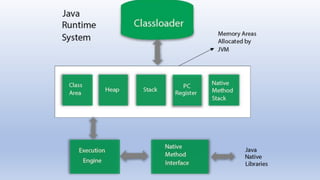
JVM (Java Virtual Machine) is an abstract machine. It is called a virtual machine because it
doesn't physically exist. It is a specification that provides a runtime environment in which Java
bytecode can be executed. It can also run those programs which are written in other languages
and compiled to Java bytecode
The JVM performs following operation:
Loads code
Verifies code
Executes code
Provides runtime environment
JavaRuntimeEnviroment
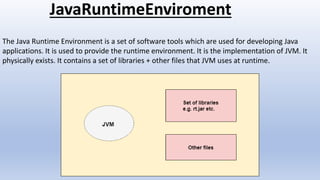
The Java Runtime Environment is a set of software tools which are used for developing Java
applications. It is used to provide the runtime environment. It is the implementation of JVM. It
physically exists. It contains a set of libraries + other files that JVM uses at runtime.
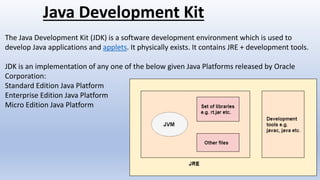
Java Development Kit
The Java Development Kit (JDK) is a software development environment which is used to
develop Java applications and applets. It physically exists. It contains JRE + development tools.
JDK is an implementation of any one of the below given Java Platforms released by Oracle
Corporation:
Standard Edition Java Platform
Enterprise Edition Java Platform
Micro Edition Java Platform
Resources
JavaTPoint.com
Presentation on java

Presentation on java

  • 1.
    “It is fareasier to design a class to be thread-safe than to retrofit it for thread safety later.” -Brian Goetz Submitted By - William john Course - B.E.Computer science (v sem )
  • 2.
    Contains • What isJava • Aplications of Java • Features of Java • JDK,JRE,JVM
  • 3.
    What is Java •Java is a programming language and a platform. • Java is a high level, robust, object-oriented and secure programming language. • James Gosling, Mike Sheridan, and Patrick Naughton initiated the Java language project in June 1991. The small team of sun engineers called Green Team. Example :- public class Simple{ public static void main(String args[]){ System.out.println("hello java"); }} Output : hello java
  • 4.
    Features of Java Simple– Java is very easy to learn, and its syntax is simple, clean and easy to understand. According to Sun, Java language is a simple programming language because: Java syntax is based on C++ (so easier for programmers to learn it after C++). Java has removed many complicated and rarely-used features, for example, explicit pointers, operator overloading, etc Object-oriented – Java is an object-oriented programming language. Everything in Java is an object. Object-oriented means we organize our software as a combination of different types of objects that incorporates both data and behavior.
  • 5.
    Platform Independent – Javais platform independent because it is different from other languages like C, C++, etc. which are compiled into platform specific machines while Java is a write once, run anywhere language. Secured – Java is best known for its security. With Java, we can develop virus-free systems. Java is secured because: No explicit pointer Java Programs run inside a virtual machine sandbox
  • 6.
    Robust – Robust simplymeans strong. Java is robust because: • It uses strong memory management. • There is a lack of pointers that avoids security problems. • There is automatic garbage collection in java which runs on the Java Virtual Machine to get rid of objects which are not being used by a Java application anymore. Architecture-neutral – Java is architecture neutral because there are no implementation dependent features, for example, the size of primitive types is fixed. In C programming, int data type occupies 2 bytes of memory for 32-bit architecture and 4 bytes of memory for 64-bit architecture. However, it occupies 4 bytes of memory for both 32 and 64-bit architectures in Java.
  • 7.
    Portable – Java isportable because it facilitates you to carry the Java bytecode to any platform. It doesn't require any implementation. High-performance – Java is faster than other traditional interpreted programming languages because Java bytecode is "close" to native code. It is still a little bit slower than a compiled language (e.g., C++). Java is an interpreted language that is why it is slower than compiled languages, e.g., C, C++, etc.
  • 8.
    Multi-threaded – A threadis like a separate program, executing concurrently. We can write Java programs that deal with many tasks at once by defining multiple threads. The main advantage of multi-threading is that it doesn't occupy memory for each thread. It shares a common memory area. Threads are important for multi- media, Web applications, etc. Dynamic – Java is a dynamic language. It supports dynamic loading of classes. It means classes are loaded on demand. It also supports functions from its native languages, i.e., C and C++. Java supports dynamic compilation and automatic memory management (garbage collection).
  • 9.
    JavaVirtualMachine JVM (Java VirtualMachine) is an abstract machine. It is called a virtual machine because it doesn't physically exist. It is a specification that provides a runtime environment in which Java bytecode can be executed. It can also run those programs which are written in other languages and compiled to Java bytecode The JVM performs following operation: Loads code Verifies code Executes code Provides runtime environment
  • 11.
    JavaRuntimeEnviroment The Java RuntimeEnvironment is a set of software tools which are used for developing Java applications. It is used to provide the runtime environment. It is the implementation of JVM. It physically exists. It contains a set of libraries + other files that JVM uses at runtime.
  • 12.
    Java Development Kit TheJava Development Kit (JDK) is a software development environment which is used to develop Java applications and applets. It physically exists. It contains JRE + development tools. JDK is an implementation of any one of the below given Java Platforms released by Oracle Corporation: Standard Edition Java Platform Enterprise Edition Java Platform Micro Edition Java Platform
  • 13.