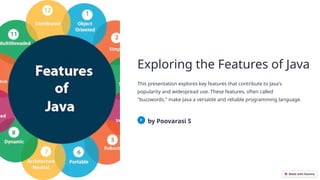
Exploring the Features of Java
This presentation explores key features that contribute to Java's
popularity and widespread use. These features, often called
"buzzwords," make Java a versatile and reliable programming language.
by Poovarasi S
Simple
Easy to Learn
Java's syntax is based on C+
+, making it relatively
straightforward to learn,
especially for those familiar
with C++.
Clean and Clear
Java removes complex
features like explicit pointers
and operator overloading,
making the language more
concise and understandable.
Automatic Garbage Collection
Java handles memory management automatically, freeing
programmers from the burden of manual memory allocation and
deallocation.
Object-Oriented
Object-Oriented Concepts
Java employs the object-oriented programming (OOP)
methodology, which organizes software as a collection of
objects that encapsulate both data and behavior.
Key OOP Principles
• Object
• Class
• Inheritance
• Polymorphism
• Abstraction
• Encapsulation
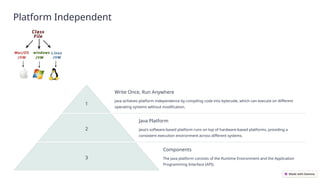
Platform Independent
1
Write Once, Run Anywhere
Java achieves platform independence by compiling code into bytecode, which can execute on different
operating systems without modification.
2
Java Platform
Java's software-based platform runs on top of hardware-based platforms, providing a
consistent execution environment across different systems.
3
Components
The Java platform consists of the Runtime Environment and the Application
Programming Interface (API).
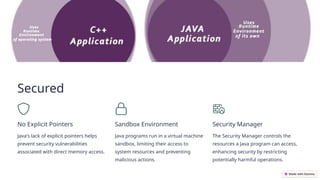
Secured
No Explicit Pointers
Java's lack of explicit pointers helps
prevent security vulnerabilities
associated with direct memory access.
Sandbox Environment
Java programs run in a virtual machine
sandbox, limiting their access to
system resources and preventing
malicious actions.
Security Manager
The Security Manager controls the
resources a Java program can access,
enhancing security by restricting
potentially harmful operations.
Robust
Strong Memory
Management
Java's robust memory
management ensures efficient
allocation and deallocation of
memory, preventing memory
leaks and crashes.
Automatic Garbage
Collection
Java automatically cleans up
unused objects, preventing
memory bloat and improving
overall system performance.
Exception Handling
Java provides mechanisms for handling runtime errors, ensuring a
more stable and reliable application environment.
Architecture-neutral
1
Fixed Primitive Sizes
Java guarantees fixed sizes for primitive data types, ensuring consistent data representation across
different architectures.
2
Platform Independence
Java's architecture neutrality contributes to its platform independence,
allowing code to run seamlessly on various hardware configurations.
3
Cross-Platform Compatibility
The consistent data representation across architectures
ensures that Java programs behave as expected,
regardless of the underlying hardware.
Portable
Java is portable because the Java bytecode can be executed on any
platform that has a Java Virtual Machine (JVM) installed. This makes Java
code highly adaptable and easily transferable across different operating
systems and environments.
High Performance
1 Bytecode Optimization
Java bytecode, while interpreted, is optimized to run efficiently,
making Java applications relatively fast compared to purely
interpreted languages.
2 Just-In-Time Compilation
JVMs often use Just-In-Time (JIT) compilation, which
dynamically compiles bytecode to native machine code during
execution, improving performance.
3 Performance Tradeoffs
While Java offers good performance, it's generally slightly
slower than compiled languages like C or C++ due to the
interpretation step.
Distributed
Java facilitates the creation of distributed applications, enabling
components of an application to run on different machines across a
network. This allows for collaborative development and resource
sharing, making Java suitable for large-scale applications and complex
systems.

Exploring-the-Features-of-Java. characters

  • 1.
    Exploring the Featuresof Java This presentation explores key features that contribute to Java's popularity and widespread use. These features, often called "buzzwords," make Java a versatile and reliable programming language. by Poovarasi S
  • 2.
    Simple Easy to Learn Java'ssyntax is based on C+ +, making it relatively straightforward to learn, especially for those familiar with C++. Clean and Clear Java removes complex features like explicit pointers and operator overloading, making the language more concise and understandable. Automatic Garbage Collection Java handles memory management automatically, freeing programmers from the burden of manual memory allocation and deallocation.
  • 3.
    Object-Oriented Object-Oriented Concepts Java employsthe object-oriented programming (OOP) methodology, which organizes software as a collection of objects that encapsulate both data and behavior. Key OOP Principles • Object • Class • Inheritance • Polymorphism • Abstraction • Encapsulation
  • 4.
    Platform Independent 1 Write Once,Run Anywhere Java achieves platform independence by compiling code into bytecode, which can execute on different operating systems without modification. 2 Java Platform Java's software-based platform runs on top of hardware-based platforms, providing a consistent execution environment across different systems. 3 Components The Java platform consists of the Runtime Environment and the Application Programming Interface (API).
  • 5.
    Secured No Explicit Pointers Java'slack of explicit pointers helps prevent security vulnerabilities associated with direct memory access. Sandbox Environment Java programs run in a virtual machine sandbox, limiting their access to system resources and preventing malicious actions. Security Manager The Security Manager controls the resources a Java program can access, enhancing security by restricting potentially harmful operations.
  • 6.
    Robust Strong Memory Management Java's robustmemory management ensures efficient allocation and deallocation of memory, preventing memory leaks and crashes. Automatic Garbage Collection Java automatically cleans up unused objects, preventing memory bloat and improving overall system performance. Exception Handling Java provides mechanisms for handling runtime errors, ensuring a more stable and reliable application environment.
  • 7.
    Architecture-neutral 1 Fixed Primitive Sizes Javaguarantees fixed sizes for primitive data types, ensuring consistent data representation across different architectures. 2 Platform Independence Java's architecture neutrality contributes to its platform independence, allowing code to run seamlessly on various hardware configurations. 3 Cross-Platform Compatibility The consistent data representation across architectures ensures that Java programs behave as expected, regardless of the underlying hardware.
  • 8.
    Portable Java is portablebecause the Java bytecode can be executed on any platform that has a Java Virtual Machine (JVM) installed. This makes Java code highly adaptable and easily transferable across different operating systems and environments.
  • 9.
    High Performance 1 BytecodeOptimization Java bytecode, while interpreted, is optimized to run efficiently, making Java applications relatively fast compared to purely interpreted languages. 2 Just-In-Time Compilation JVMs often use Just-In-Time (JIT) compilation, which dynamically compiles bytecode to native machine code during execution, improving performance. 3 Performance Tradeoffs While Java offers good performance, it's generally slightly slower than compiled languages like C or C++ due to the interpretation step.
  • 10.
    Distributed Java facilitates thecreation of distributed applications, enabling components of an application to run on different machines across a network. This allows for collaborative development and resource sharing, making Java suitable for large-scale applications and complex systems.