Feature
Article
Writing
(Pagsulat ng Lathalain)
A feature article is written in a creative,
entertaining, and persuasive way, while still
giving accurate information. A feature article often
covers an issue in greater depth or from a different
angle than a news story.
A feature article is written in a creative,
entertaining, and persuasive way, while still
giving accurate information. A feature article often
covers an issue in greater depth or from a different
angle than a news story.
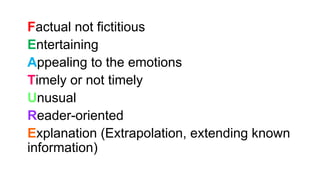
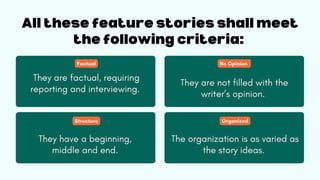
Factual not fictitious
Entertaining
Appealing to the emotions
Timely or not timely
Unusual
Reader-oriented
Explanation (Extrapolation, extending known
information)
Feature is not:
Literary article
Opinion article
Storytelling
Fiction Story
The purpose of Feature Writing is to
make an attempt to connect
emotionally with the readers. It serves
the purpose of entertaining the readers
while informing them. They are however
less objective than straight news.
What is the Difference Between a News Story
and a Feature Story?
People are often confused between a news story and a feature. Here are some
basic differences between the two –
1. While a news story usually covers recent or breaking news, feature writing
can be issue specific that might not be recent.
2. A news story summarizes the story whereas a feature focuses on anecdotal
references.
3. A feature contains a number of angles and sources whereas on the
contrary a news story general is from a single source or angle.
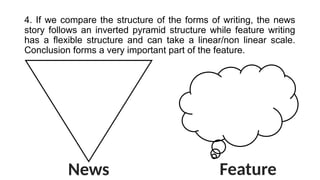
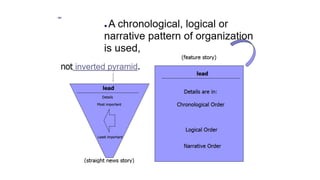
4. If we compare the structure of the forms of writing, the news story follows an
inverted pyramid structure while feature writing has a flexible structure and
can take a linear/non linear scale. Conclusion forms a very important part of
the feature.
4. If we compare the structure of the forms of writing, the news
story follows an inverted pyramid structure while feature writing
has a flexible structure and can take a linear/non linear scale.
Conclusion forms a very important part of the feature.
News Feature
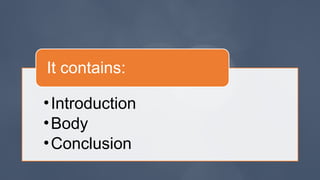
•Introduction
•Body
•Conclusion
It contains:
Introduction
The introduction is the most important part -
entice your reader, hook them in. Use drama,
emotion, quotations, questions, descriptions.
Responsableng Pluma
Sa Panulat ni Marvin N. Pamisa, Region X- Mis. Or. Division,
MOGCHS
Sulat.
Bura.
Sulat.
Bura.
Sa patuloy na pag-inog ng mundo, patuloy rin ang
pangungukilkil ng kaisipang “ang pluma ay higit na
makapangyarihan kaysa anumang sandata.” Isang kasabihang
totoo at hindi na bago para sa akin bilang isang mamamahayag.
Body
The body of the article
needs to keep any
promises or answer any
questions raised in the
introduction - try and
maintain an "atmosphere"
throughout the writing
Conclusion
While the introduction
draws the reader in, the
conclusion should be written
to help the reader remember
the story - use a strong
punchline.
Headlines
The headline is the most vital part of your
feature. Treat the headline as if it were a summary
of the article. Ask yourself, Why is this story
important? What about it will it grab readers'
interest? A good headline answers those questions
by telling the reader something new, different or
useful--in 20 words or less.
Headlines
• Plug-In Devices Help Save Money on Your Utility
Bill
• Reinventing the "Mommy Tack": More Women
Choose Business Ownership to Gain Control,
Flexibility and Family Time
• The Sleep Expert's Advice on Creating the Right
Sleep Environment for Students
To come up with a good headline, pretend
you're telling a friend what the article's about,
explaining the most interesting aspects of your
story. Keep the wording simple, and avoid
superlatives and emotive language. Also, avoid
using a brand or client name in the headline
unless it's very well known. Instead, focus on
what's most interesting about your topic.
Leads
A strong lead paragraph offers intrigue
from the start. Editors don't have time to read
through the entire article to reach your key
point, and neither do your readers. Think of the
lead as an extended version of the headline,
even using some of the same words.
When writing a lead, try to keep the
paragraph short--two to three short sentences
at the most. In total, your feature should be
close to 400 words. Don't worry about your
brand at this point--just introduce the interesting
aspects of the story. If your lead reads like an
ad, it'll be discarded immediately.
Different Types of Feature Writing
Colour Piece: A feature story that essentially tries to
inform readers regarding a particular theme or subject.
Fly on the Wall: A feature story that is conceived and
narrated unobtrusively and mostly without the explicit
permission of the subjects.
Behind the Scenes: A feature story that shifts its focus
from the principal event to the background and narrates
an interesting tale.
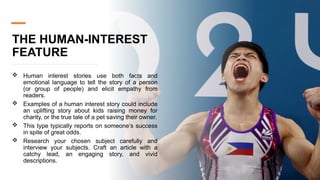
THE HUMAN-INTEREST
FEATURE
 Human interest stories use both facts and
emotional language to tell the story of a person
(or group of people) and elicit empathy from
readers.
 Examples of a human interest story could include
an uplifting story about kids raising money for
charity, or the true tale of a pet saving their owner.
 This type typically reports on someone’s success
in spite of great odds.
 Research your chosen subject carefully and
interview your subjects. Craft an article with a
catchy lead, an engaging story, and vivid
descriptions.
PERSONALITY
SKETCH
 The subject of the article may be
famous or not so famous but has
done something of interest to others.
 This type usually shows how a
person gained recognition.
 The personality feature is very much
like a character sketch.
THE NEWS FEATURE
 This type of article brings a human-interest focus
to breaking news.
 It adds personal involvement to what may
otherwise be a distant, seemingly unimportant
event.
THE HOW-TO FEATURE
This article explains how to do something – usually a complex process that
most people would not know how to do.
The best how-to articles begin by telling the reader why it is important or
beneficial for him or her to know how to do this.
The article explains the steps of the process in enough detail so that
another person can do this process.
This article also includes a list of all of the materials needed to do this
process.
THE INFORMATIONAL
FEATURE
 This type of article shows
insightful coverage of a topic.
 It gives detailed information
focused on one aspect of a given
topic.
 The article often refers to sources
of research but is not like an
encyclopedia report. Instead, the
writer makes a personal
connection to the subject and
includes his/her voice.
In Disguise: A feature story that is told while the storyteller is
a part of the event.
Interview: A feature story that develops itself around
questions asked to a respondent, who is usually in a place of
prominence.
Profile: A feature story that is based on the exploits of a
particular eminent person with or without his/ her interview.
How-To: A feature story that is dependent on research and
helps readers in solving a problem or deciphering a scenario.
Fact Box/ Chronology: A feature story that provides plain and
simple facts mostly in a chronological order
Backgrounder/ A History of: A feature
story that provides detailed information.
Full Texts: A feature story that is nothing
but extracts from a book or transcripts of
an interview.
Testimony: A feature story that is the first-
person account of an individual.
Analysis: A feature story that scholarly analyzes an
event.
Vox Pop/ Expert Roundup: A feature story that
accumulates opinions from the general citizenry and
thought leaders concerning a subject.
Opinion Poll: A feature story that conducts a research
of opinions and presents a generalized summary of the
accumulated opinions.
Review: A feature story that reviews a work of art and
presents a generalized opinion.
Feature Writing – the APPLAUSE Formula
1. A – Appeal
2. P – Plain Facts
3. P – Personalities
4. L – Logic
5. A – Action
6. U – Universal
7. S – Significance
8. E – Energy
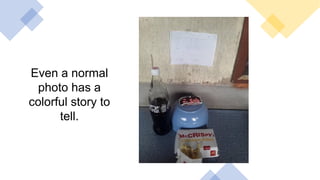
Even a normal
photo has a
colorful story to
tell.
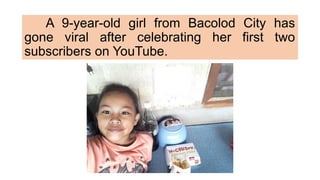
A 9-year-old girl from Bacolod City has
gone viral after celebrating her first two
subscribers on YouTube.
1st
Paragraph
Catchy short introduction.
2nd
Paragraph
The second paragraph serves to support and expand on
the ideas set out in the lead. It's also a good place to let
people know who's "behind" the feature so there's no
confusion about who provided the copy. Also, if the article has
to be shortened due to space limitations, having the name of
the company or spokesperson and your web address near
the beginning will be vitally important.
If written well, the first two paragraphs can serve as a
brief column item or filler if a newspaper or magazine has
only limited space.
2nd
Paragraph
On Monday, aspiring vlogger Mary Grace
Escober took to Facebook to share her happiness
over having two subscribers on Youtube, posting
photos of herself and the little food she prepared to
mark her milestone.
3rd
Paragraph
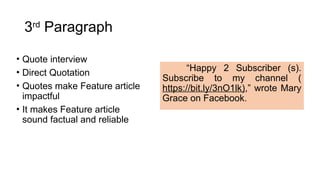
• Quote interview
• Direct Quotation
• Quotes make Feature article
impactful
• It makes Feature article
sound factual and reliable
“Happy 2 Subscriber (s).
Subscribe to my channel (
https://bit.ly/3nO1lk),” wrote Mary
Grace on Facebook.
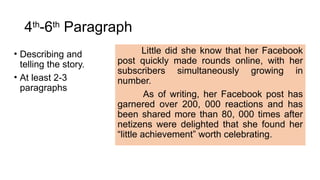
4th
-6th
Paragraph
• Describing and
telling the story.
• At least 2-3
paragraphs
Little did she know that her Facebook
post quickly made rounds online, with her
subscribers simultaneously growing in
number.
As of writing, her Facebook post has
garnered over 200, 000 reactions and has
been shared more than 80, 000 times after
netizens were delighted that she found her
“little achievement” worth celebrating.
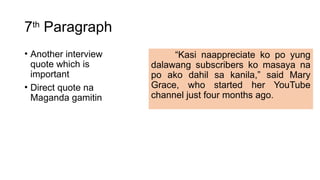
7th
Paragraph
• Another interview
quote which is
important
• Direct quote na
Maganda gamitin
“Kasi naappreciate ko po yung
dalawang subscribers ko masaya na
po ako dahil sa kanila,” said Mary
Grace, who started her YouTube
channel just four months ago.
8th
Paragraph-conclusion
• More stories about her,
sa kanyang ginagawa
• Mag-add ng
backgrounders about sa
subject
• Maglagay pa rin ng mga
quotes/indirect quotes.
Play with words
Egg-citing! An egg found inside another egg in Piddig, Ilocos
Norte
Tips in Writing a
Feature Article
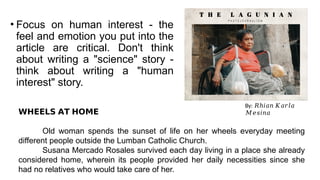
• Focus on human interest - the
feel and emotion you put into the
article are critical. Don't think
about writing a "science" story -
think about writing a "human
interest" story.
By: 𝑅ℎ𝑖𝑎𝑛 𝐾𝑎𝑟𝑙𝑎
𝑀𝑒𝑠𝑖𝑛𝑎
𝗪𝗛𝗘𝗘𝗟𝗦 𝗔𝗧 𝗛𝗢𝗠𝗘
Old woman spends the sunset of life on her wheels everyday meeting
different people outside the Lumban Catholic Church.
Susana Mercado Rosales survived each day living in a place she already
considered home, wherein its people provided her daily necessities since she
had no relatives who would take care of her.
•Be clear about why you
are writing the article. Is
it to inform, persuade,
observe, evaluate, or
evoke emotion.
• Write in the active voice. In active writing,
people do things. Passive sentences often
have the person doing the action at the end
of the sentence or things being done "by"
someone.
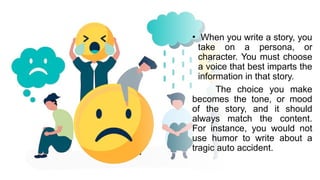
• When you write a story, you
take on a persona, or
character. You must choose
a voice that best imparts the
information in that story.
The choice you make
becomes the tone, or mood
of the story, and it should
always match the content.
For instance, you would not
use humor to write about a
tragic auto accident.
•Accuracy is important - you can interpret and
embroider but not fudge.
•Keep your audience clearly in mind - what are
their desires, what really matters to them?
•Avoid clichés (cutting edge, world beating,
revolutionary) and sentimental statements -
especially at the end of your article.
•Interviews for features usually need to be in-
depth and in person rather than over the
phone - this enables you to add in colour
and detail.
•Use anecdotes and direct quotes to tell the
story - try not to use too many of your own
words.
•Write clear, concise sentences. Sprinkle
direct quotations, observations and
additional background throughout the story.
Paragraphs can be written chronologically or
in order of importance. Be creative, watch, &
listen...
•Use transition. Connect paragraphs with
transitional words, paraphrases, and direct
quotations. Transition is the tool writers use
to move subtly from one person or topic to
the next. IT keeps readers from being jarred
by the writing.
•Talk to more than one person to provide a more
complete picture - but don't just add in sources to
show how much work you've done. Be ruthless
about who you put in and who you leave out!
•Don't rely on the computer spell- checker -
especially those with a U.S. dictionary.
•Decide on the 'tense' of your story at the
start and stick to it. Present tense usually
works best.
•Avoid lengthy, complex paragraphs. Your
article will appear in columns, so one or two
sentences equals a paragraph.
•Ideas come from everywhere - watch, read,
listen, keep up to date, take notes. Talk to
people outside the field of science to find out
what interests and concerns them.
Details in a
Feature
Article
Details in a
Feature
Article
Details in a
Feature
Article
Details in a
Feature
Article
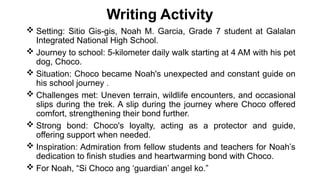
Writing Activity
 Setting: Sitio Gis-gis, Noah M. Garcia, Grade 7 student at Galalan
Integrated National High School.
 Journey to school: 5-kilometer daily walk starting at 4 AM with his pet
dog, Choco.
 Situation: Choco became Noah's unexpected and constant guide on
his school journey .
 Challenges met: Uneven terrain, wildlife encounters, and occasional
slips during the trek. A slip during the journey where Choco offered
comfort, strengthening their bond further.
 Strong bond: Choco's loyalty, acting as a protector and guide,
offering support when needed.
 Inspiration: Admiration from fellow students and teachers for Noah’s
dedication to finish studies and heartwarming bond with Choco.
 For Noah, “Si Choco ang ‘guardian’ angel ko.”
Campus Journalism Feature Article Writing.pptx

Campus Journalism Feature Article Writing.pptx

  • 1.
  • 2.
    A feature articleis written in a creative, entertaining, and persuasive way, while still giving accurate information. A feature article often covers an issue in greater depth or from a different angle than a news story.
  • 3.
    A feature articleis written in a creative, entertaining, and persuasive way, while still giving accurate information. A feature article often covers an issue in greater depth or from a different angle than a news story.
  • 4.
    Factual not fictitious Entertaining Appealingto the emotions Timely or not timely Unusual Reader-oriented Explanation (Extrapolation, extending known information)
  • 5.
    Feature is not: Literaryarticle Opinion article Storytelling Fiction Story
  • 6.
    The purpose ofFeature Writing is to make an attempt to connect emotionally with the readers. It serves the purpose of entertaining the readers while informing them. They are however less objective than straight news.
  • 7.
    What is theDifference Between a News Story and a Feature Story? People are often confused between a news story and a feature. Here are some basic differences between the two – 1. While a news story usually covers recent or breaking news, feature writing can be issue specific that might not be recent. 2. A news story summarizes the story whereas a feature focuses on anecdotal references. 3. A feature contains a number of angles and sources whereas on the contrary a news story general is from a single source or angle. 4. If we compare the structure of the forms of writing, the news story follows an inverted pyramid structure while feature writing has a flexible structure and can take a linear/non linear scale. Conclusion forms a very important part of the feature.
  • 8.
    4. If wecompare the structure of the forms of writing, the news story follows an inverted pyramid structure while feature writing has a flexible structure and can take a linear/non linear scale. Conclusion forms a very important part of the feature. News Feature
  • 12.
  • 13.
    Introduction The introduction isthe most important part - entice your reader, hook them in. Use drama, emotion, quotations, questions, descriptions.
  • 14.
    Responsableng Pluma Sa Panulatni Marvin N. Pamisa, Region X- Mis. Or. Division, MOGCHS Sulat. Bura. Sulat. Bura. Sa patuloy na pag-inog ng mundo, patuloy rin ang pangungukilkil ng kaisipang “ang pluma ay higit na makapangyarihan kaysa anumang sandata.” Isang kasabihang totoo at hindi na bago para sa akin bilang isang mamamahayag.
  • 15.
    Body The body ofthe article needs to keep any promises or answer any questions raised in the introduction - try and maintain an "atmosphere" throughout the writing
  • 16.
    Conclusion While the introduction drawsthe reader in, the conclusion should be written to help the reader remember the story - use a strong punchline.
  • 17.
    Headlines The headline isthe most vital part of your feature. Treat the headline as if it were a summary of the article. Ask yourself, Why is this story important? What about it will it grab readers' interest? A good headline answers those questions by telling the reader something new, different or useful--in 20 words or less.
  • 18.
    Headlines • Plug-In DevicesHelp Save Money on Your Utility Bill • Reinventing the "Mommy Tack": More Women Choose Business Ownership to Gain Control, Flexibility and Family Time • The Sleep Expert's Advice on Creating the Right Sleep Environment for Students
  • 19.
    To come upwith a good headline, pretend you're telling a friend what the article's about, explaining the most interesting aspects of your story. Keep the wording simple, and avoid superlatives and emotive language. Also, avoid using a brand or client name in the headline unless it's very well known. Instead, focus on what's most interesting about your topic.
  • 20.
    Leads A strong leadparagraph offers intrigue from the start. Editors don't have time to read through the entire article to reach your key point, and neither do your readers. Think of the lead as an extended version of the headline, even using some of the same words. When writing a lead, try to keep the paragraph short--two to three short sentences at the most. In total, your feature should be close to 400 words. Don't worry about your brand at this point--just introduce the interesting aspects of the story. If your lead reads like an ad, it'll be discarded immediately.
  • 21.
    Different Types ofFeature Writing Colour Piece: A feature story that essentially tries to inform readers regarding a particular theme or subject. Fly on the Wall: A feature story that is conceived and narrated unobtrusively and mostly without the explicit permission of the subjects. Behind the Scenes: A feature story that shifts its focus from the principal event to the background and narrates an interesting tale.
  • 22.
    THE HUMAN-INTEREST FEATURE  Humaninterest stories use both facts and emotional language to tell the story of a person (or group of people) and elicit empathy from readers.  Examples of a human interest story could include an uplifting story about kids raising money for charity, or the true tale of a pet saving their owner.  This type typically reports on someone’s success in spite of great odds.  Research your chosen subject carefully and interview your subjects. Craft an article with a catchy lead, an engaging story, and vivid descriptions.
  • 23.
    PERSONALITY SKETCH  The subjectof the article may be famous or not so famous but has done something of interest to others.  This type usually shows how a person gained recognition.  The personality feature is very much like a character sketch.
  • 24.
    THE NEWS FEATURE This type of article brings a human-interest focus to breaking news.  It adds personal involvement to what may otherwise be a distant, seemingly unimportant event.
  • 25.
    THE HOW-TO FEATURE Thisarticle explains how to do something – usually a complex process that most people would not know how to do. The best how-to articles begin by telling the reader why it is important or beneficial for him or her to know how to do this. The article explains the steps of the process in enough detail so that another person can do this process. This article also includes a list of all of the materials needed to do this process.
  • 26.
    THE INFORMATIONAL FEATURE  Thistype of article shows insightful coverage of a topic.  It gives detailed information focused on one aspect of a given topic.  The article often refers to sources of research but is not like an encyclopedia report. Instead, the writer makes a personal connection to the subject and includes his/her voice.
  • 27.
    In Disguise: Afeature story that is told while the storyteller is a part of the event. Interview: A feature story that develops itself around questions asked to a respondent, who is usually in a place of prominence. Profile: A feature story that is based on the exploits of a particular eminent person with or without his/ her interview. How-To: A feature story that is dependent on research and helps readers in solving a problem or deciphering a scenario. Fact Box/ Chronology: A feature story that provides plain and simple facts mostly in a chronological order
  • 28.
    Backgrounder/ A Historyof: A feature story that provides detailed information. Full Texts: A feature story that is nothing but extracts from a book or transcripts of an interview. Testimony: A feature story that is the first- person account of an individual.
  • 29.
    Analysis: A featurestory that scholarly analyzes an event. Vox Pop/ Expert Roundup: A feature story that accumulates opinions from the general citizenry and thought leaders concerning a subject. Opinion Poll: A feature story that conducts a research of opinions and presents a generalized summary of the accumulated opinions. Review: A feature story that reviews a work of art and presents a generalized opinion.
  • 30.
    Feature Writing –the APPLAUSE Formula 1. A – Appeal 2. P – Plain Facts 3. P – Personalities 4. L – Logic 5. A – Action 6. U – Universal 7. S – Significance 8. E – Energy
  • 31.
    Even a normal photohas a colorful story to tell.
  • 32.
    A 9-year-old girlfrom Bacolod City has gone viral after celebrating her first two subscribers on YouTube.
  • 33.
  • 34.
    2nd Paragraph The second paragraphserves to support and expand on the ideas set out in the lead. It's also a good place to let people know who's "behind" the feature so there's no confusion about who provided the copy. Also, if the article has to be shortened due to space limitations, having the name of the company or spokesperson and your web address near the beginning will be vitally important. If written well, the first two paragraphs can serve as a brief column item or filler if a newspaper or magazine has only limited space.
  • 35.
    2nd Paragraph On Monday, aspiringvlogger Mary Grace Escober took to Facebook to share her happiness over having two subscribers on Youtube, posting photos of herself and the little food she prepared to mark her milestone.
  • 36.
    3rd Paragraph • Quote interview •Direct Quotation • Quotes make Feature article impactful • It makes Feature article sound factual and reliable “Happy 2 Subscriber (s). Subscribe to my channel ( https://bit.ly/3nO1lk),” wrote Mary Grace on Facebook.
  • 37.
    4th -6th Paragraph • Describing and tellingthe story. • At least 2-3 paragraphs Little did she know that her Facebook post quickly made rounds online, with her subscribers simultaneously growing in number. As of writing, her Facebook post has garnered over 200, 000 reactions and has been shared more than 80, 000 times after netizens were delighted that she found her “little achievement” worth celebrating.
  • 38.
    7th Paragraph • Another interview quotewhich is important • Direct quote na Maganda gamitin “Kasi naappreciate ko po yung dalawang subscribers ko masaya na po ako dahil sa kanila,” said Mary Grace, who started her YouTube channel just four months ago.
  • 39.
    8th Paragraph-conclusion • More storiesabout her, sa kanyang ginagawa • Mag-add ng backgrounders about sa subject • Maglagay pa rin ng mga quotes/indirect quotes.
  • 40.
    Play with words Egg-citing!An egg found inside another egg in Piddig, Ilocos Norte
  • 41.
    Tips in Writinga Feature Article
  • 42.
    • Focus onhuman interest - the feel and emotion you put into the article are critical. Don't think about writing a "science" story - think about writing a "human interest" story. By: 𝑅ℎ𝑖𝑎𝑛 𝐾𝑎𝑟𝑙𝑎 𝑀𝑒𝑠𝑖𝑛𝑎 𝗪𝗛𝗘𝗘𝗟𝗦 𝗔𝗧 𝗛𝗢𝗠𝗘 Old woman spends the sunset of life on her wheels everyday meeting different people outside the Lumban Catholic Church. Susana Mercado Rosales survived each day living in a place she already considered home, wherein its people provided her daily necessities since she had no relatives who would take care of her.
  • 43.
    •Be clear aboutwhy you are writing the article. Is it to inform, persuade, observe, evaluate, or evoke emotion.
  • 44.
    • Write inthe active voice. In active writing, people do things. Passive sentences often have the person doing the action at the end of the sentence or things being done "by" someone.
  • 45.
    • When youwrite a story, you take on a persona, or character. You must choose a voice that best imparts the information in that story. The choice you make becomes the tone, or mood of the story, and it should always match the content. For instance, you would not use humor to write about a tragic auto accident.
  • 46.
    •Accuracy is important- you can interpret and embroider but not fudge. •Keep your audience clearly in mind - what are their desires, what really matters to them? •Avoid clichés (cutting edge, world beating, revolutionary) and sentimental statements - especially at the end of your article.
  • 47.
    •Interviews for featuresusually need to be in- depth and in person rather than over the phone - this enables you to add in colour and detail. •Use anecdotes and direct quotes to tell the story - try not to use too many of your own words.
  • 48.
    •Write clear, concisesentences. Sprinkle direct quotations, observations and additional background throughout the story. Paragraphs can be written chronologically or in order of importance. Be creative, watch, & listen...
  • 49.
    •Use transition. Connectparagraphs with transitional words, paraphrases, and direct quotations. Transition is the tool writers use to move subtly from one person or topic to the next. IT keeps readers from being jarred by the writing.
  • 50.
    •Talk to morethan one person to provide a more complete picture - but don't just add in sources to show how much work you've done. Be ruthless about who you put in and who you leave out! •Don't rely on the computer spell- checker - especially those with a U.S. dictionary.
  • 51.
    •Decide on the'tense' of your story at the start and stick to it. Present tense usually works best. •Avoid lengthy, complex paragraphs. Your article will appear in columns, so one or two sentences equals a paragraph.
  • 52.
    •Ideas come fromeverywhere - watch, read, listen, keep up to date, take notes. Talk to people outside the field of science to find out what interests and concerns them.
  • 53.
  • 54.
  • 55.
  • 56.
  • 57.
    Writing Activity  Setting:Sitio Gis-gis, Noah M. Garcia, Grade 7 student at Galalan Integrated National High School.  Journey to school: 5-kilometer daily walk starting at 4 AM with his pet dog, Choco.  Situation: Choco became Noah's unexpected and constant guide on his school journey .  Challenges met: Uneven terrain, wildlife encounters, and occasional slips during the trek. A slip during the journey where Choco offered comfort, strengthening their bond further.  Strong bond: Choco's loyalty, acting as a protector and guide, offering support when needed.  Inspiration: Admiration from fellow students and teachers for Noah’s dedication to finish studies and heartwarming bond with Choco.  For Noah, “Si Choco ang ‘guardian’ angel ko.”

Editor's Notes

  • #2  Ang isang feature article ay isang hindi kathang-isip na pagsusulat na nakatuon sa isang partikular na paksa at naglalayong kumuha ng damdamin ng tao. Ito ay kaibang-iba sa isang balita, na mas factual at objective. Ang feature article ay isinusulat sa isang malikhaing, kasiya-siya, at makumbinsiang paraan, habang nagbibigay pa rin ng tamang impormasyon. Karaniwang tinalakay ng feature article ang isang isyu nang mas mabuti o mula sa isang iba't ibang anggulo kaysa sa isang balita.
  • #3  Ang isang feature article ay isang hindi kathang-isip na pagsusulat na nakatuon sa isang partikular na paksa at naglalayong kumuha ng damdamin ng tao. Ito ay kaibang-iba sa isang balita, na mas factual at objective. Ang feature article ay isinusulat sa isang malikhaing, kasiya-siya, at makumbinsiang paraan, habang nagbibigay pa rin ng tamang impormasyon. Karaniwang tinalakay ng feature article ang isang isyu nang mas mabuti o mula sa isang iba't ibang anggulo kaysa sa isang balita.
  • #6 Ang layunin ng Feature Writing ay subukang magkaruon ng emosyonal na koneksyon sa mga mambabasa. Naglalayon itong magbigay aliw sa mga mambabasa habang nagbibigay ng impormasyon. Gayunpaman, mas kaunti itong objective kaysa sa tuwing balita.
  • #7 Madalas na naguguluhan ang mga tao sa pagitan ng isang balita at isang feature. Narito ang ilang pangunahing pagkakaiba sa pagitan ng dalawa: Habang karaniwan ang balita ay tumatalakay sa mga kamakailan o kasalukuyang balita, ang feature writing ay maaaring tumuon sa partikular na isyu na maaaring hindi kamakailan. Ang isang balita ay naglalahad ng buong kwento samantalang ang feature ay nakatuon sa mga sanggunian ng kwento. Ang feature ay naglalaman ng maraming anggulo at pinagmulan ng impormasyon, samantalang ang balita ay karaniwang nagmumula lamang sa isang pinagmulan o anggulo. Kung ihahambing ang istraktura ng pagsusulat, ang balita ay sumusunod sa istrukturang pyramideng baligtad samantalang ang feature writing ay may malikhaing istruktura at maaaring sumunod sa isang linear o di-linear na pagkakasunod-sunod. Ang konklusyon ay mahalaga sa isang feature.
  • #22 This is the most common type of feature article It may recall a tragic predicament. It may share a continuing struggle supported only by hope and faith. Human interest stories evoke empathy and motivation from readers. These features always have an intended purpose, whether the goal is to educate others, encourage activism, spark anger, or draw sympathy from readers. The goal of a human interest story isn’t just to inform; it’s designed to be thought-provoking and engaging by helping readers connect emotionally to the story. If you wrote about a refugee family, for example, your goal might be to educate readers. Some find this subject controversial, so you could write a story to evoke empathy and acceptance. If you were writing about a brave, remarkable mountain climber, your intent could simply be raising awareness and appreciation for the remarkable protagonist of your story. If you wrote the political exposé, your focus might be helping inspiring people into action—like grassroots campaigning or vocally supporting certain legislation.
  • #23 In Feature Writing, a personality sketch is a type of article that focuses on describing a person's character, qualities, and unique traits. Instead of just listing facts, it paints a vivid picture ofnwho the person is, often through stories, examples, and descriptions. This type of feature helps readers get a deeper sense of the person's personality, motivations, and how they interact with the world.
  • #24 The news feature is just what the name implies: a feature article that focuses on a topic in the news. News features are often published in the main news, or "A" section, or the local news, or "B" section, of a paper. These stories focus on hard-news topics but aren't deadline stories. They bring a softer writing style to hard news. These articles often are people stories, focusing on individuals behind the news, and they often seek to humanize a set of statistics.
  • #32 It can be of any length
  • #33 Hindi na maligoy o mabulaklak. Huwag muna pangalanan.
  • #34 Introduce your subject, your topic, kung sino or ano yung gusto mo i-feature. Reveal your subject. In-medias-res, PLOT of the story
  • #35 Introduce your subject, your topic, kung sino or ano yung gusto mo i-feature. Reveal your subject. In-medias-res, PLOT of the story
  • #36 This where you put quotation form the interview from your subject. Ano yung sinabi niya? Ano yung direct quotation niya, yung tuwirang sinabi niya. Binibigyan buhay, mas relatable.