FDI Story in China & India Effect of Government Regulations
Agenda: -  China FDI History - India FDI History & Government Regulations - Main Differences in FDI between India and China - FDI Discrepancy Argument - Facts & Conclusions
China FDI History
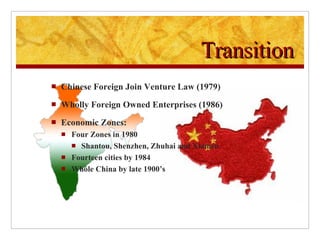
Transition Chinese Foreign Join Venture Law (1979) Wholly Foreign Owned Enterprises (1986) Economic Zones: Four Zones in 1980 Shantou, Shenzhen, Zhuhai and Xiamen Fourteen cities by 1984 Whole China by late 1900’s
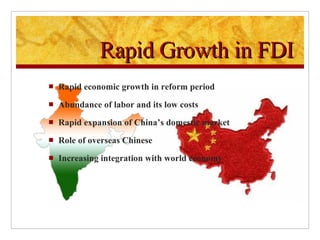
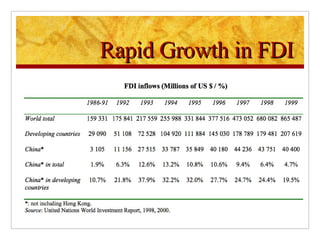
Rapid Growth in FDI Rapid economic growth in reform period Abundance of labor and its low costs Rapid expansion of China’s domestic market Role of overseas Chinese Increasing integration with world economy
Rapid Growth in FDI
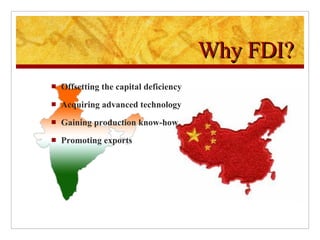
Why FDI? Offsetting the capital deficiency Acquiring advanced technology Gaining production know-how Promoting exports
India FDI History & Government Regulations
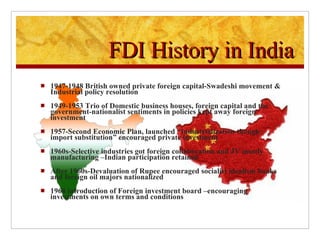
1947-1948 British owned private foreign capital-Swadeshi movement & Industrial policy resolution 1949-1953 Trio of Domestic business houses, foreign capital and the government-nationalist sentiments in policies kept away foreign investment 1957-Second Economic Plan, launched “Industrialization though import substitution” encouraged private investment 1960s-Selective industries got foreign collaboration and JV mostly manufacturing –Indian participation retained After 1960s-Devaluation of Rupee encouraged socialist idealism banks and foreign oil majors nationalized 1968 introduction of Foreign investment board –encouraging investments on own terms and conditions FDI History in India
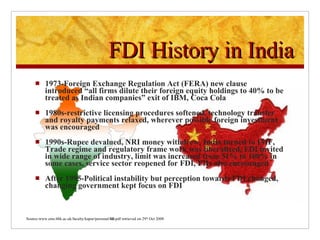
1973-Foreign Exchange Regulation Act (FERA) new clause introduced “all firms dilute their foreign equity holdings to 40% to be treated as Indian companies” exit of IBM, Coca Cola 1980s-restrictive licensing procedures softened, technology transfer and royalty payments relaxed, wherever possible foreign investment was encouraged 1990s-Rupee devalued, NRI money withdrew, India turned to IMF, Trade regime and regulatory frame work was liberalized, FDI invited in wide range of industry, limit was increased from 51% to 100% in some cases, service sector reopened for FDI, FIIs also encouraged After 1995-Political instability but perception towards FDI changed, changing government kept focus on FDI FDI History in India Source-www.ems.bbk.ac.uk/faculty/kapur/personal/ fdi .pdf retrieved on 29 th  Oct 2008
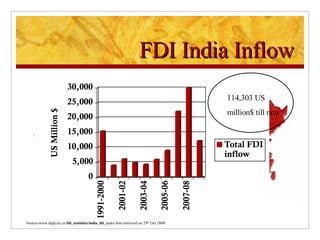
FDI India Inflow 114,303 US  million$ till now Source-www.dipp.nic.in/ fdi _ statistics / india _ fdi _index.htm retrieved on 29 th  Oct 2008
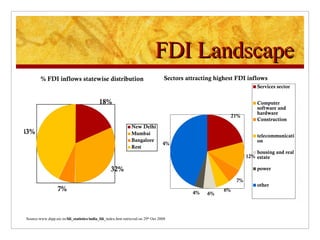
FDI Landscape Source-www.dipp.nic.in/ fdi _ statistics / india _ fdi _index.htm retrieved on 29 th  Oct 2008
Restricting product market reform Politically sensitive areas like retailing, news media and defense not deregulated yet 830 products reserved for firm below certain size specially in clothing and textiles- can not receive FDI and can not even expand Makes harder for local companies to innovate and be efficient ,local supply chains remain inefficient and  unexposed to worldwide markets and skills Loss for consumers and whole economy Examples to be considered liberalization of automotive industry and air line industry Government Regulations affecting India
Infrastructure Lack of infrastructure biggest hurdle for growth Physical infrastructure is state controlled, regional differences in infrastructure concentrate FDI to some specific regions only Multiple regional parties bring in political instability in state as well as central government making development projects slow and implementation of reforms inefficient Also a major hurdle for India “electricity shortage”-Electricity act 2003 aimed to provide electricity continuously at low cost to businesses however only 8 states implemented the act Sector itself good for FDI attraction, upgraded telecommunication highways and ports but power, railways, water and swage still major areas to be looked upon  Government Regulations affecting India
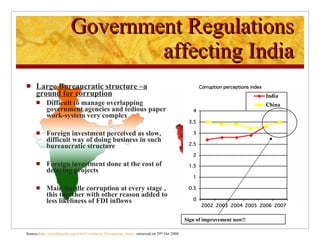
Large Bureaucratic structure –a ground for corruption Difficult to manage overlapping government agencies and tedious paper work-system very complex Foreign investment perceived as slow, difficult way of doing business in such bureaucratic structure Foreign investment done at the cost of delaying projects  Main hurdle corruption at every stage , this together with other reason added to less likeliness of FDI inflows Government Regulations affecting India Sign of improvement now!! Source- http://en.wikipedia.org/wiki/Corruption_Perceptions_Index   retrieved on 29 th  Oct 2008
Main Difference in FDI between India & China
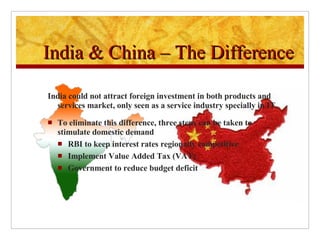
India could not attract foreign investment in both products and services market, only seen as a service industry specially in IT. To eliminate this difference, three steps can be taken to stimulate domestic demand  RBI to keep interest rates regionally competitive Implement Value Added Tax (VAT) Government to reduce budget deficit India & China – The Difference
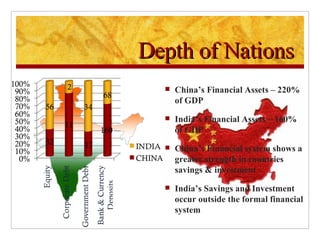
Depth of Nations China’s Financial Assets – 220% of GDP India’s Financial Assets – 160% of GDP China’s Financial system shows a greater strength in countries savings & investment India’s Savings and Investment occur outside the formal financial system
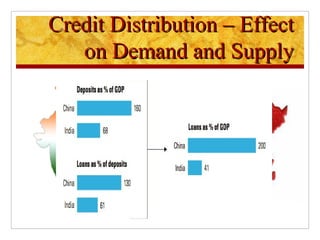
Credit Distribution – Effect on Demand and Supply
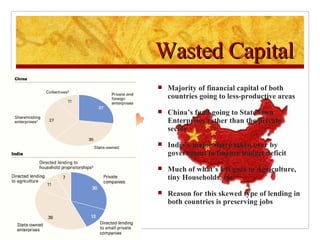
Majority of financial capital of both countries going to less-productive areas China’s fund going to State Own Enterprises rather than the private sector India’s major share taken over by government to finance budget deficit Much of what’s left goes to Agriculture, tiny Households, etc Reason for this skewed type of lending in both countries is preserving jobs Wasted Capital
FDI-Discrepancy Argument
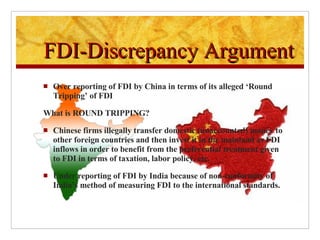
Over reporting of FDI by China in terms of its alleged ‘Round Tripping’ of FDI What is ROUND TRIPPING? Chinese firms illegally transfer domestic (unaccounted) money to other foreign countries and then invest it in the mainland as FDI inflows in order to benefit from the preferential treatment given to FDI in terms of taxation, labor policy, etc.  Under reporting of FDI by India because of non-conformity of India’s method of measuring FDI to the international standards.  FDI-Discrepancy Argument
Facts & Conclusions
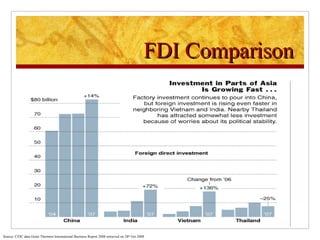
FDI Comparison Source: CEIC data Grant Thornton International Business Report 2008 retrieved on 28 th  Oct 2008
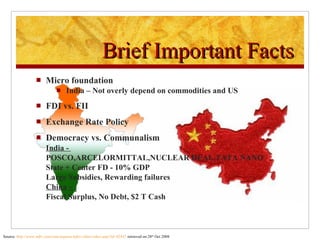
Micro foundation India – Not overly depend on commodities and US FDI vs. FII Exchange Rate Policy Democracy vs. Communalism India -  POSCO,ARCELORMITTAL,NUCLEAR DEAL,TATA NANO State + Center FD - 10% GDP Large Subsidies, Rewarding failures China -  Fiscal Surplus, No Debt, $2 T Cash Brief Important Facts Source:  http://www.ndtv.com/convergence/ndtv/video/video.aspx?id=42447  retrieved on 28 th  Oct 2008
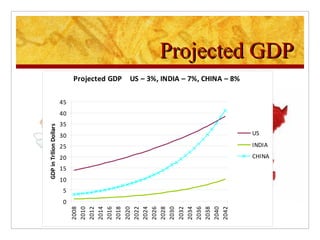
Projected GDP
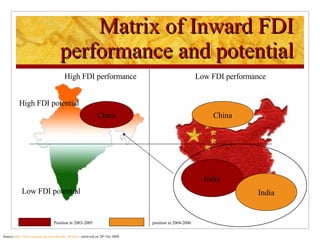
Matrix of Inward FDI performance and potential High FDI potential Low FDI potential Low FDI performance High FDI performance India China China India Position in 2003-2005 position in 2004-2006 Source: http://www.unctad.org/sections/dite_dir/docs/  retrieved on 28 th  Oct 2008
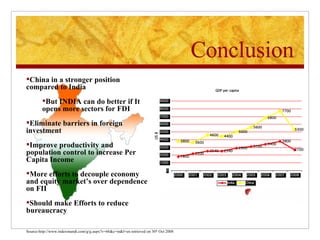
Conclusion Source-http://www.indexmundi.com/g/g.aspx?v=66&c=in&l=en retrieved on 30 th  Oct 2008 China in a stronger position compared to India But INDIA can do better if It opens more sectors for FDI Eliminate barriers in foreign investment Improve productivity and population control to increase Per Capita Income More efforts to decouple economy and equity market’s over dependence on FII Should make Efforts to reduce bureaucracy
References www.McKinsey Quarterly.com Article 1: China’s and India’s financial systems: A barrier to growth Article 2: Why believe in India Article 3: China and India: The race to growth Article 4: Making foreign investment work for China World Fact Book http://www.financialexpress.com/news/fii-vs-fdi/127133/ http://www.youtube.com/watch?v=7zmzw5WV-RA http://www.youtube.com/watch?v=VFPx1iLEGn8 http://www.ndtv.com/convergence/ndtv/video/video.aspx?id=42447 http://www.ser.tcu.edu/2003-Pro/SEP2003%20Yallapragada%20Paruchuri%2027-

FDI story in India and China.

  • 1.
    FDI Story inChina & India Effect of Government Regulations
  • 2.
    Agenda: - China FDI History - India FDI History & Government Regulations - Main Differences in FDI between India and China - FDI Discrepancy Argument - Facts & Conclusions
  • 3.
  • 4.
    Transition Chinese ForeignJoin Venture Law (1979) Wholly Foreign Owned Enterprises (1986) Economic Zones: Four Zones in 1980 Shantou, Shenzhen, Zhuhai and Xiamen Fourteen cities by 1984 Whole China by late 1900’s
  • 5.
    Rapid Growth inFDI Rapid economic growth in reform period Abundance of labor and its low costs Rapid expansion of China’s domestic market Role of overseas Chinese Increasing integration with world economy
  • 6.
  • 7.
    Why FDI? Offsettingthe capital deficiency Acquiring advanced technology Gaining production know-how Promoting exports
  • 8.
    India FDI History& Government Regulations
  • 9.
    1947-1948 British ownedprivate foreign capital-Swadeshi movement & Industrial policy resolution 1949-1953 Trio of Domestic business houses, foreign capital and the government-nationalist sentiments in policies kept away foreign investment 1957-Second Economic Plan, launched “Industrialization though import substitution” encouraged private investment 1960s-Selective industries got foreign collaboration and JV mostly manufacturing –Indian participation retained After 1960s-Devaluation of Rupee encouraged socialist idealism banks and foreign oil majors nationalized 1968 introduction of Foreign investment board –encouraging investments on own terms and conditions FDI History in India
  • 10.
    1973-Foreign Exchange RegulationAct (FERA) new clause introduced “all firms dilute their foreign equity holdings to 40% to be treated as Indian companies” exit of IBM, Coca Cola 1980s-restrictive licensing procedures softened, technology transfer and royalty payments relaxed, wherever possible foreign investment was encouraged 1990s-Rupee devalued, NRI money withdrew, India turned to IMF, Trade regime and regulatory frame work was liberalized, FDI invited in wide range of industry, limit was increased from 51% to 100% in some cases, service sector reopened for FDI, FIIs also encouraged After 1995-Political instability but perception towards FDI changed, changing government kept focus on FDI FDI History in India Source-www.ems.bbk.ac.uk/faculty/kapur/personal/ fdi .pdf retrieved on 29 th Oct 2008
  • 11.
    FDI India Inflow114,303 US million$ till now Source-www.dipp.nic.in/ fdi _ statistics / india _ fdi _index.htm retrieved on 29 th Oct 2008
  • 12.
    FDI Landscape Source-www.dipp.nic.in/fdi _ statistics / india _ fdi _index.htm retrieved on 29 th Oct 2008
  • 13.
    Restricting product marketreform Politically sensitive areas like retailing, news media and defense not deregulated yet 830 products reserved for firm below certain size specially in clothing and textiles- can not receive FDI and can not even expand Makes harder for local companies to innovate and be efficient ,local supply chains remain inefficient and unexposed to worldwide markets and skills Loss for consumers and whole economy Examples to be considered liberalization of automotive industry and air line industry Government Regulations affecting India
  • 14.
    Infrastructure Lack ofinfrastructure biggest hurdle for growth Physical infrastructure is state controlled, regional differences in infrastructure concentrate FDI to some specific regions only Multiple regional parties bring in political instability in state as well as central government making development projects slow and implementation of reforms inefficient Also a major hurdle for India “electricity shortage”-Electricity act 2003 aimed to provide electricity continuously at low cost to businesses however only 8 states implemented the act Sector itself good for FDI attraction, upgraded telecommunication highways and ports but power, railways, water and swage still major areas to be looked upon Government Regulations affecting India
  • 15.
    Large Bureaucratic structure–a ground for corruption Difficult to manage overlapping government agencies and tedious paper work-system very complex Foreign investment perceived as slow, difficult way of doing business in such bureaucratic structure Foreign investment done at the cost of delaying projects Main hurdle corruption at every stage , this together with other reason added to less likeliness of FDI inflows Government Regulations affecting India Sign of improvement now!! Source- http://en.wikipedia.org/wiki/Corruption_Perceptions_Index retrieved on 29 th Oct 2008
  • 16.
    Main Difference inFDI between India & China
  • 17.
    India could notattract foreign investment in both products and services market, only seen as a service industry specially in IT. To eliminate this difference, three steps can be taken to stimulate domestic demand RBI to keep interest rates regionally competitive Implement Value Added Tax (VAT) Government to reduce budget deficit India & China – The Difference
  • 18.
    Depth of NationsChina’s Financial Assets – 220% of GDP India’s Financial Assets – 160% of GDP China’s Financial system shows a greater strength in countries savings & investment India’s Savings and Investment occur outside the formal financial system
  • 19.
    Credit Distribution –Effect on Demand and Supply
  • 20.
    Majority of financialcapital of both countries going to less-productive areas China’s fund going to State Own Enterprises rather than the private sector India’s major share taken over by government to finance budget deficit Much of what’s left goes to Agriculture, tiny Households, etc Reason for this skewed type of lending in both countries is preserving jobs Wasted Capital
  • 21.
  • 22.
    Over reporting ofFDI by China in terms of its alleged ‘Round Tripping’ of FDI What is ROUND TRIPPING? Chinese firms illegally transfer domestic (unaccounted) money to other foreign countries and then invest it in the mainland as FDI inflows in order to benefit from the preferential treatment given to FDI in terms of taxation, labor policy, etc. Under reporting of FDI by India because of non-conformity of India’s method of measuring FDI to the international standards. FDI-Discrepancy Argument
  • 23.
  • 24.
    FDI Comparison Source:CEIC data Grant Thornton International Business Report 2008 retrieved on 28 th Oct 2008
  • 25.
    Micro foundation India– Not overly depend on commodities and US FDI vs. FII Exchange Rate Policy Democracy vs. Communalism India - POSCO,ARCELORMITTAL,NUCLEAR DEAL,TATA NANO State + Center FD - 10% GDP Large Subsidies, Rewarding failures China - Fiscal Surplus, No Debt, $2 T Cash Brief Important Facts Source: http://www.ndtv.com/convergence/ndtv/video/video.aspx?id=42447 retrieved on 28 th Oct 2008
  • 26.
  • 27.
    Matrix of InwardFDI performance and potential High FDI potential Low FDI potential Low FDI performance High FDI performance India China China India Position in 2003-2005 position in 2004-2006 Source: http://www.unctad.org/sections/dite_dir/docs/ retrieved on 28 th Oct 2008
  • 28.
    Conclusion Source-http://www.indexmundi.com/g/g.aspx?v=66&c=in&l=en retrievedon 30 th Oct 2008 China in a stronger position compared to India But INDIA can do better if It opens more sectors for FDI Eliminate barriers in foreign investment Improve productivity and population control to increase Per Capita Income More efforts to decouple economy and equity market’s over dependence on FII Should make Efforts to reduce bureaucracy
  • 29.
    References www.McKinsey Quarterly.comArticle 1: China’s and India’s financial systems: A barrier to growth Article 2: Why believe in India Article 3: China and India: The race to growth Article 4: Making foreign investment work for China World Fact Book http://www.financialexpress.com/news/fii-vs-fdi/127133/ http://www.youtube.com/watch?v=7zmzw5WV-RA http://www.youtube.com/watch?v=VFPx1iLEGn8 http://www.ndtv.com/convergence/ndtv/video/video.aspx?id=42447 http://www.ser.tcu.edu/2003-Pro/SEP2003%20Yallapragada%20Paruchuri%2027-