INDIA’S RANKING IN
INFORMATION
TECHNOLOGY
MADE BY :– SUVAM S.B AND
RITVIK MISHRA
 Information Technology of India
 IT hubs in India
 India’s GDP and IT Sector
 Growth of IT sector
 India’s export
 India's import
 Growth barriers of IT Sector
 India’s rank
 Top 10 IT Sectors countries
 IT future
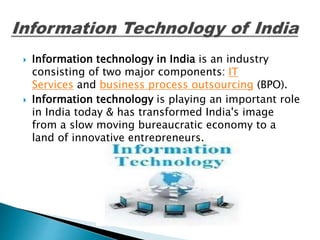
 Information technology in India is an industry
consisting of two major components: IT
Services and business process outsourcing (BPO).
 Information technology is playing an important role
in India today & has transformed India's image
from a slow moving bureaucratic economy to a
land of innovative entrepreneurs.
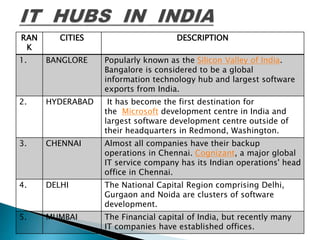
RAN
K
CITIES DESCRIPTION
1. BANGLORE Popularly known as the Silicon Valley of India.
Bangalore is considered to be a global
information technology hub and largest software
exports from India.
2. HYDERABAD It has become the first destination for
the Microsoft development centre in India and
largest software development centre outside of
their headquarters in Redmond, Washington.
3. CHENNAI Almost all companies have their backup
operations in Chennai. Cognizant, a major global
IT service company has its Indian operations' head
office in Chennai.
4. DELHI The National Capital Region comprising Delhi,
Gurgaon and Noida are clusters of software
development.
5. MUMBAI The Financial capital of India, but recently many
IT companies have established offices.
 The contribution of IT
sector to India’s GDP rose
from about 2% at the turn
of the millennium to 4.8%
at the end of fiscal year
2005-06 (April-March).
 Exports are estimated to
account for 31.3 billion
USD out of 39.7 billion
USD turn-over in fiscal
year 2006-07 [NASSCOM,
2007] in software sector.
contd.
 Exports are estimated to
account for 31.3 billion USD
out of 39.7 billion USD
turn-over in fiscal year
2006-07 [NASSCOM, 2007].
 According to a study ,India,
which currently holds a
share of 12% in offshore
engineering services, is
expected to corner 30%
share in the 1.1 trillion USD
global spending on
engineering services by
2020
 Since liberalization, the
value of India's
international trade has
increased
sharply,[199] with the
contribution of total
trade in goods and
services to the GDP rising
from 16% in 1990–91 to
47% in 2008–10.India
accounts for 1.44% of
exports for merchandise
trade and 3.34% of
exports for commercial
services trade worldwide
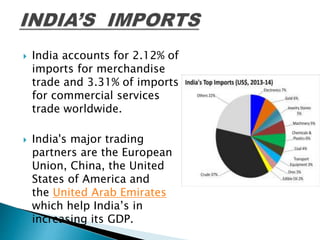
 India accounts for 2.12% of
imports for merchandise
trade and 3.31% of imports
for commercial services
trade worldwide.
 India's major trading
partners are the European
Union, China, the United
States of America and
the United Arab Emirates
which help India’s in
increasing its GDP.
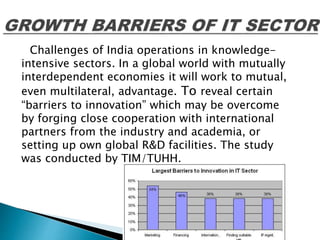
Challenges of India operations in knowledge-
intensive sectors. In a global world with mutually
interdependent economies it will work to mutual,
even multilateral, advantage. To reveal certain
“barriers to innovation” which may be overcome
by forging close cooperation with international
partners from the industry and academia, or
setting up own global R&D facilities. The study
was conducted by TIM/TUHH.
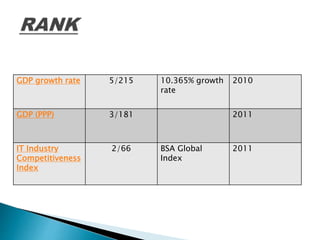
GDP growth rate 5/215 10.365% growth
rate
2010
GDP (PPP) 3/181 2011
IT Industry
Competitiveness
Index
2/66 BSA Global
Index
2011
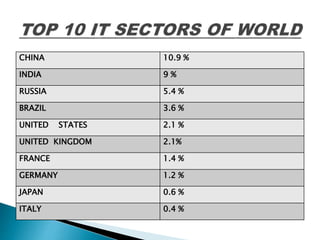
CHINA 10.9 %
INDIA 9 %
RUSSIA 5.4 %
BRAZIL 3.6 %
UNITED STATES 2.1 %
UNITED KINGDOM 2.1%
FRANCE 1.4 %
GERMANY 1.2 %
JAPAN 0.6 %
ITALY 0.4 %
 India has the second fastest growing services
sector with its compound annual growth rate at
nine per cent, just below China’s 10.9 per cent,
during the last 11-year period from 2001 to
2012, the Economic SURVEY FOR 2013-14 said.
Russia at 5.4 per cent is a distant third.
 Among the world's top 15 countries in terms of
GDP, India ranked 5th in terms of overall GDP
and 9th in terms of services GDP in 2012, it said,
adding that services share in world GDP was 65.9
per cent but its share in employment was only 44
per cent in 2011.
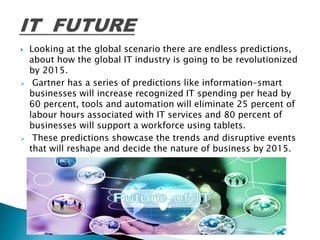
 Looking at the global scenario there are endless predictions,
about how the global IT industry is going to be revolutionized
by 2015.
 Gartner has a series of predictions like information-smart
businesses will increase recognized IT spending per head by
60 percent, tools and automation will eliminate 25 percent of
labour hours associated with IT services and 80 percent of
businesses will support a workforce using tablets.
 These predictions showcase the trends and disruptive events
that will reshape and decide the nature of business by 2015.
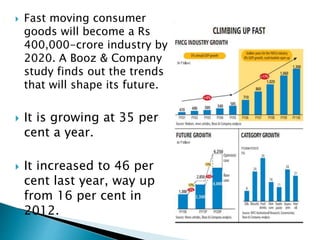
 Fast moving consumer
goods will become a Rs
400,000-crore industry by
2020. A Booz & Company
study finds out the trends
that will shape its future.
 It is growing at 35 per
cent a year.
 It increased to 46 per
cent last year, way up
from 16 per cent in
2012.
India's rank in Information Technology || IT

India's rank in Information Technology || IT

  • 1.
    INDIA’S RANKING IN INFORMATION TECHNOLOGY MADEBY :– SUVAM S.B AND RITVIK MISHRA
  • 2.
     Information Technologyof India  IT hubs in India  India’s GDP and IT Sector  Growth of IT sector  India’s export  India's import  Growth barriers of IT Sector  India’s rank  Top 10 IT Sectors countries  IT future
  • 3.
     Information technologyin India is an industry consisting of two major components: IT Services and business process outsourcing (BPO).  Information technology is playing an important role in India today & has transformed India's image from a slow moving bureaucratic economy to a land of innovative entrepreneurs.
  • 4.
    RAN K CITIES DESCRIPTION 1. BANGLOREPopularly known as the Silicon Valley of India. Bangalore is considered to be a global information technology hub and largest software exports from India. 2. HYDERABAD It has become the first destination for the Microsoft development centre in India and largest software development centre outside of their headquarters in Redmond, Washington. 3. CHENNAI Almost all companies have their backup operations in Chennai. Cognizant, a major global IT service company has its Indian operations' head office in Chennai. 4. DELHI The National Capital Region comprising Delhi, Gurgaon and Noida are clusters of software development. 5. MUMBAI The Financial capital of India, but recently many IT companies have established offices.
  • 5.
     The contributionof IT sector to India’s GDP rose from about 2% at the turn of the millennium to 4.8% at the end of fiscal year 2005-06 (April-March).  Exports are estimated to account for 31.3 billion USD out of 39.7 billion USD turn-over in fiscal year 2006-07 [NASSCOM, 2007] in software sector. contd.
  • 6.
     Exports areestimated to account for 31.3 billion USD out of 39.7 billion USD turn-over in fiscal year 2006-07 [NASSCOM, 2007].  According to a study ,India, which currently holds a share of 12% in offshore engineering services, is expected to corner 30% share in the 1.1 trillion USD global spending on engineering services by 2020
  • 7.
     Since liberalization,the value of India's international trade has increased sharply,[199] with the contribution of total trade in goods and services to the GDP rising from 16% in 1990–91 to 47% in 2008–10.India accounts for 1.44% of exports for merchandise trade and 3.34% of exports for commercial services trade worldwide
  • 8.
     India accountsfor 2.12% of imports for merchandise trade and 3.31% of imports for commercial services trade worldwide.  India's major trading partners are the European Union, China, the United States of America and the United Arab Emirates which help India’s in increasing its GDP.
  • 9.
    Challenges of Indiaoperations in knowledge- intensive sectors. In a global world with mutually interdependent economies it will work to mutual, even multilateral, advantage. To reveal certain “barriers to innovation” which may be overcome by forging close cooperation with international partners from the industry and academia, or setting up own global R&D facilities. The study was conducted by TIM/TUHH.
  • 10.
    GDP growth rate5/215 10.365% growth rate 2010 GDP (PPP) 3/181 2011 IT Industry Competitiveness Index 2/66 BSA Global Index 2011
  • 11.
    CHINA 10.9 % INDIA9 % RUSSIA 5.4 % BRAZIL 3.6 % UNITED STATES 2.1 % UNITED KINGDOM 2.1% FRANCE 1.4 % GERMANY 1.2 % JAPAN 0.6 % ITALY 0.4 %
  • 12.
     India hasthe second fastest growing services sector with its compound annual growth rate at nine per cent, just below China’s 10.9 per cent, during the last 11-year period from 2001 to 2012, the Economic SURVEY FOR 2013-14 said. Russia at 5.4 per cent is a distant third.  Among the world's top 15 countries in terms of GDP, India ranked 5th in terms of overall GDP and 9th in terms of services GDP in 2012, it said, adding that services share in world GDP was 65.9 per cent but its share in employment was only 44 per cent in 2011.
  • 13.
     Looking atthe global scenario there are endless predictions, about how the global IT industry is going to be revolutionized by 2015.  Gartner has a series of predictions like information-smart businesses will increase recognized IT spending per head by 60 percent, tools and automation will eliminate 25 percent of labour hours associated with IT services and 80 percent of businesses will support a workforce using tablets.  These predictions showcase the trends and disruptive events that will reshape and decide the nature of business by 2015.
  • 14.
     Fast movingconsumer goods will become a Rs 400,000-crore industry by 2020. A Booz & Company study finds out the trends that will shape its future.  It is growing at 35 per cent a year.  It increased to 46 per cent last year, way up from 16 per cent in 2012.