LALIT CHOUDHARI
A foreign direct investment (FDI) is a
controlling ownership in a business
enterprise in one country by an entity based
in another country.
Foreign direct investment is distinguished
from portfolio foreign investment, a passive
investment in the securities of another
country such as public stocks and bonds, by
the element of "control".
 Foreign Direct Investment (FDI) can be
defined as
 DEFINITION :-
Foreign direct investment includes “merges
and acquisitions, building new facilities,
reinvesting profits earned from overseas
operations and intracompany loans.”
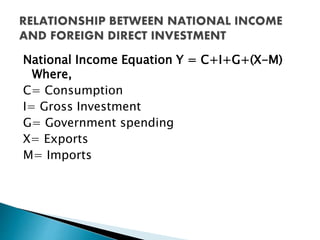
National Income Equation Y = C+I+G+(X-M)
Where,
C= Consumption
I= Gross Investment
G= Government spending
X= Exports
M= Imports
 Horizontal FDI –
Horizontal FDI arises when a firm duplicates its home country based
activities at the same value chain stage in a host country through FDI.
 Platform FDI –
Platform FDI Foreign direct investment from a source country into a
destination country for the purpose of exporting to a third country.
 Vertical FDI-
Vertical FDI takes place when a firm through FDI moves upstream or
downstream in different value chains i.e., when firms perform value
adding activities stage by stage in a vertical fashion in a host country.
Foreign direct investment incentives
may take the following forms:
 low corporate tax and individual income tax
rates
 preferential tariffs
 special economic zones
 Bonded warehouses
 Maquiladoras
 investment financial subsidies[6]
 free land or land subsidies
 relocation & expatriation
 infrastructure subsidies
 R&D support
 derogation from regulations
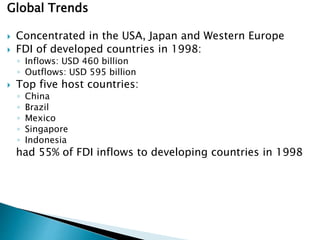
Global Trends
 Concentrated in the USA, Japan and Western Europe
 FDI of developed countries in 1998:
◦ Inflows: USD 460 billion
◦ Outflows: USD 595 billion
 Top five host countries:
◦ China
◦ Brazil
◦ Mexico
◦ Singapore
◦ Indonesia
had 55% of FDI inflows to developing countries in 1998
•Foreign investment was introduced in 1991 as Foreign
Exchange Management Act (FEMA), driven by Finance
Minister Manmohan Singh.
•A recent UNCTAD survey projected India as the second
most important FDI destination for transactional
corporations during 2010 – 2012.
•The sectors that attracted the higher inflows were services,
telecommunication, construction activities and computer
software and hardware.
• Mauritius, Singapore, United States and United Kingdom
are among the leading sources of FDI.
•Based on UNCTAD data FDI flows were $10.4 billion, a drop
of 43 % from the first half of the last year.
FOREIGN DIRECT INVESTMENT IN INDIA
SECTORS LIMIT
Hotels & Tourism, Roads & Highways, Education,
Advertisement, Farms, Petrochemicals,
Pharmaceuticals, Coal & Lignite
100 %
Multi brand Retails 100 %
Civil Aviation
Incl: Airports, scheduled & non scheduled
domestic airlines, helicopter services, ground &
maintenance services, repair organizations, flying
training institutes & technical training institutes
49 %
Insurance Sector
FDI in insurance sector, as prescribed in Insurance
Act 1999, is under automatic route
49 %
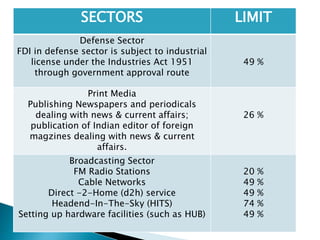
SECTORS LIMIT
Defense Sector
FDI in defense sector is subject to industrial
license under the Industries Act 1951
through government approval route
49 %
Print Media
Publishing Newspapers and periodicals
dealing with news & current affairs;
publication of Indian editor of foreign
magzines dealing with news & current
affairs.
26 %
Broadcasting Sector
FM Radio Stations
Cable Networks
Direct -2-Home (d2h) service
Headend-In-The-Sky (HITS)
Setting up hardware facilities (such as HUB)
20 %
49 %
49 %
74 %
49 %
SECTORS LIMIT
Credit Information Companies 100 %
Banking Sector
New Bank (after August 2011)
Private Sector Banks
Public Sector Banks
Construction, operation and
maintenance of specified activities of
Railway sector
49 %
74 %
49 %
100%
1.TMI Mauritius Ltd. >Rs 7294 crore/$1600 million
2. Cairn UK Holding >Rs6663 crores/$1492 million
3. Oracle Global (Mauritius) Ltd. >Rs 4805 crore/$1083 million
4. Mauritius Debt Management Ltd.>Rs 3800 crore/$956 million
5. Vodafone Mauritius Ltd. – Rs 3268 crore/$801 million
6. Etisalat Mauritius Ltd. – Rs 3228 crore
7. CMP Asia Ltd. – Rs 2638.25 crore/$653.74 million
8. Oracle Global Mauritius Ltd. – Rs 2578.88 crore / $563.94
million
9. Merrill Lynch(Mauritius) Ltd. – Rs 2230.02 crore / $483.55
million
10. Name of the company not given (but the Indian company which
got the FDI is Dhabol Power
company Ltd.)
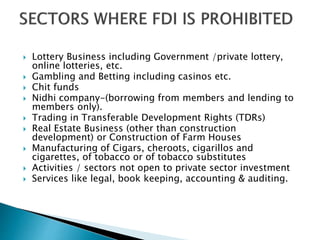
 Lottery Business including Government /private lottery,
online lotteries, etc.
 Gambling and Betting including casinos etc.
 Chit funds
 Nidhi company-(borrowing from members and lending to
members only).
 Trading in Transferable Development Rights (TDRs)
 Real Estate Business (other than construction
development) or Construction of Farm Houses
 Manufacturing of Cigars, cheroots, cigarillos and
cigarettes, of tobacco or of tobacco substitutes
 Activities / sectors not open to private sector investment
 Services like legal, book keeping, accounting & auditing.
•ADVANTAGES OF FDI
• Increase in Domestic Employment/Drop in
unemployment
• Investment in Needed Infrastructure.
• Positive Influence on the Balance of Payments.
• New Technology and “Know How” Transfer.
• Increased Capital Investment.
• Targeted Regional and Sectoral Development.
• Inflow of equipment and technology
• Competitive advantages and innovation
• Finance resource for expansive
• Employment generation
• Contribution to export growth
• Improved consumer welfare through reduced cost, wider
choice & improved quality.
• Provide access to global markets for Indian producer.
DISADVANTAGES OF FDI
•Industrial Sector Dominance in the Domestic Market.
•Technological Dependence on Foreign Technology Sources.
•Disturbance of Domestic Economic Plans in Favor of FDI-
Directed Activities.
•“Cultural Change” Created by “Ethnocentric Staffing” The
Infusion of Foreign Culture , and Foreign Business Practices
 Foreign firms do generate technological
development in the host country
 Consider these all aspect finally I conclude that FDI more
boon than bane because foreign direct investment has more
advantages than this disadvantages.
 Benefits in increased:
◦ Competition
◦ Efficiency
◦ Innovation
FDI

FDI

  • 1.
  • 2.
    A foreign directinvestment (FDI) is a controlling ownership in a business enterprise in one country by an entity based in another country. Foreign direct investment is distinguished from portfolio foreign investment, a passive investment in the securities of another country such as public stocks and bonds, by the element of "control".
  • 3.
     Foreign DirectInvestment (FDI) can be defined as  DEFINITION :- Foreign direct investment includes “merges and acquisitions, building new facilities, reinvesting profits earned from overseas operations and intracompany loans.”
  • 4.
    National Income EquationY = C+I+G+(X-M) Where, C= Consumption I= Gross Investment G= Government spending X= Exports M= Imports
  • 5.
     Horizontal FDI– Horizontal FDI arises when a firm duplicates its home country based activities at the same value chain stage in a host country through FDI.  Platform FDI – Platform FDI Foreign direct investment from a source country into a destination country for the purpose of exporting to a third country.  Vertical FDI- Vertical FDI takes place when a firm through FDI moves upstream or downstream in different value chains i.e., when firms perform value adding activities stage by stage in a vertical fashion in a host country.
  • 6.
    Foreign direct investmentincentives may take the following forms:  low corporate tax and individual income tax rates  preferential tariffs  special economic zones  Bonded warehouses  Maquiladoras  investment financial subsidies[6]  free land or land subsidies  relocation & expatriation  infrastructure subsidies  R&D support  derogation from regulations
  • 7.
    Global Trends  Concentratedin the USA, Japan and Western Europe  FDI of developed countries in 1998: ◦ Inflows: USD 460 billion ◦ Outflows: USD 595 billion  Top five host countries: ◦ China ◦ Brazil ◦ Mexico ◦ Singapore ◦ Indonesia had 55% of FDI inflows to developing countries in 1998
  • 8.
    •Foreign investment wasintroduced in 1991 as Foreign Exchange Management Act (FEMA), driven by Finance Minister Manmohan Singh. •A recent UNCTAD survey projected India as the second most important FDI destination for transactional corporations during 2010 – 2012. •The sectors that attracted the higher inflows were services, telecommunication, construction activities and computer software and hardware. • Mauritius, Singapore, United States and United Kingdom are among the leading sources of FDI. •Based on UNCTAD data FDI flows were $10.4 billion, a drop of 43 % from the first half of the last year. FOREIGN DIRECT INVESTMENT IN INDIA
  • 10.
    SECTORS LIMIT Hotels &Tourism, Roads & Highways, Education, Advertisement, Farms, Petrochemicals, Pharmaceuticals, Coal & Lignite 100 % Multi brand Retails 100 % Civil Aviation Incl: Airports, scheduled & non scheduled domestic airlines, helicopter services, ground & maintenance services, repair organizations, flying training institutes & technical training institutes 49 % Insurance Sector FDI in insurance sector, as prescribed in Insurance Act 1999, is under automatic route 49 %
  • 11.
    SECTORS LIMIT Defense Sector FDIin defense sector is subject to industrial license under the Industries Act 1951 through government approval route 49 % Print Media Publishing Newspapers and periodicals dealing with news & current affairs; publication of Indian editor of foreign magzines dealing with news & current affairs. 26 % Broadcasting Sector FM Radio Stations Cable Networks Direct -2-Home (d2h) service Headend-In-The-Sky (HITS) Setting up hardware facilities (such as HUB) 20 % 49 % 49 % 74 % 49 %
  • 12.
    SECTORS LIMIT Credit InformationCompanies 100 % Banking Sector New Bank (after August 2011) Private Sector Banks Public Sector Banks Construction, operation and maintenance of specified activities of Railway sector 49 % 74 % 49 % 100%
  • 13.
    1.TMI Mauritius Ltd.>Rs 7294 crore/$1600 million 2. Cairn UK Holding >Rs6663 crores/$1492 million 3. Oracle Global (Mauritius) Ltd. >Rs 4805 crore/$1083 million 4. Mauritius Debt Management Ltd.>Rs 3800 crore/$956 million 5. Vodafone Mauritius Ltd. – Rs 3268 crore/$801 million 6. Etisalat Mauritius Ltd. – Rs 3228 crore 7. CMP Asia Ltd. – Rs 2638.25 crore/$653.74 million 8. Oracle Global Mauritius Ltd. – Rs 2578.88 crore / $563.94 million 9. Merrill Lynch(Mauritius) Ltd. – Rs 2230.02 crore / $483.55 million 10. Name of the company not given (but the Indian company which got the FDI is Dhabol Power company Ltd.)
  • 14.
     Lottery Businessincluding Government /private lottery, online lotteries, etc.  Gambling and Betting including casinos etc.  Chit funds  Nidhi company-(borrowing from members and lending to members only).  Trading in Transferable Development Rights (TDRs)  Real Estate Business (other than construction development) or Construction of Farm Houses  Manufacturing of Cigars, cheroots, cigarillos and cigarettes, of tobacco or of tobacco substitutes  Activities / sectors not open to private sector investment  Services like legal, book keeping, accounting & auditing.
  • 15.
    •ADVANTAGES OF FDI •Increase in Domestic Employment/Drop in unemployment • Investment in Needed Infrastructure. • Positive Influence on the Balance of Payments. • New Technology and “Know How” Transfer. • Increased Capital Investment. • Targeted Regional and Sectoral Development. • Inflow of equipment and technology • Competitive advantages and innovation • Finance resource for expansive • Employment generation • Contribution to export growth • Improved consumer welfare through reduced cost, wider choice & improved quality. • Provide access to global markets for Indian producer.
  • 16.
    DISADVANTAGES OF FDI •IndustrialSector Dominance in the Domestic Market. •Technological Dependence on Foreign Technology Sources. •Disturbance of Domestic Economic Plans in Favor of FDI- Directed Activities. •“Cultural Change” Created by “Ethnocentric Staffing” The Infusion of Foreign Culture , and Foreign Business Practices
  • 17.
     Foreign firmsdo generate technological development in the host country  Consider these all aspect finally I conclude that FDI more boon than bane because foreign direct investment has more advantages than this disadvantages.  Benefits in increased: ◦ Competition ◦ Efficiency ◦ Innovation