EPC Core Overview
MCI
February-2015
y
1 © Nokia 2015
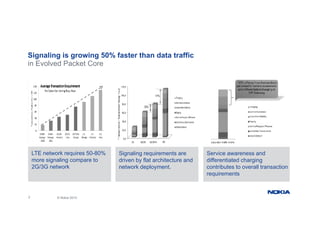
Signaling is growing 50% faster than data traffic
in Evolved Packet Core
LTE network requires 50-80%
more signaling compare to
2G/3G network
Signaling requirements are
driven by flat architecture and
network deployment.
Service awareness and
differentiated charging
contributes to overall transaction
requirements
2 © Nokia 2015
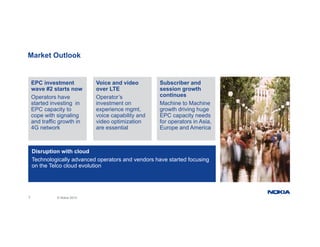
Market Outlook
EPC investment
wave #2 starts now
Operators have
Subscriber and
session growth
continues
Voice and video
over LTE
Operator’s
Operators have
started investing in
EPC capacity to
cope with signaling
and traffic growth in
continues
Machine to Machine
growth driving huge
EPC capacity needs
for operators in Asia,
Operator s
investment on
experience mgmt,
voice capability and
video optimization
g
4G network
p ,
Europe and America
p
are essential
Disruption with cloud
Technologically advanced operators and vendors have started focusing
on the Telco cloud evolution
3 © Nokia 2015
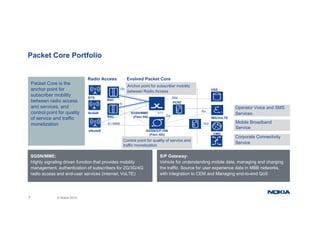
Packet Core Portfolio
Radio Access
HSS
Evolved Packet Core
Gb
Anchor point for subscriber mobility
between Radio Access
Packet Core is the
anchor point for
subscriber mobility
Operator Voice and SMS
Services
PCRF
IMS/VoLTE
S1 MME
S11
S6a
Gx
SGi
Rx
BTS
NodeB
RNC
BSC
Iu
SGSN/MME
(Flexi NS)
subscriber mobility
between radio access
and services, and
control point for quality
of service and traffic
monetization Mobile Broadband
eNodeB
Corporate Connectivity
Service
GGSN/S/P-GW
(Flexi NG)
S1-MME SGi
Control point for quality of service and
traffic monetization
monetization Mobile Broadband
Service
CMD
SGSN/MME:
Highly signaling driven function that provides mobility
management, authentication of subscribers for 2G/3G/4G
radio access and end-user services (internet, VoLTE)
S/P Gateway:
Vehicle for understanding mobile data, managing and charging
the traffic. Source for user experience data in MBB networks,
with integration to CEM and Managing end-to-end QoS
4 © Nokia 2015
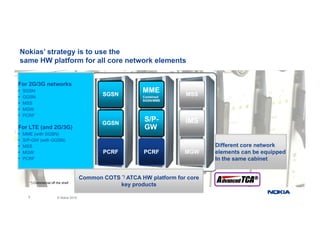
Nokias’ strategy is to use the
same HW platform for all core network elements
SGSN
MME
C bi d
MSS
For 2G/3G networks
• SGSN
• GGSN
GGSN
Combined
SGSN/MME
S/P- IMS
• GGSN
• MSS
• MGW
• PCRF
GGSN
PCRF
GW
MGW
PCRF
For LTE (and 2G/3G)
• MME (with SGSN)
• S/P-GW (with GGSN)
• MSS
G
Different core network
l t b i d
PCRF MGW
PCRF
• MGW
• PCRF
elements can be equipped
In the same cabinet
Common COTS *) ATCA HW platform for core
5 © Nokia 2015
*) Commercial off the shelf
Common COTS ) ATCA HW platform for core
key products
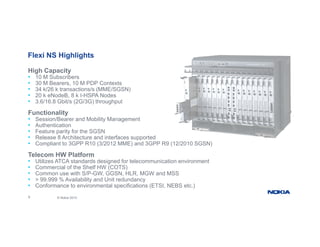
Flexi NS Highlights
Hi h C it
High Capacity
• 10 M Subscribers
• 30 M Bearers, 10 M PDP Contexts
• 34 k/26 k transactions/s (MME/SGSN)
• 20 k eNodeB 8 k I-HSPA Nodes
20 k eNodeB, 8 k I HSPA Nodes
• 3.6/16.8 Gbit/s (2G/3G) throughput
Functionality
• Session/Bearer and Mobility Management
A th ti ti
• Authentication
• Feature parity for the SGSN
• Release 8 Architecture and interfaces supported
• Compliant to 3GPP R10 (3/2012 MME) and 3GPP R9 (12/2010 SGSN)
Telecom HW Platform
• Utilizes ATCA standards designed for telecommunication environment
• Commercial of the Shelf HW (COTS)
• Common use with S/P-GW, GGSN, HLR, MGW and MSS
99 999 % A il bilit d U it d d
6 © Nokia 2015
• > 99.999 % Availability and Unit redundancy
• Conformance to environmental specifications (ETSI, NEBS etc.)
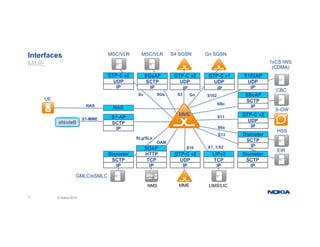
MME
Interfaces Gn SGSN
MSC/VLR MSC/VLR S4 SGSN
1xCS IWS
(CDMA)
UDP
IP
GTP-C v2
SCTP
IP
SGsAP
UDP
IP
GTP-C v1
SBcAP
Sv SGs Gn
UDP
IP
GTP-C v2
S3
CBC
( )
UDP
IP
S102AP
S102
MME
SCTP
IP
SBcAP
UDP
GTP-C v2
SCTP
S1-AP
NAS
S1-MME
NAS SBc
S11
Gn
eNodeB
UE
S-GW
S102
IP
SCTP
IP
Diameter
SCTP
IP
SOAP
S6a
S13
SLg/SLs
OAM
X1_1/X2
S10
eNodeB
HSS
EIR
SCTP
IP
Diameter
TCP
IP
LIPv2
UDP
IP
GTP-C v2
TCP
IP
HTTP
SCTP
IP
Diameter
GMLC/eSMLC
EIR
7 © Nokia 2015
LIMS/LIC
MME
NMS
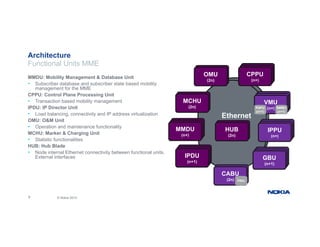
Functional Units MME
Architecture
MMDU: Mobility Management & Database Unit
• Subscriber database and subscriber state based mobility
management for the MME
CPPU: Control Plane Processing Unit
OMU
(2n)
CPPU
(n+)
CPPU: Control Plane Processing Unit
• Transaction based mobility management
IPDU: IP Director Unit
• Load balancing, connectivity and IP address virtualization
OMU: O&M Unit
Ethernet
Ethernet
MCHU
(2n)
VMU
(n+)
PAPU
(n+1)
SMMU
(n+1)
• Operation and maintenance functionality
MCHU: Marker & Charging Unit
• Statistic functionalities
HUB: Hub Blade
N d i t l Eth t ti it b t f ti l it
Ethernet
HUB
(2n)
MMDU
(n+)
IPPU
(n+)
• Node internal Ethernet connectivity between functional units.
External interfaces IPDU
(n+1)
GBU
(n+1)
CABU
8 © Nokia 2015
(2n) FRIU
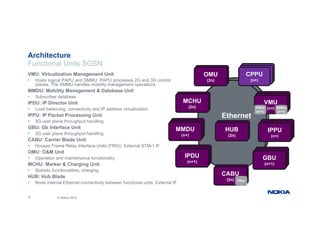
Functional Units SGSN
Architecture
VMU: Virtualization Management Unit
• Hosts logical PAPU and SMMU. PAPU processes 2G and 3G control
planes. The SMMU handles mobility management operations
MMDU: Mobility Management & Database Unit
• Subscriber database
OMU
(2n)
CPPU
(n+)
• Subscriber database
IPDU: IP Director Unit
• Load balancing, connectivity and IP address virtualization
IPPU: IP Packet Processing Unit
• 3G user plane throughput handling Ethernet
Ethernet
MCHU
(2n)
VMU
(n+)
PAPU
(n+1)
SMMU
(n+1)
p g p g
GBU: Gb Interface Unit
• 2G user plane throughput handling
CABU: Carrier Blade Unit
• Houses Frame Relay Interface Units (FRIU). External STM-1 IF
OMU O&M U it
Ethernet
HUB
(2n)
MMDU
(n+)
IPPU
(n+)
OMU: O&M Unit
• Operation and maintenance functionality
MCHU: Marker & Charging Unit
• Statistic functionalities, charging
HUB: Hub Blade
IPDU
(n+1)
GBU
(n+1)
CABU
9 © Nokia 2015
HUB: Hub Blade
• Node internal Ethernet connectivity between functional units. External IF
(2n) FRIU
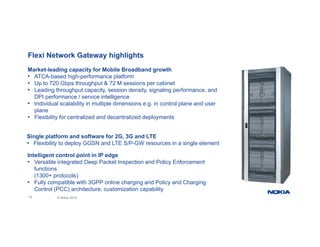
Flexi Network Gateway highlights
Market leading capacity for Mobile Broadband growth
Market-leading capacity for Mobile Broadband growth
• ATCA-based high-performance platform
• Up to 720 Gbps throughput & 72 M sessions per cabinet
• Leading throughput capacity, session density, signaling performance, and
DPI performance / service intelligence
• Individual scalability in multiple dimensions e.g. in control plane and user
plane
• Flexibility for centralized and decentralized deployments
Single platform and software for 2G, 3G and LTE
• Flexibility to deploy GGSN and LTE S/P-GW resources in a single element
Intelligent control point in IP edge
• Versatile integrated Deep Packet Inspection and Policy Enforcement
functions
(1300+ protocols)
10 © Nokia 2015
( p )
• Fully compatible with 3GPP online charging and Policy and Charging
Control (PCC) architecture, customization capability
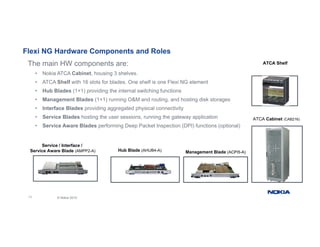
Flexi NG Hardware Components and Roles
The main HW components are: ATCA
ATCA Shelf
Shelf
• Nokia ATCA Cabinet, housing 3 shelves.
• ATCA Shelf with 16 slots for blades. One shelf is one Flexi NG element
• Hub Blades (1+1) providing the internal switching functions
• Management Blades (1+1) running O&M and routing, and hosting disk storages
• Interface Blades providing aggregated physical connectivity
• Service Blades hosting the user sessions, running the gateway application ATCA Cabinet (CAB216)
• Service Aware Blades performing Deep Packet Inspection (DPI) functions (optional)
Service / Interface /
Service Aware Blade (AMPP2 A) Hub Blade (AHUB4-A) M t Bl d (ACPI
CPI5
5 A)
A)
Service Aware Blade (AMPP2-A) Hub Blade (AHUB4-A) Management Blade (ACPI
CPI5
5-
-A)
A)
11 © Nokia 2015
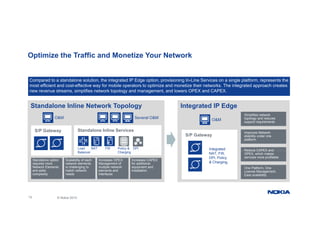
Optimize the Traffic and Monetize Your Network
Compared to a standalone solution, the integrated IP Edge option, provisioning In-Line Services on a single platform, represents the
most efficient and cost-effective way for mobile operators to optimize and monetize their networks. The integrated approach creates
new revenue streams, simplifies network topology and management, and lowers OPEX and CAPEX.
Integrated IP Edge
O&M
Simplifies network
topology and reduces
support requirements
Standalone Inline Network Topology
Several O&M
O&M
S/P Gateway
Integrated Reduce CAPEX and
Improves Network
eliability under one
platform
pp q
S/P Gateway Standalone Inline Services
NAT FW Policy & DPI
Load g
NAT, FW,
DPI, Policy
& Charging,
Reduce CAPEX and
OPEX, which makes
services more profitable
One Platform, One
License Management,
Easy scalability
Standalone option
requires more
Network Elements
and adds
complexity
Increases OPEX:
Management of
multiple network
elements and
interfaces
Increases CAPEX
for additional
equipment and
installation
Scalability of each
network elements
is challenging to
match network
needs
Charging
Balancer
12 © Nokia 2015
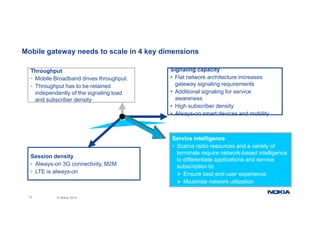
Mobile gateway needs to scale in 4 key dimensions
Th h t Signaling capacity
Throughput
• Mobile Broadband drives throughput.
• Throughput has to be retained
independently of the signaling load
Signaling capacity
• Flat network architecture increases
gateway signaling requirements
• Additional signaling for service
and subscriber density awareness
• High subscriber density
• Always-on smart devices and mobility
Service intelligence
• Scarce radio resources and a variety of
t i l i t k b d i t lli
terminals require network-based intelligence
to differentiate applications and service
subscription to:
¾ Ensure best end user experience
Session density
• Always-on 3G connectivity, M2M
• LTE is always-on
13 © Nokia 2015
¾ Maximize network utilization
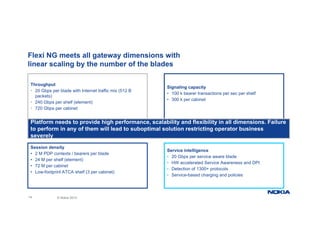
Flexi NG meets all gateway dimensions with
linear scaling by the number of the blades
Throughput
• 20 Gbps per blade with Internet traffic mix (512 B
packets)
Signaling capacity
• 100 k bearer transactions per sec per shelf
packets)
• 240 Gbps per shelf (element)
• 720 Gbps per cabinet
• 300 k per cabinet
Platform needs to provide high performance, scalability and flexibility in all dimensions. Failure
Session density
Service intelligence
Platform needs to provide high performance, scalability and flexibility in all dimensions. Failure
to perform in any of them will lead to suboptimal solution restricting operator business
severely
• 2 M PDP contexts / bearers per blade
• 24 M per shelf (element)
• 72 M per cabinet
• Low-footprint ATCA shelf (3 per cabinet)
Service intelligence
• 20 Gbps per service aware blade
• HW accelerated Service Awareness and DPI
• Detection of 1300+ protocols
• Service-based charging and policies
14 © Nokia 2015
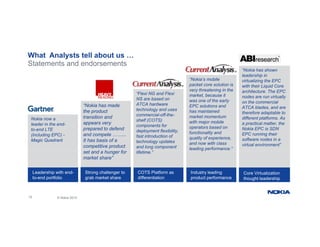
What Analysts tell about us …
Statements and endorsements
“N ki h h
“Flexi NG and Flexi
“Nokia’s mobile
packet core solution is
very threatening in the
market because it
“Nokia has shown
leadership in
virtualizing the EPC
with their Liquid Core
architecture. The EPC
nodes are run virtually
Nokia now a
leader in the end
“Nokia has made
the product
transition and
appears very
NS are based on
ATCA hardware
technology and uses
commercial-off-the-
shelf (COTS)
market, because it
was one of the early
EPC solutions and
has maintained
market momentum
with major mobile
nodes are run virtually
on the commercial
ATCA blades, and are
therefore adaptable to
different platforms. As
a practical matter the
leader in the end-
to-end LTE
(including EPC) -
Magic Quadrant
appears very
prepared to defend
and compete ……...
It has basis of a
competitive product
t d h f
components for
deployment flexibility,
fast introduction of
technology updates
and long component
lif ti ”
t ajo ob e
operators based on
functionality and
quality of experience,
and now with class
leading performance.”
a practical matter, the
Nokia EPC is SDN
EPC running their
software nodes in a
virtual environment”
Core Virtualization
thought leadership
Industry leading
product performance
COTS Platform as
differentiation
Leadership with end-
to-end portfolio
Strong challenger to
grab market share
set and a hunger for
market share”
lifetime.”
g p
15 © Nokia 2015
thought leadership
product performance
differentiation
to-end portfolio grab market share
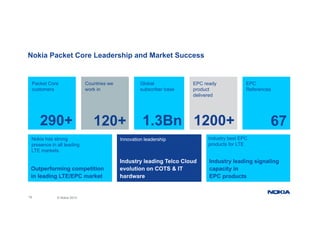
Nokia Packet Core Leadership and Market Success
Packet Core
customers
Countries we
work in
EPC ready
product
delivered
EPC
References
Global
subscriber base
delivered
290+ 120+ 1.3Bn 1200+ 67
Nokia has strong
presence in all leading
LTE markets
Innovation leadership Industry best EPC
products for LTE
290+ 120+ 1.3Bn 1200+ 67
Outperforming competition
in leading LTE/EPC market
LTE markets.
Industry leading Telco Cloud
evolution on COTS & IT
hardware
Industry leading signaling
capacity in
EPC products
16 © Nokia 2015
g a d a e EPC products
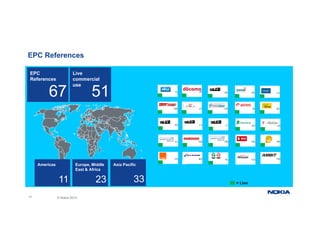
EPC References
JP
TD
FI
TD
LU
TD
US
TD
SE
EPC
References
67
Live
commercial
use
51 TD
BR
TD
LV
TD
US
TD
IN
TD
AU
TD
TD
TD
67 51
LV
TD
EE
TD
CL
TD
QA
TD
BR
TD
RU
TD
BR
TD
US
TD
SG
TD
LT
BG
TD
CH
TD
CO
TD
GL
Europe, Middle
East & Africa
23
Asia Pacific
33
Americas
11
TW
TD
17 © Nokia 2015
= Live
23 33
11
Nokia Core Network
Nodes in the Cloud
EPC
(FlexiNS, FlexiNG)
18 © Nokia 2015
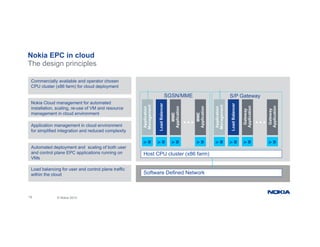
Nokia EPC in cloud
The design principles
Commercially available and operator chosen
CPU cluster (x86 farm) for cloud deployment
SGSN/MME S/P Gateway
Nokia Cloud management for automated
installation, scaling, re-use of VM and resource
management in cloud environment
d
Balancer
d
Balancer
SGSN/MME S/P Gateway
MME
pplication
MME
pplication
Gateway
pplication
Gateway
pplication
… …
pplication
nagement
pplication
nagement
Application management in cloud environment
for simplified integration and reduced complexity
Automated deployment and scaling of both user
V
M
Load
V
M
Load
V
M
Ap
V
M
Ap
V
M
G
Ap
V
M
G
Ap
V
M
Ap
Ma
V
M
Ap
Ma
and control plane EPC applications running on
VMs
Load balancing for user and control plane traffic
within the cloud Software Defined Network
Host CPU cluster (x86 farm)
19 © Nokia 2015
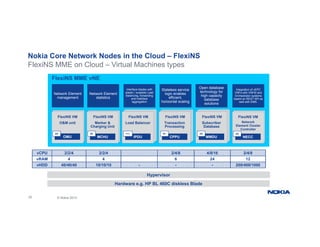
Nokia Core Network Nodes in the Cloud – FlexiNS
FlexiNS MME on Cloud – Virtual Machines types
Network Element Network Element
i i
Interface blades with
elastic / scalable Load
Balancing forwarding
Stateless service
logic enables
ffi i
Open database
technology for
high capacity
FlexiNS MME vNE
Integration of vEPC
VNFs with VNFM and
Orchestrator systems
FlexiNS VM
Marker &
FlexiNS VM
Load Balancer
FlexiNS VM
Transaction
FlexiNS VM
Subscriber
FlexiNS VM
O&M unit
management statistics
Balancing, forwarding
and interface
aggregation
efficient,
horizontal scaling
high capacity
database
solutions
FlexiNS VM
Network
Orchestrator systems
based on REST API as
well with EMS.
Marker &
Charging Unit
MCHU
Load Balancer
IPDU
Transaction
Processing
CPPU
Subscriber
Database
MMDU
O&M unit
OMU
2N
1+1 N+
2N
2N
Element Cluster
Controller
NECC
2N
Hypervisor
vCPU 2/2/4 2/2/4 2/4/8 4/8/16 2/4/8
vRAM 4 4 6 24 12
vHDD 40/40/40 10/10/10 - - - 200/400/1000
20 © Nokia 2015
Hardware e.g. HP BL 460C diskless Blade
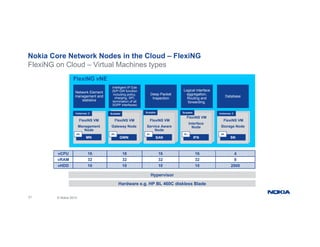
Nokia Core Network Nodes in the Cloud – FlexiNG
FlexiNG on Cloud – Virtual Machines types
Network Element
management and
Intelligent IP Ede
(S/P-GW function
including policy, Deep Packet
Logical interface
aggregation,
Database
FlexiNG vNE
FlexiNS VM FlexiNS VM
FlexiNS VM
Interface
FlexiNS VM
FlexiNS VM
management and
statistics
charging, SPI,
termination of all
3GPP interfaces)
Inspection Routing and
forwarding.
Database
Instances: 2 Scalable
Scalable Scalable Instances: 2
Gateway Node
GWN
Service Aware
Node
SAN
Interface
Node
IFN
Storage Node
SN
Management
Node
MN
2N
N+ N+
2N
2N
Hypervisor
vCPU 16 16 16 16 4
vRAM 32 32 32 32 8
vHDD 10 10 10 10 2000
21 © Nokia 2015
Hardware e.g. HP BL 460C diskless Blade
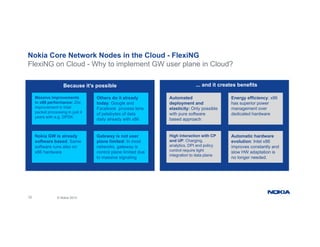
Nokia Core Network Nodes in the Cloud - FlexiNG
FlexiNG on Cloud - Why to implement GW user plane in Cloud?
Because it’s possible
M i i t Oth d it l d
... and it creates benefits
A t t d E ffi i 86
Massive improvements
in x86 performance: 20x
improvement in Intel
packet processing in just 4
years with e.g. DPDK
Others do it already
today: Google and
Facebook process tens
of petabytes of data
daily already with x86
Automated
deployment and
elasticity: Only possible
with pure software
based approach
Energy efficiency: x86
has superior power
management over
dedicated hardware
Nokia GW is already
software based: Same
software runs also on
86 h d
Gateway is not user
plane limited: In most
networks, gateway is
t l l li it d d
High interaction with CP
and UP: Charging,
analytics, DPI and policy
control require tight
Automatic hardware
evolution: Intel x86
improves constantly and
l HW d t ti i
x86 hardware control plane limited due
to massive signaling
control require tight
integration to data plane
slow HW adaptation is
no longer needed.
22 © Nokia 2015
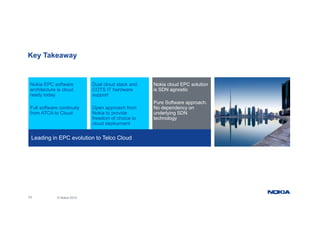
Key Takeaway
Nokia EPC software
architecture is cloud
ready today
Dual cloud stack and
COTS IT hardware
support
Nokia cloud EPC solution
is SDN agnostic
ready today
Full software continuity
from ATCA to Cloud
support
Open approach from
Nokia to provide
freedom of choice to
cloud deployment
Pure Software approach.
No dependency on
underlying SDN
technology
cloud deployment
Leading in EPC evolution to Telco Cloud
23 © Nokia 2015

pdfcoffeeeeeeee.com nokia-pdf-free EPC.pdf

  • 1.
  • 2.
    Signaling is growing50% faster than data traffic in Evolved Packet Core LTE network requires 50-80% more signaling compare to 2G/3G network Signaling requirements are driven by flat architecture and network deployment. Service awareness and differentiated charging contributes to overall transaction requirements 2 © Nokia 2015
  • 3.
    Market Outlook EPC investment wave#2 starts now Operators have Subscriber and session growth continues Voice and video over LTE Operator’s Operators have started investing in EPC capacity to cope with signaling and traffic growth in continues Machine to Machine growth driving huge EPC capacity needs for operators in Asia, Operator s investment on experience mgmt, voice capability and video optimization g 4G network p , Europe and America p are essential Disruption with cloud Disruption with cloud Technologically advanced operators and vendors have started focusing on the Telco cloud evolution 3 © Nokia 2015
  • 4.
    Packet Core Portfolio RadioAccess HSS Evolved Packet Core Gb Anchor point for subscriber mobility between Radio Access Packet Core is the anchor point for subscriber mobility Operator Voice and SMS Services PCRF IMS/VoLTE S1 MME S11 S6a Gx SGi Rx BTS NodeB RNC BSC Iu SGSN/MME (Flexi NS) subscriber mobility between radio access and services, and control point for quality of service and traffic monetization Mobile Broadband eNodeB Corporate Connectivity Service GGSN/S/P-GW (Flexi NG) S1-MME SGi Control point for quality of service and traffic monetization monetization Mobile Broadband Service CMD SGSN/MME: Highly signaling driven function that provides mobility management, authentication of subscribers for 2G/3G/4G radio access and end-user services (internet, VoLTE) S/P Gateway: Vehicle for understanding mobile data, managing and charging the traffic. Source for user experience data in MBB networks, with integration to CEM and Managing end-to-end QoS 4 © Nokia 2015
  • 5.
    Nokias’ strategy isto use the same HW platform for all core network elements SGSN MME C bi d MSS For 2G/3G networks • SGSN • GGSN GGSN Combined SGSN/MME S/P- IMS • GGSN • MSS • MGW • PCRF GGSN PCRF GW MGW PCRF For LTE (and 2G/3G) • MME (with SGSN) • S/P-GW (with GGSN) • MSS G Different core network l t b i d PCRF MGW PCRF • MGW • PCRF elements can be equipped In the same cabinet Common COTS *) ATCA HW platform for core 5 © Nokia 2015 *) Commercial off the shelf Common COTS ) ATCA HW platform for core key products
  • 6.
    Flexi NS Highlights Hih C it High Capacity • 10 M Subscribers • 30 M Bearers, 10 M PDP Contexts • 34 k/26 k transactions/s (MME/SGSN) • 20 k eNodeB 8 k I-HSPA Nodes 20 k eNodeB, 8 k I HSPA Nodes • 3.6/16.8 Gbit/s (2G/3G) throughput Functionality • Session/Bearer and Mobility Management A th ti ti • Authentication • Feature parity for the SGSN • Release 8 Architecture and interfaces supported • Compliant to 3GPP R10 (3/2012 MME) and 3GPP R9 (12/2010 SGSN) Telecom HW Platform • Utilizes ATCA standards designed for telecommunication environment • Commercial of the Shelf HW (COTS) • Common use with S/P-GW, GGSN, HLR, MGW and MSS 99 999 % A il bilit d U it d d 6 © Nokia 2015 • > 99.999 % Availability and Unit redundancy • Conformance to environmental specifications (ETSI, NEBS etc.)
  • 7.
    MME Interfaces Gn SGSN MSC/VLRMSC/VLR S4 SGSN 1xCS IWS (CDMA) UDP IP GTP-C v2 SCTP IP SGsAP UDP IP GTP-C v1 SBcAP Sv SGs Gn UDP IP GTP-C v2 S3 CBC ( ) UDP IP S102AP S102 MME SCTP IP SBcAP UDP GTP-C v2 SCTP S1-AP NAS S1-MME NAS SBc S11 Gn eNodeB UE S-GW S102 IP SCTP IP Diameter SCTP IP SOAP S6a S13 SLg/SLs OAM X1_1/X2 S10 eNodeB HSS EIR SCTP IP Diameter TCP IP LIPv2 UDP IP GTP-C v2 TCP IP HTTP SCTP IP Diameter GMLC/eSMLC EIR 7 © Nokia 2015 LIMS/LIC MME NMS
  • 8.
    Functional Units MME Architecture MMDU:Mobility Management & Database Unit • Subscriber database and subscriber state based mobility management for the MME CPPU: Control Plane Processing Unit OMU (2n) CPPU (n+) CPPU: Control Plane Processing Unit • Transaction based mobility management IPDU: IP Director Unit • Load balancing, connectivity and IP address virtualization OMU: O&M Unit Ethernet Ethernet MCHU (2n) VMU (n+) PAPU (n+1) SMMU (n+1) • Operation and maintenance functionality MCHU: Marker & Charging Unit • Statistic functionalities HUB: Hub Blade N d i t l Eth t ti it b t f ti l it Ethernet HUB (2n) MMDU (n+) IPPU (n+) • Node internal Ethernet connectivity between functional units. External interfaces IPDU (n+1) GBU (n+1) CABU 8 © Nokia 2015 (2n) FRIU
  • 9.
    Functional Units SGSN Architecture VMU:Virtualization Management Unit • Hosts logical PAPU and SMMU. PAPU processes 2G and 3G control planes. The SMMU handles mobility management operations MMDU: Mobility Management & Database Unit • Subscriber database OMU (2n) CPPU (n+) • Subscriber database IPDU: IP Director Unit • Load balancing, connectivity and IP address virtualization IPPU: IP Packet Processing Unit • 3G user plane throughput handling Ethernet Ethernet MCHU (2n) VMU (n+) PAPU (n+1) SMMU (n+1) p g p g GBU: Gb Interface Unit • 2G user plane throughput handling CABU: Carrier Blade Unit • Houses Frame Relay Interface Units (FRIU). External STM-1 IF OMU O&M U it Ethernet HUB (2n) MMDU (n+) IPPU (n+) OMU: O&M Unit • Operation and maintenance functionality MCHU: Marker & Charging Unit • Statistic functionalities, charging HUB: Hub Blade IPDU (n+1) GBU (n+1) CABU 9 © Nokia 2015 HUB: Hub Blade • Node internal Ethernet connectivity between functional units. External IF (2n) FRIU
  • 10.
    Flexi Network Gatewayhighlights Market leading capacity for Mobile Broadband growth Market-leading capacity for Mobile Broadband growth • ATCA-based high-performance platform • Up to 720 Gbps throughput & 72 M sessions per cabinet • Leading throughput capacity, session density, signaling performance, and DPI performance / service intelligence DPI performance / service intelligence • Individual scalability in multiple dimensions e.g. in control plane and user plane • Flexibility for centralized and decentralized deployments Single platform and software for 2G, 3G and LTE • Flexibility to deploy GGSN and LTE S/P-GW resources in a single element Intelligent control point in IP edge • Versatile integrated Deep Packet Inspection and Policy Enforcement functions (1300+ protocols) 10 © Nokia 2015 ( p ) • Fully compatible with 3GPP online charging and Policy and Charging Control (PCC) architecture, customization capability
  • 11.
    Flexi NG HardwareComponents and Roles The main HW components are: ATCA ATCA Shelf Shelf • Nokia ATCA Cabinet, housing 3 shelves. • ATCA Shelf with 16 slots for blades. One shelf is one Flexi NG element • Hub Blades (1+1) providing the internal switching functions • Management Blades (1+1) running O&M and routing, and hosting disk storages • Interface Blades providing aggregated physical connectivity • Service Blades hosting the user sessions, running the gateway application ATCA Cabinet (CAB216) • Service Aware Blades performing Deep Packet Inspection (DPI) functions (optional) Service / Interface / Service Aware Blade (AMPP2 A) Hub Blade (AHUB4-A) M t Bl d (ACPI CPI5 5 A) A) Service Aware Blade (AMPP2-A) Hub Blade (AHUB4-A) Management Blade (ACPI CPI5 5- -A) A) 11 © Nokia 2015
  • 12.
    Optimize the Trafficand Monetize Your Network Compared to a standalone solution, the integrated IP Edge option, provisioning In-Line Services on a single platform, represents the most efficient and cost-effective way for mobile operators to optimize and monetize their networks. The integrated approach creates new revenue streams, simplifies network topology and management, and lowers OPEX and CAPEX. Integrated IP Edge O&M Simplifies network topology and reduces support requirements Standalone Inline Network Topology Several O&M O&M S/P Gateway Integrated Reduce CAPEX and Improves Network eliability under one platform pp q S/P Gateway Standalone Inline Services NAT FW Policy & DPI Load g NAT, FW, DPI, Policy & Charging, Reduce CAPEX and OPEX, which makes services more profitable One Platform, One License Management, Easy scalability Standalone option requires more Network Elements and adds complexity Increases OPEX: Management of multiple network elements and interfaces Increases CAPEX for additional equipment and installation Scalability of each network elements is challenging to match network needs Charging Balancer 12 © Nokia 2015
  • 13.
    Mobile gateway needsto scale in 4 key dimensions Th h t Signaling capacity Throughput • Mobile Broadband drives throughput. • Throughput has to be retained independently of the signaling load Signaling capacity • Flat network architecture increases gateway signaling requirements • Additional signaling for service and subscriber density awareness • High subscriber density • Always-on smart devices and mobility Service intelligence • Scarce radio resources and a variety of t i l i t k b d i t lli terminals require network-based intelligence to differentiate applications and service subscription to: ¾ Ensure best end user experience Session density • Always-on 3G connectivity, M2M • LTE is always-on 13 © Nokia 2015 ¾ Maximize network utilization
  • 14.
    Flexi NG meetsall gateway dimensions with linear scaling by the number of the blades Throughput • 20 Gbps per blade with Internet traffic mix (512 B packets) Signaling capacity • 100 k bearer transactions per sec per shelf packets) • 240 Gbps per shelf (element) • 720 Gbps per cabinet • 300 k per cabinet Platform needs to provide high performance, scalability and flexibility in all dimensions. Failure Session density Service intelligence Platform needs to provide high performance, scalability and flexibility in all dimensions. Failure to perform in any of them will lead to suboptimal solution restricting operator business severely • 2 M PDP contexts / bearers per blade • 24 M per shelf (element) • 72 M per cabinet • Low-footprint ATCA shelf (3 per cabinet) Service intelligence • 20 Gbps per service aware blade • HW accelerated Service Awareness and DPI • Detection of 1300+ protocols • Service-based charging and policies 14 © Nokia 2015
  • 15.
    What Analysts tellabout us … Statements and endorsements “N ki h h “Flexi NG and Flexi “Nokia’s mobile packet core solution is very threatening in the market because it “Nokia has shown leadership in virtualizing the EPC with their Liquid Core architecture. The EPC nodes are run virtually Nokia now a leader in the end “Nokia has made the product transition and appears very NS are based on ATCA hardware technology and uses commercial-off-the- shelf (COTS) market, because it was one of the early EPC solutions and has maintained market momentum with major mobile nodes are run virtually on the commercial ATCA blades, and are therefore adaptable to different platforms. As a practical matter the leader in the end- to-end LTE (including EPC) - Magic Quadrant appears very prepared to defend and compete ……... It has basis of a competitive product t d h f components for deployment flexibility, fast introduction of technology updates and long component lif ti ” t ajo ob e operators based on functionality and quality of experience, and now with class leading performance.” a practical matter, the Nokia EPC is SDN EPC running their software nodes in a virtual environment” Core Virtualization thought leadership Industry leading product performance COTS Platform as differentiation Leadership with end- to-end portfolio Strong challenger to grab market share set and a hunger for market share” lifetime.” g p 15 © Nokia 2015 thought leadership product performance differentiation to-end portfolio grab market share
  • 16.
    Nokia Packet CoreLeadership and Market Success Packet Core customers Countries we work in EPC ready product delivered EPC References Global subscriber base delivered 290+ 120+ 1.3Bn 1200+ 67 Nokia has strong presence in all leading LTE markets Innovation leadership Industry best EPC products for LTE 290+ 120+ 1.3Bn 1200+ 67 Outperforming competition in leading LTE/EPC market LTE markets. Industry leading Telco Cloud evolution on COTS & IT hardware Industry leading signaling capacity in EPC products 16 © Nokia 2015 g a d a e EPC products
  • 17.
    EPC References JP TD FI TD LU TD US TD SE EPC References 67 Live commercial use 51 TD BR TD LV TD US TD IN TD AU TD TD TD 6751 LV TD EE TD CL TD QA TD BR TD RU TD BR TD US TD SG TD LT BG TD CH TD CO TD GL Europe, Middle East & Africa 23 Asia Pacific 33 Americas 11 TW TD 17 © Nokia 2015 = Live 23 33 11
  • 18.
    Nokia Core Network Nodesin the Cloud EPC (FlexiNS, FlexiNG) 18 © Nokia 2015
  • 19.
    Nokia EPC incloud The design principles Commercially available and operator chosen CPU cluster (x86 farm) for cloud deployment SGSN/MME S/P Gateway Nokia Cloud management for automated installation, scaling, re-use of VM and resource management in cloud environment d Balancer d Balancer SGSN/MME S/P Gateway MME pplication MME pplication Gateway pplication Gateway pplication … … pplication nagement pplication nagement Application management in cloud environment for simplified integration and reduced complexity Automated deployment and scaling of both user V M Load V M Load V M Ap V M Ap V M G Ap V M G Ap V M Ap Ma V M Ap Ma and control plane EPC applications running on VMs Load balancing for user and control plane traffic within the cloud Software Defined Network Host CPU cluster (x86 farm) 19 © Nokia 2015
  • 20.
    Nokia Core NetworkNodes in the Cloud – FlexiNS FlexiNS MME on Cloud – Virtual Machines types Network Element Network Element i i Interface blades with elastic / scalable Load Balancing forwarding Stateless service logic enables ffi i Open database technology for high capacity FlexiNS MME vNE Integration of vEPC VNFs with VNFM and Orchestrator systems FlexiNS VM Marker & FlexiNS VM Load Balancer FlexiNS VM Transaction FlexiNS VM Subscriber FlexiNS VM O&M unit management statistics Balancing, forwarding and interface aggregation efficient, horizontal scaling high capacity database solutions FlexiNS VM Network Orchestrator systems based on REST API as well with EMS. Marker & Charging Unit MCHU Load Balancer IPDU Transaction Processing CPPU Subscriber Database MMDU O&M unit OMU 2N 1+1 N+ 2N 2N Element Cluster Controller NECC 2N Hypervisor vCPU 2/2/4 2/2/4 2/4/8 4/8/16 2/4/8 vRAM 4 4 6 24 12 vHDD 40/40/40 10/10/10 - - - 200/400/1000 20 © Nokia 2015 Hardware e.g. HP BL 460C diskless Blade
  • 21.
    Nokia Core NetworkNodes in the Cloud – FlexiNG FlexiNG on Cloud – Virtual Machines types Network Element management and Intelligent IP Ede (S/P-GW function including policy, Deep Packet Logical interface aggregation, Database FlexiNG vNE FlexiNS VM FlexiNS VM FlexiNS VM Interface FlexiNS VM FlexiNS VM management and statistics charging, SPI, termination of all 3GPP interfaces) Inspection Routing and forwarding. Database Instances: 2 Scalable Scalable Scalable Instances: 2 Gateway Node GWN Service Aware Node SAN Interface Node IFN Storage Node SN Management Node MN 2N N+ N+ 2N 2N Hypervisor vCPU 16 16 16 16 4 vRAM 32 32 32 32 8 vHDD 10 10 10 10 2000 21 © Nokia 2015 Hardware e.g. HP BL 460C diskless Blade
  • 22.
    Nokia Core NetworkNodes in the Cloud - FlexiNG FlexiNG on Cloud - Why to implement GW user plane in Cloud? Because it’s possible M i i t Oth d it l d ... and it creates benefits A t t d E ffi i 86 Massive improvements in x86 performance: 20x improvement in Intel packet processing in just 4 years with e.g. DPDK Others do it already today: Google and Facebook process tens of petabytes of data daily already with x86 Automated deployment and elasticity: Only possible with pure software based approach Energy efficiency: x86 has superior power management over dedicated hardware Nokia GW is already software based: Same software runs also on 86 h d Gateway is not user plane limited: In most networks, gateway is t l l li it d d High interaction with CP and UP: Charging, analytics, DPI and policy control require tight Automatic hardware evolution: Intel x86 improves constantly and l HW d t ti i x86 hardware control plane limited due to massive signaling control require tight integration to data plane slow HW adaptation is no longer needed. 22 © Nokia 2015
  • 23.
    Key Takeaway Nokia EPCsoftware architecture is cloud ready today Dual cloud stack and COTS IT hardware support Nokia cloud EPC solution is SDN agnostic ready today Full software continuity from ATCA to Cloud support Open approach from Nokia to provide freedom of choice to cloud deployment Pure Software approach. No dependency on underlying SDN technology cloud deployment Leading in EPC evolution to Telco Cloud 23 © Nokia 2015