Social Value
10th February 2016
Social Value – it’s increasing importance
and benefits to clients in Construction
Peter Schofield
AGMA Procurement Hub Programme
Manager
February 2016
Agenda
 AGMA Procurement Hub
 Objectives
 Operation
 Benefits
 Social Value in Greater Manchester
 Social Value Act 2012
 GM Social Value Policy
 Indicators
 Next Steps
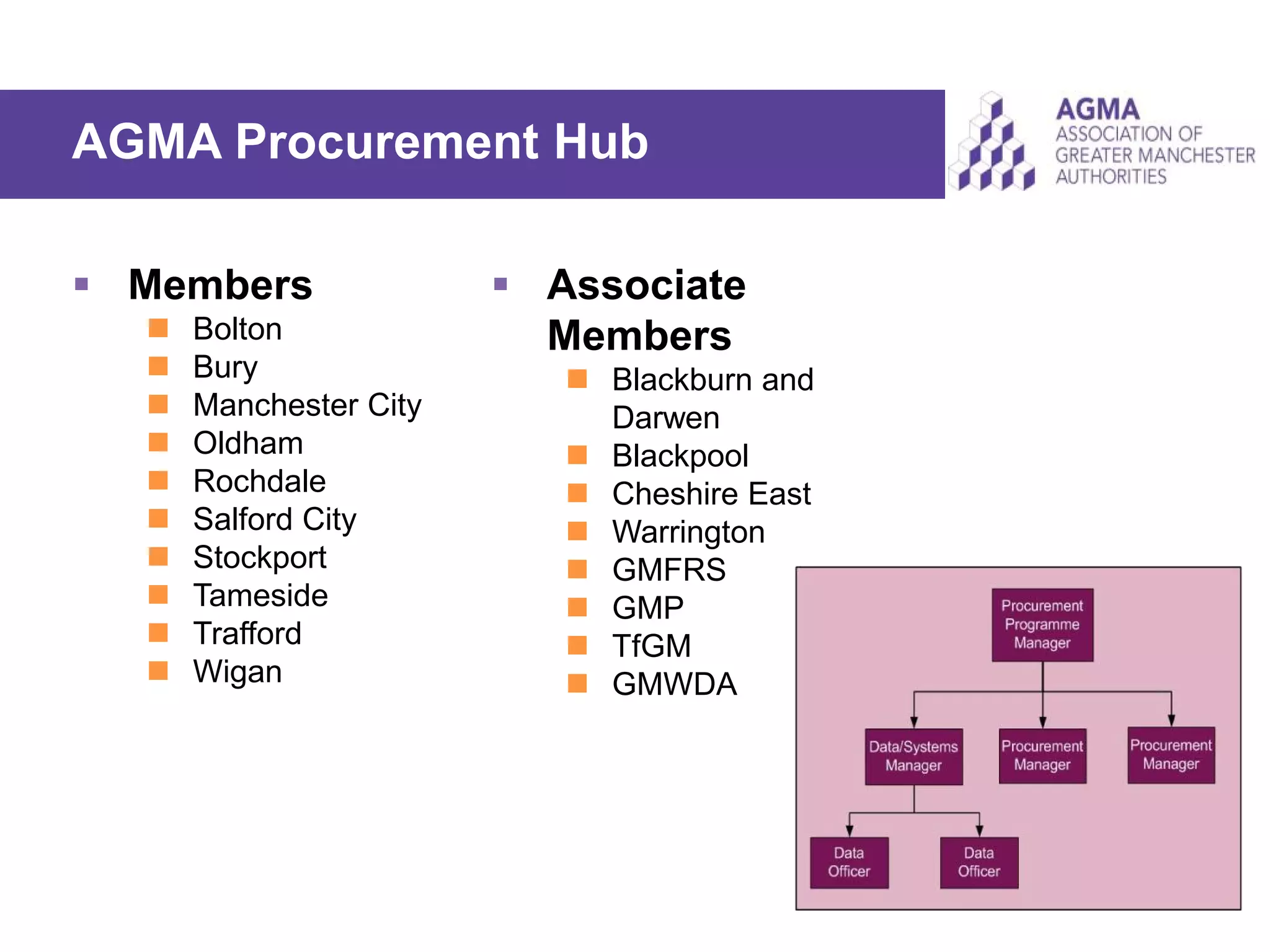
AGMA Procurement Hub
 Members
 Bolton
 Bury
 Manchester City
 Oldham
 Rochdale
 Salford City
 Stockport
 Tameside
 Trafford
 Wigan
 Associate
Members
 Blackburn and
Darwen
 Blackpool
 Cheshire East
 Warrington
 GMFRS
 GMP
 TfGM
 GMWDA
Hub Objectives
 Review and re-let existing AGMA Contracts
 Consolidate existing best deals
 Aggregate fragmented spend
 Maximise opportunities for local suppliers
 Aligning collaboration/promoting best practice
 Supporting new ways of working (eg
Devolution)
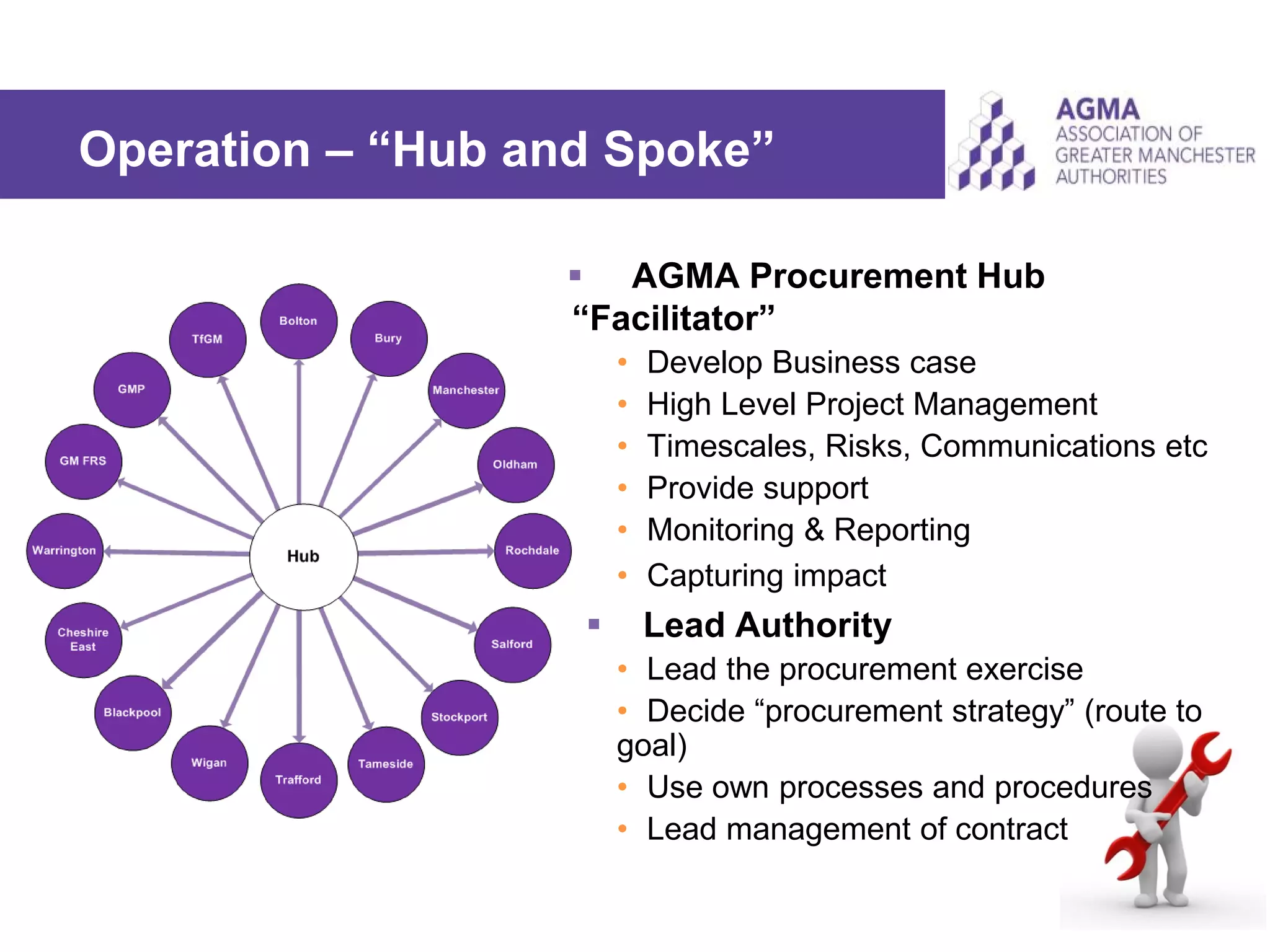
Operation – “Hub and Spoke”
 AGMA Procurement Hub
“Facilitator”
• Develop Business case
• High Level Project Management
• Timescales, Risks, Communications etc
• Provide support
• Monitoring & Reporting
• Capturing impact
 Lead Authority
• Lead the procurement exercise
• Decide “procurement strategy” (route to
goal)
• Use own processes and procedures
• Lead management of contract
Benefits
 Only do things once – internal efficiency
 Manage pipeline of projects
 Promote collaborative approach with
partners/stakeholders
 Consistency:
 Performance management of contracts
 Business cases
 Benefits reporting
 Reacting/embracing new legislation/agendas etc
 Support for working groups
 Link to other sub-regional, regional and “other regional”
bodies
 Public Services (Social Value) Act 2012 “public authorities to
have regard to economic, social and environmental well-being in connection with public
services contracts; and for connected purposes”
 GMCA requested a GM wide approach to embed
Social Value into all procurement
 Benefits from a common approach
 Ability to benchmark
 Simplified for suppliers
 Able to understand link between policy and achievements
 Social Value Policy approved by GMCA in November
2014
 Review carried out in Autumn 2015 to establish
baseline
 External verification – CLES (Centre for Local Economic
Strategies)
Social Value in Greater Manchester
GM model for delivering Social Value
 ‘Golden Thread’ of:
 Corporate Objective  Enablers  Process
 GMCA “Stronger Together” Strategy used to set
Corporate Objectives for GMCA Social Value Policy
 Each procurement exercise identifies appropriate
outcomes
 e.g. “Workforce that is fairly paid and positively supported by
employers”
 Suppliers respond on how they would deliver the
Outcome(s) and how they will be measured and
verified
 Contract Management includes delivery against
outcomes
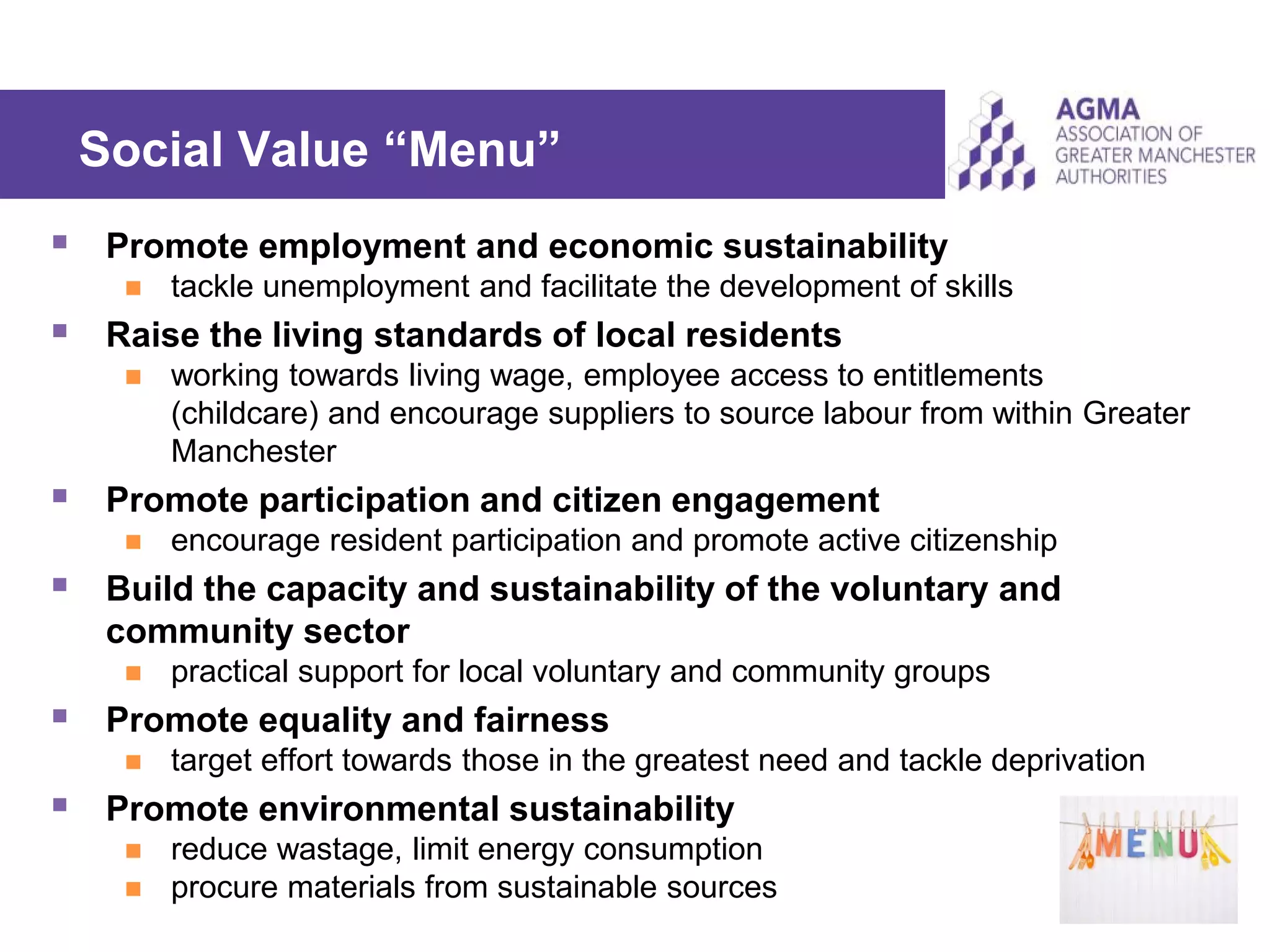
Social Value “Menu”
 Promote employment and economic sustainability
 tackle unemployment and facilitate the development of skills
 Raise the living standards of local residents
 working towards living wage, employee access to entitlements
(childcare) and encourage suppliers to source labour from within Greater
Manchester
 Promote participation and citizen engagement
 encourage resident participation and promote active citizenship
 Build the capacity and sustainability of the voluntary and
community sector
 practical support for local voluntary and community groups
 Promote equality and fairness
 target effort towards those in the greatest need and tackle deprivation
 Promote environmental sustainability
 reduce wastage, limit energy consumption
 procure materials from sustainable sources
So What?
 More thought and action “pre-procurement”
 Must follow through into Contract management
 Measurement against specific KPIs
 Baselining Exercise by CLES (Centre for Local
Environmental Strategies)
 Independent look at top 300 suppliers
 Consider spend in local economy (desktop study)
 Survey against generic KPIs
 Lord Young Review of the Act
 Overall positive but recommendations re measurement, awareness
and consistent practice
 Case Studies
 Awareness raising
 E-Learning Module
 GM Social Value Network
Promote Employment and Economic Sustainability
 84.8% of the direct spend (£1bn) with GM based suppliers
 £487 million (48.5%) of total spend with SMEs
 57% of suppliers’ employees are resident in GM
 93% of suppliers created 1060 jobs
 69% of suppliers created 195 apprenticeships
Raise living standards of GM Residents
 50% of suppliers paid all staff the Living Wage Foundation
wage of £7.85 per hour (this is now £8.25)
 Lowest paid member of staff average £7.66 per hour
 93% of employees are employed on a permanent basis
Baseline Study Findings 1
Participation and Citizen Engagement
 64% of suppliers encouraged staff to participate in
volunteering and community activities
 14,051 hours of staff time were offered in GM
Capacity and Sustainability of the VCS
 64% of suppliers actively provide support to the VCS
 10,159 hours in GM
 Examples:
 Logistical support such as the provision of office space
 Provision and improvement of community facilities
 Employment support, such as work experience and CV and
interview workshops
Baseline Study Findings 2
Baseline Study Findings 3
Equality and Fairness
 71% of suppliers created employment opportunities for
individuals described as ‘hard to reach’
 185 employment opportunities in Greater Manchester
Environmental Sustainability
 32% of suppliers actively measure carbon emissions
 82% have an environmental management strategy
 96% increasing recycling
 89% include energy use
 60% include carbon emission reduction
 56% have transport type included
 80% have waste minimisation included
 40% having a cycle or walk to work scheme
Social Value in GM – Next Steps
1. Ensure Social Value is considered as a matter of course
i. Raise awareness in Pre-procurement
ii. Embed into contract monitoring
iii. E-Learning course for all Commissioners
2. Develop a process for continuous monitoring of SV
i. Repeat baselining exercise to benchmark performance
ii. Report on contract management KPIs
3. Explore leakage out of the Greater Manchester economy
i. Chasing the missing 15%
4. Influence the behaviour of the supply chain
i. Open dialogue with suppliers about economic, social and
environmental benefits
ii. Pre-market engagement and ongoing conversations re innovation
5. Provide signposting for suppliers
i. Advice and support – eg accreditation, living Wage, Carbon Footprint
ii. Engagement with VCS etc
Questions?
Peter Schofield – AGMA Procurement Hub Programme Manager
peter.schofield@trafford.gov.uk
Tel: 0161 912 4597
Mob: 07814 459668
Social Value through Construction and
Infrastructure Procurement
Professor Peter McDermott
p.mcdermott@salford.ac.uk
School of the Built Environment
University of Salford
Also: Fady Farag and Carrie-Ann Huelin, University of Salford
Radisson Blu Edwardian Hotel, Free Trade Hall,
Agenda
What: The Social Value Agenda
Why: Why Social Value is important
How: How Social Value can be achieved
But: No Buts….Social Value can be achieved
The north-west imperative?
What?
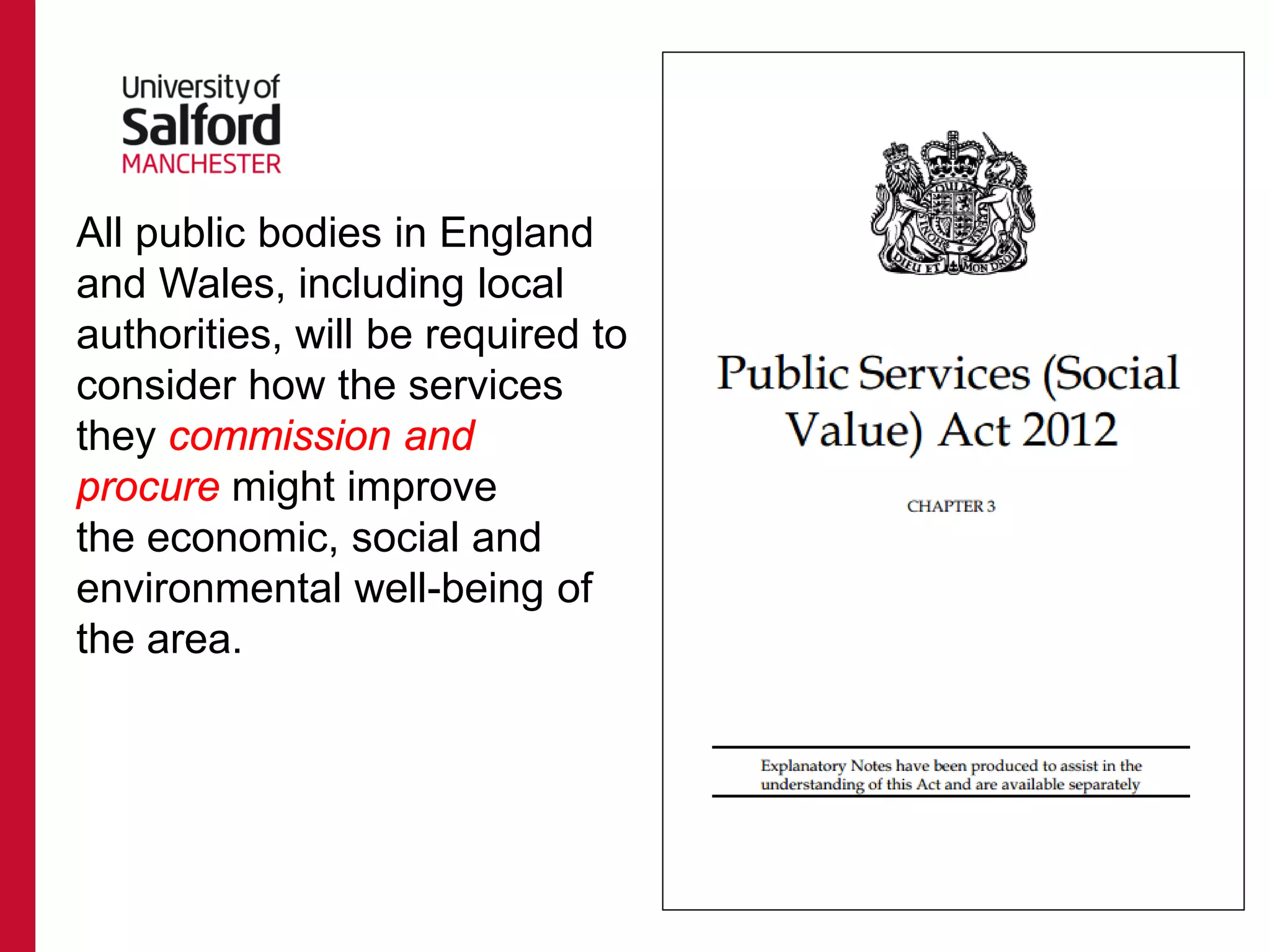
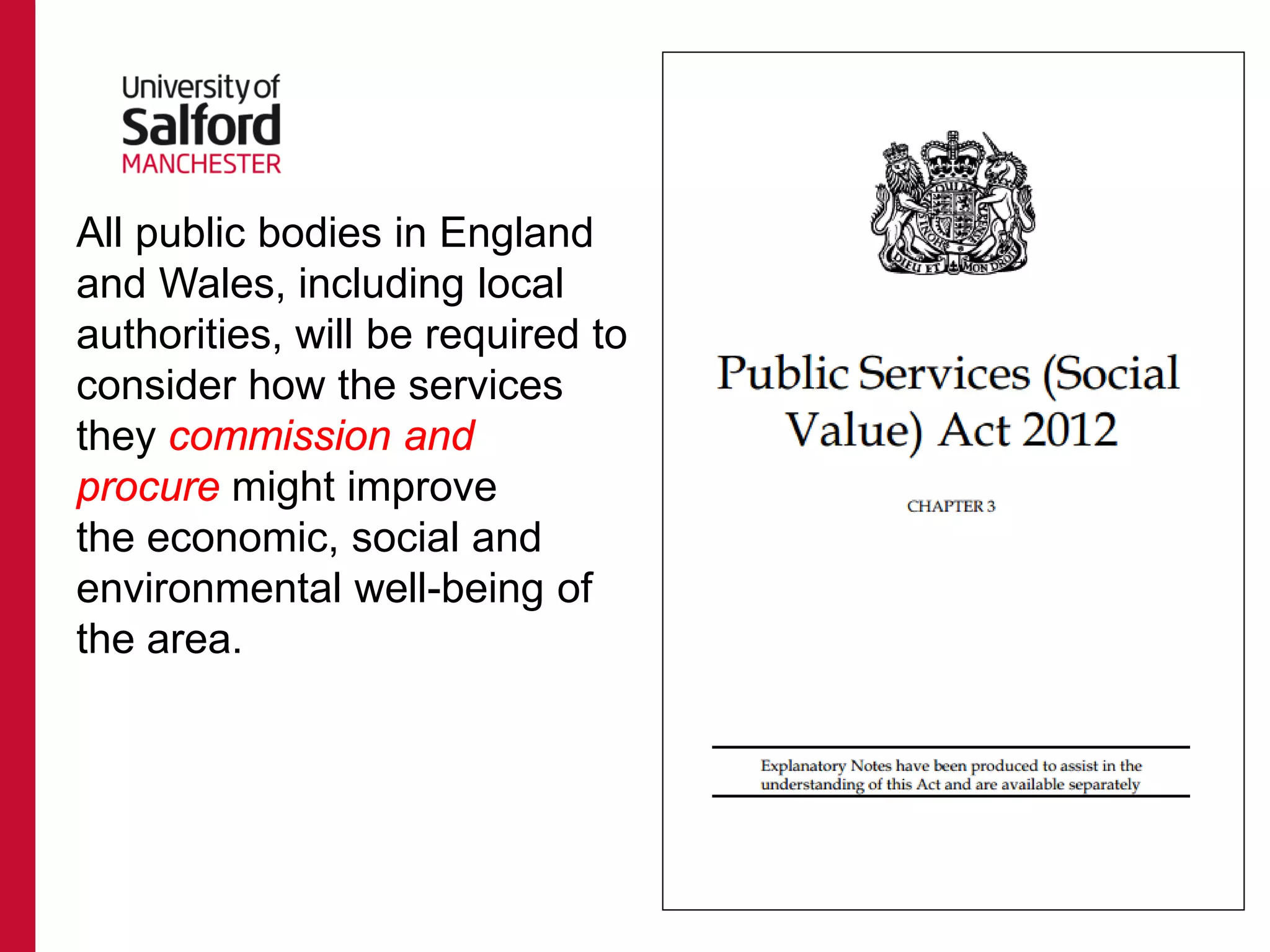
All public bodies in England
and Wales, including local
authorities, will be required to
consider how the services
they commission and
procure might improve
the economic, social and
environmental well-being of
the area.
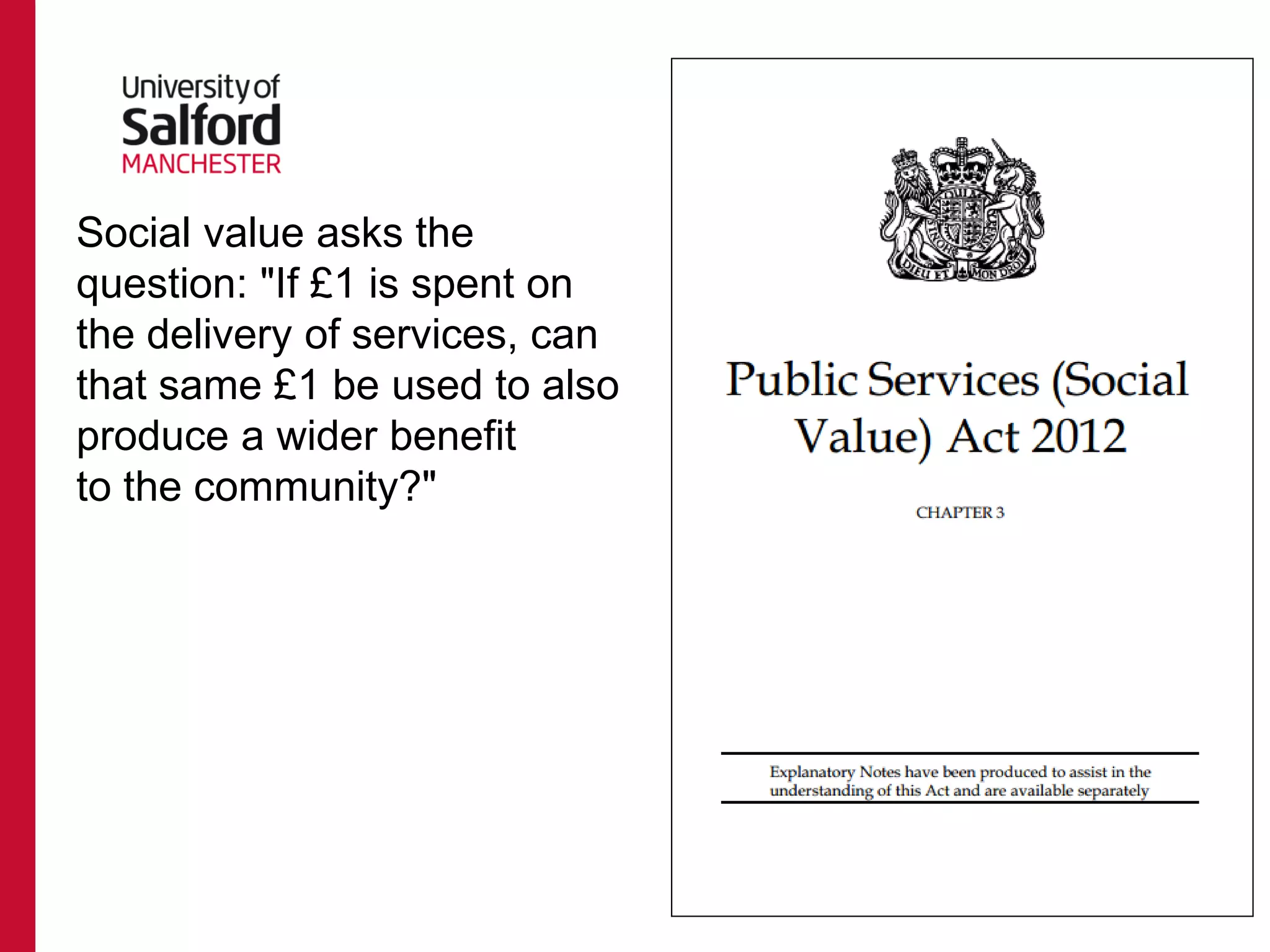
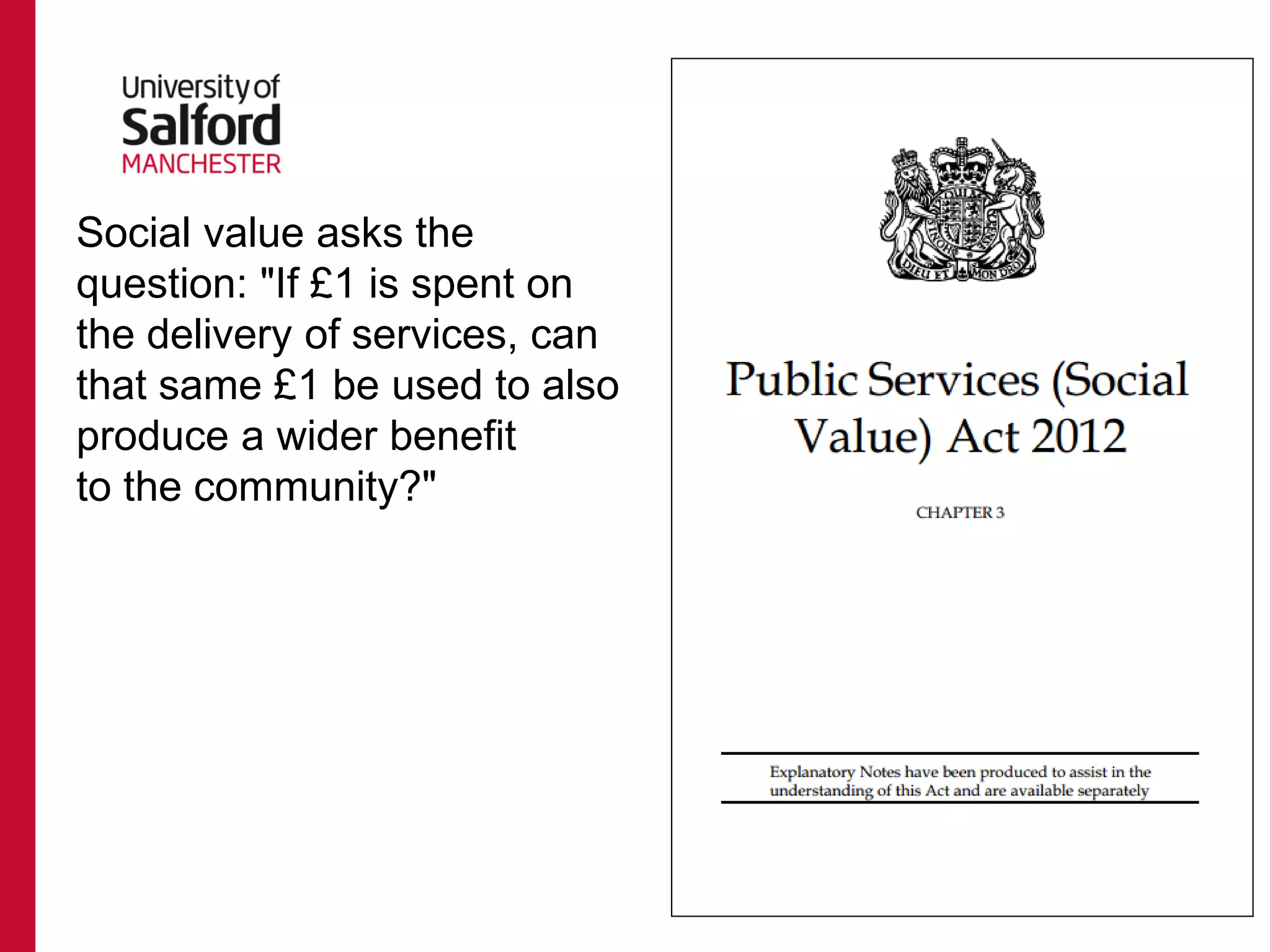
Social value asks the
question: "If £1 is spent on
the delivery of services, can
that same £1 be used to also
produce a wider benefit
to the community?"
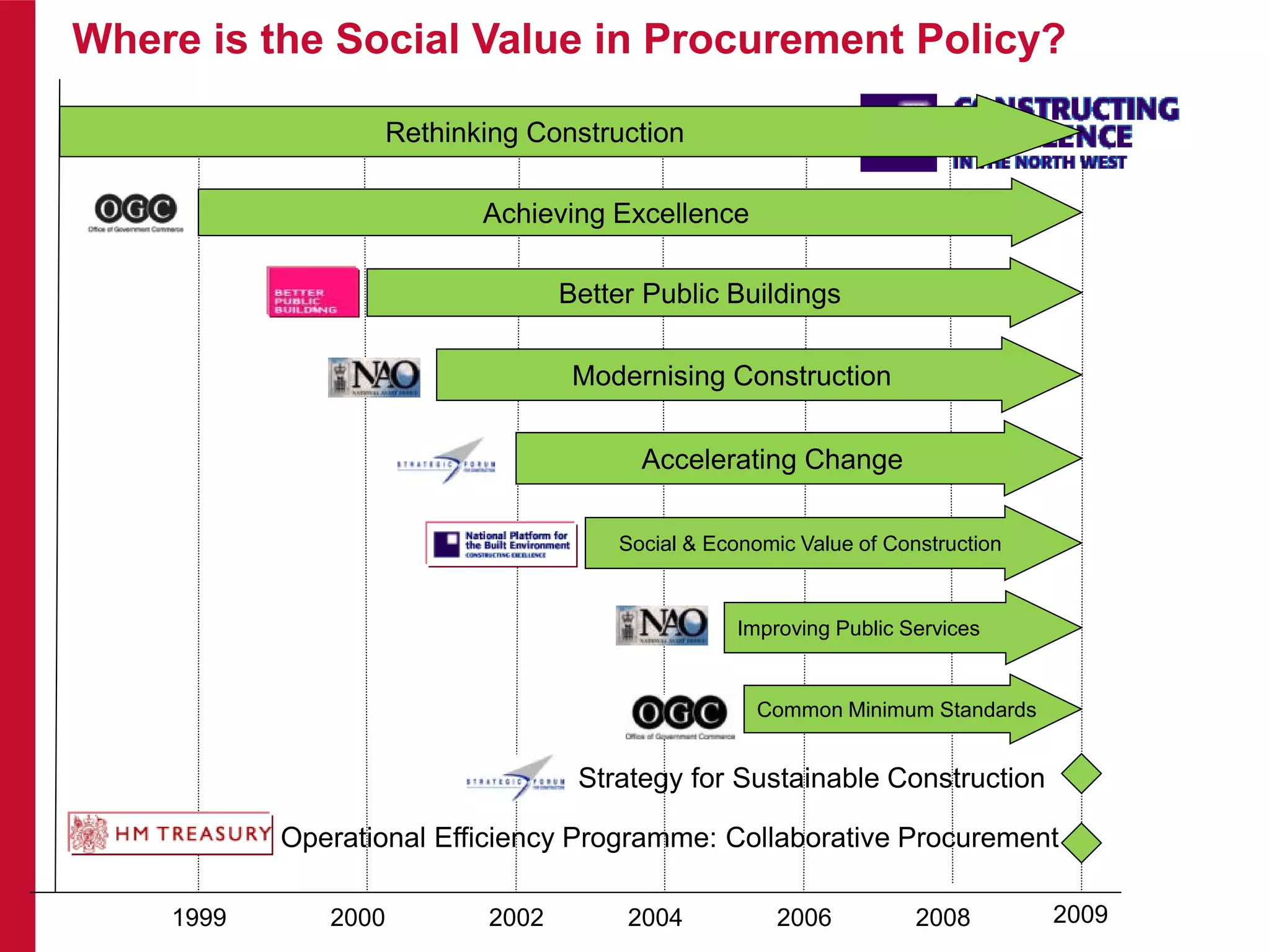
1999 2000 2002 2004 2006 2008
Modernising Construction
Rethinking Construction
Accelerating Change
Improving Public Services
Social & Economic Value of Construction
Common Minimum Standards
Achieving Excellence
Better Public Buildings
Strategy for Sustainable Construction
2009
Operational Efficiency Programme: Collaborative Procurement
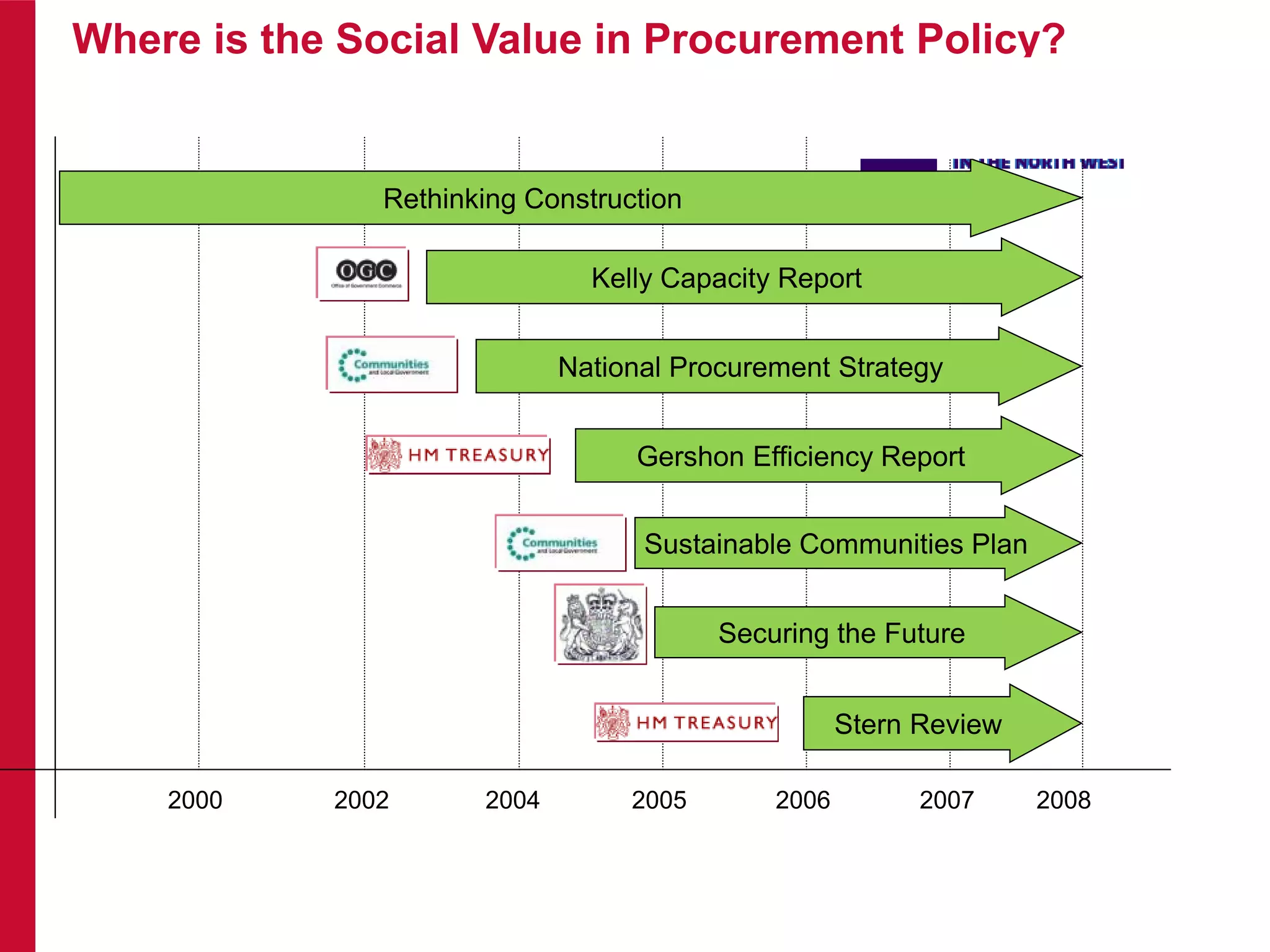
Where is the Social Value in Procurement Policy?
Government Policy…
2000 2002 2004 2005 2006 2007 2008
National Procurement Strategy
Rethinking Construction
Kelly Capacity Report
Stern Review
Gershon Efficiency Report
Sustainable Communities Plan
Securing the Future
Where is the Social Value in Procurement Policy?
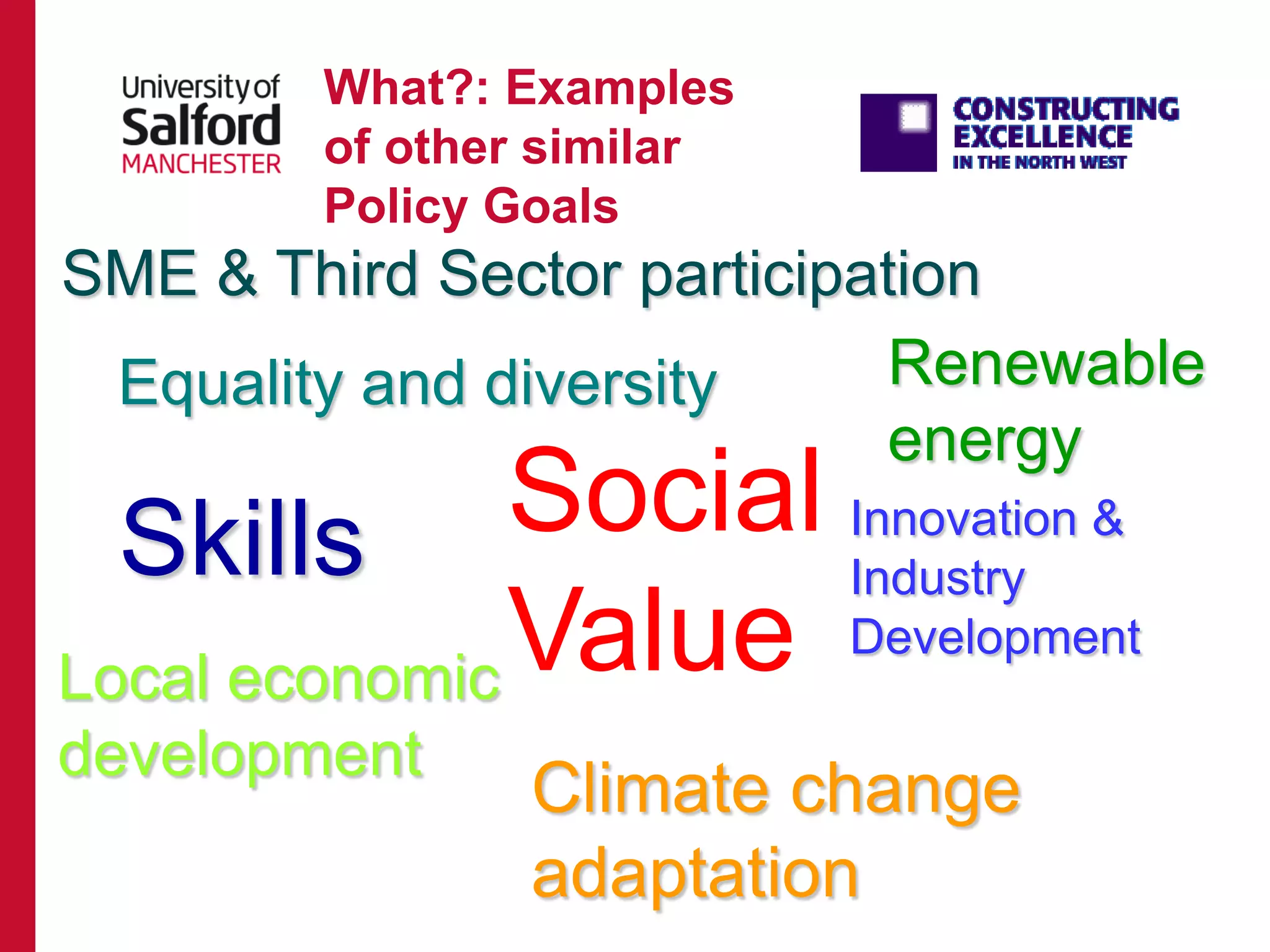
What?: Examples
of other similar
Policy Goals
Innovation &
Industry
Development
Equality and diversity
Skills
Local economic
development
Climate change
adaptation
SME & Third Sector participation
Renewable
energy
Social
Value
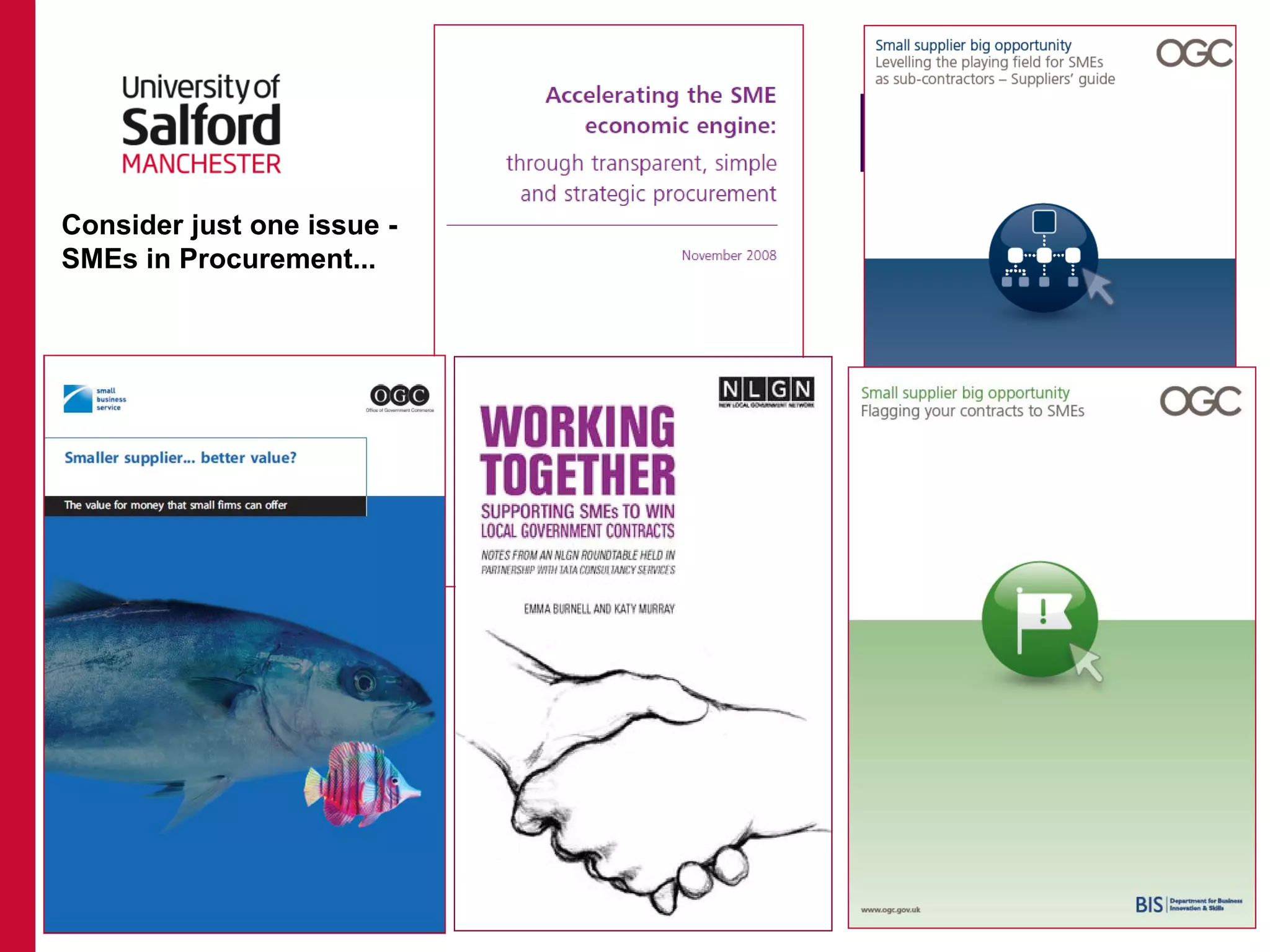
Consider just one issue -
SMEs in Procurement...
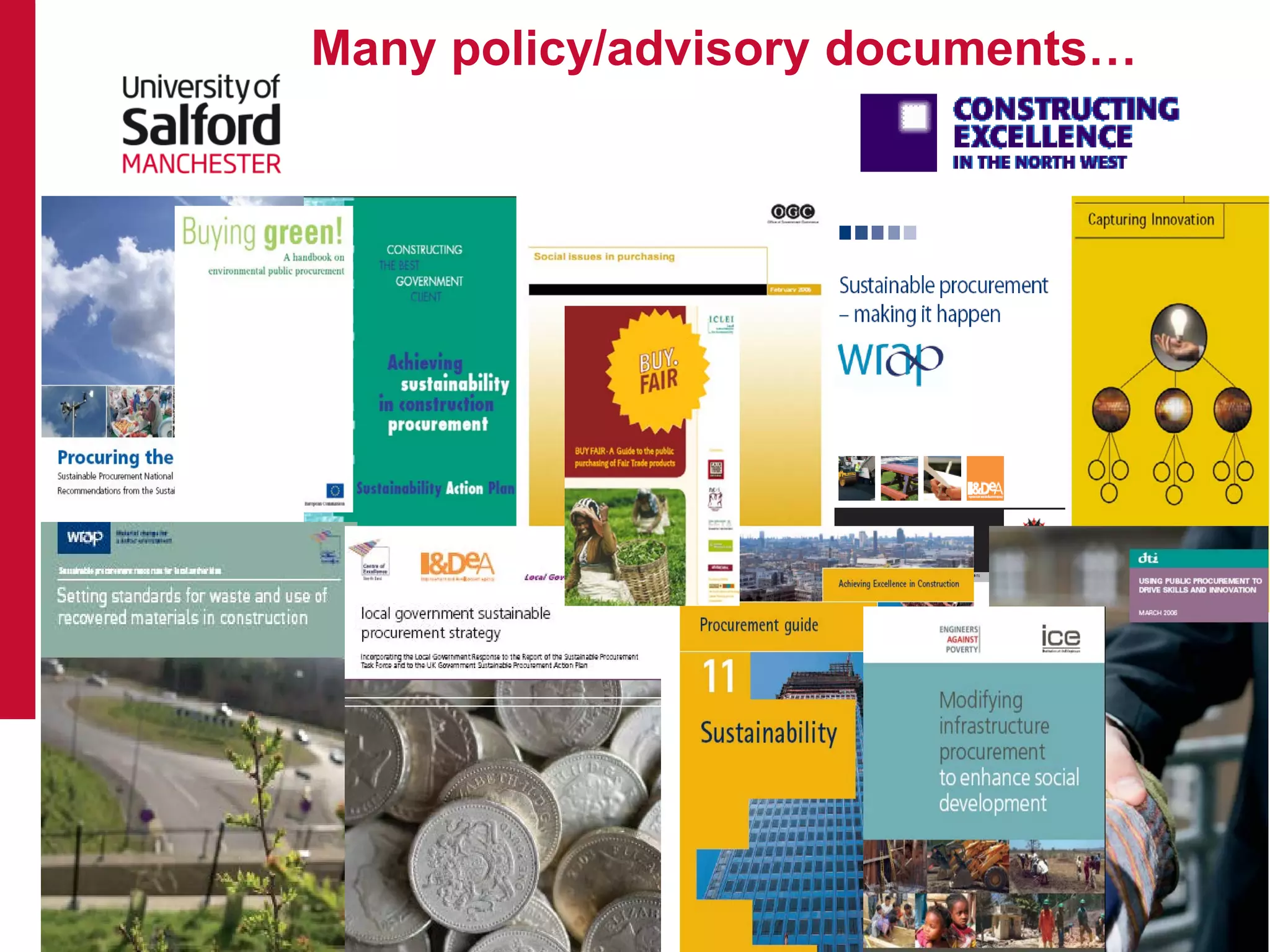
Many policy/advisory documents…
What?: Sustainable
Procurement
• “a process whereby organisations meet
their needs for goods, services, works and
utilities in a way that achieves value for
money on a whole life basis in terms of
generating benefits not only to the
organisation, but also to society and the
economy, whilst minimising damage to the
environment” (SPTF 2006, p 10).
• Sustainable procurement – in short using
procurement to support wider social,
economic and environmental objectives, in
ways that offer real long-term benefits, is
how the public sector should be spending
taxpayers money (Simms, 2006).
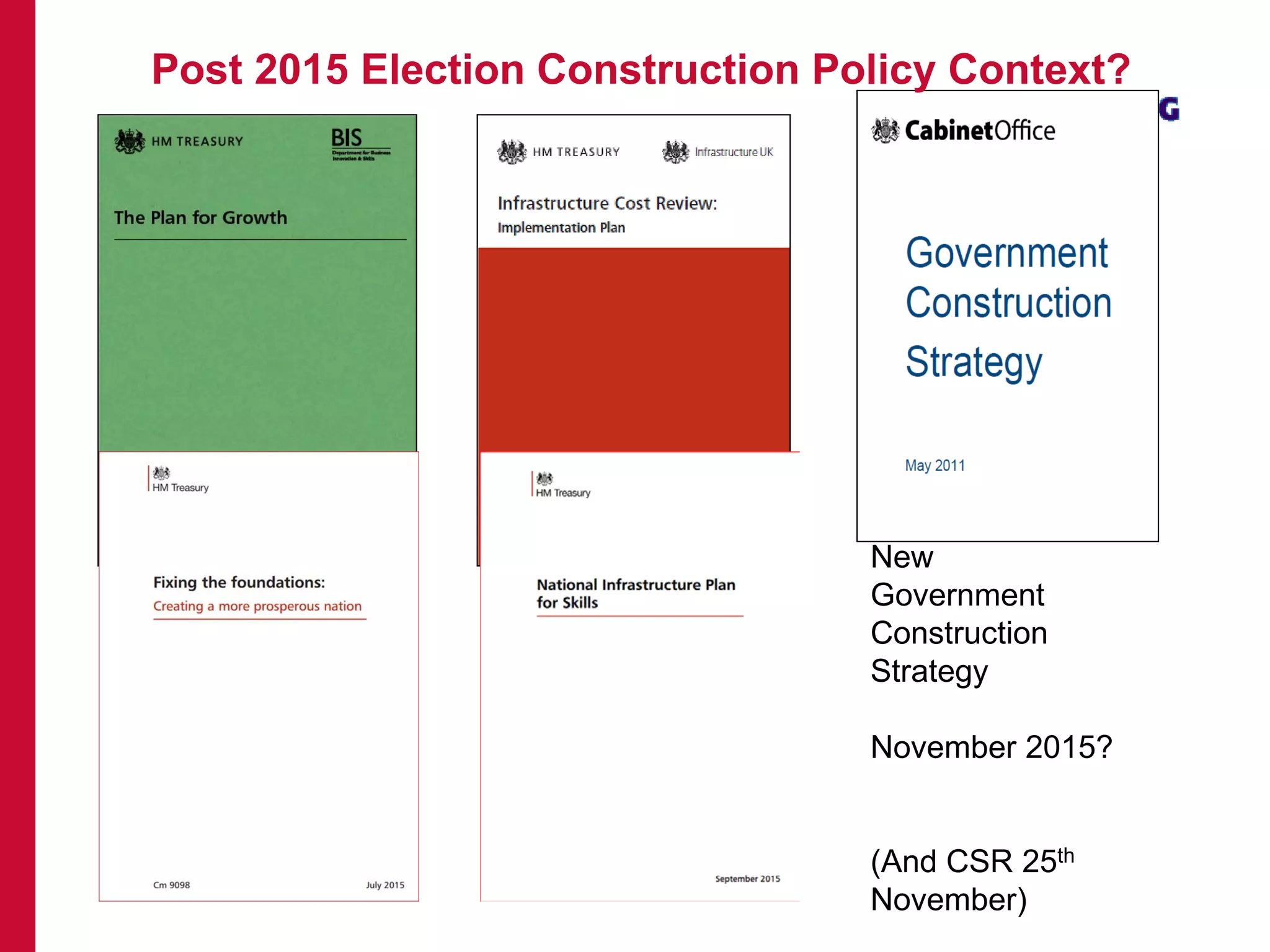
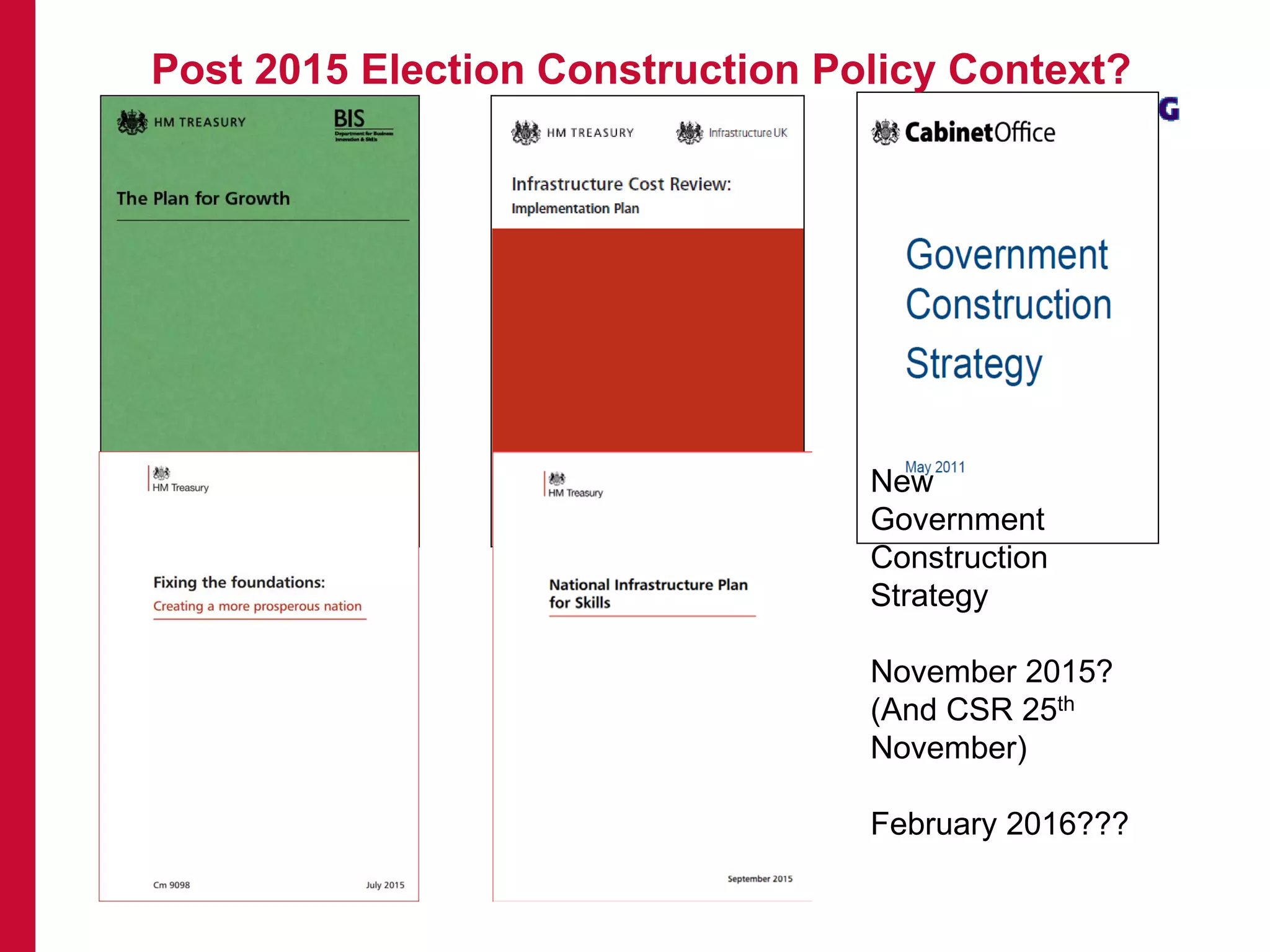
New
Government
Construction
Strategy
November 2015?
(And CSR 25th
November)
February 2016???
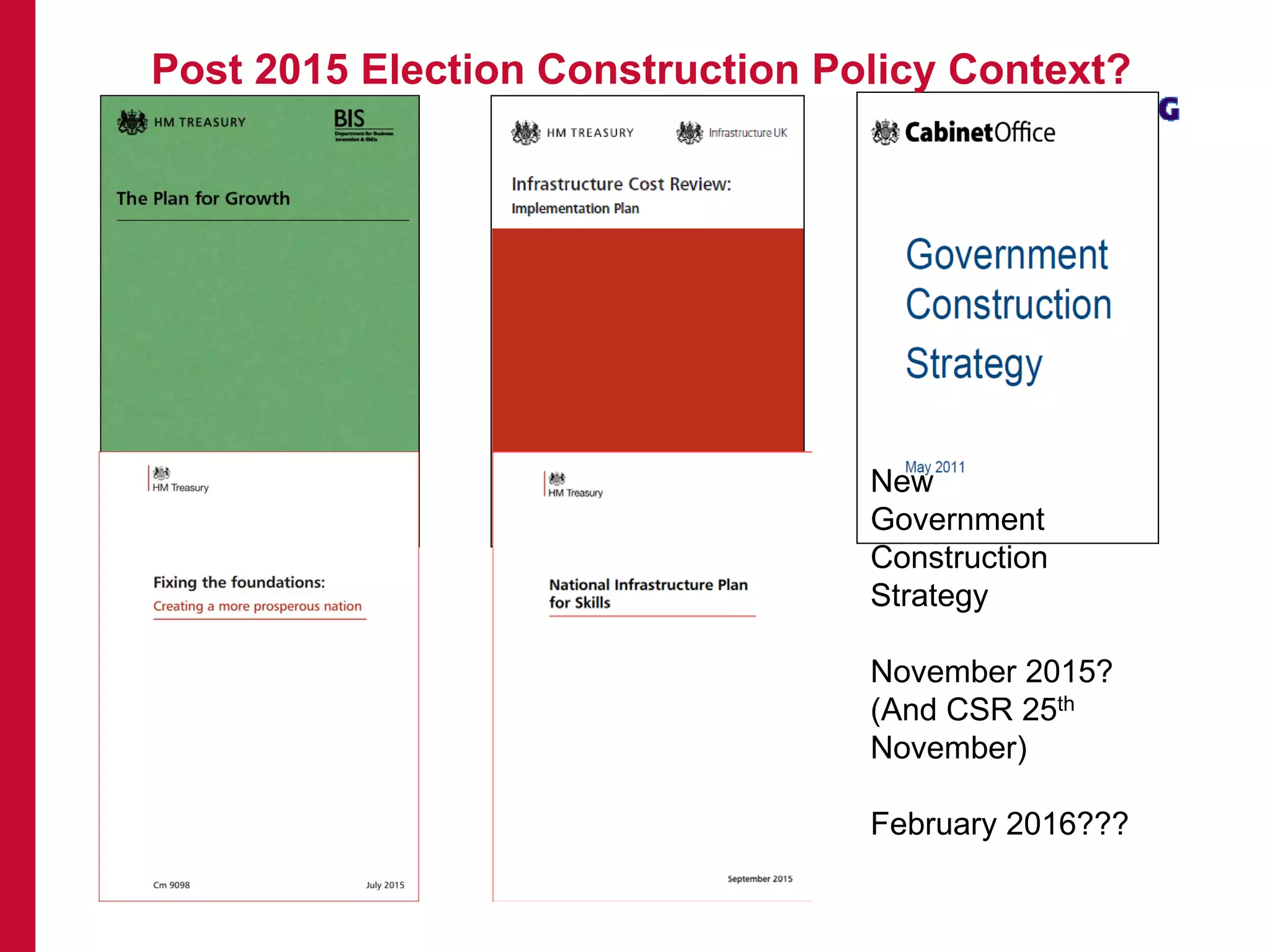
Post 2015 Election Construction Policy Context?
Why?
Why? Joined-up
government
• UK SPTF 2006: Too often the
business side of government –
the service provision, the
purchasing, the employment, fails
to reflect the policy goals of
government…
• Bringing together the business
and the policy arms of
government is what sustainable
procurement is about.
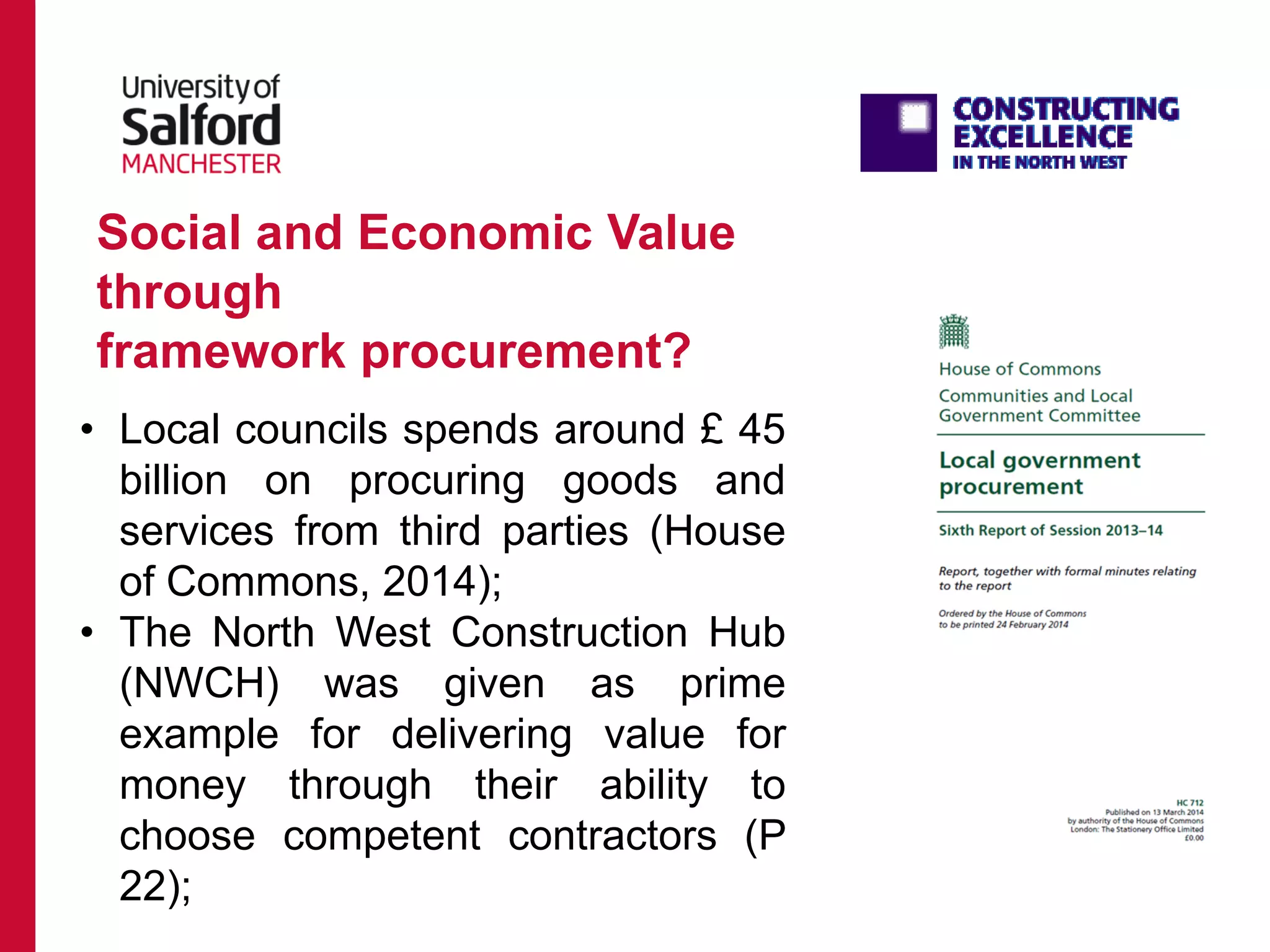
• Local councils spends around £ 45
billion on procuring goods and
services from third parties (House
of Commons, 2014);
• The North West Construction Hub
(NWCH) was given as prime
example for delivering value for
money through their ability to
choose competent contractors (P
22);
Social and Economic Value
through
framework procurement?
New
Government
Construction
Strategy
November 2015?
(And CSR 25th
November)
Post 2015 Election Construction Policy Context?
How?
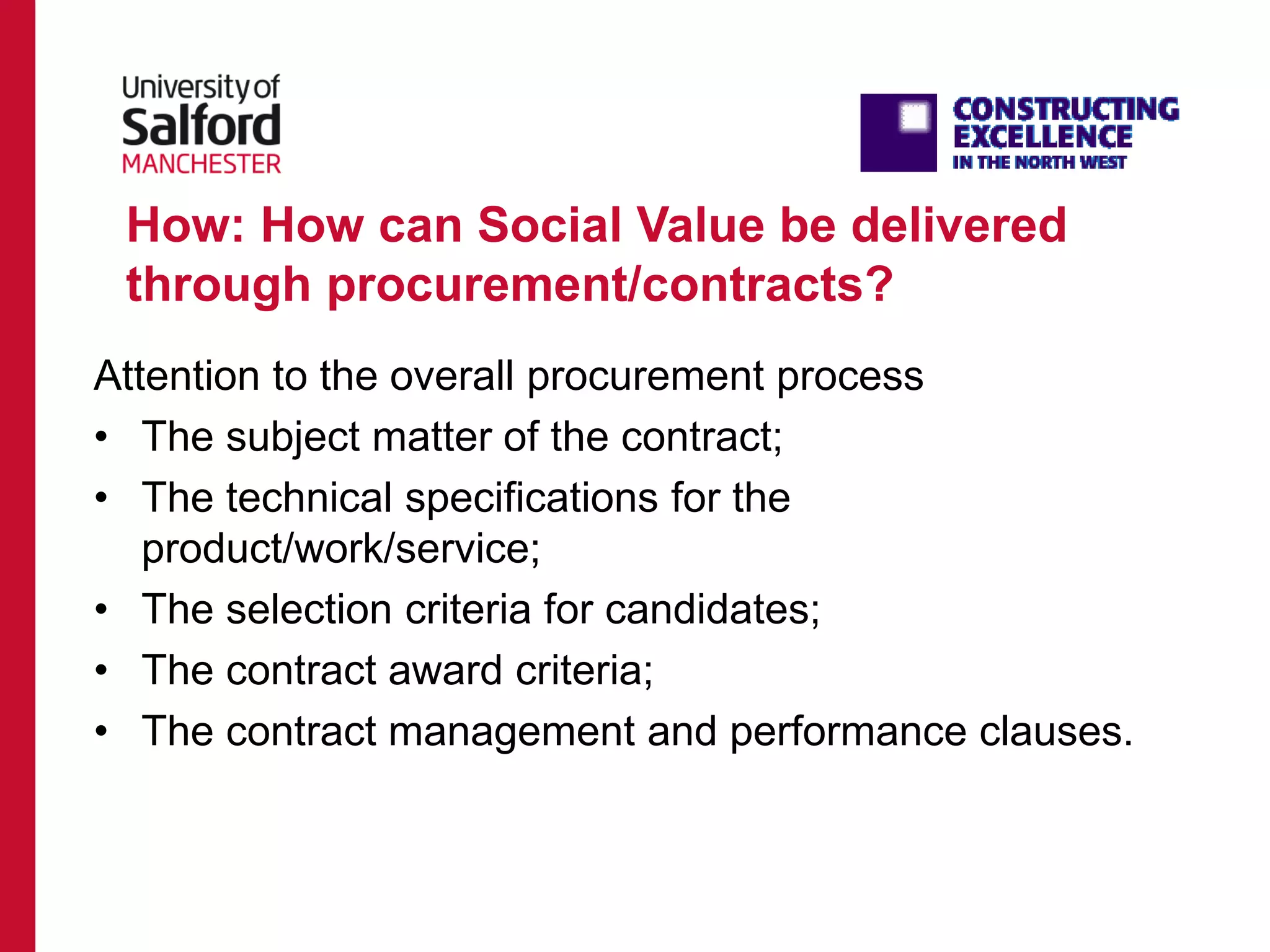
How: How can Social Value be delivered
through procurement/contracts?
Attention to the overall procurement process
• The subject matter of the contract;
• The technical specifications for the
product/work/service;
• The selection criteria for candidates;
• The contract award criteria;
• The contract management and performance clauses.
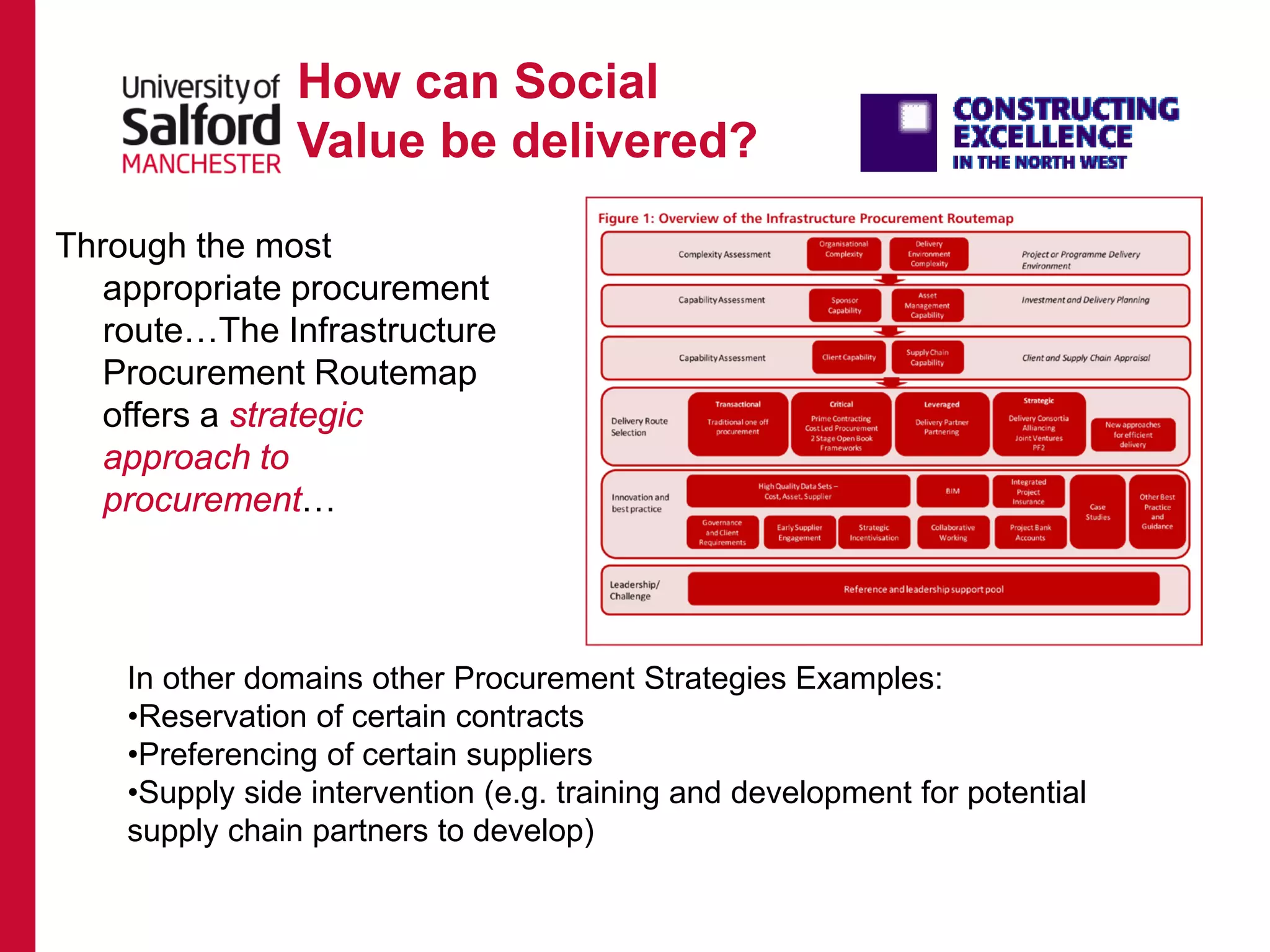
How can Social
Value be delivered?
Through the most
appropriate procurement
route…The Infrastructure
Procurement Routemap
offers a strategic
approach to
procurement…
In other domains other Procurement Strategies Examples:
•Reservation of certain contracts
•Preferencing of certain suppliers
•Supply side intervention (e.g. training and development for potential
supply chain partners to develop)
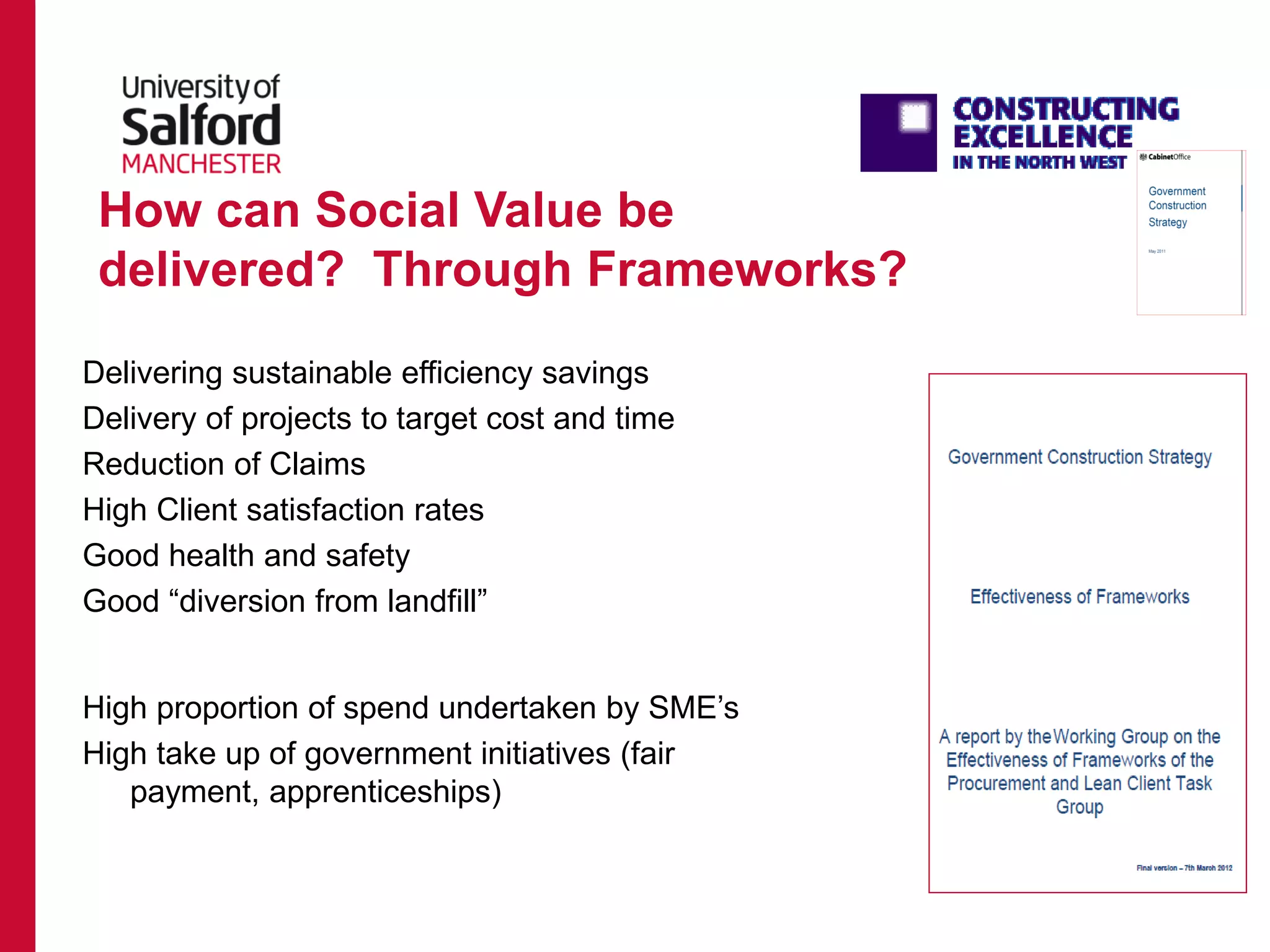
Delivering sustainable efficiency savings
Delivery of projects to target cost and time
Reduction of Claims
High Client satisfaction rates
Good health and safety
Good “diversion from landfill”
High proportion of spend undertaken by SME’s
High take up of government initiatives (fair
payment, apprenticeships)
How can Social Value be
delivered? Through Frameworks?
Social Value through frameworks?
Supply Chain Engagement:
• Agree SME and supply chain engagement strategy:
• Ensure engagement in national, regional and local
frameworks
• Emphasise the involvement and integration of tier
2/3 suppliers within the framework and design team
• Ensure transparent approach and client
engagement with supply chain
• Local sourcing, fair payment provision down the
supply chain, measure and monitor engagement
Example Measures in Local Government:
• % of Sub-Contractors SMEs
• % of Sub-Contractors local to the area
• % of Construction Contract Spent with SMEs
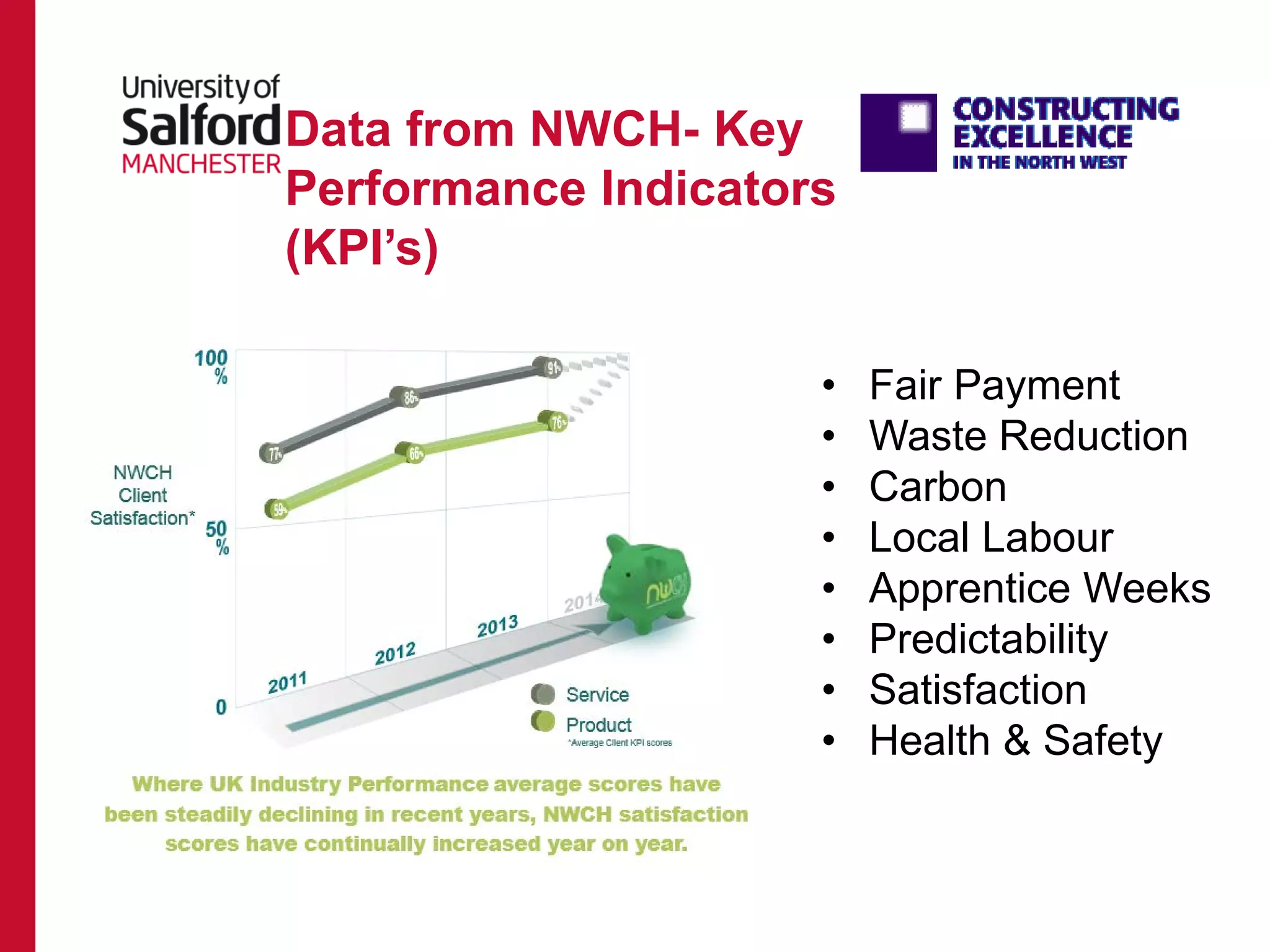
Data from NWCH- Key
Performance Indicators
(KPI’s)
KPI data is monitored
using the Centre for
Construction
Innovation (CCI)
KPI Engine and
include:
• Fair Payment
• Waste Reduction
• Carbon
• Local Labour
• Apprentice Weeks
• Predictability
• Satisfaction
• Health & Safety
Data from the NWCH
“Delivering True Value”
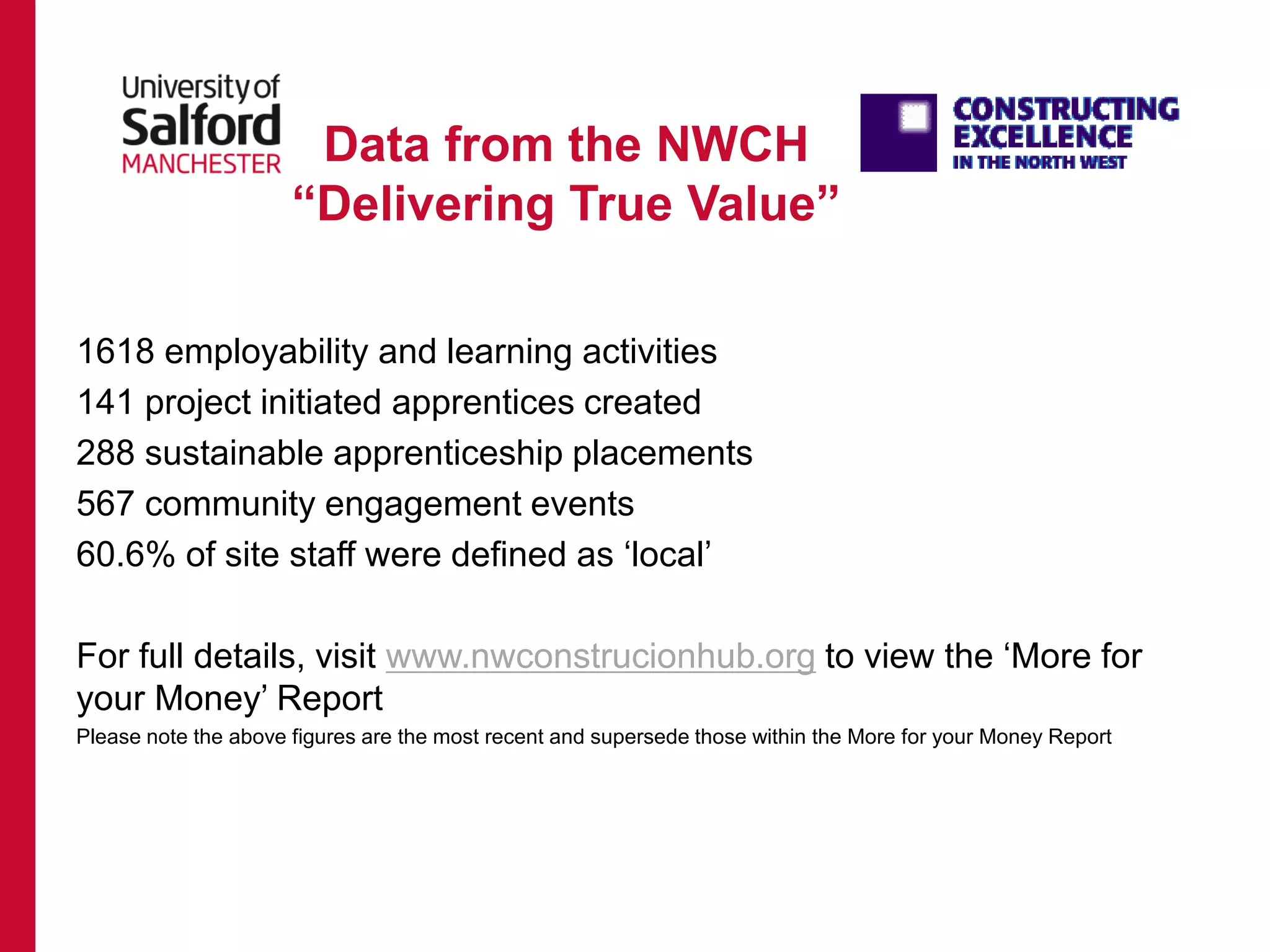
1618 employability and learning activities
141 project initiated apprentices created
288 sustainable apprenticeship placements
567 community engagement events
60.6% of site staff were defined as ‘local’
For full details, visit www.nwconstrucionhub.org to view the ‘More for
your Money’ Report
Please note the above figures are the most recent and supersede those within the More for your Money Report
But?
No buts…..
All public bodies in England
and Wales, including local
authorities, will be required to
consider how the services
they commission and
procure might improve
the economic, social and
environmental well-being of
the area.
Social value asks the
question: "If £1 is spent on
the delivery of services, can
that same £1 be used to also
produce a wider benefit
to the community?"
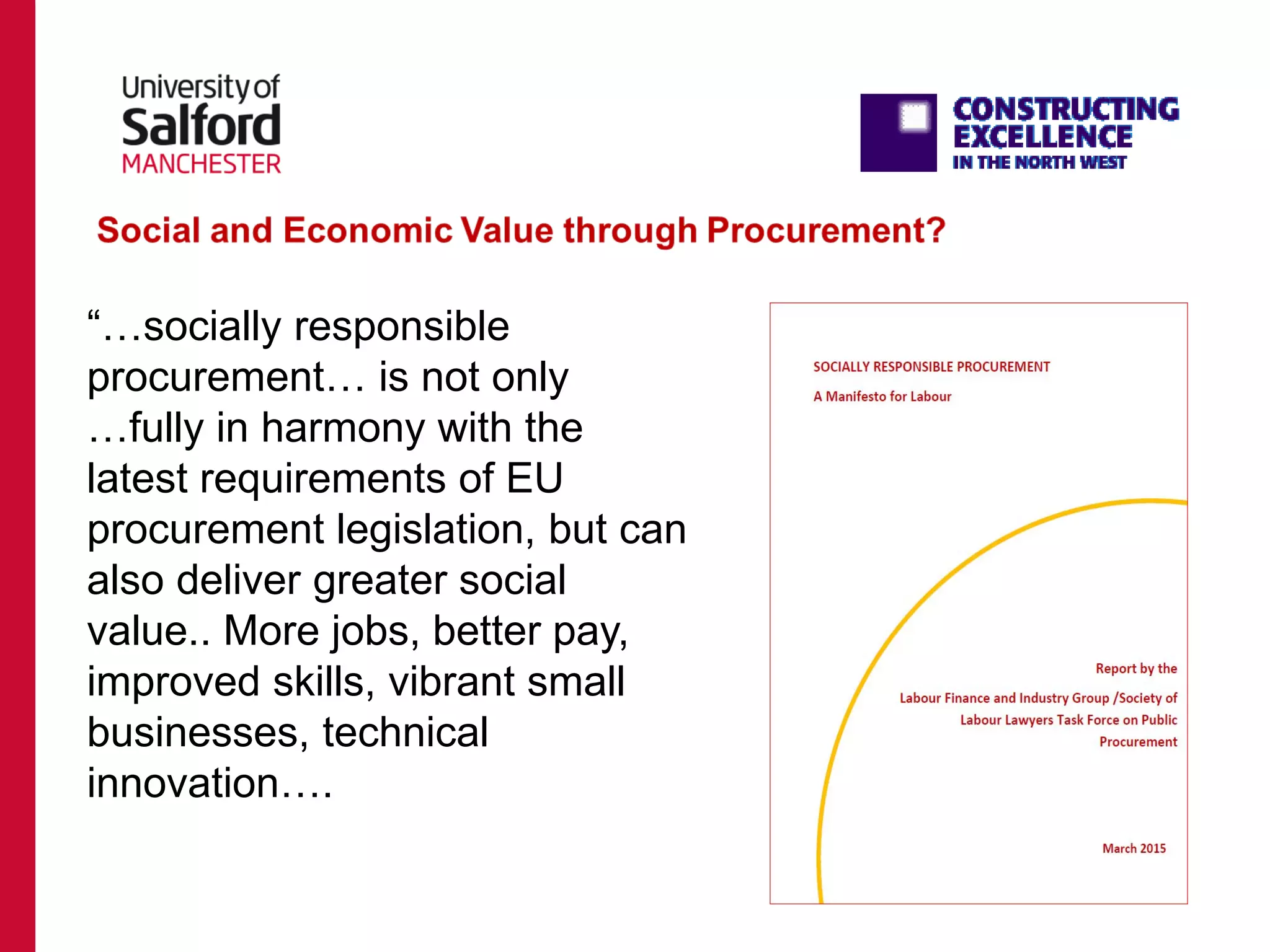
“…socially responsible
procurement… is not only
…fully in harmony with the
latest requirements of EU
procurement legislation, but can
also deliver greater social
value.. More jobs, better pay,
improved skills, vibrant small
businesses, technical
innovation….
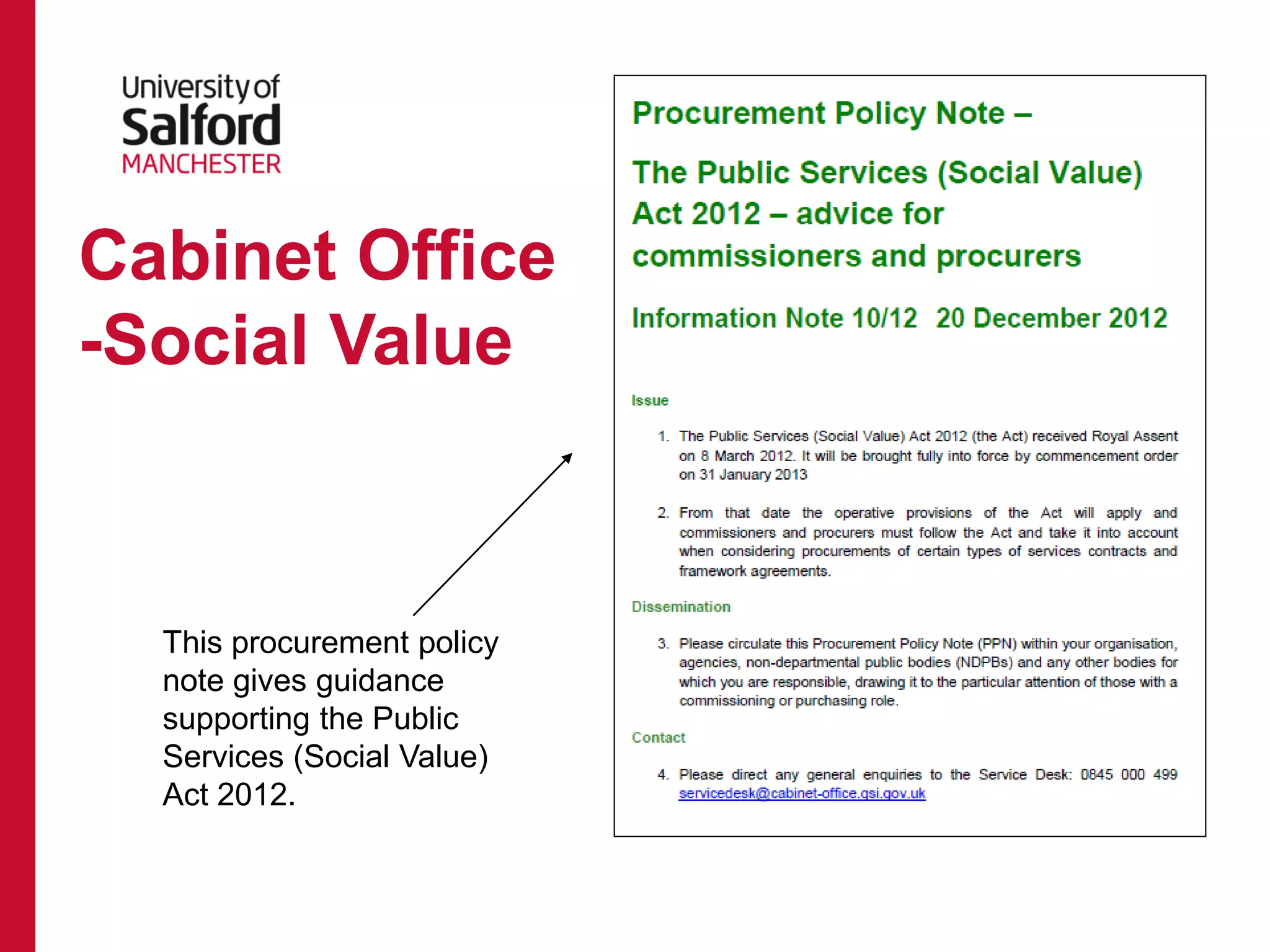
Cabinet Office
-Social Value
This procurement policy
note gives guidance
supporting the Public
Services (Social Value)
Act 2012.
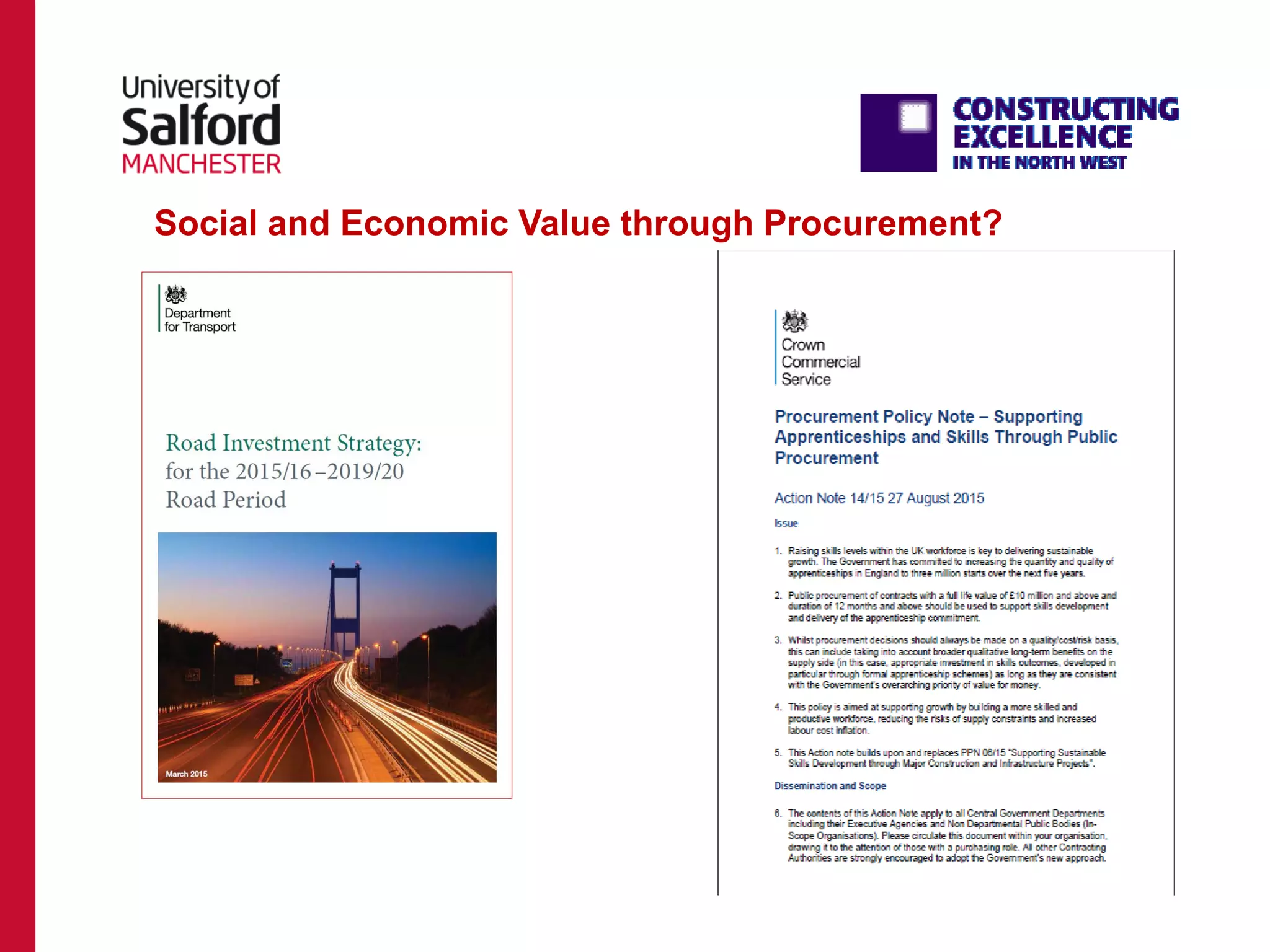
Social and Economic Value through Procurement?
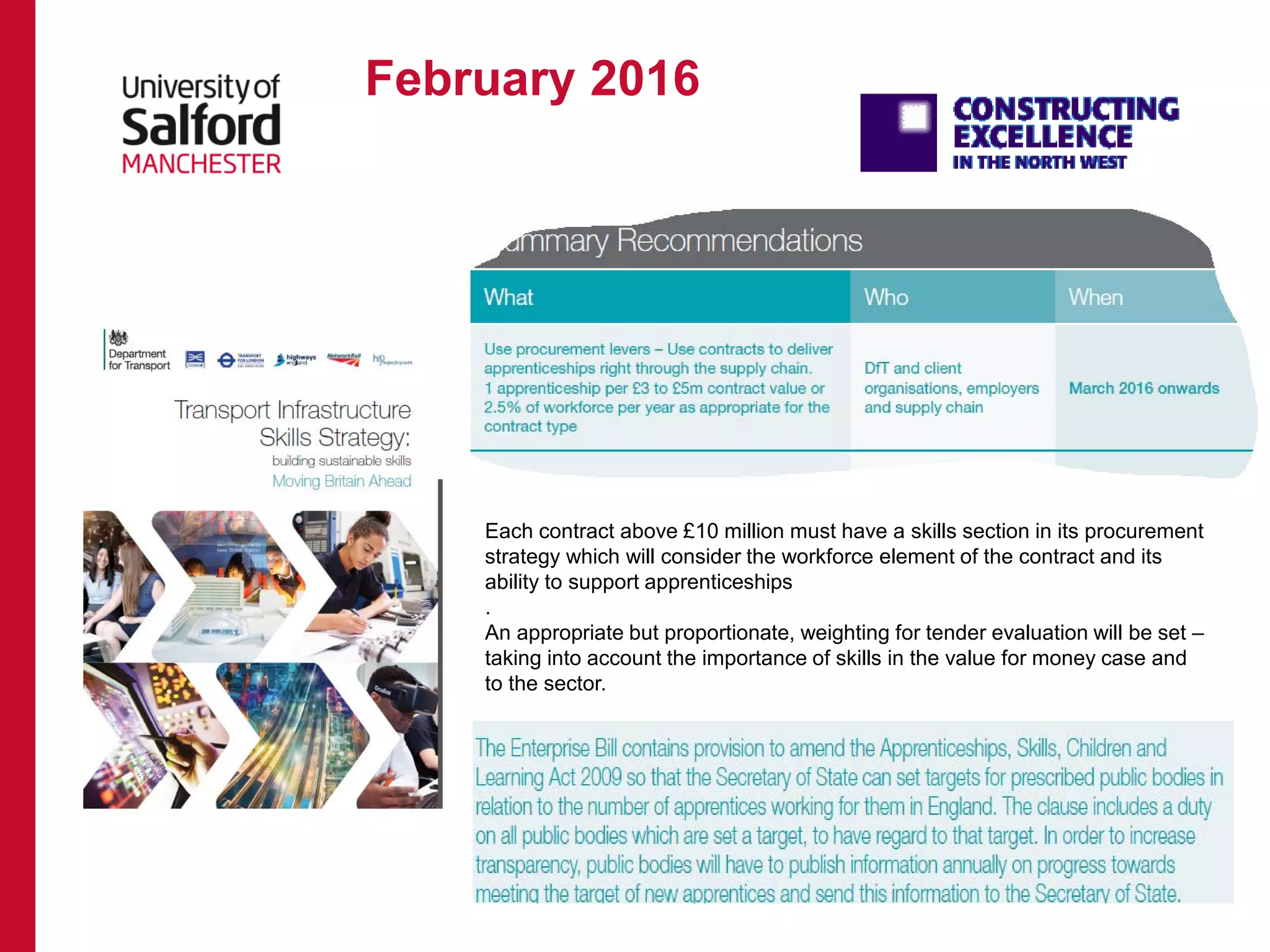
February 2016
Each contract above £10 million must have a skills section in its procurement
strategy which will consider the workforce element of the contract and its
ability to support apprenticeships
.
An appropriate but proportionate, weighting for tender evaluation will be set –
taking into account the importance of skills in the value for money case and
to the sector.
New
Government
Construction
Strategy
November 2015?
(And CSR 25th
November)
February 2016???
Post 2015 Election Construction Policy Context?
The north-west
Imperative?
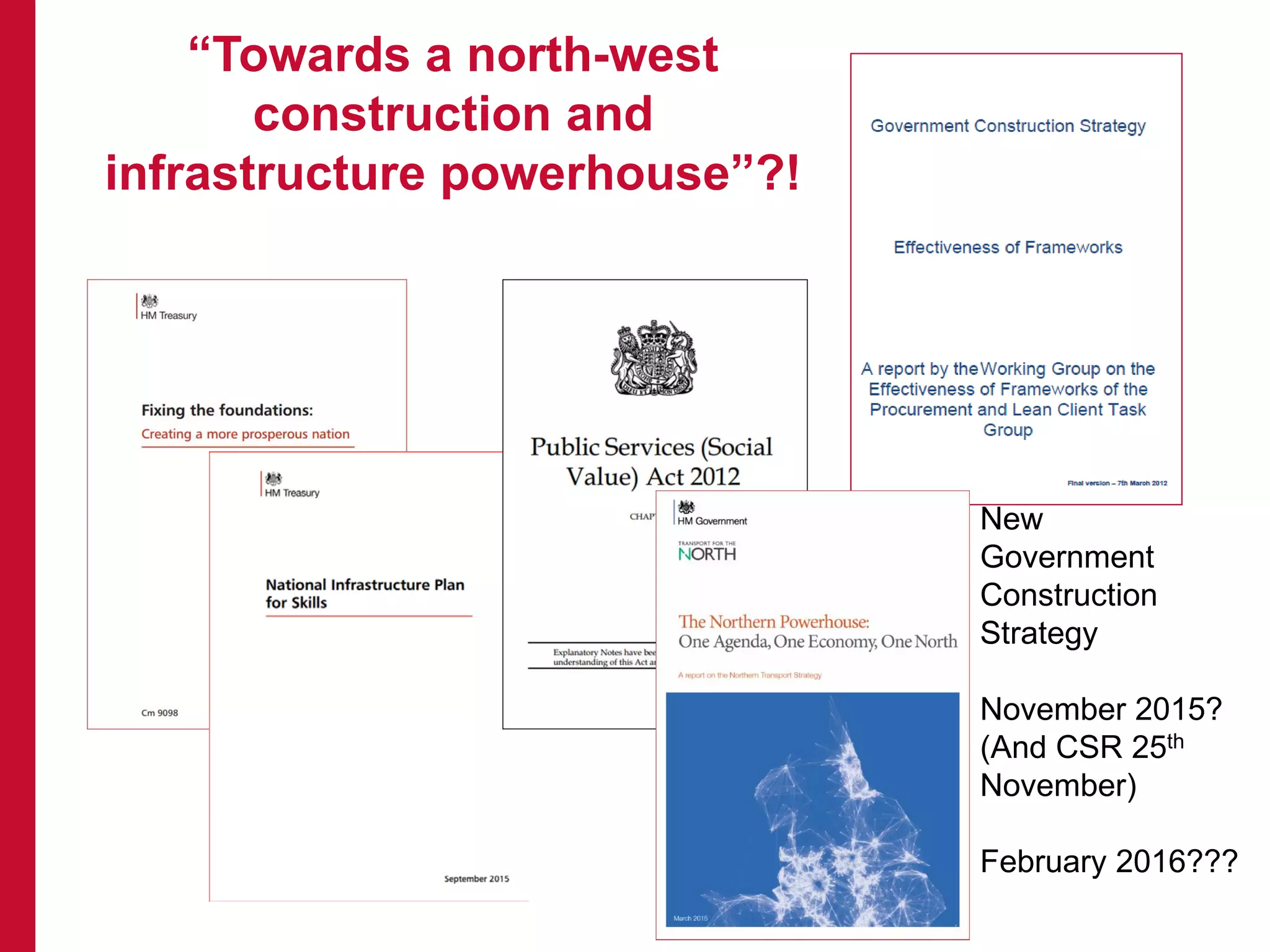
“Towards a north-west
construction and
infrastructure powerhouse”?!
New
Government
Construction
Strategy
November 2015?
(And CSR 25th
November)
February 2016???
Fixing the
foundations:
Creating a
more
prosperous
nation
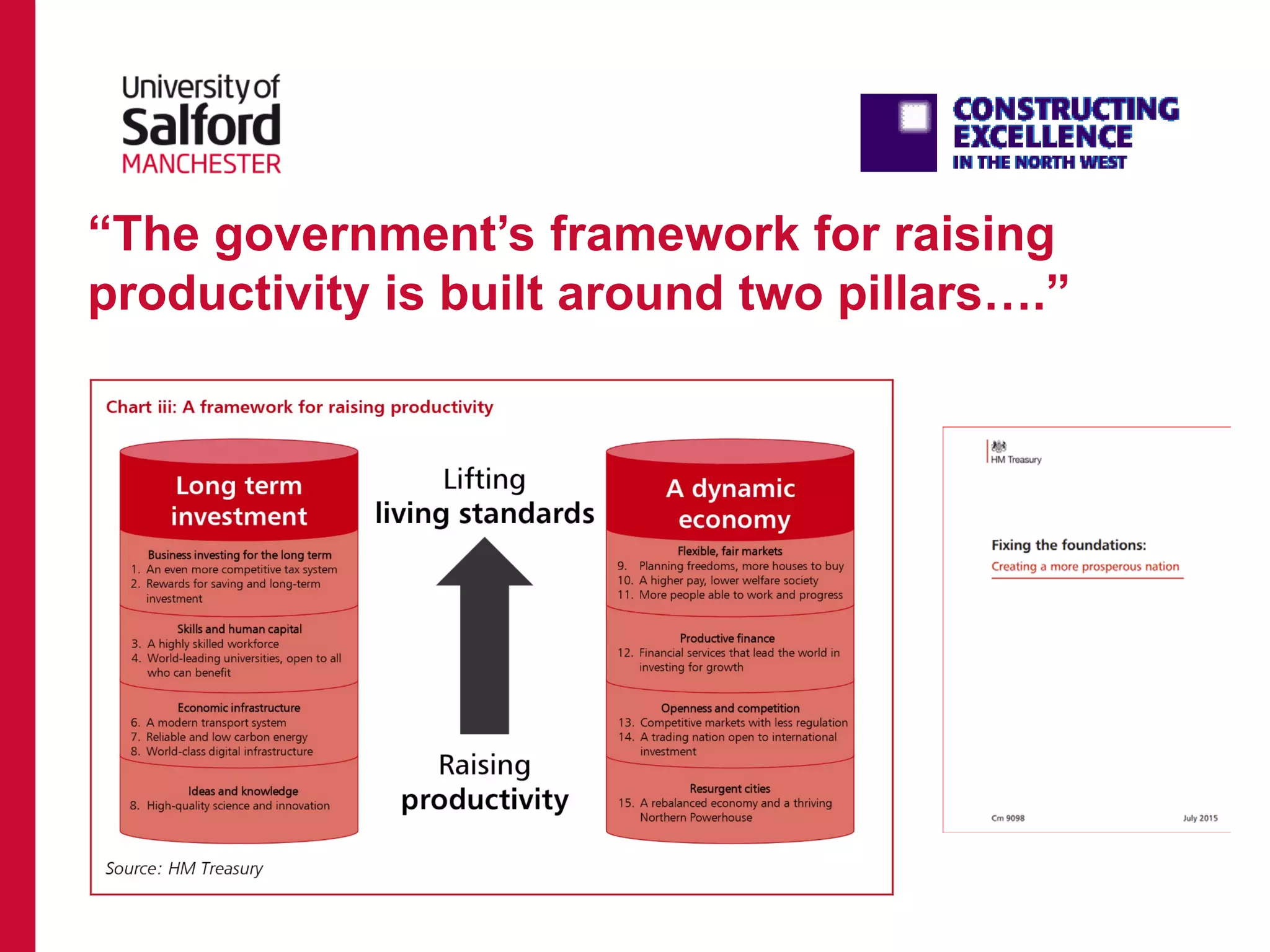
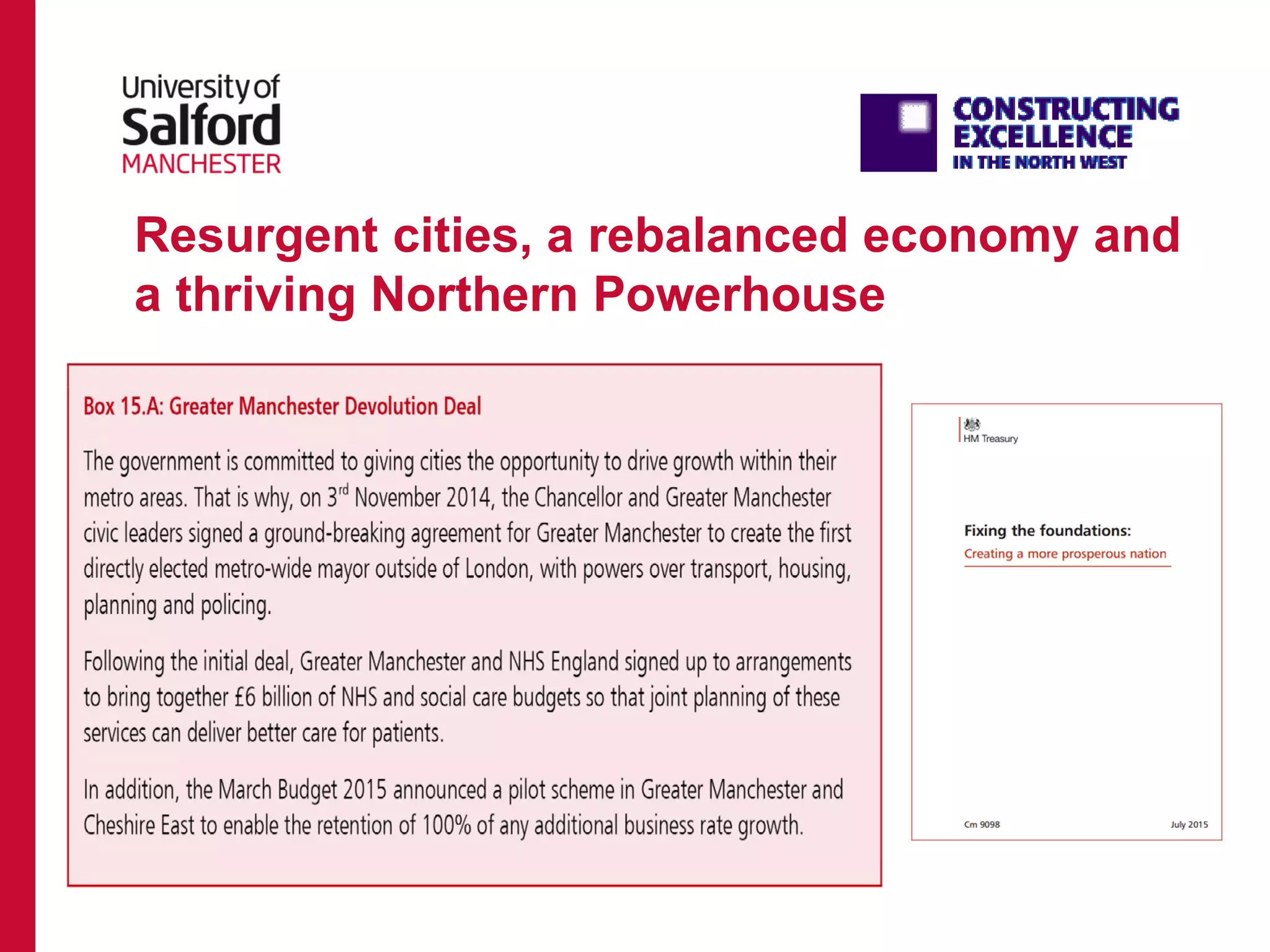
“The government’s framework for raising
productivity is built around two pillars….”
Resurgent cities, a rebalanced economy and
a thriving Northern Powerhouse
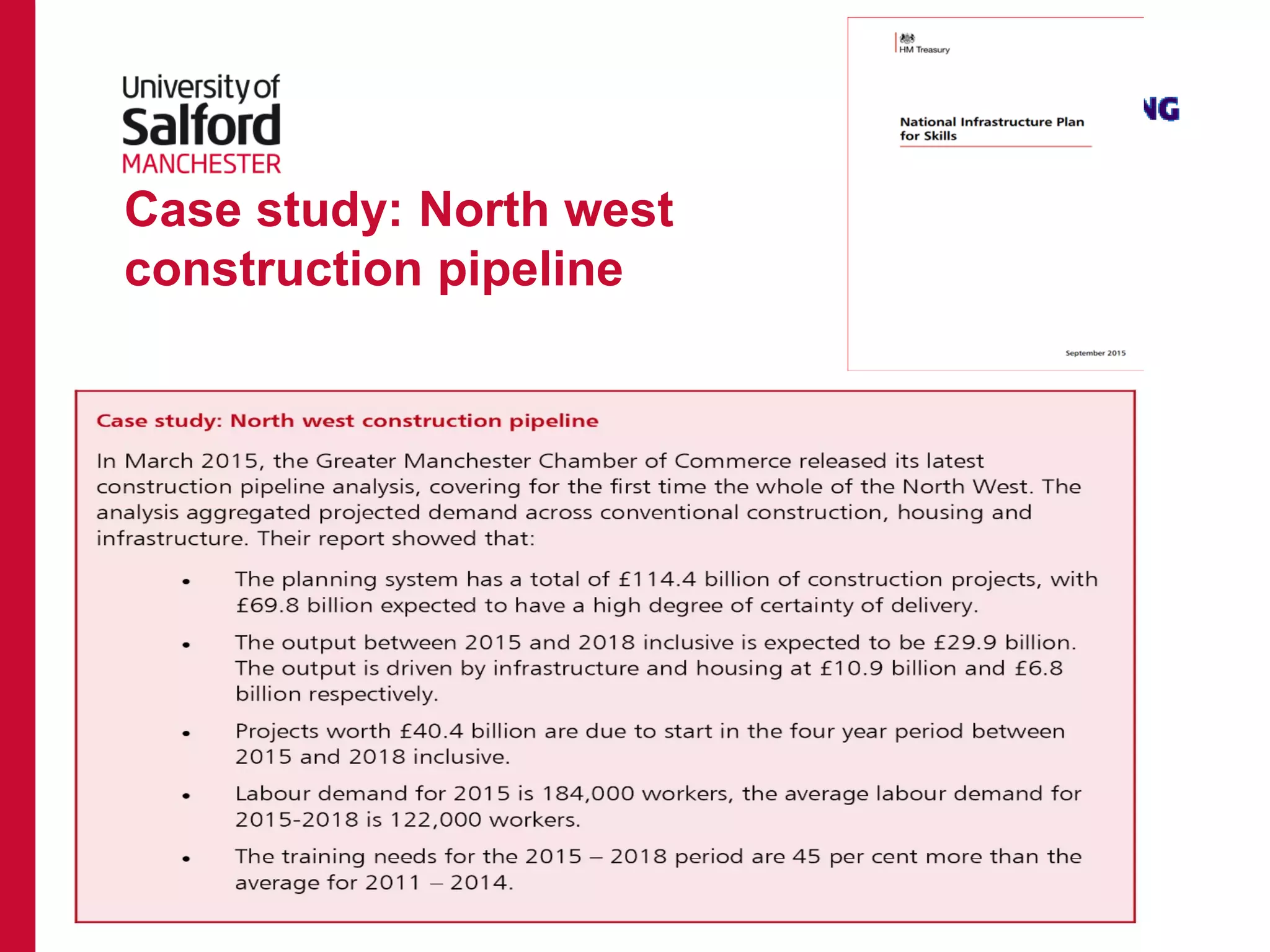
The National
Infrastructure
Plan for Skills
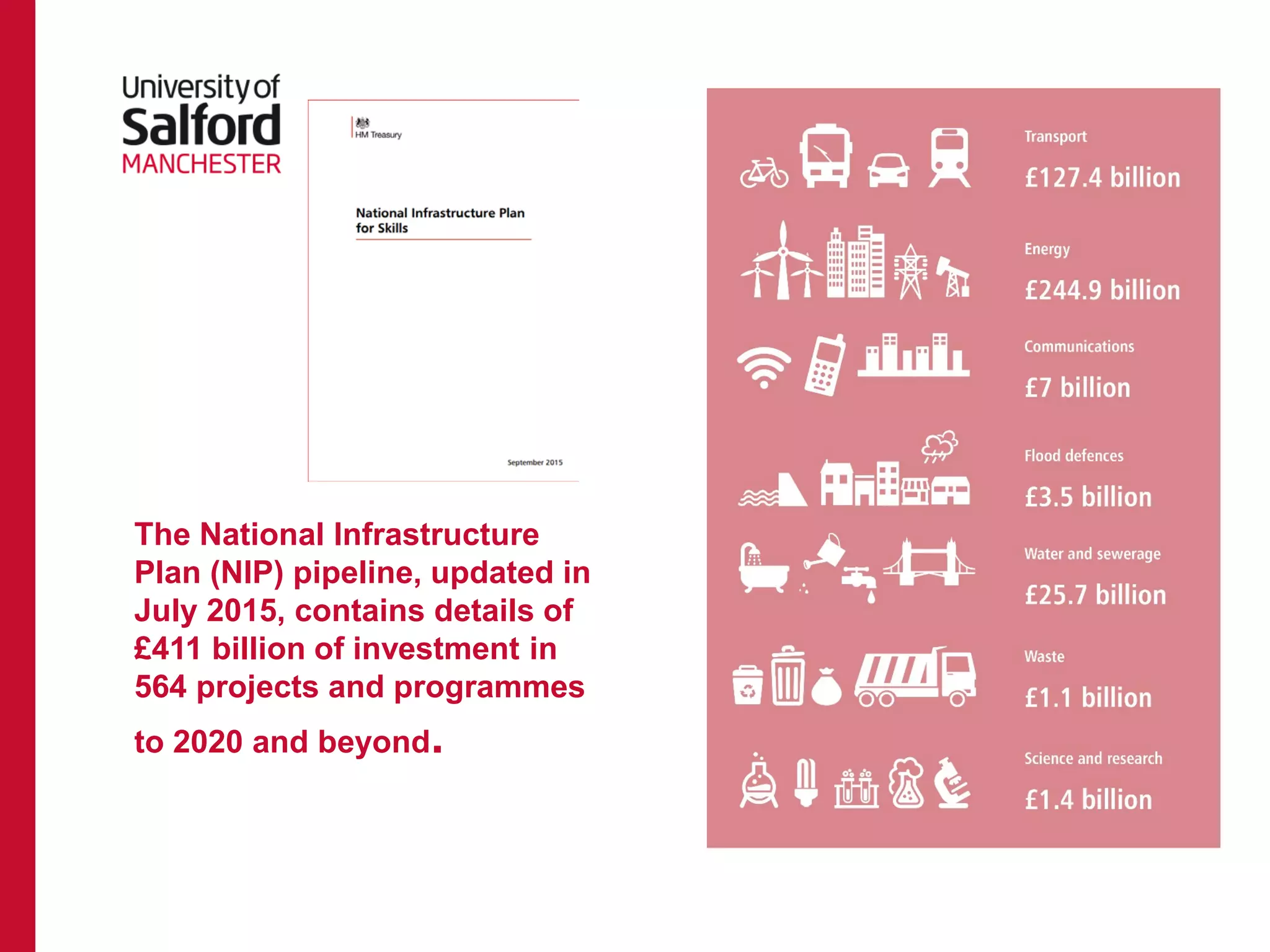
The National Infrastructure
Plan (NIP) pipeline, updated in
July 2015, contains details of
£411 billion of investment in
564 projects and programmes
to 2020 and beyond.
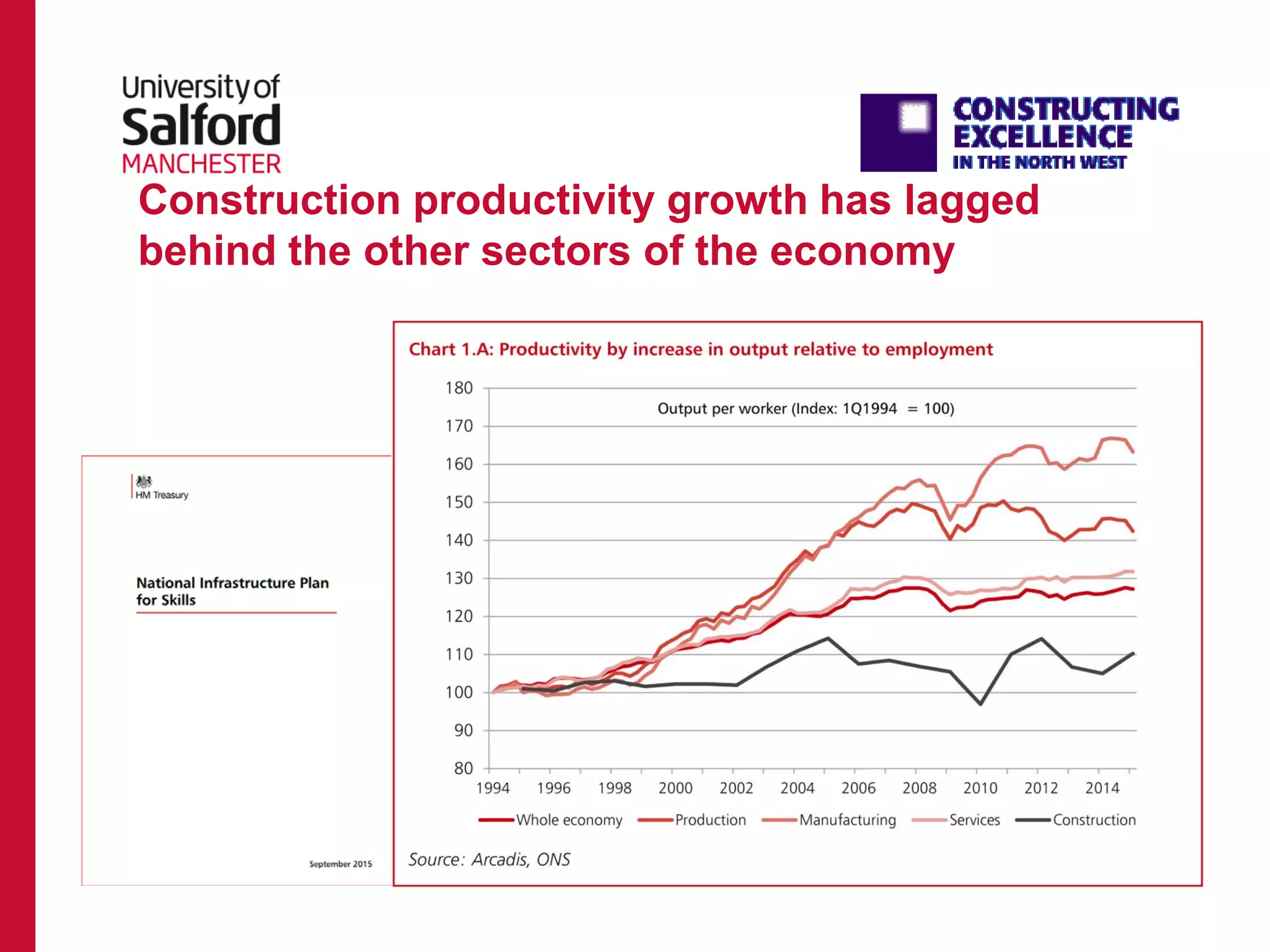
Construction productivity growth has lagged
behind the other sectors of the economy
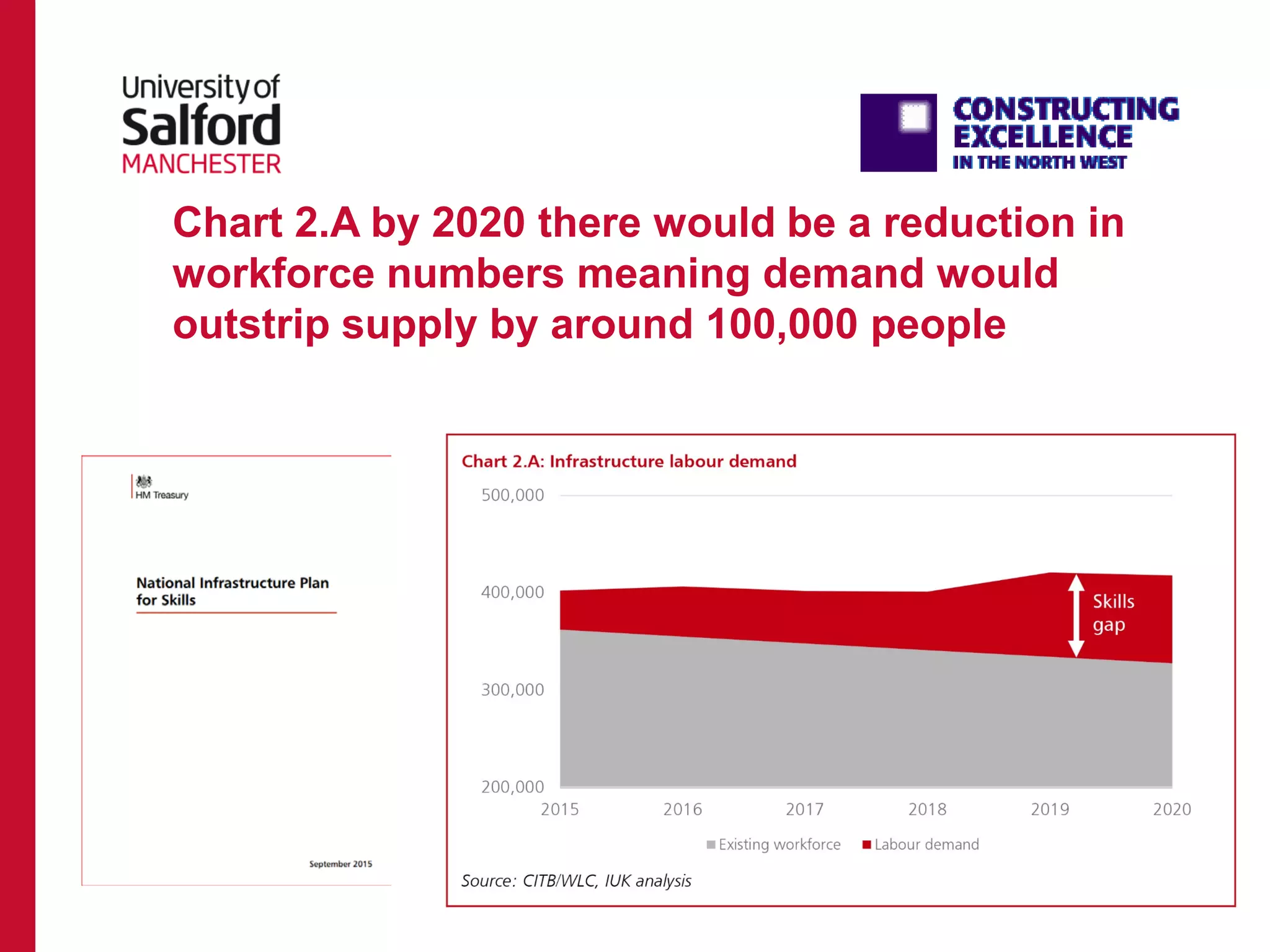
Chart 2.A by 2020 there would be a reduction in
workforce numbers meaning demand would
outstrip supply by around 100,000 people
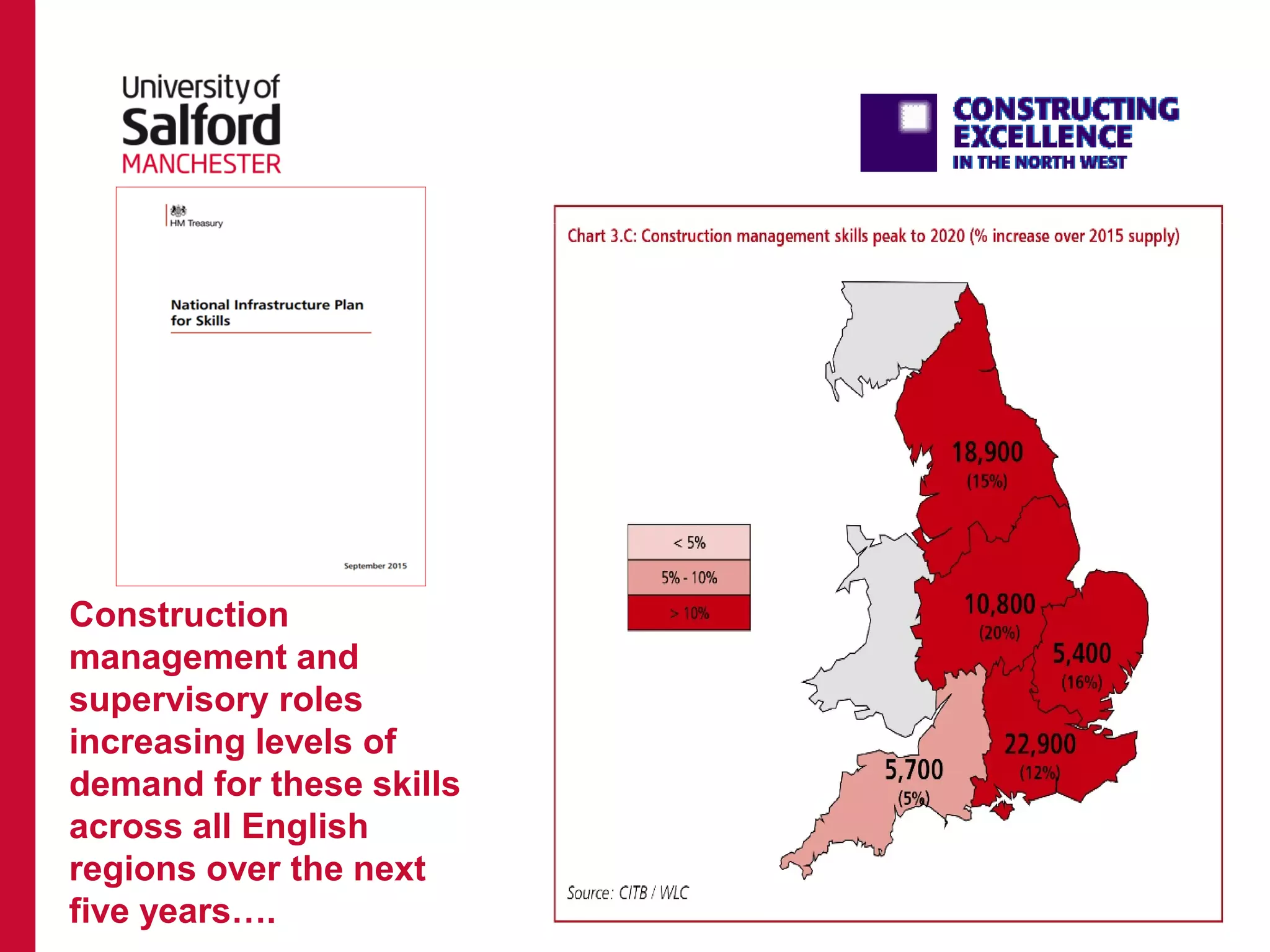
Construction
management and
supervisory roles
increasing levels of
demand for these skills
across all English
regions over the next
five years….
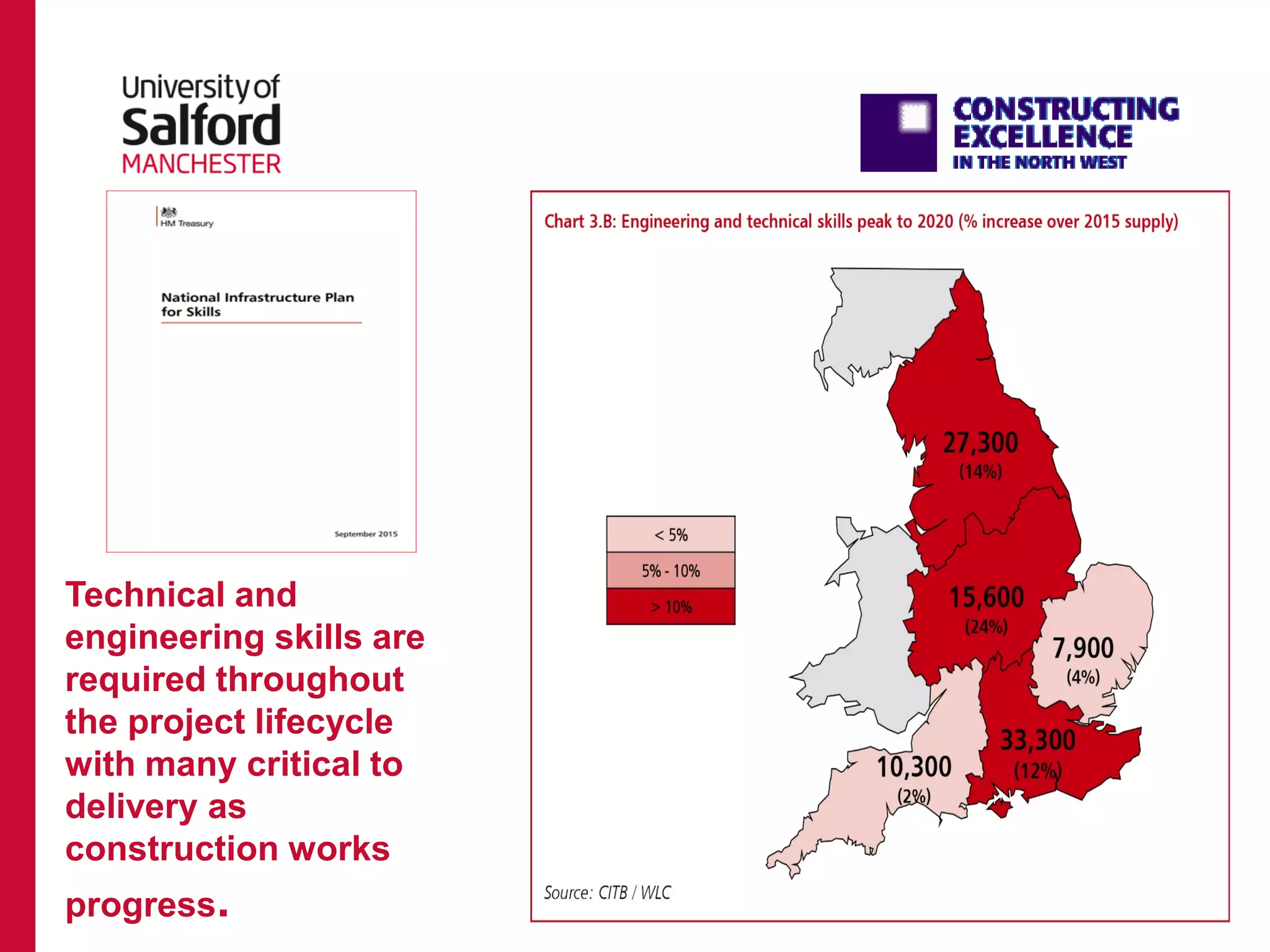
Technical and
engineering skills are
required throughout
the project lifecycle
with many critical to
delivery as
construction works
progress.
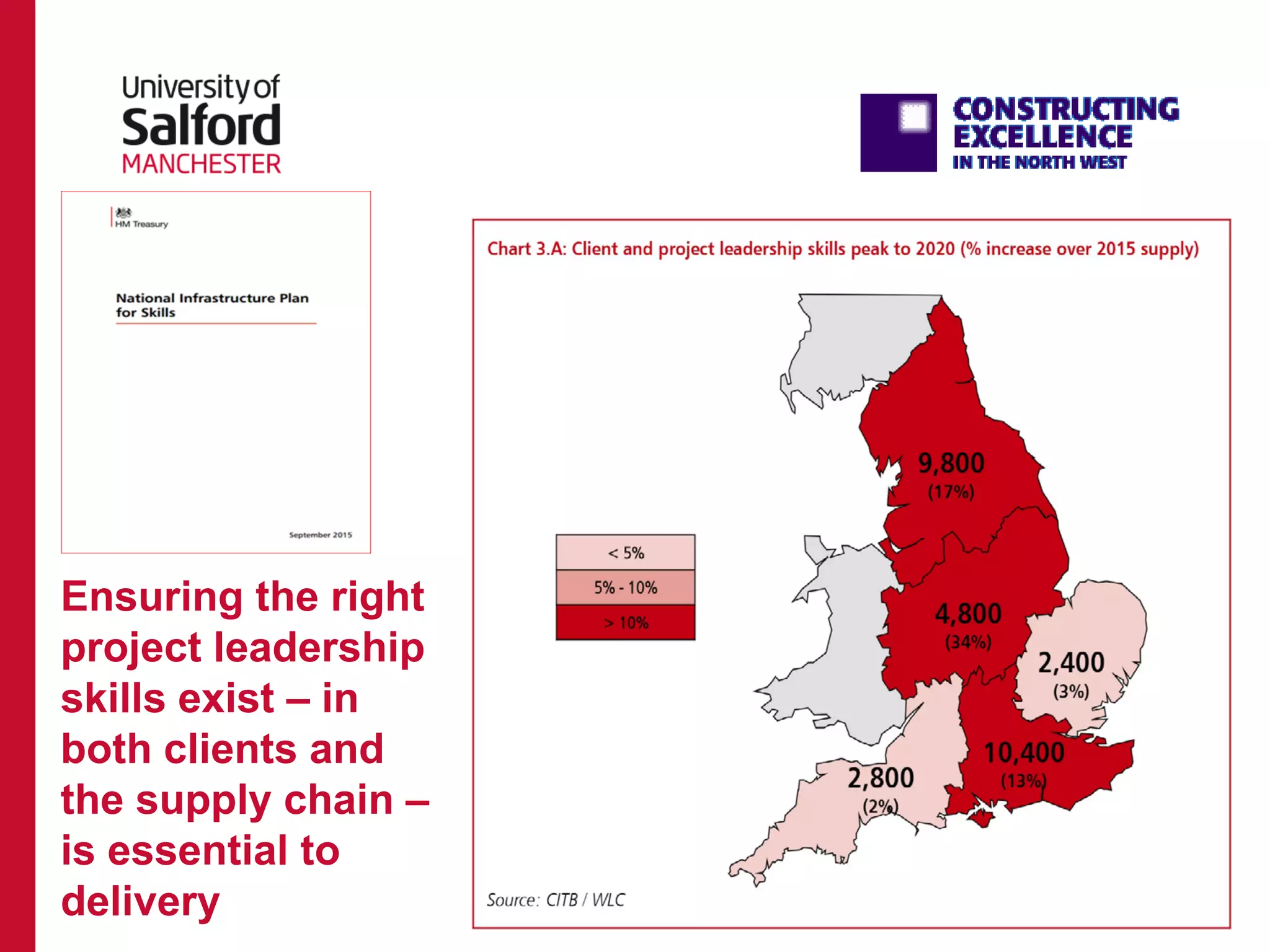
Ensuring the right
project leadership
skills exist – in
both clients and
the supply chain –
is essential to
delivery
Case study: North west
construction pipeline
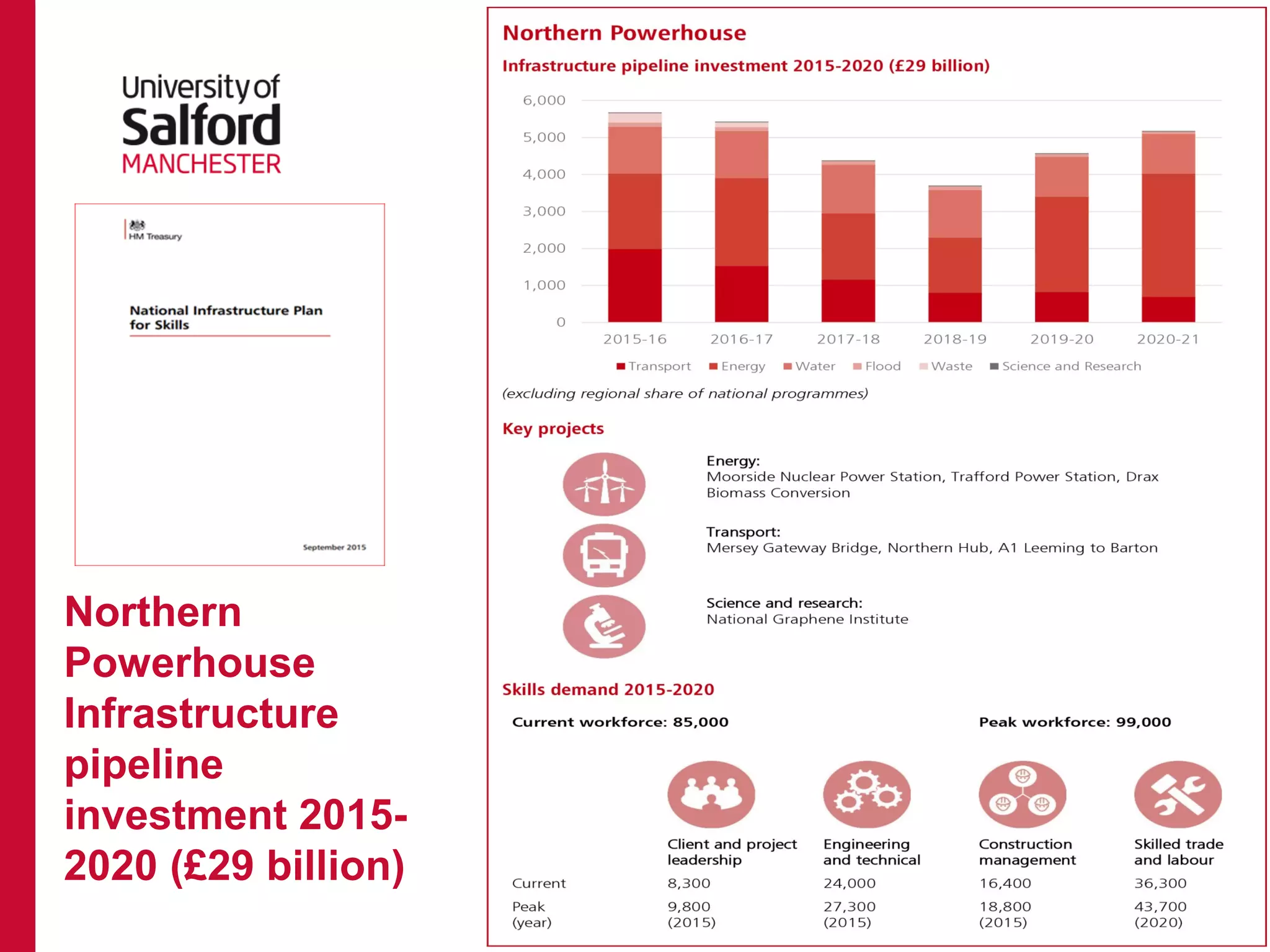
Northern
Powerhouse
Infrastructure
pipeline
investment 2015-
2020 (£29 billion)
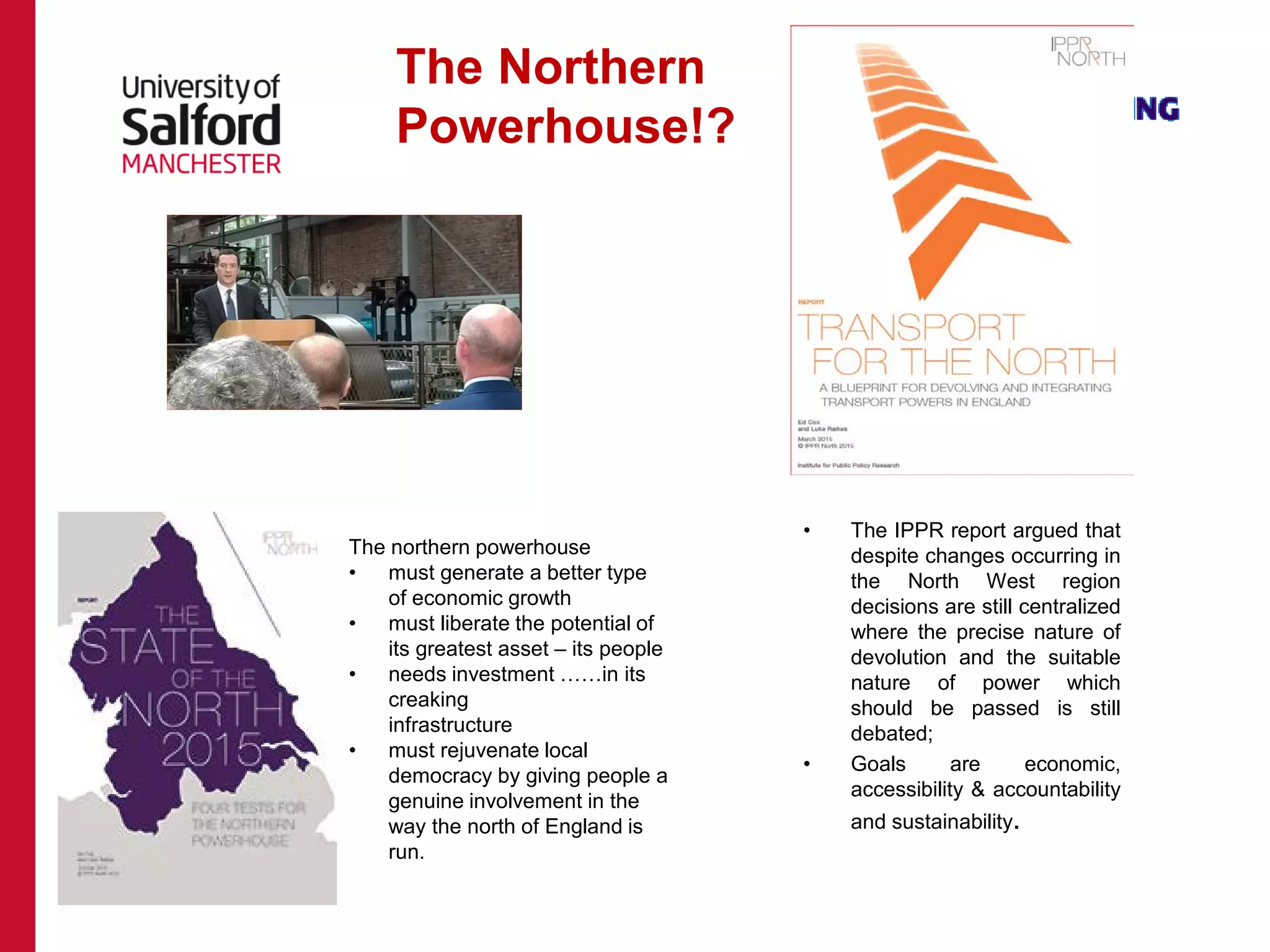
• The IPPR report argued that
despite changes occurring in
the North West region
decisions are still centralized
where the precise nature of
devolution and the suitable
nature of power which
should be passed is still
debated;
• Goals are economic,
accessibility & accountability
and sustainability.
The Northern
Powerhouse!?
The northern powerhouse
• must generate a better type
of economic growth
• must liberate the potential of
its greatest asset – its people
• needs investment ……in its
creaking
infrastructure
• must rejuvenate local
democracy by giving people a
genuine involvement in the
way the north of England is
run.
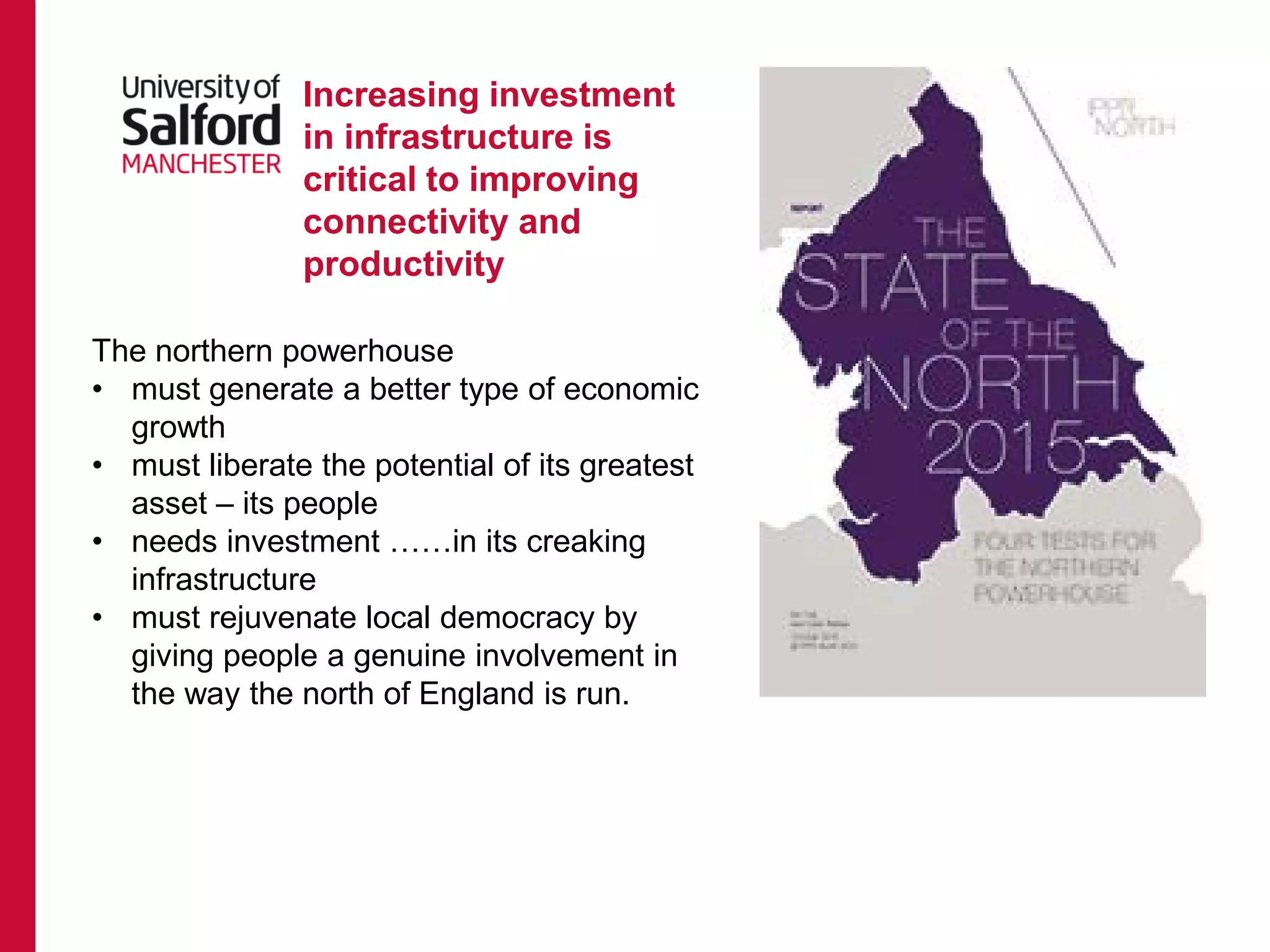
Increasing investment
in infrastructure is
critical to improving
connectivity and
productivity
The northern powerhouse
• must generate a better type of economic
growth
• must liberate the potential of its greatest
asset – its people
• needs investment ……in its creaking
infrastructure
• must rejuvenate local democracy by
giving people a genuine involvement in
the way the north of England is run.
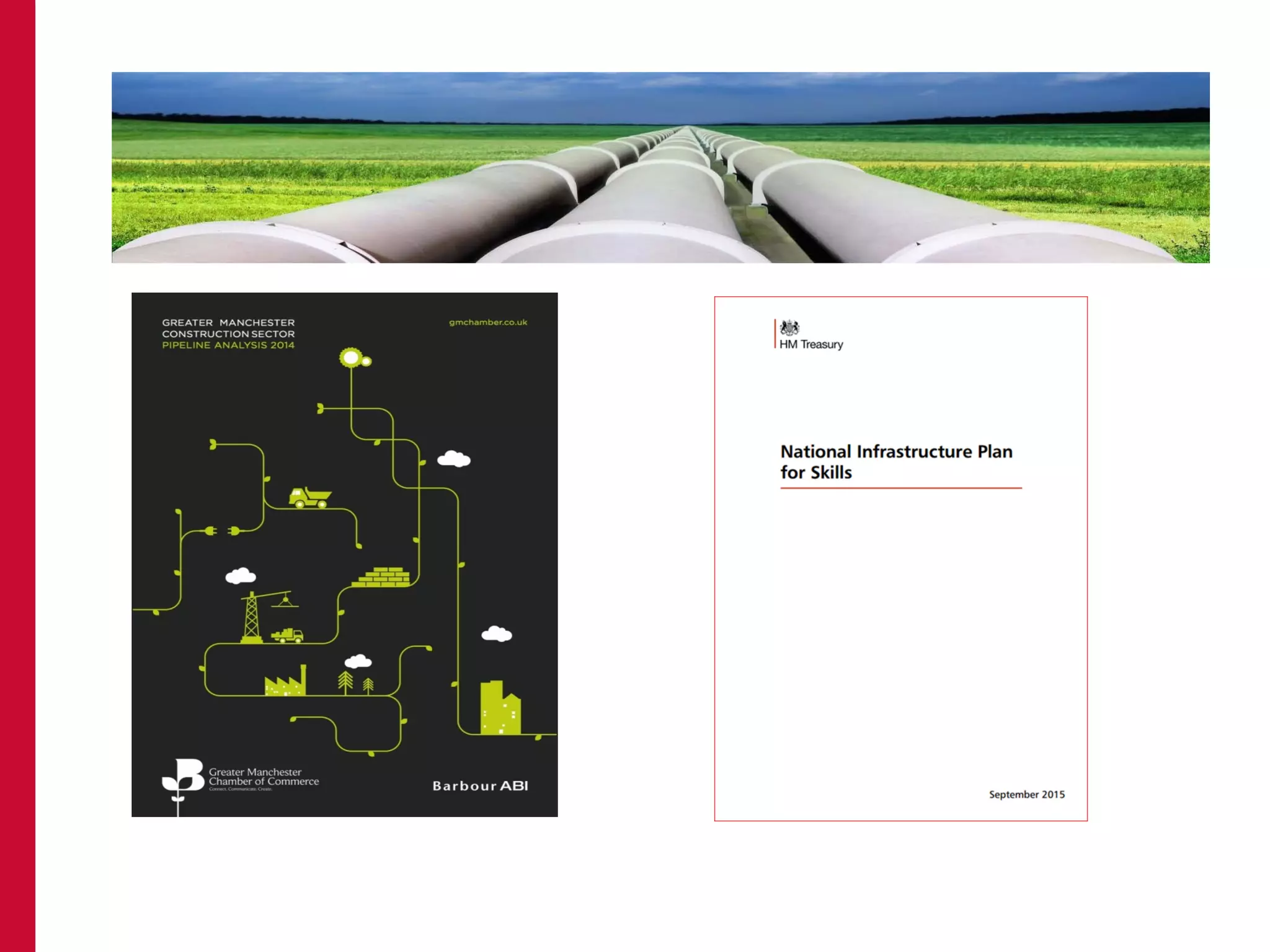
National Infrastructure
Pipeline by region
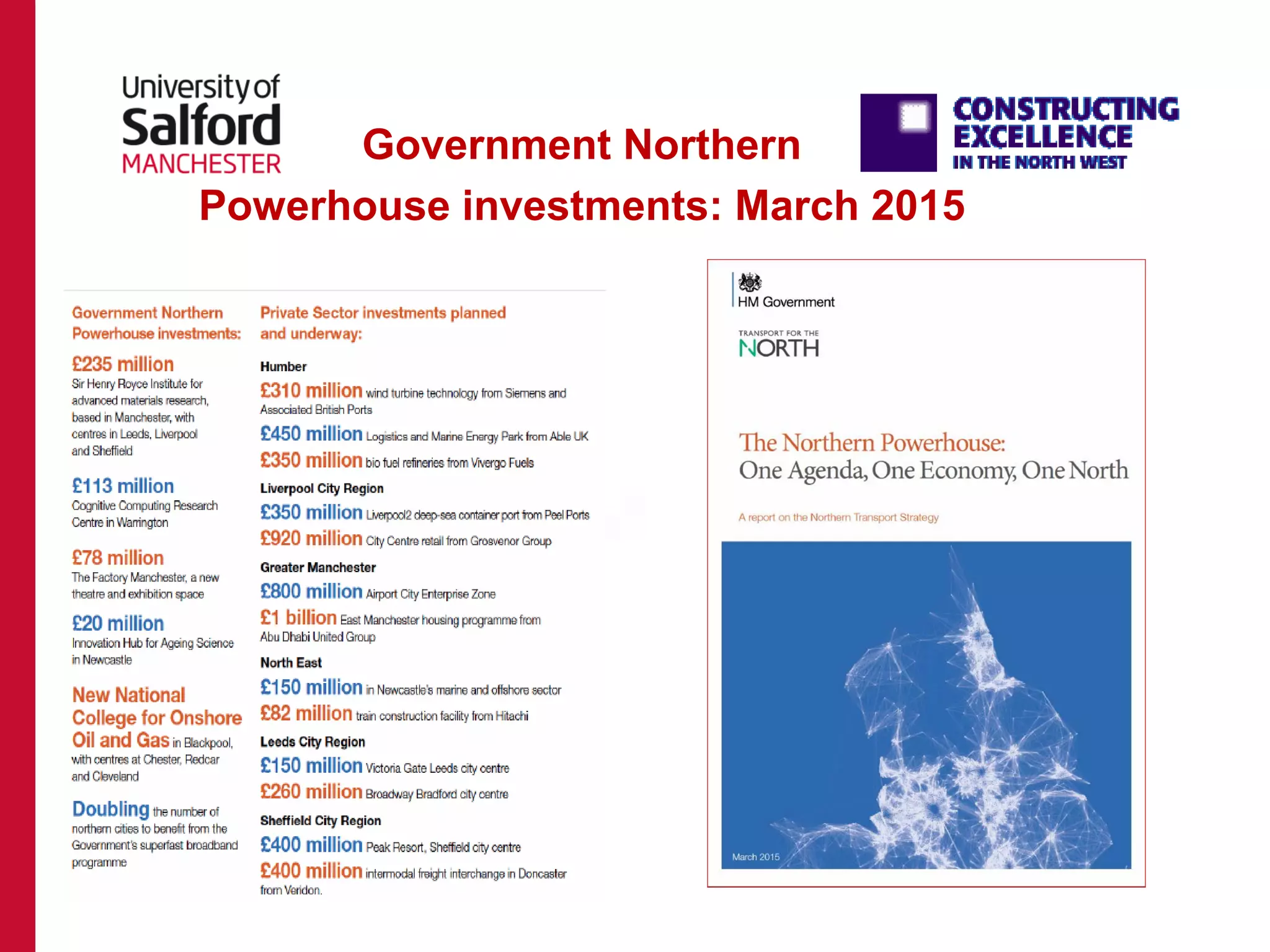
Government Northern
Powerhouse investments: March 2015
“Towards the north-west construction
and infrastructure powerhouse”?!
As the taps on the investment pipelines are turned on, it is the
procurement decisions that will determine the social and
economic impact that the “powerhouse” will generate. Amongst
all industry sectors construction has the quickest and deepest
economic multiplier effects. If the powerhouse is to be more
than a free labour market, if it is to help re-balance the
economy, if it incorporates some anti-austerity measures, if the
new governance structures for devolution are to have an impact,
then better procurement decisions, and new procurement
vehicles are needed, especially in the construction and
infrastructure sectors.
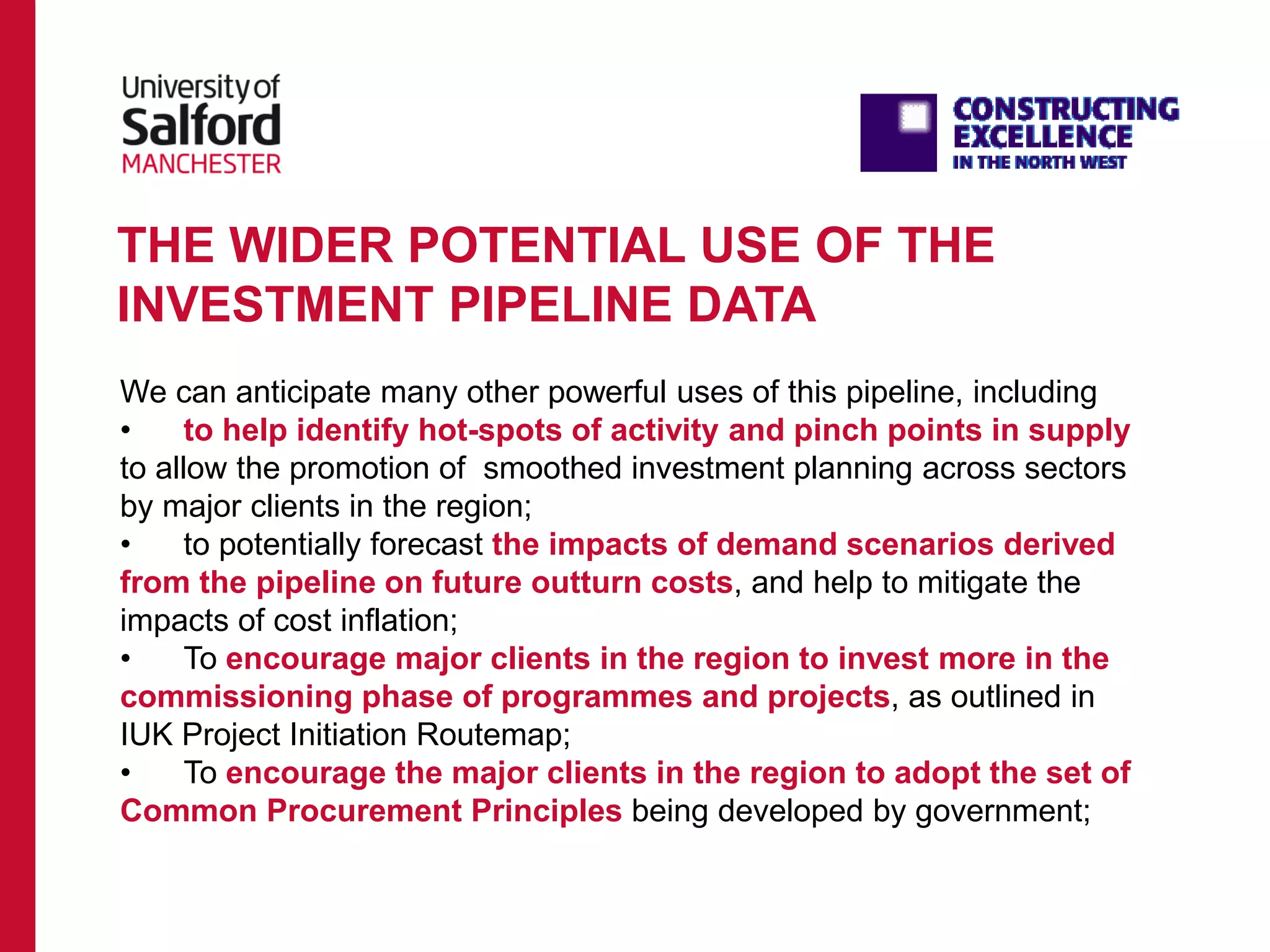
THE WIDER POTENTIAL USE OF THE
INVESTMENT PIPELINE DATA
We can anticipate many other powerful uses of this pipeline, including
• to help identify hot-spots of activity and pinch points in supply
to allow the promotion of smoothed investment planning across sectors
by major clients in the region;
• to potentially forecast the impacts of demand scenarios derived
from the pipeline on future outturn costs, and help to mitigate the
impacts of cost inflation;
• To encourage major clients in the region to invest more in the
commissioning phase of programmes and projects, as outlined in
IUK Project Initiation Routemap;
• To encourage the major clients in the region to adopt the set of
Common Procurement Principles being developed by government;
All of the above would potentially encourage changed
behaviours and new business models from suppliers?
For example, suppliers may
• invest more in their own workforce,(or their sub-suppliers),
• improve payment times, and
• may help reduce false self-employment.
Further in consideration of the recent Review of the Public Services
(Social Value Act) (2012, and especially the amendments to the EC
Procurement Regulations the use of social and environmental criteria
in procurement has been encouraged. If this public sector purchasing
power was harnessed in the north-west (pure public sector = £2.9Bn)
and was spent with a view to securing beneficial social and
environmental outcomes, it would, inter alia,
• mitigate against any overall falls in this spend during the next
parliament
• help prepare the suppliers for more inward, private sector
investment
• stimulate local growth by increasing the spend that passes, directly
and indirectly, to SME’s in supply chains
Post-Script
University of Salford is currently working on a
project – “The definition, development and
measurement of social value through construction
and infrastructure expenditure - Helping the
Construction and Infrastructure Client’s Business
Model to incorporate Social Value”
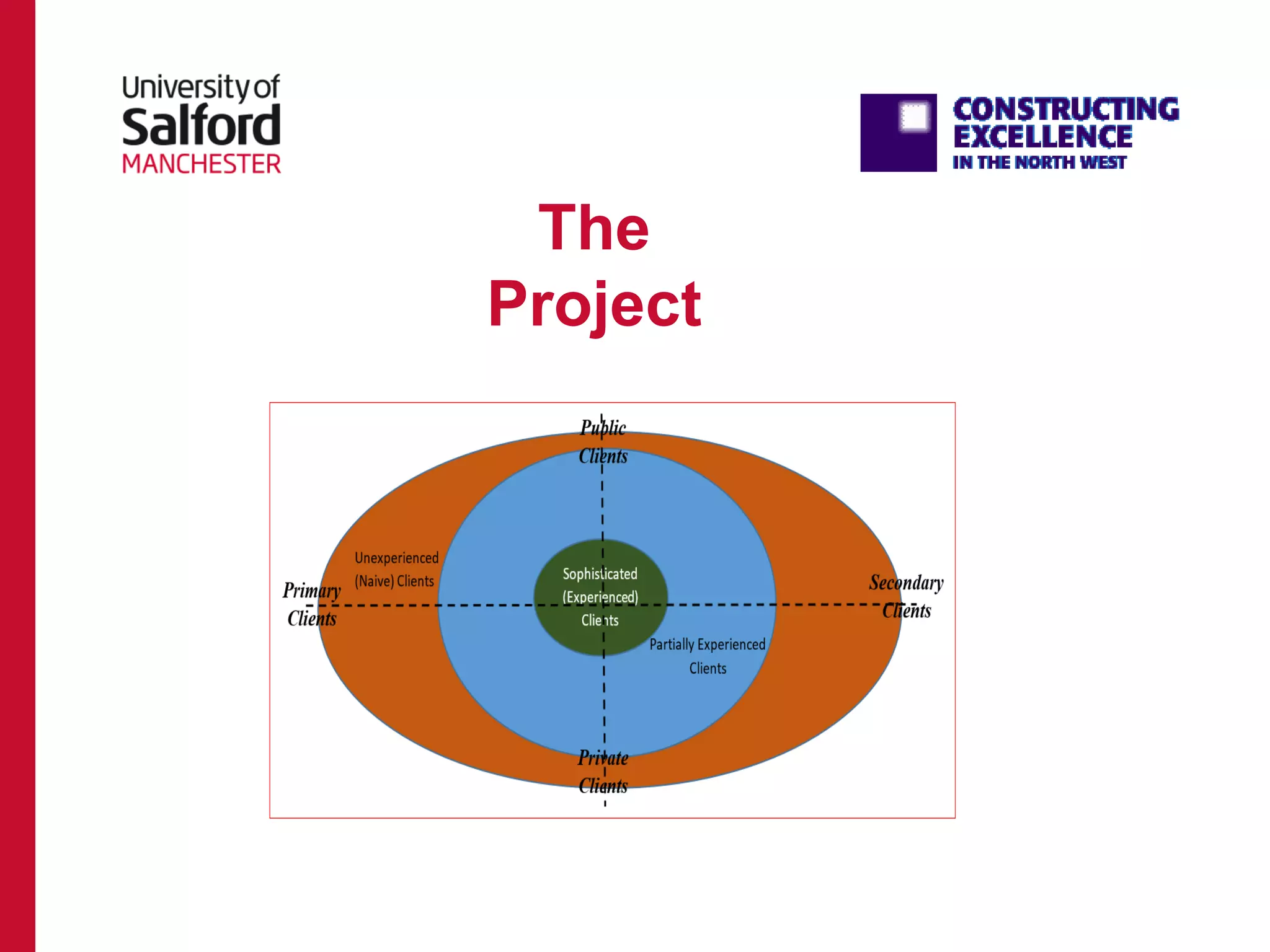
The
Project
Results so far
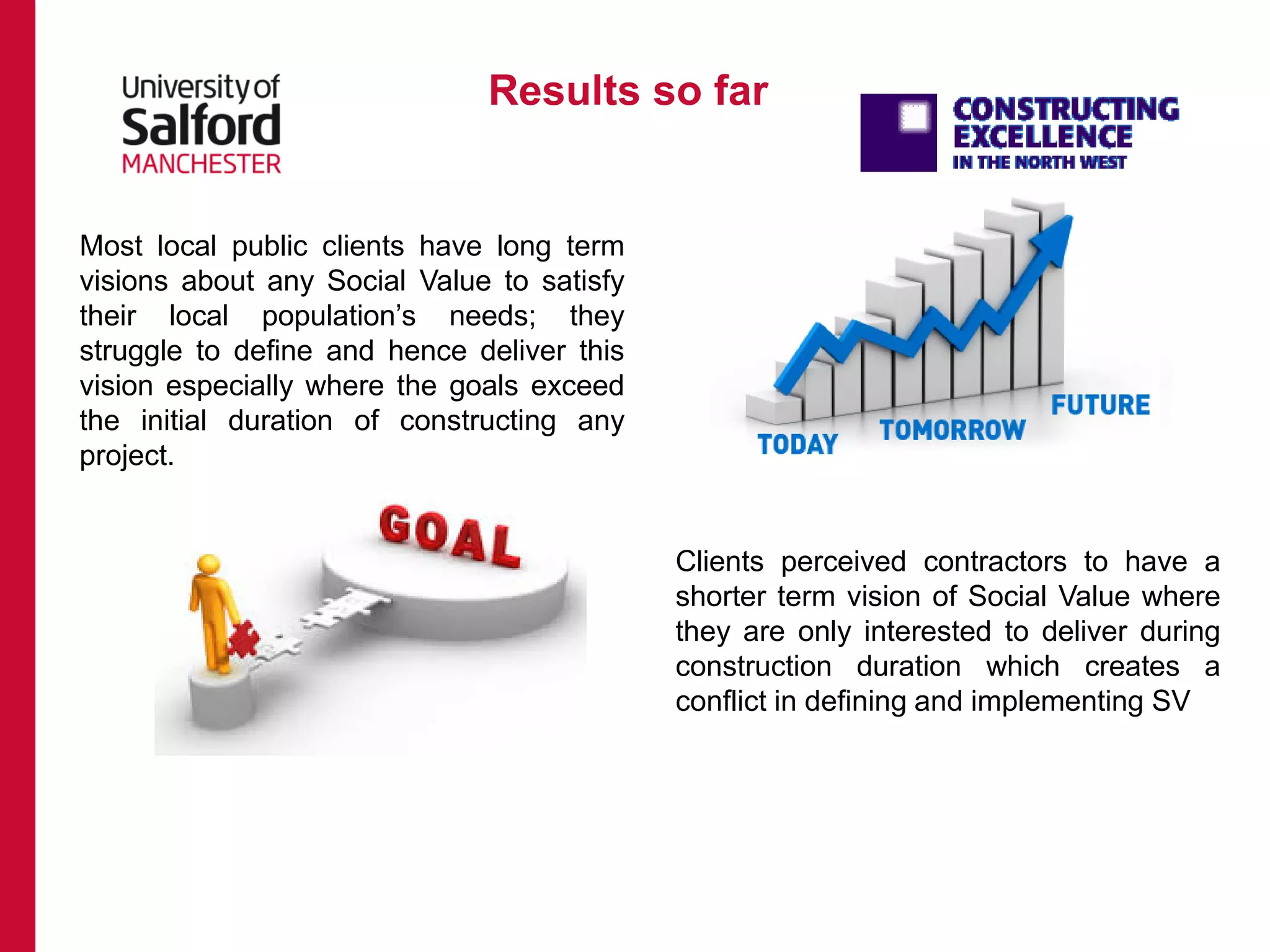
Most local public clients have long term
visions about any Social Value to satisfy
their local population’s needs; they
struggle to define and hence deliver this
vision especially where the goals exceed
the initial duration of constructing any
project.
Clients perceived contractors to have a
shorter term vision of Social Value where
they are only interested to deliver during
construction duration which creates a
conflict in defining and implementing SV
A Contractor Perspective
Jocelyne Underwood
Senior Community and Regeneration
Advisor
THE IMPORTANCE OF
SOCIAL VALUE
© Laing O’Rourke 2014, all rights reserved.74
DELIVERING SOCIAL VALUE
OUR APPROACH
MANCHESTER CASE STUDY
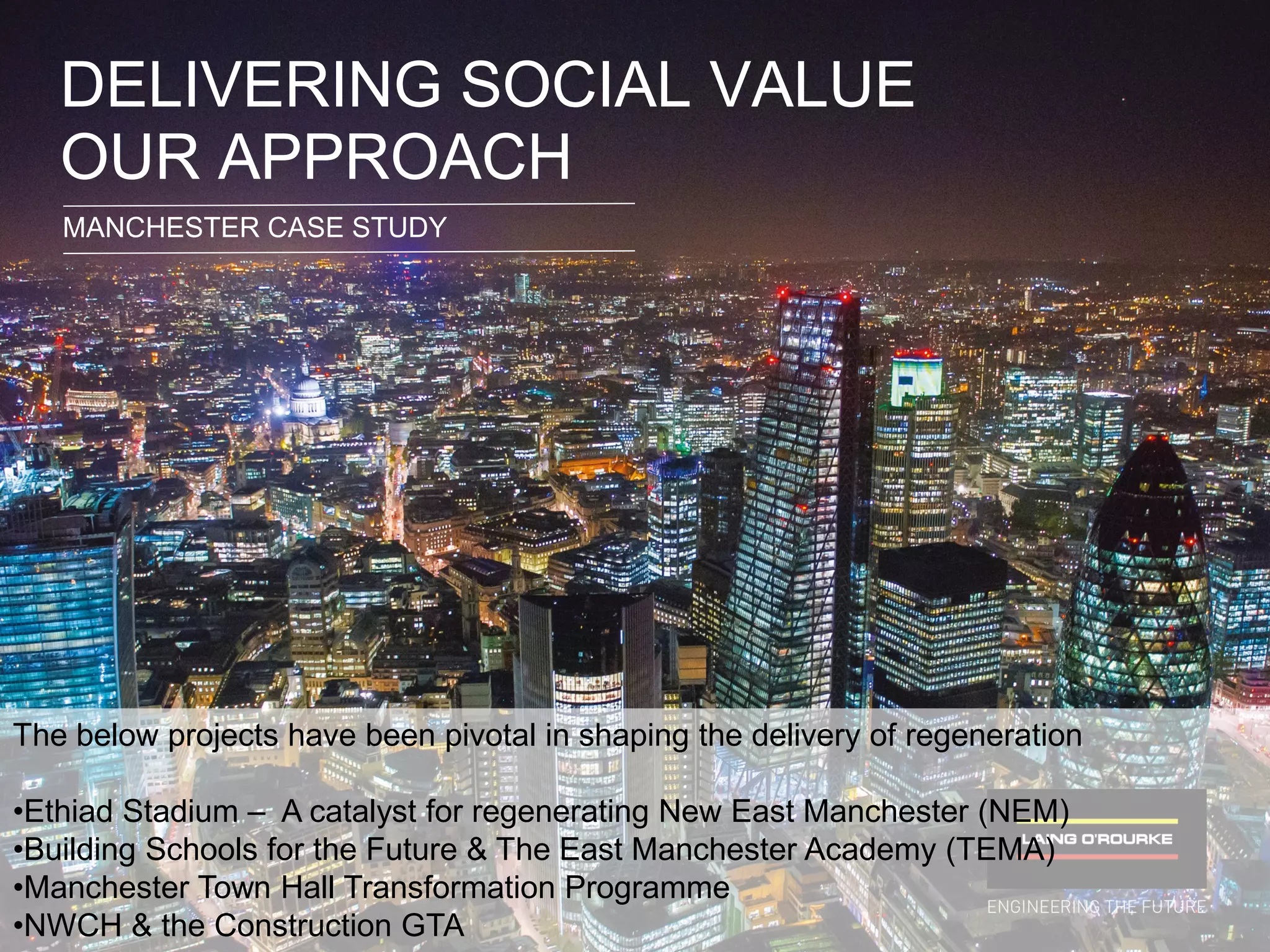
The below projects have been pivotal in shaping the delivery of regeneration
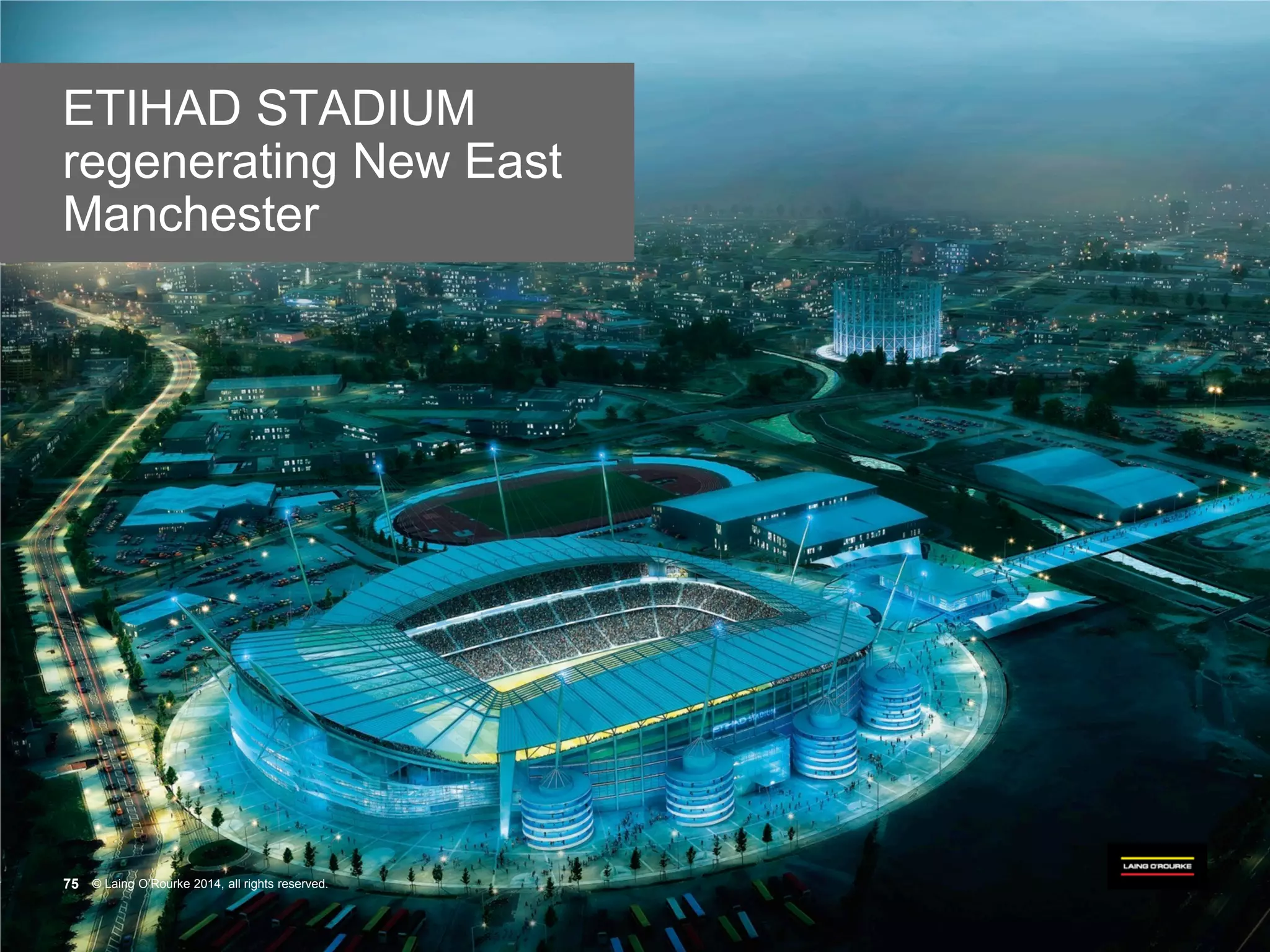
•Ethiad Stadium – A catalyst for regenerating New East Manchester (NEM)
•Building Schools for the Future & The East Manchester Academy (TEMA)
•Manchester Town Hall Transformation Programme
•NWCH & the Construction GTA
© Laing O’Rourke 2014, all rights reserved.75 © Laing O’Rourke 2014, all rights reserved.75
ETIHAD STADIUM
regenerating New East
Manchester
© Laing O’Rourke 2014, all rights reserved.76
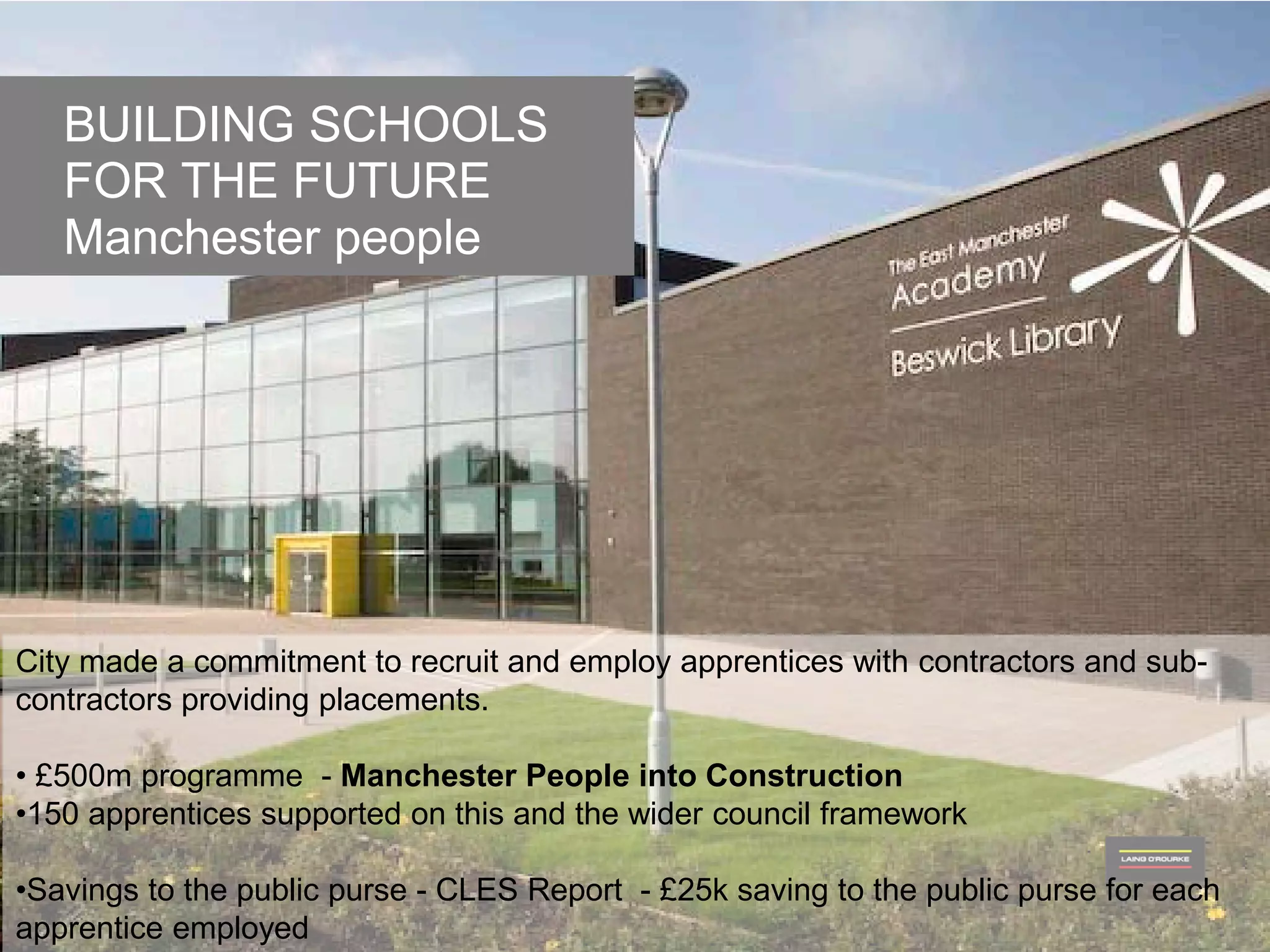
BUILDING SCHOOLS FOR THE FUTURE
BUILDING SCHOOLS
FOR THE FUTURE
Manchester people
City made a commitment to recruit and employ apprentices with contractors and sub-
contractors providing placements.
• £500m programme - Manchester People into Construction
•150 apprentices supported on this and the wider council framework
•Savings to the public purse - CLES Report - £25k saving to the public purse for each
apprentice employed
© Laing O’Rourke 2014, all rights reserved.77 © Laing O’Rourke 2014, all rights reserved.77
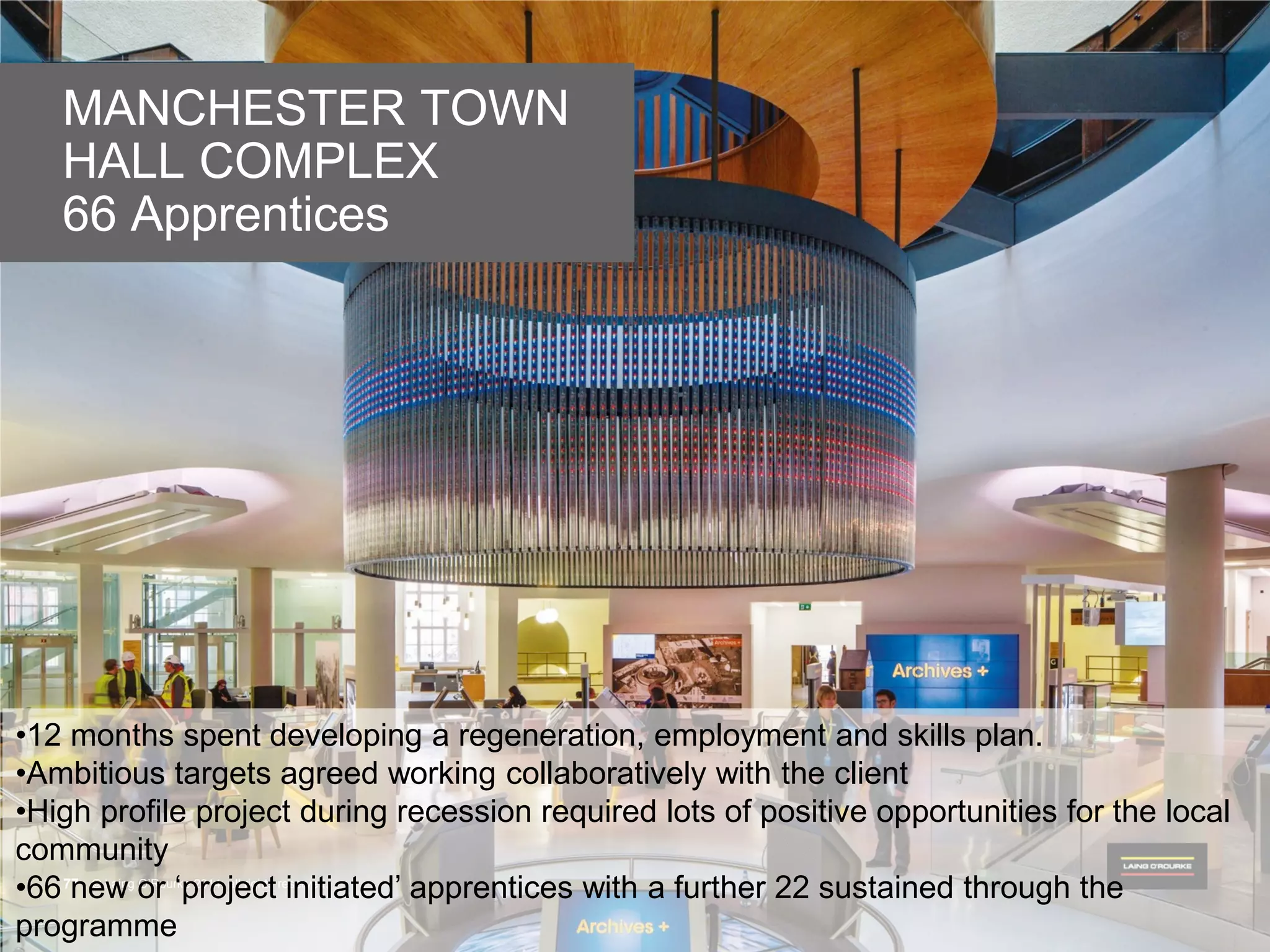
MANCHESTER TOWN
HALL COMPLEX
66 Apprentices
•12 months spent developing a regeneration, employment and skills plan.
•Ambitious targets agreed working collaboratively with the client
•High profile project during recession required lots of positive opportunities for the local
community
•66 new or ‘project initiated’ apprentices with a further 22 sustained through the
programme
© Laing O’Rourke 2014, all rights reserved.78 © Laing O’Rourke 2014, all rights reserved.78
ETHIAD STADIUM
Regenerating New East
Manchester
500+
APPRENTICESHIPS
industry collaboration
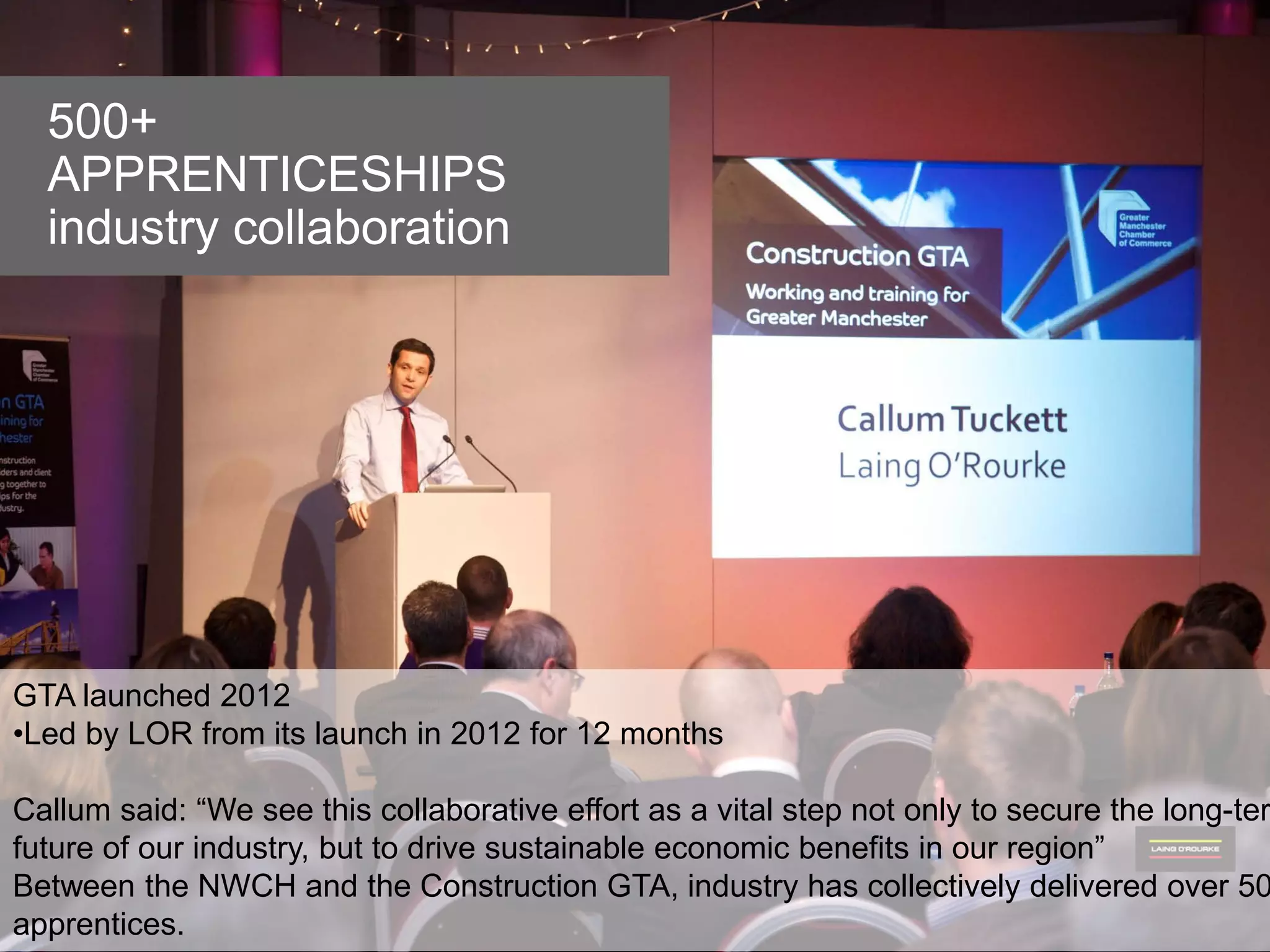
GTA launched 2012
•Led by LOR from its launch in 2012 for 12 months
Callum said: “We see this collaborative effort as a vital step not only to secure the long-ter
future of our industry, but to drive sustainable economic benefits in our region”
Between the NWCH and the Construction GTA, industry has collectively delivered over 50
apprentices.
© Laing O’Rourke 2014, all rights reserved.79 © Laing O’Rourke 2014, all rights reserved.79
THE IMPORTANCE OF
SOCIAL VALUE
2006 -
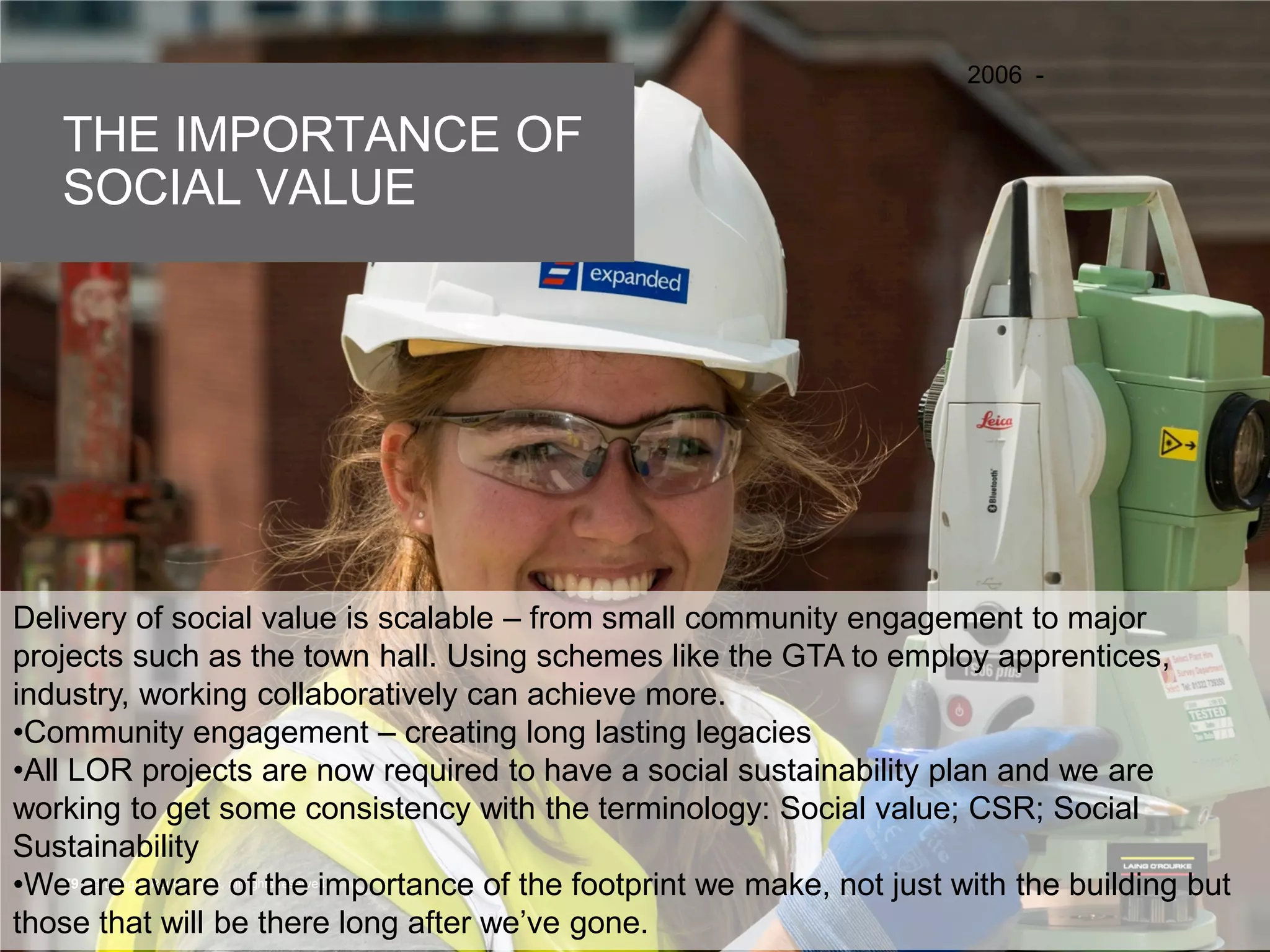
Delivery of social value is scalable – from small community engagement to major
projects such as the town hall. Using schemes like the GTA to employ apprentices,
industry, working collaboratively can achieve more.
•Community engagement – creating long lasting legacies
•All LOR projects are now required to have a social sustainability plan and we are
working to get some consistency with the terminology: Social value; CSR; Social
Sustainability
•We are aware of the importance of the footprint we make, not just with the building but
those that will be there long after we’ve gone.

FBE Manchester - Social Value - 10th February 2016

  • 1.
  • 2.
    Social Value –it’s increasing importance and benefits to clients in Construction Peter Schofield AGMA Procurement Hub Programme Manager February 2016
  • 3.
    Agenda  AGMA ProcurementHub  Objectives  Operation  Benefits  Social Value in Greater Manchester  Social Value Act 2012  GM Social Value Policy  Indicators  Next Steps
  • 4.
    AGMA Procurement Hub Members  Bolton  Bury  Manchester City  Oldham  Rochdale  Salford City  Stockport  Tameside  Trafford  Wigan  Associate Members  Blackburn and Darwen  Blackpool  Cheshire East  Warrington  GMFRS  GMP  TfGM  GMWDA
  • 5.
    Hub Objectives  Reviewand re-let existing AGMA Contracts  Consolidate existing best deals  Aggregate fragmented spend  Maximise opportunities for local suppliers  Aligning collaboration/promoting best practice  Supporting new ways of working (eg Devolution)
  • 6.
    Operation – “Huband Spoke”  AGMA Procurement Hub “Facilitator” • Develop Business case • High Level Project Management • Timescales, Risks, Communications etc • Provide support • Monitoring & Reporting • Capturing impact  Lead Authority • Lead the procurement exercise • Decide “procurement strategy” (route to goal) • Use own processes and procedures • Lead management of contract
  • 7.
    Benefits  Only dothings once – internal efficiency  Manage pipeline of projects  Promote collaborative approach with partners/stakeholders  Consistency:  Performance management of contracts  Business cases  Benefits reporting  Reacting/embracing new legislation/agendas etc  Support for working groups  Link to other sub-regional, regional and “other regional” bodies
  • 8.
     Public Services(Social Value) Act 2012 “public authorities to have regard to economic, social and environmental well-being in connection with public services contracts; and for connected purposes”  GMCA requested a GM wide approach to embed Social Value into all procurement  Benefits from a common approach  Ability to benchmark  Simplified for suppliers  Able to understand link between policy and achievements  Social Value Policy approved by GMCA in November 2014  Review carried out in Autumn 2015 to establish baseline  External verification – CLES (Centre for Local Economic Strategies) Social Value in Greater Manchester
  • 9.
    GM model fordelivering Social Value  ‘Golden Thread’ of:  Corporate Objective  Enablers  Process  GMCA “Stronger Together” Strategy used to set Corporate Objectives for GMCA Social Value Policy  Each procurement exercise identifies appropriate outcomes  e.g. “Workforce that is fairly paid and positively supported by employers”  Suppliers respond on how they would deliver the Outcome(s) and how they will be measured and verified  Contract Management includes delivery against outcomes
  • 10.
    Social Value “Menu” Promote employment and economic sustainability  tackle unemployment and facilitate the development of skills  Raise the living standards of local residents  working towards living wage, employee access to entitlements (childcare) and encourage suppliers to source labour from within Greater Manchester  Promote participation and citizen engagement  encourage resident participation and promote active citizenship  Build the capacity and sustainability of the voluntary and community sector  practical support for local voluntary and community groups  Promote equality and fairness  target effort towards those in the greatest need and tackle deprivation  Promote environmental sustainability  reduce wastage, limit energy consumption  procure materials from sustainable sources
  • 11.
    So What?  Morethought and action “pre-procurement”  Must follow through into Contract management  Measurement against specific KPIs  Baselining Exercise by CLES (Centre for Local Environmental Strategies)  Independent look at top 300 suppliers  Consider spend in local economy (desktop study)  Survey against generic KPIs  Lord Young Review of the Act  Overall positive but recommendations re measurement, awareness and consistent practice  Case Studies  Awareness raising  E-Learning Module  GM Social Value Network
  • 12.
    Promote Employment andEconomic Sustainability  84.8% of the direct spend (£1bn) with GM based suppliers  £487 million (48.5%) of total spend with SMEs  57% of suppliers’ employees are resident in GM  93% of suppliers created 1060 jobs  69% of suppliers created 195 apprenticeships Raise living standards of GM Residents  50% of suppliers paid all staff the Living Wage Foundation wage of £7.85 per hour (this is now £8.25)  Lowest paid member of staff average £7.66 per hour  93% of employees are employed on a permanent basis Baseline Study Findings 1
  • 13.
    Participation and CitizenEngagement  64% of suppliers encouraged staff to participate in volunteering and community activities  14,051 hours of staff time were offered in GM Capacity and Sustainability of the VCS  64% of suppliers actively provide support to the VCS  10,159 hours in GM  Examples:  Logistical support such as the provision of office space  Provision and improvement of community facilities  Employment support, such as work experience and CV and interview workshops Baseline Study Findings 2
  • 14.
    Baseline Study Findings3 Equality and Fairness  71% of suppliers created employment opportunities for individuals described as ‘hard to reach’  185 employment opportunities in Greater Manchester Environmental Sustainability  32% of suppliers actively measure carbon emissions  82% have an environmental management strategy  96% increasing recycling  89% include energy use  60% include carbon emission reduction  56% have transport type included  80% have waste minimisation included  40% having a cycle or walk to work scheme
  • 15.
    Social Value inGM – Next Steps 1. Ensure Social Value is considered as a matter of course i. Raise awareness in Pre-procurement ii. Embed into contract monitoring iii. E-Learning course for all Commissioners 2. Develop a process for continuous monitoring of SV i. Repeat baselining exercise to benchmark performance ii. Report on contract management KPIs 3. Explore leakage out of the Greater Manchester economy i. Chasing the missing 15% 4. Influence the behaviour of the supply chain i. Open dialogue with suppliers about economic, social and environmental benefits ii. Pre-market engagement and ongoing conversations re innovation 5. Provide signposting for suppliers i. Advice and support – eg accreditation, living Wage, Carbon Footprint ii. Engagement with VCS etc
  • 16.
    Questions? Peter Schofield –AGMA Procurement Hub Programme Manager peter.schofield@trafford.gov.uk Tel: 0161 912 4597 Mob: 07814 459668
  • 17.
    Social Value throughConstruction and Infrastructure Procurement Professor Peter McDermott p.mcdermott@salford.ac.uk School of the Built Environment University of Salford Also: Fady Farag and Carrie-Ann Huelin, University of Salford Radisson Blu Edwardian Hotel, Free Trade Hall,
  • 18.
    Agenda What: The SocialValue Agenda Why: Why Social Value is important How: How Social Value can be achieved But: No Buts….Social Value can be achieved The north-west imperative?
  • 19.
  • 20.
    All public bodiesin England and Wales, including local authorities, will be required to consider how the services they commission and procure might improve the economic, social and environmental well-being of the area.
  • 21.
    Social value asksthe question: "If £1 is spent on the delivery of services, can that same £1 be used to also produce a wider benefit to the community?"
  • 22.
    1999 2000 20022004 2006 2008 Modernising Construction Rethinking Construction Accelerating Change Improving Public Services Social & Economic Value of Construction Common Minimum Standards Achieving Excellence Better Public Buildings Strategy for Sustainable Construction 2009 Operational Efficiency Programme: Collaborative Procurement Where is the Social Value in Procurement Policy?
  • 23.
    Government Policy… 2000 20022004 2005 2006 2007 2008 National Procurement Strategy Rethinking Construction Kelly Capacity Report Stern Review Gershon Efficiency Report Sustainable Communities Plan Securing the Future Where is the Social Value in Procurement Policy?
  • 24.
    What?: Examples of othersimilar Policy Goals Innovation & Industry Development Equality and diversity Skills Local economic development Climate change adaptation SME & Third Sector participation Renewable energy Social Value
  • 25.
    Consider just oneissue - SMEs in Procurement...
  • 26.
  • 27.
    What?: Sustainable Procurement • “aprocess whereby organisations meet their needs for goods, services, works and utilities in a way that achieves value for money on a whole life basis in terms of generating benefits not only to the organisation, but also to society and the economy, whilst minimising damage to the environment” (SPTF 2006, p 10). • Sustainable procurement – in short using procurement to support wider social, economic and environmental objectives, in ways that offer real long-term benefits, is how the public sector should be spending taxpayers money (Simms, 2006).
  • 28.
    New Government Construction Strategy November 2015? (And CSR25th November) February 2016??? Post 2015 Election Construction Policy Context?
  • 29.
  • 30.
    Why? Joined-up government • UKSPTF 2006: Too often the business side of government – the service provision, the purchasing, the employment, fails to reflect the policy goals of government… • Bringing together the business and the policy arms of government is what sustainable procurement is about.
  • 31.
    • Local councilsspends around £ 45 billion on procuring goods and services from third parties (House of Commons, 2014); • The North West Construction Hub (NWCH) was given as prime example for delivering value for money through their ability to choose competent contractors (P 22); Social and Economic Value through framework procurement?
  • 32.
    New Government Construction Strategy November 2015? (And CSR25th November) Post 2015 Election Construction Policy Context?
  • 33.
  • 34.
    How: How canSocial Value be delivered through procurement/contracts? Attention to the overall procurement process • The subject matter of the contract; • The technical specifications for the product/work/service; • The selection criteria for candidates; • The contract award criteria; • The contract management and performance clauses.
  • 35.
    How can Social Valuebe delivered? Through the most appropriate procurement route…The Infrastructure Procurement Routemap offers a strategic approach to procurement… In other domains other Procurement Strategies Examples: •Reservation of certain contracts •Preferencing of certain suppliers •Supply side intervention (e.g. training and development for potential supply chain partners to develop)
  • 36.
    Delivering sustainable efficiencysavings Delivery of projects to target cost and time Reduction of Claims High Client satisfaction rates Good health and safety Good “diversion from landfill” High proportion of spend undertaken by SME’s High take up of government initiatives (fair payment, apprenticeships) How can Social Value be delivered? Through Frameworks?
  • 37.
    Social Value throughframeworks? Supply Chain Engagement: • Agree SME and supply chain engagement strategy: • Ensure engagement in national, regional and local frameworks • Emphasise the involvement and integration of tier 2/3 suppliers within the framework and design team • Ensure transparent approach and client engagement with supply chain • Local sourcing, fair payment provision down the supply chain, measure and monitor engagement Example Measures in Local Government: • % of Sub-Contractors SMEs • % of Sub-Contractors local to the area • % of Construction Contract Spent with SMEs
  • 38.
    Data from NWCH-Key Performance Indicators (KPI’s) KPI data is monitored using the Centre for Construction Innovation (CCI) KPI Engine and include: • Fair Payment • Waste Reduction • Carbon • Local Labour • Apprentice Weeks • Predictability • Satisfaction • Health & Safety
  • 39.
    Data from theNWCH “Delivering True Value” 1618 employability and learning activities 141 project initiated apprentices created 288 sustainable apprenticeship placements 567 community engagement events 60.6% of site staff were defined as ‘local’ For full details, visit www.nwconstrucionhub.org to view the ‘More for your Money’ Report Please note the above figures are the most recent and supersede those within the More for your Money Report
  • 40.
  • 41.
    All public bodiesin England and Wales, including local authorities, will be required to consider how the services they commission and procure might improve the economic, social and environmental well-being of the area.
  • 42.
    Social value asksthe question: "If £1 is spent on the delivery of services, can that same £1 be used to also produce a wider benefit to the community?"
  • 43.
    “…socially responsible procurement… isnot only …fully in harmony with the latest requirements of EU procurement legislation, but can also deliver greater social value.. More jobs, better pay, improved skills, vibrant small businesses, technical innovation….
  • 44.
    Cabinet Office -Social Value Thisprocurement policy note gives guidance supporting the Public Services (Social Value) Act 2012.
  • 45.
    Social and EconomicValue through Procurement?
  • 46.
    February 2016 Each contractabove £10 million must have a skills section in its procurement strategy which will consider the workforce element of the contract and its ability to support apprenticeships . An appropriate but proportionate, weighting for tender evaluation will be set – taking into account the importance of skills in the value for money case and to the sector.
  • 47.
    New Government Construction Strategy November 2015? (And CSR25th November) February 2016??? Post 2015 Election Construction Policy Context?
  • 48.
  • 49.
    “Towards a north-west constructionand infrastructure powerhouse”?! New Government Construction Strategy November 2015? (And CSR 25th November) February 2016???
  • 50.
  • 51.
    “The government’s frameworkfor raising productivity is built around two pillars….”
  • 52.
    Resurgent cities, arebalanced economy and a thriving Northern Powerhouse
  • 53.
  • 54.
    The National Infrastructure Plan(NIP) pipeline, updated in July 2015, contains details of £411 billion of investment in 564 projects and programmes to 2020 and beyond.
  • 55.
    Construction productivity growthhas lagged behind the other sectors of the economy
  • 56.
    Chart 2.A by2020 there would be a reduction in workforce numbers meaning demand would outstrip supply by around 100,000 people
  • 57.
    Construction management and supervisory roles increasinglevels of demand for these skills across all English regions over the next five years….
  • 58.
    Technical and engineering skillsare required throughout the project lifecycle with many critical to delivery as construction works progress.
  • 59.
    Ensuring the right projectleadership skills exist – in both clients and the supply chain – is essential to delivery
  • 60.
    Case study: Northwest construction pipeline
  • 61.
  • 62.
    • The IPPRreport argued that despite changes occurring in the North West region decisions are still centralized where the precise nature of devolution and the suitable nature of power which should be passed is still debated; • Goals are economic, accessibility & accountability and sustainability. The Northern Powerhouse!? The northern powerhouse • must generate a better type of economic growth • must liberate the potential of its greatest asset – its people • needs investment ……in its creaking infrastructure • must rejuvenate local democracy by giving people a genuine involvement in the way the north of England is run.
  • 63.
    Increasing investment in infrastructureis critical to improving connectivity and productivity The northern powerhouse • must generate a better type of economic growth • must liberate the potential of its greatest asset – its people • needs investment ……in its creaking infrastructure • must rejuvenate local democracy by giving people a genuine involvement in the way the north of England is run.
  • 64.
  • 65.
  • 67.
    “Towards the north-westconstruction and infrastructure powerhouse”?! As the taps on the investment pipelines are turned on, it is the procurement decisions that will determine the social and economic impact that the “powerhouse” will generate. Amongst all industry sectors construction has the quickest and deepest economic multiplier effects. If the powerhouse is to be more than a free labour market, if it is to help re-balance the economy, if it incorporates some anti-austerity measures, if the new governance structures for devolution are to have an impact, then better procurement decisions, and new procurement vehicles are needed, especially in the construction and infrastructure sectors.
  • 68.
    THE WIDER POTENTIALUSE OF THE INVESTMENT PIPELINE DATA We can anticipate many other powerful uses of this pipeline, including • to help identify hot-spots of activity and pinch points in supply to allow the promotion of smoothed investment planning across sectors by major clients in the region; • to potentially forecast the impacts of demand scenarios derived from the pipeline on future outturn costs, and help to mitigate the impacts of cost inflation; • To encourage major clients in the region to invest more in the commissioning phase of programmes and projects, as outlined in IUK Project Initiation Routemap; • To encourage the major clients in the region to adopt the set of Common Procurement Principles being developed by government;
  • 69.
    All of theabove would potentially encourage changed behaviours and new business models from suppliers? For example, suppliers may • invest more in their own workforce,(or their sub-suppliers), • improve payment times, and • may help reduce false self-employment. Further in consideration of the recent Review of the Public Services (Social Value Act) (2012, and especially the amendments to the EC Procurement Regulations the use of social and environmental criteria in procurement has been encouraged. If this public sector purchasing power was harnessed in the north-west (pure public sector = £2.9Bn) and was spent with a view to securing beneficial social and environmental outcomes, it would, inter alia, • mitigate against any overall falls in this spend during the next parliament • help prepare the suppliers for more inward, private sector investment • stimulate local growth by increasing the spend that passes, directly and indirectly, to SME’s in supply chains
  • 70.
    Post-Script University of Salfordis currently working on a project – “The definition, development and measurement of social value through construction and infrastructure expenditure - Helping the Construction and Infrastructure Client’s Business Model to incorporate Social Value”
  • 71.
  • 72.
    Results so far Mostlocal public clients have long term visions about any Social Value to satisfy their local population’s needs; they struggle to define and hence deliver this vision especially where the goals exceed the initial duration of constructing any project. Clients perceived contractors to have a shorter term vision of Social Value where they are only interested to deliver during construction duration which creates a conflict in defining and implementing SV
  • 73.
    A Contractor Perspective JocelyneUnderwood Senior Community and Regeneration Advisor THE IMPORTANCE OF SOCIAL VALUE
  • 74.
    © Laing O’Rourke2014, all rights reserved.74 DELIVERING SOCIAL VALUE OUR APPROACH MANCHESTER CASE STUDY The below projects have been pivotal in shaping the delivery of regeneration •Ethiad Stadium – A catalyst for regenerating New East Manchester (NEM) •Building Schools for the Future & The East Manchester Academy (TEMA) •Manchester Town Hall Transformation Programme •NWCH & the Construction GTA
  • 75.
    © Laing O’Rourke2014, all rights reserved.75 © Laing O’Rourke 2014, all rights reserved.75 ETIHAD STADIUM regenerating New East Manchester
  • 76.
    © Laing O’Rourke2014, all rights reserved.76 BUILDING SCHOOLS FOR THE FUTURE BUILDING SCHOOLS FOR THE FUTURE Manchester people City made a commitment to recruit and employ apprentices with contractors and sub- contractors providing placements. • £500m programme - Manchester People into Construction •150 apprentices supported on this and the wider council framework •Savings to the public purse - CLES Report - £25k saving to the public purse for each apprentice employed
  • 77.
    © Laing O’Rourke2014, all rights reserved.77 © Laing O’Rourke 2014, all rights reserved.77 MANCHESTER TOWN HALL COMPLEX 66 Apprentices •12 months spent developing a regeneration, employment and skills plan. •Ambitious targets agreed working collaboratively with the client •High profile project during recession required lots of positive opportunities for the local community •66 new or ‘project initiated’ apprentices with a further 22 sustained through the programme
  • 78.
    © Laing O’Rourke2014, all rights reserved.78 © Laing O’Rourke 2014, all rights reserved.78 ETHIAD STADIUM Regenerating New East Manchester 500+ APPRENTICESHIPS industry collaboration GTA launched 2012 •Led by LOR from its launch in 2012 for 12 months Callum said: “We see this collaborative effort as a vital step not only to secure the long-ter future of our industry, but to drive sustainable economic benefits in our region” Between the NWCH and the Construction GTA, industry has collectively delivered over 50 apprentices.
  • 79.
    © Laing O’Rourke2014, all rights reserved.79 © Laing O’Rourke 2014, all rights reserved.79 THE IMPORTANCE OF SOCIAL VALUE 2006 - Delivery of social value is scalable – from small community engagement to major projects such as the town hall. Using schemes like the GTA to employ apprentices, industry, working collaboratively can achieve more. •Community engagement – creating long lasting legacies •All LOR projects are now required to have a social sustainability plan and we are working to get some consistency with the terminology: Social value; CSR; Social Sustainability •We are aware of the importance of the footprint we make, not just with the building but those that will be there long after we’ve gone.