Social Value
Tim Baverstock
Strategic Commissioning Manager
SCC Adults & Health
“the additional benefit to the
community from a
commissioning/ procurement
process over and above the
direct purchasing of
goods, services and outcomes”.
The Social Value Guide: Implementing the Public Services (Social Value Act),
Social Enterprise UK
Definition of Social Value
Under the Public Services (Social Value) Act 2012,
SCC must consider the following when commissioning
and procuring:
• how what is to be procured may improve the social,
environmental and economic well-being of a
relevant area;
• how they might secure any such improvement;
• whether there is a need to undertake consultation on
these matters.
Statutory Responsibilities
This sets out how SCC complies with its statutory responsibilities. The
key points within this document from an Applicant/ Supplier perspective
are as follows:
 SCC will take a value for money approach to procurement (not
lowest cost);
 Only matters relevant to what is to be procured need to be
considered;
 SCC is responsible for agreeing Social Value criteria;
 Social Value will be appropriately weighted in the evaluation and
decision making process;
 SCC may specify particular requirements or ask potential providers
for innovative ideas.
Social Value Policy Statement
The following example aims to describe
the difference between Added Value
and Social Value:
Requirement of a contract involving community delivery to
provide 4 venues:
Added Value: Applicant A responds to say that for no additional cost
they would be able to provide SCC with 5 venues.
Social Value: Applicant B responds to say that they can provide 4
venues however, when these are not in use on the SCC contract they
would be used as a community resource.
Difference between Social Value & Added Value
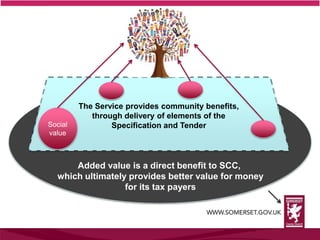
The Service provides community benefits,
through delivery of elements of the
Specification and TenderSocial
value
Added value is a direct benefit to SCC,
which ultimately provides better value for money
for its tax payers
 Delivering services out in communities reduces travel costs and fuel
emissions
 Offering volunteering opportunities to promote employment
 Youth employment e.g. apprenticeships, training schemes
 Building capacity within the voluntary and community sector
 Tackling deprivation and targeting those most disadvantaged
 Buying sustainable materials
 Sharing of buildings when not in use
 Spending in the local supply chain
Examples of Social Value
Example criteria to evaluate Social / Added Value
Recent Social Value Criteria used in a tender process:
The response:
1. Demonstrates a clear understanding of what Social Value is;
2. Clearly describes what Social Value benefits would be delivered as a
direct result of and as part of delivering this contract;
3. Clearly describes what experience the Applicant has in realising Social
Value Benefits;
4. Clearly describes what other Added Value the Applicant would deliver
above and beyond the Service Specification.
Example answers Social /Added
Value Good and Bad!
“We organise trips for residents and an example of this is a coach
trip to see the Christmas lights…”
“48 staff employed, most living in the village and all within a 7 mile
radius having a big impact on local employment levels in a small
community….apprenticeship schemes set up with local college”
“Supplies and services are sourced locally wherever possible”
“mentoring and support for young people thinking of entering the
care sector…office manager helps with mock interviews at local
college”
Any questions?
Tim Baverstock, Strategic Commissioning Manager,
SCC Adults & Health
Contact details:
tdbaverstock@somerset.gov.uk

Social Value in Somerset

  • 1.
    Social Value Tim Baverstock StrategicCommissioning Manager SCC Adults & Health
  • 2.
    “the additional benefitto the community from a commissioning/ procurement process over and above the direct purchasing of goods, services and outcomes”. The Social Value Guide: Implementing the Public Services (Social Value Act), Social Enterprise UK Definition of Social Value
  • 3.
    Under the PublicServices (Social Value) Act 2012, SCC must consider the following when commissioning and procuring: • how what is to be procured may improve the social, environmental and economic well-being of a relevant area; • how they might secure any such improvement; • whether there is a need to undertake consultation on these matters. Statutory Responsibilities
  • 4.
    This sets outhow SCC complies with its statutory responsibilities. The key points within this document from an Applicant/ Supplier perspective are as follows:  SCC will take a value for money approach to procurement (not lowest cost);  Only matters relevant to what is to be procured need to be considered;  SCC is responsible for agreeing Social Value criteria;  Social Value will be appropriately weighted in the evaluation and decision making process;  SCC may specify particular requirements or ask potential providers for innovative ideas. Social Value Policy Statement
  • 5.
    The following exampleaims to describe the difference between Added Value and Social Value: Requirement of a contract involving community delivery to provide 4 venues: Added Value: Applicant A responds to say that for no additional cost they would be able to provide SCC with 5 venues. Social Value: Applicant B responds to say that they can provide 4 venues however, when these are not in use on the SCC contract they would be used as a community resource. Difference between Social Value & Added Value
  • 6.
    The Service providescommunity benefits, through delivery of elements of the Specification and TenderSocial value Added value is a direct benefit to SCC, which ultimately provides better value for money for its tax payers
  • 7.
     Delivering servicesout in communities reduces travel costs and fuel emissions  Offering volunteering opportunities to promote employment  Youth employment e.g. apprenticeships, training schemes  Building capacity within the voluntary and community sector  Tackling deprivation and targeting those most disadvantaged  Buying sustainable materials  Sharing of buildings when not in use  Spending in the local supply chain Examples of Social Value
  • 8.
    Example criteria toevaluate Social / Added Value Recent Social Value Criteria used in a tender process: The response: 1. Demonstrates a clear understanding of what Social Value is; 2. Clearly describes what Social Value benefits would be delivered as a direct result of and as part of delivering this contract; 3. Clearly describes what experience the Applicant has in realising Social Value Benefits; 4. Clearly describes what other Added Value the Applicant would deliver above and beyond the Service Specification.
  • 9.
    Example answers Social/Added Value Good and Bad! “We organise trips for residents and an example of this is a coach trip to see the Christmas lights…” “48 staff employed, most living in the village and all within a 7 mile radius having a big impact on local employment levels in a small community….apprenticeship schemes set up with local college” “Supplies and services are sourced locally wherever possible” “mentoring and support for young people thinking of entering the care sector…office manager helps with mock interviews at local college”
  • 10.
    Any questions? Tim Baverstock,Strategic Commissioning Manager, SCC Adults & Health Contact details: tdbaverstock@somerset.gov.uk