Making the Move from the Academic
      to the Commercial Lab:
 What You Should Know Before You Go “All In”
     Brought to you by Principal Investigators Association
          Presented by: John W. Ludlow, Ph.D.

Live Webinar Thursday, January 17, 2013 at 2:00 PM EST


       For More Information visit http://bit.ly/LabCareer
       For More Information visit http://bit.ly/LabCareer
              Or Call 1-800-303-0129 ext.506
              Or Call 1-800-303-0129 ext.506
Thursday: January 17, 2013
                2:00 PM EST | 11:00 AM PST
This insightful Webinar will cover areas to be considered when making the career
change from an academic setting to the commercial lab, including the culture of the
commercial laboratory working environment, career advancement, scientific recognition,
mentoring, and availability of opportunities.

           55Key Take-Aways:
              Key Take-Aways:

           •Similarities and differences between academic and commercial
            •Similarities and differences between academic and commercial
           laboratory working environments
            laboratory working environments
           •Suggestions on how to increase your autonomy and independence
            •Suggestions on how to increase your autonomy and independence
           in conducting research at aacommercial laboratory
            in conducting research at commercial laboratory
           •How to ‘hedge your bets’ so that deadlines and milestones are
            •How to ‘hedge your bets’ so that deadlines and milestones are
           reached
            reached
           •Balancing publishing and intellectual property generation
            •Balancing publishing and intellectual property generation
           •The difference in costs between academic and commercial
            •The difference in costs between academic and commercial
           laboratory research
            laboratory research


                 Attend the Live Webinar and receive a free recording in
                           CD-ROM, MP4 or PDF Transcript..

                     For More Information visit http://bit.ly/LabCareer
                     For More Information visit http://bit.ly/LabCareer
Making the Move from the Academic to the Commercial Lab:
      What You Should Know Before You Go “All In”

 •   Erosion of academic research support contributes to a
     career change to commercial laboratories
 •   Desire to pursue science having a more direct
     application
 •   Career advancement
 •   Political environment
 •   Compensation considerations
 •   Time and Effort
Presentation Goals
1. Points to consider when
   contemplating a change from an
   academic to a commercial
   science career

2. Similarities and differences
   between the two laboratory
   settings

3. Career advancement in the
   commercial sector


  Areas of emphasis are highlighted in yellow
Presentation Outline
1. Introduction
        • Current landscape
        • Large vs. small companies
        • Contract research

2. The two cultures
        • Academic
        • Commercial

3. Making the move
        • Decision
        • Action

4. Advancement after the move
5. Suggested resources
6. Summary and closing remarks
Current Landscape

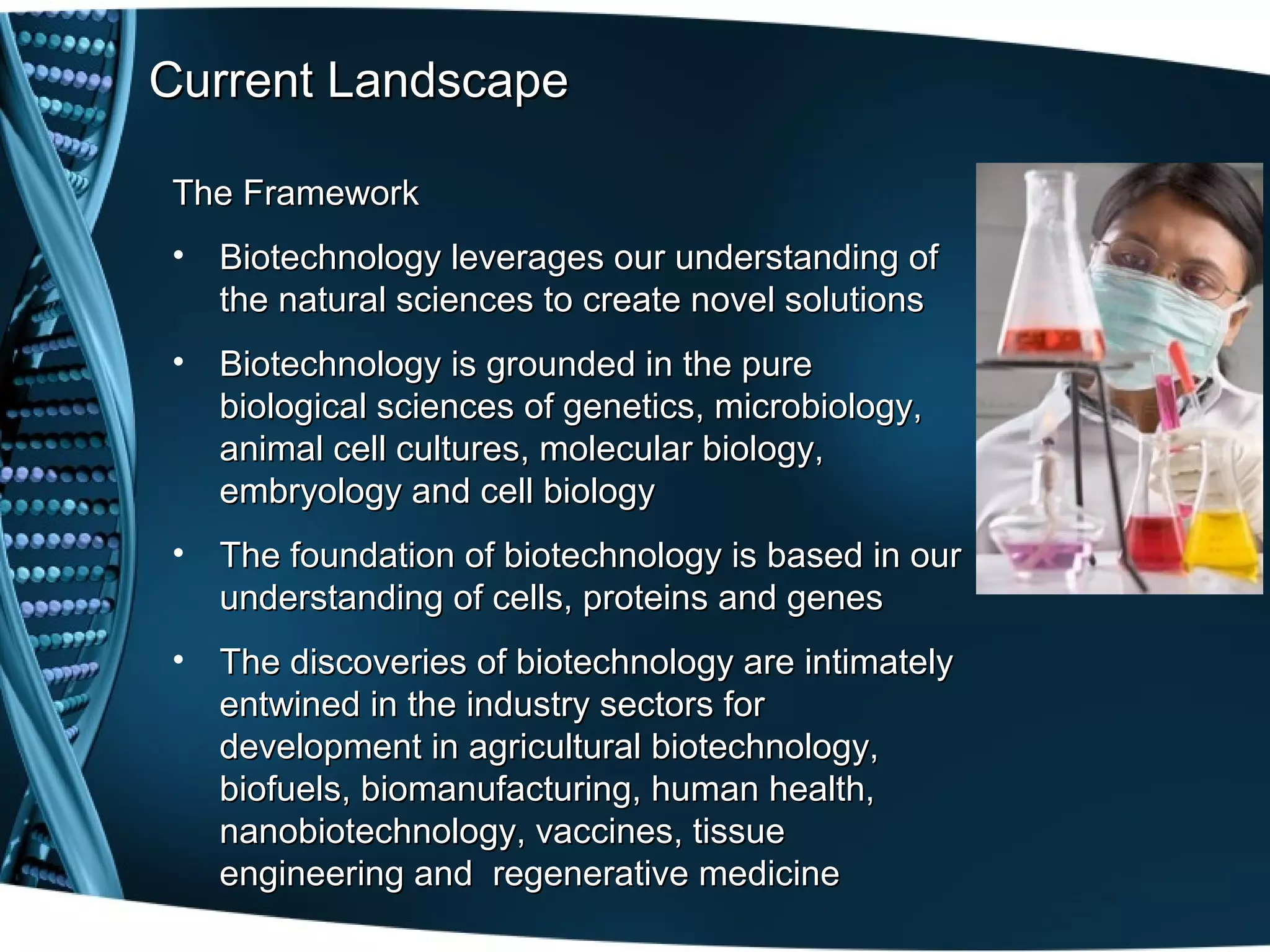
The Framework
• Biotechnology leverages our understanding of
  the natural sciences to create novel solutions
• Biotechnology is grounded in the pure
  biological sciences of genetics, microbiology,
  animal cell cultures, molecular biology,
  embryology and cell biology
• The foundation of biotechnology is based in our
  understanding of cells, proteins and genes
• The discoveries of biotechnology are intimately
  entwined in the industry sectors for
  development in agricultural biotechnology,
  biofuels, biomanufacturing, human health,
  nanobiotechnology, vaccines, tissue
  engineering and regenerative medicine
Current Landscape

We have all heard about the challenges of
   changing career paths ‘in this
   environment’
•   Unemployment among scientists tends to
    be less than in other fields
•   Opportunities tend to be more available
    the closer you are to the bench
•   There are geographical differences in
    opportunities for those wanting to move to
    a commercial laboratory
•   Research and development dollars in
    commercial laboratories are not at the
    levels they were in the past
•   The landscape is dynamic
Commercial Biotechnology Labs

• Part of a not-yet profitable company to conduct
  research and development studies for a repeatable
  and scalable business model
• Perform fee-for-service analysis for healthcare,
  environmental, and veterinary organizations
• A division in a profitable company to carry out
  research and development studies for pipeline
  products
• A service company providing biological products for
  the academic and other private sector laboratories
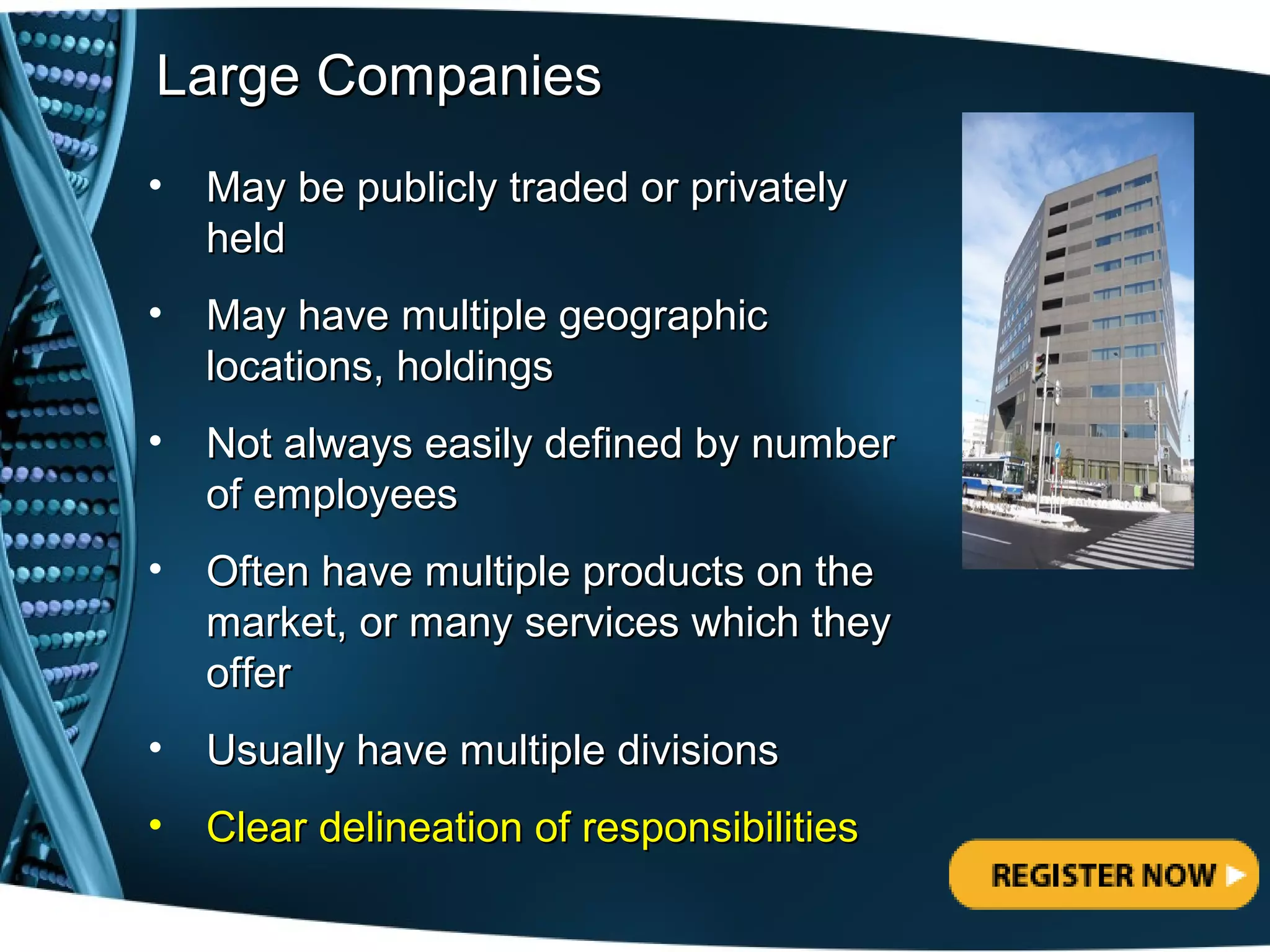
Large Companies
•   May be publicly traded or privately
    held
•   May have multiple geographic
    locations, holdings
•   Not always easily defined by number
    of employees
•   Often have multiple products on the
    market, or many services which they
    offer
•   Usually have multiple divisions
•   Clear delineation of responsibilities
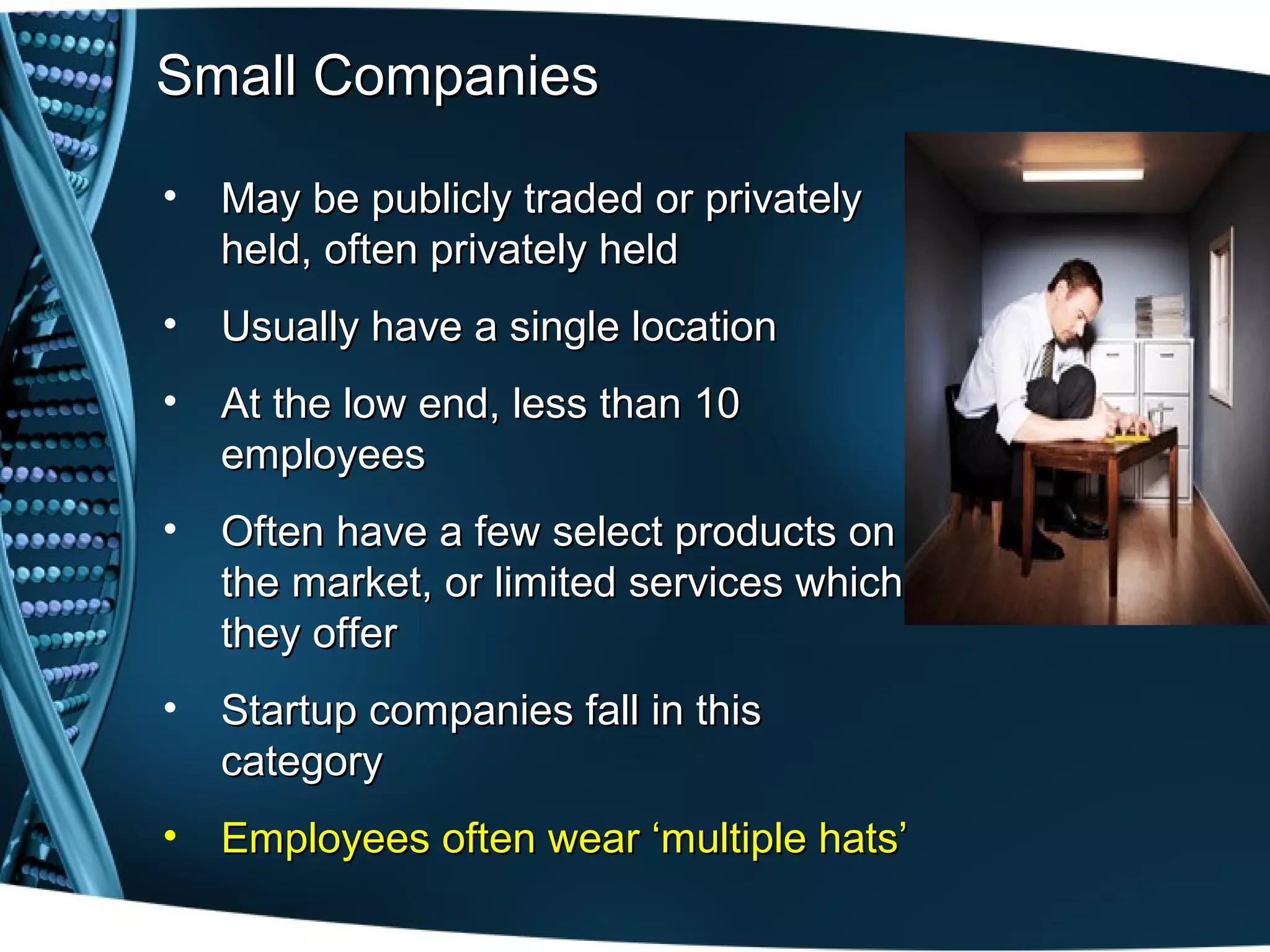
Small Companies

•   May be publicly traded or privately
    held, often privately held
•   Usually have a single location
•   At the low end, less than 10
    employees
•   Often have a few select products on
    the market, or limited services which
    they offer
•   Startup companies fall in this
    category
•   Employees often wear ‘multiple hats’
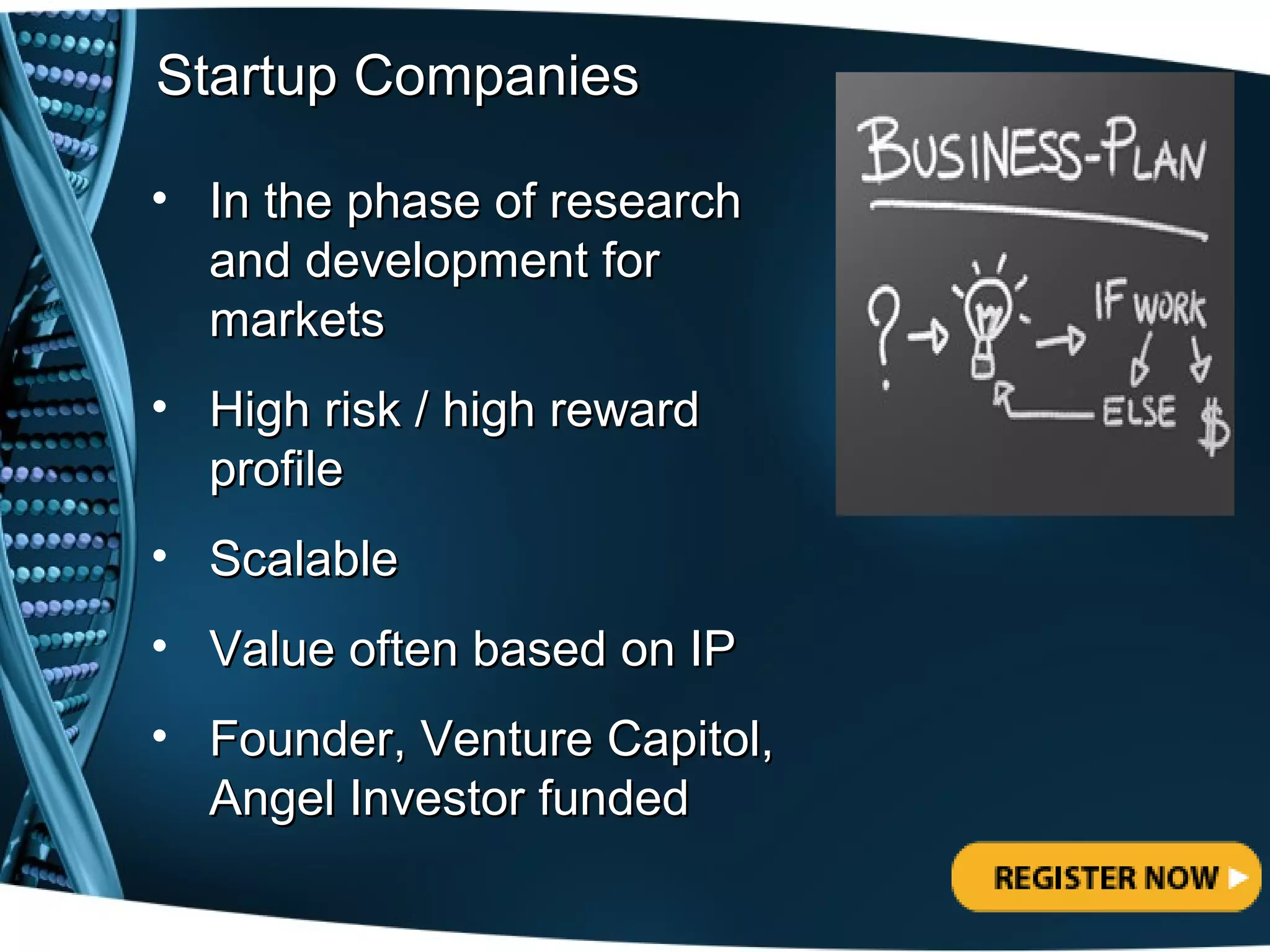
Startup Companies

• In the phase of research
  and development for
  markets
• High risk / high reward
  profile
• Scalable
• Value often based on IP
• Founder, Venture Capitol,
  Angel Investor funded
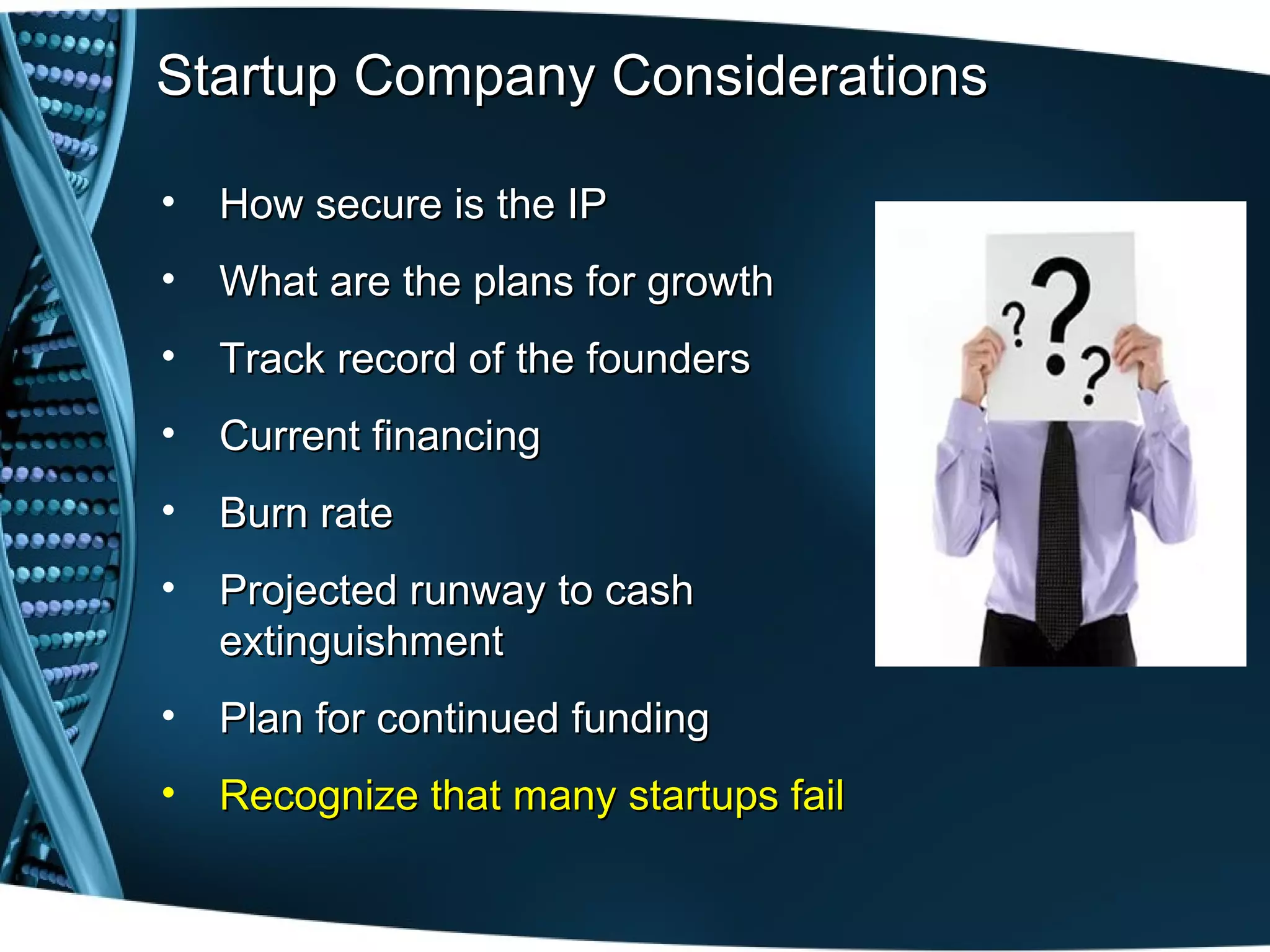
Startup Company Considerations

•   How secure is the IP
•   What are the plans for growth
•   Track record of the founders
•   Current financing
•   Burn rate
•   Projected runway to cash
    extinguishment
•   Plan for continued funding
•   Recognize that many startups fail
Contract Research Organization (CRO)

•   Offers fee-for-services support
    primarily to manufactures of
    medicinal products and
    biotechnology companies
•   Current Good Laboratory
    Practices (cGMP) compliant
•   Follow Standard Operating
    Procedures (SOP) for work
    performed
•   Provide quality assured
    documentation to client
Contract Research Organization (CRO)
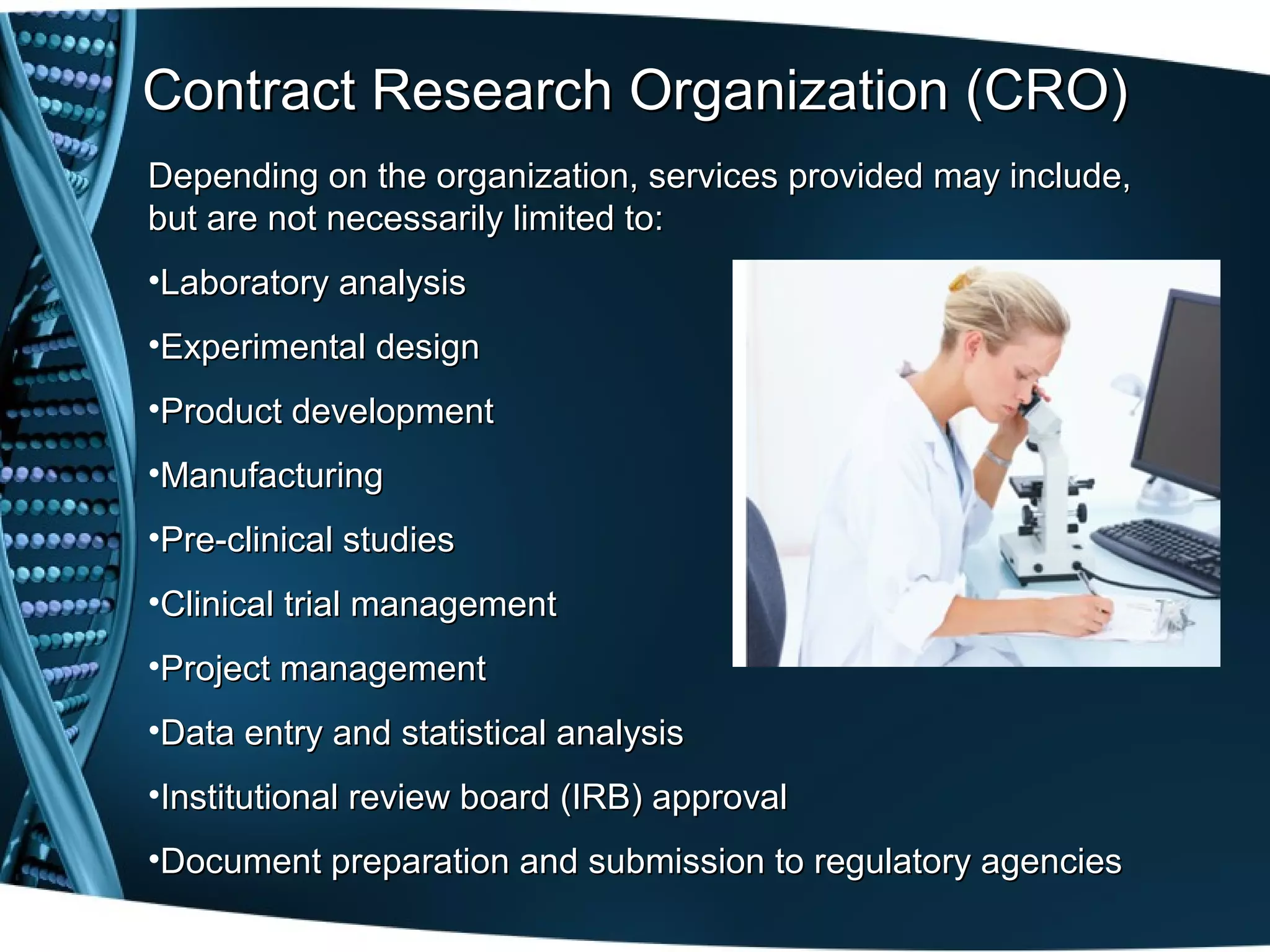
Depending on the organization, services provided may include,
but are not necessarily limited to:
•Laboratory analysis
•Experimental design
•Product development
•Manufacturing
•Pre-clinical studies
•Clinical trial management
•Project management
•Data entry and statistical analysis
•Institutional review board (IRB) approval
•Document preparation and submission to regulatory agencies
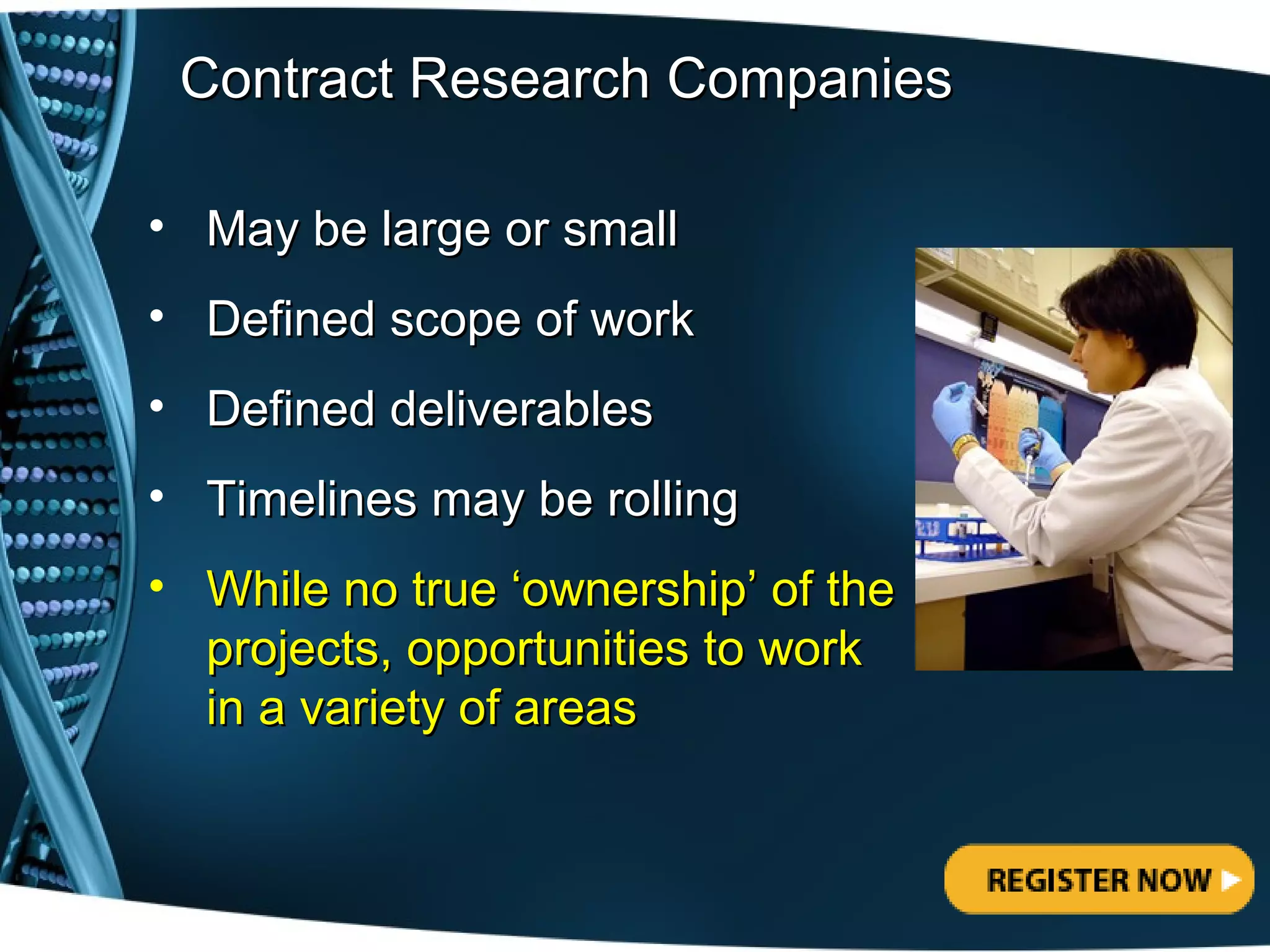
Contract Research Companies

• May be large or small
• Defined scope of work
• Defined deliverables
• Timelines may be rolling
• While no true ‘ownership’ of the
  projects, opportunities to work
  in a variety of areas
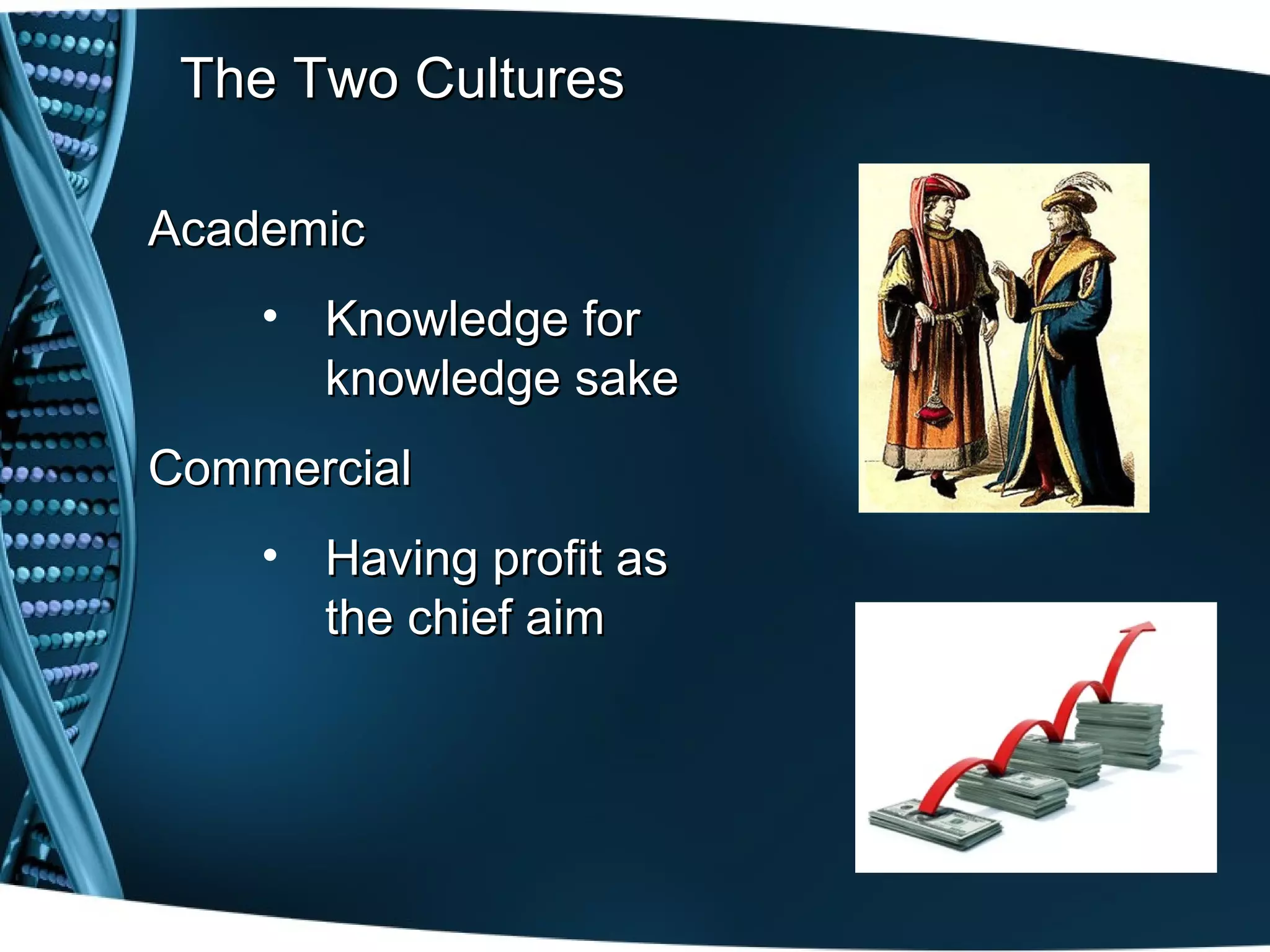
The Two Cultures

Academic
    • Knowledge for
      knowledge sake
Commercial
    • Having profit as
      the chief aim
The Two Cultures

     Academic                        Company
Freedom to choose pursuit          Defined pursuit
  Intellectual curiosity        Product development
Prestige of independence          Corporate identity
    Publications                       Patents
      Grants                      Corporate support
    Build a group                 Build or join a group
    Soft timelines                  Fixed timelines
           Success is determined by finances
The Two Cultures

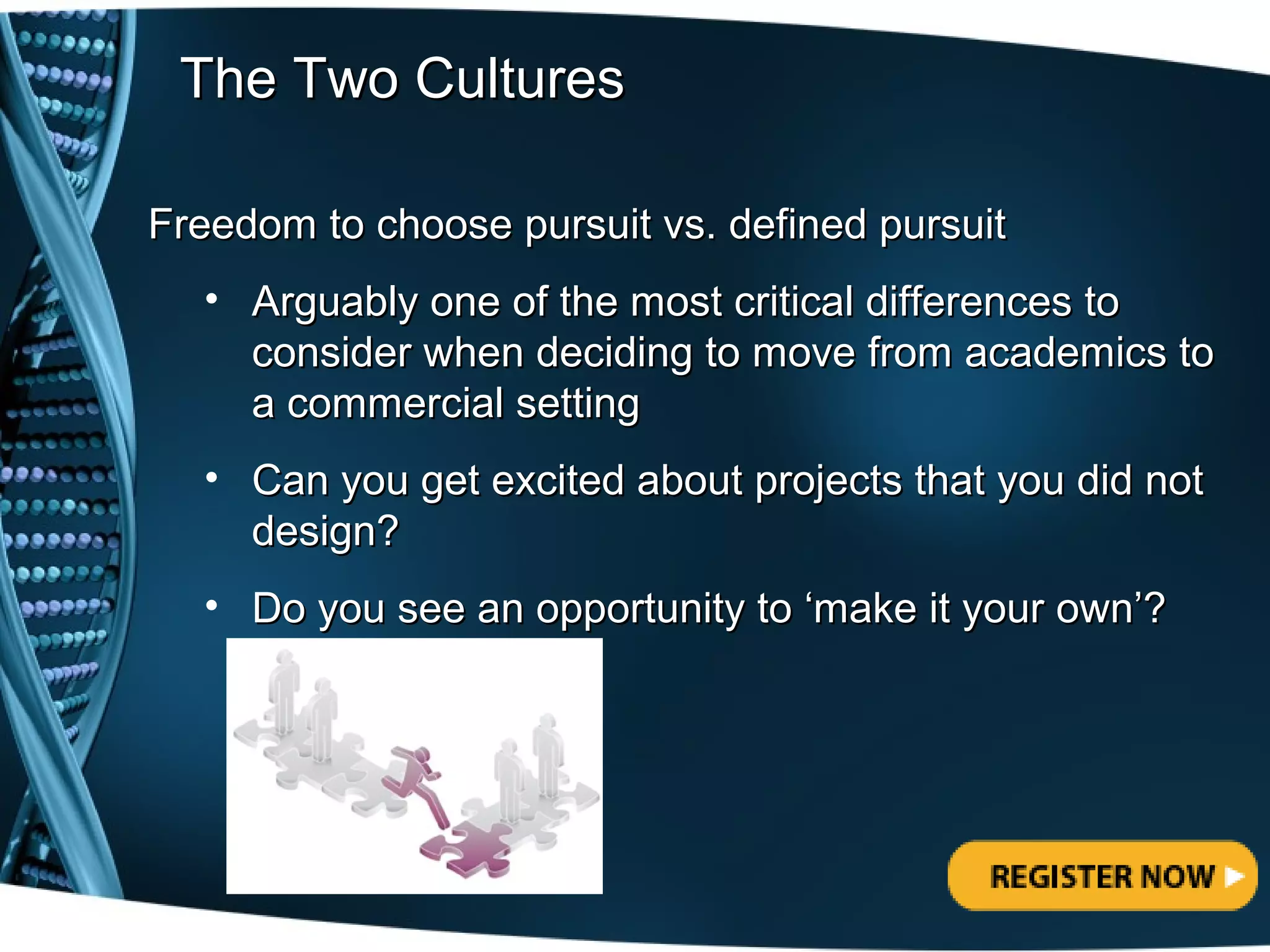
Freedom to choose pursuit vs. defined pursuit
  • Arguably one of the most critical differences to
    consider when deciding to move from academics to
    a commercial setting
  • Can you get excited about projects that you did not
    design?
  • Do you see an opportunity to ‘make it your own’?
The Two Cultures

Intellectual curiosity vs. product development
   • Ideally the project will satisfy both
   • Development tends to be more predictable
   • Do you see an opportunity to pursue curiosities?
Publications
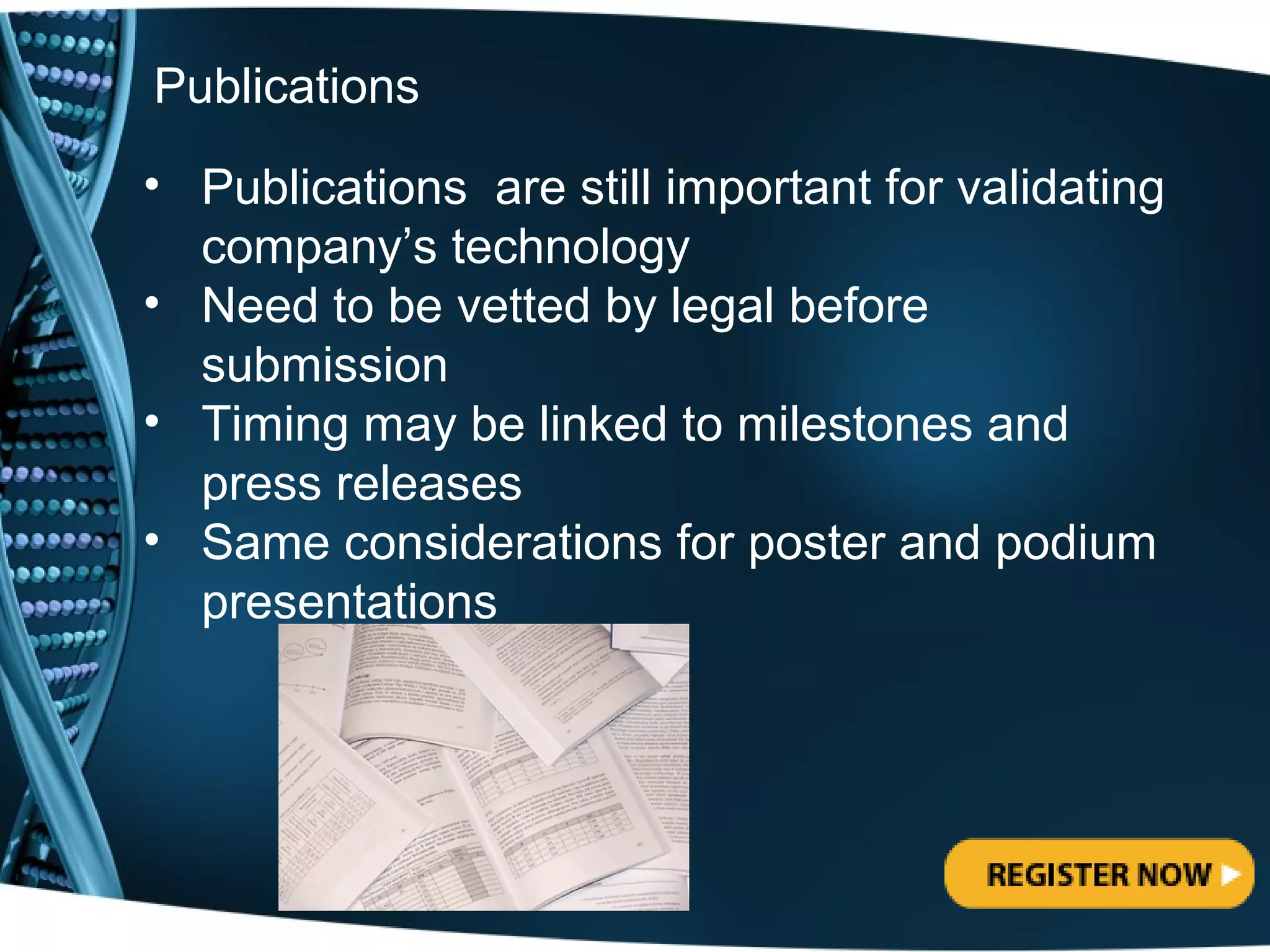
• Publications are still important for validating
  company’s technology
• Need to be vetted by legal before
  submission
• Timing may be linked to milestones and
  press releases
• Same considerations for poster and podium
  presentations
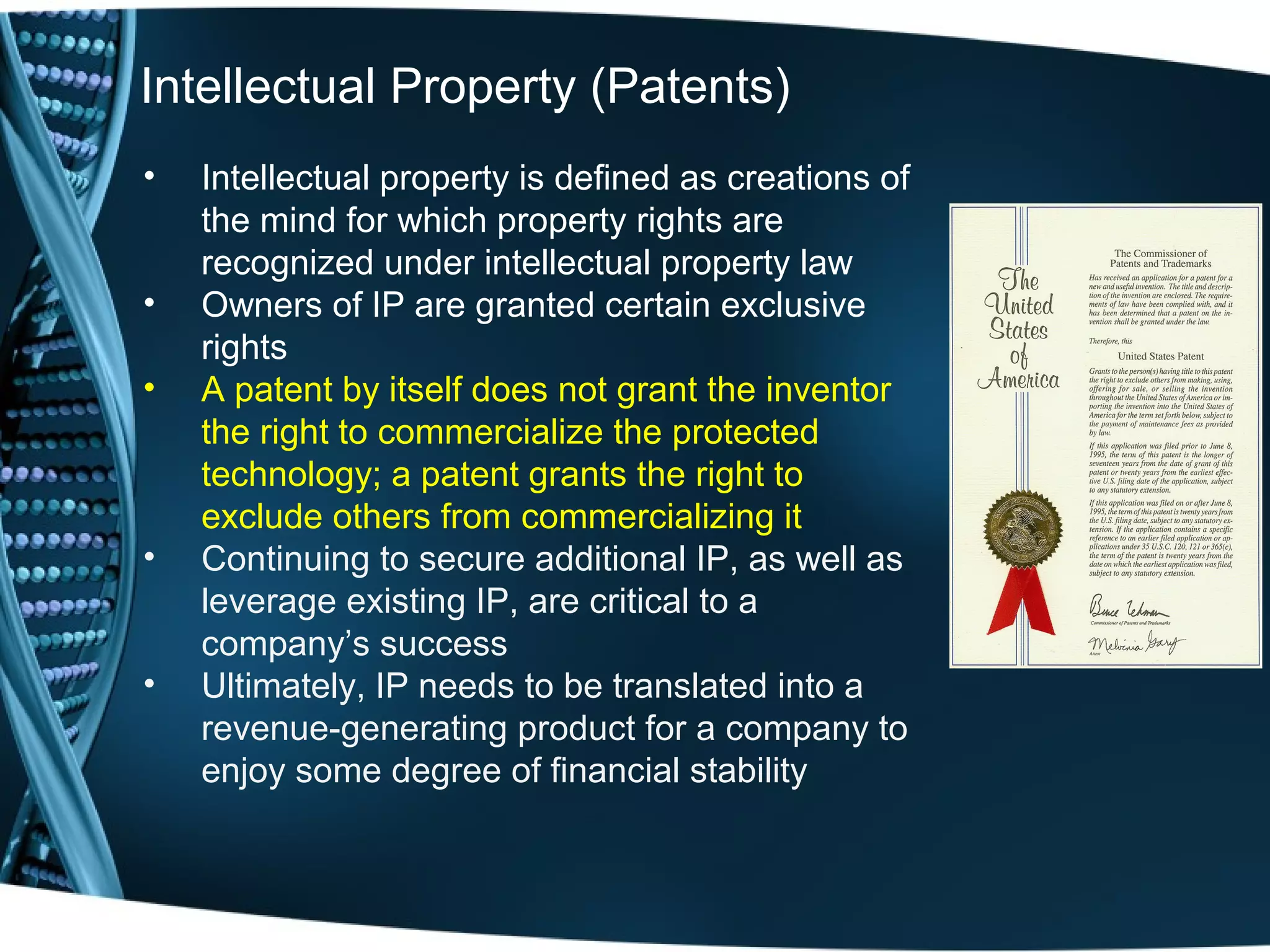
Intellectual Property (Patents)
•   Intellectual property is defined as creations of
    the mind for which property rights are
    recognized under intellectual property law
•   Owners of IP are granted certain exclusive
    rights
•   A patent by itself does not grant the inventor
    the right to commercialize the protected
    technology; a patent grants the right to
    exclude others from commercializing it
•   Continuing to secure additional IP, as well as
    leverage existing IP, are critical to a
    company’s success
•   Ultimately, IP needs to be translated into a
    revenue-generating product for a company to
    enjoy some degree of financial stability
Decision Making

•   Confirm there is a viable market
•   Is there sufficient capitalization
•   What are the competitive advantages
•   Will there be competition with industry leaders
•   Is the technology niche too small
•   Assess the founding team stability
•   Is the growth pace too rapid
•   Have trust in the sources utilized to answers these
    questions
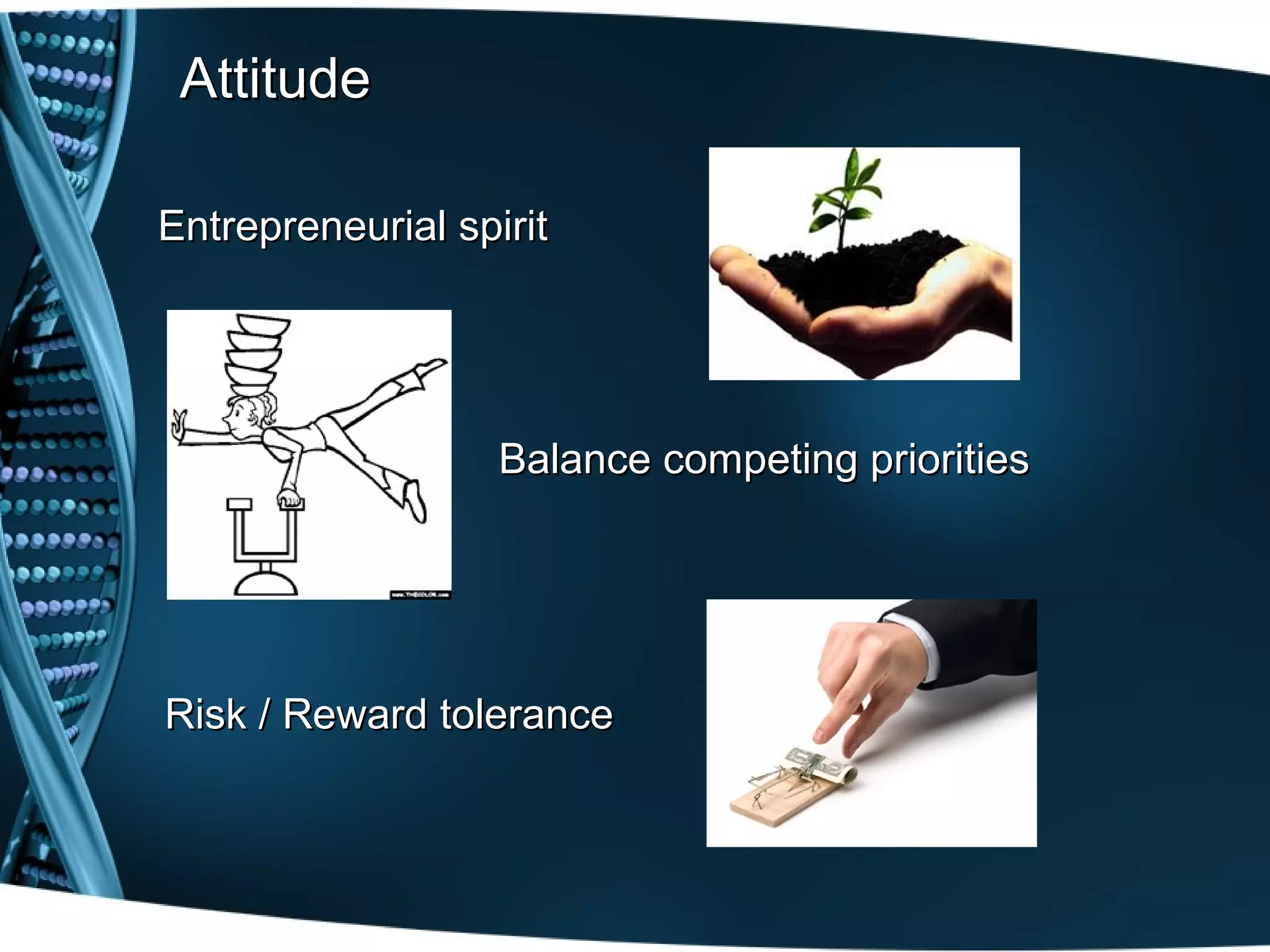
Attitude

Entrepreneurial spirit


                   Balance competing priorities


Risk / Reward tolerance
Taking Action

•    Are there any conflict of interest
     issues to be addressed?
•    Determining what belongs to you
     and what belongs to the academic
     institution
•    Release from your academic
     responsibilities
•    Notifying granting agencies of
     your academic departure
Advancement

•    Rank initially assessed by length of
     service
•    Responsibilities similar to
     academic positions, with different
     nomenclature
•    Success rate for deliverables
•    Organization size dictates
     advancement opportunities
•    Local biotechnology environment
Suggested Resources
• Colleagues who have ties to industry
• Faculty at colleges and universities with
  biotechnology programs
• University Technology Transfer Office
• State Biotechnology Office
• Networking events at scientific meetings
• Industrial internship, fellowship, apprenticeship
• Visiting a biotechnology company
Summary and Closing Remarks

 •   Milestone driven
 •   Product development or service provider
 •   Patents
 •   Commercial success
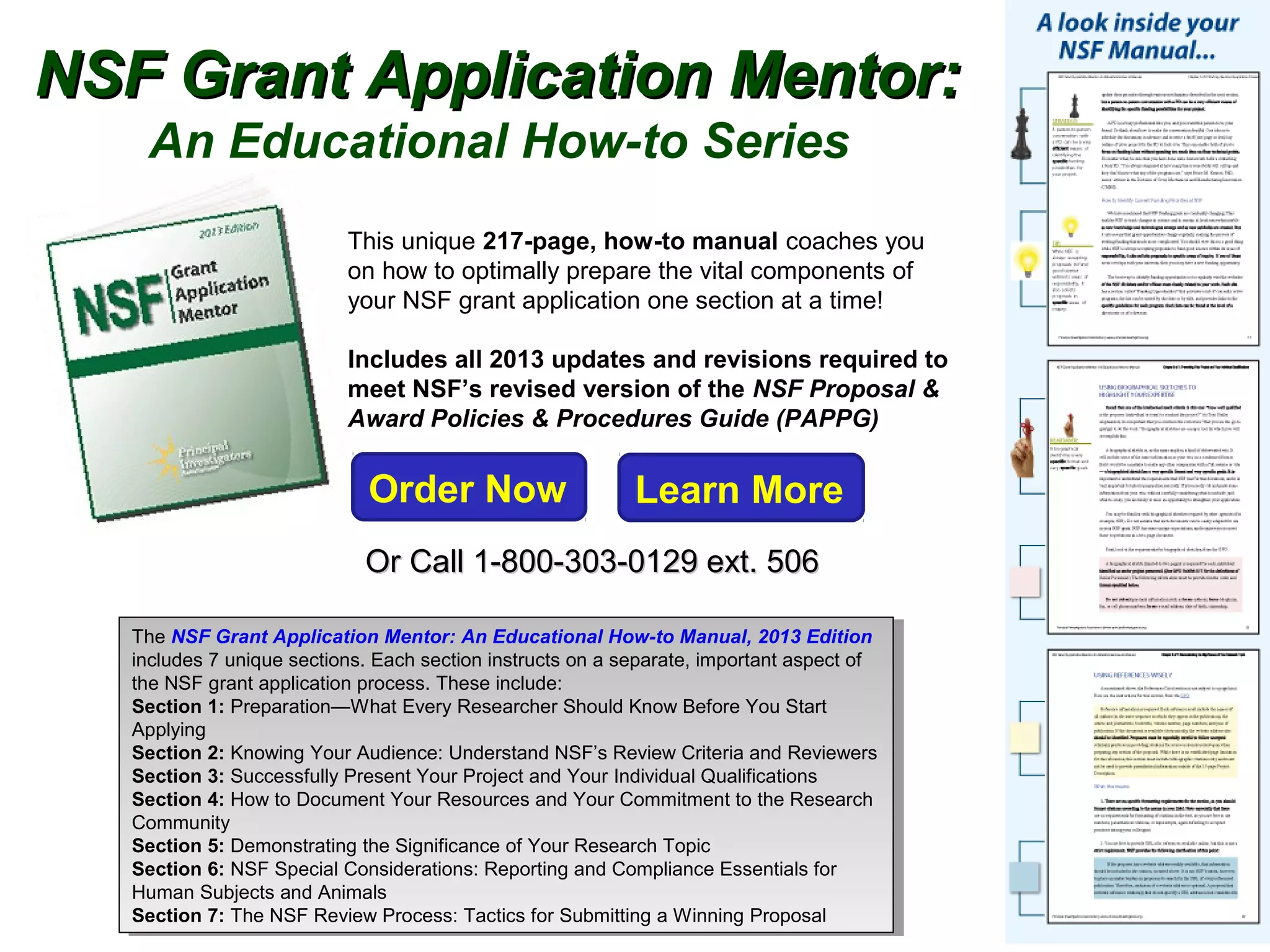
NSF Grant Application Mentor:
    An Educational How-to Series
                           This unique 217-page, how-to manual coaches you
                           on how to optimally prepare the vital components of
                           your NSF grant application one section at a time!

                           Includes all 2013 updates and revisions required to
                           meet NSF’s revised version of the NSF Proposal &
                           Award Policies & Procedures Guide (PAPPG)


                             Order Now                      Learn More
                             Or Call 1-800-303-0129 ext. 506

   The NSF Grant Application Mentor: An Educational How-to Manual, 2013 Edition
     The NSF Grant Application Mentor: An Educational How-to Manual, 2013 Edition
   includes 77 unique sections. Each section instructs on a separate, important aspect of
     includes unique sections. Each section instructs on a separate, important aspect of
   the NSF grant application process. These include:
     the NSF grant application process. These include:
   Section 1: Preparation—What Every Researcher Should Know Before You Start
     Section 1: Preparation—What Every Researcher Should Know Before You Start
   Applying
     Applying
   Section 2: Knowing Your Audience: Understand NSF’s Review Criteria and Reviewers
     Section 2: Knowing Your Audience: Understand NSF’s Review Criteria and Reviewers
   Section 3: Successfully Present Your Project and Your Individual Qualifications
     Section 3: Successfully Present Your Project and Your Individual Qualifications
   Section 4: How to Document Your Resources and Your Commitment to the Research
     Section 4: How to Document Your Resources and Your Commitment to the Research
   Community
     Community
   Section 5: Demonstrating the Significance of Your Research Topic
     Section 5: Demonstrating the Significance of Your Research Topic
   Section 6: NSF Special Considerations: Reporting and Compliance Essentials for
     Section 6: NSF Special Considerations: Reporting and Compliance Essentials for
   Human Subjects and Animals
     Human Subjects and Animals
   Section 7: The NSF Review Process: Tactics for Submitting aa Winning Proposal
     Section 7: The NSF Review Process: Tactics for Submitting Winning Proposal
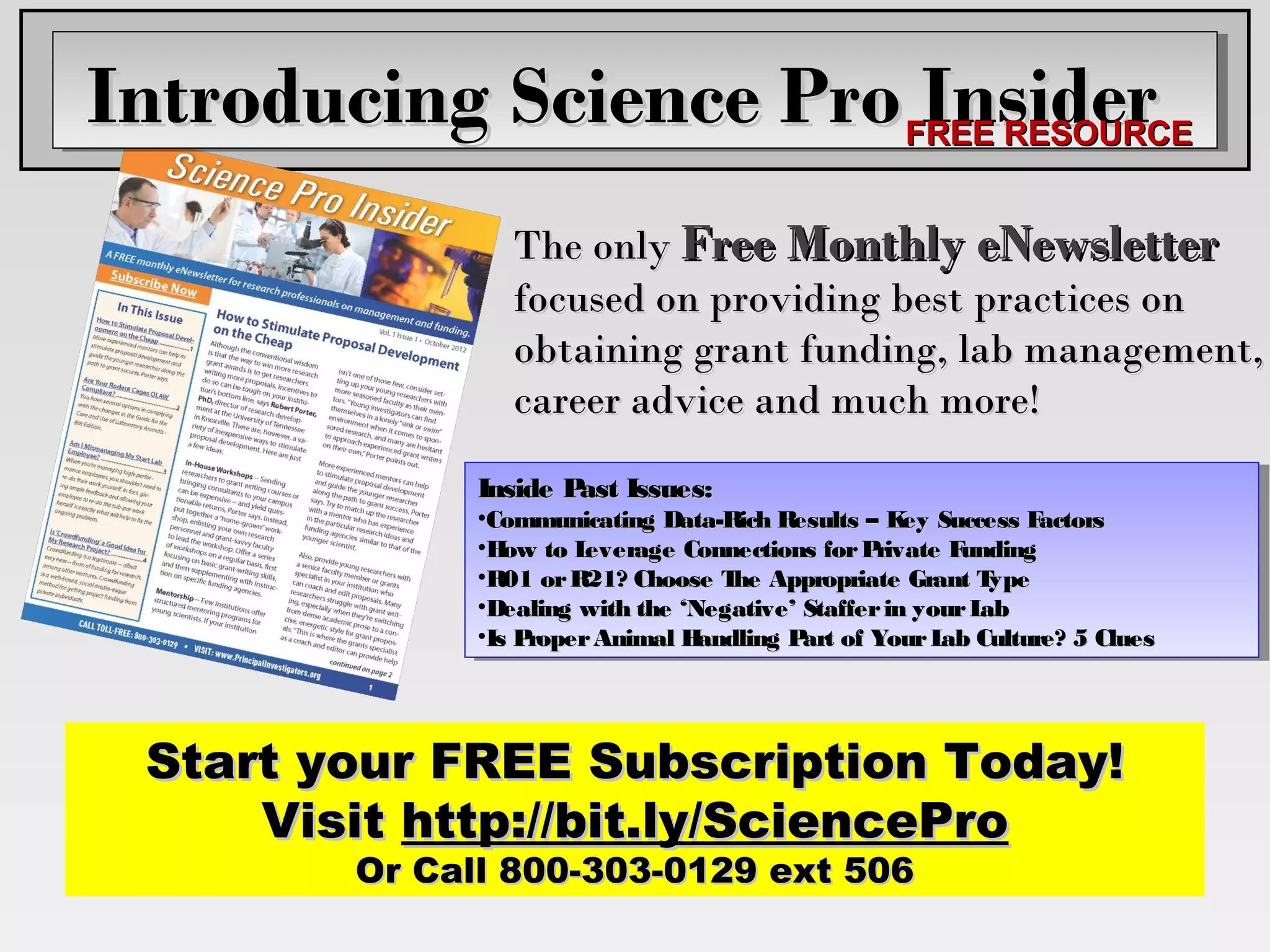
Introducing Science Pro FREE RESOURCE
                         Insider
                 The only Free Monthly eNewsletter
                 focused on providing best practices on
                 obtaining grant funding, lab management,
                 career advice and much more!
              Inside P astIssues:
                      ast
               Inside P Issues:
              •Communicating Data-Rich Results ––K eySuccess Factors
                                                     ey
               •Communicating Data-Rich Results K Success Factors
              •H owto L everageConnections for P rivateFunding
                 ow
               •H to L  everage Connections for P rivate Funding
              •R01 or R21? Choose T heAppropriate Grant T ype
                                     he
               •R01 or R21? Choose T Appropriate Grant T     ype
              •Dealing with the ‘Negative’ Staffer in your L ab
                                                            ab
               •Dealing with the ‘Negative’ Staffer in your L
              •Is P roper AnimalH andlingP artof Your L abCulture? 5 Clues
                   roper Animal H
               •Is P              andling P of Your L Culture? 5 Clues
                                           art          ab


 Start your FREE Subscription Today!
     Visit http://bit.ly/SciencePro
        Or Call 800-303-0129 ext 506

Making the Move from the Academic to the Commercial Lab: What You Should Know Before You Go “All In”

  • 1.
    Making the Movefrom the Academic to the Commercial Lab: What You Should Know Before You Go “All In” Brought to you by Principal Investigators Association Presented by: John W. Ludlow, Ph.D. Live Webinar Thursday, January 17, 2013 at 2:00 PM EST For More Information visit http://bit.ly/LabCareer For More Information visit http://bit.ly/LabCareer Or Call 1-800-303-0129 ext.506 Or Call 1-800-303-0129 ext.506
  • 2.
    Thursday: January 17,2013 2:00 PM EST | 11:00 AM PST This insightful Webinar will cover areas to be considered when making the career change from an academic setting to the commercial lab, including the culture of the commercial laboratory working environment, career advancement, scientific recognition, mentoring, and availability of opportunities. 55Key Take-Aways: Key Take-Aways: •Similarities and differences between academic and commercial •Similarities and differences between academic and commercial laboratory working environments laboratory working environments •Suggestions on how to increase your autonomy and independence •Suggestions on how to increase your autonomy and independence in conducting research at aacommercial laboratory in conducting research at commercial laboratory •How to ‘hedge your bets’ so that deadlines and milestones are •How to ‘hedge your bets’ so that deadlines and milestones are reached reached •Balancing publishing and intellectual property generation •Balancing publishing and intellectual property generation •The difference in costs between academic and commercial •The difference in costs between academic and commercial laboratory research laboratory research Attend the Live Webinar and receive a free recording in CD-ROM, MP4 or PDF Transcript.. For More Information visit http://bit.ly/LabCareer For More Information visit http://bit.ly/LabCareer
  • 3.
    Making the Movefrom the Academic to the Commercial Lab: What You Should Know Before You Go “All In” • Erosion of academic research support contributes to a career change to commercial laboratories • Desire to pursue science having a more direct application • Career advancement • Political environment • Compensation considerations • Time and Effort
  • 4.
    Presentation Goals 1. Pointsto consider when contemplating a change from an academic to a commercial science career 2. Similarities and differences between the two laboratory settings 3. Career advancement in the commercial sector Areas of emphasis are highlighted in yellow
  • 5.
    Presentation Outline 1. Introduction • Current landscape • Large vs. small companies • Contract research 2. The two cultures • Academic • Commercial 3. Making the move • Decision • Action 4. Advancement after the move 5. Suggested resources 6. Summary and closing remarks
  • 6.
    Current Landscape The Framework •Biotechnology leverages our understanding of the natural sciences to create novel solutions • Biotechnology is grounded in the pure biological sciences of genetics, microbiology, animal cell cultures, molecular biology, embryology and cell biology • The foundation of biotechnology is based in our understanding of cells, proteins and genes • The discoveries of biotechnology are intimately entwined in the industry sectors for development in agricultural biotechnology, biofuels, biomanufacturing, human health, nanobiotechnology, vaccines, tissue engineering and regenerative medicine
  • 7.
    Current Landscape We haveall heard about the challenges of changing career paths ‘in this environment’ • Unemployment among scientists tends to be less than in other fields • Opportunities tend to be more available the closer you are to the bench • There are geographical differences in opportunities for those wanting to move to a commercial laboratory • Research and development dollars in commercial laboratories are not at the levels they were in the past • The landscape is dynamic
  • 8.
    Commercial Biotechnology Labs •Part of a not-yet profitable company to conduct research and development studies for a repeatable and scalable business model • Perform fee-for-service analysis for healthcare, environmental, and veterinary organizations • A division in a profitable company to carry out research and development studies for pipeline products • A service company providing biological products for the academic and other private sector laboratories
  • 9.
    Large Companies • May be publicly traded or privately held • May have multiple geographic locations, holdings • Not always easily defined by number of employees • Often have multiple products on the market, or many services which they offer • Usually have multiple divisions • Clear delineation of responsibilities
  • 10.
    Small Companies • May be publicly traded or privately held, often privately held • Usually have a single location • At the low end, less than 10 employees • Often have a few select products on the market, or limited services which they offer • Startup companies fall in this category • Employees often wear ‘multiple hats’
  • 11.
    Startup Companies • Inthe phase of research and development for markets • High risk / high reward profile • Scalable • Value often based on IP • Founder, Venture Capitol, Angel Investor funded
  • 12.
    Startup Company Considerations • How secure is the IP • What are the plans for growth • Track record of the founders • Current financing • Burn rate • Projected runway to cash extinguishment • Plan for continued funding • Recognize that many startups fail
  • 13.
    Contract Research Organization(CRO) • Offers fee-for-services support primarily to manufactures of medicinal products and biotechnology companies • Current Good Laboratory Practices (cGMP) compliant • Follow Standard Operating Procedures (SOP) for work performed • Provide quality assured documentation to client
  • 14.
    Contract Research Organization(CRO) Depending on the organization, services provided may include, but are not necessarily limited to: •Laboratory analysis •Experimental design •Product development •Manufacturing •Pre-clinical studies •Clinical trial management •Project management •Data entry and statistical analysis •Institutional review board (IRB) approval •Document preparation and submission to regulatory agencies
  • 15.
    Contract Research Companies •May be large or small • Defined scope of work • Defined deliverables • Timelines may be rolling • While no true ‘ownership’ of the projects, opportunities to work in a variety of areas
  • 16.
    The Two Cultures Academic • Knowledge for knowledge sake Commercial • Having profit as the chief aim
  • 17.
    The Two Cultures Academic Company Freedom to choose pursuit Defined pursuit Intellectual curiosity Product development Prestige of independence Corporate identity Publications Patents Grants Corporate support Build a group Build or join a group Soft timelines Fixed timelines Success is determined by finances
  • 18.
    The Two Cultures Freedomto choose pursuit vs. defined pursuit • Arguably one of the most critical differences to consider when deciding to move from academics to a commercial setting • Can you get excited about projects that you did not design? • Do you see an opportunity to ‘make it your own’?
  • 19.
    The Two Cultures Intellectualcuriosity vs. product development • Ideally the project will satisfy both • Development tends to be more predictable • Do you see an opportunity to pursue curiosities?
  • 20.
    Publications • Publications arestill important for validating company’s technology • Need to be vetted by legal before submission • Timing may be linked to milestones and press releases • Same considerations for poster and podium presentations
  • 21.
    Intellectual Property (Patents) • Intellectual property is defined as creations of the mind for which property rights are recognized under intellectual property law • Owners of IP are granted certain exclusive rights • A patent by itself does not grant the inventor the right to commercialize the protected technology; a patent grants the right to exclude others from commercializing it • Continuing to secure additional IP, as well as leverage existing IP, are critical to a company’s success • Ultimately, IP needs to be translated into a revenue-generating product for a company to enjoy some degree of financial stability
  • 22.
    Decision Making • Confirm there is a viable market • Is there sufficient capitalization • What are the competitive advantages • Will there be competition with industry leaders • Is the technology niche too small • Assess the founding team stability • Is the growth pace too rapid • Have trust in the sources utilized to answers these questions
  • 23.
    Attitude Entrepreneurial spirit Balance competing priorities Risk / Reward tolerance
  • 24.
    Taking Action • Are there any conflict of interest issues to be addressed? • Determining what belongs to you and what belongs to the academic institution • Release from your academic responsibilities • Notifying granting agencies of your academic departure
  • 25.
    Advancement • Rank initially assessed by length of service • Responsibilities similar to academic positions, with different nomenclature • Success rate for deliverables • Organization size dictates advancement opportunities • Local biotechnology environment
  • 26.
    Suggested Resources • Colleagueswho have ties to industry • Faculty at colleges and universities with biotechnology programs • University Technology Transfer Office • State Biotechnology Office • Networking events at scientific meetings • Industrial internship, fellowship, apprenticeship • Visiting a biotechnology company
  • 27.
    Summary and ClosingRemarks • Milestone driven • Product development or service provider • Patents • Commercial success
  • 28.
    NSF Grant ApplicationMentor: An Educational How-to Series This unique 217-page, how-to manual coaches you on how to optimally prepare the vital components of your NSF grant application one section at a time! Includes all 2013 updates and revisions required to meet NSF’s revised version of the NSF Proposal & Award Policies & Procedures Guide (PAPPG) Order Now Learn More Or Call 1-800-303-0129 ext. 506 The NSF Grant Application Mentor: An Educational How-to Manual, 2013 Edition The NSF Grant Application Mentor: An Educational How-to Manual, 2013 Edition includes 77 unique sections. Each section instructs on a separate, important aspect of includes unique sections. Each section instructs on a separate, important aspect of the NSF grant application process. These include: the NSF grant application process. These include: Section 1: Preparation—What Every Researcher Should Know Before You Start Section 1: Preparation—What Every Researcher Should Know Before You Start Applying Applying Section 2: Knowing Your Audience: Understand NSF’s Review Criteria and Reviewers Section 2: Knowing Your Audience: Understand NSF’s Review Criteria and Reviewers Section 3: Successfully Present Your Project and Your Individual Qualifications Section 3: Successfully Present Your Project and Your Individual Qualifications Section 4: How to Document Your Resources and Your Commitment to the Research Section 4: How to Document Your Resources and Your Commitment to the Research Community Community Section 5: Demonstrating the Significance of Your Research Topic Section 5: Demonstrating the Significance of Your Research Topic Section 6: NSF Special Considerations: Reporting and Compliance Essentials for Section 6: NSF Special Considerations: Reporting and Compliance Essentials for Human Subjects and Animals Human Subjects and Animals Section 7: The NSF Review Process: Tactics for Submitting aa Winning Proposal Section 7: The NSF Review Process: Tactics for Submitting Winning Proposal
  • 29.
    Introducing Science ProFREE RESOURCE Insider The only Free Monthly eNewsletter focused on providing best practices on obtaining grant funding, lab management, career advice and much more! Inside P astIssues: ast Inside P Issues: •Communicating Data-Rich Results ––K eySuccess Factors ey •Communicating Data-Rich Results K Success Factors •H owto L everageConnections for P rivateFunding ow •H to L everage Connections for P rivate Funding •R01 or R21? Choose T heAppropriate Grant T ype he •R01 or R21? Choose T Appropriate Grant T ype •Dealing with the ‘Negative’ Staffer in your L ab ab •Dealing with the ‘Negative’ Staffer in your L •Is P roper AnimalH andlingP artof Your L abCulture? 5 Clues roper Animal H •Is P andling P of Your L Culture? 5 Clues art ab Start your FREE Subscription Today! Visit http://bit.ly/SciencePro Or Call 800-303-0129 ext 506