Fast Nearest Neighbor Search with Keywords
Abstract:
Conventional spatial queries, such as range search and nearest neighbor retrieval,
involve only conditions on objects’ geometric properties. Today, many modern
applications call for novel forms of queries that aim to find objects satisfying both
a spatial predicate, and a predicate on their associated texts. For example, instead
of considering all the restaurants, a nearest neighbor query would instead ask for
the restaurant that is the closest among those whose menus contain “steak,
spaghetti, brandy” all at the same time. Currently the best solution to such queries
is based on the IR2-tree, which, as shown in this paper, has a few deficiencies that
seriously impact its efficiency. Motivated by this, we develop a new access method
called the spatial inverted index that extends the conventional inverted index to
cope with multidimensional data, and comes with algorithms that can answer
nearest neighbor queries with keywords in real time. As verified by experiments,
the proposed techniques outperform the IR2-tree in query response time
significantly, often by a factor of orders of magnitude.
GLOBALSOFT TECHNOLOGIES
IEEE PROJECTS & SOFTWARE DEVELOPMENTS
IEEE FINAL YEAR PROJECTS|IEEE ENGINEERING PROJECTS|IEEE STUDENTS PROJECTS|IEEE
BULK PROJECTS|BE/BTECH/ME/MTECH/MS/MCA PROJECTS|CSE/IT/ECE/EEE PROJECTS
CELL: +91 98495 39085, +91 99662 35788, +91 98495 57908, +91 97014 40401
Visit: www.finalyearprojects.org Mail to:ieeefinalsemprojects@gmail.com
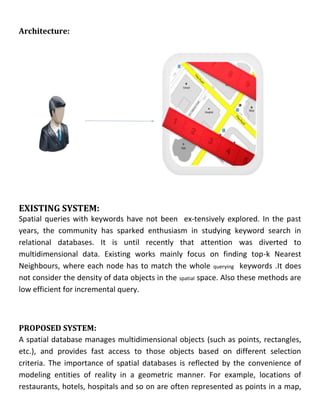
Architecture:
EXISTING SYSTEM:
Spatial queries with keywords have not been ex-tensively explored. In the past
years, the community has sparked enthusiasm in studying keyword search in
relational databases. It is until recently that attention was diverted to
multidimensional data. Existing works mainly focus on finding top-k Nearest
Neighbours, where each node has to match the whole querying keywords .It does
not consider the density of data objects in the spatial space. Also these methods are
low efficient for incremental query.
PROPOSED SYSTEM:
A spatial database manages multidimensional objects (such as points, rectangles,
etc.), and provides fast access to those objects based on different selection
criteria. The importance of spatial databases is reflected by the convenience of
modeling entities of reality in a geometric manner. For example, locations of
restaurants, hotels, hospitals and so on are often represented as points in a map,
while larger extents such as parks, lakes, and landscapes often as a combination of
rectangles. Many functionalities of a spatial database are useful in various ways in
specific contexts. For instance, in a geography information system, range search
can be deployed to find all restaurants in a certain area, while nearest neighbor
retrieval can discover the restaurant closest to a given address.
Modules :
1. Registration
2. Login
3. Hotel_Registration
4. Search Techniques
5. Map_view
6. Distance_Search
Modules Description
Registration:
In this module an User have to register first, then only he/she
has to access the data base.
Login:
In this module, any of the above mentioned person have to
login,they should login by giving their email id and password .
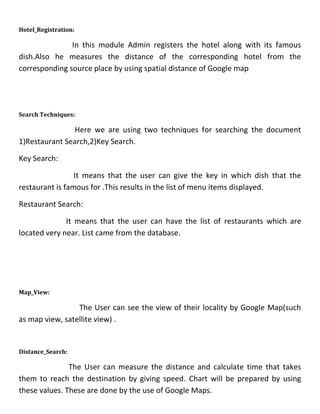
Hotel_Registration:
In this module Admin registers the hotel along with its famous
dish.Also he measures the distance of the corresponding hotel from the
corresponding source place by using spatial distance of Google map
Search Techniques:
Here we are using two techniques for searching the document
1)Restaurant Search,2)Key Search.
Key Search:
It means that the user can give the key in which dish that the
restaurant is famous for .This results in the list of menu items displayed.
Restaurant Search:
It means that the user can have the list of restaurants which are
located very near. List came from the database.
Map_View:
The User can see the view of their locality by Google Map(such
as map view, satellite view) .
Distance_Search:
The User can measure the distance and calculate time that takes
them to reach the destination by giving speed. Chart will be prepared by using
these values. These are done by the use of Google Maps.
System Configuration:-
H/W System Configuration:-
Processor - Pentium –III
Speed - 1.1 GHz
RAM - 256 MB (min)
Hard Disk - 20 GB
Floppy Drive - 1.44 MB
Key Board - Standard Windows Keyboard
Mouse - Two or Three Button Mouse
Monitor - SVGA
S/W System Configuration:-
 Operating System :Windows95/98/2000/XP
 Application Server : Tomcat5.0/6.X
 Front End : HTML, Java, Jsp
 Scripts : JavaScript.
 Server side Script : Java Server Pages.
 Database : My sql
 Database Connectivity : JDBC.
Conclusion:
We have seen plenty of applications calling for a search engine that is able to
efficiently support novel forms of spatial queries that are integrated with keyword
search. The existing solutions to such queries either incur prohibitive space
consumption or are unable to give real time answers. In this paper, we have
remedied the situation by developing an access method called the spatial inverted
index (SI-index). Not only that the SI-index is fairly space economical, but also it
has the ability to perform keyword-augmented nearest neighbor search in time
that is at the order of dozens of milli-seconds. Furthermore, as the SI-index is
based on the conventional technology of inverted index, it is readily incorporable
in a commercial search engine that applies massive parallelism, implying its
immediate industrial merits.

Fast nearest neighbor search with keywords

  • 1.
    Fast Nearest NeighborSearch with Keywords Abstract: Conventional spatial queries, such as range search and nearest neighbor retrieval, involve only conditions on objects’ geometric properties. Today, many modern applications call for novel forms of queries that aim to find objects satisfying both a spatial predicate, and a predicate on their associated texts. For example, instead of considering all the restaurants, a nearest neighbor query would instead ask for the restaurant that is the closest among those whose menus contain “steak, spaghetti, brandy” all at the same time. Currently the best solution to such queries is based on the IR2-tree, which, as shown in this paper, has a few deficiencies that seriously impact its efficiency. Motivated by this, we develop a new access method called the spatial inverted index that extends the conventional inverted index to cope with multidimensional data, and comes with algorithms that can answer nearest neighbor queries with keywords in real time. As verified by experiments, the proposed techniques outperform the IR2-tree in query response time significantly, often by a factor of orders of magnitude. GLOBALSOFT TECHNOLOGIES IEEE PROJECTS & SOFTWARE DEVELOPMENTS IEEE FINAL YEAR PROJECTS|IEEE ENGINEERING PROJECTS|IEEE STUDENTS PROJECTS|IEEE BULK PROJECTS|BE/BTECH/ME/MTECH/MS/MCA PROJECTS|CSE/IT/ECE/EEE PROJECTS CELL: +91 98495 39085, +91 99662 35788, +91 98495 57908, +91 97014 40401 Visit: www.finalyearprojects.org Mail to:ieeefinalsemprojects@gmail.com
  • 2.
    Architecture: EXISTING SYSTEM: Spatial querieswith keywords have not been ex-tensively explored. In the past years, the community has sparked enthusiasm in studying keyword search in relational databases. It is until recently that attention was diverted to multidimensional data. Existing works mainly focus on finding top-k Nearest Neighbours, where each node has to match the whole querying keywords .It does not consider the density of data objects in the spatial space. Also these methods are low efficient for incremental query. PROPOSED SYSTEM: A spatial database manages multidimensional objects (such as points, rectangles, etc.), and provides fast access to those objects based on different selection criteria. The importance of spatial databases is reflected by the convenience of modeling entities of reality in a geometric manner. For example, locations of restaurants, hotels, hospitals and so on are often represented as points in a map,
  • 3.
    while larger extentssuch as parks, lakes, and landscapes often as a combination of rectangles. Many functionalities of a spatial database are useful in various ways in specific contexts. For instance, in a geography information system, range search can be deployed to find all restaurants in a certain area, while nearest neighbor retrieval can discover the restaurant closest to a given address. Modules : 1. Registration 2. Login 3. Hotel_Registration 4. Search Techniques 5. Map_view 6. Distance_Search Modules Description Registration: In this module an User have to register first, then only he/she has to access the data base. Login: In this module, any of the above mentioned person have to login,they should login by giving their email id and password .
  • 4.
    Hotel_Registration: In this moduleAdmin registers the hotel along with its famous dish.Also he measures the distance of the corresponding hotel from the corresponding source place by using spatial distance of Google map Search Techniques: Here we are using two techniques for searching the document 1)Restaurant Search,2)Key Search. Key Search: It means that the user can give the key in which dish that the restaurant is famous for .This results in the list of menu items displayed. Restaurant Search: It means that the user can have the list of restaurants which are located very near. List came from the database. Map_View: The User can see the view of their locality by Google Map(such as map view, satellite view) . Distance_Search: The User can measure the distance and calculate time that takes them to reach the destination by giving speed. Chart will be prepared by using these values. These are done by the use of Google Maps.
  • 5.
    System Configuration:- H/W SystemConfiguration:- Processor - Pentium –III Speed - 1.1 GHz RAM - 256 MB (min) Hard Disk - 20 GB Floppy Drive - 1.44 MB Key Board - Standard Windows Keyboard Mouse - Two or Three Button Mouse Monitor - SVGA S/W System Configuration:-  Operating System :Windows95/98/2000/XP  Application Server : Tomcat5.0/6.X  Front End : HTML, Java, Jsp  Scripts : JavaScript.  Server side Script : Java Server Pages.  Database : My sql  Database Connectivity : JDBC.
  • 6.
    Conclusion: We have seenplenty of applications calling for a search engine that is able to efficiently support novel forms of spatial queries that are integrated with keyword search. The existing solutions to such queries either incur prohibitive space consumption or are unable to give real time answers. In this paper, we have remedied the situation by developing an access method called the spatial inverted index (SI-index). Not only that the SI-index is fairly space economical, but also it has the ability to perform keyword-augmented nearest neighbor search in time that is at the order of dozens of milli-seconds. Furthermore, as the SI-index is based on the conventional technology of inverted index, it is readily incorporable in a commercial search engine that applies massive parallelism, implying its immediate industrial merits.