Service Operator-aware Trust Scheme for Resource
Matchmaking across Multiple Clouds
Presented by
Jisa Joy
Guided by
Er. Asha Yeldose
ABSTRACT
 Service Operator-aware Trust Scheme (SOTS)[multi-dimentional
resource service operator]
 For resource matchmaking across multiple clouds
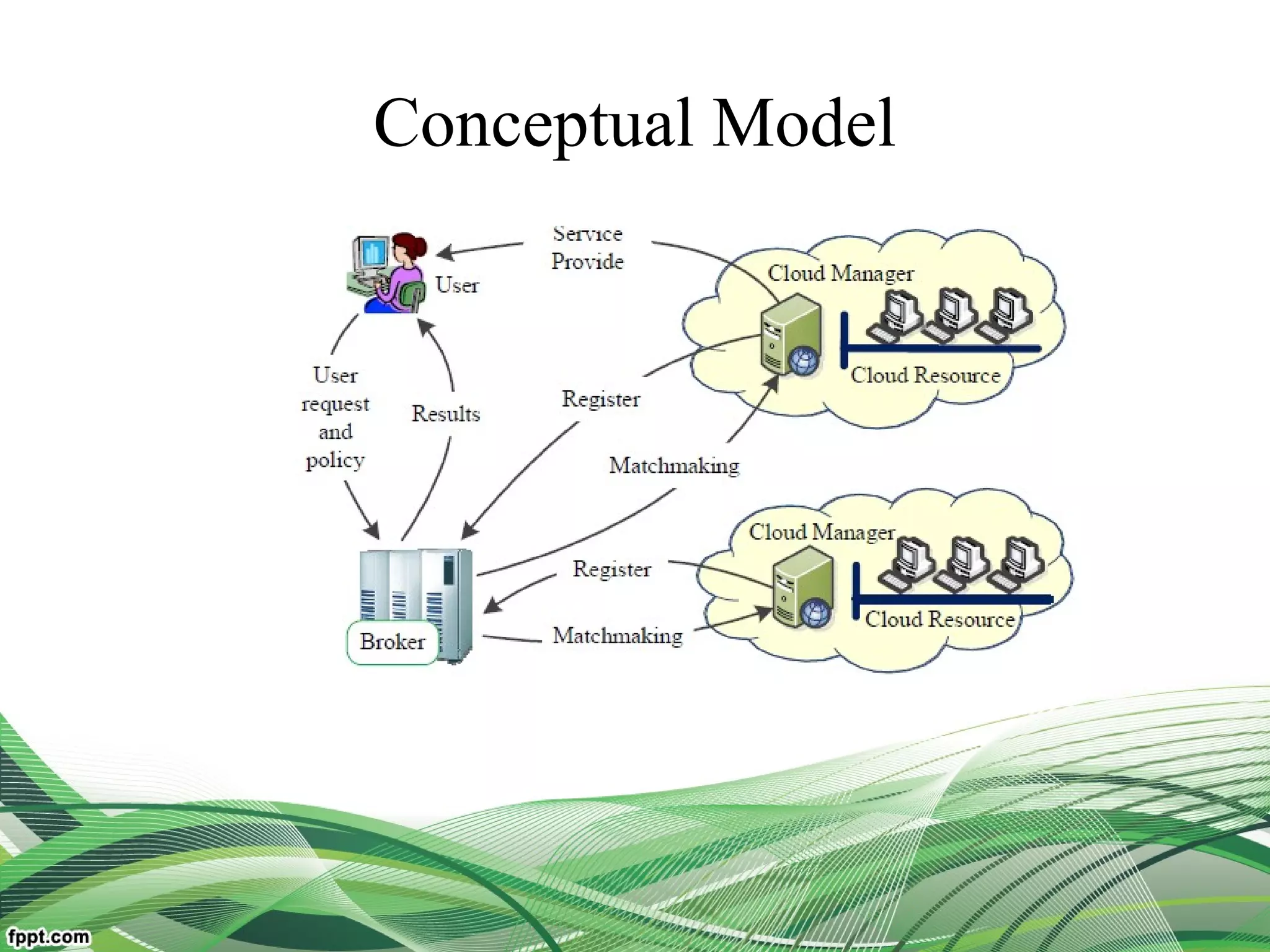
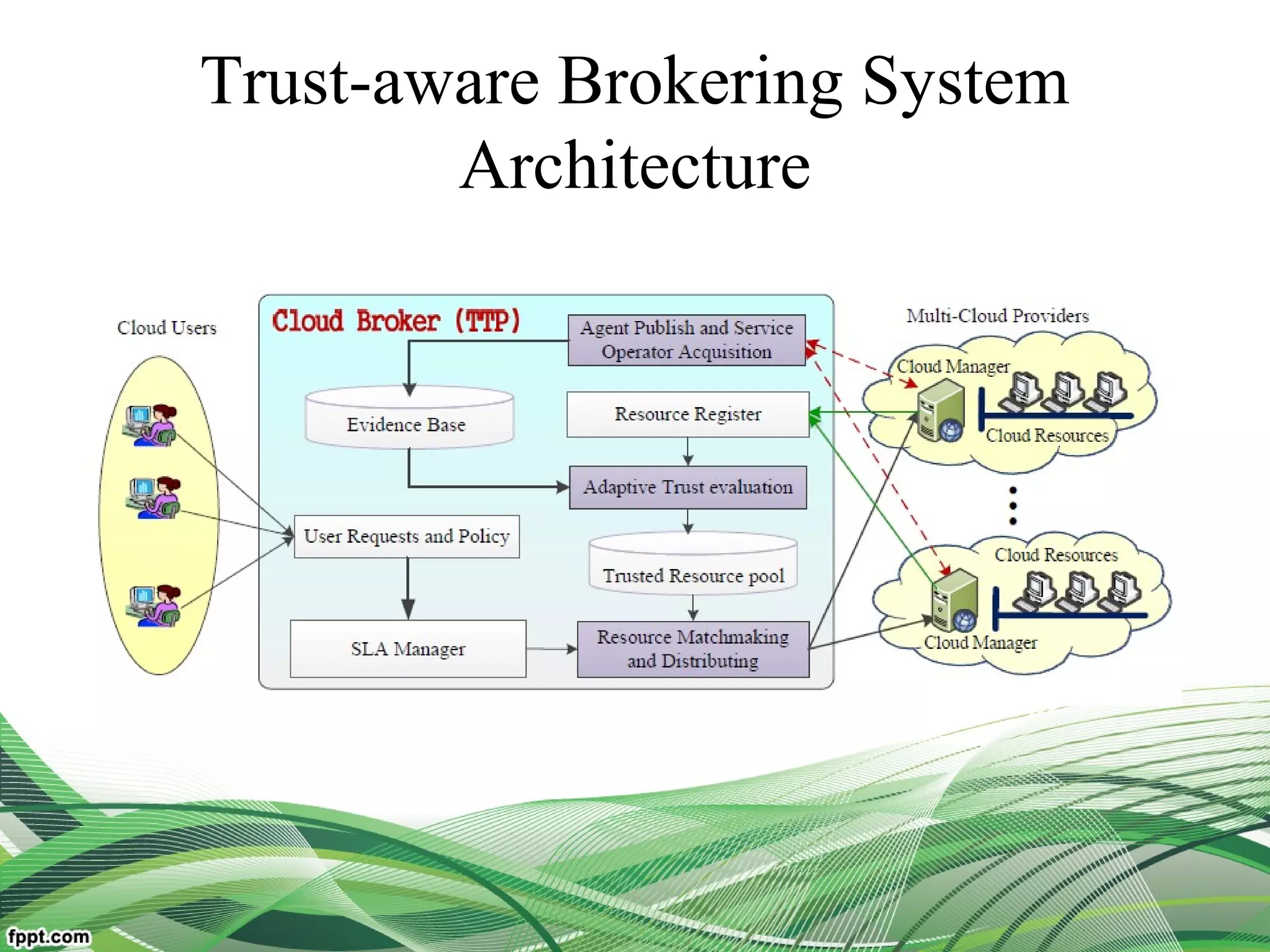
 Explain relationship between the users, broker, the service
resources(middleware framework of trust)
 Reduce user burden and improve system dependability
 Model the problem of trust evaluation by multi-attribute decision-making
 Develop an adaptive trust evaluation approach on information entropy
theory
 To overcome the limitations of traditional trust schemes
 the broker can efficiently and accurately prepare the most trusted resources
 provide more dependable resources to users
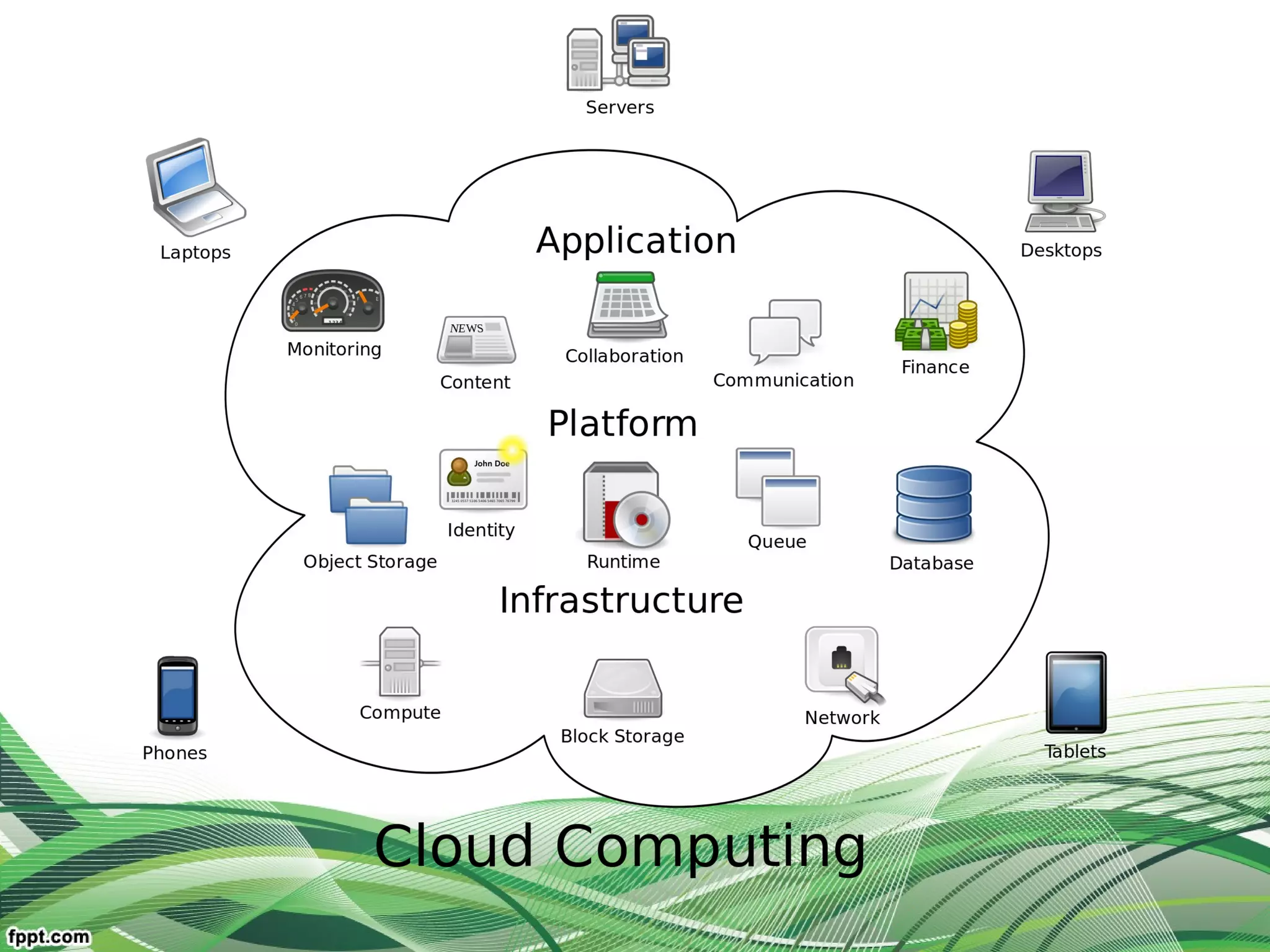
What is cloud computing??
INTRODUCTION
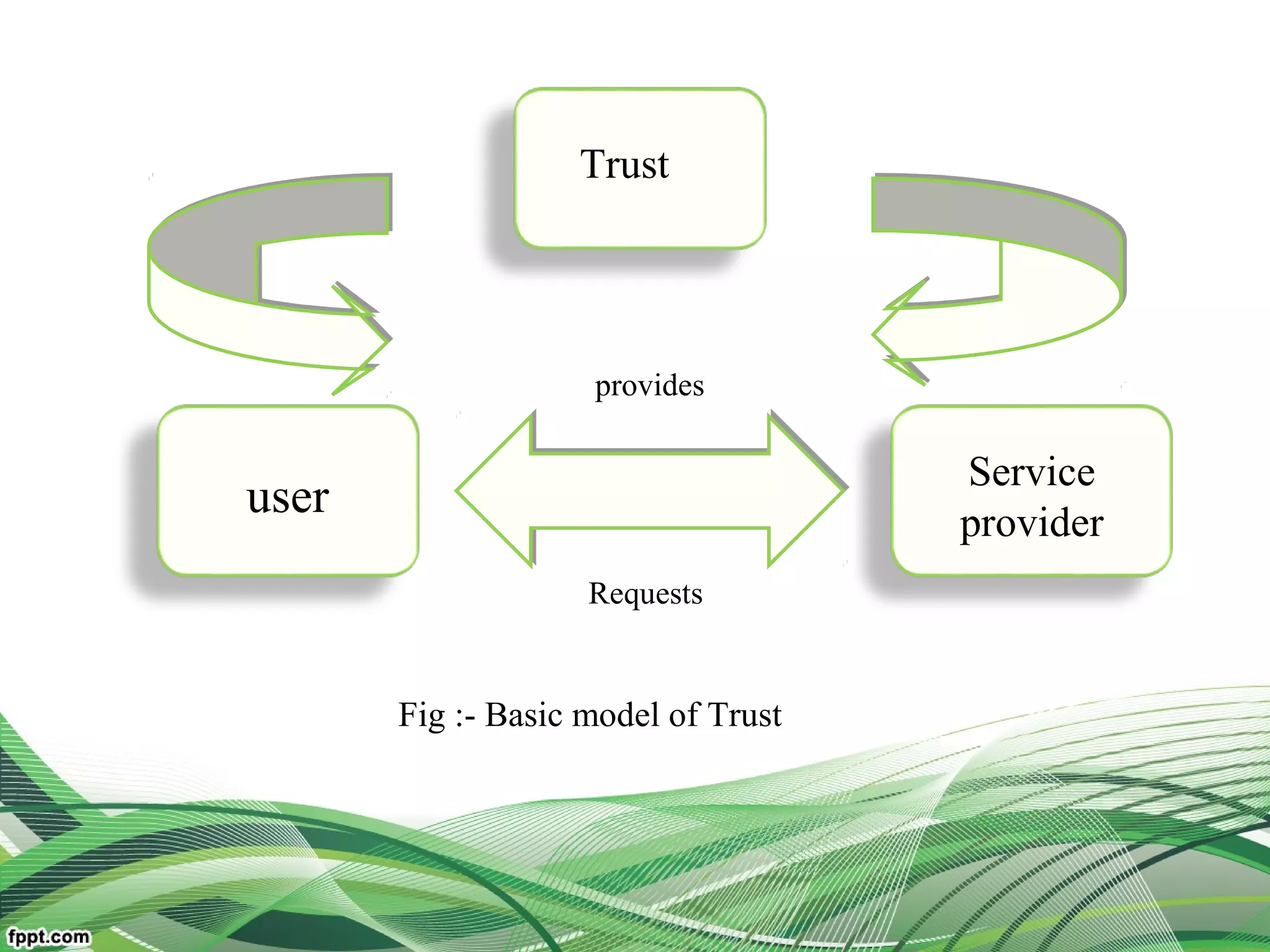
Service
provider
user
Requests
provides
Trust
Fig :- Basic model of Trust
EXISTING SYSTEM
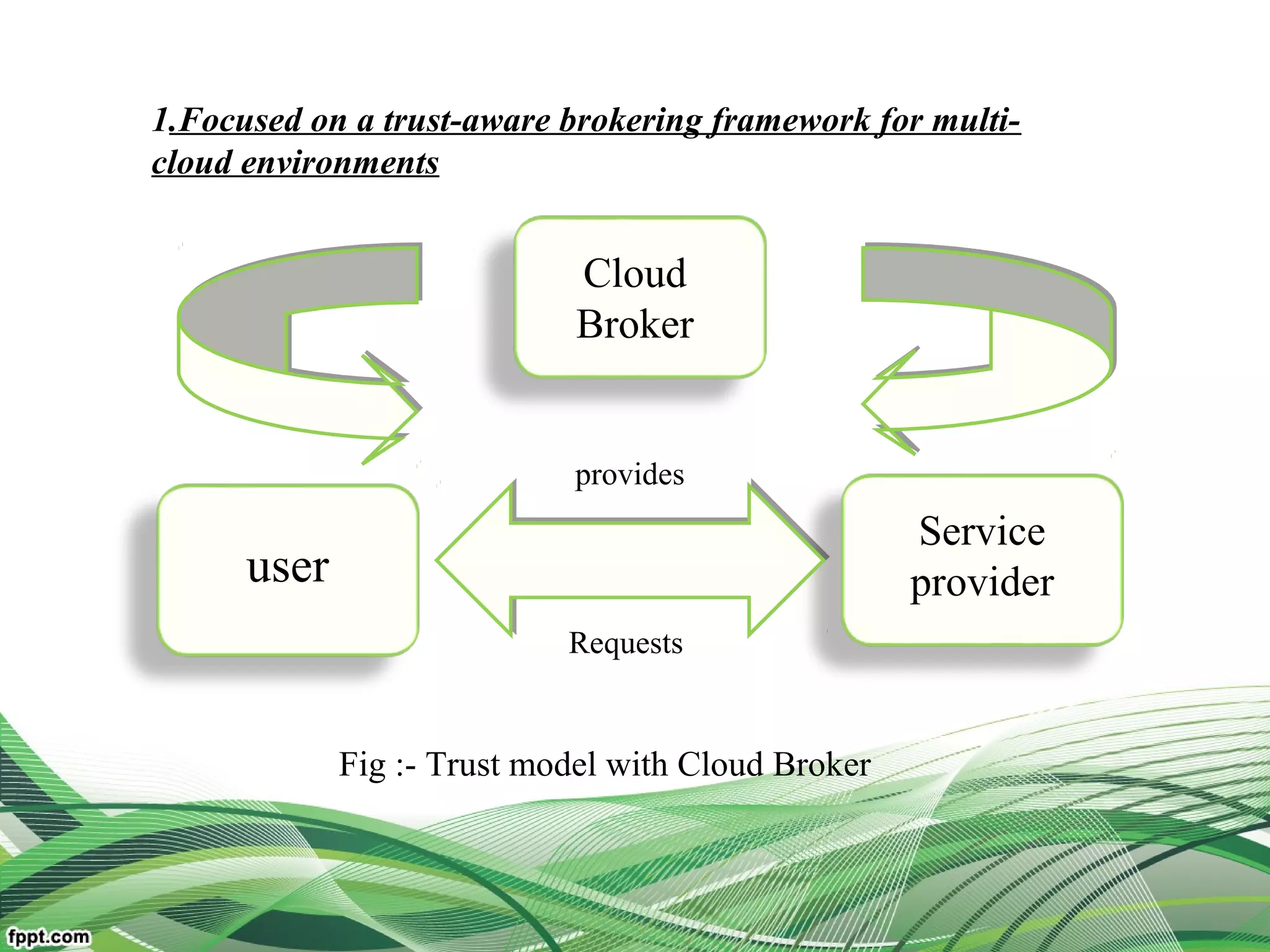
user
Service
provider
Cloud
Broker
provides
Requests
Fig :- Trust model with Cloud Broker
1.Focused on a trust-aware brokering framework for multi-
cloud environments
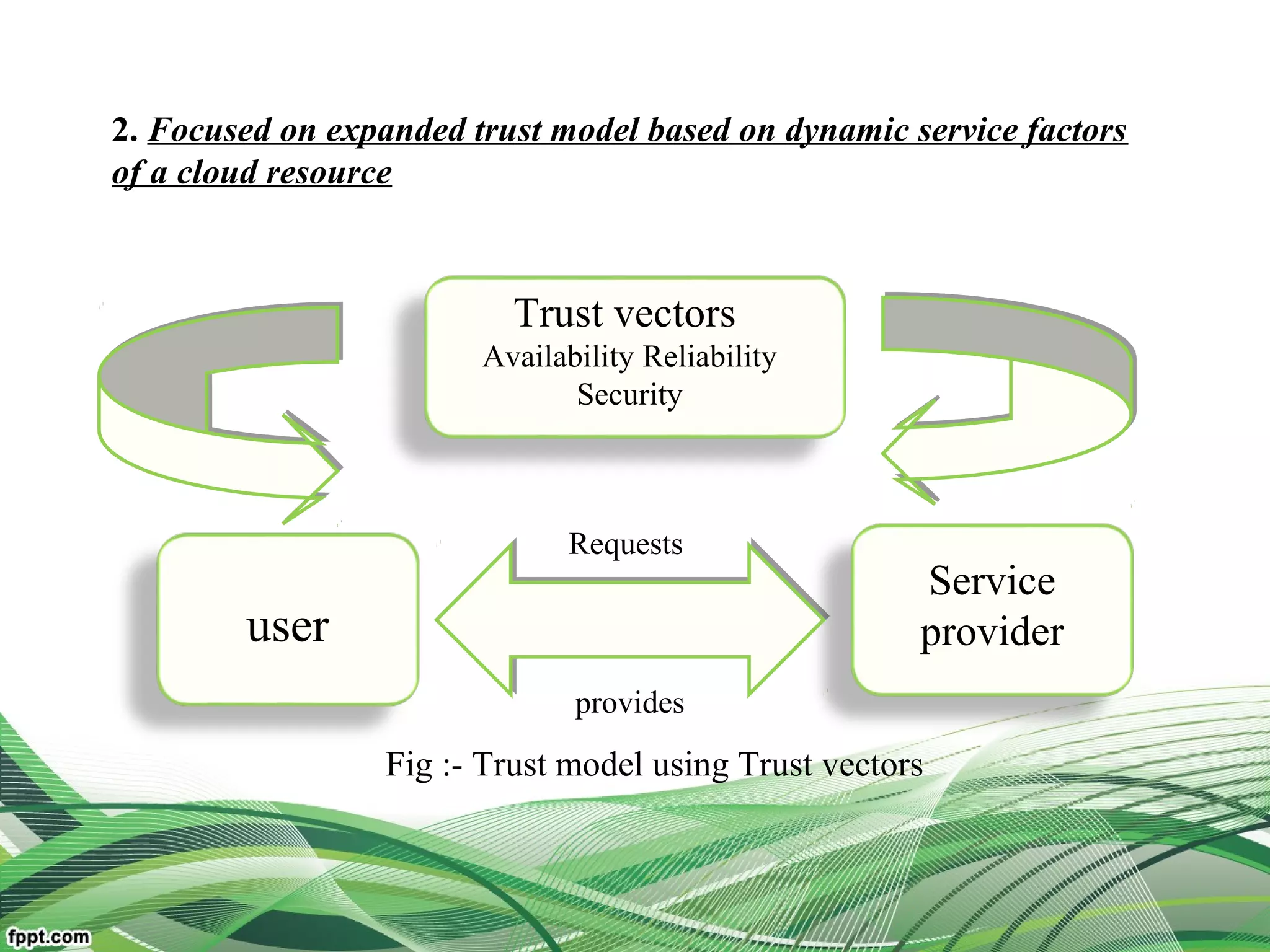
user
Service
provider
provides
Requests
Trust vectors
Availability Reliability
Security
Fig :- Trust model using Trust vectors
2. Focused on expanded trust model based on dynamic service factors
of a cloud resource
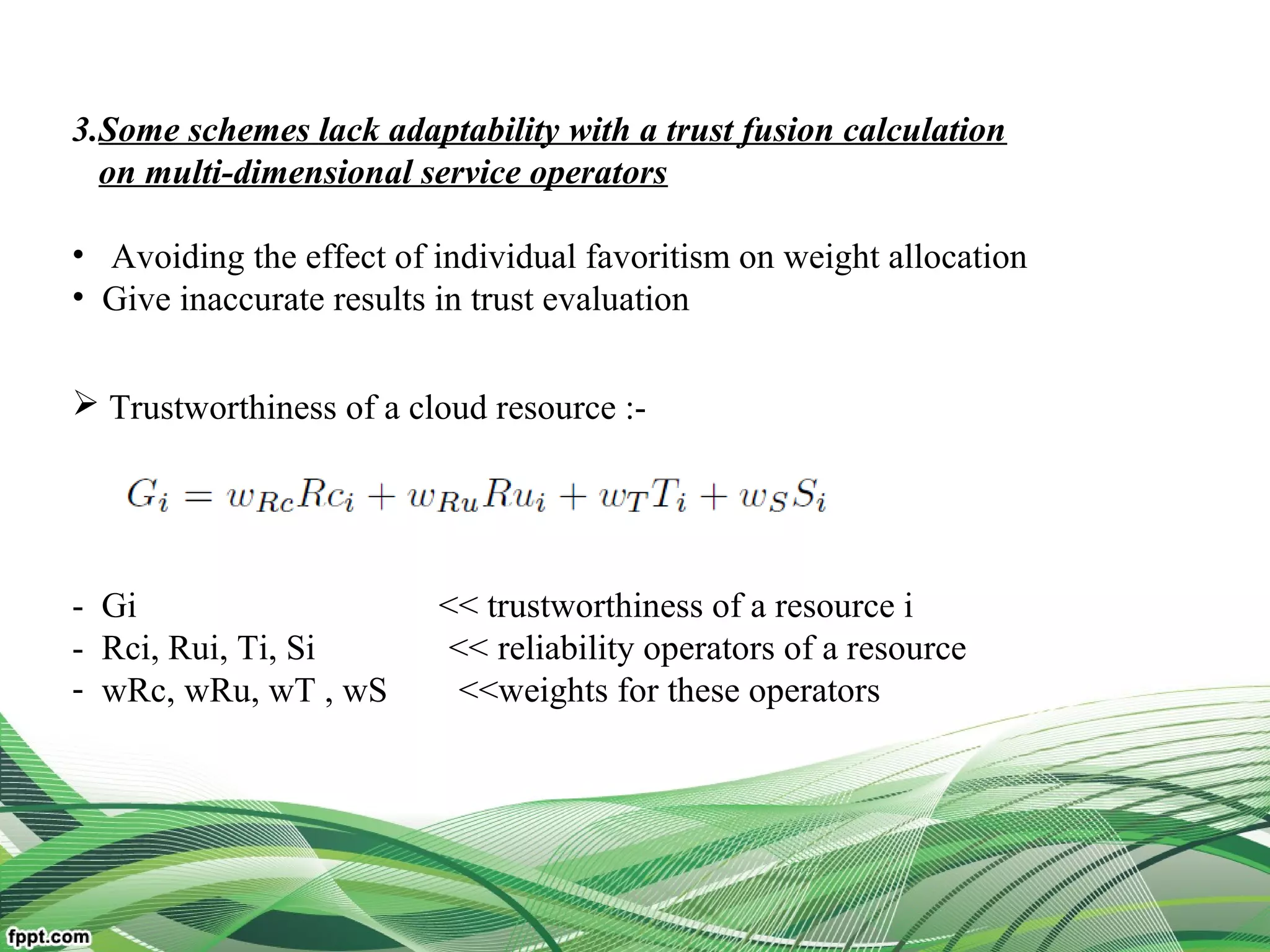
 Trustworthiness of a cloud resource :-
- Gi << trustworthiness of a resource i
- Rci, Rui, Ti, Si << reliability operators of a resource
- wRc, wRu, wT , wS <<weights for these operators
3.Some schemes lack adaptability with a trust fusion calculation
on multi-dimensional service operators
• Avoiding the effect of individual favoritism on weight allocation
• Give inaccurate results in trust evaluation
TRUST SCHEMES
 Reputations-based schemes
 Self-assessment schemes.
 TTP-based schemes
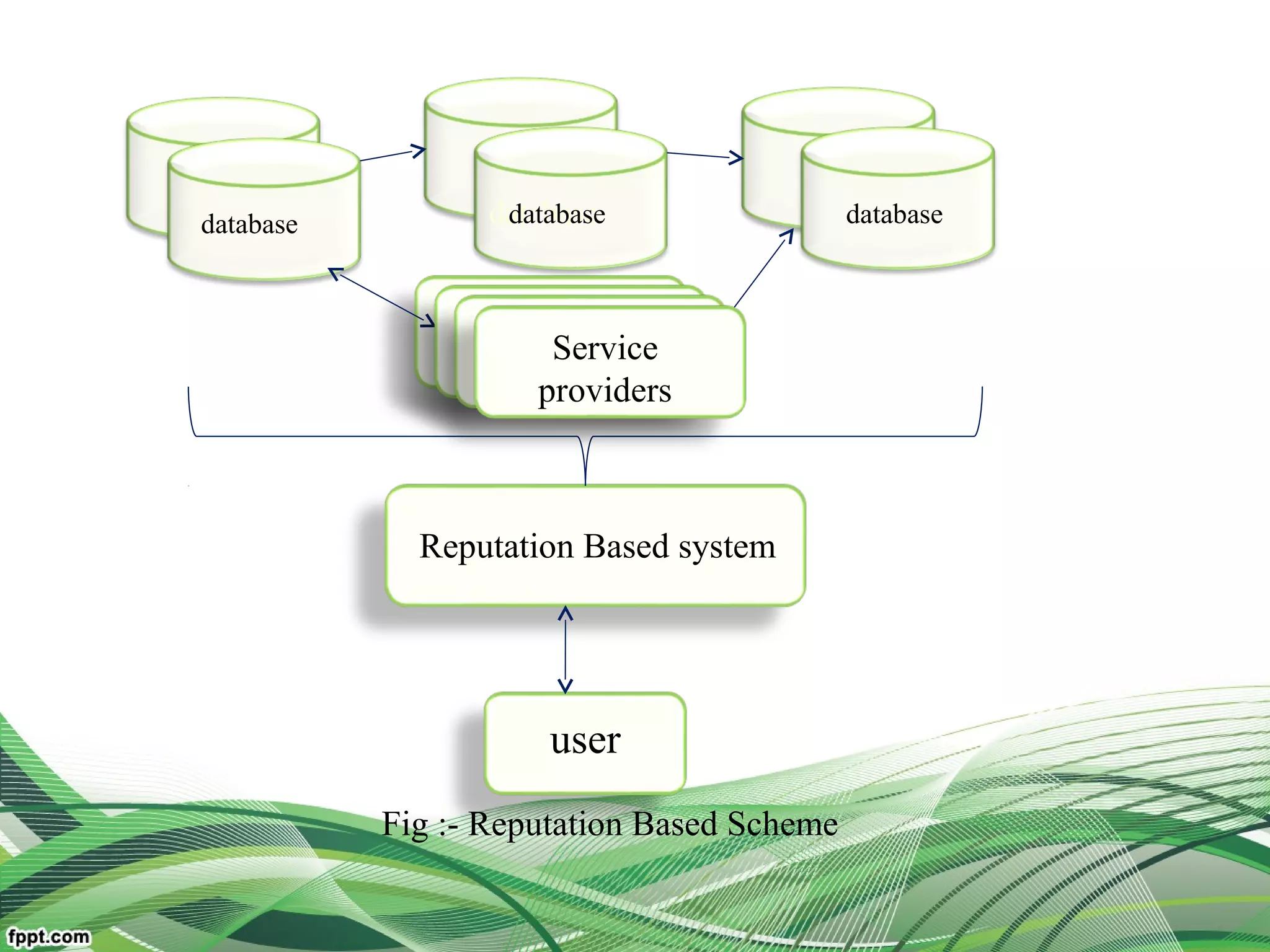
Reputation Based system
Service
providers
user
Fig :- Reputation Based Scheme
databasedatabase database database
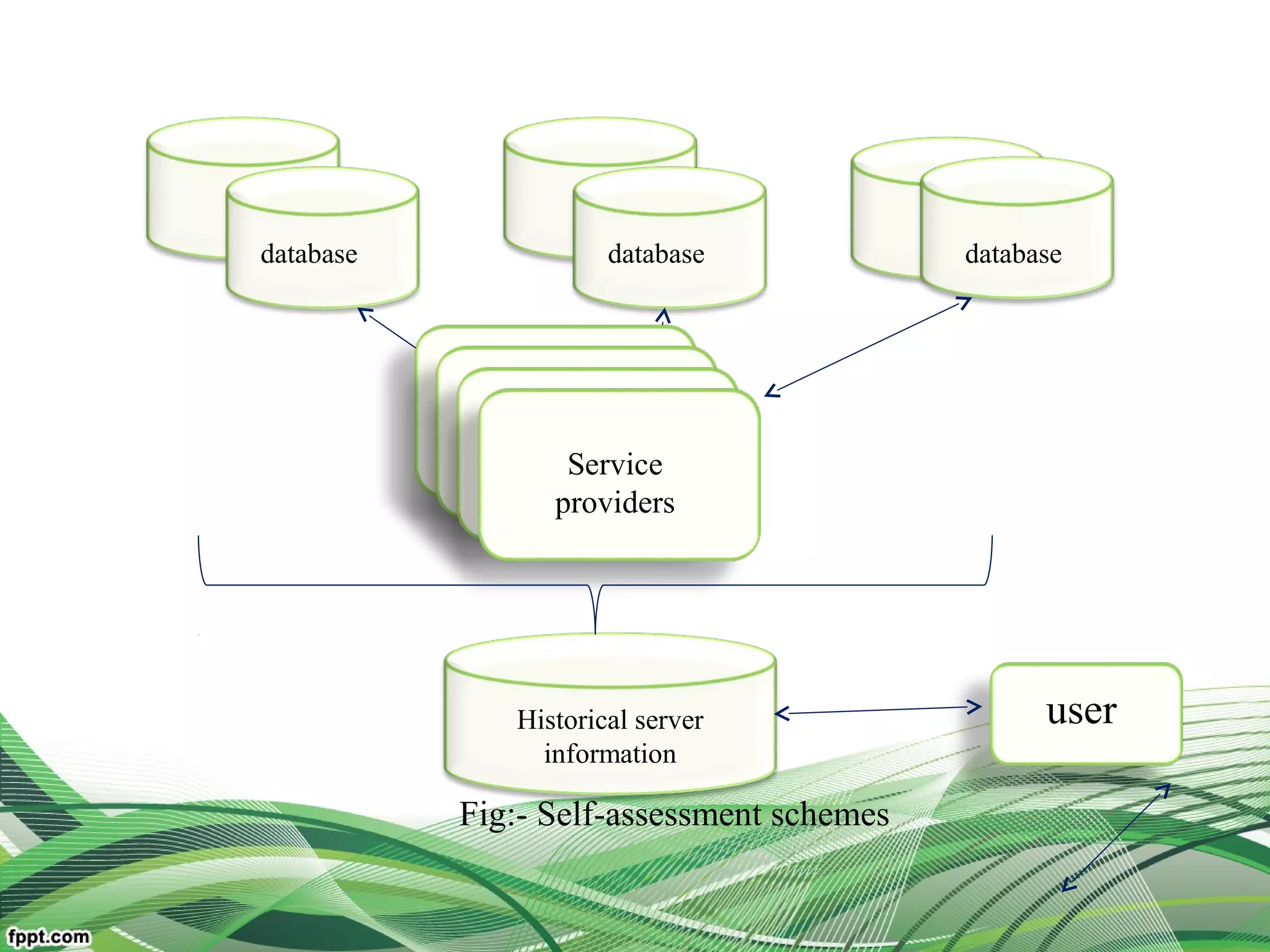
Service
providers
database databasedatabase
Historical server
information
user
Fig:- Self-assessment schemes
Service
providers
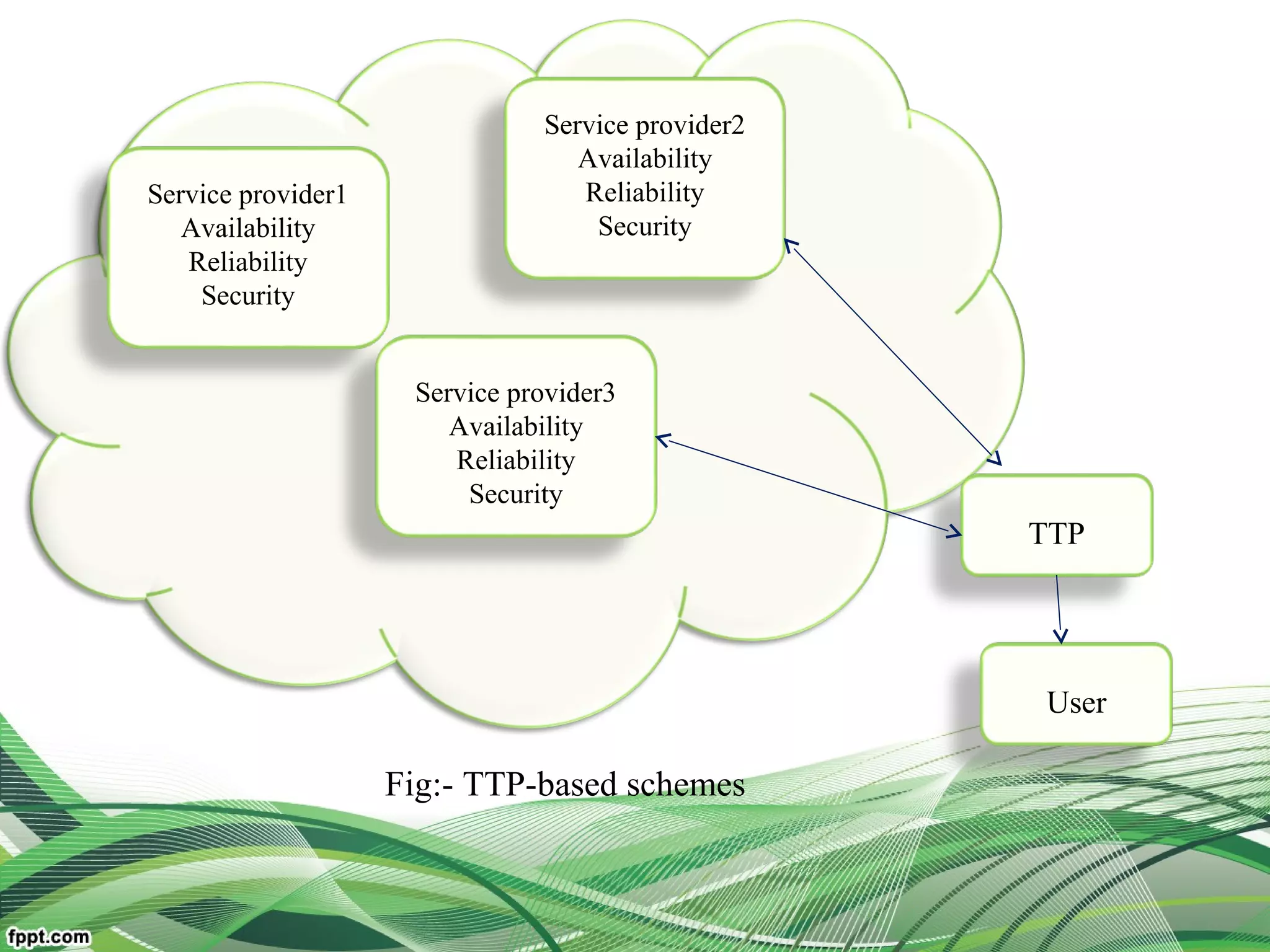
Service provider1
Availability
Reliability
Security
Service provider3
Availability
Reliability
Security
Service provider2
Availability
Reliability
Security
TTP
Fig:- TTP-based schemes
User
PROPOSED SYSTEM
 Inspired from an idea
- Service Operator-aware Trust Scheme (SOTS)
Definitions for Trust :-
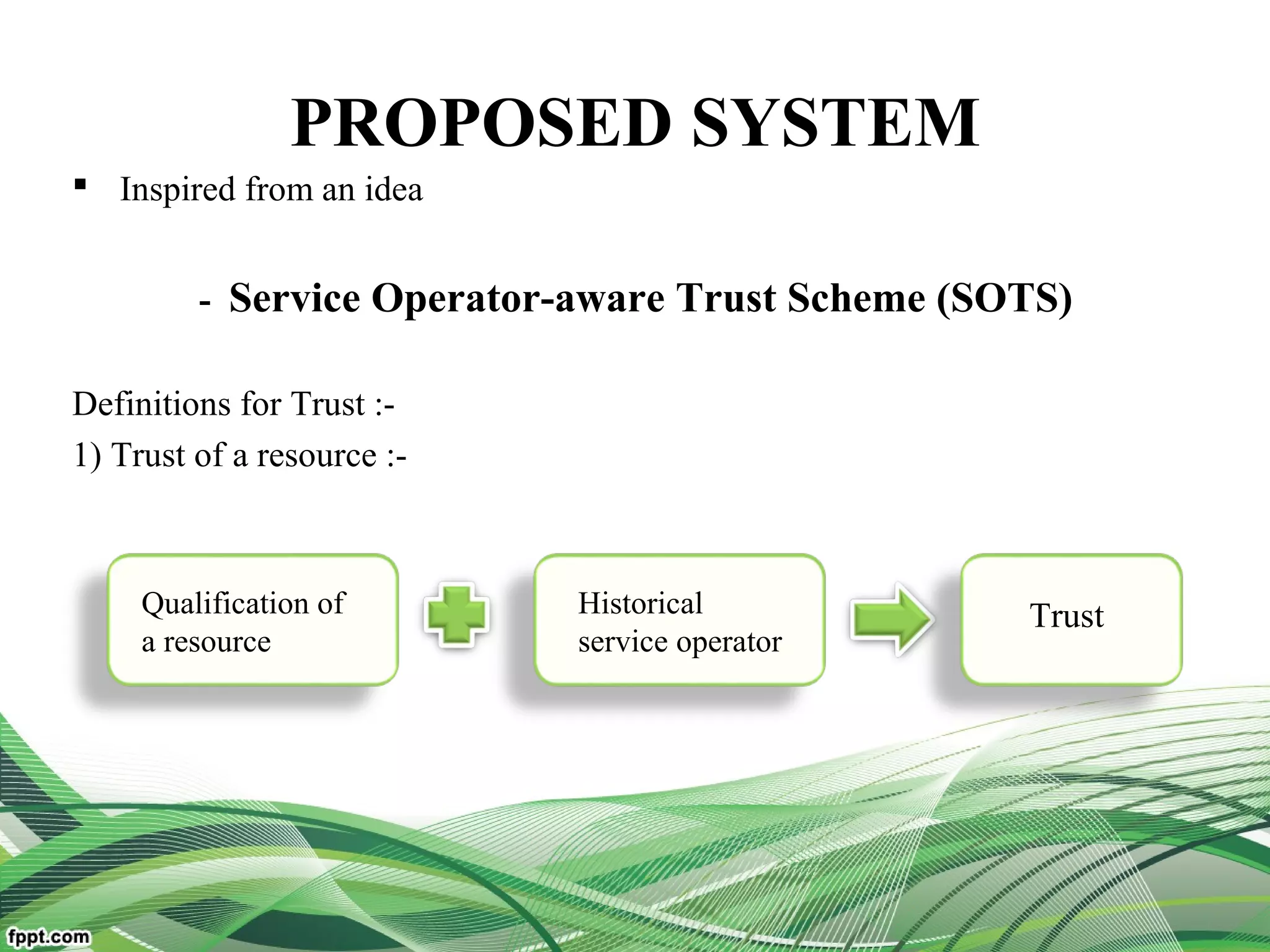
1) Trust of a resource :-
Qualification of
a resource
Historical
service operator
Trust
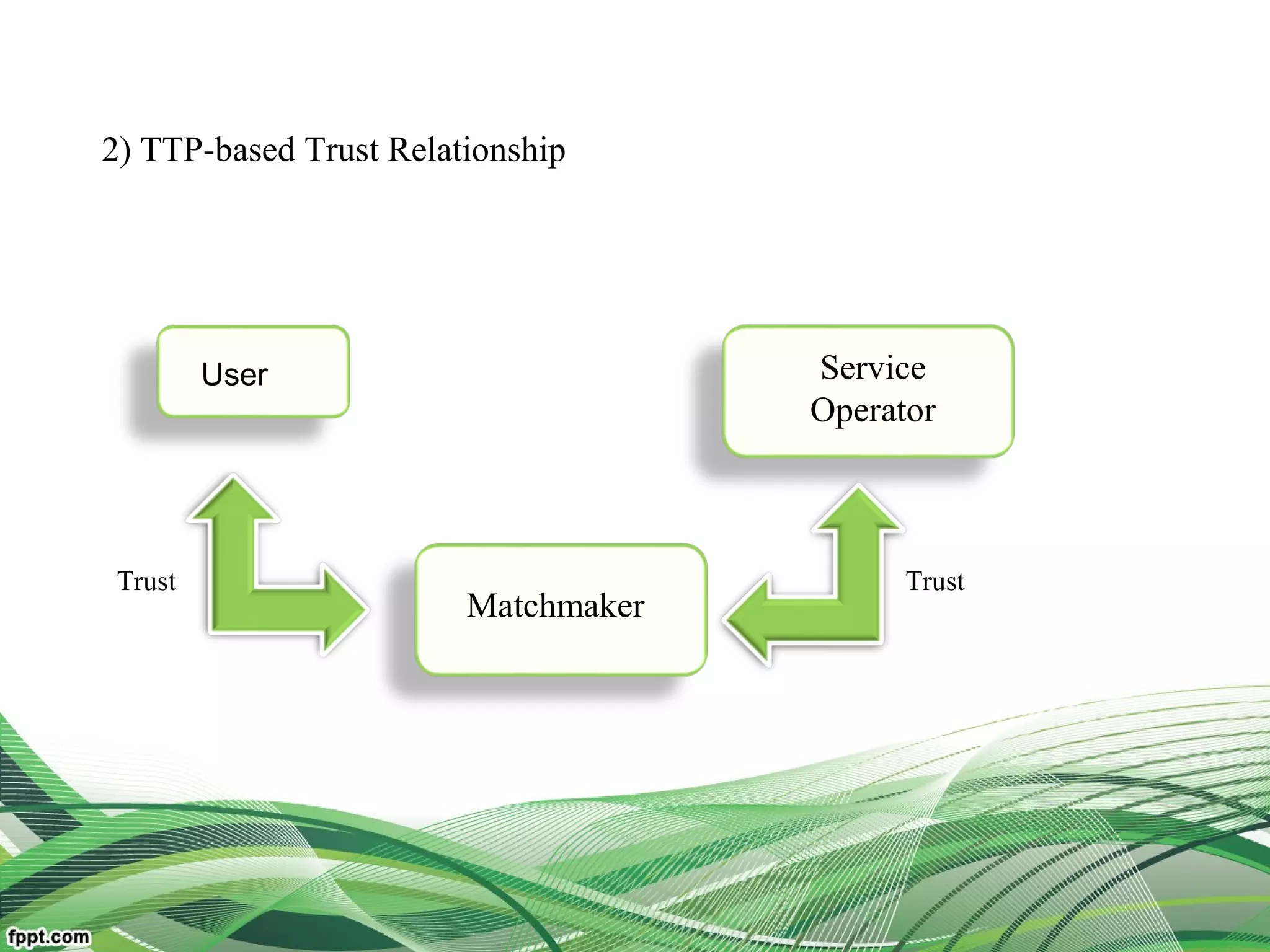
2) TTP-based Trust Relationship
Matchmaker
User Service
Operator
TrustTrust
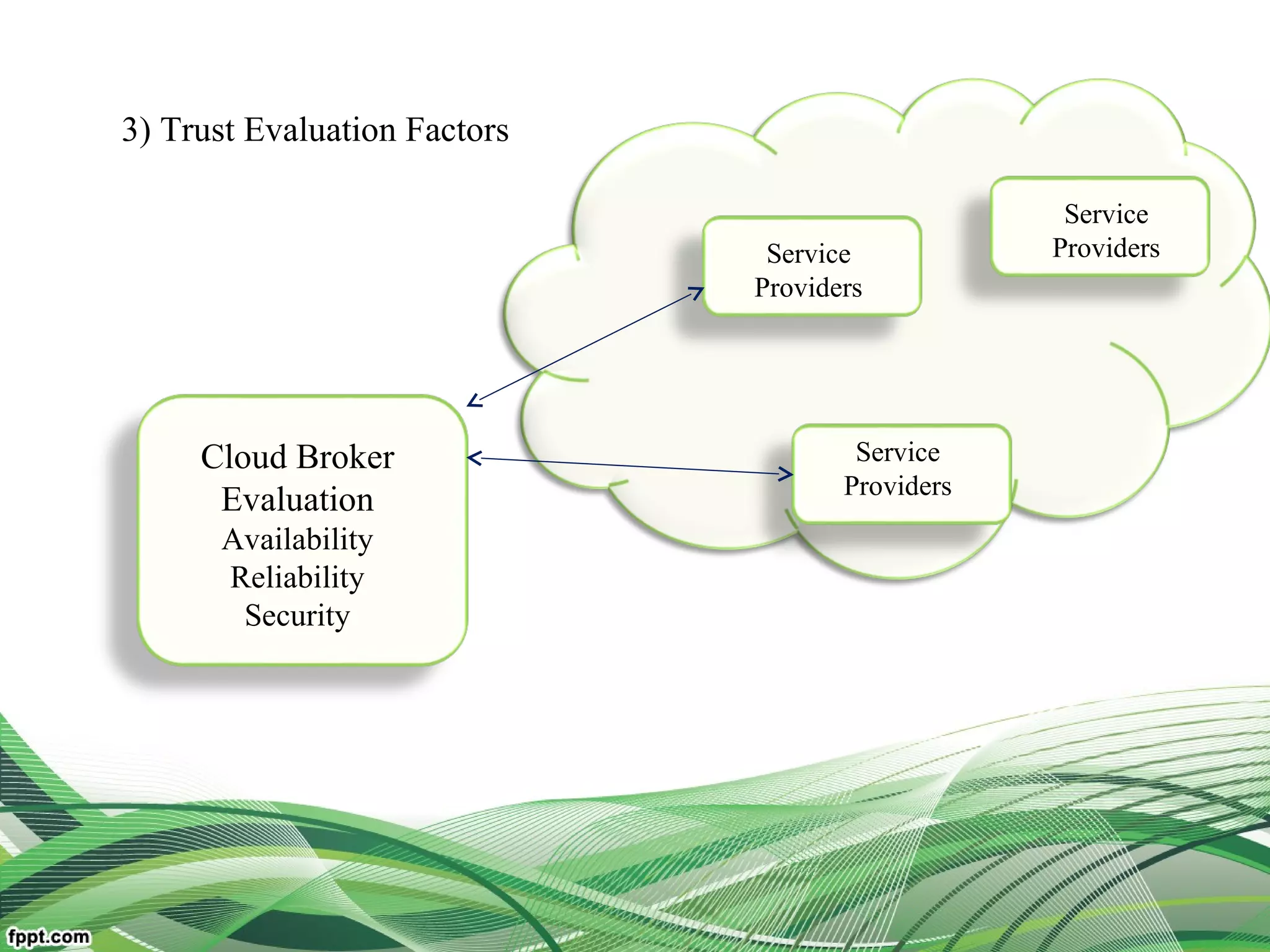
3) Trust Evaluation Factors
Service
Providers
Service
Providers
Service
Providers
Cloud Broker
Evaluation
Availability
Reliability
Security
Conceptual Model
Trust-aware Brokering System
Architecture
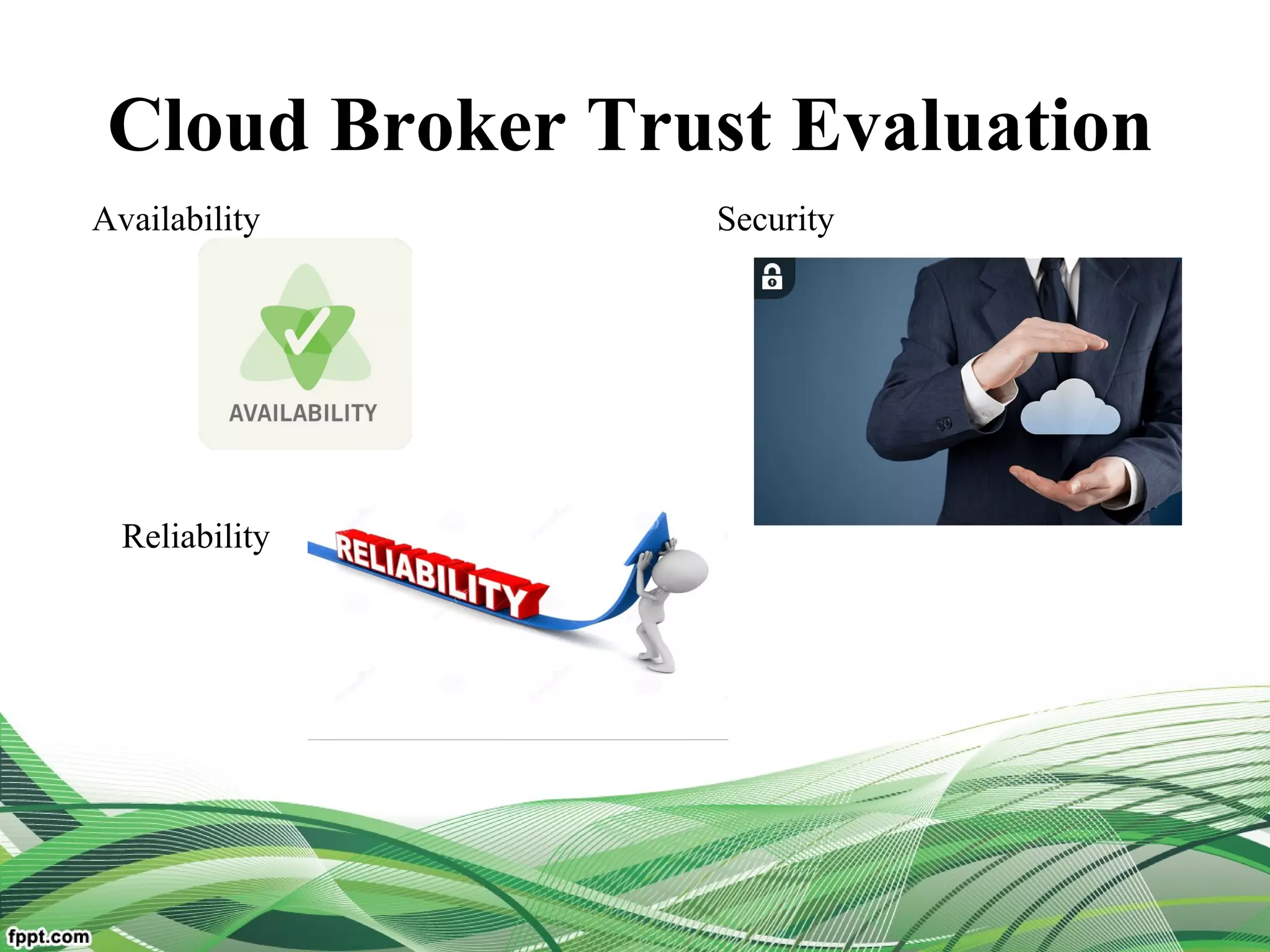
Cloud Broker Trust Evaluation
Availability Security
Reliability
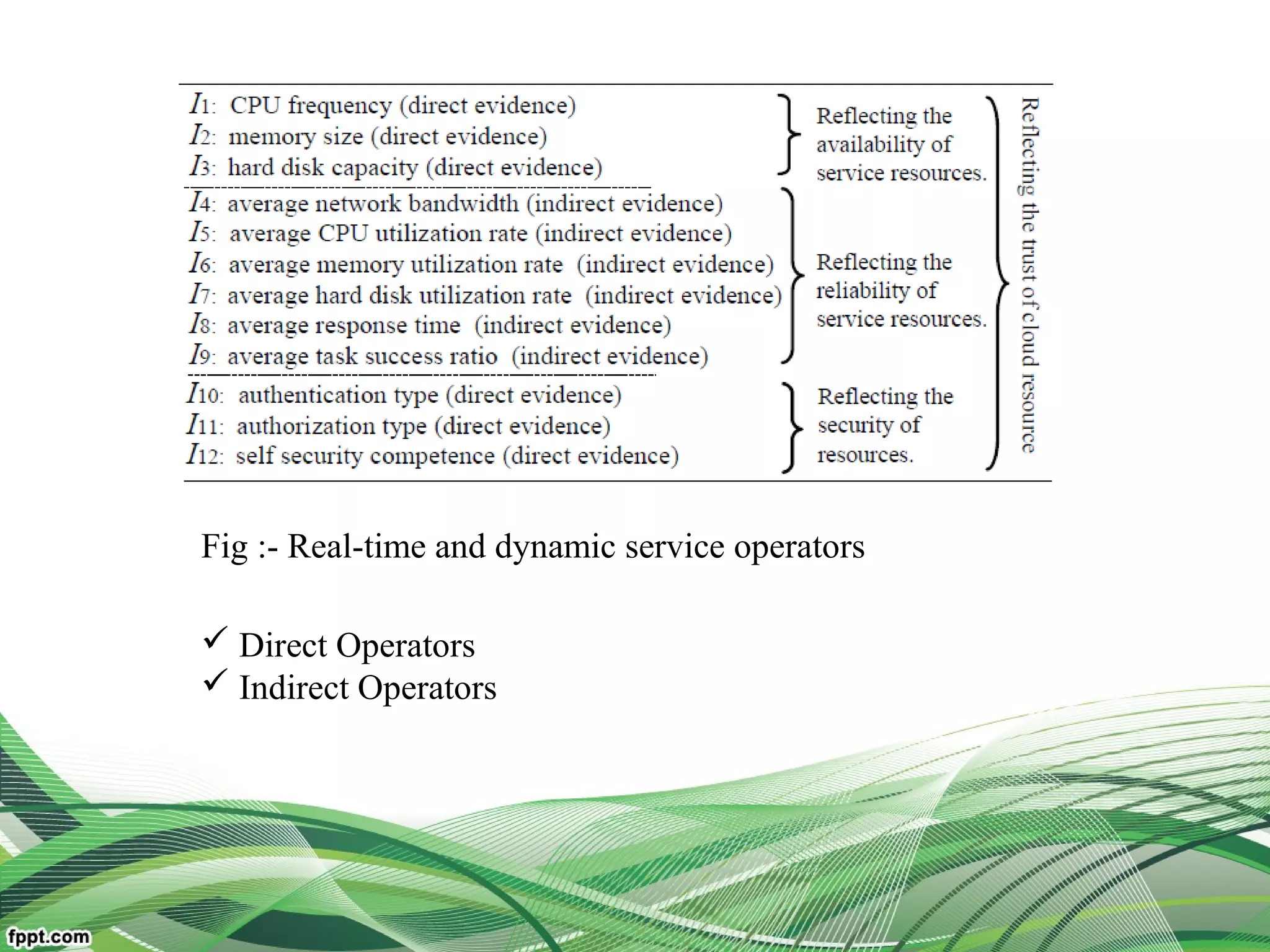
Fig :- Real-time and dynamic service operators
 Direct Operators
 Indirect Operators
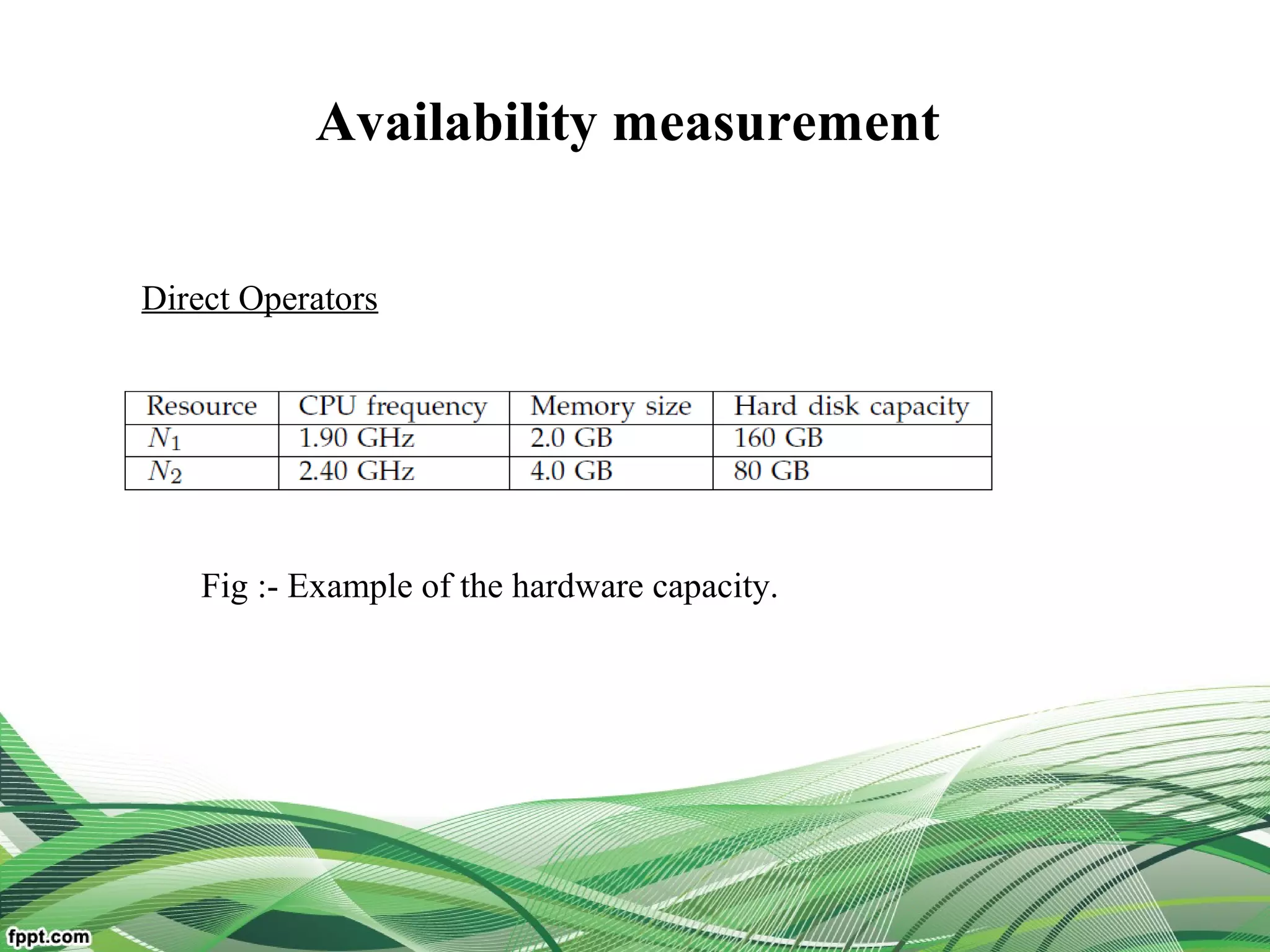
Availability measurement
Fig :- Example of the hardware capacity.
Direct Operators
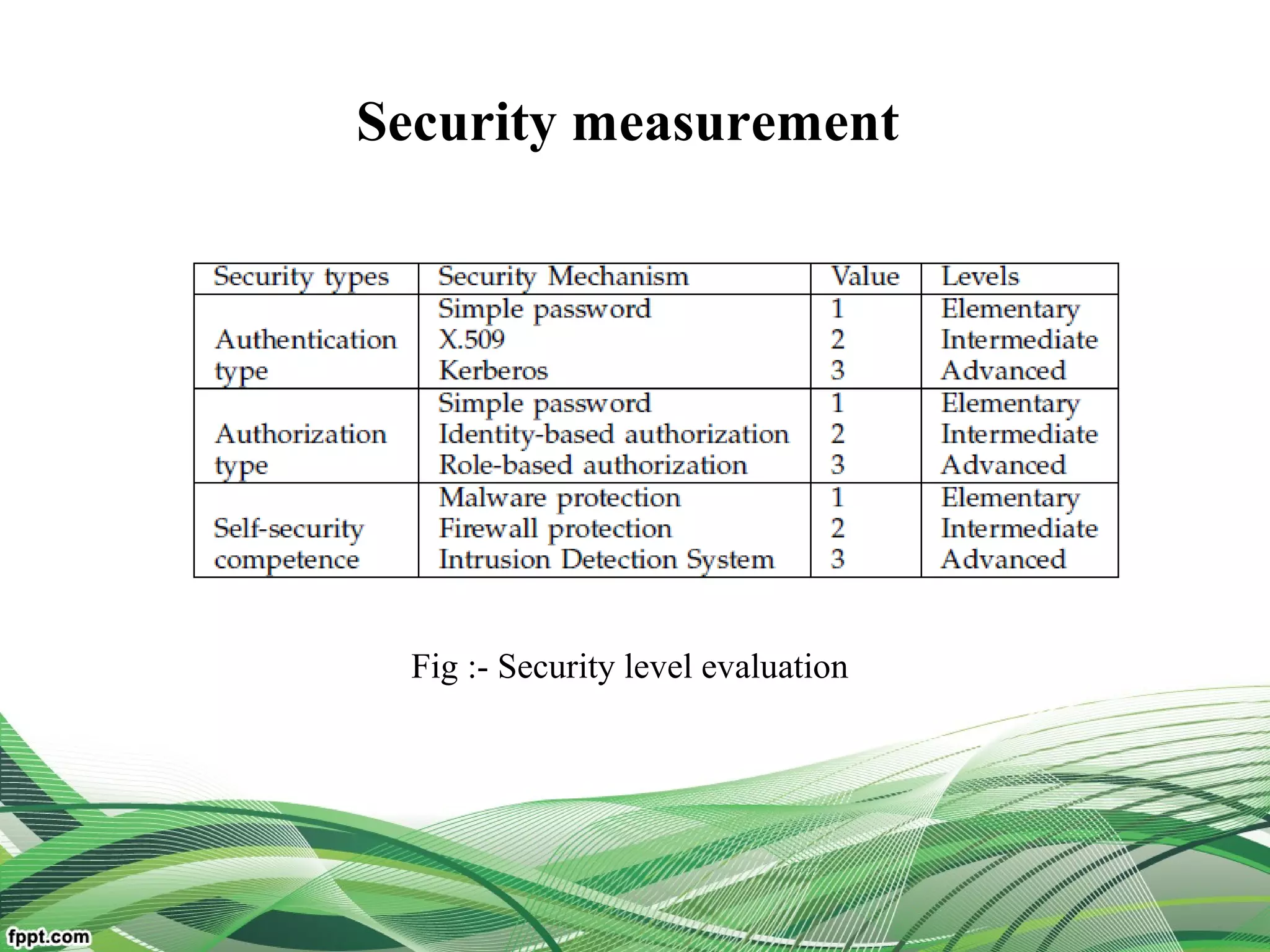
Security measurement
Fig :- Security level evaluation
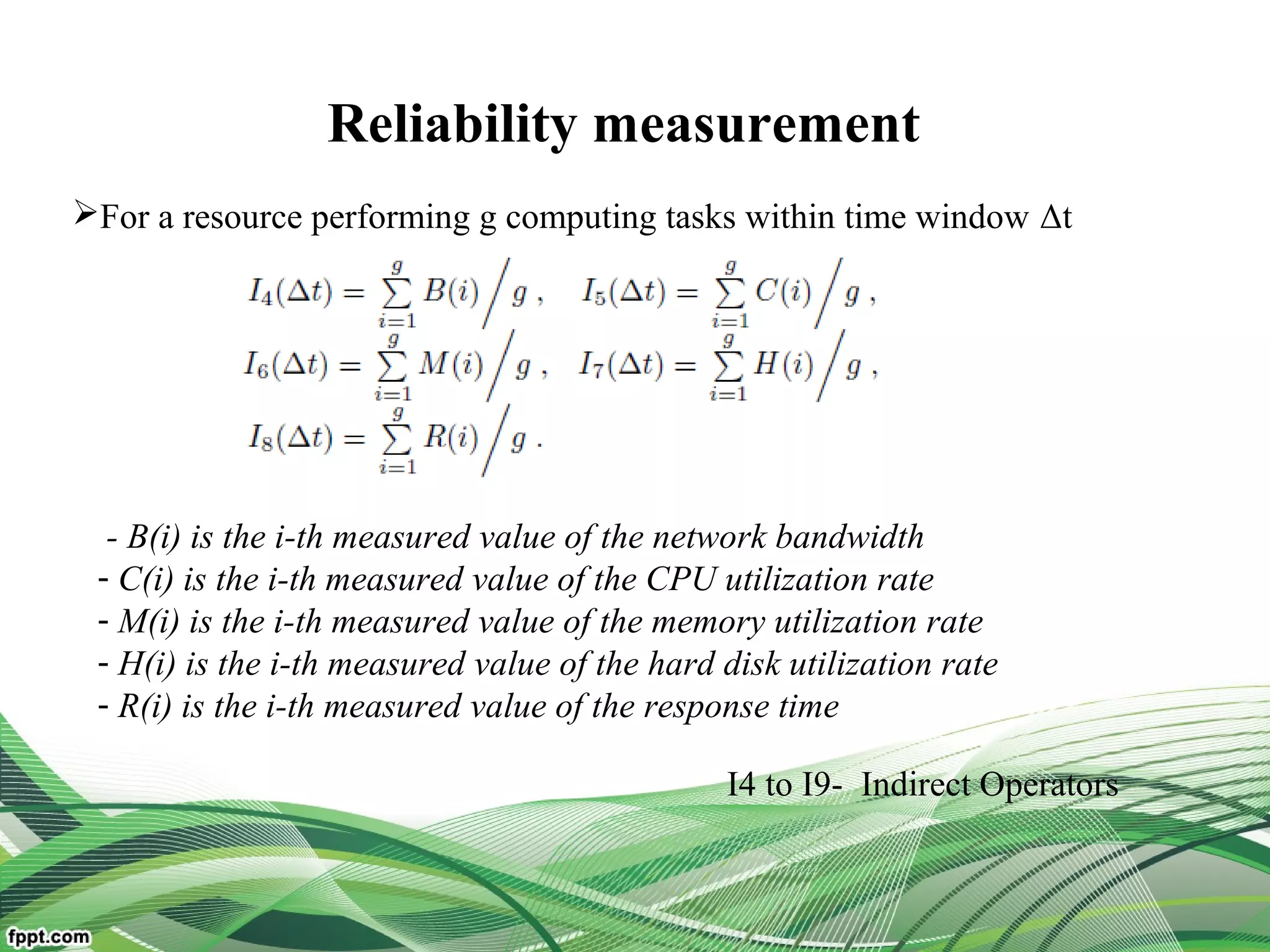
Reliability measurement
For a resource performing g computing tasks within time window Δt
- B(i) is the i-th measured value of the network bandwidth
- C(i) is the i-th measured value of the CPU utilization rate
- M(i) is the i-th measured value of the memory utilization rate
- H(i) is the i-th measured value of the hard disk utilization rate
- R(i) is the i-th measured value of the response time
I4 to I9- Indirect Operators
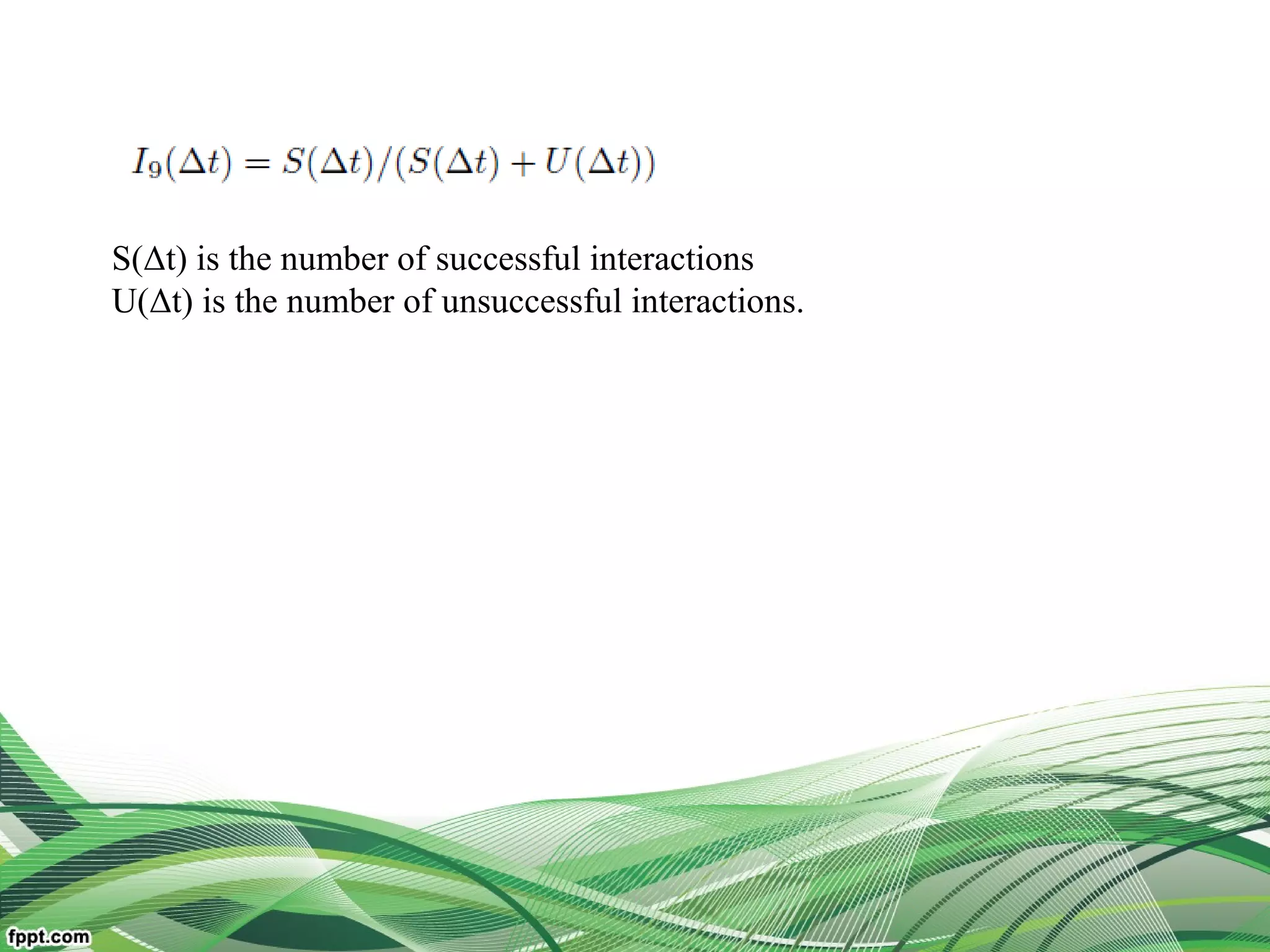
S(Δt) is the number of successful interactions
U(Δt) is the number of unsuccessful interactions.
ADAPTIVE AND EFFICIENT
TRUST EVALUATION
 Evaluation Matrix Normalization
 Real-trust Trust Degree (RTD)
 Entropy-based and Adaptive Weight Calculation
 Global Trust Degree (GTD)
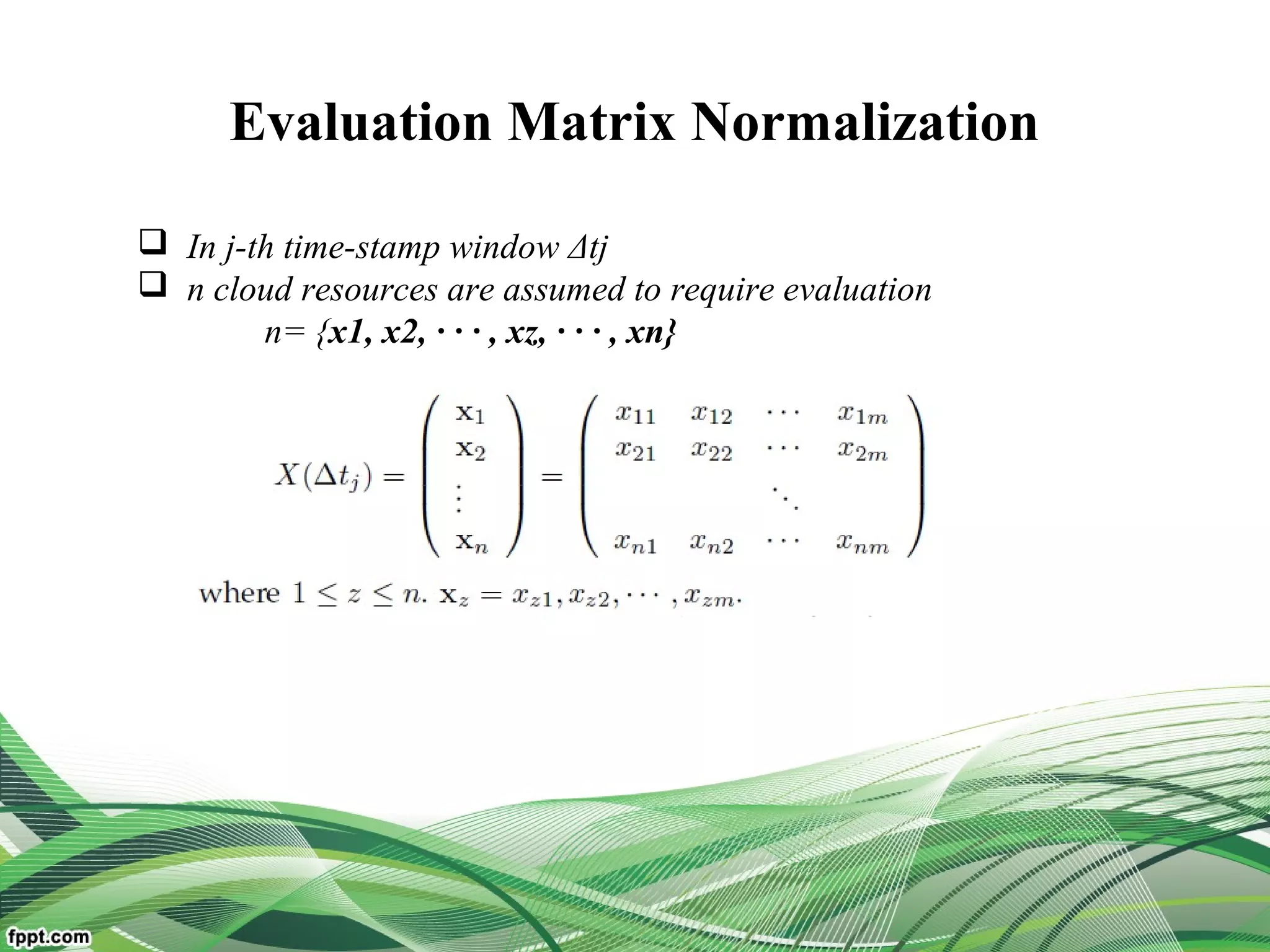
Evaluation Matrix Normalization
 In j-th time-stamp window Δtj
 n cloud resources are assumed to require evaluation
n= {x1, x2, · · · , xz, · · · , xn}
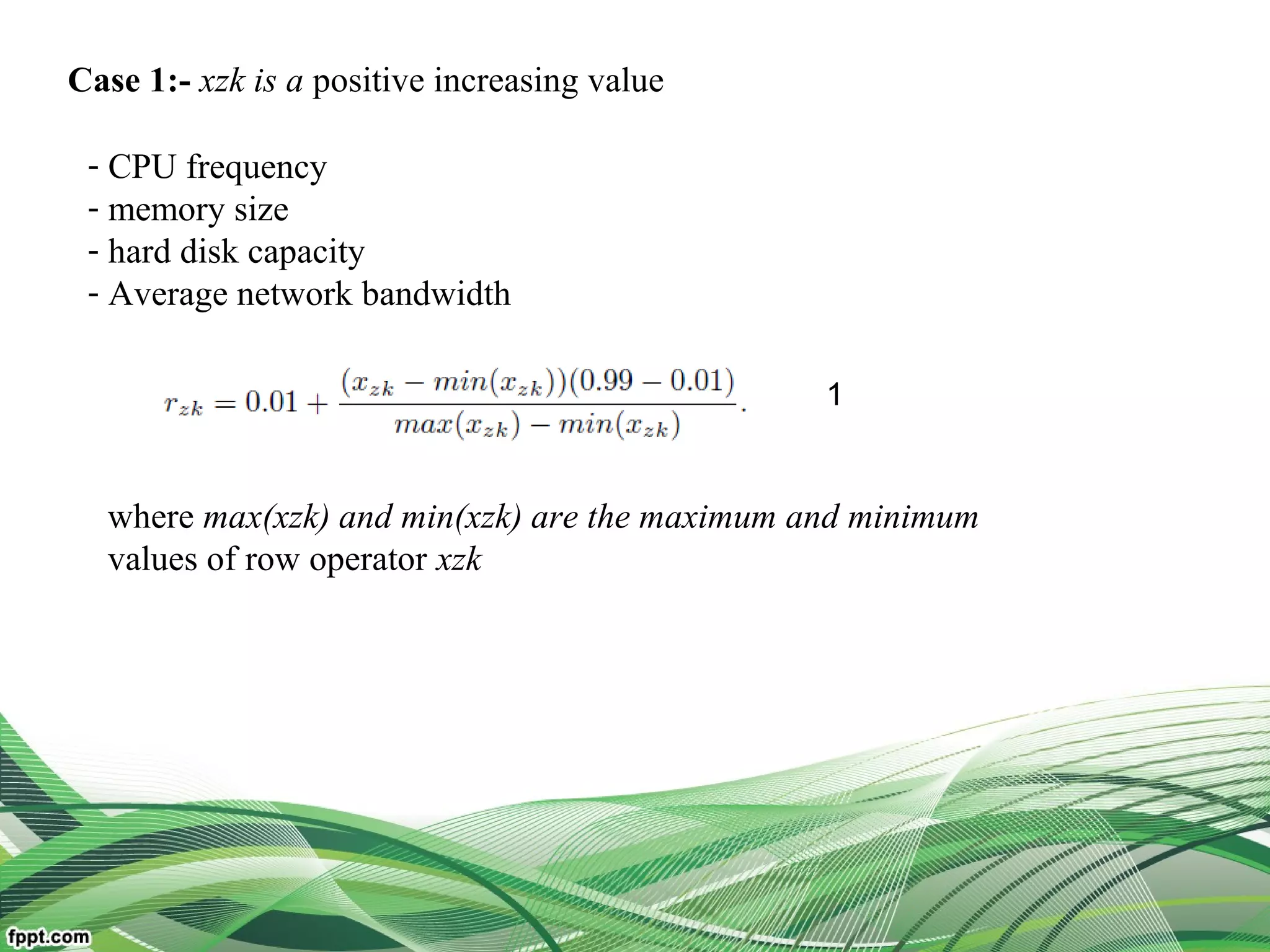
Case 1:- xzk is a positive increasing value
- CPU frequency
- memory size
- hard disk capacity
- Average network bandwidth
where max(xzk) and min(xzk) are the maximum and minimum
values of row operator xzk
1
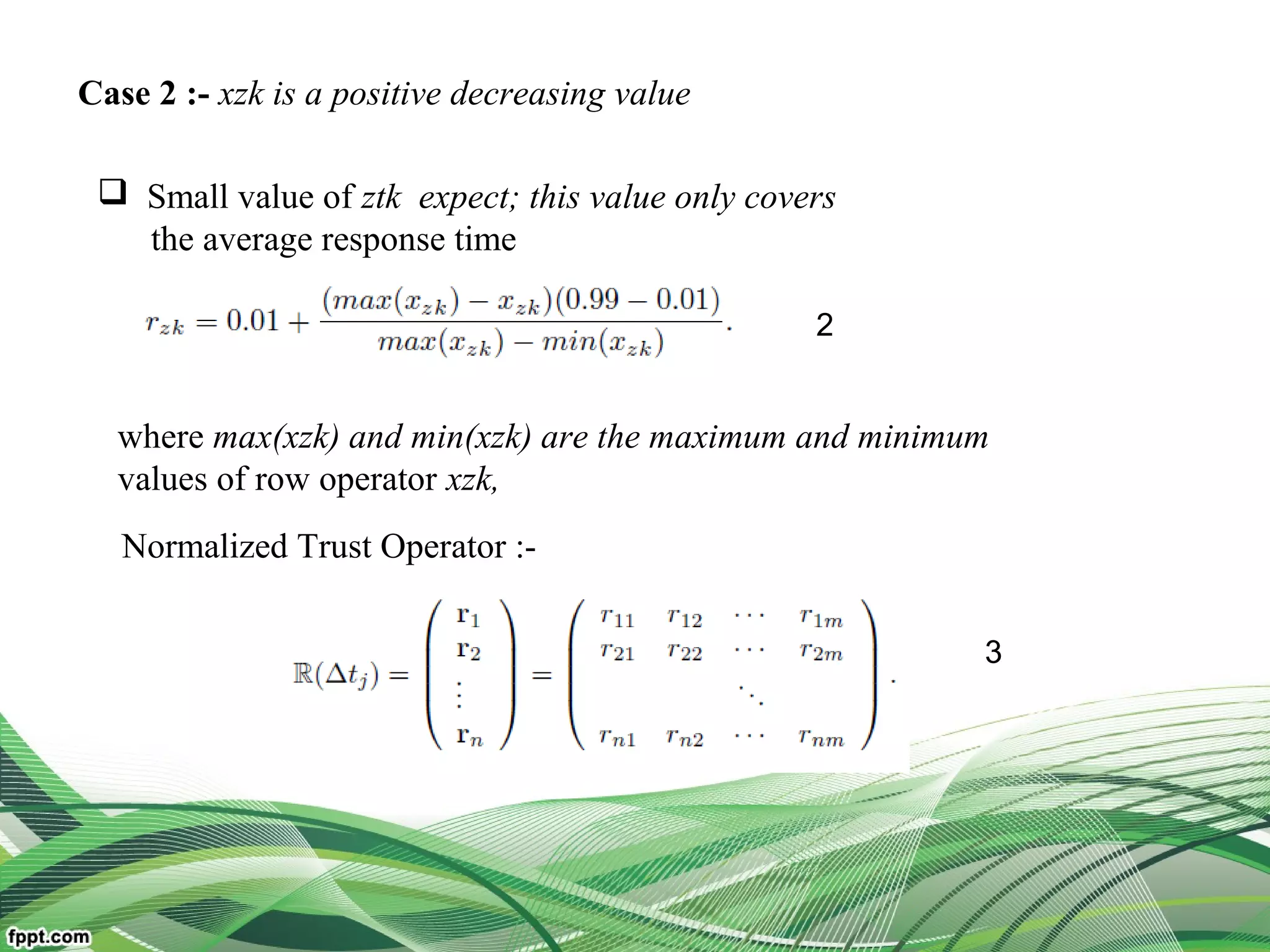
Case 2 :- xzk is a positive decreasing value
 Small value of ztk expect; this value only covers
the average response time
where max(xzk) and min(xzk) are the maximum and minimum
values of row operator xzk,
2
Normalized Trust Operator :-
3
Real-trust Trust Degree (RTD)
 Evaluate recent cloud resource service operators
 Evaluated by resource’s quality of service
- time window-based trusted indicator for service operators
- more sensitive to new operators
- generates time window interaction takes place b/w user and
resource
 Definition :-
Ω = {N1,N2, · · · ,Nn} denotes n registered resources in the broker
TNz(Δtj) denote the RTD of resource Nn
TNz(Δtj) = rz × W
rz=(rz1, rz2, · · · , rzk, · · · , rzm),
W = { 1, 2, · · · ,ϖ ϖ ϖk, · · ·ϖm} ϖk [0, 1],∈
Entropy-based and Adaptive Weight
Calculation
 Adaptive data fusion tool
 A low time and space overhead in dealing with large-scale data
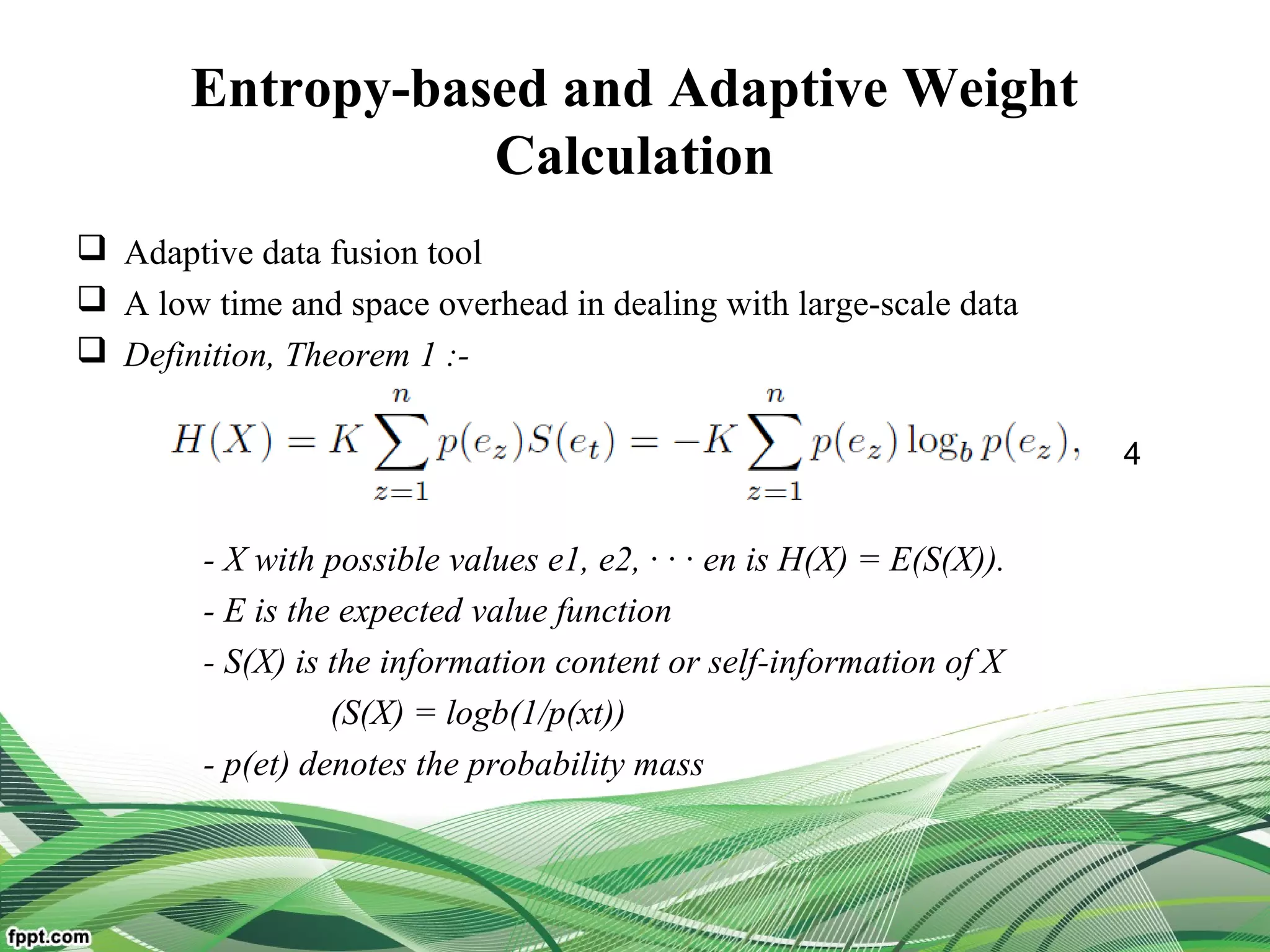
 Definition, Theorem 1 :-
- X with possible values e1, e2, · · · en is H(X) = E(S(X)).
- E is the expected value function
- S(X) is the information content or self-information of X
(S(X) = logb(1/p(xt))
- p(et) denotes the probability mass
4
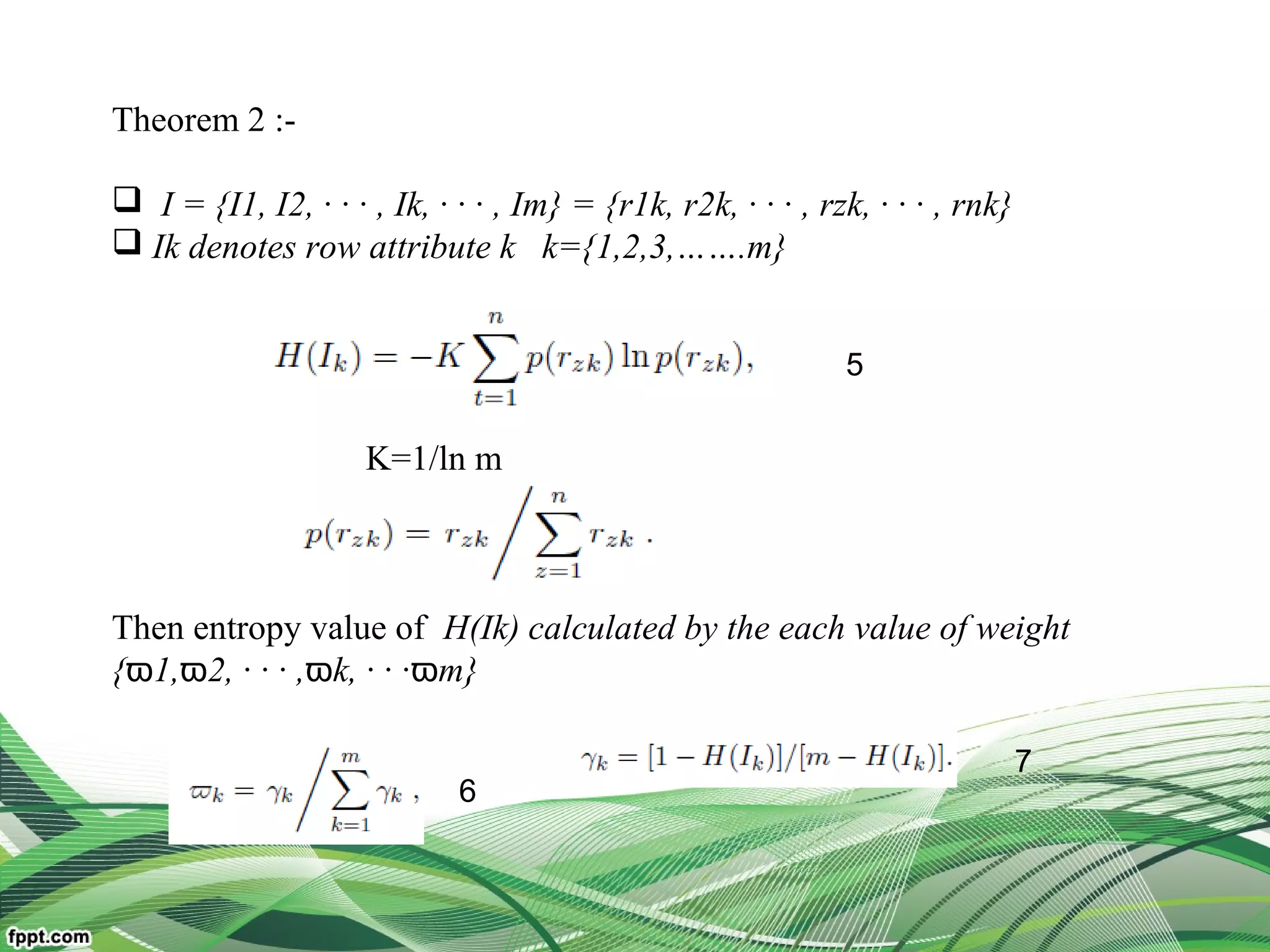
Theorem 2 :-
 I = {I1, I2, · · · , Ik, · · · , Im} = {r1k, r2k, · · · , rzk, · · · , rnk}
 Ik denotes row attribute k k={1,2,3,…….m}
K=1/ln m
Then entropy value of H(Ik) calculated by the each value of weight
{ 1, 2, · · · ,ϖ ϖ ϖk, · · ·ϖm}
5
6
7
Global Trust Degree (GTD)
 Time window v = (Δt1,Δt2, · · · ,Δtn)
 Time series D = {TNi(Δt1), TNi(Δt2), · · · , TNi(Δtn)}
A = {a(Δt1), a(Δt2), · · · , a(Δtj), · · · , a(Δtn)}
a(Δtj) [0, 1] is the weights assigned∈ to each RTD TNi(Δtj)
λ [0, 1]∈
8
9
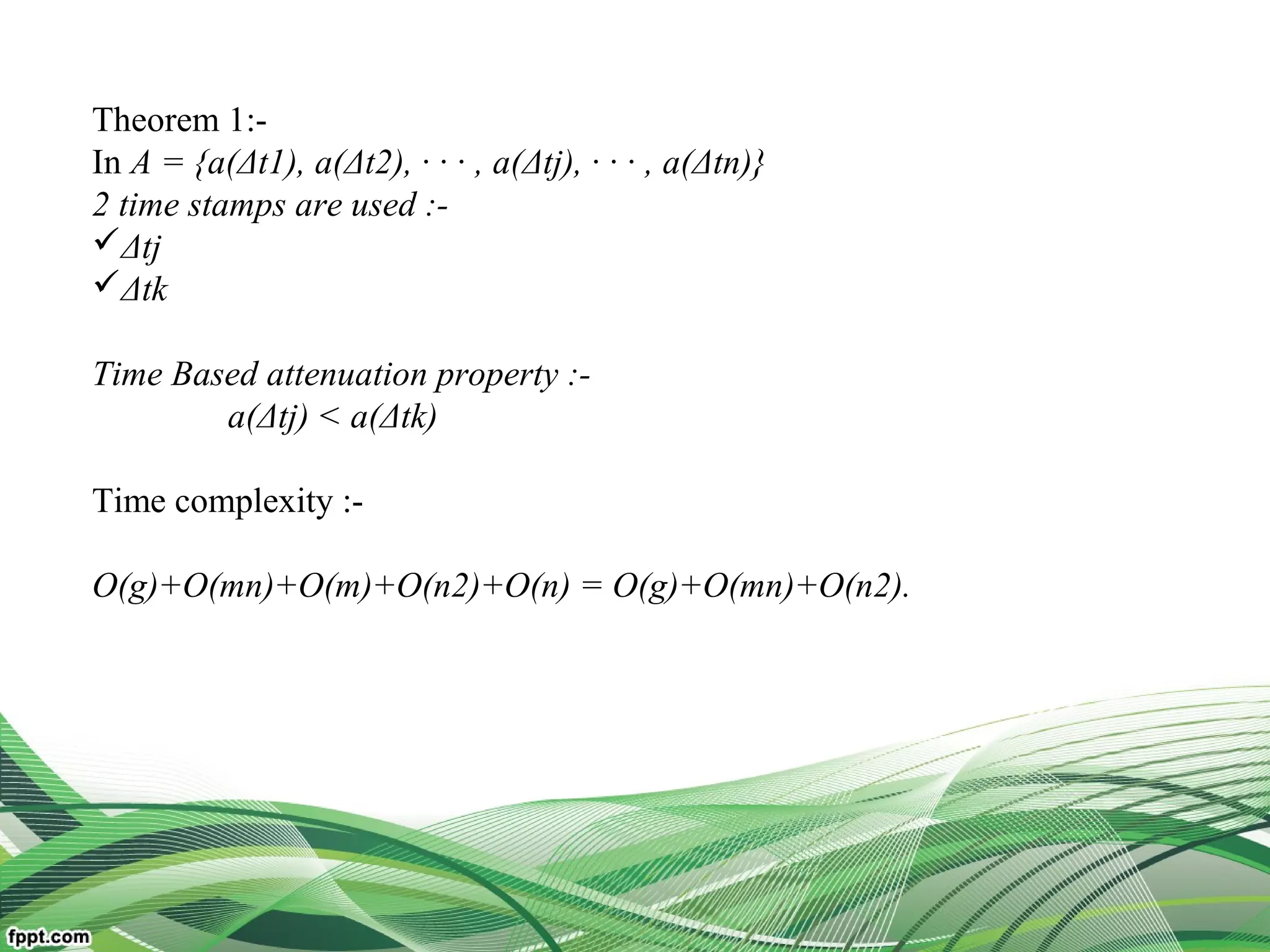
Theorem 1:-
In A = {a(Δt1), a(Δt2), · · · , a(Δtj), · · · , a(Δtn)}
2 time stamps are used :-
Δtj
Δtk
Time Based attenuation property :-
a(Δtj) < a(Δtk)
Time complexity :-
O(g)+O(mn)+O(m)+O(n2)+O(n) = O(g)+O(mn)+O(n2).
Conclusion
Here explains a new scheme knows as SOTS
 For resource matchmaking across multiple clouds
 Explain relationship between the users, broker, the service
resources(middleware framework of trust)
 Reduce user burden and improve system dependability
 Model the problem of trust evaluation by multi-attribute decision-making
 Develop an adaptive trust evaluation approach on information entropy
theory
 To overcome the limitations of traditional trust schemes
 the broker can efficiently and accurately prepare the most trusted resources
 provide more dependable resources to users
Advantages
 Trust management scheme for multi-cloud, multi-dimensional resource
services
 Adaptive fused computing approach for dynamic service operators,
entropy theory
 FSLA mechanism overcomes trust initialization problem for newly
registered resources.
Disadvantages and Future Scope
1) Combining trust scheme with reputation management to concerns users’
feedback
2) Universal measurement and quantitative method to assess the security
levels of a resource
3) Evaluation of the proposed scheme in a larger-scale multiple cloud
environment
Applications
References
1. K. M. Khan, Q. Malluhi, “Establishing Trust in Cloud Comput-ing”,
IEEE IT Professional, vol. 12, no. 5, 2010, pp. 20-27.
2. K. Hwang, D. Li, “Trusted Cloud Computing with Secure Resources and
Data Coloring”, IEEE Internet Computing, vol. 14, no. 5, 2010, pp. 14-
22.
3. H. Kim, H. Lee, W. Kim, Y. Kim, “A Trust Evaluation Model for QoS
Guarantee in Cloud Systems”, International Journal of Grid and
Distributed Computing, vol.3, no.1, pp. 1-10, 2010.
4. P. D. Manuel, S. Thamarai Selvi, M. I. A. E. Barr, “Trust management
system for grid and cloud resources”, Proc. of the First International
Conference on Advanced Computing (ICAC 2009), 2009, 13-15 Dec, pp.
176-181.
END OF PRESENTATION
THANK YOU…...
ANY DOUBTS ??…..

cloud computing- service operator aware trust scheme

  • 1.
    Service Operator-aware TrustScheme for Resource Matchmaking across Multiple Clouds Presented by Jisa Joy Guided by Er. Asha Yeldose
  • 2.
    ABSTRACT  Service Operator-awareTrust Scheme (SOTS)[multi-dimentional resource service operator]  For resource matchmaking across multiple clouds  Explain relationship between the users, broker, the service resources(middleware framework of trust)  Reduce user burden and improve system dependability  Model the problem of trust evaluation by multi-attribute decision-making  Develop an adaptive trust evaluation approach on information entropy theory  To overcome the limitations of traditional trust schemes  the broker can efficiently and accurately prepare the most trusted resources  provide more dependable resources to users
  • 3.
    What is cloudcomputing??
  • 5.
  • 6.
  • 7.
  • 8.
    user Service provider Cloud Broker provides Requests Fig :- Trustmodel with Cloud Broker 1.Focused on a trust-aware brokering framework for multi- cloud environments
  • 9.
    user Service provider provides Requests Trust vectors Availability Reliability Security Fig:- Trust model using Trust vectors 2. Focused on expanded trust model based on dynamic service factors of a cloud resource
  • 10.
     Trustworthiness ofa cloud resource :- - Gi << trustworthiness of a resource i - Rci, Rui, Ti, Si << reliability operators of a resource - wRc, wRu, wT , wS <<weights for these operators 3.Some schemes lack adaptability with a trust fusion calculation on multi-dimensional service operators • Avoiding the effect of individual favoritism on weight allocation • Give inaccurate results in trust evaluation
  • 11.
    TRUST SCHEMES  Reputations-basedschemes  Self-assessment schemes.  TTP-based schemes
  • 12.
    Reputation Based system Service providers user Fig:- Reputation Based Scheme databasedatabase database database Service providers
  • 13.
  • 14.
    Service provider1 Availability Reliability Security Service provider3 Availability Reliability Security Serviceprovider2 Availability Reliability Security TTP Fig:- TTP-based schemes User
  • 15.
    PROPOSED SYSTEM  Inspiredfrom an idea - Service Operator-aware Trust Scheme (SOTS) Definitions for Trust :- 1) Trust of a resource :- Qualification of a resource Historical service operator Trust
  • 16.
    2) TTP-based TrustRelationship Matchmaker User Service Operator TrustTrust
  • 17.
    3) Trust EvaluationFactors Service Providers Service Providers Service Providers Cloud Broker Evaluation Availability Reliability Security
  • 18.
  • 19.
  • 20.
    Cloud Broker TrustEvaluation Availability Security Reliability
  • 21.
    Fig :- Real-timeand dynamic service operators  Direct Operators  Indirect Operators
  • 22.
    Availability measurement Fig :-Example of the hardware capacity. Direct Operators
  • 23.
    Security measurement Fig :-Security level evaluation
  • 24.
    Reliability measurement For aresource performing g computing tasks within time window Δt - B(i) is the i-th measured value of the network bandwidth - C(i) is the i-th measured value of the CPU utilization rate - M(i) is the i-th measured value of the memory utilization rate - H(i) is the i-th measured value of the hard disk utilization rate - R(i) is the i-th measured value of the response time I4 to I9- Indirect Operators
  • 25.
    S(Δt) is thenumber of successful interactions U(Δt) is the number of unsuccessful interactions.
  • 26.
    ADAPTIVE AND EFFICIENT TRUSTEVALUATION  Evaluation Matrix Normalization  Real-trust Trust Degree (RTD)  Entropy-based and Adaptive Weight Calculation  Global Trust Degree (GTD)
  • 27.
    Evaluation Matrix Normalization In j-th time-stamp window Δtj  n cloud resources are assumed to require evaluation n= {x1, x2, · · · , xz, · · · , xn}
  • 28.
    Case 1:- xzkis a positive increasing value - CPU frequency - memory size - hard disk capacity - Average network bandwidth where max(xzk) and min(xzk) are the maximum and minimum values of row operator xzk 1
  • 29.
    Case 2 :-xzk is a positive decreasing value  Small value of ztk expect; this value only covers the average response time where max(xzk) and min(xzk) are the maximum and minimum values of row operator xzk, 2 Normalized Trust Operator :- 3
  • 30.
    Real-trust Trust Degree(RTD)  Evaluate recent cloud resource service operators  Evaluated by resource’s quality of service - time window-based trusted indicator for service operators - more sensitive to new operators - generates time window interaction takes place b/w user and resource  Definition :- Ω = {N1,N2, · · · ,Nn} denotes n registered resources in the broker TNz(Δtj) denote the RTD of resource Nn TNz(Δtj) = rz × W rz=(rz1, rz2, · · · , rzk, · · · , rzm), W = { 1, 2, · · · ,ϖ ϖ ϖk, · · ·ϖm} ϖk [0, 1],∈
  • 31.
    Entropy-based and AdaptiveWeight Calculation  Adaptive data fusion tool  A low time and space overhead in dealing with large-scale data  Definition, Theorem 1 :- - X with possible values e1, e2, · · · en is H(X) = E(S(X)). - E is the expected value function - S(X) is the information content or self-information of X (S(X) = logb(1/p(xt)) - p(et) denotes the probability mass 4
  • 32.
    Theorem 2 :- I = {I1, I2, · · · , Ik, · · · , Im} = {r1k, r2k, · · · , rzk, · · · , rnk}  Ik denotes row attribute k k={1,2,3,…….m} K=1/ln m Then entropy value of H(Ik) calculated by the each value of weight { 1, 2, · · · ,ϖ ϖ ϖk, · · ·ϖm} 5 6 7
  • 33.
    Global Trust Degree(GTD)  Time window v = (Δt1,Δt2, · · · ,Δtn)  Time series D = {TNi(Δt1), TNi(Δt2), · · · , TNi(Δtn)} A = {a(Δt1), a(Δt2), · · · , a(Δtj), · · · , a(Δtn)} a(Δtj) [0, 1] is the weights assigned∈ to each RTD TNi(Δtj) λ [0, 1]∈ 8 9
  • 34.
    Theorem 1:- In A= {a(Δt1), a(Δt2), · · · , a(Δtj), · · · , a(Δtn)} 2 time stamps are used :- Δtj Δtk Time Based attenuation property :- a(Δtj) < a(Δtk) Time complexity :- O(g)+O(mn)+O(m)+O(n2)+O(n) = O(g)+O(mn)+O(n2).
  • 35.
    Conclusion Here explains anew scheme knows as SOTS  For resource matchmaking across multiple clouds  Explain relationship between the users, broker, the service resources(middleware framework of trust)  Reduce user burden and improve system dependability  Model the problem of trust evaluation by multi-attribute decision-making  Develop an adaptive trust evaluation approach on information entropy theory  To overcome the limitations of traditional trust schemes  the broker can efficiently and accurately prepare the most trusted resources  provide more dependable resources to users
  • 36.
    Advantages  Trust managementscheme for multi-cloud, multi-dimensional resource services  Adaptive fused computing approach for dynamic service operators, entropy theory  FSLA mechanism overcomes trust initialization problem for newly registered resources.
  • 37.
    Disadvantages and FutureScope 1) Combining trust scheme with reputation management to concerns users’ feedback 2) Universal measurement and quantitative method to assess the security levels of a resource 3) Evaluation of the proposed scheme in a larger-scale multiple cloud environment
  • 38.
  • 39.
    References 1. K. M.Khan, Q. Malluhi, “Establishing Trust in Cloud Comput-ing”, IEEE IT Professional, vol. 12, no. 5, 2010, pp. 20-27. 2. K. Hwang, D. Li, “Trusted Cloud Computing with Secure Resources and Data Coloring”, IEEE Internet Computing, vol. 14, no. 5, 2010, pp. 14- 22. 3. H. Kim, H. Lee, W. Kim, Y. Kim, “A Trust Evaluation Model for QoS Guarantee in Cloud Systems”, International Journal of Grid and Distributed Computing, vol.3, no.1, pp. 1-10, 2010. 4. P. D. Manuel, S. Thamarai Selvi, M. I. A. E. Barr, “Trust management system for grid and cloud resources”, Proc. of the First International Conference on Advanced Computing (ICAC 2009), 2009, 13-15 Dec, pp. 176-181.
  • 40.
  • 41.