FASHION TREND
ANALYSIS
WHAT IS FASHION TREND ANALYSIS ?
Fashion trend analysis is the prediction of what will be the present of the
future in the fashion context.
Fashion trend analysis focus on knowing what will come next in fashion
which will be accepted by the mass population.
Fashion trend analysis and forecasting describes the mechanism of a
fashion trend and the changes related to that.
The changes in a fashion trend is not only limited with clothes but also
changes with the change in social, cultural, economical and technological
changes.
WHAT DOES AN ANALYST DO ?
Fashion trend analysts are responsible for spotting upcoming trends and
products. They attempt to project today’s trends, into the future, to
discover what will be hot next season. Their predictions can guide
manufactures and designers to use certain materials or focus on certain
styles.
TOOLS USED BY A TREND ANALYST
Collezioni magazines
Trend forecasting websites
Instagram
Google’s annual trends report
Pantone’s fashion colour report
WHAT IS FASHION FORECASTING ?
A fashion forecaster predicts the colors, fabrics, textures, materials, prints,
graphics, beauty/grooming, accessories, footwear, street style, and other
styles that will be presented on the runway and in the stores for the
upcoming seasons.
Trend forecasting is a useful way to look at past sales or market growth,
determine possible trends from that data and use the information of what
could happen in the future. Marketing experts typically utilize trend
forecasting to help determine potential future sales growth.
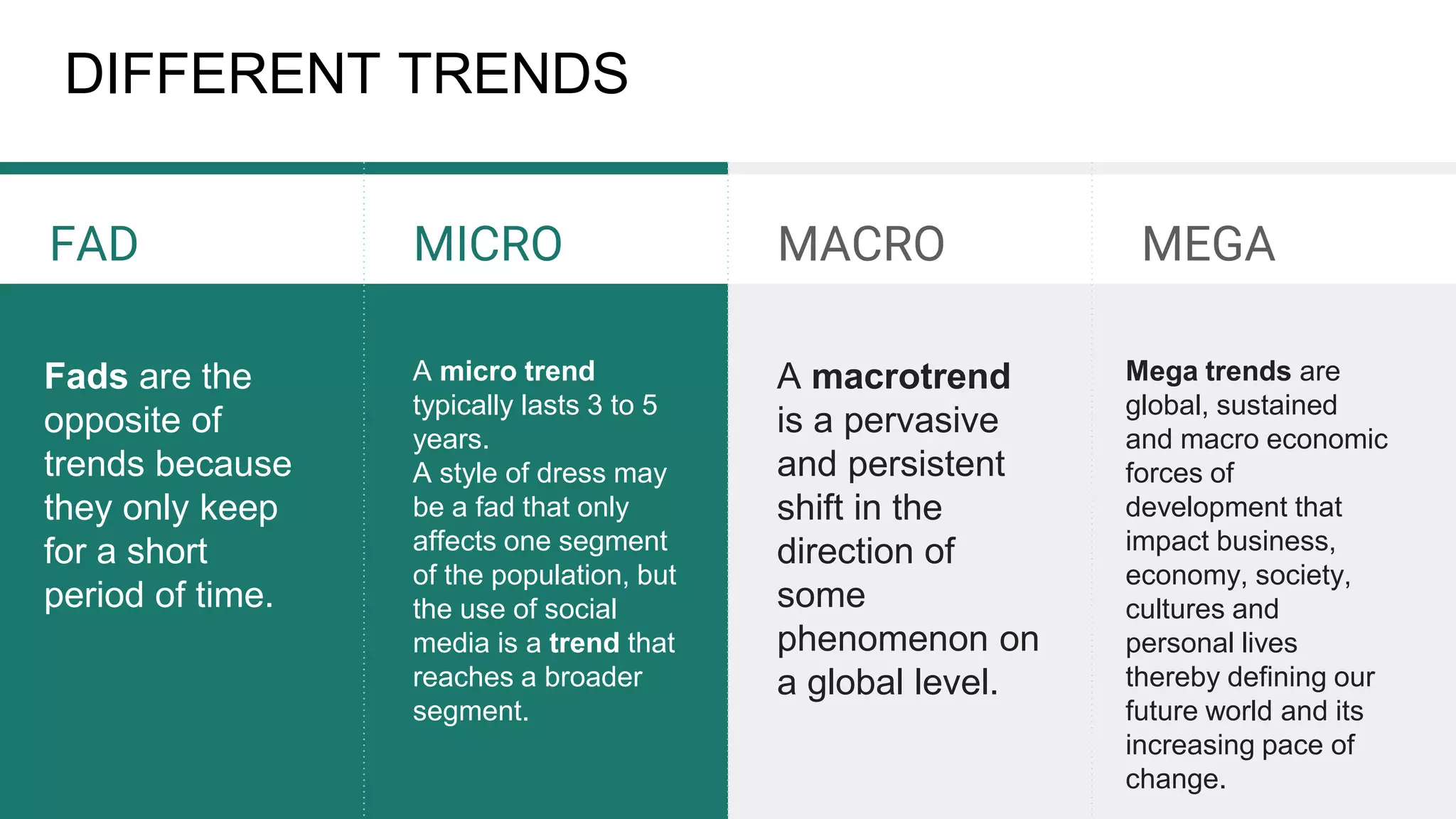
DIFFERENT TRENDS
MEGAMACROMICROFAD
Fads are the
opposite of
trends because
they only keep
for a short
period of time.
A micro trend
typically lasts 3 to 5
years.
A style of dress may
be a fad that only
affects one segment
of the population, but
the use of social
media is a trend that
reaches a broader
segment.
A macrotrend
is a pervasive
and persistent
shift in the
direction of
some
phenomenon on
a global level.
Mega trends are
global, sustained
and macro economic
forces of
development that
impact business,
economy, society,
cultures and
personal lives
thereby defining our
future world and its
increasing pace of
change.
FAD
Fads are the opposite of trends because they only keep for a short period of time.
This doesn’t mean we need to ignore them, especially if we have to do with people
that may be following them. Examples of fads are commonly seen in clothing,
diets, exercised, hairstyles and more other areas like this. Fads are easily driven
by social media channels today. In fact, social media was a fad until later stages of
today in which it can even be perceived almost as a megatrend.
MICRO
Micro-trends are the “children” of Macro-trends. They are the most active, diverse
and appearing very fast one after another. The list of micro-trends is the most
lengthy and diverse, and that’s because they are the “solutions” that directly
address to consumers. These micro-trends can also be segmented into categories
such as marketing & media innovations, new technologies, service innovations,
innovative business models, international startups, and many others.
● Marketing & media innovations
● New technologies
● Service innovations
● New products
● Innovative business models
● International startups
MACRO
Macro-trends are the children of megatrends. They are more numerous and all of
them related to the “profession” of their parents. As megatrends are covering a
very large area, mega-trends tend to focus on certain parts of the bigger picture.
Macro-trends are the smaller of the major trend movements. Assigned to the
respective mega-trends, they describe developments that are backed up with
concrete innovations.
Climate
People
Connectivity
MEGA
Megatrends events that occur over a longer period of time and of which we can
be sure about, influencing all the aspects of life. These events mostly occur as a
reaction to the behavior and activities done by people in the last century but also
more recently. Examples of these trends are demographic changes,
urbanization, climate change, advance in technology and so on. This kind of
tendencies cannot be stopped or influenced easily, but it’s possible – and advised
– to respond to them.

Fashion Trend Analysis

  • 1.
  • 2.
    WHAT IS FASHIONTREND ANALYSIS ? Fashion trend analysis is the prediction of what will be the present of the future in the fashion context. Fashion trend analysis focus on knowing what will come next in fashion which will be accepted by the mass population. Fashion trend analysis and forecasting describes the mechanism of a fashion trend and the changes related to that. The changes in a fashion trend is not only limited with clothes but also changes with the change in social, cultural, economical and technological changes.
  • 3.
    WHAT DOES ANANALYST DO ? Fashion trend analysts are responsible for spotting upcoming trends and products. They attempt to project today’s trends, into the future, to discover what will be hot next season. Their predictions can guide manufactures and designers to use certain materials or focus on certain styles.
  • 4.
    TOOLS USED BYA TREND ANALYST Collezioni magazines Trend forecasting websites Instagram Google’s annual trends report Pantone’s fashion colour report
  • 5.
    WHAT IS FASHIONFORECASTING ? A fashion forecaster predicts the colors, fabrics, textures, materials, prints, graphics, beauty/grooming, accessories, footwear, street style, and other styles that will be presented on the runway and in the stores for the upcoming seasons. Trend forecasting is a useful way to look at past sales or market growth, determine possible trends from that data and use the information of what could happen in the future. Marketing experts typically utilize trend forecasting to help determine potential future sales growth.
  • 6.
    DIFFERENT TRENDS MEGAMACROMICROFAD Fads arethe opposite of trends because they only keep for a short period of time. A micro trend typically lasts 3 to 5 years. A style of dress may be a fad that only affects one segment of the population, but the use of social media is a trend that reaches a broader segment. A macrotrend is a pervasive and persistent shift in the direction of some phenomenon on a global level. Mega trends are global, sustained and macro economic forces of development that impact business, economy, society, cultures and personal lives thereby defining our future world and its increasing pace of change.
  • 7.
    FAD Fads are theopposite of trends because they only keep for a short period of time. This doesn’t mean we need to ignore them, especially if we have to do with people that may be following them. Examples of fads are commonly seen in clothing, diets, exercised, hairstyles and more other areas like this. Fads are easily driven by social media channels today. In fact, social media was a fad until later stages of today in which it can even be perceived almost as a megatrend.
  • 8.
    MICRO Micro-trends are the“children” of Macro-trends. They are the most active, diverse and appearing very fast one after another. The list of micro-trends is the most lengthy and diverse, and that’s because they are the “solutions” that directly address to consumers. These micro-trends can also be segmented into categories such as marketing & media innovations, new technologies, service innovations, innovative business models, international startups, and many others. ● Marketing & media innovations ● New technologies ● Service innovations ● New products ● Innovative business models ● International startups
  • 9.
    MACRO Macro-trends are thechildren of megatrends. They are more numerous and all of them related to the “profession” of their parents. As megatrends are covering a very large area, mega-trends tend to focus on certain parts of the bigger picture. Macro-trends are the smaller of the major trend movements. Assigned to the respective mega-trends, they describe developments that are backed up with concrete innovations. Climate People Connectivity
  • 10.
    MEGA Megatrends events thatoccur over a longer period of time and of which we can be sure about, influencing all the aspects of life. These events mostly occur as a reaction to the behavior and activities done by people in the last century but also more recently. Examples of these trends are demographic changes, urbanization, climate change, advance in technology and so on. This kind of tendencies cannot be stopped or influenced easily, but it’s possible – and advised – to respond to them.