Statement of
Financial Accounting
Standards No. 119
Note: This Statement has been completely superseded
FAS119 Status Page
FAS119 Summary
Disclosure about Derivative Financial Instruments
and Fair Value of Financial Instruments
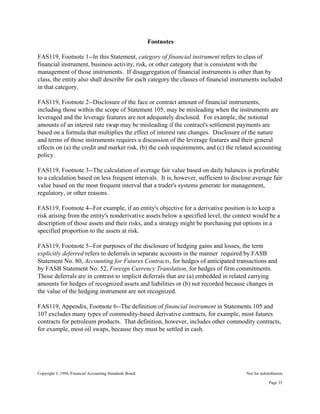
October 1994
Financial Accounting Standards Board
of the Financial Accounting Foundation
401 MERRITT 7, P.O. BOX 5116, NORWALK, CONNECTICUT 06856-5116
Copyright © 1994 by Financial Accounting Standards Board. All rights reserved. No
part of this publication may be reproduced, stored in a retrieval system, or transmitted, in
any form or by any means, electronic, mechanical, photocopying, recording, or
otherwise, without the prior written permission of the Financial Accounting Standards
Board.
Page 2
Statement of Financial Accounting Standards No. 119
Disclosure about Derivative Financial Instruments and Fair Value of Financial
Instruments
October 1994
CONTENTS
Paragraph
Numbers
Introduction ...................................................................................................................1-4
Standards of Financial Accounting and Reporting:
Definitions and Scope .............................................................................................5-7
Disclosure about All Derivative Financial Instruments ............................................. 8
Disclosure about Purposes for Which Derivative Financial Instruments
Are Held or Issued.............................................................................................9-13
Disclosure about Derivative Financial Instruments Held or Issued for
Trading Purposes............................................................................................ 10
Disclosure about Derivative Financial Instruments Held or Issued for
Purposes Other Than Trading......................................................................... 11
Encouraged Disclosure about All Derivative Financial Instruments
Held or Issued............................................................................................12-13
Amendments to Existing Pronouncements .........................................................14-15
Effective Dates and Transition............................................................................16-17
Appendix: Background Information and Basis for Conclusions............................18-110
Page 3
Copyright © 1994, Financial Accounting Standards Board Not for redistribution
FAS 119: Disclosure about Derivative Financial Instruments and
Fair Value of Financial Instruments
FAS 119 Summary
This Statement requires disclosures about derivative financial instruments—futures,
forward, swap, and option contracts, and other financial instruments with similar characteristics.
It also amends existing requirements of FASB Statement No. 105, Disclosure of Information
about Financial Instruments with Off-Balance-Sheet Risk and Financial Instruments with
Concentrations of Credit Risk, and FASB Statement No. 107, Disclosures about Fair Value of
Financial Instruments.
This Statement requires disclosures about amounts, nature, and terms of derivative
financial instruments that are not subject to Statement 105 because they do not result in
off-balance-sheet risk of accounting loss. It requires that a distinction be made between financial
instruments held or issued for trading purpose (including dealing and other trading activities
measured at fair value with gains and losses recognized in earnings) and financial instruments
held or issued for purposes other than trading. It also amends Statements 105 and 107 to require
that distinction in certain disclosures required by those Statements.
For entities that hold or issue derivative financial instruments for trading purposes, this
Statement requires disclosure of average fair value and of net trading gains or losses. For
entities that hold or issue derivative financial instruments for purposes other than trading, it
requires disclosure about those purposes and about how the instruments are reported in financial
statements. For entities that hold or issue derivative financial instruments and account for them
as hedges of anticipated transactions, it requires disclosure about the anticipated transactions, the
classes of derivative financial instruments used to hedge those transactions, the amounts of
hedging gains and losses deferred, and the transactions or other events that result in recognition
of the deferred gains or losses in earnings. This Statement also encourages, but does not require,
quantitative information about market risks of derivative financial instruments, and also of other
assets and liabilities, that is consistent with the way the entity manages or adjusts risks and that
is useful for comparing the results of applying the entity's strategies to its objectives for holding
or issuing the derivative financial instruments.
This Statement amends Statement 105 to require disaggregation of information about
financial instruments with off-balance-sheet risk of accounting loss by class, business activity,
Page 4
Copyright © 1994, Financial Accounting Standards Board Not for redistribution
risk, or other category that is consistent with the entity's management of those instruments. This
Statement also amends Statement 107 to require that fair value information be presented without
combining, aggregating, or netting the fair value of derivative financial instruments with the fair
value of nonderivative financial instruments and be presented together with the related carrying
amounts in the body of the financial statements, a single footnote, or a summary table in a form
that makes it clear whether the amounts represent assets or liabilities.
This Statement is effective for financial statements issued for fiscal years ending after
December 15, 1994, except for entities with less than $150 million in total assets. For those
entities, this Statement is effective for financial statements issued for fiscal years ending after
December 15, 1995.
INTRODUCTION
1. The Board added a project on financial instruments and off-balance-sheet financing to its
technical agenda in May 1986. The project's objective is to develop broad standards to aid in
resolving existing financial accounting and reporting issues and other issues likely to arise in the
future about various financial instruments and related transactions.
2. Due to the complexity of the issues about how financial instruments and related
transactions should be recognized and measured, and the likelihood that it will take time to
resolve those issues, the Board decided that improved disclosure of information about financial
instruments was necessary in the meantime. FASB Statement No. 105, Disclosure of
Information about Financial Instruments with Off-Balance-Sheet Risk and Financial Instruments
with Concentrations of Credit Risk, was issued in March 1990 and FASB Statement No. 107,
Disclosures about Fair Value of Financial Instruments, was issued in December 1991.
3. Since the issuance of Statements 105 and 107, several parties have called for further
improvements in disclosure about derivative financial instruments. This Statement responds to
those requests. Some have called for voluntary disclosures like those already provided by a few
entities, while others have urged the Board to enhance existing disclosure requirements. Some
also have suggested that the Board should improve the clarity of the disclosures about fair value
required for all financial instruments. As a result of those requests, the Board decided that
further improvements in disclosures about derivative financial instruments and fair value of
financial instruments are necessary.
4. The Board concluded that more disclosure about derivative financial instruments is needed
because they are increasingly important in business and finance but are as yet not well
understood by many investors, creditors, and others. Investors and creditors need information
about derivative financial instruments, specifically, information about the purposes for which
derivative financial instruments are held or issued. The information they need—and the ability
of entities to provide that information varies—depending on an entity's purpose for holding or
Page 5
Copyright © 1994, Financial Accounting Standards Board Not for redistribution
issuing the derivatives.
STANDARDS OF FINANCIAL ACCOUNTING AND REPORTING
Definitions and Scope
5. Financial instrument is defined in Statement 107. For purposes of this Statement, a
derivative financial instrument is a futures, forward, swap, or option contract, or other financial
instrument with similar characteristics.
6. Examples of other financial instruments with characteristics similar to option contracts
include interest rate caps or floors and fixed-rate loan commitments. Those instruments have
characteristics similar to options in that they provide the holder with benefits of favorable
movements in the price of an underlying asset or index with limited or no exposure to losses
from unfavorable price movements, generally in return for a premium paid at inception by the
holder to the issuer. Variable-rate loan commitments and other variable-rate financial
instruments also may have characteristics similar to option contracts. For example, contract rate
adjustments may lag changes in market rates or be subject to caps or floors. Examples of other
financial instruments with characteristics similar to forward contracts include various kinds of
commitments to purchase stocks or bonds, forward interest rate agreements, and interest rate
collars. Those instruments are similar to forwards in that they provide benefits of favorable
movements in the price of an underlying asset or index and exposure to losses from unfavorable
price movements, generally with no payments at inception.
7. The definition of derivative financial instrument in paragraph 5 excludes all
on-balance-sheet receivables and payables, including those that "derive" their values or
contractually required cash flows from the price of some other security or index, such as
mortgage-backed securities, interest-only and principal-only obligations, and indexed debt
instruments. It also excludes optional features that are embedded within an on-balance-sheet
receivable or payable, for example, the conversion feature and call provisions embedded in
convertible bonds.
Disclosure about All Derivative Financial Instruments
8. For many derivative financial instruments, information about their amounts, nature, and
terms is required to be disclosed because those instruments are included in the scope of
Statement 105. For options held and other derivative financial instruments not included in the
scope of Statement 105 (because they do not have off-balance-sheet risk of accounting loss, as
defined in Statement 105), an entity shall disclose either in the body of the financial statements
or in the accompanying notes the following information by category of financial instrument: 1
Page 6
Copyright © 1994, Financial Accounting Standards Board Not for redistribution
a. The face or contract amount (or notional principal amount if there is no face or contract
amount) 2
b. The nature and terms, including, at a minimum, a discussion of (1) the credit and market risk
of those instruments, (2) the cash requirements of those instruments, and (3) the related
accounting policy pursuant to the requirements of APB Opinion No. 22, Disclosure of
Accounting Policies.
Disclosure about Purposes for Which Derivative Financial Instruments Are Held or Issued
9. The disclosures required in paragraph 8 of this Statement shall distinguish between
derivative financial instruments held or issued for:
a. Trading purposes, including dealing and other trading activities measured at fair value with
gains and losses recognized in earnings
b. Purposes other than trading.
Disclosure about Derivative Financial Instruments Held or Issued for Trading Purposes
10. Entities that hold or issue derivative financial instruments for trading purposes shall
disclose, either in the body of the financial statements or in the accompanying notes, the
following:
a. The average fair value of those derivative financial instruments during the reporting period,
3 presented together with the related end-of-period fair value, distinguishing between assets
and liabilities
b. The net gains or losses (often referred to as net trading revenues) arising from trading
activities during the reporting period disaggregated by class, business activity, risk, or other
category that is consistent with the management of those activities and where those net
trading gains or losses are reported in the income statement. If the disaggregation is other
than by class, the entity also shall describe for each category the classes of derivative
financial instruments, other financial instruments, and nonfinancial assets and liabilities
from which the net trading gains or losses arose.
Entities that trade other types of financial instruments or nonfinancial assets are encouraged, but
not required, to present a more complete picture of their trading activities by also disclosing
average fair value for those assets and liabilities.
Disclosure about Derivative Financial Instruments Held or Issued for Purposes Other Than
Trading
11. Entities that hold or issue derivative financial instruments for purposes other than trading
shall disclose the following:
Page 7
Copyright © 1994, Financial Accounting Standards Board Not for redistribution
a. A description of the entity's objectives for holding or issuing the derivative financial
instruments, the context needed to understand those objectives, and its strategies for
achieving those objectives, including the classes of derivative financial instruments used 4
b. A description of how each class of derivative financial instrument is reported in the financial
statements including the policies for recognizing (or reasons for not recognizing) and
measuring the derivative financial instruments held or issued, and when recognized, where
those instruments and related gains and losses are reported in the statements of financial
position and income
c. For derivative financial instruments that are held or issued and accounted for as hedges of
anticipated transactions (both firm commitments and forecasted transactions for which there
is no firm commitment), (1) a description of the anticipated transactions whose risks are
hedged, including the period of time until the anticipated transactions are expected to occur,
(2) a description of the classes of derivative financial instruments used to hedge the
anticipated transactions, (3) the amount of hedging gains and losses explicitly deferred, 5
and (4) a description of the transactions or other events that result in the recognition in
earnings of gains or losses deferred by hedge accounting.
Encouraged Disclosure about All Derivative Financial Instruments Held or Issued
12. Entities are encouraged, but not required, to disclose quantitative information about
interest rate, foreign exchange, commodity price, or other market risks of derivative financial
instruments that is consistent with the way the entity manages or adjusts those risks and that is
useful for comparing the results of applying the entity's strategies to its objectives for holding or
issuing the derivative financial instruments. Quantitative disclosures about the risks of derivative
financial instruments are likely to be even more useful, and less likely to be perceived to be out
of context or otherwise misunderstood, if similar information is disclosed about the risks of other
financial instruments or nonfinancial assets and liabilities to which the derivative financial
instruments are related by a risk management or other strategy.
13. Appropriate ways of reporting the quantitative information encouraged in paragraph 12
will differ for different entities and will likely evolve over time as management approaches and
measurement techniques evolve. Possibilities include disclosing (a) more details about current
positions and perhaps activity during the period, (b) the hypothetical effects on equity, or on
annual income, of several possible changes in market prices, (c) a gap analysis of interest rate
repricing or maturity dates, (d) the duration of the financial instruments, or (e) the entity's value
at risk from derivative financial instruments and from other positions at the end of the reporting
period and the average value at risk during the year. This list is not exhaustive, and entities are
encouraged to develop other ways of reporting the quantitative information.
Amendments to Existing Pronouncements
14. Statement 105 is amended as follows:
Page 8
Copyright © 1994, Financial Accounting Standards Board Not for redistribution
a. In paragraph 17, the following footnote is added after financial instruments with
off-balance-sheet risk:
*Similar disclosures are required for derivative financial instruments without
off-balance-sheet risk in paragraph 8 of FASB Statement No. 119, Disclosure about
Derivative Financial Instruments and Fair Value of Financial Instruments.
b. In paragraphs 17 and 18, class is replaced by category.
c. The following paragraph is inserted at the beginning of footnote 12:
In this Statement, category of financial instrument refers to class of financial instrument,
business activity, risk, or other category that is consistent with the management of those
instruments. If disaggregation of financial instruments is other than by class, the entity
also shall describe for each category the classes of financial instruments included in that
category.
d. The following paragraph is added after paragraph 17:
The disclosures required in paragraph 17 shall distinguish between financial instruments
with off-balance-sheet risk held or issued for trading purposes, including dealing and
other trading activities measured at fair value with gains and losses recognized in
earnings, and financial instruments with off-balance-sheet risk held or issued for
purposes other than trading.
15. Statement 107 is amended as follows:
a. In paragraph 10, the following footnote is added after either in the body of the financial
statements or in the accompanying notes:
*If disclosed in more than a single note, one of the notes shall include a summary table.
The summary table shall contain the fair value and related carrying amounts and
cross-references to the location(s) of the remaining disclosures required by this
Statement, as amended.
b. In paragraph 10, the following is added after the first sentence:
Fair value disclosed in the notes shall be presented together with the related carrying
amount in a form that makes it clear whether the fair value and carrying amount represent
assets or liabilities and how the carrying amounts relate to what is reported in the
statement of financial position.
c. The following is added to the end of paragraph 10:
Page 9
Copyright © 1994, Financial Accounting Standards Board Not for redistribution
The disclosures shall distinguish between financial instruments held or issued for trading
purposes, including dealing and other trading activities measured at fair value with gains
and losses recognized in earnings, and financial instruments held or issued for purposes
other than trading.
d. The following paragraph and footnote are added after paragraph 13:
In disclosing the fair value of a derivative financial instrument,* an entity shall not (a)
combine, aggregate, or net that fair value with the fair value of nonderivative financial
instruments or (b) net that fair value with the fair value of other derivative financial
instruments—even if those nonderivative or derivative financial instruments are
considered to be related, for example, by a risk management strategy—except to the
extent that the offsetting of carrying amounts in the statement of financial position is
permitted under the general principle in paragraphs 5 and 6 of FASB Interpretation No.
39, Offsetting of Amounts Related to Certain Contracts, or the exception for master
netting arrangements in paragraph 10 of Interpretation 39.
_____________________
*For purposes of this Statement, derivative financial instrument is used in the same sense as in paragraph 5
of FASB Statement No. 119, Disclosure about Derivative Financial Instruments and Fair Value of
Financial Instruments.
Effective Dates and Transition
16. This Statement shall be effective for financial statements issued for fiscal years ending
after December 15, 1994, except for entities with less than $150 million in total assets in the
current statement of financial position. For those entities, this Statement shall be effective for
financial statements issued for fiscal years ending after December 15, 1995. Earlier application
is encouraged. In the initial year of application, this Statement need not be applied to complete
interim financial statements.
17. Disclosures required by paragraphs 8-11 and paragraphs 14 and 15 that have not
previously been reported need not be included in financial statements that are presented for
comparative purposes for fiscal years ending before the applicable effective date of this
Statement. For all subsequent fiscal years, the information required to be disclosed by paragraph
10(b) of this Statement shall be included for each year for which an income statement is
presented for comparative purposes, and all other information required to be disclosed by this
Statement shall be included for each year for which a statement of financial position is presented
for comparative purposes.
The provisions of this Statement need
not be applied to immaterial items.
Page 10
Copyright © 1994, Financial Accounting Standards Board Not for redistribution
This Statement was adopted by the unanimous vote of the seven members of the Financial
Accounting Standards Board:
Dennis R. Beresford, Chairman
Joseph V. Anania
Anthony T. Cope
John M. Foster
James J. Leisenring
Robert H. Northcutt
Robert J. Swieringa
Page 11
Appendix
BACKGROUND INFORMATION AND BASIS FOR CONCLUSIONS
CONTENTS
Paragraph
Numbers
Introduction .................................................................................................................... 18
Background Information ...........................................................................................19-30
Definitions and Scope ...............................................................................................31-36
Disclosure about All Derivative Financial Instruments ............................................37-41
Disclosure about Purposes for Which Derivative Financial Instruments
Are Held or Issued.................................................................................................42-75
Disclosure about Derivative Financial Instruments Held or Issued
for Trading Purposes .......................................................................................50-57
Disclosure about Derivative Financial Instruments Held or Issued
for Purposes Other Than Trading....................................................................58-66
All Purposes Other Than Trading .................................................................58-61
Hedging.........................................................................................................62-66
Encouraged Disclosure about All Derivative Financial Instruments
Held or Issued..................................................................................................67-75
Amendments to Existing Pronouncements ...............................................................76-92
Cost-Benefit Considerations .....................................................................................93-94
Applicability to Certain Entities................................................................................95-99
Location of Information within Financial Reports................................................100-105
Applicability to Interim Financial Statements.............................................................. 106
Effective Dates and Transition..............................................................................107-110
Page 12
Copyright © 1994, Financial Accounting Standards Board Not for redistribution
Appendix: BACKGROUND INFORMATION AND BASIS FOR
CONCLUSIONS
Introduction
18. This appendix summarizes considerations that Board members deemed significant in
reaching the conclusions in this statement. It includes reasons for accepting certain views and
rejecting others. Individual Board members gave greater weight to some factors than to others.
Background Information
19. The Board added a project on financial instruments to its agenda in 1986. As an early step
in that project the Board focused on disclosures, resulting in FASB Statement No. 105,
Disclosure of Information about Financial Instruments with Off-Balance-Sheet Risk and
Financial Instruments with Concentrations of Credit Risk, which became effective in 1990, and
FASB Statement No. 107, Disclosures about Fair Value of Financial Instruments, which became
effective for larger entities in 1992. Background information on the overall project and the early
disclosure work is provided in Appendix D of Statement 105 and Appendix C of Statement 107.
20. The Board received requests from many different constituents for further improvements in
disclosures about derivatives, generally meaning futures, forward, swap, and option contracts
and the like. Some called for voluntary action such as the added disclosures already being
provided by a few institutions, while others urged the Board to enhance existing requirements as
a further intermediate step in its project on financial instruments. Many urged that this be done
quickly.
21. For example, in its July 1993 study Derivatives: Practices and Principles, the Group of
Thirty, a private, independent, nonprofit body that examines financial issues, called for
disclosure of information about management's attitude toward financial risks, how derivatives
are used and how risks are controlled, accounting policies, management's analysis of positions at
the balance sheet date and the credit risk inherent in those positions, and, for dealers, additional
information about the extent of activities in derivatives. Derivatives also were the subject of
major studies prepared by several federal agencies, all of which cited the need for improvements
in financial reporting for derivatives.
22. Several government officials expressed concern about derivatives, including financial
reporting for them, in speeches and in writings. SEC commissioners and staff members
suggested that the Board and the SEC must do more given the lack of transparency in financial
statements of entities with derivative notional amounts far in excess of their capital. They also
Page 13
Copyright © 1994, Financial Accounting Standards Board Not for redistribution
recommended that entities should strive to provide investors with as much information about
off-balance-sheet items used to manage on-balance-sheet assets and liabilities as is already being
disclosed for the on-balance-sheet items. Federal banking regulators called for modernization of
accounting and disclosure standards to address new products and new risk management
techniques. Those regulators cited serious deficiencies in the disclosures noted in the Group of
Thirty study, especially the absence of a summary measure of market-risk exposure, and called
for a "no surprises" policy on derivatives. They also issued directives to banks on that subject
and considered requiring improved disclosure in regulatory reports. Extensive news reports
cited those concerns and publicized difficulties encountered by several dealers and end-users of
derivatives. Congressional hearings and proposed legislation were a further demonstration of
concern.
23. Investors and creditors also expressed concern. For example, in its 1993 position paper,
Financial Reporting in the 1990s and Beyond, the Association for Investment Management and
Research (AIMR) noted that:
Analysts also are confounded by the interrelationships and complexity of
financial instruments. . . . Those risks are at least to be disclosed under the
provisions of FASB Statement 105, but the disclosures are scattered throughout
the financial statement notes and are completely understood only by relatively
sophisticated and tenacious financial statement readers. [page 30]
24. The AICPA Special Committee on Financial Reporting told the Board that investors and
creditors it interviewed almost uniformly complained of being mystified and frustrated about the
effects of derivatives on the companies they follow and supported the AIMR position, rating the
general category of off-balance-sheet exposures from financial instruments as one of their top
priorities for improvement in financial reporting.
25. Concern about the financial reporting for derivatives is an international phenomenon. The
International Accounting Standards Committee, in its revised Exposure Draft E48, Financial
Instruments, proposes extensive disclosure about derivatives and other financial instruments,
some of which goes beyond what is currently required in the United States.
26. After considering those concerns, in November 1993 the FASB staff solicited comments
from the Financial Instruments Task Force, the Emerging Issues Task Force, and the Financial
Accounting Standards Advisory Council to help in the prompt formulation of a recommendation
to the Board on the need for action. After receiving comments from members of those bodies
and from others who had expressed interest and weighing its other priorities, the Board decided
in December 1993 to redirect some of its efforts on financial instruments toward enhanced
disclosure about derivatives.
27. Following that decision, the Board held an open meeting with interested parties to discuss
what disclosures needed to be improved and how the improvements might be accomplished.
Page 14
Copyright © 1994, Financial Accounting Standards Board Not for redistribution
28. The Board established both general and specific objectives for this Statement. The
general objectives are the same as the objectives for disclosures of financial instruments
explored in paragraphs 129-139 of the 1987 Exposure Draft, Disclosures about Financial
Instruments. Those objectives, later summarized in paragraphs 79-85 of Statement 105, include:
to describe items recognized in the financial statements, to provide appropriate measures of
financial assets and financial liabilities, and to help users assess the risks and potentials that are
present and the effects on the entity of different possible outcomes. The more specific objectives
of this Statement are (a) to enhance disclosure about derivative financial instruments, (b) to
make technical improvements to the disclosure of information about fair value of financial
instruments, and (c) to accomplish (a) and (b) in time to improve 1994 year-end financial
reporting. This Statement will not resolve all of the concerns expressed. In particular, the Board
is aware that the disclosures required by this Statement are likely to be of only limited value to
regulators and others concerned about the "systemic risk" of derivatives.
29. The Board issued the Exposure Draft, Disclosure about Derivative Financial Instruments
and Fair Value of Financial Instruments, in April 1994. The Board received 144 comment
letters on that Exposure Draft. In June 1994, the Board met with interested parties to discuss
derivative disclosures made for 1993 year-end financial reporting and how improvements might
be made to the disclosures proposed in the Exposure Draft. The Board concluded that it could
reach an informed decision on the basis of existing information without a public hearing.
30. The Board concluded that (a) the main focus of this Statement should be set by the term
derivative financial instrument, (b) information about amounts, nature, and terms should be
disclosed for all derivative financial instruments, not just for those with off-balance-sheet risk of
accounting loss, (c) disclosure about derivative financial instruments should distinguish between,
and report different kinds of information for, derivative financial instruments held or issued for
trading purposes and those held or issued for purposes other than trading, (d) disclosure of
quantitative information about risks of derivative financial instruments and their role in
managing other risks should be encouraged, though not required at this time, and (e) Statements
105 and 107 should be amended to improve the disclosures they require. The remaining sections
of this appendix discuss those conclusions in more detail.
Definitions and Scope
31. The Board concluded that for purposes of this Statement a derivative financial instrument
is a futures, forward, swap, or option contract, or other financial instrument with similar
characteristics.
32. That definition of derivative financial instrument builds on the definition of a financial
instrument in Statements 105 and 107. That definition excludes contracts that either require the
exchange of a financial instrument for a nonfinancial commodity or permit settlement of an
obligation by delivery of a nonfinancial commodity, because those contracts involve the required
Page 15
Copyright © 1994, Financial Accounting Standards Board Not for redistribution
or optional future exchange or delivery of an item that is not a financial instrument. Some
respondents suggested that the scope of this Statement should be expanded to include commodity
contracts.6 In some cases, commodity contracts and some other contractual arrangements have
characteristics similar to derivative financial instruments in that they are used interchangeably,
present somewhat similar risks and potentials, and are not always well disclosed.
33. The Board considered suggestions from respondents to include those items within the
definition of derivative but was concerned about the complexities and complications, both
known and unknown, that a more expanded scope might entail. The Board also was concerned
that a more expanded scope might be inconsistent with the Board's objective of improving 1994
year-end financial reporting. The Board, therefore, concluded that the definition of derivative
for the purposes of this Statement should be limited by the definition of financial instrument.
34. Some respondents questioned whether the term derivative financial instrument should
include such on-balance-sheet receivables and payables as mortgage-backed securities,
interest-only and principal-only obligations, and debt instruments indexed to the price of
precious metals or common stock. They noted that all of those on-balance-sheet receivables and
payables "derive" their values or required cash flows from the price of some other security or
index. Others suggested that the term should include optional features that are embedded within
an on-balance-sheet receivable or payable, for example, the conversion feature and call
provisions embedded in convertible bonds. While better information about those items may be
needed, the widespread concern that led to this Statement was more narrowly focused.
Moreover, the Board was concerned that a more expanded scope might be inconsistent with the
Board's objective of improving 1994 year-end financial reporting. The Board, therefore, decided
that this Statement should follow a narrower usage of the term derivative that includes futures,
forward, swap, and option contracts, and other financial instruments with similar characteristics,
and excludes on-balance-sheet receivables and payables and optional features that are embedded
in those receivables and payables.
35. The definition of derivative financial instrument includes other financial instruments with
similar characteristics. Examples of other financial instruments with characteristics similar to
option contracts include interest rate caps or floors and fixed-rate loan commitments. Some
respondents objected to those examples. They argued that fixed-rate loan commitments are not
typically considered derivatives and should be excluded from the definition. The Board believes
that fixed-rate loan commitments have characteristics similar to option contracts in that they
provide the holder with benefits of favorable movements in the price of an underlying asset or
index with limited or no exposure to losses from unfavorable price movements. Like option
contracts, they subject the issuer to market risk. The Board decided that those financial
instruments should be included within the definition of derivative financial instrument and
subject to the disclosures required by this Statement.
36. Variable-rate loan commitments and other variable-rate financial instruments also may
include terms that subject the issuer to market risk. For example, contract rate adjustments may
Page 16
Copyright © 1994, Financial Accounting Standards Board Not for redistribution
lag changes in market rates or be subject to caps or floors. Those financial instruments have
characteristics similar to option contracts and, therefore, are subject to the disclosures required
by this Statement.
Disclosure about All Derivative Financial Instruments
37. For many derivative financial instruments, certain information already is required to be
disclosed because those instruments are included within the scope of Statement 105. Statement
105 requires all entities to disclose information about the extent, nature, terms, and credit risk of
financial instruments with off-balance-sheet risk of accounting loss and the concentrations of
credit risk for all financial instruments. Paragraph 62 of Statement 105 explains that the goal in
limiting the scope of Statement 105 to "principally financial instruments with off-balance-sheet
risk" resulted from a Board conclusion that that was "the most expeditious way to deal with what
many respondents perceive as the area most in need of improvement."
38. The Board was concerned that because Statement 105's scope generally excludes financial
instruments that do not have off-balance-sheet risk of accounting loss, some entities have
omitted disclosures of significant positions in certain derivative financial instruments.
Frequently cited examples include options held, interest rate caps and floors held, and loan
commitments held. If financial statements fail to disclose those instruments, investors and
creditors may be less likely to understand an entity's purpose for holding or issuing the
instruments that are disclosed.
39. The Board concluded that information about the face or contract amount (or notional
principal amount) of derivative financial instruments not within the scope of Statement 105,
when coupled with the Statement 105 disclosures, will more effectively communicate the
relative significance of an entity's entire derivative financial instrument position and may
facilitate an understanding of the purpose for which the instruments are held or issued. The
Board also concluded that disclosures that discuss the credit, market, and liquidity risk and the
related accounting policy of an entity's derivative financial instruments that are not within the
scope of Statement 105 should help investors and creditors to better understand those positions.
40. Some respondents suggested that more disclosure should be required about the credit risk
of derivative financial instruments that are not within the scope of Statement 105. Paragraphs 18
and 19 of Statement 105 require credit risk disclosures for derivative financial instruments with
off-balance-sheet credit risk of accounting loss. For a derivative financial instrument that is not
within the scope of Statement 105, such as an option held, the credit risk of accounting loss is
on-balance-sheet and reflected in the carrying amount of the assets recognized in the statement
of financial position. Derivative financial instruments, however, can present economic credit
risk on unrealized gains from past favorable price movements that have not yet been recognized
in the financial statements or from possible future favorable price movements. Those economic
credit risks are not risks of accounting loss and are not necessarily reported in the Statement 105
disclosures or elsewhere. Moreover, it is unclear how financial statements could disclose those
Page 17
Copyright © 1994, Financial Accounting Standards Board Not for redistribution
risks, other than, perhaps, in disclosing fair value.
41. Statement 107 already requires disclosures about fair value of derivative financial
instruments. In addition, paragraph 20 of Statement 105 already requires disclosures of
significant concentrations of credit risk for all financial instruments. The Board concluded that
this Statement need not require more disclosure about credit risk of derivative financial
instruments not within the scope of Statement 105.
Disclosure about Purposes for Which Derivative Financial Instruments Are Held or Issued
42. One factor that contributes to the confusion and concern about derivative financial
instruments is that financial statements omit or inadequately explain why entities hold or issue
various types of derivatives. The Board concluded in the Exposure Draft that disclosures of
derivative financial instruments should be separated into two categories based on the reasons that
entities hold or issue the derivatives. The Exposure Draft proposed that disclosures distinguish
between derivative financial instruments held or issued for trading purposes, including dealing
or other activities reported in a trading account and measured at fair value, and purposes other
than trading. The Board agreed that that distinction would be meaningful and readily
understood by most financial statement users.
43. Most respondents supported the Exposure Draft's distinction between trading purposes
and purposes other than trading. Some respondents, however, stated that those two categories
did not accurately reflect derivatives activity. They suggested that the disclosures would be
more realistic if separated into three categories: dealing, speculative position taking, and risk
management. The Board considered that alternative but was concerned about the inherent
difficulties in defining and distinguishing between those categories, particularly speculative
position taking and risk management.
44. Some respondents stated that the distinction should be based on how derivatives are
accounted for rather than on their purpose. They suggested that it would be more appropriate to
distinguish between derivatives measured at fair value with gains and losses recognized in
earnings and all other derivatives. The Board, however, concluded that a distinction based on
accounting method, although possibly easier to apply, would not be as useful in providing an
indication of why derivatives are held or issued.
45. Some respondents asked that the trading purposes category be clarified. They asked
whether trading has the same meaning as in trading securities in FASB Statement No. 115,
Accounting for Certain Investments in Debt and Equity Securities. Paragraph 12(a) of Statement
115 defines trading securities as "securities that are bought and held principally for the purpose
of selling them in the near term (thus held for only a short period of time)." The Board decided
that that definition would not always readily apply to derivative financial instruments because
some traders of swaps and other less liquid customized derivatives commonly maintain those
positions for longer periods but report them as part of their trading portfolios.
Page 18
Copyright © 1994, Financial Accounting Standards Board Not for redistribution
46. Paragraph 12(a) of Statement 115, however, also states: "Trading generally reflects active
and frequent buying and selling, and trading securities are generally used with the objective of
generating profits on short-term differences in price." Those types of activities in derivative
financial instruments generally indicate that the instruments are held or issued for trading
purposes.
47. Some respondents asked whether derivative financial instruments used to hedge dealing
activities also are considered held or issued for trading purposes. The Board concluded that for
purposes of this Statement, dealing is the activity of standing ready to trade—either buying or
selling—for the dealer's own account, thereby providing liquidity to the market. To facilitate
this activity, dealers commonly hold contracts with customers for derivative financial
instruments for indefinite periods and enter into other contracts to manage the risks arising from
their trading account assets and liabilities. All of those activities are considered dealing for
purposes of this Statement, and dealing is included as one component of trading purposes.
48. Some respondents asked that the Board clarify whether all derivative financial instruments
that are measured at fair value should be categorized as held or issued for trading purposes. In
the Exposure Draft, trading purposes included "other activities reported in a trading account and
measured at fair value." The Board believes that some derivative financial instruments may be
measured at fair value but not considered held or issued for trading purposes. For example,
some hedging activities may entail the use of foreign exchange contracts that fail to meet the
criteria for deferral accounting under FASB Statement No. 52, Foreign Currency Translation.
Those derivative financial instruments, although measured at fair value, may be categorized as
held or issued for purposes other than trading.
49. Some respondents asked that the Board clarify whether all derivative financial instruments
that are measured at fair value but not reported in an established trading account should be
categorized as held or issued for purposes other than trading. As noted in paragraph 48, the
Exposure Draft defined trading purposes as including "other activities reported in a trading
account and measured at fair value" (emphasis added). Some respondents suggested that the
term trading account had common usage and meaning in only some industries. The Board,
therefore, decided that trading purposes should include "dealing and other trading activities
measured at fair value with gains and losses recognized in earnings."
Disclosure about Derivative Financial Instruments Held or Issued for Trading Purposes
50. Fair value of derivative financial instruments at the end of the reporting period already is
required to be disclosed under Statement 107. However, trading positions typically fluctuate,
and the ending balance may not always be representative of the range of balances and related
risks that an entity has assumed during a period. The Exposure Draft proposed that for
derivative financial instruments held or issued for trading purposes, an entity should disclose the
average, maximum, and minimum aggregate fair value of each class of derivative financial
instrument, distinguished between assets and liabilities. The Board concluded that that
Page 19
Copyright © 1994, Financial Accounting Standards Board Not for redistribution
information would provide investors and creditors with a better indication of the level of risk
assumed by an entity when holding or issuing derivative financial instruments for trading
purposes.
51. Some respondents stated that maximum and minimum balances are not currently captured
or used for management purposes and that significant time and costs would be required to collect
and maintain that information. Some also questioned the usefulness of that information. In
response to those and other concerns, the Board decided not to require disclosures of maximum
and minimum aggregate fair value. The Board believes disclosures of the average fair value
when coupled with comparable period-end balances, as required by Statement 107, as amended,
will enhance the information about an entity's activities during the reporting period.
52. Some respondents stated that while some traders are required to collect average balance
information for regulatory purposes, that information generally is not collected by class of
financial instrument, in part, because of the complications created by cross-product master
netting agreements. The Board concluded that it was more important to disclose average fair
value consistent with the period-end disclosures required by Statement 107, as amended, than to
focus on disclosures limited by class and, consequently, decided not to require disclosures of
average fair value by class of derivative financial instrument.
53. The Board also considered whether the average fair value of trading positions should be
based on daily balances. As indicated by the Group of Thirty study, many banks, broker-dealers,
and other kinds of entities currently have systems in place to accumulate daily information for
management purposes. Moreover, they may be required to report that information to regulators.
Some traders may not be subject to those regulations and may not otherwise have the systems in
place to generate daily balances. The Board concluded that while information based on daily
balances is preferable to less frequent intervals, it is sufficient to disclose average fair value
based on the most frequent interval that a trader's systems generate for management, regulatory,
or other reasons.
54. Information about average fair value is potentially useful for investors and creditors of any
entity with a position in derivatives, whether for trading purposes or for purposes other than
trading. The Board decided to require those disclosures for trading purposes because the
information needed is generally available. For example, the Group of Thirty study strongly
recommended daily market valuation of derivative positions as best practice for dealers, and its
survey indicated that the vast majority already follow that practice. In contrast, that study
recommended regular, rather than daily, market valuation by end-users of derivatives, and its
survey indicated that most end-users currently do not regularly value their positions. Thus, the
necessary data may be less likely to be available for derivative financial instruments held or
issued for purposes other than trading, and the Board decided not to require average fair value
for those derivatives.
55. Trading activities of many entities include both derivative financial instruments and other
Page 20
Copyright © 1994, Financial Accounting Standards Board Not for redistribution
kinds of financial instruments or nonfinancial assets or liabilities that are not derivative financial
instruments. Currently, most entities with trading operations are required by their regulators to
report total net trading gains or losses from all sources. The Exposure Draft proposed that
entities disclose "the net gains or losses . . . arising from derivative financial instrument trading
activities. . . ." The Board had concluded that disclosing net trading gains or losses from
derivative trading activities separately would help users better understand the magnitude of those
activities. In addition, a comparison of the changes in net trading gains or losses from period to
period would illustrate the degree of volatility inherent in the operations.
56. Some respondents stated that to be more meaningful and operational the disclosure of net
trading gains or losses must reflect the way the trading activities are managed. For management
purposes, net trading gains or losses are generally disaggregated by business activity, risk, or
some other category. Each category may include net trading gains or losses from derivative
financial instruments, other financial instruments, commodity contracts, and other nonfinancial
assets and liabilities. After considering those comments, the Board decided not to require the
disclosure of net trading gains or losses solely from derivative financial instruments. The Board
concluded that the amount of net trading gains or losses should be disclosed by whatever
categories are consistent with the management of those activities. The Board also concluded that
for each category the entity should provide a qualitative disclosure describing the classes of
derivative financial instruments, other financial instruments, and nonfinancial assets and
liabilities from which the net trading gains or losses arose.
57. The Board acknowledges that this Statement's required disclosures may not be
representative of an entity's overall trading activities. However, the main concern of those who
called for improved disclosure is the inadequacy of information about derivatives. This
Statement responds to that concern. The Board concluded that entities that trade other financial
instruments or nonfinancial assets should be encouraged, but not required, to present a more
complete picture of their trading activities by also disclosing average fair value for those items
and any other information that may improve financial statement users' understanding of the
entity's overall trading activities.
Disclosure about Derivative Financial Instruments Held or Issued for Purposes Other Than
Trading
All Purposes Other Than Trading
58. The Board believes that for derivatives held or issued for purposes other than trading, such
as risk management, qualitative disclosures should be required to help investors and creditors
understand what an entity is trying to accomplish with its derivatives. The Board concluded that
an entity should disclose its objectives for holding or issuing derivative financial instruments, the
context needed to understand those objectives, and its strategies for achieving those objectives.
59. The Exposure Draft proposed that the objectives, context, and strategies be disclosed by
class of derivative financial instrument held or issued for purposes other than trading. Some
Page 21
Copyright © 1994, Financial Accounting Standards Board Not for redistribution
respondents noted that disclosure by class would require unnecessary detail and might be
inconsistent with the way in which the entity is managed. In response to those comments, the
Board decided not to require disclosure of the objectives, context, and strategies by class of
derivative financial instrument.
60. Existing disclosure of accounting policies in response to the requirements of APB Opinion
No. 22, Disclosure of Accounting Policies, could be more helpful in assisting investors,
creditors, and others in understanding how derivative financial instruments held or issued for
purposes other than trading are reported in the financial statements. The Board concluded that
this Statement should emphasize the disclosure of the policies for recognizing (or not
recognizing) and measuring the derivative financial instruments held or issued, and when
recognized, where those instruments and related gains and losses are reported in the statements
of financial position and income.
61. Some respondents suggested that disclosure of the portion of earnings attributable to
derivative financial instruments held for purposes other than trading, such as hedging or risk
management activities, should be required. They argued that that information is necessary to
assess the profitability and cash flows of an entity's core business before the effects of hedging or
risk management. However, the Board was concerned about the difficulty of defining hedging
or risk management. Further, even if hedging or risk management was adequately defined, many
entities would not have systems in place to identify and accumulate the portion of earnings
generated from those activities. Moreover, some suggested that even if those systems did exist,
the amounts disclosed would be incomplete and possibly misleading if limited solely to earnings
from derivative financial instruments, since those instruments are held or issued to hedge or in
some way manage risks arising from an entity's other activities, not necessarily to produce
profits. For all of those reasons, the Board concluded that those disclosures should not be
required.
Hedging
62. The Board considered whether current hedging-related disclosures should provide
additional information to enable investors, creditors, and other users of financial statements to
understand an entity's risk exposures and its techniques for managing those risks. Disclosures
previously have been required for some hedges. FASB Statement No. 80, Accounting for
Futures Contracts, requires certain disclosures about hedging with exchange-traded futures
contracts. In addition, EITF Issue No. 91-4, "Hedging Foreign Currency Risks with Complex
Options and Similar Transactions," requires certain disclosures for currency options, option
combinations, and similar instruments used to hedge anticipated transactions. Many of the
instruments currently used for hedging, however, such as most forwards, most options, and all
interest rate swaps, are not explicitly covered by any disclosure requirement.
63. The Board concluded that four additional disclosures should be required for derivative
financial instruments that are held or issued for the purpose of hedging anticipated transactions
Page 22
Copyright © 1994, Financial Accounting Standards Board Not for redistribution
(both firm commitments and forecasted transactions for which there is no firm commitment): (a)
a description of the anticipated transactions whose risks are hedged with derivative financial
instruments, including the period of time until the anticipated transactions are expected to occur,
(b) a description of the classes of derivative financial instruments used to hedge the anticipated
transactions, (c) the amount of hedging gains and losses explicitly deferred, and (d) a description
of the transactions or other events that result in the recognition in earnings of gains or losses
deferred by hedge accounting. The Board concluded that those disclosures would assist
investors, creditors, and other users of financial statements in evaluating an entity's success in
hedging anticipated transactions and the importance of that activity to the entity.
64. The Board considered whether additional disclosures also should be required for deferred
gains and losses on hedges of existing assets and liabilities because disclosures only about
hedging anticipated transactions might present an incomplete picture of an entity's overall
hedging activities. Previous accounting standards have not required that deferrals on hedging of
existing assets and liabilities be reported separately from the hedged items. For example,
Statement 80 requires that a change in the market value of a futures contract that qualifies as a
hedge of an existing asset or liability be recognized as an adjustment of the carrying amount of
the item being hedged. Thus, it may not be easy to separate deferred hedging gains or losses
from the carrying amount of an item that has been hedged more than once. Similarly, if a
deferred gain or loss has been recognized by adjusting the carrying amount of an interest-bearing
asset and has been factored into that asset's effective yield, after a time the amount remaining to
be recognized may not be readily identifiable. Those disclosures will become feasible only if
accounting standards for deferred hedging gains and losses are modified so that those gains and
losses are separately distinguishable from the related hedged positions. The Board concluded
that it should not require entities to provide information about gains and losses deferred as a
result of hedge accounting of existing assets and liabilities.
65. The Board also considered whether it should require disclosure of hedging gains and
losses that are implicitly deferred because changes in value of the hedging instrument are not
recognized. The Board concluded that it should not require disclosure of implicit deferrals
primarily for cost-benefit reasons, because it is not convinced that most entities have systems
capable of identifying and accounting for those amounts. Furthermore, Statement 107, as
amended by this Statement, requires the disclosure of the fair value of derivative financial
instruments to be presented together with the related carrying amounts. That disclosure may in
some cases be a useful indication of hedging gains and losses that have been implicitly deferred.
66. The Board also considered whether it should require an analysis of the changes in deferred
gains and losses associated with hedging transactions that have occurred during the period. The
analysis might be required to show (a) the beginning and ending amounts of deferred losses
recognized as assets in the financial statements, deferred gains recognized as liabilities in the
financial statements, and net deferred gains or losses recognized as a separate component of
equity, indicating the category in the statement of financial position within which those deferred
gains or losses are reported, (b) additions to deferred gains and losses and removals from
Page 23
Copyright © 1994, Financial Accounting Standards Board Not for redistribution
deferred gains and losses during the period, and (c) the amount of the change in deferred gains or
losses recognized in income during the period and a discussion of the events and transactions
that result in recognition in income. The Board is not convinced that the benefits from
disclosing that information justify the preparation costs and the costs to users of trying to
interpret the data. The Board concluded that those disclosures should not be required.
Encouraged Disclosure about All Derivative Financial Instruments Held or Issued
67. One major use for derivatives is to manage interest rate, foreign exchange, commodity
price, and other market risks. Few requirements for disclosure about market risks of derivative
financial instruments have been codified in the accounting literature. Existing requirements
include the disclosure required by Statement 105 about off-balance-sheet risk of accounting loss,
which requires face or contract or notional principal amounts and a discussion of the market risk
of those instruments. While that information should be useful in assessing market risk,
comments of investors, creditors, and other users of financial statements suggest that the
resulting disclosure is insufficient for understanding the risk management activities of entities
that hold or issue derivative financial instruments for purposes other than trading. The Group of
Thirty study and other recent studies that have focused attention on the risk management
activities of traders of derivative financial instruments suggest that information disclosed about
those activities also is insufficient.
68. Other information about market risks also has been disclosed in management discussion
and analysis sections of SEC filings and in bank call reports and in other reports required by
regulators. The comments of financial statement users and from recent studies and press reports
suggest that even those additional data have not been fully responsive to concerns of investors,
creditors, regulators, and other users of financial statements.
69. Several different kinds of quantitative information about market risks of derivative
financial instruments are used by management and are sometimes disclosed in practice. Possible
approaches for reporting that information in financial statements include disclosing:
a. More details about current positions—An example for an entity with a small number of
swaps might include disclosure of the fixed rates, the floating index, and the term of each
swap. Entities, however, that use a large number of derivative financial instruments for
managing or adjusting risk may find disclosure about each derivative impractical.
b. The hypothetical effects of several possible changes in market prices—An example of the
effects of several possible changes in market prices might be disclosure of the effects of +
100 and + 200 basis point shifts in all interest rates; flattening of the yield curve by an
increase in short rates or a decrease in long rates, or conversely, steepening of the curve; +
10 percent shifts in all exchange rates against the reporting currency; or + 20 percent shifts
in prices of commodities that the entity purchases regularly. The indicated amounts of
change + are only illustrative. Entities choosing this disclosure would show some of the
changes in market prices that they actually use in managing or adjusting risk. Some
Page 24
Copyright © 1994, Financial Accounting Standards Board Not for redistribution
respondents suggested that this disclosure would be of limited value, since it would simply
represent a "snapshot" of the portfolio on a given date. The Board is aware of that limitation
but notes that most financial information is reported as of a balance sheet date or for a
previous year and, therefore, is subject to the same kind of limitation.
c. A gap analysis—Gap analysis is an approach to the measurement of interest rate risk. The
carrying amounts of rate-sensitive assets and liabilities, and the notional principal amounts
of swaps and other unrecognized derivatives, are grouped by expected repricing or maturity
date. The results are summed to show a cumulative interest sensitivity "gap" between assets
and liabilities. Some form of gap analysis has been disclosed by some financial entities for
several years. Some respondents suggested that gap analysis is losing its popularity as a
management tool for financial entities because it fails to capture the effect of options and
because it can be misleading unless all of the instruments in the analysis are denominated in
a single currency.
d. The duration of instruments—Duration is the result of a calculation based on the timing of
future cash flows and can be thought of as the life, in years, of a notional zero-coupon bond
whose fair value would change by the same amount as the real bond or portfolio in response
to a change in market interest rates. Only a few institutions have reported duration
information. The usefulness of information about the duration of a bond or portfolio might
be enhanced by also disclosing the convexity, which is the extent to which duration itself
changes as prices change.
e. The entity's value at risk—Value at risk is the expected loss from an adverse market
movement with a specified probability over a period of time. For example, based on a
simulation of a large number of possible scenarios, an entity can determine with 97.5
percent probability (corresponding to calculations using about 2 standard deviations) that
any adverse change in the portfolio value over 1 day will not exceed a calculated amount,
the value at risk. Value at risk is used by dealers in managing risk of derivative financial
instruments, and the Group of Thirty study recommended its use as best practice. Some
suggested that value at risk might have some relation to a minimum safe level of capital.
Value at risk has the disadvantage of being little known among investors, creditors,
preparers, and indeed financial entities that are not derivative dealers. Some respondents
suggested that although value at risk is an appropriate measure, most banks and other
entities do not yet have the measurement or reporting systems to support that disclosure.
70. The Exposure Draft would have encouraged, but would not have required, disclosure of
quantitative information about interest rate or other market risks of derivative financial
instruments. Most respondents favored that approach. Others, including some commissioners
and staff of the SEC, suggested that the encouraged quantitative information should be required.
Some said that required disclosure of that information would better facilitate risk assessment,
particularly for end-users of derivatives, than would the disclosures required by this Statement.
71. The Board, however, was concerned about requiring disclosure of quantitative information
about risks using approaches that were not well defined, that were not well understood, and that
could not easily be explained or calculated. The Board also was concerned about the various
Page 25
Copyright © 1994, Financial Accounting Standards Board Not for redistribution
shortcomings of the different approaches. The Board considered requiring entities that hold or
issue derivative financial instruments to disclose quantitative information using one or more of
the approaches identified in the Exposure Draft. It also considered requiring disclosure of
whichever approach is consistent with the technique an entity uses to manage its market risks.
72. The Board believes that the continuing evolution of approaches to risk management limits
the ability to clearly define the most useful approach to disclosing quantitative information about
market risks and that encouraging disclosure will aid that evolution. Even if an approach could
be defined, the Board is concerned about the difficulty, at least for some entities, of gathering
and calculating the information for 1994 year-end financial reporting purposes. For those and
other reasons, the Board concluded that the disclosure of quantitative information about risks
should be encouraged rather than required.
73. Some respondents argued that the encouraged disclosure, if provided, will include
forward-looking information. They suggested that that information has potential legal
ramifications if actual outcomes were to differ from estimates disclosed. The Board disagrees
that the encouraged disclosure must include forward-looking information. The quantitative
disclosures encouraged in this Statement, depending on the approach chosen, could measure
either an entity's current risk position or its success in achieving prior objectives. The Board
believes that disclosure of both kinds of information may be useful and that neither kind of
information necessitates disclosure of forward-looking information.
74. Some entities use one approach to manage risk in one part of their business and a different
approach to manage risk in other parts of their business. The Board encourages those entities to
provide separate disclosure for each part of their business.
75. The quantitative disclosures encouraged in this Statement, if limited solely to the risks of
derivative financial instruments, may present an unbalanced view of an entity's overall market
risk. The Board encourages entities to disclose similar information about the risks of other
financial instruments or nonfinancial assets and liabilities to which the derivative financial
instruments are related by a risk management or other strategy.
Amendments to Existing Pronouncements
76. Statement 105 requires an entity to disclose the extent, nature, and terms of financial
instruments with off-balance-sheet risk of accounting loss. Paragraph 94 of Statement 105 states
that some respondents to the 1989 revised Exposure Draft, Disclosure of Information about
Financial Instruments with Off-Balance-Sheet Risk and Financial Instruments with
Concentrations of Credit Risk, had suggested that the Board require:
. . . disclosure of information about the entity's purpose for holding or
contracting financial instruments with off-balance-sheet risk. . . . The Board
concluded that a requirement to disclose the purpose of entering into certain
Page 26
Copyright © 1994, Financial Accounting Standards Board Not for redistribution
financial instruments is not necessary because reporting entities are likely to
disclose that information to explain more adequately the nature of risks of those
instruments.
In developing this Statement, the Board became aware that since the adoption of Statement 105
many entities have not chosen to explain their purposes for entering into financial instruments
with off-balance-sheet risk of accounting loss, including derivative financial instruments. The
Board and most respondents agreed that disclosure about financial instruments with
off-balance-sheet risk would be more useful to investors, creditors, and other users of financial
statements if information about purposes was provided.
77. The Board concluded that to be consistent with the other disclosures required by this
Statement, Statement 105 should be amended to require that the disclosure of the extent, nature,
and terms of financial instruments with off-balance-sheet risk distinguish between instruments
held or issued for trading purposes and instruments held or issued for purposes other than
trading. For similar reasons, the Board also concluded that Statement 107 should be amended to
require that the disclosures about fair value of financial instruments be categorized in the same
manner.
78. Some respondents objected to the requirement in Statement 105 to disclose the face or
contract amount (or notional principal amount) of financial instruments with off-balance-sheet
risk. Some respondents suggested that those amounts are not useful and could be misleading
particularly in the case of leveraged instruments when the amount disclosed may not be
representative of the risks of the instrument.
79. The Board understands that disclosure of the face or contract amount is an imperfect
measure of market or credit risk for some financial instruments. Those amounts, however,
provide an indication of the presence of those risks and of the volume of derivative activity. The
Board continues to believe that that information is useful to investors and creditors. The Board
agrees that the face or contract amount of some financial instruments may be misleading,
particularly if the instruments are leveraged and information about the leverage features of those
instruments is not provided. The Board concluded that entities are required to disclose the
general effects of the leverage features of financial instruments as part of the description of the
nature and terms of those instruments required by paragraph 17 of Statement 105 and paragraph
8 of this Statement.
80. Some respondents disagreed with the provision in the Exposure Draft that information
should be provided by class of financial instrument, as required by Statement 105. Some argued
that disclosure of the face or contract amount by class is not useful and that some other
categorization would better indicate the risk exposures of those instruments. In response to those
concerns, the Board decided that disclosure by class for purposes of Statement 105 should be
optional and that the disclosure could instead be disaggregated by whatever category is
consistent with the management of those instruments. The Board also decided that if the
Page 27
Copyright © 1994, Financial Accounting Standards Board Not for redistribution
disaggregation is other than by class of financial instrument, the entity should provide a
qualitative description of the classes of financial instruments included in each category. The
Board believes that, overall, this amendment should improve the usefulness of the Statement 105
disclosure by allowing entities to provide the information in the manner in which it is most
meaningful.
81. Statement 107 requires that an entity disclose, either in the body of the financial
statements or in the accompanying notes, the fair value of financial instruments for which it is
practicable to estimate that value. Entities also are required to disclose the methods and
significant assumptions used to estimate the fair value of those financial instruments. Statement
107 provides illustrations that some have used as a guide for implementing the disclosure
requirements. However, Statement 107 permits various ways of disclosing the information.
82. Statement 107 became effective for larger entities in late 1992. Based on the first two
years of application, some have said that the disclosures are not as useful as they could have
been. Some specifically asked the Board to improve those disclosures. Others suggested that
the Board wait and allow higher quality disclosures to emerge in response to market forces. The
Board concluded that disclosures about fair value of financial instruments should be improved
by amending Statement 107 to provide more guidance on how to present the required
information.
83. The disclosures required by Statement 107 are not limited to derivative financial
instruments. This Statement presents an opportunity to improve those disclosures. The Board
believes this Statement will enable investors, creditors, and other users to better understand the
Statement 107 disclosures and better assess the consequences of an entity's investment and
financing strategies.
84. Paragraph 10 of Statement 107 permitted disclosures "either in the body of the financial
statements or in the accompanying notes." In that Statement, the Board concluded that entities
should be allowed to determine the most appropriate way to disclose the fair value information
in their financial statements. The Board reconsidered that earlier conclusion in light of observed
practices and concluded in the Exposure Draft that an approach that put the disclosures in the
body of the financial statements or in "one location" in the accompanying notes would be more
likely to achieve the objective of meaningful and useful financial reporting.
85. Some respondents disagreed with the Board's conclusion, arguing that one location was
undefined and, therefore, the intent and effect of requiring disclosures in one location were
unclear. Other respondents argued that it was more meaningful to include disclosures of fair
value in several footnotes where they could be combined with related information. In its
redeliberations, the Board considered requiring that the disclosures be presented in a single
footnote to the financial statements. That approach, however, would be impractical in some
cases due to the breadth of the disclosures and their interrelationship with the disclosures of
Statement 105 and the other disclosures required by this Statement. The Board, therefore,
Page 28
Copyright © 1994, Financial Accounting Standards Board Not for redistribution
concluded that if the disclosures are provided in more than a single footnote, one of the notes
should contain a summary table. The summary table should contain the fair value and related
carrying amounts and cross-references to the location(s) of the remaining disclosures required by
Statement 107, as amended.
86. Some respondents said that disclosures that present fair value and net carrying amounts
together were easier to use than those that made no reference to carrying amounts. The
presentation of net carrying amounts is already suggested, although not required, by Statement
107. Paragraph 44 of Statement 107 states:
The Board concluded that information about fair value of financial
instruments, combined with information about carrying value, is relevant in part
because it reflects the effects of management's decisions to buy a financial asset
or incur a financial liability at a specific time, and then to continue to hold an
asset or owe a liability.
In addition, the disclosure of carrying values is illustrated in the examples in Appendix B of
Statement 107. Based on comments received and observation of practice, the Board concluded
that it should specifically require that presentation.
87. The Board was concerned that in some Statement 107 disclosures it was impossible to
determine whether fair value amounts disclosed for such "off-balance-sheet" items as interest
rate swaps were favorable (representing unrecognized assets) or unfavorable (representing
unrecognized liabilities) to the entity. That ambiguity limited the usefulness of those disclosures
for investors and creditors who were interested in aggregating the values of recognized and
unrecognized financial instruments. The Exposure Draft proposed that the disclosures make
clear whether the amounts disclosed are "favorable (assets) or unfavorable (liabilities)."
88. Some respondents suggested that the Exposure Draft's use of the words favorable and
unfavorable could potentially be confusing, particularly in the case of certain futures contracts
when the carrying amount may be recorded as a deferred gain or loss. In response to those
concerns, the Board decided to delete those words in its amendment to Statement 107.
89. The Exposure Draft would have amended Statement 107 to require that in disclosing the
fair value of a class of off-balance-sheet derivative financial instruments an entity should not
combine, aggregate, or net the fair value of separate financial instruments of a different class,
even if those instruments are considered to be related, for example, by a risk management
strategy. The Exposure Draft also would have prohibited the netting of the fair value of financial
instruments within a single class, except to the extent that the offsetting of carrying amounts was
permitted by FASB Interpretation No. 39, Offsetting of Amounts Related to Certain Contracts.
90. Some respondents stated that the Exposure Draft's proposed amendment was confusing
and inconsistent with the requirements of Interpretation 39. Others suggested that the proposed
Page 29
Copyright © 1994, Financial Accounting Standards Board Not for redistribution
amendment would be misleading unless the disclosures were accompanied by a narrative
description of the relationships between amounts disaggregated by this proposed amendment.
Interpretation 39 permits the offsetting of the carrying amount of on-balance-sheet derivative
financial instruments if the contracts are executed with the same counterparty under a master
netting arrangement. The Board was concerned that the amendment as proposed would have
permitted less offsetting in the footnote disclosures than is permitted in the statement of financial
position. Furthermore, some entities had modified their information systems to comply with
Interpretation 39 and might have had to modify those systems again to comply with this
proposed amendment. The Board decided to revise the amendment to prohibit the combining,
aggregating, or netting of the fair value of derivative financial instruments with the fair value of
nonderivative financial instruments and the netting of derivative financial instruments with other
derivative financial instruments, except to the extent that the offsetting of carrying amounts in
the statement of financial position is permitted by Interpretation 39. The Board also concluded
that if some entities believe that additional disclosures are necessary to prevent the disaggregated
fair value amounts from being misleading, this Statement would not prohibit those disclosures.
91. Some respondents also suggested that Statement 107 should be amended to require
standardization of methods and assumptions used in estimating fair value. That Statement
currently does not prescribe standard methods or assumptions. The Board's reasons are stated in
paragraph 56 of Statement 107:
. . . the Board reaffirmed its preference for general rather than detailed
guidance in this Statement even though general guidance may result in
disclosures that are less comparable from entity to entity. The Board concluded
that the benefits to investors and creditors of having some timely information
about fair value outweigh the disadvantage of that information being less than
fully comparable. . . . The Board also is aware that the current practices followed
by entities that estimate fair value . . . for internal management purposes vary and
to impose specific methods or assumptions could increase the cost of compliance
for at least some entities. . . . Finally, financial instruments have such diverse
characteristics that the Board believes that it is not practicable at this time to
prescribe detailed methods and assumptions to be used in estimating fair value.
The Board believes that those reasons remain persuasive and decided not to amend Statement
107 to require standardization of methods and assumptions.
92. Some respondents also suggested that Statement 107 should be amended to require more
detailed disclosures of the methods and assumptions for determining fair value. Paragraph 10 of
Statement 107 already calls for the kind of disclosures being requested. It states that "an entity
also shall disclose the method(s) and significant assumptions used to estimate the fair value of
financial instruments." The illustrations in Appendix B of Statement 107 provide detailed
disclosures of methods and assumptions. The Board decided that a further evaluation of the
extent of the problem and potential solutions would be necessary before considering any
Page 30
Copyright © 1994, Financial Accounting Standards Board Not for redistribution
amendment to Statement 107 to require more detailed disclosures of methods and assumptions.
Cost-Benefit Considerations
93. One of the precepts of the Board's mission is to promulgate standards only when the
expected benefits of the resulting information exceed the perceived costs. The Board strives to
determine that a proposed standard will fill a significant need and that the costs entailed in
satisfying that need, as compared with other alternatives, are justified in relation to the overall
benefits of the resulting information. The benefits of providing information about derivative
financial instruments and improving the disclosures about derivative financial instruments with
off-balance-sheet risk and the fair value of financial instruments are discussed in earlier
paragraphs of this Statement, in paragraphs 71-85 of Statement 105, and in paragraphs 51-54 of
Statement 107.
94. The benefits of providing information about derivative financial instruments and
improving the disclosures of other financial instruments come at a cost—namely, the incremental
cost of developing, implementing, and maintaining a system to generate the required disclosures.
Many entities, particularly those who hold derivatives for trading purposes, already have systems
in place to monitor and manage their derivative activities. The Board has attempted to contain
any incremental costs of the disclosure requirements of this Statement by (a) giving only general
guidance on the quantitative and qualitative disclosures about the purposes for which derivative
financial instruments are held or issued so that an entity can exercise its judgment in determining
the most cost-effective way of obtaining the information, (b) excluding certain proposed
trading-purposes disclosures (paragraphs 50-56) and hedging-related disclosures (paragraphs
64-66) from this Statement because the benefits of providing that information are at least
uncertain in relation to the costs involved, and (c) encouraging rather than requiring the
disclosure of quantitative information about market risks of derivative financial instruments, in
part because the measurement tools are still evolving.
Applicability to Certain Entities
95. The Board considered whether certain entities should be excluded from the scope of this
Statement. In particular, the Board considered the usefulness of the disclosures about derivative
financial instruments required by this Statement for small or predominantly nonfinancial entities.
The Board also considered the usefulness of the disclosures for investment companies.
96. Many small entities have few, if any, derivative financial instruments, so costs of
compliance to them may be minimal. Moreover, the decision to allow small entities additional
time to apply the provisions of this Statement recognizes that the initial costs of compliance for
those small entities that hold or issue more than a few derivative financial instruments may be
higher than those for larger entities.
97. The Board also concluded that while this Statement would likely have its greatest impact
Page 31
Copyright © 1994, Financial Accounting Standards Board Not for redistribution
on the financial reporting of entities whose assets and liabilities are primarily financial
instruments, many predominantly nonfinancial entities have financial instruments, including
derivative financial instruments, as an important part of their assets and liabilities. Disclosures
about their identity, measurement, and the purposes for which they are held or issued are useful
and should be required.
98. The Board acknowledged that for predominantly nonfinancial entities that have relatively
small amounts of derivative financial instruments in proportion to their total assets or liabilities,
the benefits of this Statement's disclosures to the users of their financial statements may be less
than those for financial entities for which derivative financial instruments are a more important
part of their activities. However, the costs of compliance are relatively lower for those entities,
and there are comparability benefits associated with having similar disclosure requirements
apply to similar financial instruments. Accordingly, the Board decided that the disclosures
required by this Statement should apply to all entities.
99. Some respondents to the Exposure Draft questioned whether this Statement should apply
to investment companies, for example, mutual funds. Those respondents said that the
disclosures required by this Statement would duplicate the information that they are already
required to provide, such as the disclosures required in Management's Discussion and Analysis
(MD&A). The Board considered those comments but believes that some of the disclosures
required by this Statement extend beyond what investment companies currently disclose.
Moreover, the Board noted that if current MD&A disclosures satisfy the requirements of this
Statement, those disclosures could be included in the basic financial statements through
incorporation by reference to MD&A. Accordingly, the Board decided that the disclosures
required by this Statement also should apply to investment companies.
Location of Information within Financial Reports
100. The Board considered whether the disclosures required by this Statement should be a part
of the basic financial statements or whether they should be provided in MD&A or as other
supplementary information. FASB Concepts Statement No. 5, Recognition and Measurement in
Financial Statements of Business Enterprises, distinguishes between information that should be a
part of the basic financial statements and that which should be provided as supplementary
information. Paragraph 7 of Concepts Statement 5 emphasizes that information disclosed as part
of the basic financial statements amplifies or explains information recognized in financial
statements and is essential to understanding that information.
101. Some respondents suggested that the qualitative information required by this Statement
should be disclosed in MD&A. They argued that entities would be less constrained and the
disclosures could be better integrated with related disclosures about trading and risk management
activities. Other respondents suggested that the Board should not place the disclosures in
MD&A. They argued that MD&A is required only by the SEC and thus is only applicable to
public companies, while some of the significant dealers and users of derivative financial
Page 32
Copyright © 1994, Financial Accounting Standards Board Not for redistribution
instruments are nonpublic companies. Others suggested that the Board has no authority to
prescribe requirements for MD&A.
102. Some respondents suggested that the qualitative information required by this Statement
should be disclosed as other supplementary information because of the subjectivity associated
with describing the purposes for which derivative financial instruments are held and the
difficulty in auditing that information. Others suggested that the accuracy and quality of the
disclosures would suffer if the information was permitted to be supplementary. Still others
argued that since the information is important and related to the Statement 105 and 107
disclosures, it should be included in footnotes to the basic financial statements.
103. The Board has never addressed the issue of whether it could require disclosures in
MD&A. Because the scope of this project is narrowly focused, the Board decided not to address
that issue in this Statement. As noted in paragraph 99, however, the Board decided that, in order
to limit redundancy, it would be appropriate for entities to include the disclosures required by
this Statement in the basic financial statements through incorporation by reference to MD&A.
104. In prior standards, the Board has required information to be supplementary partly as a way
of excluding certain entities from the scope of the requirements. However, as discussed in
paragraphs 95-99, the Board concluded that the disclosures required by this Statement should be
provided by all entities.
105. The disclosures required by this Statement build on disclosures already included in the
basic financial statements and, like them, serve the major purposes of disclosure summarized in
Appendix D of Statement 105; that is, to provide descriptions, to provide measures, and to help
in assessing risks and potentials. The Board concluded that there are no persuasive reasons for
the disclosures about derivative financial instruments to be outside the basic financial statements.
The Board also observed that information encouraged, but not required, by paragraphs 12 and 13
of this Statement could be disclosed within or outside the basic financial statements.
Applicability to Interim Financial Statements
106. Some respondents questioned whether the provisions of this Statement should apply to
interim financial statements. Paragraph 16 of this Statement clarifies that disclosures are
required for all complete sets of interim financial statements, except in the initial year of
application of this Statement. The minimum disclosure requirements for summarized interim
financial information issued by publicly traded entities that are established by APB Opinion No.
28, Interim Financial Reporting, are not affected by this Statement.
Effective Dates and Transition
107. The Board decided that, in the initial year of applying the provisions of this Statement, all
newly required disclosures about all derivative financial instruments, about purposes for which
Page 33
Copyright © 1994, Financial Accounting Standards Board Not for redistribution
derivative financial instruments are held or issued, and of the amendments to existing
pronouncements should be required only as of the date of the latest statement of financial
position. Disclosures of prior-year information also would be helpful. The Board concluded that
obtaining prior-year information for many of the disclosures might be difficult for many entities
and impossible for others and that the benefits may likely not justify the costs. The Board
observed that the transition for this Statement is similar to that used in Statements 105 and 107.
108. The Board concluded that, after transition, comparative information should be provided
because that information is useful in assessing the management of market risk and pertinent
trends.
109. Some larger reporting entities expressed concern that certain disclosures proposed in the
Exposure Draft, particularly those applicable to derivatives held or issued for trading purposes,
could not be provided without significant systems changes. In response to those and other
concerns, the Board decided not to require certain disclosures for which information was not
available nor readily calculable (paragraphs 50-56). For that and other reasons, the Board
concluded that the proposed effective date would not unduly burden larger reporting entities.
110. Statement 107 became effective for larger entities, defined as entities with $150 million or
more in total assets in the current statement of financial position, for financial statements issued
for fiscal years ending after December 15, 1992. For smaller entities, Statement 107 becomes
effective for financial statements issued for fiscal years ending after December 15, 1995.
Because this Statement amends Statement 107, the Board decided to delay the effective date for
smaller entities by one year to coincide with the effective date of Statement 107 for those
entities. While the other provisions of this Statement could perhaps be made effective earlier for
smaller entities, the Board believes a single delayed effective date will be simpler and will allow
smaller entities more time to develop the required disclosures, in light of the experience gained
by larger entities.
Page 34
Copyright © 1994, Financial Accounting Standards Board Not for redistribution
Footnotes
FAS119, Footnote 1--In this Statement, category of financial instrument refers to class of
financial instrument, business activity, risk, or other category that is consistent with the
management of those instruments. If disaggregation of financial instruments is other than by
class, the entity also shall describe for each category the classes of financial instruments included
in that category.
FAS119, Footnote 2--Disclosure of the face or contract amount of financial instruments,
including those within the scope of Statement 105, may be misleading when the instruments are
leveraged and the leverage features are not adequately disclosed. For example, the notional
amounts of an interest rate swap may be misleading if the contract's settlement payments are
based on a formula that multiplies the effect of interest rate changes. Disclosure of the nature
and terms of those instruments requires a discussion of the leverage features and their general
effects on (a) the credit and market risk, (b) the cash requirements, and (c) the related accounting
policy.
FAS119, Footnote 3--The calculation of average fair value based on daily balances is preferable
to a calculation based on less frequent intervals. It is, however, sufficient to disclose average fair
value based on the most frequent interval that a trader's systems generate for management,
regulatory, or other reasons.
FAS119, Footnote 4--For example, if an entity's objective for a derivative position is to keep a
risk arising from the entity's nonderivative assets below a specified level, the context would be a
description of those assets and their risks, and a strategy might be purchasing put options in a
specified proportion to the assets at risk.
FAS119, Footnote 5--For purposes of the disclosure of hedging gains and losses, the term
explicitly deferred refers to deferrals in separate accounts in the manner required by FASB
Statement No. 80, Accounting for Futures Contracts, for hedges of anticipated transactions and
by FASB Statement No. 52, Foreign Currency Translation, for hedges of firm commitments.
Those deferrals are in contrast to implicit deferrals that are (a) embedded in related carrying
amounts for hedges of recognized assets and liabilities or (b) not recorded because changes in
the value of the hedging instrument are not recognized.
FAS119, Appendix, Footnote 6--The definition of financial instrument in Statements 105 and
107 excludes many types of commodity-based derivative contracts, for example, most futures
contracts for petroleum products. That definition, however, includes other commodity contracts,
for example, most oil swaps, because they must be settled in cash.
Page 35

FAS119 Disclosure about Derivatives Financial Instruments and Fair Value of Financial Instruments

  • 1.
    Statement of Financial Accounting StandardsNo. 119 Note: This Statement has been completely superseded FAS119 Status Page FAS119 Summary Disclosure about Derivative Financial Instruments and Fair Value of Financial Instruments October 1994 Financial Accounting Standards Board of the Financial Accounting Foundation 401 MERRITT 7, P.O. BOX 5116, NORWALK, CONNECTICUT 06856-5116
  • 2.
    Copyright © 1994by Financial Accounting Standards Board. All rights reserved. No part of this publication may be reproduced, stored in a retrieval system, or transmitted, in any form or by any means, electronic, mechanical, photocopying, recording, or otherwise, without the prior written permission of the Financial Accounting Standards Board. Page 2
  • 3.
    Statement of FinancialAccounting Standards No. 119 Disclosure about Derivative Financial Instruments and Fair Value of Financial Instruments October 1994 CONTENTS Paragraph Numbers Introduction ...................................................................................................................1-4 Standards of Financial Accounting and Reporting: Definitions and Scope .............................................................................................5-7 Disclosure about All Derivative Financial Instruments ............................................. 8 Disclosure about Purposes for Which Derivative Financial Instruments Are Held or Issued.............................................................................................9-13 Disclosure about Derivative Financial Instruments Held or Issued for Trading Purposes............................................................................................ 10 Disclosure about Derivative Financial Instruments Held or Issued for Purposes Other Than Trading......................................................................... 11 Encouraged Disclosure about All Derivative Financial Instruments Held or Issued............................................................................................12-13 Amendments to Existing Pronouncements .........................................................14-15 Effective Dates and Transition............................................................................16-17 Appendix: Background Information and Basis for Conclusions............................18-110 Page 3
  • 4.
    Copyright © 1994,Financial Accounting Standards Board Not for redistribution FAS 119: Disclosure about Derivative Financial Instruments and Fair Value of Financial Instruments FAS 119 Summary This Statement requires disclosures about derivative financial instruments—futures, forward, swap, and option contracts, and other financial instruments with similar characteristics. It also amends existing requirements of FASB Statement No. 105, Disclosure of Information about Financial Instruments with Off-Balance-Sheet Risk and Financial Instruments with Concentrations of Credit Risk, and FASB Statement No. 107, Disclosures about Fair Value of Financial Instruments. This Statement requires disclosures about amounts, nature, and terms of derivative financial instruments that are not subject to Statement 105 because they do not result in off-balance-sheet risk of accounting loss. It requires that a distinction be made between financial instruments held or issued for trading purpose (including dealing and other trading activities measured at fair value with gains and losses recognized in earnings) and financial instruments held or issued for purposes other than trading. It also amends Statements 105 and 107 to require that distinction in certain disclosures required by those Statements. For entities that hold or issue derivative financial instruments for trading purposes, this Statement requires disclosure of average fair value and of net trading gains or losses. For entities that hold or issue derivative financial instruments for purposes other than trading, it requires disclosure about those purposes and about how the instruments are reported in financial statements. For entities that hold or issue derivative financial instruments and account for them as hedges of anticipated transactions, it requires disclosure about the anticipated transactions, the classes of derivative financial instruments used to hedge those transactions, the amounts of hedging gains and losses deferred, and the transactions or other events that result in recognition of the deferred gains or losses in earnings. This Statement also encourages, but does not require, quantitative information about market risks of derivative financial instruments, and also of other assets and liabilities, that is consistent with the way the entity manages or adjusts risks and that is useful for comparing the results of applying the entity's strategies to its objectives for holding or issuing the derivative financial instruments. This Statement amends Statement 105 to require disaggregation of information about financial instruments with off-balance-sheet risk of accounting loss by class, business activity, Page 4
  • 5.
    Copyright © 1994,Financial Accounting Standards Board Not for redistribution risk, or other category that is consistent with the entity's management of those instruments. This Statement also amends Statement 107 to require that fair value information be presented without combining, aggregating, or netting the fair value of derivative financial instruments with the fair value of nonderivative financial instruments and be presented together with the related carrying amounts in the body of the financial statements, a single footnote, or a summary table in a form that makes it clear whether the amounts represent assets or liabilities. This Statement is effective for financial statements issued for fiscal years ending after December 15, 1994, except for entities with less than $150 million in total assets. For those entities, this Statement is effective for financial statements issued for fiscal years ending after December 15, 1995. INTRODUCTION 1. The Board added a project on financial instruments and off-balance-sheet financing to its technical agenda in May 1986. The project's objective is to develop broad standards to aid in resolving existing financial accounting and reporting issues and other issues likely to arise in the future about various financial instruments and related transactions. 2. Due to the complexity of the issues about how financial instruments and related transactions should be recognized and measured, and the likelihood that it will take time to resolve those issues, the Board decided that improved disclosure of information about financial instruments was necessary in the meantime. FASB Statement No. 105, Disclosure of Information about Financial Instruments with Off-Balance-Sheet Risk and Financial Instruments with Concentrations of Credit Risk, was issued in March 1990 and FASB Statement No. 107, Disclosures about Fair Value of Financial Instruments, was issued in December 1991. 3. Since the issuance of Statements 105 and 107, several parties have called for further improvements in disclosure about derivative financial instruments. This Statement responds to those requests. Some have called for voluntary disclosures like those already provided by a few entities, while others have urged the Board to enhance existing disclosure requirements. Some also have suggested that the Board should improve the clarity of the disclosures about fair value required for all financial instruments. As a result of those requests, the Board decided that further improvements in disclosures about derivative financial instruments and fair value of financial instruments are necessary. 4. The Board concluded that more disclosure about derivative financial instruments is needed because they are increasingly important in business and finance but are as yet not well understood by many investors, creditors, and others. Investors and creditors need information about derivative financial instruments, specifically, information about the purposes for which derivative financial instruments are held or issued. The information they need—and the ability of entities to provide that information varies—depending on an entity's purpose for holding or Page 5
  • 6.
    Copyright © 1994,Financial Accounting Standards Board Not for redistribution issuing the derivatives. STANDARDS OF FINANCIAL ACCOUNTING AND REPORTING Definitions and Scope 5. Financial instrument is defined in Statement 107. For purposes of this Statement, a derivative financial instrument is a futures, forward, swap, or option contract, or other financial instrument with similar characteristics. 6. Examples of other financial instruments with characteristics similar to option contracts include interest rate caps or floors and fixed-rate loan commitments. Those instruments have characteristics similar to options in that they provide the holder with benefits of favorable movements in the price of an underlying asset or index with limited or no exposure to losses from unfavorable price movements, generally in return for a premium paid at inception by the holder to the issuer. Variable-rate loan commitments and other variable-rate financial instruments also may have characteristics similar to option contracts. For example, contract rate adjustments may lag changes in market rates or be subject to caps or floors. Examples of other financial instruments with characteristics similar to forward contracts include various kinds of commitments to purchase stocks or bonds, forward interest rate agreements, and interest rate collars. Those instruments are similar to forwards in that they provide benefits of favorable movements in the price of an underlying asset or index and exposure to losses from unfavorable price movements, generally with no payments at inception. 7. The definition of derivative financial instrument in paragraph 5 excludes all on-balance-sheet receivables and payables, including those that "derive" their values or contractually required cash flows from the price of some other security or index, such as mortgage-backed securities, interest-only and principal-only obligations, and indexed debt instruments. It also excludes optional features that are embedded within an on-balance-sheet receivable or payable, for example, the conversion feature and call provisions embedded in convertible bonds. Disclosure about All Derivative Financial Instruments 8. For many derivative financial instruments, information about their amounts, nature, and terms is required to be disclosed because those instruments are included in the scope of Statement 105. For options held and other derivative financial instruments not included in the scope of Statement 105 (because they do not have off-balance-sheet risk of accounting loss, as defined in Statement 105), an entity shall disclose either in the body of the financial statements or in the accompanying notes the following information by category of financial instrument: 1 Page 6
  • 7.
    Copyright © 1994,Financial Accounting Standards Board Not for redistribution a. The face or contract amount (or notional principal amount if there is no face or contract amount) 2 b. The nature and terms, including, at a minimum, a discussion of (1) the credit and market risk of those instruments, (2) the cash requirements of those instruments, and (3) the related accounting policy pursuant to the requirements of APB Opinion No. 22, Disclosure of Accounting Policies. Disclosure about Purposes for Which Derivative Financial Instruments Are Held or Issued 9. The disclosures required in paragraph 8 of this Statement shall distinguish between derivative financial instruments held or issued for: a. Trading purposes, including dealing and other trading activities measured at fair value with gains and losses recognized in earnings b. Purposes other than trading. Disclosure about Derivative Financial Instruments Held or Issued for Trading Purposes 10. Entities that hold or issue derivative financial instruments for trading purposes shall disclose, either in the body of the financial statements or in the accompanying notes, the following: a. The average fair value of those derivative financial instruments during the reporting period, 3 presented together with the related end-of-period fair value, distinguishing between assets and liabilities b. The net gains or losses (often referred to as net trading revenues) arising from trading activities during the reporting period disaggregated by class, business activity, risk, or other category that is consistent with the management of those activities and where those net trading gains or losses are reported in the income statement. If the disaggregation is other than by class, the entity also shall describe for each category the classes of derivative financial instruments, other financial instruments, and nonfinancial assets and liabilities from which the net trading gains or losses arose. Entities that trade other types of financial instruments or nonfinancial assets are encouraged, but not required, to present a more complete picture of their trading activities by also disclosing average fair value for those assets and liabilities. Disclosure about Derivative Financial Instruments Held or Issued for Purposes Other Than Trading 11. Entities that hold or issue derivative financial instruments for purposes other than trading shall disclose the following: Page 7
  • 8.
    Copyright © 1994,Financial Accounting Standards Board Not for redistribution a. A description of the entity's objectives for holding or issuing the derivative financial instruments, the context needed to understand those objectives, and its strategies for achieving those objectives, including the classes of derivative financial instruments used 4 b. A description of how each class of derivative financial instrument is reported in the financial statements including the policies for recognizing (or reasons for not recognizing) and measuring the derivative financial instruments held or issued, and when recognized, where those instruments and related gains and losses are reported in the statements of financial position and income c. For derivative financial instruments that are held or issued and accounted for as hedges of anticipated transactions (both firm commitments and forecasted transactions for which there is no firm commitment), (1) a description of the anticipated transactions whose risks are hedged, including the period of time until the anticipated transactions are expected to occur, (2) a description of the classes of derivative financial instruments used to hedge the anticipated transactions, (3) the amount of hedging gains and losses explicitly deferred, 5 and (4) a description of the transactions or other events that result in the recognition in earnings of gains or losses deferred by hedge accounting. Encouraged Disclosure about All Derivative Financial Instruments Held or Issued 12. Entities are encouraged, but not required, to disclose quantitative information about interest rate, foreign exchange, commodity price, or other market risks of derivative financial instruments that is consistent with the way the entity manages or adjusts those risks and that is useful for comparing the results of applying the entity's strategies to its objectives for holding or issuing the derivative financial instruments. Quantitative disclosures about the risks of derivative financial instruments are likely to be even more useful, and less likely to be perceived to be out of context or otherwise misunderstood, if similar information is disclosed about the risks of other financial instruments or nonfinancial assets and liabilities to which the derivative financial instruments are related by a risk management or other strategy. 13. Appropriate ways of reporting the quantitative information encouraged in paragraph 12 will differ for different entities and will likely evolve over time as management approaches and measurement techniques evolve. Possibilities include disclosing (a) more details about current positions and perhaps activity during the period, (b) the hypothetical effects on equity, or on annual income, of several possible changes in market prices, (c) a gap analysis of interest rate repricing or maturity dates, (d) the duration of the financial instruments, or (e) the entity's value at risk from derivative financial instruments and from other positions at the end of the reporting period and the average value at risk during the year. This list is not exhaustive, and entities are encouraged to develop other ways of reporting the quantitative information. Amendments to Existing Pronouncements 14. Statement 105 is amended as follows: Page 8
  • 9.
    Copyright © 1994,Financial Accounting Standards Board Not for redistribution a. In paragraph 17, the following footnote is added after financial instruments with off-balance-sheet risk: *Similar disclosures are required for derivative financial instruments without off-balance-sheet risk in paragraph 8 of FASB Statement No. 119, Disclosure about Derivative Financial Instruments and Fair Value of Financial Instruments. b. In paragraphs 17 and 18, class is replaced by category. c. The following paragraph is inserted at the beginning of footnote 12: In this Statement, category of financial instrument refers to class of financial instrument, business activity, risk, or other category that is consistent with the management of those instruments. If disaggregation of financial instruments is other than by class, the entity also shall describe for each category the classes of financial instruments included in that category. d. The following paragraph is added after paragraph 17: The disclosures required in paragraph 17 shall distinguish between financial instruments with off-balance-sheet risk held or issued for trading purposes, including dealing and other trading activities measured at fair value with gains and losses recognized in earnings, and financial instruments with off-balance-sheet risk held or issued for purposes other than trading. 15. Statement 107 is amended as follows: a. In paragraph 10, the following footnote is added after either in the body of the financial statements or in the accompanying notes: *If disclosed in more than a single note, one of the notes shall include a summary table. The summary table shall contain the fair value and related carrying amounts and cross-references to the location(s) of the remaining disclosures required by this Statement, as amended. b. In paragraph 10, the following is added after the first sentence: Fair value disclosed in the notes shall be presented together with the related carrying amount in a form that makes it clear whether the fair value and carrying amount represent assets or liabilities and how the carrying amounts relate to what is reported in the statement of financial position. c. The following is added to the end of paragraph 10: Page 9
  • 10.
    Copyright © 1994,Financial Accounting Standards Board Not for redistribution The disclosures shall distinguish between financial instruments held or issued for trading purposes, including dealing and other trading activities measured at fair value with gains and losses recognized in earnings, and financial instruments held or issued for purposes other than trading. d. The following paragraph and footnote are added after paragraph 13: In disclosing the fair value of a derivative financial instrument,* an entity shall not (a) combine, aggregate, or net that fair value with the fair value of nonderivative financial instruments or (b) net that fair value with the fair value of other derivative financial instruments—even if those nonderivative or derivative financial instruments are considered to be related, for example, by a risk management strategy—except to the extent that the offsetting of carrying amounts in the statement of financial position is permitted under the general principle in paragraphs 5 and 6 of FASB Interpretation No. 39, Offsetting of Amounts Related to Certain Contracts, or the exception for master netting arrangements in paragraph 10 of Interpretation 39. _____________________ *For purposes of this Statement, derivative financial instrument is used in the same sense as in paragraph 5 of FASB Statement No. 119, Disclosure about Derivative Financial Instruments and Fair Value of Financial Instruments. Effective Dates and Transition 16. This Statement shall be effective for financial statements issued for fiscal years ending after December 15, 1994, except for entities with less than $150 million in total assets in the current statement of financial position. For those entities, this Statement shall be effective for financial statements issued for fiscal years ending after December 15, 1995. Earlier application is encouraged. In the initial year of application, this Statement need not be applied to complete interim financial statements. 17. Disclosures required by paragraphs 8-11 and paragraphs 14 and 15 that have not previously been reported need not be included in financial statements that are presented for comparative purposes for fiscal years ending before the applicable effective date of this Statement. For all subsequent fiscal years, the information required to be disclosed by paragraph 10(b) of this Statement shall be included for each year for which an income statement is presented for comparative purposes, and all other information required to be disclosed by this Statement shall be included for each year for which a statement of financial position is presented for comparative purposes. The provisions of this Statement need not be applied to immaterial items. Page 10
  • 11.
    Copyright © 1994,Financial Accounting Standards Board Not for redistribution This Statement was adopted by the unanimous vote of the seven members of the Financial Accounting Standards Board: Dennis R. Beresford, Chairman Joseph V. Anania Anthony T. Cope John M. Foster James J. Leisenring Robert H. Northcutt Robert J. Swieringa Page 11
  • 12.
    Appendix BACKGROUND INFORMATION ANDBASIS FOR CONCLUSIONS CONTENTS Paragraph Numbers Introduction .................................................................................................................... 18 Background Information ...........................................................................................19-30 Definitions and Scope ...............................................................................................31-36 Disclosure about All Derivative Financial Instruments ............................................37-41 Disclosure about Purposes for Which Derivative Financial Instruments Are Held or Issued.................................................................................................42-75 Disclosure about Derivative Financial Instruments Held or Issued for Trading Purposes .......................................................................................50-57 Disclosure about Derivative Financial Instruments Held or Issued for Purposes Other Than Trading....................................................................58-66 All Purposes Other Than Trading .................................................................58-61 Hedging.........................................................................................................62-66 Encouraged Disclosure about All Derivative Financial Instruments Held or Issued..................................................................................................67-75 Amendments to Existing Pronouncements ...............................................................76-92 Cost-Benefit Considerations .....................................................................................93-94 Applicability to Certain Entities................................................................................95-99 Location of Information within Financial Reports................................................100-105 Applicability to Interim Financial Statements.............................................................. 106 Effective Dates and Transition..............................................................................107-110 Page 12
  • 13.
    Copyright © 1994,Financial Accounting Standards Board Not for redistribution Appendix: BACKGROUND INFORMATION AND BASIS FOR CONCLUSIONS Introduction 18. This appendix summarizes considerations that Board members deemed significant in reaching the conclusions in this statement. It includes reasons for accepting certain views and rejecting others. Individual Board members gave greater weight to some factors than to others. Background Information 19. The Board added a project on financial instruments to its agenda in 1986. As an early step in that project the Board focused on disclosures, resulting in FASB Statement No. 105, Disclosure of Information about Financial Instruments with Off-Balance-Sheet Risk and Financial Instruments with Concentrations of Credit Risk, which became effective in 1990, and FASB Statement No. 107, Disclosures about Fair Value of Financial Instruments, which became effective for larger entities in 1992. Background information on the overall project and the early disclosure work is provided in Appendix D of Statement 105 and Appendix C of Statement 107. 20. The Board received requests from many different constituents for further improvements in disclosures about derivatives, generally meaning futures, forward, swap, and option contracts and the like. Some called for voluntary action such as the added disclosures already being provided by a few institutions, while others urged the Board to enhance existing requirements as a further intermediate step in its project on financial instruments. Many urged that this be done quickly. 21. For example, in its July 1993 study Derivatives: Practices and Principles, the Group of Thirty, a private, independent, nonprofit body that examines financial issues, called for disclosure of information about management's attitude toward financial risks, how derivatives are used and how risks are controlled, accounting policies, management's analysis of positions at the balance sheet date and the credit risk inherent in those positions, and, for dealers, additional information about the extent of activities in derivatives. Derivatives also were the subject of major studies prepared by several federal agencies, all of which cited the need for improvements in financial reporting for derivatives. 22. Several government officials expressed concern about derivatives, including financial reporting for them, in speeches and in writings. SEC commissioners and staff members suggested that the Board and the SEC must do more given the lack of transparency in financial statements of entities with derivative notional amounts far in excess of their capital. They also Page 13
  • 14.
    Copyright © 1994,Financial Accounting Standards Board Not for redistribution recommended that entities should strive to provide investors with as much information about off-balance-sheet items used to manage on-balance-sheet assets and liabilities as is already being disclosed for the on-balance-sheet items. Federal banking regulators called for modernization of accounting and disclosure standards to address new products and new risk management techniques. Those regulators cited serious deficiencies in the disclosures noted in the Group of Thirty study, especially the absence of a summary measure of market-risk exposure, and called for a "no surprises" policy on derivatives. They also issued directives to banks on that subject and considered requiring improved disclosure in regulatory reports. Extensive news reports cited those concerns and publicized difficulties encountered by several dealers and end-users of derivatives. Congressional hearings and proposed legislation were a further demonstration of concern. 23. Investors and creditors also expressed concern. For example, in its 1993 position paper, Financial Reporting in the 1990s and Beyond, the Association for Investment Management and Research (AIMR) noted that: Analysts also are confounded by the interrelationships and complexity of financial instruments. . . . Those risks are at least to be disclosed under the provisions of FASB Statement 105, but the disclosures are scattered throughout the financial statement notes and are completely understood only by relatively sophisticated and tenacious financial statement readers. [page 30] 24. The AICPA Special Committee on Financial Reporting told the Board that investors and creditors it interviewed almost uniformly complained of being mystified and frustrated about the effects of derivatives on the companies they follow and supported the AIMR position, rating the general category of off-balance-sheet exposures from financial instruments as one of their top priorities for improvement in financial reporting. 25. Concern about the financial reporting for derivatives is an international phenomenon. The International Accounting Standards Committee, in its revised Exposure Draft E48, Financial Instruments, proposes extensive disclosure about derivatives and other financial instruments, some of which goes beyond what is currently required in the United States. 26. After considering those concerns, in November 1993 the FASB staff solicited comments from the Financial Instruments Task Force, the Emerging Issues Task Force, and the Financial Accounting Standards Advisory Council to help in the prompt formulation of a recommendation to the Board on the need for action. After receiving comments from members of those bodies and from others who had expressed interest and weighing its other priorities, the Board decided in December 1993 to redirect some of its efforts on financial instruments toward enhanced disclosure about derivatives. 27. Following that decision, the Board held an open meeting with interested parties to discuss what disclosures needed to be improved and how the improvements might be accomplished. Page 14
  • 15.
    Copyright © 1994,Financial Accounting Standards Board Not for redistribution 28. The Board established both general and specific objectives for this Statement. The general objectives are the same as the objectives for disclosures of financial instruments explored in paragraphs 129-139 of the 1987 Exposure Draft, Disclosures about Financial Instruments. Those objectives, later summarized in paragraphs 79-85 of Statement 105, include: to describe items recognized in the financial statements, to provide appropriate measures of financial assets and financial liabilities, and to help users assess the risks and potentials that are present and the effects on the entity of different possible outcomes. The more specific objectives of this Statement are (a) to enhance disclosure about derivative financial instruments, (b) to make technical improvements to the disclosure of information about fair value of financial instruments, and (c) to accomplish (a) and (b) in time to improve 1994 year-end financial reporting. This Statement will not resolve all of the concerns expressed. In particular, the Board is aware that the disclosures required by this Statement are likely to be of only limited value to regulators and others concerned about the "systemic risk" of derivatives. 29. The Board issued the Exposure Draft, Disclosure about Derivative Financial Instruments and Fair Value of Financial Instruments, in April 1994. The Board received 144 comment letters on that Exposure Draft. In June 1994, the Board met with interested parties to discuss derivative disclosures made for 1993 year-end financial reporting and how improvements might be made to the disclosures proposed in the Exposure Draft. The Board concluded that it could reach an informed decision on the basis of existing information without a public hearing. 30. The Board concluded that (a) the main focus of this Statement should be set by the term derivative financial instrument, (b) information about amounts, nature, and terms should be disclosed for all derivative financial instruments, not just for those with off-balance-sheet risk of accounting loss, (c) disclosure about derivative financial instruments should distinguish between, and report different kinds of information for, derivative financial instruments held or issued for trading purposes and those held or issued for purposes other than trading, (d) disclosure of quantitative information about risks of derivative financial instruments and their role in managing other risks should be encouraged, though not required at this time, and (e) Statements 105 and 107 should be amended to improve the disclosures they require. The remaining sections of this appendix discuss those conclusions in more detail. Definitions and Scope 31. The Board concluded that for purposes of this Statement a derivative financial instrument is a futures, forward, swap, or option contract, or other financial instrument with similar characteristics. 32. That definition of derivative financial instrument builds on the definition of a financial instrument in Statements 105 and 107. That definition excludes contracts that either require the exchange of a financial instrument for a nonfinancial commodity or permit settlement of an obligation by delivery of a nonfinancial commodity, because those contracts involve the required Page 15
  • 16.
    Copyright © 1994,Financial Accounting Standards Board Not for redistribution or optional future exchange or delivery of an item that is not a financial instrument. Some respondents suggested that the scope of this Statement should be expanded to include commodity contracts.6 In some cases, commodity contracts and some other contractual arrangements have characteristics similar to derivative financial instruments in that they are used interchangeably, present somewhat similar risks and potentials, and are not always well disclosed. 33. The Board considered suggestions from respondents to include those items within the definition of derivative but was concerned about the complexities and complications, both known and unknown, that a more expanded scope might entail. The Board also was concerned that a more expanded scope might be inconsistent with the Board's objective of improving 1994 year-end financial reporting. The Board, therefore, concluded that the definition of derivative for the purposes of this Statement should be limited by the definition of financial instrument. 34. Some respondents questioned whether the term derivative financial instrument should include such on-balance-sheet receivables and payables as mortgage-backed securities, interest-only and principal-only obligations, and debt instruments indexed to the price of precious metals or common stock. They noted that all of those on-balance-sheet receivables and payables "derive" their values or required cash flows from the price of some other security or index. Others suggested that the term should include optional features that are embedded within an on-balance-sheet receivable or payable, for example, the conversion feature and call provisions embedded in convertible bonds. While better information about those items may be needed, the widespread concern that led to this Statement was more narrowly focused. Moreover, the Board was concerned that a more expanded scope might be inconsistent with the Board's objective of improving 1994 year-end financial reporting. The Board, therefore, decided that this Statement should follow a narrower usage of the term derivative that includes futures, forward, swap, and option contracts, and other financial instruments with similar characteristics, and excludes on-balance-sheet receivables and payables and optional features that are embedded in those receivables and payables. 35. The definition of derivative financial instrument includes other financial instruments with similar characteristics. Examples of other financial instruments with characteristics similar to option contracts include interest rate caps or floors and fixed-rate loan commitments. Some respondents objected to those examples. They argued that fixed-rate loan commitments are not typically considered derivatives and should be excluded from the definition. The Board believes that fixed-rate loan commitments have characteristics similar to option contracts in that they provide the holder with benefits of favorable movements in the price of an underlying asset or index with limited or no exposure to losses from unfavorable price movements. Like option contracts, they subject the issuer to market risk. The Board decided that those financial instruments should be included within the definition of derivative financial instrument and subject to the disclosures required by this Statement. 36. Variable-rate loan commitments and other variable-rate financial instruments also may include terms that subject the issuer to market risk. For example, contract rate adjustments may Page 16
  • 17.
    Copyright © 1994,Financial Accounting Standards Board Not for redistribution lag changes in market rates or be subject to caps or floors. Those financial instruments have characteristics similar to option contracts and, therefore, are subject to the disclosures required by this Statement. Disclosure about All Derivative Financial Instruments 37. For many derivative financial instruments, certain information already is required to be disclosed because those instruments are included within the scope of Statement 105. Statement 105 requires all entities to disclose information about the extent, nature, terms, and credit risk of financial instruments with off-balance-sheet risk of accounting loss and the concentrations of credit risk for all financial instruments. Paragraph 62 of Statement 105 explains that the goal in limiting the scope of Statement 105 to "principally financial instruments with off-balance-sheet risk" resulted from a Board conclusion that that was "the most expeditious way to deal with what many respondents perceive as the area most in need of improvement." 38. The Board was concerned that because Statement 105's scope generally excludes financial instruments that do not have off-balance-sheet risk of accounting loss, some entities have omitted disclosures of significant positions in certain derivative financial instruments. Frequently cited examples include options held, interest rate caps and floors held, and loan commitments held. If financial statements fail to disclose those instruments, investors and creditors may be less likely to understand an entity's purpose for holding or issuing the instruments that are disclosed. 39. The Board concluded that information about the face or contract amount (or notional principal amount) of derivative financial instruments not within the scope of Statement 105, when coupled with the Statement 105 disclosures, will more effectively communicate the relative significance of an entity's entire derivative financial instrument position and may facilitate an understanding of the purpose for which the instruments are held or issued. The Board also concluded that disclosures that discuss the credit, market, and liquidity risk and the related accounting policy of an entity's derivative financial instruments that are not within the scope of Statement 105 should help investors and creditors to better understand those positions. 40. Some respondents suggested that more disclosure should be required about the credit risk of derivative financial instruments that are not within the scope of Statement 105. Paragraphs 18 and 19 of Statement 105 require credit risk disclosures for derivative financial instruments with off-balance-sheet credit risk of accounting loss. For a derivative financial instrument that is not within the scope of Statement 105, such as an option held, the credit risk of accounting loss is on-balance-sheet and reflected in the carrying amount of the assets recognized in the statement of financial position. Derivative financial instruments, however, can present economic credit risk on unrealized gains from past favorable price movements that have not yet been recognized in the financial statements or from possible future favorable price movements. Those economic credit risks are not risks of accounting loss and are not necessarily reported in the Statement 105 disclosures or elsewhere. Moreover, it is unclear how financial statements could disclose those Page 17
  • 18.
    Copyright © 1994,Financial Accounting Standards Board Not for redistribution risks, other than, perhaps, in disclosing fair value. 41. Statement 107 already requires disclosures about fair value of derivative financial instruments. In addition, paragraph 20 of Statement 105 already requires disclosures of significant concentrations of credit risk for all financial instruments. The Board concluded that this Statement need not require more disclosure about credit risk of derivative financial instruments not within the scope of Statement 105. Disclosure about Purposes for Which Derivative Financial Instruments Are Held or Issued 42. One factor that contributes to the confusion and concern about derivative financial instruments is that financial statements omit or inadequately explain why entities hold or issue various types of derivatives. The Board concluded in the Exposure Draft that disclosures of derivative financial instruments should be separated into two categories based on the reasons that entities hold or issue the derivatives. The Exposure Draft proposed that disclosures distinguish between derivative financial instruments held or issued for trading purposes, including dealing or other activities reported in a trading account and measured at fair value, and purposes other than trading. The Board agreed that that distinction would be meaningful and readily understood by most financial statement users. 43. Most respondents supported the Exposure Draft's distinction between trading purposes and purposes other than trading. Some respondents, however, stated that those two categories did not accurately reflect derivatives activity. They suggested that the disclosures would be more realistic if separated into three categories: dealing, speculative position taking, and risk management. The Board considered that alternative but was concerned about the inherent difficulties in defining and distinguishing between those categories, particularly speculative position taking and risk management. 44. Some respondents stated that the distinction should be based on how derivatives are accounted for rather than on their purpose. They suggested that it would be more appropriate to distinguish between derivatives measured at fair value with gains and losses recognized in earnings and all other derivatives. The Board, however, concluded that a distinction based on accounting method, although possibly easier to apply, would not be as useful in providing an indication of why derivatives are held or issued. 45. Some respondents asked that the trading purposes category be clarified. They asked whether trading has the same meaning as in trading securities in FASB Statement No. 115, Accounting for Certain Investments in Debt and Equity Securities. Paragraph 12(a) of Statement 115 defines trading securities as "securities that are bought and held principally for the purpose of selling them in the near term (thus held for only a short period of time)." The Board decided that that definition would not always readily apply to derivative financial instruments because some traders of swaps and other less liquid customized derivatives commonly maintain those positions for longer periods but report them as part of their trading portfolios. Page 18
  • 19.
    Copyright © 1994,Financial Accounting Standards Board Not for redistribution 46. Paragraph 12(a) of Statement 115, however, also states: "Trading generally reflects active and frequent buying and selling, and trading securities are generally used with the objective of generating profits on short-term differences in price." Those types of activities in derivative financial instruments generally indicate that the instruments are held or issued for trading purposes. 47. Some respondents asked whether derivative financial instruments used to hedge dealing activities also are considered held or issued for trading purposes. The Board concluded that for purposes of this Statement, dealing is the activity of standing ready to trade—either buying or selling—for the dealer's own account, thereby providing liquidity to the market. To facilitate this activity, dealers commonly hold contracts with customers for derivative financial instruments for indefinite periods and enter into other contracts to manage the risks arising from their trading account assets and liabilities. All of those activities are considered dealing for purposes of this Statement, and dealing is included as one component of trading purposes. 48. Some respondents asked that the Board clarify whether all derivative financial instruments that are measured at fair value should be categorized as held or issued for trading purposes. In the Exposure Draft, trading purposes included "other activities reported in a trading account and measured at fair value." The Board believes that some derivative financial instruments may be measured at fair value but not considered held or issued for trading purposes. For example, some hedging activities may entail the use of foreign exchange contracts that fail to meet the criteria for deferral accounting under FASB Statement No. 52, Foreign Currency Translation. Those derivative financial instruments, although measured at fair value, may be categorized as held or issued for purposes other than trading. 49. Some respondents asked that the Board clarify whether all derivative financial instruments that are measured at fair value but not reported in an established trading account should be categorized as held or issued for purposes other than trading. As noted in paragraph 48, the Exposure Draft defined trading purposes as including "other activities reported in a trading account and measured at fair value" (emphasis added). Some respondents suggested that the term trading account had common usage and meaning in only some industries. The Board, therefore, decided that trading purposes should include "dealing and other trading activities measured at fair value with gains and losses recognized in earnings." Disclosure about Derivative Financial Instruments Held or Issued for Trading Purposes 50. Fair value of derivative financial instruments at the end of the reporting period already is required to be disclosed under Statement 107. However, trading positions typically fluctuate, and the ending balance may not always be representative of the range of balances and related risks that an entity has assumed during a period. The Exposure Draft proposed that for derivative financial instruments held or issued for trading purposes, an entity should disclose the average, maximum, and minimum aggregate fair value of each class of derivative financial instrument, distinguished between assets and liabilities. The Board concluded that that Page 19
  • 20.
    Copyright © 1994,Financial Accounting Standards Board Not for redistribution information would provide investors and creditors with a better indication of the level of risk assumed by an entity when holding or issuing derivative financial instruments for trading purposes. 51. Some respondents stated that maximum and minimum balances are not currently captured or used for management purposes and that significant time and costs would be required to collect and maintain that information. Some also questioned the usefulness of that information. In response to those and other concerns, the Board decided not to require disclosures of maximum and minimum aggregate fair value. The Board believes disclosures of the average fair value when coupled with comparable period-end balances, as required by Statement 107, as amended, will enhance the information about an entity's activities during the reporting period. 52. Some respondents stated that while some traders are required to collect average balance information for regulatory purposes, that information generally is not collected by class of financial instrument, in part, because of the complications created by cross-product master netting agreements. The Board concluded that it was more important to disclose average fair value consistent with the period-end disclosures required by Statement 107, as amended, than to focus on disclosures limited by class and, consequently, decided not to require disclosures of average fair value by class of derivative financial instrument. 53. The Board also considered whether the average fair value of trading positions should be based on daily balances. As indicated by the Group of Thirty study, many banks, broker-dealers, and other kinds of entities currently have systems in place to accumulate daily information for management purposes. Moreover, they may be required to report that information to regulators. Some traders may not be subject to those regulations and may not otherwise have the systems in place to generate daily balances. The Board concluded that while information based on daily balances is preferable to less frequent intervals, it is sufficient to disclose average fair value based on the most frequent interval that a trader's systems generate for management, regulatory, or other reasons. 54. Information about average fair value is potentially useful for investors and creditors of any entity with a position in derivatives, whether for trading purposes or for purposes other than trading. The Board decided to require those disclosures for trading purposes because the information needed is generally available. For example, the Group of Thirty study strongly recommended daily market valuation of derivative positions as best practice for dealers, and its survey indicated that the vast majority already follow that practice. In contrast, that study recommended regular, rather than daily, market valuation by end-users of derivatives, and its survey indicated that most end-users currently do not regularly value their positions. Thus, the necessary data may be less likely to be available for derivative financial instruments held or issued for purposes other than trading, and the Board decided not to require average fair value for those derivatives. 55. Trading activities of many entities include both derivative financial instruments and other Page 20
  • 21.
    Copyright © 1994,Financial Accounting Standards Board Not for redistribution kinds of financial instruments or nonfinancial assets or liabilities that are not derivative financial instruments. Currently, most entities with trading operations are required by their regulators to report total net trading gains or losses from all sources. The Exposure Draft proposed that entities disclose "the net gains or losses . . . arising from derivative financial instrument trading activities. . . ." The Board had concluded that disclosing net trading gains or losses from derivative trading activities separately would help users better understand the magnitude of those activities. In addition, a comparison of the changes in net trading gains or losses from period to period would illustrate the degree of volatility inherent in the operations. 56. Some respondents stated that to be more meaningful and operational the disclosure of net trading gains or losses must reflect the way the trading activities are managed. For management purposes, net trading gains or losses are generally disaggregated by business activity, risk, or some other category. Each category may include net trading gains or losses from derivative financial instruments, other financial instruments, commodity contracts, and other nonfinancial assets and liabilities. After considering those comments, the Board decided not to require the disclosure of net trading gains or losses solely from derivative financial instruments. The Board concluded that the amount of net trading gains or losses should be disclosed by whatever categories are consistent with the management of those activities. The Board also concluded that for each category the entity should provide a qualitative disclosure describing the classes of derivative financial instruments, other financial instruments, and nonfinancial assets and liabilities from which the net trading gains or losses arose. 57. The Board acknowledges that this Statement's required disclosures may not be representative of an entity's overall trading activities. However, the main concern of those who called for improved disclosure is the inadequacy of information about derivatives. This Statement responds to that concern. The Board concluded that entities that trade other financial instruments or nonfinancial assets should be encouraged, but not required, to present a more complete picture of their trading activities by also disclosing average fair value for those items and any other information that may improve financial statement users' understanding of the entity's overall trading activities. Disclosure about Derivative Financial Instruments Held or Issued for Purposes Other Than Trading All Purposes Other Than Trading 58. The Board believes that for derivatives held or issued for purposes other than trading, such as risk management, qualitative disclosures should be required to help investors and creditors understand what an entity is trying to accomplish with its derivatives. The Board concluded that an entity should disclose its objectives for holding or issuing derivative financial instruments, the context needed to understand those objectives, and its strategies for achieving those objectives. 59. The Exposure Draft proposed that the objectives, context, and strategies be disclosed by class of derivative financial instrument held or issued for purposes other than trading. Some Page 21
  • 22.
    Copyright © 1994,Financial Accounting Standards Board Not for redistribution respondents noted that disclosure by class would require unnecessary detail and might be inconsistent with the way in which the entity is managed. In response to those comments, the Board decided not to require disclosure of the objectives, context, and strategies by class of derivative financial instrument. 60. Existing disclosure of accounting policies in response to the requirements of APB Opinion No. 22, Disclosure of Accounting Policies, could be more helpful in assisting investors, creditors, and others in understanding how derivative financial instruments held or issued for purposes other than trading are reported in the financial statements. The Board concluded that this Statement should emphasize the disclosure of the policies for recognizing (or not recognizing) and measuring the derivative financial instruments held or issued, and when recognized, where those instruments and related gains and losses are reported in the statements of financial position and income. 61. Some respondents suggested that disclosure of the portion of earnings attributable to derivative financial instruments held for purposes other than trading, such as hedging or risk management activities, should be required. They argued that that information is necessary to assess the profitability and cash flows of an entity's core business before the effects of hedging or risk management. However, the Board was concerned about the difficulty of defining hedging or risk management. Further, even if hedging or risk management was adequately defined, many entities would not have systems in place to identify and accumulate the portion of earnings generated from those activities. Moreover, some suggested that even if those systems did exist, the amounts disclosed would be incomplete and possibly misleading if limited solely to earnings from derivative financial instruments, since those instruments are held or issued to hedge or in some way manage risks arising from an entity's other activities, not necessarily to produce profits. For all of those reasons, the Board concluded that those disclosures should not be required. Hedging 62. The Board considered whether current hedging-related disclosures should provide additional information to enable investors, creditors, and other users of financial statements to understand an entity's risk exposures and its techniques for managing those risks. Disclosures previously have been required for some hedges. FASB Statement No. 80, Accounting for Futures Contracts, requires certain disclosures about hedging with exchange-traded futures contracts. In addition, EITF Issue No. 91-4, "Hedging Foreign Currency Risks with Complex Options and Similar Transactions," requires certain disclosures for currency options, option combinations, and similar instruments used to hedge anticipated transactions. Many of the instruments currently used for hedging, however, such as most forwards, most options, and all interest rate swaps, are not explicitly covered by any disclosure requirement. 63. The Board concluded that four additional disclosures should be required for derivative financial instruments that are held or issued for the purpose of hedging anticipated transactions Page 22
  • 23.
    Copyright © 1994,Financial Accounting Standards Board Not for redistribution (both firm commitments and forecasted transactions for which there is no firm commitment): (a) a description of the anticipated transactions whose risks are hedged with derivative financial instruments, including the period of time until the anticipated transactions are expected to occur, (b) a description of the classes of derivative financial instruments used to hedge the anticipated transactions, (c) the amount of hedging gains and losses explicitly deferred, and (d) a description of the transactions or other events that result in the recognition in earnings of gains or losses deferred by hedge accounting. The Board concluded that those disclosures would assist investors, creditors, and other users of financial statements in evaluating an entity's success in hedging anticipated transactions and the importance of that activity to the entity. 64. The Board considered whether additional disclosures also should be required for deferred gains and losses on hedges of existing assets and liabilities because disclosures only about hedging anticipated transactions might present an incomplete picture of an entity's overall hedging activities. Previous accounting standards have not required that deferrals on hedging of existing assets and liabilities be reported separately from the hedged items. For example, Statement 80 requires that a change in the market value of a futures contract that qualifies as a hedge of an existing asset or liability be recognized as an adjustment of the carrying amount of the item being hedged. Thus, it may not be easy to separate deferred hedging gains or losses from the carrying amount of an item that has been hedged more than once. Similarly, if a deferred gain or loss has been recognized by adjusting the carrying amount of an interest-bearing asset and has been factored into that asset's effective yield, after a time the amount remaining to be recognized may not be readily identifiable. Those disclosures will become feasible only if accounting standards for deferred hedging gains and losses are modified so that those gains and losses are separately distinguishable from the related hedged positions. The Board concluded that it should not require entities to provide information about gains and losses deferred as a result of hedge accounting of existing assets and liabilities. 65. The Board also considered whether it should require disclosure of hedging gains and losses that are implicitly deferred because changes in value of the hedging instrument are not recognized. The Board concluded that it should not require disclosure of implicit deferrals primarily for cost-benefit reasons, because it is not convinced that most entities have systems capable of identifying and accounting for those amounts. Furthermore, Statement 107, as amended by this Statement, requires the disclosure of the fair value of derivative financial instruments to be presented together with the related carrying amounts. That disclosure may in some cases be a useful indication of hedging gains and losses that have been implicitly deferred. 66. The Board also considered whether it should require an analysis of the changes in deferred gains and losses associated with hedging transactions that have occurred during the period. The analysis might be required to show (a) the beginning and ending amounts of deferred losses recognized as assets in the financial statements, deferred gains recognized as liabilities in the financial statements, and net deferred gains or losses recognized as a separate component of equity, indicating the category in the statement of financial position within which those deferred gains or losses are reported, (b) additions to deferred gains and losses and removals from Page 23
  • 24.
    Copyright © 1994,Financial Accounting Standards Board Not for redistribution deferred gains and losses during the period, and (c) the amount of the change in deferred gains or losses recognized in income during the period and a discussion of the events and transactions that result in recognition in income. The Board is not convinced that the benefits from disclosing that information justify the preparation costs and the costs to users of trying to interpret the data. The Board concluded that those disclosures should not be required. Encouraged Disclosure about All Derivative Financial Instruments Held or Issued 67. One major use for derivatives is to manage interest rate, foreign exchange, commodity price, and other market risks. Few requirements for disclosure about market risks of derivative financial instruments have been codified in the accounting literature. Existing requirements include the disclosure required by Statement 105 about off-balance-sheet risk of accounting loss, which requires face or contract or notional principal amounts and a discussion of the market risk of those instruments. While that information should be useful in assessing market risk, comments of investors, creditors, and other users of financial statements suggest that the resulting disclosure is insufficient for understanding the risk management activities of entities that hold or issue derivative financial instruments for purposes other than trading. The Group of Thirty study and other recent studies that have focused attention on the risk management activities of traders of derivative financial instruments suggest that information disclosed about those activities also is insufficient. 68. Other information about market risks also has been disclosed in management discussion and analysis sections of SEC filings and in bank call reports and in other reports required by regulators. The comments of financial statement users and from recent studies and press reports suggest that even those additional data have not been fully responsive to concerns of investors, creditors, regulators, and other users of financial statements. 69. Several different kinds of quantitative information about market risks of derivative financial instruments are used by management and are sometimes disclosed in practice. Possible approaches for reporting that information in financial statements include disclosing: a. More details about current positions—An example for an entity with a small number of swaps might include disclosure of the fixed rates, the floating index, and the term of each swap. Entities, however, that use a large number of derivative financial instruments for managing or adjusting risk may find disclosure about each derivative impractical. b. The hypothetical effects of several possible changes in market prices—An example of the effects of several possible changes in market prices might be disclosure of the effects of + 100 and + 200 basis point shifts in all interest rates; flattening of the yield curve by an increase in short rates or a decrease in long rates, or conversely, steepening of the curve; + 10 percent shifts in all exchange rates against the reporting currency; or + 20 percent shifts in prices of commodities that the entity purchases regularly. The indicated amounts of change + are only illustrative. Entities choosing this disclosure would show some of the changes in market prices that they actually use in managing or adjusting risk. Some Page 24
  • 25.
    Copyright © 1994,Financial Accounting Standards Board Not for redistribution respondents suggested that this disclosure would be of limited value, since it would simply represent a "snapshot" of the portfolio on a given date. The Board is aware of that limitation but notes that most financial information is reported as of a balance sheet date or for a previous year and, therefore, is subject to the same kind of limitation. c. A gap analysis—Gap analysis is an approach to the measurement of interest rate risk. The carrying amounts of rate-sensitive assets and liabilities, and the notional principal amounts of swaps and other unrecognized derivatives, are grouped by expected repricing or maturity date. The results are summed to show a cumulative interest sensitivity "gap" between assets and liabilities. Some form of gap analysis has been disclosed by some financial entities for several years. Some respondents suggested that gap analysis is losing its popularity as a management tool for financial entities because it fails to capture the effect of options and because it can be misleading unless all of the instruments in the analysis are denominated in a single currency. d. The duration of instruments—Duration is the result of a calculation based on the timing of future cash flows and can be thought of as the life, in years, of a notional zero-coupon bond whose fair value would change by the same amount as the real bond or portfolio in response to a change in market interest rates. Only a few institutions have reported duration information. The usefulness of information about the duration of a bond or portfolio might be enhanced by also disclosing the convexity, which is the extent to which duration itself changes as prices change. e. The entity's value at risk—Value at risk is the expected loss from an adverse market movement with a specified probability over a period of time. For example, based on a simulation of a large number of possible scenarios, an entity can determine with 97.5 percent probability (corresponding to calculations using about 2 standard deviations) that any adverse change in the portfolio value over 1 day will not exceed a calculated amount, the value at risk. Value at risk is used by dealers in managing risk of derivative financial instruments, and the Group of Thirty study recommended its use as best practice. Some suggested that value at risk might have some relation to a minimum safe level of capital. Value at risk has the disadvantage of being little known among investors, creditors, preparers, and indeed financial entities that are not derivative dealers. Some respondents suggested that although value at risk is an appropriate measure, most banks and other entities do not yet have the measurement or reporting systems to support that disclosure. 70. The Exposure Draft would have encouraged, but would not have required, disclosure of quantitative information about interest rate or other market risks of derivative financial instruments. Most respondents favored that approach. Others, including some commissioners and staff of the SEC, suggested that the encouraged quantitative information should be required. Some said that required disclosure of that information would better facilitate risk assessment, particularly for end-users of derivatives, than would the disclosures required by this Statement. 71. The Board, however, was concerned about requiring disclosure of quantitative information about risks using approaches that were not well defined, that were not well understood, and that could not easily be explained or calculated. The Board also was concerned about the various Page 25
  • 26.
    Copyright © 1994,Financial Accounting Standards Board Not for redistribution shortcomings of the different approaches. The Board considered requiring entities that hold or issue derivative financial instruments to disclose quantitative information using one or more of the approaches identified in the Exposure Draft. It also considered requiring disclosure of whichever approach is consistent with the technique an entity uses to manage its market risks. 72. The Board believes that the continuing evolution of approaches to risk management limits the ability to clearly define the most useful approach to disclosing quantitative information about market risks and that encouraging disclosure will aid that evolution. Even if an approach could be defined, the Board is concerned about the difficulty, at least for some entities, of gathering and calculating the information for 1994 year-end financial reporting purposes. For those and other reasons, the Board concluded that the disclosure of quantitative information about risks should be encouraged rather than required. 73. Some respondents argued that the encouraged disclosure, if provided, will include forward-looking information. They suggested that that information has potential legal ramifications if actual outcomes were to differ from estimates disclosed. The Board disagrees that the encouraged disclosure must include forward-looking information. The quantitative disclosures encouraged in this Statement, depending on the approach chosen, could measure either an entity's current risk position or its success in achieving prior objectives. The Board believes that disclosure of both kinds of information may be useful and that neither kind of information necessitates disclosure of forward-looking information. 74. Some entities use one approach to manage risk in one part of their business and a different approach to manage risk in other parts of their business. The Board encourages those entities to provide separate disclosure for each part of their business. 75. The quantitative disclosures encouraged in this Statement, if limited solely to the risks of derivative financial instruments, may present an unbalanced view of an entity's overall market risk. The Board encourages entities to disclose similar information about the risks of other financial instruments or nonfinancial assets and liabilities to which the derivative financial instruments are related by a risk management or other strategy. Amendments to Existing Pronouncements 76. Statement 105 requires an entity to disclose the extent, nature, and terms of financial instruments with off-balance-sheet risk of accounting loss. Paragraph 94 of Statement 105 states that some respondents to the 1989 revised Exposure Draft, Disclosure of Information about Financial Instruments with Off-Balance-Sheet Risk and Financial Instruments with Concentrations of Credit Risk, had suggested that the Board require: . . . disclosure of information about the entity's purpose for holding or contracting financial instruments with off-balance-sheet risk. . . . The Board concluded that a requirement to disclose the purpose of entering into certain Page 26
  • 27.
    Copyright © 1994,Financial Accounting Standards Board Not for redistribution financial instruments is not necessary because reporting entities are likely to disclose that information to explain more adequately the nature of risks of those instruments. In developing this Statement, the Board became aware that since the adoption of Statement 105 many entities have not chosen to explain their purposes for entering into financial instruments with off-balance-sheet risk of accounting loss, including derivative financial instruments. The Board and most respondents agreed that disclosure about financial instruments with off-balance-sheet risk would be more useful to investors, creditors, and other users of financial statements if information about purposes was provided. 77. The Board concluded that to be consistent with the other disclosures required by this Statement, Statement 105 should be amended to require that the disclosure of the extent, nature, and terms of financial instruments with off-balance-sheet risk distinguish between instruments held or issued for trading purposes and instruments held or issued for purposes other than trading. For similar reasons, the Board also concluded that Statement 107 should be amended to require that the disclosures about fair value of financial instruments be categorized in the same manner. 78. Some respondents objected to the requirement in Statement 105 to disclose the face or contract amount (or notional principal amount) of financial instruments with off-balance-sheet risk. Some respondents suggested that those amounts are not useful and could be misleading particularly in the case of leveraged instruments when the amount disclosed may not be representative of the risks of the instrument. 79. The Board understands that disclosure of the face or contract amount is an imperfect measure of market or credit risk for some financial instruments. Those amounts, however, provide an indication of the presence of those risks and of the volume of derivative activity. The Board continues to believe that that information is useful to investors and creditors. The Board agrees that the face or contract amount of some financial instruments may be misleading, particularly if the instruments are leveraged and information about the leverage features of those instruments is not provided. The Board concluded that entities are required to disclose the general effects of the leverage features of financial instruments as part of the description of the nature and terms of those instruments required by paragraph 17 of Statement 105 and paragraph 8 of this Statement. 80. Some respondents disagreed with the provision in the Exposure Draft that information should be provided by class of financial instrument, as required by Statement 105. Some argued that disclosure of the face or contract amount by class is not useful and that some other categorization would better indicate the risk exposures of those instruments. In response to those concerns, the Board decided that disclosure by class for purposes of Statement 105 should be optional and that the disclosure could instead be disaggregated by whatever category is consistent with the management of those instruments. The Board also decided that if the Page 27
  • 28.
    Copyright © 1994,Financial Accounting Standards Board Not for redistribution disaggregation is other than by class of financial instrument, the entity should provide a qualitative description of the classes of financial instruments included in each category. The Board believes that, overall, this amendment should improve the usefulness of the Statement 105 disclosure by allowing entities to provide the information in the manner in which it is most meaningful. 81. Statement 107 requires that an entity disclose, either in the body of the financial statements or in the accompanying notes, the fair value of financial instruments for which it is practicable to estimate that value. Entities also are required to disclose the methods and significant assumptions used to estimate the fair value of those financial instruments. Statement 107 provides illustrations that some have used as a guide for implementing the disclosure requirements. However, Statement 107 permits various ways of disclosing the information. 82. Statement 107 became effective for larger entities in late 1992. Based on the first two years of application, some have said that the disclosures are not as useful as they could have been. Some specifically asked the Board to improve those disclosures. Others suggested that the Board wait and allow higher quality disclosures to emerge in response to market forces. The Board concluded that disclosures about fair value of financial instruments should be improved by amending Statement 107 to provide more guidance on how to present the required information. 83. The disclosures required by Statement 107 are not limited to derivative financial instruments. This Statement presents an opportunity to improve those disclosures. The Board believes this Statement will enable investors, creditors, and other users to better understand the Statement 107 disclosures and better assess the consequences of an entity's investment and financing strategies. 84. Paragraph 10 of Statement 107 permitted disclosures "either in the body of the financial statements or in the accompanying notes." In that Statement, the Board concluded that entities should be allowed to determine the most appropriate way to disclose the fair value information in their financial statements. The Board reconsidered that earlier conclusion in light of observed practices and concluded in the Exposure Draft that an approach that put the disclosures in the body of the financial statements or in "one location" in the accompanying notes would be more likely to achieve the objective of meaningful and useful financial reporting. 85. Some respondents disagreed with the Board's conclusion, arguing that one location was undefined and, therefore, the intent and effect of requiring disclosures in one location were unclear. Other respondents argued that it was more meaningful to include disclosures of fair value in several footnotes where they could be combined with related information. In its redeliberations, the Board considered requiring that the disclosures be presented in a single footnote to the financial statements. That approach, however, would be impractical in some cases due to the breadth of the disclosures and their interrelationship with the disclosures of Statement 105 and the other disclosures required by this Statement. The Board, therefore, Page 28
  • 29.
    Copyright © 1994,Financial Accounting Standards Board Not for redistribution concluded that if the disclosures are provided in more than a single footnote, one of the notes should contain a summary table. The summary table should contain the fair value and related carrying amounts and cross-references to the location(s) of the remaining disclosures required by Statement 107, as amended. 86. Some respondents said that disclosures that present fair value and net carrying amounts together were easier to use than those that made no reference to carrying amounts. The presentation of net carrying amounts is already suggested, although not required, by Statement 107. Paragraph 44 of Statement 107 states: The Board concluded that information about fair value of financial instruments, combined with information about carrying value, is relevant in part because it reflects the effects of management's decisions to buy a financial asset or incur a financial liability at a specific time, and then to continue to hold an asset or owe a liability. In addition, the disclosure of carrying values is illustrated in the examples in Appendix B of Statement 107. Based on comments received and observation of practice, the Board concluded that it should specifically require that presentation. 87. The Board was concerned that in some Statement 107 disclosures it was impossible to determine whether fair value amounts disclosed for such "off-balance-sheet" items as interest rate swaps were favorable (representing unrecognized assets) or unfavorable (representing unrecognized liabilities) to the entity. That ambiguity limited the usefulness of those disclosures for investors and creditors who were interested in aggregating the values of recognized and unrecognized financial instruments. The Exposure Draft proposed that the disclosures make clear whether the amounts disclosed are "favorable (assets) or unfavorable (liabilities)." 88. Some respondents suggested that the Exposure Draft's use of the words favorable and unfavorable could potentially be confusing, particularly in the case of certain futures contracts when the carrying amount may be recorded as a deferred gain or loss. In response to those concerns, the Board decided to delete those words in its amendment to Statement 107. 89. The Exposure Draft would have amended Statement 107 to require that in disclosing the fair value of a class of off-balance-sheet derivative financial instruments an entity should not combine, aggregate, or net the fair value of separate financial instruments of a different class, even if those instruments are considered to be related, for example, by a risk management strategy. The Exposure Draft also would have prohibited the netting of the fair value of financial instruments within a single class, except to the extent that the offsetting of carrying amounts was permitted by FASB Interpretation No. 39, Offsetting of Amounts Related to Certain Contracts. 90. Some respondents stated that the Exposure Draft's proposed amendment was confusing and inconsistent with the requirements of Interpretation 39. Others suggested that the proposed Page 29
  • 30.
    Copyright © 1994,Financial Accounting Standards Board Not for redistribution amendment would be misleading unless the disclosures were accompanied by a narrative description of the relationships between amounts disaggregated by this proposed amendment. Interpretation 39 permits the offsetting of the carrying amount of on-balance-sheet derivative financial instruments if the contracts are executed with the same counterparty under a master netting arrangement. The Board was concerned that the amendment as proposed would have permitted less offsetting in the footnote disclosures than is permitted in the statement of financial position. Furthermore, some entities had modified their information systems to comply with Interpretation 39 and might have had to modify those systems again to comply with this proposed amendment. The Board decided to revise the amendment to prohibit the combining, aggregating, or netting of the fair value of derivative financial instruments with the fair value of nonderivative financial instruments and the netting of derivative financial instruments with other derivative financial instruments, except to the extent that the offsetting of carrying amounts in the statement of financial position is permitted by Interpretation 39. The Board also concluded that if some entities believe that additional disclosures are necessary to prevent the disaggregated fair value amounts from being misleading, this Statement would not prohibit those disclosures. 91. Some respondents also suggested that Statement 107 should be amended to require standardization of methods and assumptions used in estimating fair value. That Statement currently does not prescribe standard methods or assumptions. The Board's reasons are stated in paragraph 56 of Statement 107: . . . the Board reaffirmed its preference for general rather than detailed guidance in this Statement even though general guidance may result in disclosures that are less comparable from entity to entity. The Board concluded that the benefits to investors and creditors of having some timely information about fair value outweigh the disadvantage of that information being less than fully comparable. . . . The Board also is aware that the current practices followed by entities that estimate fair value . . . for internal management purposes vary and to impose specific methods or assumptions could increase the cost of compliance for at least some entities. . . . Finally, financial instruments have such diverse characteristics that the Board believes that it is not practicable at this time to prescribe detailed methods and assumptions to be used in estimating fair value. The Board believes that those reasons remain persuasive and decided not to amend Statement 107 to require standardization of methods and assumptions. 92. Some respondents also suggested that Statement 107 should be amended to require more detailed disclosures of the methods and assumptions for determining fair value. Paragraph 10 of Statement 107 already calls for the kind of disclosures being requested. It states that "an entity also shall disclose the method(s) and significant assumptions used to estimate the fair value of financial instruments." The illustrations in Appendix B of Statement 107 provide detailed disclosures of methods and assumptions. The Board decided that a further evaluation of the extent of the problem and potential solutions would be necessary before considering any Page 30
  • 31.
    Copyright © 1994,Financial Accounting Standards Board Not for redistribution amendment to Statement 107 to require more detailed disclosures of methods and assumptions. Cost-Benefit Considerations 93. One of the precepts of the Board's mission is to promulgate standards only when the expected benefits of the resulting information exceed the perceived costs. The Board strives to determine that a proposed standard will fill a significant need and that the costs entailed in satisfying that need, as compared with other alternatives, are justified in relation to the overall benefits of the resulting information. The benefits of providing information about derivative financial instruments and improving the disclosures about derivative financial instruments with off-balance-sheet risk and the fair value of financial instruments are discussed in earlier paragraphs of this Statement, in paragraphs 71-85 of Statement 105, and in paragraphs 51-54 of Statement 107. 94. The benefits of providing information about derivative financial instruments and improving the disclosures of other financial instruments come at a cost—namely, the incremental cost of developing, implementing, and maintaining a system to generate the required disclosures. Many entities, particularly those who hold derivatives for trading purposes, already have systems in place to monitor and manage their derivative activities. The Board has attempted to contain any incremental costs of the disclosure requirements of this Statement by (a) giving only general guidance on the quantitative and qualitative disclosures about the purposes for which derivative financial instruments are held or issued so that an entity can exercise its judgment in determining the most cost-effective way of obtaining the information, (b) excluding certain proposed trading-purposes disclosures (paragraphs 50-56) and hedging-related disclosures (paragraphs 64-66) from this Statement because the benefits of providing that information are at least uncertain in relation to the costs involved, and (c) encouraging rather than requiring the disclosure of quantitative information about market risks of derivative financial instruments, in part because the measurement tools are still evolving. Applicability to Certain Entities 95. The Board considered whether certain entities should be excluded from the scope of this Statement. In particular, the Board considered the usefulness of the disclosures about derivative financial instruments required by this Statement for small or predominantly nonfinancial entities. The Board also considered the usefulness of the disclosures for investment companies. 96. Many small entities have few, if any, derivative financial instruments, so costs of compliance to them may be minimal. Moreover, the decision to allow small entities additional time to apply the provisions of this Statement recognizes that the initial costs of compliance for those small entities that hold or issue more than a few derivative financial instruments may be higher than those for larger entities. 97. The Board also concluded that while this Statement would likely have its greatest impact Page 31
  • 32.
    Copyright © 1994,Financial Accounting Standards Board Not for redistribution on the financial reporting of entities whose assets and liabilities are primarily financial instruments, many predominantly nonfinancial entities have financial instruments, including derivative financial instruments, as an important part of their assets and liabilities. Disclosures about their identity, measurement, and the purposes for which they are held or issued are useful and should be required. 98. The Board acknowledged that for predominantly nonfinancial entities that have relatively small amounts of derivative financial instruments in proportion to their total assets or liabilities, the benefits of this Statement's disclosures to the users of their financial statements may be less than those for financial entities for which derivative financial instruments are a more important part of their activities. However, the costs of compliance are relatively lower for those entities, and there are comparability benefits associated with having similar disclosure requirements apply to similar financial instruments. Accordingly, the Board decided that the disclosures required by this Statement should apply to all entities. 99. Some respondents to the Exposure Draft questioned whether this Statement should apply to investment companies, for example, mutual funds. Those respondents said that the disclosures required by this Statement would duplicate the information that they are already required to provide, such as the disclosures required in Management's Discussion and Analysis (MD&A). The Board considered those comments but believes that some of the disclosures required by this Statement extend beyond what investment companies currently disclose. Moreover, the Board noted that if current MD&A disclosures satisfy the requirements of this Statement, those disclosures could be included in the basic financial statements through incorporation by reference to MD&A. Accordingly, the Board decided that the disclosures required by this Statement also should apply to investment companies. Location of Information within Financial Reports 100. The Board considered whether the disclosures required by this Statement should be a part of the basic financial statements or whether they should be provided in MD&A or as other supplementary information. FASB Concepts Statement No. 5, Recognition and Measurement in Financial Statements of Business Enterprises, distinguishes between information that should be a part of the basic financial statements and that which should be provided as supplementary information. Paragraph 7 of Concepts Statement 5 emphasizes that information disclosed as part of the basic financial statements amplifies or explains information recognized in financial statements and is essential to understanding that information. 101. Some respondents suggested that the qualitative information required by this Statement should be disclosed in MD&A. They argued that entities would be less constrained and the disclosures could be better integrated with related disclosures about trading and risk management activities. Other respondents suggested that the Board should not place the disclosures in MD&A. They argued that MD&A is required only by the SEC and thus is only applicable to public companies, while some of the significant dealers and users of derivative financial Page 32
  • 33.
    Copyright © 1994,Financial Accounting Standards Board Not for redistribution instruments are nonpublic companies. Others suggested that the Board has no authority to prescribe requirements for MD&A. 102. Some respondents suggested that the qualitative information required by this Statement should be disclosed as other supplementary information because of the subjectivity associated with describing the purposes for which derivative financial instruments are held and the difficulty in auditing that information. Others suggested that the accuracy and quality of the disclosures would suffer if the information was permitted to be supplementary. Still others argued that since the information is important and related to the Statement 105 and 107 disclosures, it should be included in footnotes to the basic financial statements. 103. The Board has never addressed the issue of whether it could require disclosures in MD&A. Because the scope of this project is narrowly focused, the Board decided not to address that issue in this Statement. As noted in paragraph 99, however, the Board decided that, in order to limit redundancy, it would be appropriate for entities to include the disclosures required by this Statement in the basic financial statements through incorporation by reference to MD&A. 104. In prior standards, the Board has required information to be supplementary partly as a way of excluding certain entities from the scope of the requirements. However, as discussed in paragraphs 95-99, the Board concluded that the disclosures required by this Statement should be provided by all entities. 105. The disclosures required by this Statement build on disclosures already included in the basic financial statements and, like them, serve the major purposes of disclosure summarized in Appendix D of Statement 105; that is, to provide descriptions, to provide measures, and to help in assessing risks and potentials. The Board concluded that there are no persuasive reasons for the disclosures about derivative financial instruments to be outside the basic financial statements. The Board also observed that information encouraged, but not required, by paragraphs 12 and 13 of this Statement could be disclosed within or outside the basic financial statements. Applicability to Interim Financial Statements 106. Some respondents questioned whether the provisions of this Statement should apply to interim financial statements. Paragraph 16 of this Statement clarifies that disclosures are required for all complete sets of interim financial statements, except in the initial year of application of this Statement. The minimum disclosure requirements for summarized interim financial information issued by publicly traded entities that are established by APB Opinion No. 28, Interim Financial Reporting, are not affected by this Statement. Effective Dates and Transition 107. The Board decided that, in the initial year of applying the provisions of this Statement, all newly required disclosures about all derivative financial instruments, about purposes for which Page 33
  • 34.
    Copyright © 1994,Financial Accounting Standards Board Not for redistribution derivative financial instruments are held or issued, and of the amendments to existing pronouncements should be required only as of the date of the latest statement of financial position. Disclosures of prior-year information also would be helpful. The Board concluded that obtaining prior-year information for many of the disclosures might be difficult for many entities and impossible for others and that the benefits may likely not justify the costs. The Board observed that the transition for this Statement is similar to that used in Statements 105 and 107. 108. The Board concluded that, after transition, comparative information should be provided because that information is useful in assessing the management of market risk and pertinent trends. 109. Some larger reporting entities expressed concern that certain disclosures proposed in the Exposure Draft, particularly those applicable to derivatives held or issued for trading purposes, could not be provided without significant systems changes. In response to those and other concerns, the Board decided not to require certain disclosures for which information was not available nor readily calculable (paragraphs 50-56). For that and other reasons, the Board concluded that the proposed effective date would not unduly burden larger reporting entities. 110. Statement 107 became effective for larger entities, defined as entities with $150 million or more in total assets in the current statement of financial position, for financial statements issued for fiscal years ending after December 15, 1992. For smaller entities, Statement 107 becomes effective for financial statements issued for fiscal years ending after December 15, 1995. Because this Statement amends Statement 107, the Board decided to delay the effective date for smaller entities by one year to coincide with the effective date of Statement 107 for those entities. While the other provisions of this Statement could perhaps be made effective earlier for smaller entities, the Board believes a single delayed effective date will be simpler and will allow smaller entities more time to develop the required disclosures, in light of the experience gained by larger entities. Page 34
  • 35.
    Copyright © 1994,Financial Accounting Standards Board Not for redistribution Footnotes FAS119, Footnote 1--In this Statement, category of financial instrument refers to class of financial instrument, business activity, risk, or other category that is consistent with the management of those instruments. If disaggregation of financial instruments is other than by class, the entity also shall describe for each category the classes of financial instruments included in that category. FAS119, Footnote 2--Disclosure of the face or contract amount of financial instruments, including those within the scope of Statement 105, may be misleading when the instruments are leveraged and the leverage features are not adequately disclosed. For example, the notional amounts of an interest rate swap may be misleading if the contract's settlement payments are based on a formula that multiplies the effect of interest rate changes. Disclosure of the nature and terms of those instruments requires a discussion of the leverage features and their general effects on (a) the credit and market risk, (b) the cash requirements, and (c) the related accounting policy. FAS119, Footnote 3--The calculation of average fair value based on daily balances is preferable to a calculation based on less frequent intervals. It is, however, sufficient to disclose average fair value based on the most frequent interval that a trader's systems generate for management, regulatory, or other reasons. FAS119, Footnote 4--For example, if an entity's objective for a derivative position is to keep a risk arising from the entity's nonderivative assets below a specified level, the context would be a description of those assets and their risks, and a strategy might be purchasing put options in a specified proportion to the assets at risk. FAS119, Footnote 5--For purposes of the disclosure of hedging gains and losses, the term explicitly deferred refers to deferrals in separate accounts in the manner required by FASB Statement No. 80, Accounting for Futures Contracts, for hedges of anticipated transactions and by FASB Statement No. 52, Foreign Currency Translation, for hedges of firm commitments. Those deferrals are in contrast to implicit deferrals that are (a) embedded in related carrying amounts for hedges of recognized assets and liabilities or (b) not recorded because changes in the value of the hedging instrument are not recognized. FAS119, Appendix, Footnote 6--The definition of financial instrument in Statements 105 and 107 excludes many types of commodity-based derivative contracts, for example, most futures contracts for petroleum products. That definition, however, includes other commodity contracts, for example, most oil swaps, because they must be settled in cash. Page 35