P.K. Mudbhary Chief, Policy Assistance Branch FAO Regional Office for Asia and the Pacific 1 Workshop and Advanced Briefing for FAO Representatives 2- 6 February 2009 Bangkok, Thailand FAO’s Initiative on Soaring Food Prices in  Asia and the Pacific
PRESENTATION OUTLINE Food prices and government response in Asia FAO’s response – the Initiative on Soaring Food Prices (ISFP) FAO ISFP in Asia & the Pacific FAO’s collaboration with regional organizations: ISFP and beyond 2
Food prices and government response in Asia
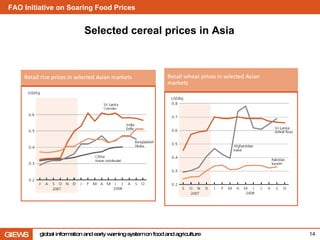
Selected cereal prices in Asia 14
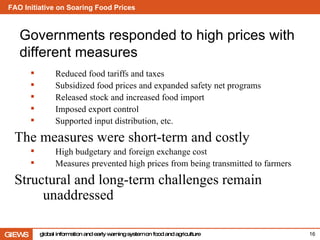
Reduced food tariffs and taxes Subsidized food prices and  expanded safety net programs Released stock and increased food import Imposed export control Supported input distribution, etc. The measures were short-term and costly High budgetary and foreign exchange cost Measures prevented high prices from being transmitted to farmers Structural and long-term challenges remain unaddressed Governments responded to high prices with different measures 16
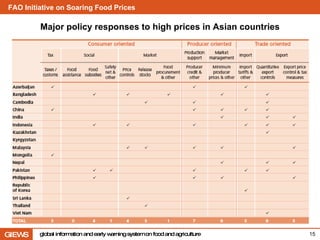
Major policy responses to high prices in Asian countries 15
FAO’S response -  the Initiative on Soaring Food Prices (ISFP) 17
OBJECTIVES increase food availability  boost smallholder productivity contribute to longer-term food security by addressing underlying drivers of the crisis   FAO Initiative on Soaring Food Prices (Launched in December 2007 and fully expanded after the High-level conference to translate the commitments into action) 19
FEATURES partnership country driven catalytic diversified targets smallholders tests best approaches FAO Initiative on Soaring Food Prices 20
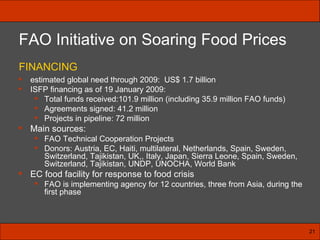
estimated global need through 2009:  US$ 1.7 billion ISFP financing as of 19 January 2009:  Total funds received:101.9 million (including 35.9 million FAO funds) Agreements signed: 41.2 million  Projects in pipeline: 72 million  Main sources: FAO Technical Cooperation Projects Donors: Austria, EC, Haiti, multilateral, Netherlands, Spain, Sweden, Switzerland, Tajikistan, UK,, Italy, Japan, Sierra Leone, Spain, Sweden, Switzerland, Tajikistan, UNDP, UNOCHA, World Bank EC food facility for response to food crisis FAO is implementing agency for 12 countries, three from Asia, during the first phase FAO Initiative on Soaring Food Prices FINANCING 21
inter-agency assessment missions country action plans: FAO Initiative on Soaring Food Prices MAIN ACTION ELEMENTS input supply (seeds, fertilizer, etc.) small-scale irrigation linking farmers with markets reducing crop losses supportive policies 22
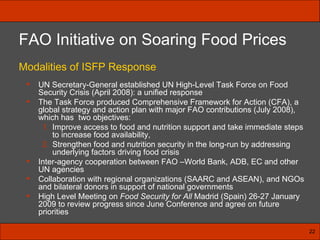
UN Secretary-General established UN High-Level Task Force on Food Security Crisis (April 2008): a unified response  The Task Force produced Comprehensive Framework for Action (CFA), a global strategy and action plan with major FAO contributions (July 2008), which has  two objectives: Improve access to food and nutrition support and take immediate steps to increase food availability,  Strengthen food and nutrition security in the long-run by addressing underlying factors driving food crisis Inter-agency cooperation between FAO –World Bank, ADB, EC and other UN agencies  Collaboration with regional organizations (SAARC and ASEAN), and NGOs and bilateral donors in support of national governments High Level Meeting on  Food Security for All  Madrid (Spain) 26-27 January 2009 to review progress since June Conference and agree on future priorities FAO Initiative on Soaring Food Prices Modalities of ISFP Response 22
FAO ISFP in  Asia & the Pacific Region 26
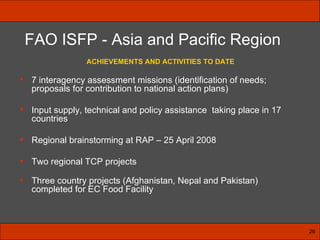
ACHIEVEMENTS AND ACTIVITIES TO DATE 7 interagency assessment missions (identification of needs; proposals for contribution to national action plans)  Input supply, technical and policy assistance  taking place in 17 countries Regional brainstorming at RAP – 25 April 2008 Two regional TCP projects Three country projects (Afghanistan, Nepal and Pakistan) completed for EC Food Facility   FAO ISFP - Asia and Pacific Region 26
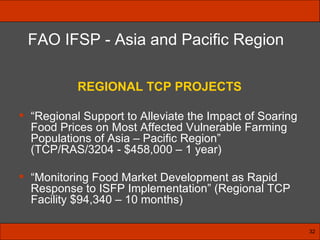
REGIONAL TCP PROJECTS “ Regional Support to Alleviate the Impact of Soaring Food Prices on Most Affected Vulnerable Farming Populations of Asia – Pacific Region” (TCP/RAS/3204 - $458,000 – 1 year) “ Monitoring Food Market Development as Rapid Response to ISFP Implementation” (Regional TCP Facility $94,340 – 10 months) FAO IFSP - Asia and Pacific Region 32
Regional Support to ISFP activities at the country level (TCP/RAS/3204) Objectives Support countries to increase agricultural production through enhanced supply of inputs, while ensuring timeliness, full transparency, quality of inputs and access to those most in need; Assist countries in setting up effective monitoring and evaluation  mechanisms to assess the impact of activities to address the soaring food prices situation; Support inter-agency assessments at the national level on the impact of the food crisis, the development of country action plans and the detailed formulation of recommended projects; Provide coordination services at regional/subregional level; identify scope for synergy, lessons learned and potential for upgrading and further development of national initiatives; and Strengthen regional and subregional organizations to better address and monitor the food security situation in the region.
Regional Support to ISFP activities at the country level (TCP/RAS/3204) Activities Technical support and supervision missions Regional workshop Mission to assess implementation and follow-up programming Project implementation support – Timor Leste Technical and operational support
Monitoring Food Market Development and Rapid Response to ISFP Implementation – TCP Facility Objectives To monitor the dynamic changes in the food markets (price fluctuations, market conditions, policy actions, etc.) in the Asia Pacific Region; To provide periodic analyses of important market and policy issues related to food security in RAP member countries in order to assist policy makers in decision‑making; and To continue the wide dissemination (website, email) of market information and analysis through the “Asia Pacific Food Situation Update” (APFSU) to governments, embassies, international organizations, related institutions.
Monitoring Food Market Development and Rapid Response to ISFP Implementation – TCP Facility Activities/ Outputs A network of trade and market correspondents in selected countries. A database of food and input prices (both domestic and international) A monthly newsletter  with analysis of international and domestic food prices, indicators and any changes relating to food/agriculture market and policy for stakeholders’ decision-making.
FAO’s collaboration with regional organizations: ISFP and beyond
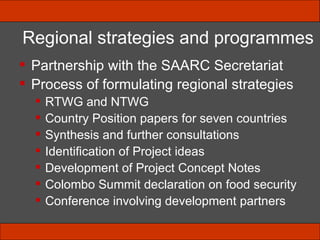
Regional strategies and programmes Partnership with the SAARC Secretariat Process of formulating regional strategies RTWG and NTWG Country Position papers for seven countries Synthesis and further consultations Identification of Project ideas Development of Project Concept Notes Colombo Summit declaration on food security Conference involving development partners
Proposed Areas for Regional Cooperation in SAARC
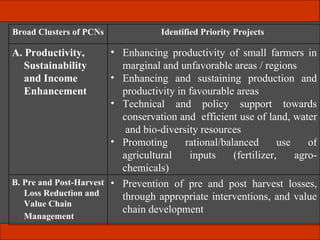
Prevention of pre and post harvest losses, through appropriate interventions, and value chain development B. Pre and Post-Harvest Loss Reduction and Value Chain Management   Enhancing productivity of small farmers in marginal and unfavorable areas / regions Enhancing and sustaining production and productivity in favourable areas Technical and policy support towards conservation and  efficient use of land, water  and bio-diversity resources Promoting rational/balanced use of agricultural inputs (fertilizer, agro-chemicals) A. Productivity, Sustainability and Income Enhancement  Identified Priority Projects  Broad Clusters of PCNs
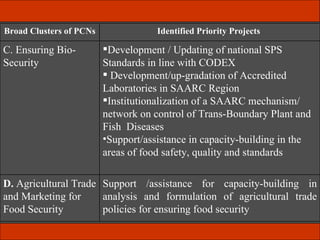
Identified Priority Projects  Broad Clusters of PCNs  Support /assistance for capacity-building in analysis and formulation of agricultural trade policies for ensuring food security D.  Agricultural Trade and Marketing for Food Security Development / Updating of national SPS  Standards in line with CODEX Development/up-gradation of Accredited Laboratories in SAARC Region Institutionalization of a SAARC mechanism/ network on control of Trans-Boundary Plant and Fish  Diseases Support/assistance in capacity-building in the areas of food safety, quality and standards  C. Ensuring Bio-Security
Proposed Areas for Regional Cooperation in ASEAN
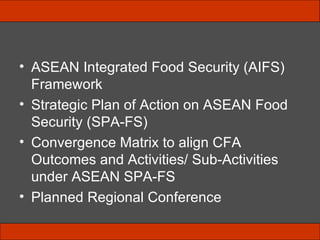
ASEAN Integrated Food Security (AIFS) Framework  Strategic Plan of Action on ASEAN Food Security (SPA-FS) Convergence Matrix to align CFA Outcomes and Activities/ Sub-Activities under ASEAN SPA-FS Planned Regional Conference
THANK YOU www.fao.org/isfp 43

FAO ISFP Presentation to IFAD APR Workshop

  • 1.
    P.K. Mudbhary Chief,Policy Assistance Branch FAO Regional Office for Asia and the Pacific 1 Workshop and Advanced Briefing for FAO Representatives 2- 6 February 2009 Bangkok, Thailand FAO’s Initiative on Soaring Food Prices in Asia and the Pacific
  • 2.
    PRESENTATION OUTLINE Foodprices and government response in Asia FAO’s response – the Initiative on Soaring Food Prices (ISFP) FAO ISFP in Asia & the Pacific FAO’s collaboration with regional organizations: ISFP and beyond 2
  • 3.
    Food prices andgovernment response in Asia
  • 4.
  • 5.
    Reduced food tariffsand taxes Subsidized food prices and expanded safety net programs Released stock and increased food import Imposed export control Supported input distribution, etc. The measures were short-term and costly High budgetary and foreign exchange cost Measures prevented high prices from being transmitted to farmers Structural and long-term challenges remain unaddressed Governments responded to high prices with different measures 16
  • 6.
    Major policy responsesto high prices in Asian countries 15
  • 7.
    FAO’S response - the Initiative on Soaring Food Prices (ISFP) 17
  • 8.
    OBJECTIVES increase foodavailability boost smallholder productivity contribute to longer-term food security by addressing underlying drivers of the crisis FAO Initiative on Soaring Food Prices (Launched in December 2007 and fully expanded after the High-level conference to translate the commitments into action) 19
  • 9.
    FEATURES partnership countrydriven catalytic diversified targets smallholders tests best approaches FAO Initiative on Soaring Food Prices 20
  • 10.
    estimated global needthrough 2009: US$ 1.7 billion ISFP financing as of 19 January 2009: Total funds received:101.9 million (including 35.9 million FAO funds) Agreements signed: 41.2 million Projects in pipeline: 72 million Main sources: FAO Technical Cooperation Projects Donors: Austria, EC, Haiti, multilateral, Netherlands, Spain, Sweden, Switzerland, Tajikistan, UK,, Italy, Japan, Sierra Leone, Spain, Sweden, Switzerland, Tajikistan, UNDP, UNOCHA, World Bank EC food facility for response to food crisis FAO is implementing agency for 12 countries, three from Asia, during the first phase FAO Initiative on Soaring Food Prices FINANCING 21
  • 11.
    inter-agency assessment missionscountry action plans: FAO Initiative on Soaring Food Prices MAIN ACTION ELEMENTS input supply (seeds, fertilizer, etc.) small-scale irrigation linking farmers with markets reducing crop losses supportive policies 22
  • 12.
    UN Secretary-General establishedUN High-Level Task Force on Food Security Crisis (April 2008): a unified response The Task Force produced Comprehensive Framework for Action (CFA), a global strategy and action plan with major FAO contributions (July 2008), which has two objectives: Improve access to food and nutrition support and take immediate steps to increase food availability, Strengthen food and nutrition security in the long-run by addressing underlying factors driving food crisis Inter-agency cooperation between FAO –World Bank, ADB, EC and other UN agencies Collaboration with regional organizations (SAARC and ASEAN), and NGOs and bilateral donors in support of national governments High Level Meeting on Food Security for All Madrid (Spain) 26-27 January 2009 to review progress since June Conference and agree on future priorities FAO Initiative on Soaring Food Prices Modalities of ISFP Response 22
  • 13.
    FAO ISFP in Asia & the Pacific Region 26
  • 14.
    ACHIEVEMENTS AND ACTIVITIESTO DATE 7 interagency assessment missions (identification of needs; proposals for contribution to national action plans) Input supply, technical and policy assistance taking place in 17 countries Regional brainstorming at RAP – 25 April 2008 Two regional TCP projects Three country projects (Afghanistan, Nepal and Pakistan) completed for EC Food Facility FAO ISFP - Asia and Pacific Region 26
  • 15.
    REGIONAL TCP PROJECTS“ Regional Support to Alleviate the Impact of Soaring Food Prices on Most Affected Vulnerable Farming Populations of Asia – Pacific Region” (TCP/RAS/3204 - $458,000 – 1 year) “ Monitoring Food Market Development as Rapid Response to ISFP Implementation” (Regional TCP Facility $94,340 – 10 months) FAO IFSP - Asia and Pacific Region 32
  • 16.
    Regional Support toISFP activities at the country level (TCP/RAS/3204) Objectives Support countries to increase agricultural production through enhanced supply of inputs, while ensuring timeliness, full transparency, quality of inputs and access to those most in need; Assist countries in setting up effective monitoring and evaluation mechanisms to assess the impact of activities to address the soaring food prices situation; Support inter-agency assessments at the national level on the impact of the food crisis, the development of country action plans and the detailed formulation of recommended projects; Provide coordination services at regional/subregional level; identify scope for synergy, lessons learned and potential for upgrading and further development of national initiatives; and Strengthen regional and subregional organizations to better address and monitor the food security situation in the region.
  • 17.
    Regional Support toISFP activities at the country level (TCP/RAS/3204) Activities Technical support and supervision missions Regional workshop Mission to assess implementation and follow-up programming Project implementation support – Timor Leste Technical and operational support
  • 18.
    Monitoring Food MarketDevelopment and Rapid Response to ISFP Implementation – TCP Facility Objectives To monitor the dynamic changes in the food markets (price fluctuations, market conditions, policy actions, etc.) in the Asia Pacific Region; To provide periodic analyses of important market and policy issues related to food security in RAP member countries in order to assist policy makers in decision‑making; and To continue the wide dissemination (website, email) of market information and analysis through the “Asia Pacific Food Situation Update” (APFSU) to governments, embassies, international organizations, related institutions.
  • 19.
    Monitoring Food MarketDevelopment and Rapid Response to ISFP Implementation – TCP Facility Activities/ Outputs A network of trade and market correspondents in selected countries. A database of food and input prices (both domestic and international) A monthly newsletter with analysis of international and domestic food prices, indicators and any changes relating to food/agriculture market and policy for stakeholders’ decision-making.
  • 20.
    FAO’s collaboration withregional organizations: ISFP and beyond
  • 21.
    Regional strategies andprogrammes Partnership with the SAARC Secretariat Process of formulating regional strategies RTWG and NTWG Country Position papers for seven countries Synthesis and further consultations Identification of Project ideas Development of Project Concept Notes Colombo Summit declaration on food security Conference involving development partners
  • 22.
    Proposed Areas forRegional Cooperation in SAARC
  • 23.
    Prevention of preand post harvest losses, through appropriate interventions, and value chain development B. Pre and Post-Harvest Loss Reduction and Value Chain Management Enhancing productivity of small farmers in marginal and unfavorable areas / regions Enhancing and sustaining production and productivity in favourable areas Technical and policy support towards conservation and efficient use of land, water and bio-diversity resources Promoting rational/balanced use of agricultural inputs (fertilizer, agro-chemicals) A. Productivity, Sustainability and Income Enhancement Identified Priority Projects Broad Clusters of PCNs
  • 24.
    Identified Priority Projects Broad Clusters of PCNs Support /assistance for capacity-building in analysis and formulation of agricultural trade policies for ensuring food security D. Agricultural Trade and Marketing for Food Security Development / Updating of national SPS Standards in line with CODEX Development/up-gradation of Accredited Laboratories in SAARC Region Institutionalization of a SAARC mechanism/ network on control of Trans-Boundary Plant and Fish Diseases Support/assistance in capacity-building in the areas of food safety, quality and standards C. Ensuring Bio-Security
  • 25.
    Proposed Areas forRegional Cooperation in ASEAN
  • 26.
    ASEAN Integrated FoodSecurity (AIFS) Framework Strategic Plan of Action on ASEAN Food Security (SPA-FS) Convergence Matrix to align CFA Outcomes and Activities/ Sub-Activities under ASEAN SPA-FS Planned Regional Conference
  • 27.