“Regional Integration Bodies:
Coordination and dialogue opportunities
between national, regional,
and global Levels”
Regional Dialogue on Hunger Eradication in the Caribbean:
Right to Food and Governance principles
Antigua and Barbuda, Jolly Beach Resort
August 1-2, 2013
Global Machinery
At the global level there are a number of organizations that have
Food and Nutrition Security and Agriculture Development as a
principal element of there mandate:
• Agricultural Development Banks.
• European Commission Directorate General for Agriculture and Rural
Development. EU directorate responsible for the implementation of
agriculture and rural development policy.
• Food and Agriculture Organization of the United Nations. The
major international organization for food and agriculture. Includes
datasets, catalogs and information systems on food, agriculture,
forestry and fisheries worldwide.
Global Machinery
• International Fund for Agricultural Development. Specialized
agency of the United Nations financing agricultural
development projects in developing countries. Good source of
online publications.
• World Bank Program in Rural Development Research. World
Bank section devoted to agriculture and rural development,
including agricultural trade, fisheries, forestry, land policy, etc.
• World Food Programme. World's largest humanitarian agency
and food aid branch of the United Nations.
Regional Machinery
Caribbean Countries are confronted with several critical issues
that are all linked to Food and Nutrition Security and hence the
approach must be dynamic and multifaceted .
Each institution within the CARICOM Community has a role of our
advancing the work of eradicating hunger in the Caribbean
• THE CARICOM Secretariat – Ensuring Organization and
collaboration within the sector
The Cluster Approach is intended to not only engender greater
Collaboration but also to achieve greater coordination among the
respective work programmes, especially in relation to garnering
resources to implement these.
Regional Machinery
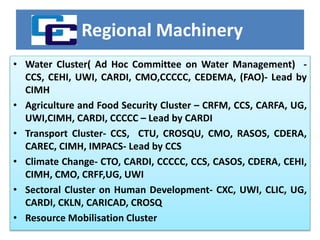
• Water Cluster( Ad Hoc Committee on Water Management) -
CCS, CEHI, UWI, CARDI, CMO,CCCCC, CEDEMA, (FAO)- Lead by
CIMH
• Agriculture and Food Security Cluster – CRFM, CCS, CARFA, UG,
UWI,CIMH, CARDI, CCCCC – Lead by CARDI
• Transport Cluster- CCS, CTU, CROSQU, CMO, RASOS, CDERA,
CAREC, CIMH, IMPACS- Lead by CCS
• Climate Change- CTO, CARDI, CCCCC, CCS, CASOS, CDERA, CEHI,
CIMH, CMO, CRFF,UG, UWI
• Sectoral Cluster on Human Development- CXC, UWI, CLIC, UG,
CARDI, CKLN, CARICAD, CROSQ
• Resource Mobilisation Cluster
Regional Machinery
The Regional Food and Nutrition Security Committee (RFNSC)
The Regional Committee will be responsible for providing overall policy guidance for the RFNSAP
(essentially broad policy thrusts and conceptual oversight, including review of performance
evaluations for the Action Plan as a whole). The RFNSC will be anchored within the Secretariat by
the CARICOM Regional FNS Focal Point with support from the Senior Project Officer, Health Sector
Development, the Agriculture Business Specialist, and the Sustainable development. More
specifically, the RAFNSC will be responsible for:
• Providing general policy guidance for the implementation of the plan;
• Advising national food and nutrition security councils and other bodies on establishing
mechanisms for redress, as mandated by the Regional Food and Nutrition Security Policy;
• Reviewing progress and advising on necessary adjustments;
• Reviewing reports for submission to the Heads of Government and other relevant bodies of the
CARICOM governance system.
Chairman : Dr Braithwaite
Policy Framework for FNS
The Revised Treaty of Chaguaramas - the CARICOM Single Market
and Economy (CSME) provides for the Community Agriculture
Policy (Articles 56 and 57), Marketing of Agriculture Products
(Article 59), Fisheries Management and Development (Article 60)
and Forest Management and Development (Article 61).
• Vision: The fundamental transformation of the agricultural
sector towards market-oriented, internationally competitive
and environmentally sound production of agricultural
products and services;
Policy Framework for FNS
• Jagdeo Initiative – 9 KBC - TMACs
• Liliendaal Declaration on Agriculture and Food
Security
• Liliendaal Declaration on Climate Change
• Community Agriculture Policy (CAP)
Five pillars:
(1) Food and Nutrition Security;
(2) Production and Trade/Value Chain;
(3) Sustainable Development of Natural Resources;
(4) Rural Modernization and Youth Programmes and;
(5) a Modern Agricultural Knowledge and Information
System.
Cross-cutting themes
• Information and knowledge
Systems/Knowledge management
• HRD and capacity building
• Innovation and Technology
• Disaster risk management
• Labour and human rights
• Access to ICT
• Resource mobilisation
Regional Food and Nutrition
Security Policy & AP
The Regional Food and Nutrition Security Policy
2011- 2025 (RFNSP) that was adopted by the
Council of Trade and Economic Development in
2010. The Regional Food and Nutrition Security
Action Plan is to implement the CARICOM
Regional Food and Nutrition Security Policy and
was adopted by the COTED in 2011. The first
plan covers a fifteen-year period from 2012 to
2026.
Regional Food and Nutrition
Security Policy & AP
The two major objectives are to:
1.Reduce hunger especially in the vulnerable groups by
increasing access to affordable, nutritious, safe and quality
food.
2.Shifting to sustainable food production systems where the
producers receive adequate remuneration for their
products enabling them to have an adequate standard of
living.
• The RFNSP has also been accepted by
CARICOM’s international development
partners as the framework to guide their
interventions in the field of Food and
Nutrition Security in the Region
Regional Food and Nutrition
Security Policy & AP
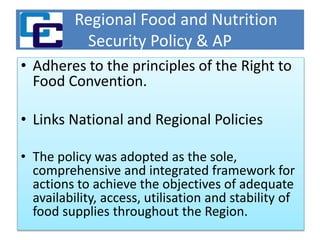
• Adheres to the principles of the Right to
Food Convention.
• Links National and Regional Policies
• The policy was adopted as the sole,
comprehensive and integrated framework for
actions to achieve the objectives of adequate
availability, access, utilisation and stability of
food supplies throughout the Region.
Regional Food and Nutrition
Security Policy & AP
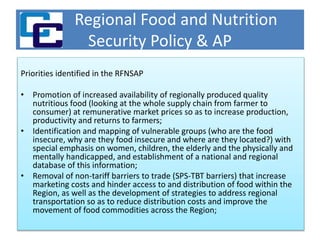
Priorities identified in the RFNSAP
• Promotion of increased availability of regionally produced quality
nutritious food (looking at the whole supply chain from farmer to
consumer) at remunerative market prices so as to increase production,
productivity and returns to farmers;
• Identification and mapping of vulnerable groups (who are the food
insecure, why are they food insecure and where are they located?) with
special emphasis on women, children, the elderly and the physically and
mentally handicapped, and establishment of a national and regional
database of this information;
• Removal of non-tariff barriers to trade (SPS-TBT barriers) that increase
marketing costs and hinder access to and distribution of food within the
Region, as well as the development of strategies to address regional
transportation so as to reduce distribution costs and improve the
movement of food commodities across the Region;
Regional Food and Nutrition
Security Policy & AP Process
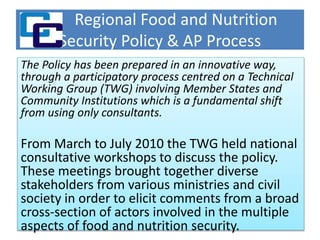
The Policy has been prepared in an innovative way,
through a participatory process centred on a Technical
Working Group (TWG) involving Member States and
Community Institutions which is a fundamental shift
from using only consultants.
From March to July 2010 the TWG held national
consultative workshops to discuss the policy.
These meetings brought together diverse
stakeholders from various ministries and civil
society in order to elicit comments from a broad
cross-section of actors involved in the multiple
aspects of food and nutrition security.
The Formulation Process
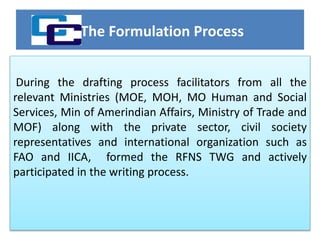
During the drafting process facilitators from all the
relevant Ministries (MOE, MOH, MO Human and Social
Services, Min of Amerindian Affairs, Ministry of Trade and
MOF) along with the private sector, civil society
representatives and international organization such as
FAO and IICA, formed the RFNS TWG and actively
participated in the writing process.
Actions Currently Being Undertaken to
address the FNS Situation
Regional Technical Cooperation Projects (TCP) on
Food and Nutrition Security Implemented
• The (TCP) project entitled “Sub-regional Project
for the preparation of National Food and
Nutrition Security Policies and Action This
project is funded by the UN FAO.
• The TCP entitled “Sub-regional Project for the
establishment of an Information and Early
Warning System in support of Food and
Nutrition Security in the CARICOM Sub-region
Actions Currently Being Undertaken to
address the FNS Situation
• The FAO funded, Post-Harvest Losses Project seeks to build
on and expand the current programs using the value chain
approach as a vehicle to promote and address post-harvest
loss reduction strategies. The project was submitted to UN
FAO Barbados and has recently been formally approved. It is
anticipated that this project will come on stream in the first
quarter of 2014.
Actions Currently Being Undertaken to
address the FNS Situation
• The Financing Agreement for the Intra-ACP
Agriculture Policy Programme was signed by
the European Union and the Secretary
General of the ACP States in February 2012.
The Three Components of this agreement are:
Policy
Technology and Innovation
Agri Business
Actions Currently Being Undertaken to
address the FNS Situation
• In addition, during the past three months
the Agriculture Cluster Work Program
has undergone a series of assessments
which has culminated in the preparation
of a combined Regional Agriculture Work
Programme aimed at enhancing
synergies and optimizing the limited
resources available in the sector.
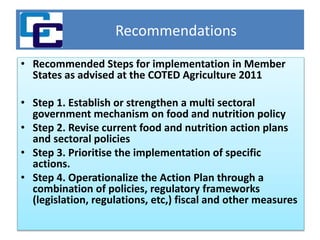
Recommendations
• Recommended Steps for implementation in Member
States as advised at the COTED Agriculture 2011
• Step 1. Establish or strengthen a multi sectoral
government mechanism on food and nutrition policy
• Step 2. Revise current food and nutrition action plans
and sectoral policies
• Step 3. Prioritise the implementation of specific
actions.
• Step 4. Operationalize the Action Plan through a
combination of policies, regulatory frameworks
(legislation, regulations, etc,) fiscal and other measures
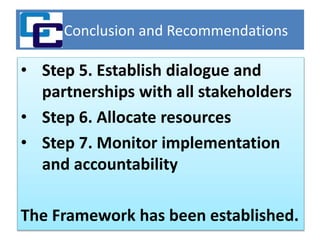
Conclusion and Recommendations
• Step 5. Establish dialogue and
partnerships with all stakeholders
• Step 6. Allocate resources
• Step 7. Monitor implementation
and accountability
The Framework has been established.
Thank you!
Thank You

Regional Integration Bodies: Coordination and dialogue opportunities between national, regional and global levels

  • 1.
    “Regional Integration Bodies: Coordinationand dialogue opportunities between national, regional, and global Levels” Regional Dialogue on Hunger Eradication in the Caribbean: Right to Food and Governance principles Antigua and Barbuda, Jolly Beach Resort August 1-2, 2013
  • 2.
    Global Machinery At theglobal level there are a number of organizations that have Food and Nutrition Security and Agriculture Development as a principal element of there mandate: • Agricultural Development Banks. • European Commission Directorate General for Agriculture and Rural Development. EU directorate responsible for the implementation of agriculture and rural development policy. • Food and Agriculture Organization of the United Nations. The major international organization for food and agriculture. Includes datasets, catalogs and information systems on food, agriculture, forestry and fisheries worldwide.
  • 3.
    Global Machinery • InternationalFund for Agricultural Development. Specialized agency of the United Nations financing agricultural development projects in developing countries. Good source of online publications. • World Bank Program in Rural Development Research. World Bank section devoted to agriculture and rural development, including agricultural trade, fisheries, forestry, land policy, etc. • World Food Programme. World's largest humanitarian agency and food aid branch of the United Nations.
  • 4.
    Regional Machinery Caribbean Countriesare confronted with several critical issues that are all linked to Food and Nutrition Security and hence the approach must be dynamic and multifaceted . Each institution within the CARICOM Community has a role of our advancing the work of eradicating hunger in the Caribbean • THE CARICOM Secretariat – Ensuring Organization and collaboration within the sector The Cluster Approach is intended to not only engender greater Collaboration but also to achieve greater coordination among the respective work programmes, especially in relation to garnering resources to implement these.
  • 5.
    Regional Machinery • WaterCluster( Ad Hoc Committee on Water Management) - CCS, CEHI, UWI, CARDI, CMO,CCCCC, CEDEMA, (FAO)- Lead by CIMH • Agriculture and Food Security Cluster – CRFM, CCS, CARFA, UG, UWI,CIMH, CARDI, CCCCC – Lead by CARDI • Transport Cluster- CCS, CTU, CROSQU, CMO, RASOS, CDERA, CAREC, CIMH, IMPACS- Lead by CCS • Climate Change- CTO, CARDI, CCCCC, CCS, CASOS, CDERA, CEHI, CIMH, CMO, CRFF,UG, UWI • Sectoral Cluster on Human Development- CXC, UWI, CLIC, UG, CARDI, CKLN, CARICAD, CROSQ • Resource Mobilisation Cluster
  • 6.
    Regional Machinery The RegionalFood and Nutrition Security Committee (RFNSC) The Regional Committee will be responsible for providing overall policy guidance for the RFNSAP (essentially broad policy thrusts and conceptual oversight, including review of performance evaluations for the Action Plan as a whole). The RFNSC will be anchored within the Secretariat by the CARICOM Regional FNS Focal Point with support from the Senior Project Officer, Health Sector Development, the Agriculture Business Specialist, and the Sustainable development. More specifically, the RAFNSC will be responsible for: • Providing general policy guidance for the implementation of the plan; • Advising national food and nutrition security councils and other bodies on establishing mechanisms for redress, as mandated by the Regional Food and Nutrition Security Policy; • Reviewing progress and advising on necessary adjustments; • Reviewing reports for submission to the Heads of Government and other relevant bodies of the CARICOM governance system. Chairman : Dr Braithwaite
  • 7.
    Policy Framework forFNS The Revised Treaty of Chaguaramas - the CARICOM Single Market and Economy (CSME) provides for the Community Agriculture Policy (Articles 56 and 57), Marketing of Agriculture Products (Article 59), Fisheries Management and Development (Article 60) and Forest Management and Development (Article 61). • Vision: The fundamental transformation of the agricultural sector towards market-oriented, internationally competitive and environmentally sound production of agricultural products and services;
  • 8.
    Policy Framework forFNS • Jagdeo Initiative – 9 KBC - TMACs • Liliendaal Declaration on Agriculture and Food Security • Liliendaal Declaration on Climate Change • Community Agriculture Policy (CAP) Five pillars: (1) Food and Nutrition Security; (2) Production and Trade/Value Chain; (3) Sustainable Development of Natural Resources; (4) Rural Modernization and Youth Programmes and; (5) a Modern Agricultural Knowledge and Information System.
  • 9.
    Cross-cutting themes • Informationand knowledge Systems/Knowledge management • HRD and capacity building • Innovation and Technology • Disaster risk management • Labour and human rights • Access to ICT • Resource mobilisation
  • 10.
    Regional Food andNutrition Security Policy & AP The Regional Food and Nutrition Security Policy 2011- 2025 (RFNSP) that was adopted by the Council of Trade and Economic Development in 2010. The Regional Food and Nutrition Security Action Plan is to implement the CARICOM Regional Food and Nutrition Security Policy and was adopted by the COTED in 2011. The first plan covers a fifteen-year period from 2012 to 2026.
  • 11.
    Regional Food andNutrition Security Policy & AP The two major objectives are to: 1.Reduce hunger especially in the vulnerable groups by increasing access to affordable, nutritious, safe and quality food. 2.Shifting to sustainable food production systems where the producers receive adequate remuneration for their products enabling them to have an adequate standard of living. • The RFNSP has also been accepted by CARICOM’s international development partners as the framework to guide their interventions in the field of Food and Nutrition Security in the Region
  • 12.
    Regional Food andNutrition Security Policy & AP • Adheres to the principles of the Right to Food Convention. • Links National and Regional Policies • The policy was adopted as the sole, comprehensive and integrated framework for actions to achieve the objectives of adequate availability, access, utilisation and stability of food supplies throughout the Region.
  • 13.
    Regional Food andNutrition Security Policy & AP Priorities identified in the RFNSAP • Promotion of increased availability of regionally produced quality nutritious food (looking at the whole supply chain from farmer to consumer) at remunerative market prices so as to increase production, productivity and returns to farmers; • Identification and mapping of vulnerable groups (who are the food insecure, why are they food insecure and where are they located?) with special emphasis on women, children, the elderly and the physically and mentally handicapped, and establishment of a national and regional database of this information; • Removal of non-tariff barriers to trade (SPS-TBT barriers) that increase marketing costs and hinder access to and distribution of food within the Region, as well as the development of strategies to address regional transportation so as to reduce distribution costs and improve the movement of food commodities across the Region;
  • 14.
    Regional Food andNutrition Security Policy & AP Process The Policy has been prepared in an innovative way, through a participatory process centred on a Technical Working Group (TWG) involving Member States and Community Institutions which is a fundamental shift from using only consultants. From March to July 2010 the TWG held national consultative workshops to discuss the policy. These meetings brought together diverse stakeholders from various ministries and civil society in order to elicit comments from a broad cross-section of actors involved in the multiple aspects of food and nutrition security.
  • 15.
    The Formulation Process Duringthe drafting process facilitators from all the relevant Ministries (MOE, MOH, MO Human and Social Services, Min of Amerindian Affairs, Ministry of Trade and MOF) along with the private sector, civil society representatives and international organization such as FAO and IICA, formed the RFNS TWG and actively participated in the writing process.
  • 16.
    Actions Currently BeingUndertaken to address the FNS Situation Regional Technical Cooperation Projects (TCP) on Food and Nutrition Security Implemented • The (TCP) project entitled “Sub-regional Project for the preparation of National Food and Nutrition Security Policies and Action This project is funded by the UN FAO. • The TCP entitled “Sub-regional Project for the establishment of an Information and Early Warning System in support of Food and Nutrition Security in the CARICOM Sub-region
  • 17.
    Actions Currently BeingUndertaken to address the FNS Situation • The FAO funded, Post-Harvest Losses Project seeks to build on and expand the current programs using the value chain approach as a vehicle to promote and address post-harvest loss reduction strategies. The project was submitted to UN FAO Barbados and has recently been formally approved. It is anticipated that this project will come on stream in the first quarter of 2014.
  • 18.
    Actions Currently BeingUndertaken to address the FNS Situation • The Financing Agreement for the Intra-ACP Agriculture Policy Programme was signed by the European Union and the Secretary General of the ACP States in February 2012. The Three Components of this agreement are: Policy Technology and Innovation Agri Business
  • 19.
    Actions Currently BeingUndertaken to address the FNS Situation • In addition, during the past three months the Agriculture Cluster Work Program has undergone a series of assessments which has culminated in the preparation of a combined Regional Agriculture Work Programme aimed at enhancing synergies and optimizing the limited resources available in the sector.
  • 20.
    Recommendations • Recommended Stepsfor implementation in Member States as advised at the COTED Agriculture 2011 • Step 1. Establish or strengthen a multi sectoral government mechanism on food and nutrition policy • Step 2. Revise current food and nutrition action plans and sectoral policies • Step 3. Prioritise the implementation of specific actions. • Step 4. Operationalize the Action Plan through a combination of policies, regulatory frameworks (legislation, regulations, etc,) fiscal and other measures
  • 21.
    Conclusion and Recommendations •Step 5. Establish dialogue and partnerships with all stakeholders • Step 6. Allocate resources • Step 7. Monitor implementation and accountability The Framework has been established.
  • 22.