1

Project in Physics 105.3

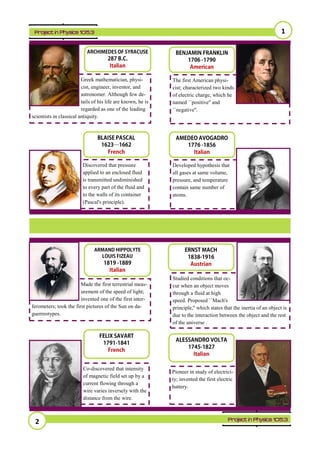
Greek mathematician, physicist, engineer, inventor, and
astronomer. Although few details of his life are known, he is
regarded as one of the leading
scientists in classical antiquity.

Discovered that pressure
applied to an enclosed fluid
is transmitted undiminished
to every part of the fluid and
to the walls of its container
(Pascal's principle).

Made the first terrestrial measurement of the speed of light;
invented one of the first interferometers; took the first pictures of the Sun on daguerreotypes.

Co-discovered that intensity
of magnetic field set up by a
current flowing through a
wire varies inversely with the
distance from the wire.

2

The first American physicist; characterized two kinds
of electric charge, which he
named ``positive'' and
``negative''.

Developed hypothesis that
all gases at same volume,
pressure, and temperature
contain same number of
atoms.

Studied conditions that occur when an object moves
through a fluid at high
speed. Proposed ``Mach's
principle,'' which states that the inertia of an object is
due to the interaction between the object and the rest
of the universe .

Pioneer in study of electricity; invented the first electric
battery.

Project in Physics 105.3
3

Project in Physics 105.3

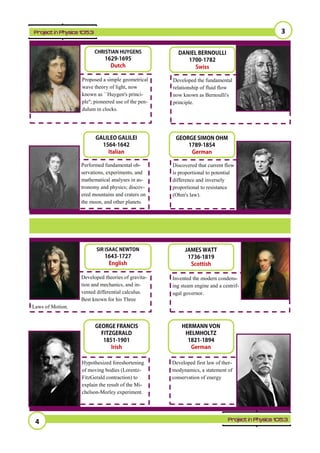
Proposed a simple geometrical
wave theory of light, now
known as ``Huygen's principle''; pioneered use of the pendulum in clocks.

Developed the fundamental
relationship of fluid flow
now known as Bernoulli's
principle.

Performed fundamental observations, experiments, and
mathematical analyses in astronomy and physics; discovered mountains and craters on
the moon, and other planets.

Discovered that current flow
is proportional to potential
difference and inversely
proportional to resistance
(Ohm's law).

Developed theories of gravitation and mechanics, and invented differential calculus.
Best known for his Three

Invented the modern condensing steam engine and a centrifugal governor.

Hypothesized foreshortening
of moving bodies (LorentzFitzGerald contraction) to
explain the result of the Michelson-Morley experiment.

Developed first law of thermodynamics, a statement of
conservation of energy

Laws of Motion.

4

Project in Physics 105.3
5

Project in Physics 105.3

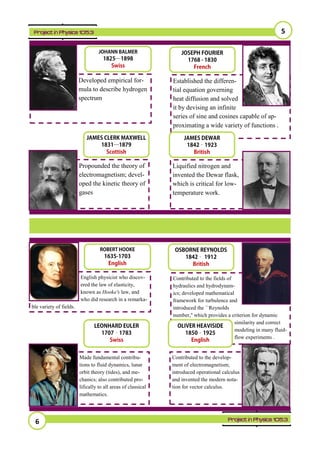
Developed empirical formula to describe hydrogen
spectrum

Established the differential equation governing
heat diffusion and solved
it by devising an infinite
series of sine and cosines capable of approximating a wide variety of functions .

Propounded the theory of
electromagnetism; developed the kinetic theory of
gases

Liquified nitrogen and
invented the Dewar flask,
which is critical for lowtemperature work.

English physicist who discovered the law of elasticity,
known as Hooke's law, and
who did research in a remarka-

Contributed to the fields of
hydraulics and hydrodynamics; developed mathematical
framework for turbulence and
introduced the ``Reynolds
number,'' which provides a criterion for dynamic
similarity and correct
modeling in many fluidflow experiments .

Made fundamental contributions to fluid dynamics, lunar
orbit theory (tides), and mechanics; also contributed prolifically to all areas of classical
mathematics.

Contributed to the development of electromagnetism;
introduced operational calculus
and invented the modern notation for vector calculus.

ble variety of fields.

6

Project in Physics 105.3
7

Project in Physics 105.3

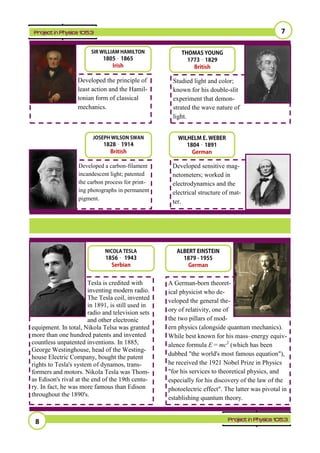
Developed the principle of
least action and the Hamiltonian form of classical
mechanics.

Studied light and color;
known for his double-slit
experiment that demonstrated the wave nature of
light.

Developed a carbon-filament
incandescent light; patented
the carbon process for printing photographs in permanent
pigment.

Developed sensitive magnetometers; worked in
electrodynamics and the
electrical structure of matter.

Tesla is credited with
inventing modern radio.
The Tesla coil, invented
in 1891, is still used in
radio and television sets
and other electronic
equipment. In total, Nikola Telsa was granted
more than one hundred patents and invented
countless unpatented inventions. In 1885,
George Westinghouse, head of the Westinghouse Electric Company, bought the patent
rights to Tesla's system of dynamos, transformers and motors. Nikola Tesla was Thomas Edison's rival at the end of the 19th century. In fact, he was more famous than Edison
throughout the 1890's.

8

A German-born theoretical physicist who developed the general theory of relativity, one of
the two pillars of modern physics (alongside quantum mechanics).
While best known for his mass–energy equivalence formula E = mc2 (which has been
dubbed "the world's most famous equation"),
he received the 1921 Nobel Prize in Physics
"for his services to theoretical physics, and
especially for his discovery of the law of the
photoelectric effect". The latter was pivotal in
establishing quantum theory.

Project in Physics 105.3

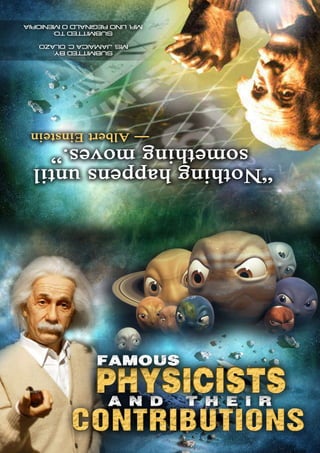
Famous Physicists and Their Contributions

  • 2.
    1 Project in Physics105.3 Greek mathematician, physicist, engineer, inventor, and astronomer. Although few details of his life are known, he is regarded as one of the leading scientists in classical antiquity. Discovered that pressure applied to an enclosed fluid is transmitted undiminished to every part of the fluid and to the walls of its container (Pascal's principle). Made the first terrestrial measurement of the speed of light; invented one of the first interferometers; took the first pictures of the Sun on daguerreotypes. Co-discovered that intensity of magnetic field set up by a current flowing through a wire varies inversely with the distance from the wire. 2 The first American physicist; characterized two kinds of electric charge, which he named ``positive'' and ``negative''. Developed hypothesis that all gases at same volume, pressure, and temperature contain same number of atoms. Studied conditions that occur when an object moves through a fluid at high speed. Proposed ``Mach's principle,'' which states that the inertia of an object is due to the interaction between the object and the rest of the universe . Pioneer in study of electricity; invented the first electric battery. Project in Physics 105.3
  • 3.
    3 Project in Physics105.3 Proposed a simple geometrical wave theory of light, now known as ``Huygen's principle''; pioneered use of the pendulum in clocks. Developed the fundamental relationship of fluid flow now known as Bernoulli's principle. Performed fundamental observations, experiments, and mathematical analyses in astronomy and physics; discovered mountains and craters on the moon, and other planets. Discovered that current flow is proportional to potential difference and inversely proportional to resistance (Ohm's law). Developed theories of gravitation and mechanics, and invented differential calculus. Best known for his Three Invented the modern condensing steam engine and a centrifugal governor. Hypothesized foreshortening of moving bodies (LorentzFitzGerald contraction) to explain the result of the Michelson-Morley experiment. Developed first law of thermodynamics, a statement of conservation of energy Laws of Motion. 4 Project in Physics 105.3
  • 4.
    5 Project in Physics105.3 Developed empirical formula to describe hydrogen spectrum Established the differential equation governing heat diffusion and solved it by devising an infinite series of sine and cosines capable of approximating a wide variety of functions . Propounded the theory of electromagnetism; developed the kinetic theory of gases Liquified nitrogen and invented the Dewar flask, which is critical for lowtemperature work. English physicist who discovered the law of elasticity, known as Hooke's law, and who did research in a remarka- Contributed to the fields of hydraulics and hydrodynamics; developed mathematical framework for turbulence and introduced the ``Reynolds number,'' which provides a criterion for dynamic similarity and correct modeling in many fluidflow experiments . Made fundamental contributions to fluid dynamics, lunar orbit theory (tides), and mechanics; also contributed prolifically to all areas of classical mathematics. Contributed to the development of electromagnetism; introduced operational calculus and invented the modern notation for vector calculus. ble variety of fields. 6 Project in Physics 105.3
  • 5.
    7 Project in Physics105.3 Developed the principle of least action and the Hamiltonian form of classical mechanics. Studied light and color; known for his double-slit experiment that demonstrated the wave nature of light. Developed a carbon-filament incandescent light; patented the carbon process for printing photographs in permanent pigment. Developed sensitive magnetometers; worked in electrodynamics and the electrical structure of matter. Tesla is credited with inventing modern radio. The Tesla coil, invented in 1891, is still used in radio and television sets and other electronic equipment. In total, Nikola Telsa was granted more than one hundred patents and invented countless unpatented inventions. In 1885, George Westinghouse, head of the Westinghouse Electric Company, bought the patent rights to Tesla's system of dynamos, transformers and motors. Nikola Tesla was Thomas Edison's rival at the end of the 19th century. In fact, he was more famous than Edison throughout the 1890's. 8 A German-born theoretical physicist who developed the general theory of relativity, one of the two pillars of modern physics (alongside quantum mechanics). While best known for his mass–energy equivalence formula E = mc2 (which has been dubbed "the world's most famous equation"), he received the 1921 Nobel Prize in Physics "for his services to theoretical physics, and especially for his discovery of the law of the photoelectric effect". The latter was pivotal in establishing quantum theory. Project in Physics 105.3