FAMILY & MUSIC THERAPY
RITARANI NAYAK
ASSISTANTPROFESSER
SUMNURSINGCOLLEGE
FAMILYTHERAPY
Introduction:
 Family therapy is the branch of psychiatry which sees an individual’s psychiatric
symptoms as inseparably related to the family in which he lives. Thus the focus of
treatment is not on the individual, but the family.
 Family therapy is a relatively new development that came about in the mid-
twentieth century as an adjunct to individual treatment and refers to thetreatment
of the family as whole.
 Family therapists use a wide variety of theoretical philosophies and techniquesto
bring about change in dysfunctional patterns of behaviour and interaction, some
therapists may focus on the here and now,
 Although different therapists may adhere to different theories and use awide
variety of methods, the goals of family therapy are basically thesame.
Goals :
To reduce dysfunctional behaviour of individual family
members.
To resolve or reduce intrafamily relationship conflicts.
To improve family communication skills.
To heighten awareness and sensitivity to other family members
to meet their needs.
To strengthen the family ability to cope with the major life
stressors and traumatic events.
To improve integration of the family system into the social
system.
Indication and contraindication of
family therapy
Indications:
Problems in the relationship within the family(urge existence of
communication or generation gap)
Interdependence of symptoms(e.g. the wife’s depression being
contingent on the husband’s alcohol consumption and vice versa)
Failure of individual therapy(may be because family tensions have not
been handled)
Development of stress in other family members when one family
member improves (e.g. development of depression in wife following
husband’s giving up drinking, leading to his improves participation in
family matters)
Contraindications:
A. Family factors
Family in the process of breaking up
Families in which tense, dysfunctional equilibrium is
present.
Families staying apart
No availability of the key family member
Unwillingness to accept the therapy.
Functions of the family therapy
Boundary function: boundaries will maintain a distinction
between individuals with the family. Rigid boundaries prevent
family members from trying out new ideas.
Communication function: communication within the family
encourages its members to express their feelings or emotions
appropriately.
Supportive function: supportive function within the family
give freedom to grow and explore new roles within the family
members.
Socialization function: socialization helps to
interact, negotiate and plan adopts coping skills
within the members of the family.
Biological function: family is a medium where the
sex relations are regulated.
Psychological function: love, belongingness,
affection, sympathy, security, attention, emotional
satisfaction, sexual relationship, intimacy etc. will
be attained through family.
Educational function: mother is the first teacher
and primary care giver who will take care of the
children. Child’s personality and character
formation will be attained through family.
 Protective function: family protects the interest
of the child, provides security to cultivate healthy
behavior.
 Recreational function: family creates an
atmosphere where the child’s interest can be
fulfilled. The love among family members will
create positive interest in the child.
 Religious function: family develops religious thoughts, kind
heartedness and fellow belonging. The child learns more moral values,
ethics, codes, honesty, truthfulness, traditions and religious patterns.
Cultural function: family molds its members according to its culture.
It transmits ideas, folkways, mores, customs, traditions, beliefs and
values from one generation to another generation.
Social function:
- maintain social status and controls member’s activities.
-Promotes safety and security and lays emphasis on kinship patterns
-provides physical shelter, food, clothing which are necessary to the
existence of life.
TYPES OF FAMILYTHERAPY:
INDIVIDUAL FAMILYTHERAPY
 In individual family therapy, each family
member has a single therapist. The whole
family may meet occasionally with one or
two of the therapists to see how the
member’s ae relating to one another and
work out specific issues that have been
defined by the individual members.
CONJOINT FAMILYTHERAPY
 The most common type of family therapy is the
single-family group, or conjoint family therapy.
The nuclear family is seen, and the issues and
problems raised by the family are the ones
addressed by the therapist. The way in which the
family interacts is observed and becomes the
focus of therapy. The therapist helps the family
deal more effectively with problems as they
arise and are defined.
 COUPLES THERAPY
Couples are often seen by the therapist together. The
couple may be experiencing difficulties in their
marriage, and in therapy, they are helped to work
together to seek a resolution for their problems.
Family patterns, interaction and the communication
styles, and each partner’s goals, hopes and
expectations are examined in therapy. This
examination enables the couple to find a common
ground for resolving conflicts by recognizing and
respecting each other’s similarities and differences.
 MULTIPLE FAMILY GROUPTHERAPY
In multiple family group therapy, four or five families
meet weekly to confront and deal with the problems or
issues they have in common. Ability or inability to
function well in the home and community fearing of
talking to or relating to others, abuse, anger, neglect,
the development of social skills, and responsibility for
oneself are some of the issues on which these group
focus. The multiple family group become the support
for all the families. The network also encourages each
person to reach out form new relationships outside the
group.
 MULTIPLE IMPACT THERAPY
In multiple impact therapy, several therapists come
together with families in a community setting. They
live together and deal with pertinent issues for each
family member within the context of the group.
Multiple impact therapy is similar to multiple family
group therapy except that it is more intense and time
limited. Like multiple family group therapy, it focuses
on developing skills or working together as a family
and with other families.
 NETWORK THERAPY
Network therapy is conducted in people’s homes.All
individuals interested or invested in a problem or
crisis that particular person or persons in a family are
experiencing take part. This gathering includes
family, friends, neighbours, professional groups or
persons, and anyone in the community who has an
investment in the outcome of the current crisis.
People who form the network generally know each
other and interact on a regular basis in each other’s
lives. Thus a network may include as many as 40 to
60 people.
Family therapy assessment
Boyer and Jeffrey (1984) describe six elements on
which families are assessed to be either functional or
dysfunctional. The six element of assessment include:
Communication
Self-concept reinforcement
Family member expectations.
Handling differences.
Family interactional patterns.
Family climate
Communication
Functional communication patterns are those in
which verbal and non-verbal messages are clear,
direct, and congruent between sender and
intended receiver. Family member are
encouraged to express honest feelings and
opinions, and all members participate in
decisions that affect the family system. Each
member is an active listener to other members
of the family.
Making assumption:
in this, one assumes that others will know
what is meant by an action or an expression
For e.g., a father says to his teenage son “you
should have gone to market to bring some
provisions for home during my absence at
home”.
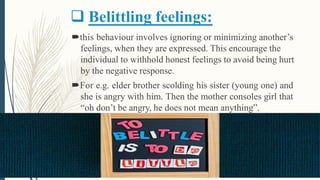
 Belittling feelings:
this behaviour involves ignoring or minimizing another’s
feelings, when they are expressed. This encourage the
individual to withhold honest feelings to avoid being hurt
by the negative response.
For e.g. elder brother scolding his sister (young one) and
she is angry with him. Then the mother consoles girl that
“oh don’t be angry, he does not mean anything”.
 Failing to listen:
in this, one does not hear what the other individual
is saying. This can mean , not hearing the words by
‘turning out’ what is being said, or It can be
selective listening, in which a person hears only
selective part of the message or interprets in a
selective manner.
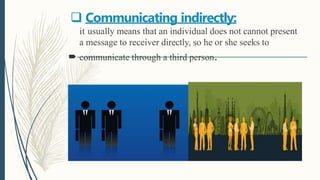
 Communicating indirectly:

it usually means that an individual does not cannot present
a message to receiver directly, so he or she seeks to
communicate through a third person.
Presenting double-bind messages:
In this, family-member may respond to
a direct request by another family
member only to be rebuked when the
request is fulfilled.
Self-concept
Reinforcement
– Functional families strive to reinforce and
strengthen each member’s self-concept, with
the positive results being that family
members feel loved and valued.in this, the
manner in which children see and value
themselves is influenced most significantly
by the messages they receive concerning
their value to other members of the family.
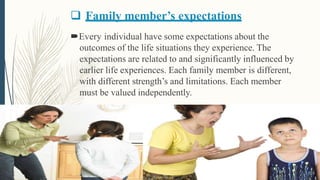
 Family member’s expectations
Every individual have some expectations about the
outcomes of the life situations they experience. The
expectations are related to and significantly influenced by
earlier life experiences. Each family member is different,
with different strength’s and limitations. Each member
must be valued independently.
Handling differences
It is difficult to conceive of two or more
individuals living together who agree on
everything all of the time.
Serious problems in a family functioning appear
when differences becomes equated with “badness”
is seen not caring.
Member are willing to hear the other person’s
position, respect the other person’s right and work
to modify the expectations on both sides of the
issue to negotiate a workable solution.
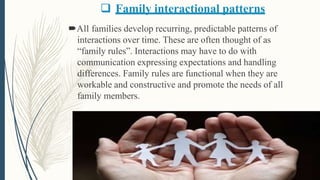
 Family interactional patterns
All families develop recurring, predictable patterns of
interactions over time. These are often thought of as
“family rules”. Interactions may have to do with
communication expressing expectations and handling
differences. Family rules are functional when they are
workable and constructive and promote the needs of all
family members.
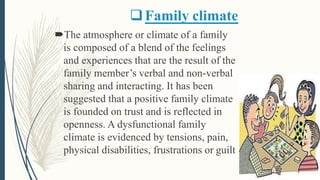
Family climate
The atmosphere or climate of a family
is composed of a blend of the feelings
and experiences that are the result of the
family member’s verbal and non-verbal
sharing and interacting. It has been
suggested that a positive family climate
is founded on trust and is reflected in
openness. A dysfunctional family
climate is evidenced by tensions, pain,
physical disabilities, frustrations or guilt
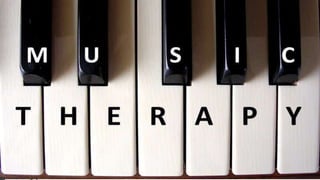
Music Therapy
Introduction:
Music therapy is a special type of therapy where forms of
musical interactions and communication are used
alongside verbal communication.
Systemic process of interventions wherein the therapist
helps the client to promote health, using music
experiences and the relationship developing through them
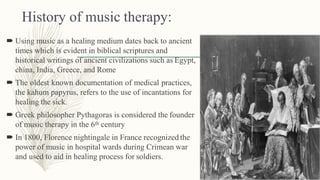
History of music therapy:
 Using music as a healing medium dates back to ancient
times which is evident in biblical scriptures and
historical writings of ancient civilizations such as Egypt,
china, India, Greece, and Rome
 The oldest known documentation of medical practices,
the kahum papyrus, refers to the use of incantations for
healing the sick.
 Greek philosopher Pythagoras is considered the founder
of music therapy in the 6th century
 In 1800, Florence nightingale in France recognized the
power of music in hospital wards during Crimean war
and used to aid in healing process for soldiers.
ADVANTAGES OF MUSIC
THERAPY Music can help you to fight with stress find comfort, and
manage pain.
 Women planning vaginal childbirth are usually encouraged
to bring along music that will help them to relax during their
labour.
 It increases relaxation
 It reduces loneliness
 It enhances spiritual connection
 Helps in fight with depression and anxiety
 Facilitates emotional expressions
 Improves cognitive skills like learning, listening and
attention span
 Social interaction is stimulated
IndicationsPsychotic disorders
Schizophrenia
Schizoaffective disorder
Drug induced psychosis
Mood disorders
Major depressive disorder
Bipolar disorder
Developmental disorders
Autism, mental retardation
Neurological disorders
Dementia, Parkinson’s disease
Typesof music
therapyBackground music therapy
It is a form of therapy in which music is heard for an
average of 8 to 12 hours per day as part of a hospital
routine.
It is transmitted via audio tapes and radio
The aim of this therapy is to create a calm
environment in the hospital.
Contemplative music therapy
It helps the patients to appreciate the significance of
music and art in general
Before music is played for patients, they are given a
biography of the composer and other details about the
music.
This can be administered in a group setting or
individually.
Combined music therapy
It is used in conjunction with other therapeutic procedures.
Unlike background music therapy, it call for the patient to
select musical compositions that enhance musical outcome and
suit the patient.
Sometimes in this form of musical therapy, hypnosis is
conducted while the subject listens to the music.
This form of music therapy has been used in combination with
cerebral electro sleep therapy and behaviour therapy.
Executive music therapy
It consists of individual or group singing
and playing musical instruments.
Patients with long hospital stays are the
best candidates for this form of therapy.
Executive Iatromusic therapy
In this therapy a musician performs in
children’s psychiatric units.
This form of therapy frequently is used in
managing emotionally disturbed, mentally
retarded and dyslexic children.
Creative music therapy
In this a patient write a song, compose
music, and play instruments as a form of
catharsis.
In this repressed feelings or fears to be
expressed in music and song.
 conclusion
 Family therapy is one of the current generation of family based treatments
for adolescents behaviour problems as both prevention and an
intervention program, the success of family therapy is due to its
integration of a clear, comprehensive, and multisystemic clinical model
 Music therapy is one of the current generation of useful form of
complementary medicine used to decrease stress and anxiety, relieve
pain, provide distraction, promote expression of feelings, nurses are
responsible for assessing, identifying and referring patients and families
who are most likely to benefit from music therapy and can help assure that
the sessions are effective
 Indicated for a broad range of serious mental disorders.
•Proven an effective therapy for serious mental disorders.
•Helps patients to improve global state, symptoms and functioning.
•It may be an effective therapy for a population which often does not
respond easily to traditional approaches.
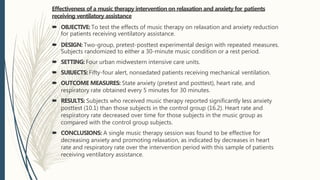
Effectiveness of a music therapy intervention on relaxation and anxiety for patients
receiving ventilatory assistance
 OBJECTIVE: To test the effects of music therapy on relaxation and anxiety reduction
for patients receiving ventilatory assistance.
 DESIGN: Two-group, pretest-posttest experimental design with repeated measures.
Subjects randomized to either a 30-minute music condition or a rest period.
 SETTING: Four urban midwestern intensive care units.
 SUBJECTS:Fifty-four alert, nonsedated patients receiving mechanical ventilation.
 OUTCOME MEASURES: State anxiety (pretest and posttest), heart rate, and
respiratory rate obtained every 5 minutes for 30 minutes.
 RESULTS: Subjects who received music therapy reported significantly less anxiety
posttest (10.1) than those subjects in the control group (16.2). Heart rate and
respiratory rate decreased over time for those subjects in the music group as
compared with the control group subjects.
 CONCLUSIONS: A single music therapy session was found to be effective for
decreasing anxiety and promoting relaxation, as indicated by decreases in heart
rate and respiratory rate over the intervention period with this sample of patients
receiving ventilatory assistance.
Familytherapy

Familytherapy

  • 1.
    FAMILY & MUSICTHERAPY RITARANI NAYAK ASSISTANTPROFESSER SUMNURSINGCOLLEGE
  • 2.
    FAMILYTHERAPY Introduction:  Family therapyis the branch of psychiatry which sees an individual’s psychiatric symptoms as inseparably related to the family in which he lives. Thus the focus of treatment is not on the individual, but the family.  Family therapy is a relatively new development that came about in the mid- twentieth century as an adjunct to individual treatment and refers to thetreatment of the family as whole.  Family therapists use a wide variety of theoretical philosophies and techniquesto bring about change in dysfunctional patterns of behaviour and interaction, some therapists may focus on the here and now,  Although different therapists may adhere to different theories and use awide variety of methods, the goals of family therapy are basically thesame.
  • 3.
    Goals : To reducedysfunctional behaviour of individual family members. To resolve or reduce intrafamily relationship conflicts. To improve family communication skills. To heighten awareness and sensitivity to other family members to meet their needs. To strengthen the family ability to cope with the major life stressors and traumatic events. To improve integration of the family system into the social system.
  • 4.
    Indication and contraindicationof family therapy Indications: Problems in the relationship within the family(urge existence of communication or generation gap) Interdependence of symptoms(e.g. the wife’s depression being contingent on the husband’s alcohol consumption and vice versa) Failure of individual therapy(may be because family tensions have not been handled) Development of stress in other family members when one family member improves (e.g. development of depression in wife following husband’s giving up drinking, leading to his improves participation in family matters)
  • 5.
    Contraindications: A. Family factors Familyin the process of breaking up Families in which tense, dysfunctional equilibrium is present. Families staying apart No availability of the key family member Unwillingness to accept the therapy.
  • 6.
    Functions of thefamily therapy Boundary function: boundaries will maintain a distinction between individuals with the family. Rigid boundaries prevent family members from trying out new ideas. Communication function: communication within the family encourages its members to express their feelings or emotions appropriately. Supportive function: supportive function within the family give freedom to grow and explore new roles within the family members.
  • 7.
    Socialization function: socializationhelps to interact, negotiate and plan adopts coping skills within the members of the family. Biological function: family is a medium where the sex relations are regulated. Psychological function: love, belongingness, affection, sympathy, security, attention, emotional satisfaction, sexual relationship, intimacy etc. will be attained through family.
  • 8.
    Educational function: motheris the first teacher and primary care giver who will take care of the children. Child’s personality and character formation will be attained through family.  Protective function: family protects the interest of the child, provides security to cultivate healthy behavior.  Recreational function: family creates an atmosphere where the child’s interest can be fulfilled. The love among family members will create positive interest in the child.
  • 9.
     Religious function:family develops religious thoughts, kind heartedness and fellow belonging. The child learns more moral values, ethics, codes, honesty, truthfulness, traditions and religious patterns. Cultural function: family molds its members according to its culture. It transmits ideas, folkways, mores, customs, traditions, beliefs and values from one generation to another generation. Social function: - maintain social status and controls member’s activities. -Promotes safety and security and lays emphasis on kinship patterns -provides physical shelter, food, clothing which are necessary to the existence of life.
  • 10.
    TYPES OF FAMILYTHERAPY: INDIVIDUALFAMILYTHERAPY  In individual family therapy, each family member has a single therapist. The whole family may meet occasionally with one or two of the therapists to see how the member’s ae relating to one another and work out specific issues that have been defined by the individual members.
  • 12.
    CONJOINT FAMILYTHERAPY  Themost common type of family therapy is the single-family group, or conjoint family therapy. The nuclear family is seen, and the issues and problems raised by the family are the ones addressed by the therapist. The way in which the family interacts is observed and becomes the focus of therapy. The therapist helps the family deal more effectively with problems as they arise and are defined.
  • 13.
     COUPLES THERAPY Couplesare often seen by the therapist together. The couple may be experiencing difficulties in their marriage, and in therapy, they are helped to work together to seek a resolution for their problems. Family patterns, interaction and the communication styles, and each partner’s goals, hopes and expectations are examined in therapy. This examination enables the couple to find a common ground for resolving conflicts by recognizing and respecting each other’s similarities and differences.
  • 15.
     MULTIPLE FAMILYGROUPTHERAPY In multiple family group therapy, four or five families meet weekly to confront and deal with the problems or issues they have in common. Ability or inability to function well in the home and community fearing of talking to or relating to others, abuse, anger, neglect, the development of social skills, and responsibility for oneself are some of the issues on which these group focus. The multiple family group become the support for all the families. The network also encourages each person to reach out form new relationships outside the group.
  • 17.
     MULTIPLE IMPACTTHERAPY In multiple impact therapy, several therapists come together with families in a community setting. They live together and deal with pertinent issues for each family member within the context of the group. Multiple impact therapy is similar to multiple family group therapy except that it is more intense and time limited. Like multiple family group therapy, it focuses on developing skills or working together as a family and with other families.
  • 19.
     NETWORK THERAPY Networktherapy is conducted in people’s homes.All individuals interested or invested in a problem or crisis that particular person or persons in a family are experiencing take part. This gathering includes family, friends, neighbours, professional groups or persons, and anyone in the community who has an investment in the outcome of the current crisis. People who form the network generally know each other and interact on a regular basis in each other’s lives. Thus a network may include as many as 40 to 60 people.
  • 21.
    Family therapy assessment Boyerand Jeffrey (1984) describe six elements on which families are assessed to be either functional or dysfunctional. The six element of assessment include: Communication Self-concept reinforcement Family member expectations. Handling differences. Family interactional patterns. Family climate
  • 22.
    Communication Functional communication patternsare those in which verbal and non-verbal messages are clear, direct, and congruent between sender and intended receiver. Family member are encouraged to express honest feelings and opinions, and all members participate in decisions that affect the family system. Each member is an active listener to other members of the family.
  • 23.
    Making assumption: in this,one assumes that others will know what is meant by an action or an expression For e.g., a father says to his teenage son “you should have gone to market to bring some provisions for home during my absence at home”.
  • 24.
     Belittling feelings: thisbehaviour involves ignoring or minimizing another’s feelings, when they are expressed. This encourage the individual to withhold honest feelings to avoid being hurt by the negative response. For e.g. elder brother scolding his sister (young one) and she is angry with him. Then the mother consoles girl that “oh don’t be angry, he does not mean anything”.
  • 25.
     Failing tolisten: in this, one does not hear what the other individual is saying. This can mean , not hearing the words by ‘turning out’ what is being said, or It can be selective listening, in which a person hears only selective part of the message or interprets in a selective manner.
  • 26.
     Communicating indirectly:  itusually means that an individual does not cannot present a message to receiver directly, so he or she seeks to communicate through a third person.
  • 27.
    Presenting double-bind messages: Inthis, family-member may respond to a direct request by another family member only to be rebuked when the request is fulfilled.
  • 28.
    Self-concept Reinforcement – Functional familiesstrive to reinforce and strengthen each member’s self-concept, with the positive results being that family members feel loved and valued.in this, the manner in which children see and value themselves is influenced most significantly by the messages they receive concerning their value to other members of the family.
  • 29.
     Family member’sexpectations Every individual have some expectations about the outcomes of the life situations they experience. The expectations are related to and significantly influenced by earlier life experiences. Each family member is different, with different strength’s and limitations. Each member must be valued independently.
  • 30.
    Handling differences It isdifficult to conceive of two or more individuals living together who agree on everything all of the time. Serious problems in a family functioning appear when differences becomes equated with “badness” is seen not caring. Member are willing to hear the other person’s position, respect the other person’s right and work to modify the expectations on both sides of the issue to negotiate a workable solution.
  • 31.
     Family interactionalpatterns All families develop recurring, predictable patterns of interactions over time. These are often thought of as “family rules”. Interactions may have to do with communication expressing expectations and handling differences. Family rules are functional when they are workable and constructive and promote the needs of all family members.
  • 32.
    Family climate The atmosphereor climate of a family is composed of a blend of the feelings and experiences that are the result of the family member’s verbal and non-verbal sharing and interacting. It has been suggested that a positive family climate is founded on trust and is reflected in openness. A dysfunctional family climate is evidenced by tensions, pain, physical disabilities, frustrations or guilt
  • 34.
    Music Therapy Introduction: Music therapyis a special type of therapy where forms of musical interactions and communication are used alongside verbal communication. Systemic process of interventions wherein the therapist helps the client to promote health, using music experiences and the relationship developing through them
  • 35.
    History of musictherapy:  Using music as a healing medium dates back to ancient times which is evident in biblical scriptures and historical writings of ancient civilizations such as Egypt, china, India, Greece, and Rome  The oldest known documentation of medical practices, the kahum papyrus, refers to the use of incantations for healing the sick.  Greek philosopher Pythagoras is considered the founder of music therapy in the 6th century  In 1800, Florence nightingale in France recognized the power of music in hospital wards during Crimean war and used to aid in healing process for soldiers.
  • 36.
    ADVANTAGES OF MUSIC THERAPYMusic can help you to fight with stress find comfort, and manage pain.  Women planning vaginal childbirth are usually encouraged to bring along music that will help them to relax during their labour.  It increases relaxation  It reduces loneliness  It enhances spiritual connection  Helps in fight with depression and anxiety  Facilitates emotional expressions  Improves cognitive skills like learning, listening and attention span  Social interaction is stimulated
  • 37.
    IndicationsPsychotic disorders Schizophrenia Schizoaffective disorder Druginduced psychosis Mood disorders Major depressive disorder Bipolar disorder Developmental disorders Autism, mental retardation Neurological disorders Dementia, Parkinson’s disease
  • 38.
    Typesof music therapyBackground musictherapy It is a form of therapy in which music is heard for an average of 8 to 12 hours per day as part of a hospital routine. It is transmitted via audio tapes and radio The aim of this therapy is to create a calm environment in the hospital.
  • 39.
    Contemplative music therapy Ithelps the patients to appreciate the significance of music and art in general Before music is played for patients, they are given a biography of the composer and other details about the music. This can be administered in a group setting or individually.
  • 40.
    Combined music therapy Itis used in conjunction with other therapeutic procedures. Unlike background music therapy, it call for the patient to select musical compositions that enhance musical outcome and suit the patient. Sometimes in this form of musical therapy, hypnosis is conducted while the subject listens to the music. This form of music therapy has been used in combination with cerebral electro sleep therapy and behaviour therapy.
  • 41.
    Executive music therapy Itconsists of individual or group singing and playing musical instruments. Patients with long hospital stays are the best candidates for this form of therapy.
  • 42.
    Executive Iatromusic therapy Inthis therapy a musician performs in children’s psychiatric units. This form of therapy frequently is used in managing emotionally disturbed, mentally retarded and dyslexic children.
  • 43.
    Creative music therapy Inthis a patient write a song, compose music, and play instruments as a form of catharsis. In this repressed feelings or fears to be expressed in music and song.
  • 44.
     conclusion  Familytherapy is one of the current generation of family based treatments for adolescents behaviour problems as both prevention and an intervention program, the success of family therapy is due to its integration of a clear, comprehensive, and multisystemic clinical model  Music therapy is one of the current generation of useful form of complementary medicine used to decrease stress and anxiety, relieve pain, provide distraction, promote expression of feelings, nurses are responsible for assessing, identifying and referring patients and families who are most likely to benefit from music therapy and can help assure that the sessions are effective  Indicated for a broad range of serious mental disorders. •Proven an effective therapy for serious mental disorders. •Helps patients to improve global state, symptoms and functioning. •It may be an effective therapy for a population which often does not respond easily to traditional approaches.
  • 45.
    Effectiveness of amusic therapy intervention on relaxation and anxiety for patients receiving ventilatory assistance  OBJECTIVE: To test the effects of music therapy on relaxation and anxiety reduction for patients receiving ventilatory assistance.  DESIGN: Two-group, pretest-posttest experimental design with repeated measures. Subjects randomized to either a 30-minute music condition or a rest period.  SETTING: Four urban midwestern intensive care units.  SUBJECTS:Fifty-four alert, nonsedated patients receiving mechanical ventilation.  OUTCOME MEASURES: State anxiety (pretest and posttest), heart rate, and respiratory rate obtained every 5 minutes for 30 minutes.  RESULTS: Subjects who received music therapy reported significantly less anxiety posttest (10.1) than those subjects in the control group (16.2). Heart rate and respiratory rate decreased over time for those subjects in the music group as compared with the control group subjects.  CONCLUSIONS: A single music therapy session was found to be effective for decreasing anxiety and promoting relaxation, as indicated by decreases in heart rate and respiratory rate over the intervention period with this sample of patients receiving ventilatory assistance.