



Family Functions 
SPED 232-Assignment 3 
Sheelagh Lucas
Give a little love to a child, 
and you get a great deal 
back.-John Ruskin 
 How do I show concern? 
 Let the parents know how the kid is doing with 
little notes, emails, or phone calls if time 
permits 
 Ask how “everyone is doing?” Knowing it may 
take a little time out of your day, try to show 
interest in the family. This will make them more 
receptive to the teacher. 
 If you can, recall a detail or two from each 
conversation you can ask about…upcoming 
event, other children, or something new going 
on in the student’s life. 
 All these things will show true interest the 
parents want to see…this is how you 
motivate the family to become more 
involved with the education process…if 
you seem to care, they will be more 
willing to listen. 
Motivation for Family 
Involvement is easy to come 
by. Parents need to 
understand that the 
instructors and school merely 
want what is best for the 
child. They need to seem 
invested in that child’s well 
being. It is easy to seem as 
though there is not the love 
and involvement that parents 
want, especially in a young 
child. But to motivate family 
involvement, genuine 
concern caring should be 
shown.
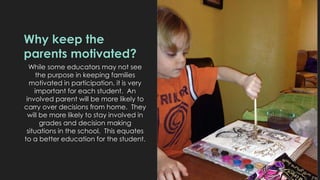
Why keep the 
parents motivated? 
While some educators may not see 
the purpose in keeping families 
motivated in participation, it is very 
important for each student. An 
involved parent will be more likely to 
carry over decisions from home. They 
will be more likely to stay involved in 
grades and decision making 
situations in the school. This equates 
to a better education for the student.
“Intelligence is the 
ability to adapt to 
change” 
-Stephen Hawking 
Families with children with special needs 
often have to adapt their entire lifestyle 
around that need. Their travel, family 
interactions, daily routine and major 
decisions are all affected. Teachers need 
to aware of these family alterations and 
understand what it means to them.
Routines! 
Parents may ask for changes in 
The teacher’s routine. If they are minor 
And achievable, this may make the 
Difference between a good day 
And a bad for any student. 
Location, Location, Location! 
Like any typically functioning children, a 
simple location change may mean the 
difference between a student success and 
a student meltdown. Some kids need to 
be near doors, closer to teacher’s desks, or 
slightly removed from other students. 
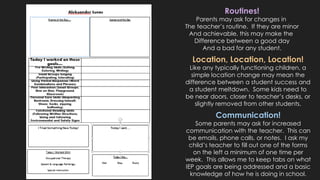
Communication! 
Some parents may ask for increased 
communication with the teacher. This can 
be emails, phone calls, or notes. I ask my 
child’s teacher to fill out one of the forms 
on the left a minimum of one time per 
week. This allows me to keep tabs on what 
IEP goals are being addressed and a basic 
knowledge of how he is doing in school.
Why should we make so many changes? 
 As instructors we need to understand a small flexibility on our behalf, goes a very long way 
with the family 
 This small effort really solidifies the parent’s desire for involvement 
 How can I let parents know I am open to adapting? 
 Tell them! 
 Ask questions, “Is there anything I can do to help make Janie more comfortable?” 
 Are there specific things you do at home that might be helpful here? 
 An example of this would be specific language. We told teachers specific phrases “It’s 
time to…” “Quiet Spot” that would help her in the classroom, and help us feel comfortable 
with the teacher’s ability to adapt.
“You have a little brother with Autism because 
he is really an angel. He had to go to a very 
special family. If he went to other families, 
then he would not have so much fun because 
here he has three sisters. We are very luck to 
have an Autism angel in our house, God does 
not let just any family have that kind of little 
brother!”-Emmeline Lucas, age 7 
Impacts on a Family 
that has a Child with 
a Disability
“We must let go of the life we had planned so as to have the 
life that is waiting for us”-Joseph Campbell 
 My son may never be the Eagle Scout my 
husband dreamed. I will most likely never 
watch him play in traditional team sports 
like his peers. I may never be Mother of 
the Groom, or see grandchildren from this 
particular child…in fact he may never 
leave home in my lifetime to live a life of 
his own…I simply do not know. 
 But, what I can celebrate are tiny 
accomplishments that grow into one. 
When his therapists and teachers give me 
little celebrations, they feel like the 
biggest accomplishments in the world to 
me and my family! 
When asked how a child with disabilities affects a 
family there are not singular words to describe 
it…though I believe Joseph Campbell comes close.
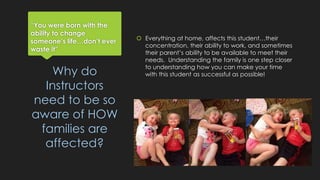
“You were born with the 
ability to change 
someone’s life…don’t ever 
waste it” 
 Everything at home, affects this student…their 
concentration, their ability to work, and sometimes 
their parent’s ability to be available to meet their 
needs. Understanding the family is one step closer 
to understanding how you can make your time 
with this Why do student as successful as possible! 
Instructors 
need to be so 
aware of HOW 
families are 
affected?
Issues that may arise…. 
 Today, approximately one of six students in schools across the United States cannot benefit fully from a 
traditional educational program because they have a disability that impairs their ability to participate in - 
classroom activities 
 84% of couples with children who have special needs divorce 
 The cost of autism is staggering. It can cost a typical family $60,000 per year and expenses are rising even 
further 
 families with disabled children experienced uncovered, out-of-pocket expenses substantially higher than 
those of families with no disabled children. 
 Mothers of children with mental illness were two to three times more likely to be depressed than mothers 
of healthy children 
 Your student may be encountering a split home, poverty, financial hardship, family discord, or other 
family troubles, this can cause definite ripples in the child’s well being. By knowing the hardships families 
encur with a special needs child, you can better understand what is happening at home.
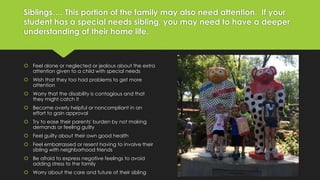
Siblings…. This portion of the family may also need attention. If your 
student has a special needs sibling, you may need to have a deeper 
understanding of their home life. 
 Feel alone or neglected or jealous about the extra 
attention given to a child with special needs 
 Wish that they too had problems to get more 
attention 
 Worry that the disability is contagious and that 
they might catch it 
 Become overly helpful or noncompliant in an 
effort to gain approval 
 Try to ease their parents' burden by not making 
demands or feeling guilty 
 Feel guilty about their own good health 
 Feel embarrassed or resent having to involve their 
sibling with neighborhood friends 
 Be afraid to express negative feelings to avoid 
adding stress to the family 
 Worry about the care and future of their sibling
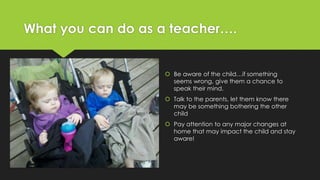
What you can do as a teacher…. 
 Be aware of the child…if something 
seems wrong, give them a chance to 
speak their mind. 
 Talk to the parents, let them know there 
may be something bothering the other 
child 
 Pay attention to any major changes at 
home that may impact the child and stay 
aware!
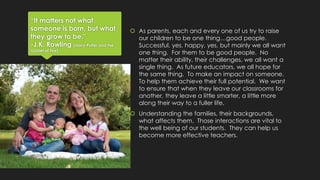
“It matters not what 
someone is born, but what 
they grow to be." 
-J.K. Rowling, (Harry Potter and the 
Goblet of Fire) 
 As parents, each and every one of us try to raise 
our children to be one thing…good people. 
Successful, yes, happy, yes, but mainly we all want 
one thing. For them to be good people. No 
matter their ability, their challenges, we all want a 
single thing. As future educators, we all hope for 
the same thing. To make an impact on someone. 
To help them achieve their full potential. We want 
to ensure that when they leave our classrooms for 
another, they leave a little smarter, a little more 
along their way to a fuller life. 
 Understanding the families, their backgrounds, 
what affects them. Those interactions are vital to 
the well being of our students. They can help us 
become more effective teachers.
References 
 http://futureofchildren.org/publications/journals/article/index.xml?journalid=45&articleid=204&sectionid=1 
328 
 https://www.mint.com/blog/planning/the-cost-of-raising-a-special-needs-child-0713/ 
 http://aspe.hhs.gov/daltcp/reports/wrkwlfes.htm 
 http://www.psychologytoday.com/blog/insight-is-2020/201310/pity-the-parents-special-needs-children-part- 
one 
 http://www.aboutourkids.org/articles/siblings_children_special_needs

Family functions

  • 1.
    Family Functions SPED232-Assignment 3 Sheelagh Lucas
  • 2.
    Give a littlelove to a child, and you get a great deal back.-John Ruskin  How do I show concern?  Let the parents know how the kid is doing with little notes, emails, or phone calls if time permits  Ask how “everyone is doing?” Knowing it may take a little time out of your day, try to show interest in the family. This will make them more receptive to the teacher.  If you can, recall a detail or two from each conversation you can ask about…upcoming event, other children, or something new going on in the student’s life.  All these things will show true interest the parents want to see…this is how you motivate the family to become more involved with the education process…if you seem to care, they will be more willing to listen. Motivation for Family Involvement is easy to come by. Parents need to understand that the instructors and school merely want what is best for the child. They need to seem invested in that child’s well being. It is easy to seem as though there is not the love and involvement that parents want, especially in a young child. But to motivate family involvement, genuine concern caring should be shown.
  • 3.
    Why keep the parents motivated? While some educators may not see the purpose in keeping families motivated in participation, it is very important for each student. An involved parent will be more likely to carry over decisions from home. They will be more likely to stay involved in grades and decision making situations in the school. This equates to a better education for the student.
  • 4.
    “Intelligence is the ability to adapt to change” -Stephen Hawking Families with children with special needs often have to adapt their entire lifestyle around that need. Their travel, family interactions, daily routine and major decisions are all affected. Teachers need to aware of these family alterations and understand what it means to them.
  • 5.
    Routines! Parents mayask for changes in The teacher’s routine. If they are minor And achievable, this may make the Difference between a good day And a bad for any student. Location, Location, Location! Like any typically functioning children, a simple location change may mean the difference between a student success and a student meltdown. Some kids need to be near doors, closer to teacher’s desks, or slightly removed from other students. Communication! Some parents may ask for increased communication with the teacher. This can be emails, phone calls, or notes. I ask my child’s teacher to fill out one of the forms on the left a minimum of one time per week. This allows me to keep tabs on what IEP goals are being addressed and a basic knowledge of how he is doing in school.
  • 6.
    Why should wemake so many changes?  As instructors we need to understand a small flexibility on our behalf, goes a very long way with the family  This small effort really solidifies the parent’s desire for involvement  How can I let parents know I am open to adapting?  Tell them!  Ask questions, “Is there anything I can do to help make Janie more comfortable?”  Are there specific things you do at home that might be helpful here?  An example of this would be specific language. We told teachers specific phrases “It’s time to…” “Quiet Spot” that would help her in the classroom, and help us feel comfortable with the teacher’s ability to adapt.
  • 7.
    “You have alittle brother with Autism because he is really an angel. He had to go to a very special family. If he went to other families, then he would not have so much fun because here he has three sisters. We are very luck to have an Autism angel in our house, God does not let just any family have that kind of little brother!”-Emmeline Lucas, age 7 Impacts on a Family that has a Child with a Disability
  • 8.
    “We must letgo of the life we had planned so as to have the life that is waiting for us”-Joseph Campbell  My son may never be the Eagle Scout my husband dreamed. I will most likely never watch him play in traditional team sports like his peers. I may never be Mother of the Groom, or see grandchildren from this particular child…in fact he may never leave home in my lifetime to live a life of his own…I simply do not know.  But, what I can celebrate are tiny accomplishments that grow into one. When his therapists and teachers give me little celebrations, they feel like the biggest accomplishments in the world to me and my family! When asked how a child with disabilities affects a family there are not singular words to describe it…though I believe Joseph Campbell comes close.
  • 9.
    “You were bornwith the ability to change someone’s life…don’t ever waste it”  Everything at home, affects this student…their concentration, their ability to work, and sometimes their parent’s ability to be available to meet their needs. Understanding the family is one step closer to understanding how you can make your time with this Why do student as successful as possible! Instructors need to be so aware of HOW families are affected?
  • 10.
    Issues that mayarise….  Today, approximately one of six students in schools across the United States cannot benefit fully from a traditional educational program because they have a disability that impairs their ability to participate in - classroom activities  84% of couples with children who have special needs divorce  The cost of autism is staggering. It can cost a typical family $60,000 per year and expenses are rising even further  families with disabled children experienced uncovered, out-of-pocket expenses substantially higher than those of families with no disabled children.  Mothers of children with mental illness were two to three times more likely to be depressed than mothers of healthy children  Your student may be encountering a split home, poverty, financial hardship, family discord, or other family troubles, this can cause definite ripples in the child’s well being. By knowing the hardships families encur with a special needs child, you can better understand what is happening at home.
  • 11.
    Siblings…. This portionof the family may also need attention. If your student has a special needs sibling, you may need to have a deeper understanding of their home life.  Feel alone or neglected or jealous about the extra attention given to a child with special needs  Wish that they too had problems to get more attention  Worry that the disability is contagious and that they might catch it  Become overly helpful or noncompliant in an effort to gain approval  Try to ease their parents' burden by not making demands or feeling guilty  Feel guilty about their own good health  Feel embarrassed or resent having to involve their sibling with neighborhood friends  Be afraid to express negative feelings to avoid adding stress to the family  Worry about the care and future of their sibling
  • 12.
    What you cando as a teacher….  Be aware of the child…if something seems wrong, give them a chance to speak their mind.  Talk to the parents, let them know there may be something bothering the other child  Pay attention to any major changes at home that may impact the child and stay aware!
  • 13.
    “It matters notwhat someone is born, but what they grow to be." -J.K. Rowling, (Harry Potter and the Goblet of Fire)  As parents, each and every one of us try to raise our children to be one thing…good people. Successful, yes, happy, yes, but mainly we all want one thing. For them to be good people. No matter their ability, their challenges, we all want a single thing. As future educators, we all hope for the same thing. To make an impact on someone. To help them achieve their full potential. We want to ensure that when they leave our classrooms for another, they leave a little smarter, a little more along their way to a fuller life.  Understanding the families, their backgrounds, what affects them. Those interactions are vital to the well being of our students. They can help us become more effective teachers.
  • 14.
    References  http://futureofchildren.org/publications/journals/article/index.xml?journalid=45&articleid=204&sectionid=1 328  https://www.mint.com/blog/planning/the-cost-of-raising-a-special-needs-child-0713/  http://aspe.hhs.gov/daltcp/reports/wrkwlfes.htm  http://www.psychologytoday.com/blog/insight-is-2020/201310/pity-the-parents-special-needs-children-part- one  http://www.aboutourkids.org/articles/siblings_children_special_needs