FALLS PREVENTION
We Can Make A Difference
Cost to the Nation £ 1 billion
per year and rising!
Ann Gates
Head of Medicines Management
North Eastern Derbyshire PCT
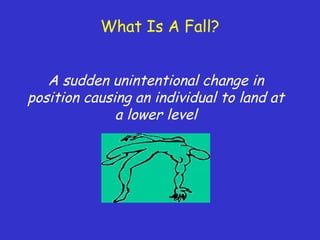
What Is A Fall?
A sudden unintentional change in
position causing an individual to land at
a lower level
For Us The Results Are Dramatic
•There are causes
•Surprise . . Projects and Pilots
•Plenty of advice on prevention
•Medicines get some of the blame
•There’s certainly guidance!
•There are consequence
What Should We Consider First?
•There are demands on emergency
services
Budgets of Course!
•Home adaptation & rehabilitation
•Primary Care follow-up costs
•Winter pressures-bed blocking
•Hospital admissions
-if anyone has a bed!
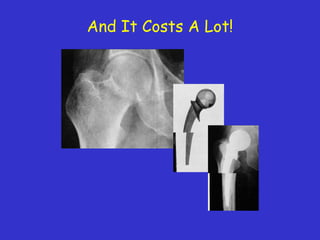
And It Costs A Lot!
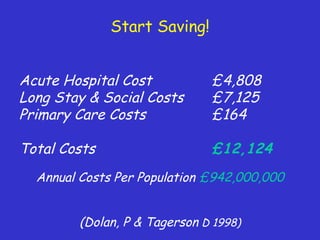
Start Saving!
Acute Hospital Cost £4,808
Long Stay & Social Costs £7,125
Primary Care Costs £164
Total Costs £12,124
Annual Costs Per Population £942,000,000
(Dolan, P & Tagerson D 1998)
That’s Not Going To Please Mr
Milburn!
The Individual Isn’t Going To Be
Very Happy Either!
•Loss of function
•Increased isolation and loneliness
•Fear of further falls
•Loss of dignity
•Loss of mobility & independence
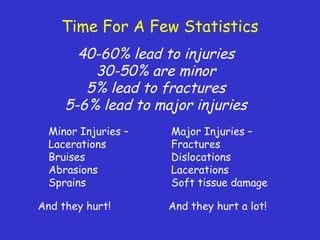
Time For A Few Statistics
40-60% lead to injuries
30-50% are minor
5% lead to fractures
5-6% lead to major injuries
Minor Injuries –
Lacerations
Bruises
Abrasions
Sprains
And they hurt!
Major Injuries –
Fractures
Dislocations
Lacerations
Soft tissue damage
And they hurt a lot!
0
500
1000
1500
2000
2500
3000
3500
65-69 70-74 75-79 80-84 85+
Male
Female
Rate /
100,00
Age-specific
hospital
admission rates
for falls
[SE Thames
1991-2]
Cryer et al
Age group- years
Hospitalisation
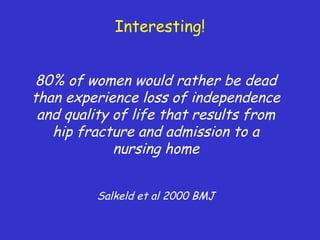
Interesting!
80% of women would rather be dead
than experience loss of independence
and quality of life that results from
hip fracture and admission to a
nursing home
Salkeld et al 2000 BMJ
0
5
10
15
20
25
30
[National Center for Health Statistics USA 1986]
Deaths
% Causes of injury death in people aged 65+ years
Falls Motor Suicide Procs Aspiration Fire Homicide Poison Other
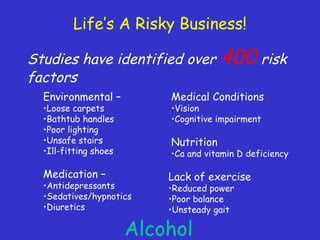
Studies have identified over 400 risk
factors
Life’s A Risky Business!
Environmental –
•Loose carpets
•Bathtub handles
•Poor lighting
•Unsafe stairs
•Ill-fitting shoes
Medication –
•Antidepressants
•Sedatives/hypnotics
•Diuretics
Medical Conditions
•Vision
•Cognitive impairment
Nutrition
•Ca and vitamin D deficiency
Lack of exercise
•Reduced power
•Poor balance
•Unsteady gait
Alcohol
Guidance
• Health of the Nation- Policy assessed 1998
– “Failed over its 5 year span to realise its full potential….
By 1997 its impact on local policy making was negligible”
• Saving Lives- Our Healthier Nation 1999
– Reduce risks for falling/stumbling in older people
• NSF Older People 2001
• NICE guidance on falls prevention 2003
While I Have Been Talking . .
FOUR older people will have been
seriously injured
SIX older people will have had
another injury
Drug Therapy Is More Likely To
Cause A Fall If . .
•The patient has more than four drugs
•A new drug was started within the
previous two weeks
And . . .
•Lots of drugs increase the risk of
falling
•They aggravate problems for those
who are already fallers
Can We Help At-Risk Patients?
YES!!!
•Does the patient need the drug?
•Does poor compliance cause problems
• Do effects lead to falling
-anti hypertensives?
•Do side effects lead to falls
-drowsiness?
Drug Problems
Sedative drugs
benzodiazepines, tricyclics, phenothiazines,
barbiturates and antihistamines
Cardiovascular drugs
diuretics, beta-blockers, ACE inhibitors, alpha-
blockers, calcium channel blockers and vasodilators
What Drugs Can Do
In the elderly, drugs like
• Digoxin cause dizziness
• Baclofen cause muscle weakness
• Phenytoin cause ataxia
• Prochlorperazine and
metoclopramide cause Parkinson’s features
• Procyclidine cause visual impairment
They Can Also Cause Confusion
Drugs like:
•Digoxin in overdose cause acute confusion
•Cimetidine confuses when there is renal or
liver impairment
•Corticosteroids can confuse
•Methyldopa can confuse
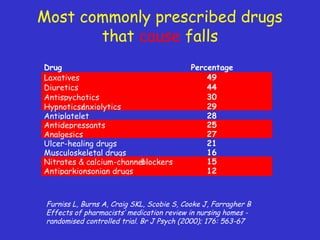
Most commonly prescribed drugs
that cause falls
Drug Percentage
Laxatives 49
Diuretics 44
Antispychotics 30
Hypnotics/anxiolytics 29
Antiplatelet 28
Antidepressants 25
Analgesics 27
Ulcer-healing drugs 21
Musculoskeletal drugs 16
Nitrates & calcium-channelblockers 15
Antiparkionsonian drugs 12
Furniss L, Burns A, Craig SKL, Scobie S, Cooke J, Farragher B
Effects of pharmacists’ medication review in nursing homes -
randomised controlled trial. Br J Psych (2000); 176: 563-67
As Ever, There Is No Shortage Of
Advice
DTI “Avoid Slips, Trips, Broken HipsDTI “Step Up To Safety’’
The Falls Prevention Services
•Wear appropriate flat shoes
•Wear glasses (if you need them!)
•Have regular eye checks
•Treat cataracts (if you’ve got them!)
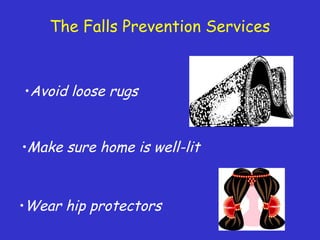
The Falls Prevention Services
•Make sure home is well-lit
•Avoid loose rugs
•Wear hip protectors
The Falls Prevention Services
•Adopt a multi disciplinary approach
•Patients Environment
- heat, stairs
•Local councils
-Pavements, street lighting
•Local exercise classes
-tai chi
Good Practice
•Wycombe PCT – community pharmacists
•Cambridgeshire – tackling falls
•Government NSF – older people
•Barnet – health promotion project
•Colchester GH – medication reviews, interface
pharmacist
•Greater Derby PCT – osteoporosis nurses
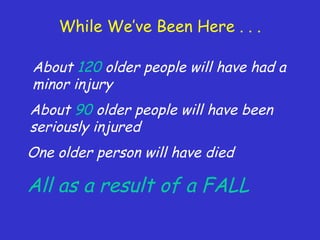
While We’ve Been Here . . .
About 120 older people will have had a
minor injury
About 90 older people will have been
seriously injured
One older person will have died
All as a result of a FALL
Don’t Forget . . .
Falls are very expensive and, as the
old saying goes . . .
A Fall and the Money
are Soon Parted

Falls a slippy topic(5)

  • 1.
    FALLS PREVENTION We CanMake A Difference Cost to the Nation £ 1 billion per year and rising! Ann Gates Head of Medicines Management North Eastern Derbyshire PCT
  • 3.
    What Is AFall? A sudden unintentional change in position causing an individual to land at a lower level
  • 4.
    For Us TheResults Are Dramatic •There are causes •Surprise . . Projects and Pilots •Plenty of advice on prevention •Medicines get some of the blame •There’s certainly guidance! •There are consequence
  • 5.
    What Should WeConsider First? •There are demands on emergency services Budgets of Course! •Home adaptation & rehabilitation •Primary Care follow-up costs •Winter pressures-bed blocking •Hospital admissions -if anyone has a bed!
  • 6.
  • 7.
    Start Saving! Acute HospitalCost £4,808 Long Stay & Social Costs £7,125 Primary Care Costs £164 Total Costs £12,124 Annual Costs Per Population £942,000,000 (Dolan, P & Tagerson D 1998)
  • 8.
    That’s Not GoingTo Please Mr Milburn!
  • 9.
    The Individual Isn’tGoing To Be Very Happy Either! •Loss of function •Increased isolation and loneliness •Fear of further falls •Loss of dignity •Loss of mobility & independence
  • 10.
    Time For AFew Statistics 40-60% lead to injuries 30-50% are minor 5% lead to fractures 5-6% lead to major injuries Minor Injuries – Lacerations Bruises Abrasions Sprains And they hurt! Major Injuries – Fractures Dislocations Lacerations Soft tissue damage And they hurt a lot!
  • 11.
    0 500 1000 1500 2000 2500 3000 3500 65-69 70-74 75-7980-84 85+ Male Female Rate / 100,00 Age-specific hospital admission rates for falls [SE Thames 1991-2] Cryer et al Age group- years Hospitalisation
  • 12.
    Interesting! 80% of womenwould rather be dead than experience loss of independence and quality of life that results from hip fracture and admission to a nursing home Salkeld et al 2000 BMJ
  • 13.
    0 5 10 15 20 25 30 [National Center forHealth Statistics USA 1986] Deaths % Causes of injury death in people aged 65+ years Falls Motor Suicide Procs Aspiration Fire Homicide Poison Other
  • 14.
    Studies have identifiedover 400 risk factors Life’s A Risky Business! Environmental – •Loose carpets •Bathtub handles •Poor lighting •Unsafe stairs •Ill-fitting shoes Medication – •Antidepressants •Sedatives/hypnotics •Diuretics Medical Conditions •Vision •Cognitive impairment Nutrition •Ca and vitamin D deficiency Lack of exercise •Reduced power •Poor balance •Unsteady gait Alcohol
  • 15.
    Guidance • Health ofthe Nation- Policy assessed 1998 – “Failed over its 5 year span to realise its full potential…. By 1997 its impact on local policy making was negligible” • Saving Lives- Our Healthier Nation 1999 – Reduce risks for falling/stumbling in older people • NSF Older People 2001 • NICE guidance on falls prevention 2003
  • 16.
    While I HaveBeen Talking . . FOUR older people will have been seriously injured SIX older people will have had another injury
  • 17.
    Drug Therapy IsMore Likely To Cause A Fall If . . •The patient has more than four drugs •A new drug was started within the previous two weeks
  • 18.
    And . .. •Lots of drugs increase the risk of falling •They aggravate problems for those who are already fallers
  • 19.
    Can We HelpAt-Risk Patients? YES!!! •Does the patient need the drug? •Does poor compliance cause problems • Do effects lead to falling -anti hypertensives? •Do side effects lead to falls -drowsiness?
  • 20.
    Drug Problems Sedative drugs benzodiazepines,tricyclics, phenothiazines, barbiturates and antihistamines Cardiovascular drugs diuretics, beta-blockers, ACE inhibitors, alpha- blockers, calcium channel blockers and vasodilators
  • 21.
    What Drugs CanDo In the elderly, drugs like • Digoxin cause dizziness • Baclofen cause muscle weakness • Phenytoin cause ataxia • Prochlorperazine and metoclopramide cause Parkinson’s features • Procyclidine cause visual impairment
  • 22.
    They Can AlsoCause Confusion Drugs like: •Digoxin in overdose cause acute confusion •Cimetidine confuses when there is renal or liver impairment •Corticosteroids can confuse •Methyldopa can confuse
  • 23.
    Most commonly prescribeddrugs that cause falls Drug Percentage Laxatives 49 Diuretics 44 Antispychotics 30 Hypnotics/anxiolytics 29 Antiplatelet 28 Antidepressants 25 Analgesics 27 Ulcer-healing drugs 21 Musculoskeletal drugs 16 Nitrates & calcium-channelblockers 15 Antiparkionsonian drugs 12 Furniss L, Burns A, Craig SKL, Scobie S, Cooke J, Farragher B Effects of pharmacists’ medication review in nursing homes - randomised controlled trial. Br J Psych (2000); 176: 563-67
  • 24.
    As Ever, ThereIs No Shortage Of Advice DTI “Avoid Slips, Trips, Broken HipsDTI “Step Up To Safety’’
  • 25.
    The Falls PreventionServices •Wear appropriate flat shoes •Wear glasses (if you need them!) •Have regular eye checks •Treat cataracts (if you’ve got them!)
  • 26.
    The Falls PreventionServices •Make sure home is well-lit •Avoid loose rugs •Wear hip protectors
  • 27.
    The Falls PreventionServices •Adopt a multi disciplinary approach •Patients Environment - heat, stairs •Local councils -Pavements, street lighting •Local exercise classes -tai chi
  • 28.
    Good Practice •Wycombe PCT– community pharmacists •Cambridgeshire – tackling falls •Government NSF – older people •Barnet – health promotion project •Colchester GH – medication reviews, interface pharmacist •Greater Derby PCT – osteoporosis nurses
  • 29.
    While We’ve BeenHere . . . About 120 older people will have had a minor injury About 90 older people will have been seriously injured One older person will have died All as a result of a FALL
  • 30.
    Don’t Forget .. . Falls are very expensive and, as the old saying goes . . . A Fall and the Money are Soon Parted

Editor's Notes

  • #4 There are many definitions of falls, but for the purposes of todays presentation I shall be using this one, although…..
  • #5 However for the population and all services the results are dramatic and warrant national and local action. Today I would like to present an overview on falls management, if we are to address the problem. We need to therefore look at the: Causes Consequences Current guidance and evidence Why as pharmacists we need to be developing medication reviews and becoming involved in falls prevention Adopt a multi disciplinary approach And learn and share from cureent good practice
  • #6 But we need to give falls management some perspectives… so what do we need to consideer first Budgets of course!! There are demands on emergency servcies and doctor out of hours services to cover older people who have fallen There is subsequent hospital admissions In cold frosty weather, falls and fractures put considerable pressure on an already over burdened All the follow up services in primary care plus physiotherapy etc And then there are the important social services and rehab costs…..
  • #7 And Hip replacements cost a lot
  • #8 So here are some of the costs that we could start saving!!!
  • #9 So all pharmacists in this room could go back to their PCT’s , and start drawing up buisness plans to start saving this money.
  • #10 But how do we cost the individual traum of a fall?
  • #11 So lets look at the problem more closely. Lets start working some of these issues and costs into redcuing falls by developing comprehensive medcines services