Dealing with Cash
RBI Law
• The Reserve Bank of India in an circular issued to all
  Banks states that an FIR has to be filed against a
  person tendering a counterfeit currency note
• The Banks have informed that where Insurance
  Companies tender counterfeit currency notes, the
  FIR would be filed against the Insurance Company
• Printing and circulation of forged notes are offences
  under Sections 489A to 489E of the Indian Penal
  Code and are punishable in the courts of law by fine
  or imprisonment or both.
Notes’ Dominations
The various currency dominations available in notes in India


                           Rs. 50/-              Rs. 5/-
Rs. 1000/-


Rs. 500/-                 Rs. 20/-              Rs. 10/-


                               Rs. 100/-
Coins’ Denominations
1.Watermark

The Mahatma Gandhi Series of banknotes
contain the Mahatma Gandhi watermark with
a light and shade effect and multi-directional
lines in the watermark window.
2. Security thread
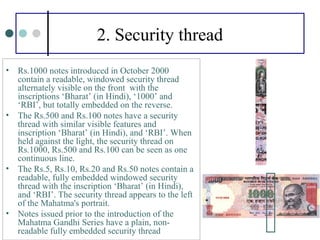
•   Rs.1000 notes introduced in October 2000
    contain a readable, windowed security thread
    alternately visible on the front with the
    inscriptions ‘Bharat’ (in Hindi), ‘1000’ and
    ‘RBI’, but totally embedded on the reverse.
•   The Rs.500 and Rs.100 notes have a security
    thread with similar visible features and
    inscription ‘Bharat’ (in Hindi), and ‘RBI’. When
    held against the light, the security thread on
    Rs.1000, Rs.500 and Rs.100 can be seen as one
    continuous line.
•   The Rs.5, Rs.10, Rs.20 and Rs.50 notes contain a
    readable, fully embedded windowed security
    thread with the inscription ‘Bharat’ (in Hindi),
    and ‘RBI’. The security thread appears to the left
    of the Mahatma's portrait.
•   Notes issued prior to the introduction of the
    Mahatma Gandhi Series have a plain, non-
    readable fully embedded security thread
3. Latent Image

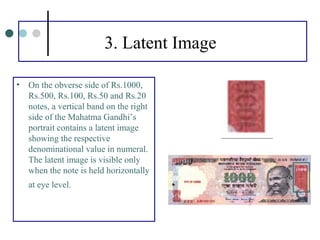
•   On the obverse side of Rs.1000,
    Rs.500, Rs.100, Rs.50 and Rs.20
    notes, a vertical band on the right
    side of the Mahatma Gandhi’s
    portrait contains a latent image
    showing the respective
    denominational value in numeral.
    The latent image is visible only
    when the note is held horizontally
    at eye level.
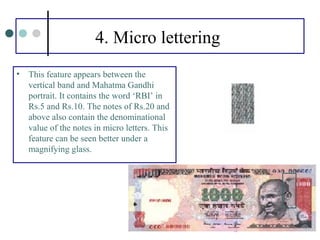
4. Micro lettering
• This feature appears between the
  vertical band and Mahatma Gandhi
  portrait. It contains the word ‘RBI’ in
  Rs.5 and Rs.10. The notes of Rs.20 and
  above also contain the denominational
  value of the notes in micro letters. This
  feature can be seen better under a
  magnifying glass.
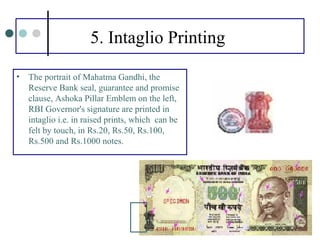
5. Intaglio Printing

•   The portrait of Mahatma Gandhi, the
    Reserve Bank seal, guarantee and promise
    clause, Ashoka Pillar Emblem on the left,
    RBI Governor's signature are printed in
    intaglio i.e. in raised prints, which can be
    felt by touch, in Rs.20, Rs.50, Rs.100,
    Rs.500 and Rs.1000 notes.
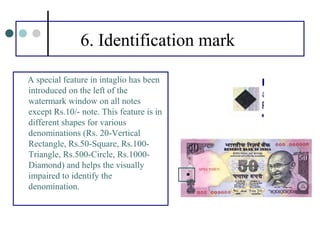
6. Identification mark

A special feature in intaglio has been
introduced on the left of the
watermark window on all notes
except Rs.10/- note. This feature is in
different shapes for various
denominations (Rs. 20-Vertical
Rectangle, Rs.50-Square, Rs.100-
Triangle, Rs.500-Circle, Rs.1000-
Diamond) and helps the visually
impaired to identify the
denomination.
7. Fluorescence

Number panels of the notes are printed in fluorescent ink.
The notes also have optical fibres. Both can be seen when
the notes are exposed to ultra-violet lamp.
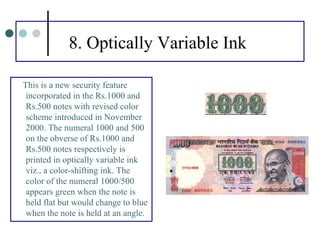
8. Optically Variable Ink

This is a new security feature
 incorporated in the Rs.1000 and
 Rs.500 notes with revised color
 scheme introduced in November
 2000. The numeral 1000 and 500
 on the obverse of Rs.1000 and
 Rs.500 notes respectively is
 printed in optically variable ink
 viz., a color-shifting ink. The
 color of the numeral 1000/500
 appears green when the note is
 held flat but would change to blue
 when the note is held at an angle.
9. See through Register

The small floral design printed both
on the front (hollow) and back
(filled up) of the note in the middle
of the vertical band next to the
Watermark has an accurate back to
back registration. The design will
appear as one floral design when
seen against the light
Soiled and Mutilated Notes

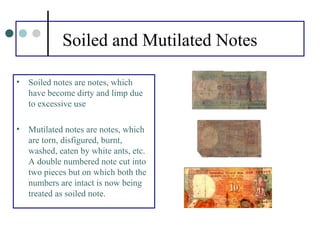
•   Soiled notes are notes, which
    have become dirty and limp due
    to excessive use

•   Mutilated notes are notes, which
    are torn, disfigured, burnt,
    washed, eaten by white ants, etc.
    A double numbered note cut into
    two pieces but on which both the
    numbers are intact is now being
    treated as soiled note.
Acceptance of soiled notes

  We shall not accept Soiled/Mutilated notes.

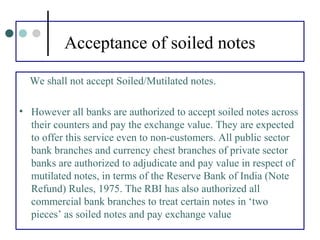
• However all banks are authorized to accept soiled notes across
  their counters and pay the exchange value. They are expected
  to offer this service even to non-customers. All public sector
  bank branches and currency chest branches of private sector
  banks are authorized to adjudicate and pay value in respect of
  mutilated notes, in terms of the Reserve Bank of India (Note
  Refund) Rules, 1975. The RBI has also authorized all
  commercial bank branches to treat certain notes in ‘two
  pieces’ as soiled notes and pay exchange value
Non accepted currency
  Do not accept any notes where less than half the area of the
  full note is

• Devoid of the major portion of the number, i.e., the prefix and
  three digits or four digits of the number in notes up to and
  inclusive of Rs.5; in respect of notes of Rs.10 and above,
  where this inadequacy is present at both the numbering panels.
• Cancelled by any office of the Reserve Bank or against which
  the value has already been paid
• Found to be forged
• Deliberately cut, mutilated or tampered
• Carrying extrinsic words or visible representation intended to
  convey or capable of conveying any message of a political
  character
How to deal with counterfeit notes?

• Examine all notes received by you

• Strictly do not accept any counterfeit notes

• Inform immediate supervisor & take appropriate action
  against this

• Do not use the word ‘fake ’ while dealing with clients/agents.
  They might feel offended as they would have unknowingly
  received it from a third party.
Example 1

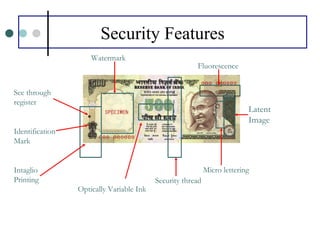
Identify all the security features in the currency specimen below-
Security Features
                       Watermark                            Fluorescence


See through                                                                Latent
register                                                                   Image

Identification
Mark
                                                             Micro lettering

Intaglio         Optically Variable Ink
                                          Security thread
Printing
Example 2

Identify all the security features in the currency specimen below-
Security Features
                     Watermark
                                                       Fluorescence


See through
register
                                                                          Latent
                                                                          Image
Identification
Mark


Intaglio                                                    Micro lettering
Printing                                  Security thread
                 Optically Variable Ink
Fake note detection

Fake note detection

  • 1.
  • 2.
    RBI Law • TheReserve Bank of India in an circular issued to all Banks states that an FIR has to be filed against a person tendering a counterfeit currency note • The Banks have informed that where Insurance Companies tender counterfeit currency notes, the FIR would be filed against the Insurance Company • Printing and circulation of forged notes are offences under Sections 489A to 489E of the Indian Penal Code and are punishable in the courts of law by fine or imprisonment or both.
  • 3.
    Notes’ Dominations The variouscurrency dominations available in notes in India Rs. 50/- Rs. 5/- Rs. 1000/- Rs. 500/- Rs. 20/- Rs. 10/- Rs. 100/-
  • 4.
  • 5.
    1.Watermark The Mahatma GandhiSeries of banknotes contain the Mahatma Gandhi watermark with a light and shade effect and multi-directional lines in the watermark window.
  • 6.
    2. Security thread • Rs.1000 notes introduced in October 2000 contain a readable, windowed security thread alternately visible on the front with the inscriptions ‘Bharat’ (in Hindi), ‘1000’ and ‘RBI’, but totally embedded on the reverse. • The Rs.500 and Rs.100 notes have a security thread with similar visible features and inscription ‘Bharat’ (in Hindi), and ‘RBI’. When held against the light, the security thread on Rs.1000, Rs.500 and Rs.100 can be seen as one continuous line. • The Rs.5, Rs.10, Rs.20 and Rs.50 notes contain a readable, fully embedded windowed security thread with the inscription ‘Bharat’ (in Hindi), and ‘RBI’. The security thread appears to the left of the Mahatma's portrait. • Notes issued prior to the introduction of the Mahatma Gandhi Series have a plain, non- readable fully embedded security thread
  • 7.
    3. Latent Image • On the obverse side of Rs.1000, Rs.500, Rs.100, Rs.50 and Rs.20 notes, a vertical band on the right side of the Mahatma Gandhi’s portrait contains a latent image showing the respective denominational value in numeral. The latent image is visible only when the note is held horizontally at eye level.
  • 8.
    4. Micro lettering •This feature appears between the vertical band and Mahatma Gandhi portrait. It contains the word ‘RBI’ in Rs.5 and Rs.10. The notes of Rs.20 and above also contain the denominational value of the notes in micro letters. This feature can be seen better under a magnifying glass.
  • 9.
    5. Intaglio Printing • The portrait of Mahatma Gandhi, the Reserve Bank seal, guarantee and promise clause, Ashoka Pillar Emblem on the left, RBI Governor's signature are printed in intaglio i.e. in raised prints, which can be felt by touch, in Rs.20, Rs.50, Rs.100, Rs.500 and Rs.1000 notes.
  • 10.
    6. Identification mark Aspecial feature in intaglio has been introduced on the left of the watermark window on all notes except Rs.10/- note. This feature is in different shapes for various denominations (Rs. 20-Vertical Rectangle, Rs.50-Square, Rs.100- Triangle, Rs.500-Circle, Rs.1000- Diamond) and helps the visually impaired to identify the denomination.
  • 11.
    7. Fluorescence Number panelsof the notes are printed in fluorescent ink. The notes also have optical fibres. Both can be seen when the notes are exposed to ultra-violet lamp.
  • 12.
    8. Optically VariableInk This is a new security feature incorporated in the Rs.1000 and Rs.500 notes with revised color scheme introduced in November 2000. The numeral 1000 and 500 on the obverse of Rs.1000 and Rs.500 notes respectively is printed in optically variable ink viz., a color-shifting ink. The color of the numeral 1000/500 appears green when the note is held flat but would change to blue when the note is held at an angle.
  • 13.
    9. See throughRegister The small floral design printed both on the front (hollow) and back (filled up) of the note in the middle of the vertical band next to the Watermark has an accurate back to back registration. The design will appear as one floral design when seen against the light
  • 14.
    Soiled and MutilatedNotes • Soiled notes are notes, which have become dirty and limp due to excessive use • Mutilated notes are notes, which are torn, disfigured, burnt, washed, eaten by white ants, etc. A double numbered note cut into two pieces but on which both the numbers are intact is now being treated as soiled note.
  • 15.
    Acceptance of soilednotes We shall not accept Soiled/Mutilated notes. • However all banks are authorized to accept soiled notes across their counters and pay the exchange value. They are expected to offer this service even to non-customers. All public sector bank branches and currency chest branches of private sector banks are authorized to adjudicate and pay value in respect of mutilated notes, in terms of the Reserve Bank of India (Note Refund) Rules, 1975. The RBI has also authorized all commercial bank branches to treat certain notes in ‘two pieces’ as soiled notes and pay exchange value
  • 16.
    Non accepted currency Do not accept any notes where less than half the area of the full note is • Devoid of the major portion of the number, i.e., the prefix and three digits or four digits of the number in notes up to and inclusive of Rs.5; in respect of notes of Rs.10 and above, where this inadequacy is present at both the numbering panels. • Cancelled by any office of the Reserve Bank or against which the value has already been paid • Found to be forged • Deliberately cut, mutilated or tampered • Carrying extrinsic words or visible representation intended to convey or capable of conveying any message of a political character
  • 17.
    How to dealwith counterfeit notes? • Examine all notes received by you • Strictly do not accept any counterfeit notes • Inform immediate supervisor & take appropriate action against this • Do not use the word ‘fake ’ while dealing with clients/agents. They might feel offended as they would have unknowingly received it from a third party.
  • 18.
    Example 1 Identify allthe security features in the currency specimen below-
  • 19.
    Security Features Watermark Fluorescence See through Latent register Image Identification Mark Micro lettering Intaglio Optically Variable Ink Security thread Printing
  • 20.
    Example 2 Identify allthe security features in the currency specimen below-
  • 21.
    Security Features Watermark Fluorescence See through register Latent Image Identification Mark Intaglio Micro lettering Printing Security thread Optically Variable Ink