SECURITY FEATURES
OF INDIAN BANK NOTES
Monica Simon
Assistant Professor
Dept. Of Forensic Science
JAIN (Deemed-to-be University)
PRACTICAL 04
Module: 3
Session: 04
Subject code: 17BSFH3C01
INTRODUCTION
• The Reserve Bank has the sole authority to issue bank notes in
India. Reserve Bank, like other central banks the world over,
changes the design of banknotes from time to time.
• The Reserve Bank has introduced banknotes in the Mahatma
Gandhi Series since 1996 and has so far issued notes. These
notes contain distinct easily recognizable security features to
facilitate the detection of genuine notes
Contd..
• Presently there are four units which include Indian Security
Press, Nasik, Bank Note Press, Dewas, New Bank Note Press,
Mysore and New Bank Note Press, Salboni (WB).
• Denominations to be printed are Rs 10, 20, 50, 100, 200, 500
and 2000.
• All these notes have some common security features and some
distinguishing features.
• Security features are incorporated in the notes to provide them
immunity against counterfeiting .
What are security
features?
Security features are
those features which
provides security to a
document against forgery
or counterfeiting.
Security features can be
covert or overt, visible or
invisible.
http://2.bp.blogspot.com/cleIQO8SNVU/T5KzmyYKKGI/
AAAAAAAABnk/FWAPBG465wg/s1600/png_4299-Owl-Teacher-
Cartoon-Character-With-Graduate-Cap-And-Pointer.png
https://www.secureidnews.com/wp-content/uploads/2017/05/document-security-level-pyramid.png
http://static-news.moneycontrol.com/static-mcnews/2017/08/notes-770x435.png
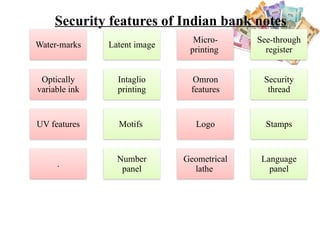
Water-marks Latent image
Micro-
printing
See-through
register
Optically
variable ink
Intaglio
printing
Omron
features
Security
thread
UV features Motifs Logo Stamps
.
Number
panel
Geometrical
lathe
Language
panel
Security features of Indian bank notes
 Watermarks:
Watermarks are the designs that are
generated in the currency notes
incorporated during the manufacturing
process by varying the distribution of
fibres in the given space.
 Latent Image:
The latent image is a safety feature that is
covered within the note. Vertical band on
the right side of the Mahatma Gandhi’s
portrait contains a latent image showing
the respective denominational value in
numeral. It is visible only when it is held
horizontally at eye level
 Micro Lettering:
Micro lettering refers to the minute
inscriptions that can only be read under a
microscope or by using a hand
lens/magnifier.
 Intaglio Printing :
Inscriptions or motifs printed using the Intaglio
printing or raised printing technique can be felt by
touch.
On Indian banknote of denomination, the portrait
of Mahatma Gandhi, the Reserve Bank seal,
guarantee and promise clause, Ashoka Pillar
Emblem on the right, RBI Governor’s signature are
printed in intaglio.
 Identification Mark:
Identification marks are made on
banknotes to help the visually impaired
identify the denomination of notes.
 Fluorescence:
Number panels of the notes are printed in
fluorescent ink. The notes also have
optical fibres. Both can be seen when the
notes are exposed to ultra-violet lamp.
 Optically Variable Ink:
This is a new security feature incorporated in
the with revised colour scheme introduced in
November 2000. The numeral are printed in
optically variable ink, a colour-shifting ink.
The colour of the numeral appears green
when the note is held flat but would change
to blue when the note is held at an angle.
 Security Thread:
The security thread, usually windowed
and reads three words particularly “RBI”,
“BHARAT” imprinted on it alternatively
with the security thread changing its
colour from green to blue on being held at
an angle and tilted.
Omron Feature:
Omron feature refers to the circle-shaped
anti-copy feature located on the left side of
the note
 Bleed Lines:
Angular bleed lines are printed on the
upper left and the right hand edge of the
notes to aid the visually impaired.
See Through Register
The see through register refers to the
denomination numeral that is printed on both
sides of the note, on one side, it is hollow and on
the other side it is filled up. It is written
horizontally just along the micro lettering and
above the latent image on the left side of the
currency note. It looks like one single design
when seen against the light.
New Numbering Pattern:
The numbers in both the number panels
tends to increase from left to right while
the first three alpha numeric characters
remains constant in size.
See through register with denominational numeral can be seen
when the note is held against it.
Latent image with denominational numeral can be seen when the
banknote is held at 45 degree angle at eye level.
Denominational numeral in Devnagari script.
Color shift windowed security thread with inscriptions ‘ ’
भारत , RBI
and denominational numeral.
Color of the thread changes from green to blue when the note is
tilted.
Micro printing on spectacle stick and collar of Mahatma Gandhi
and on the left side beside see-through register.
Security features on the Obverse side
Guarantee clause, governor’s signature with promise
clause and RBI emblem towards right.
3-6 watermarks varying from denomination to
denomination.
Ascending number panel with numerals growing from
small to big on the top left side and bottom right side.
Denominational numeral with rupee symbol, in green to
blue color changing ink (optically variable ink).
Latent image of denominational numeral with rupee
symbol on the left side.
For visually impaired
 Raised printing of mahatma Gandhi portrait, Ashoka pillar
emblem.
 Horizontal rectangle with 2000 in raised print on the right.
₹
 Seven angular bleed lines on left and right side in raised print.
UV Features
 Randomly distributed UV visible Optical fibers of varying colors: green,
orange and blue.
 UV fluorescent security thread.
 UV visible Omron features on left and right side.
Security features on the Reverse side
 Language panel consisting 15 Indian languages.
 Unique motif: Mangalyan on Rs 2000 note and Red-fort on Rs 500 note.
 Latent image on different locations of different denomination notes.
 Swaccha Bharat logo on left side.
UV Features
 Randomly distributed UV visible Optical fibers of varying colors: green,
orange and blue.
 UV fluorescent security thread.
 UV visible Omron features on left and right side.
REFERENCES
• International Journal for Research in Applied
Science & Engineering Technology. (n.d.).
Retrieved August 2020, from
https://www.ijraset.com/fileserve.php?
FID=14308
• https://english.cdn.zeenews.com/sites/default/files/2017/11/30/642575-onerupenote.jpg

Module 3_Session 4- Security features in bank notes .pptx

  • 1.
    SECURITY FEATURES OF INDIANBANK NOTES Monica Simon Assistant Professor Dept. Of Forensic Science JAIN (Deemed-to-be University) PRACTICAL 04 Module: 3 Session: 04 Subject code: 17BSFH3C01
  • 2.
    INTRODUCTION • The ReserveBank has the sole authority to issue bank notes in India. Reserve Bank, like other central banks the world over, changes the design of banknotes from time to time. • The Reserve Bank has introduced banknotes in the Mahatma Gandhi Series since 1996 and has so far issued notes. These notes contain distinct easily recognizable security features to facilitate the detection of genuine notes
  • 3.
    Contd.. • Presently thereare four units which include Indian Security Press, Nasik, Bank Note Press, Dewas, New Bank Note Press, Mysore and New Bank Note Press, Salboni (WB). • Denominations to be printed are Rs 10, 20, 50, 100, 200, 500 and 2000. • All these notes have some common security features and some distinguishing features. • Security features are incorporated in the notes to provide them immunity against counterfeiting .
  • 4.
    What are security features? Securityfeatures are those features which provides security to a document against forgery or counterfeiting. Security features can be covert or overt, visible or invisible. http://2.bp.blogspot.com/cleIQO8SNVU/T5KzmyYKKGI/ AAAAAAAABnk/FWAPBG465wg/s1600/png_4299-Owl-Teacher- Cartoon-Character-With-Graduate-Cap-And-Pointer.png
  • 5.
  • 6.
  • 7.
    Water-marks Latent image Micro- printing See-through register Optically variableink Intaglio printing Omron features Security thread UV features Motifs Logo Stamps . Number panel Geometrical lathe Language panel Security features of Indian bank notes
  • 8.
     Watermarks: Watermarks arethe designs that are generated in the currency notes incorporated during the manufacturing process by varying the distribution of fibres in the given space.
  • 9.
     Latent Image: Thelatent image is a safety feature that is covered within the note. Vertical band on the right side of the Mahatma Gandhi’s portrait contains a latent image showing the respective denominational value in numeral. It is visible only when it is held horizontally at eye level
  • 10.
     Micro Lettering: Microlettering refers to the minute inscriptions that can only be read under a microscope or by using a hand lens/magnifier.
  • 11.
     Intaglio Printing: Inscriptions or motifs printed using the Intaglio printing or raised printing technique can be felt by touch. On Indian banknote of denomination, the portrait of Mahatma Gandhi, the Reserve Bank seal, guarantee and promise clause, Ashoka Pillar Emblem on the right, RBI Governor’s signature are printed in intaglio.
  • 12.
     Identification Mark: Identificationmarks are made on banknotes to help the visually impaired identify the denomination of notes.
  • 13.
     Fluorescence: Number panelsof the notes are printed in fluorescent ink. The notes also have optical fibres. Both can be seen when the notes are exposed to ultra-violet lamp.
  • 14.
     Optically VariableInk: This is a new security feature incorporated in the with revised colour scheme introduced in November 2000. The numeral are printed in optically variable ink, a colour-shifting ink. The colour of the numeral appears green when the note is held flat but would change to blue when the note is held at an angle.
  • 15.
     Security Thread: Thesecurity thread, usually windowed and reads three words particularly “RBI”, “BHARAT” imprinted on it alternatively with the security thread changing its colour from green to blue on being held at an angle and tilted.
  • 16.
    Omron Feature: Omron featurerefers to the circle-shaped anti-copy feature located on the left side of the note
  • 17.
     Bleed Lines: Angularbleed lines are printed on the upper left and the right hand edge of the notes to aid the visually impaired.
  • 18.
    See Through Register Thesee through register refers to the denomination numeral that is printed on both sides of the note, on one side, it is hollow and on the other side it is filled up. It is written horizontally just along the micro lettering and above the latent image on the left side of the currency note. It looks like one single design when seen against the light.
  • 19.
    New Numbering Pattern: Thenumbers in both the number panels tends to increase from left to right while the first three alpha numeric characters remains constant in size.
  • 20.
    See through registerwith denominational numeral can be seen when the note is held against it. Latent image with denominational numeral can be seen when the banknote is held at 45 degree angle at eye level. Denominational numeral in Devnagari script. Color shift windowed security thread with inscriptions ‘ ’ भारत , RBI and denominational numeral. Color of the thread changes from green to blue when the note is tilted. Micro printing on spectacle stick and collar of Mahatma Gandhi and on the left side beside see-through register. Security features on the Obverse side
  • 21.
    Guarantee clause, governor’ssignature with promise clause and RBI emblem towards right. 3-6 watermarks varying from denomination to denomination. Ascending number panel with numerals growing from small to big on the top left side and bottom right side. Denominational numeral with rupee symbol, in green to blue color changing ink (optically variable ink). Latent image of denominational numeral with rupee symbol on the left side.
  • 22.
    For visually impaired Raised printing of mahatma Gandhi portrait, Ashoka pillar emblem.  Horizontal rectangle with 2000 in raised print on the right. ₹  Seven angular bleed lines on left and right side in raised print. UV Features  Randomly distributed UV visible Optical fibers of varying colors: green, orange and blue.  UV fluorescent security thread.  UV visible Omron features on left and right side.
  • 23.
    Security features onthe Reverse side  Language panel consisting 15 Indian languages.  Unique motif: Mangalyan on Rs 2000 note and Red-fort on Rs 500 note.  Latent image on different locations of different denomination notes.  Swaccha Bharat logo on left side. UV Features  Randomly distributed UV visible Optical fibers of varying colors: green, orange and blue.  UV fluorescent security thread.  UV visible Omron features on left and right side.
  • 24.
    REFERENCES • International Journalfor Research in Applied Science & Engineering Technology. (n.d.). Retrieved August 2020, from https://www.ijraset.com/fileserve.php? FID=14308
  • 25.