Fake news: Identifying, debunking and discussing false narratives with learners
The presentation by Alyce Hogg at La Trobe Melbourne aims to equip educators with tools to identify and discuss fake news, enhancing news literacy among learners. It defines fake news, explores its historical context, and highlights its greater reach compared to legitimate news, using a specific example to demonstrate verification techniques. Strategies for discussing misinformation and promoting critical thinking among students are also outlined, emphasizing the importance of reliable sources and fact-checking resources.
Aims of thispresentation
• This presentation will provide you with the tools
you need to identify potential misinformation
and verify sources and narratives.
• We will touch only briefly on the politicisation of
fake news. This topic is far too complex to cover
in any great detail in this presentation.
• We will explore strategies for discussing fake
news with your learners and increasing their
news literacy (an increasingly important skill,
one which is necessary for navigating the online
sphere).
3.
What is fakenews?
• Fake news was Collins Dictionary’s “word of 2017”. The
publication defines fake news as: “false, often sensational,
information disseminated under the guise of
news reporting”.
• Fake news can be intentional or unintentional. We will look
at an example of intentional fake news in this presentation.
• It is not a new concept or problem (we can track reports of
fake news stories back as far as 1843)
• Studies show that fake news has a greater audience reach
than legitimate news.
• Corrections and apologies published by news publications
have also been shown to have less audience reach than the
original misinformation.
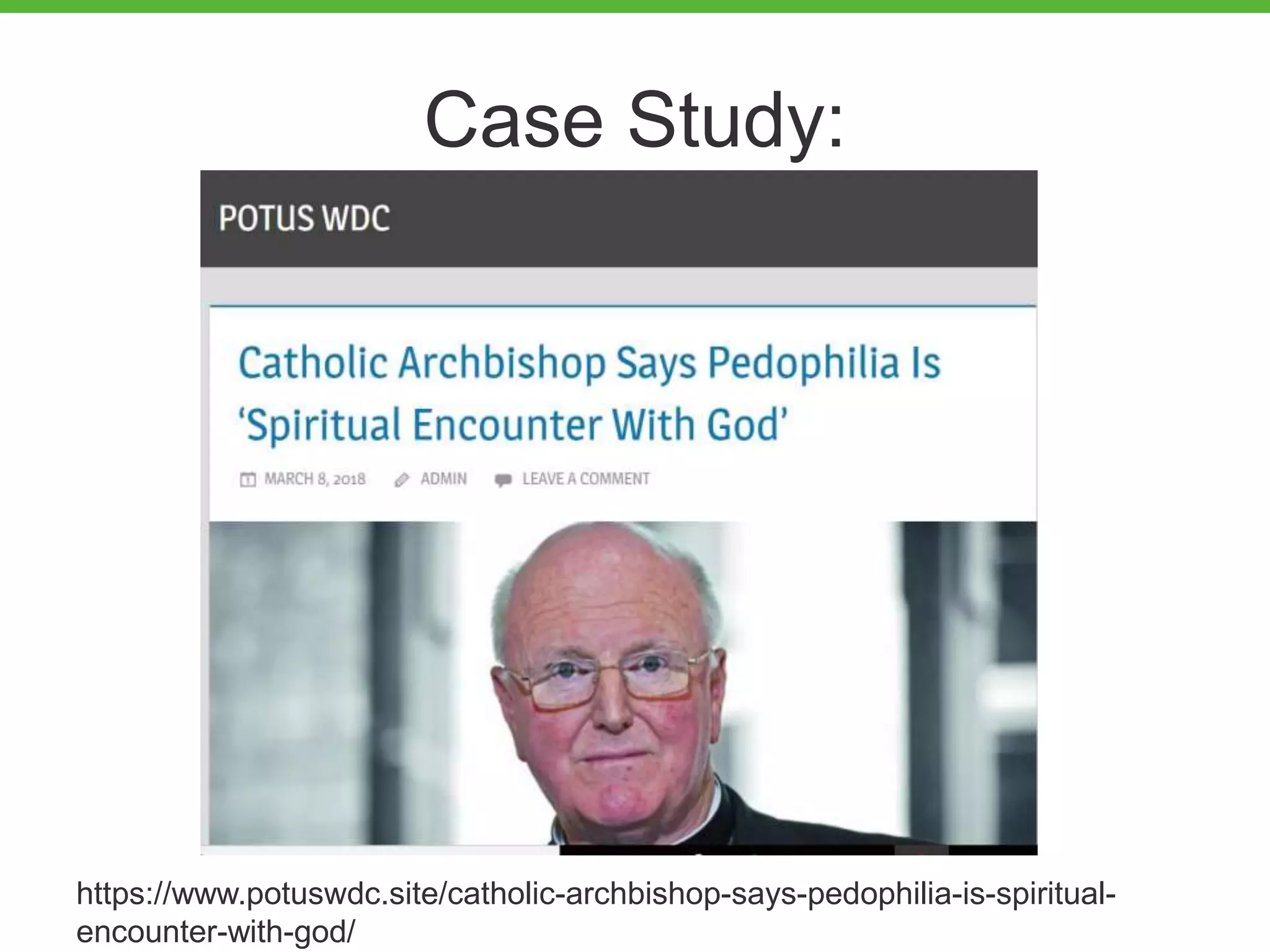
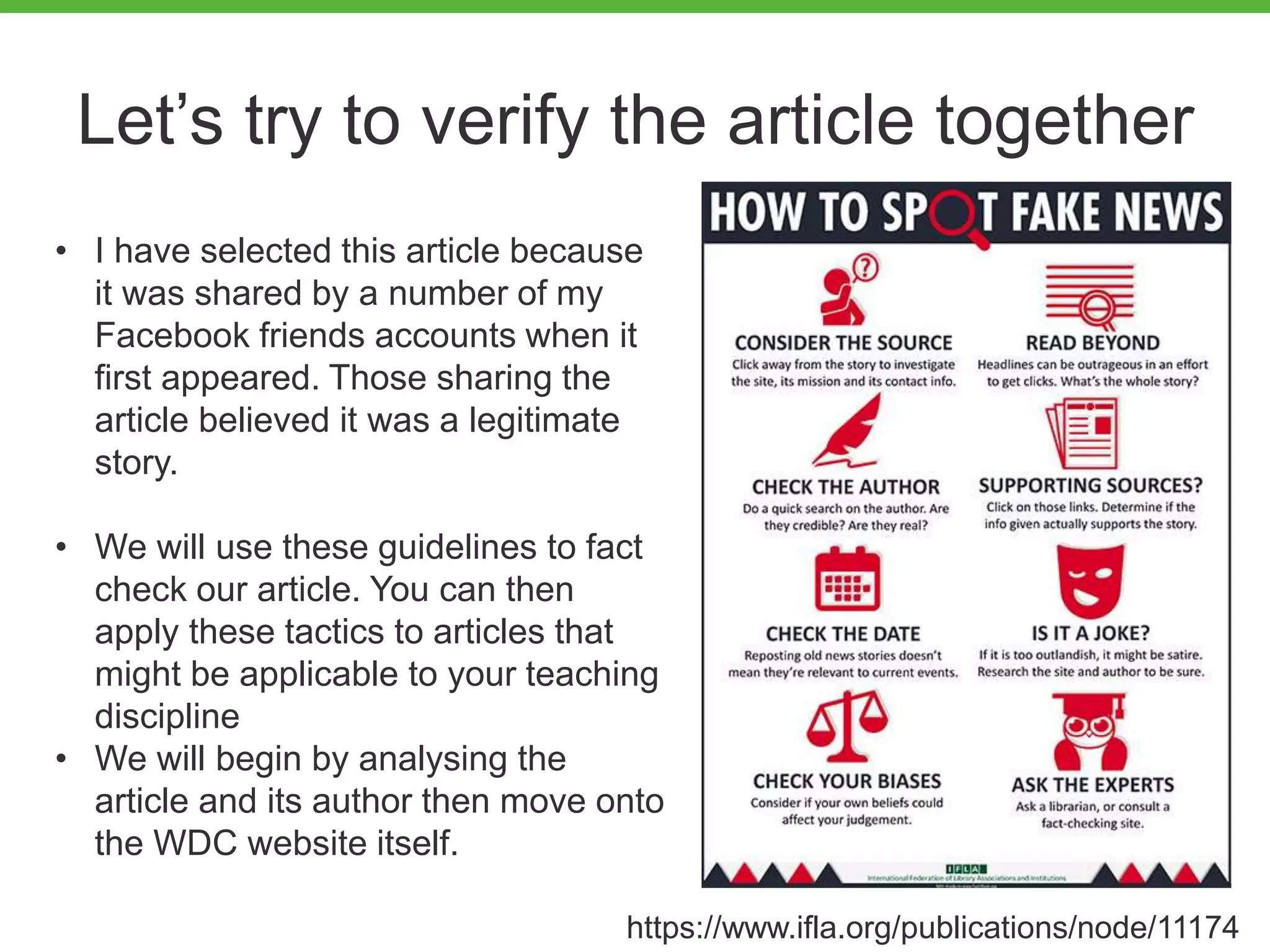
Let’s try toverify the article together
• I have selected this article because
it was shared by a number of my
Facebook friends accounts when it
first appeared. Those sharing the
article believed it was a legitimate
story.
• We will use these guidelines to fact
check our article. You can then
apply these tactics to articles that
might be applicable to your teaching
discipline
• We will begin by analysing the
article and its author then move onto
the WDC website itself.
https://www.ifla.org/publications/node/11174
6.
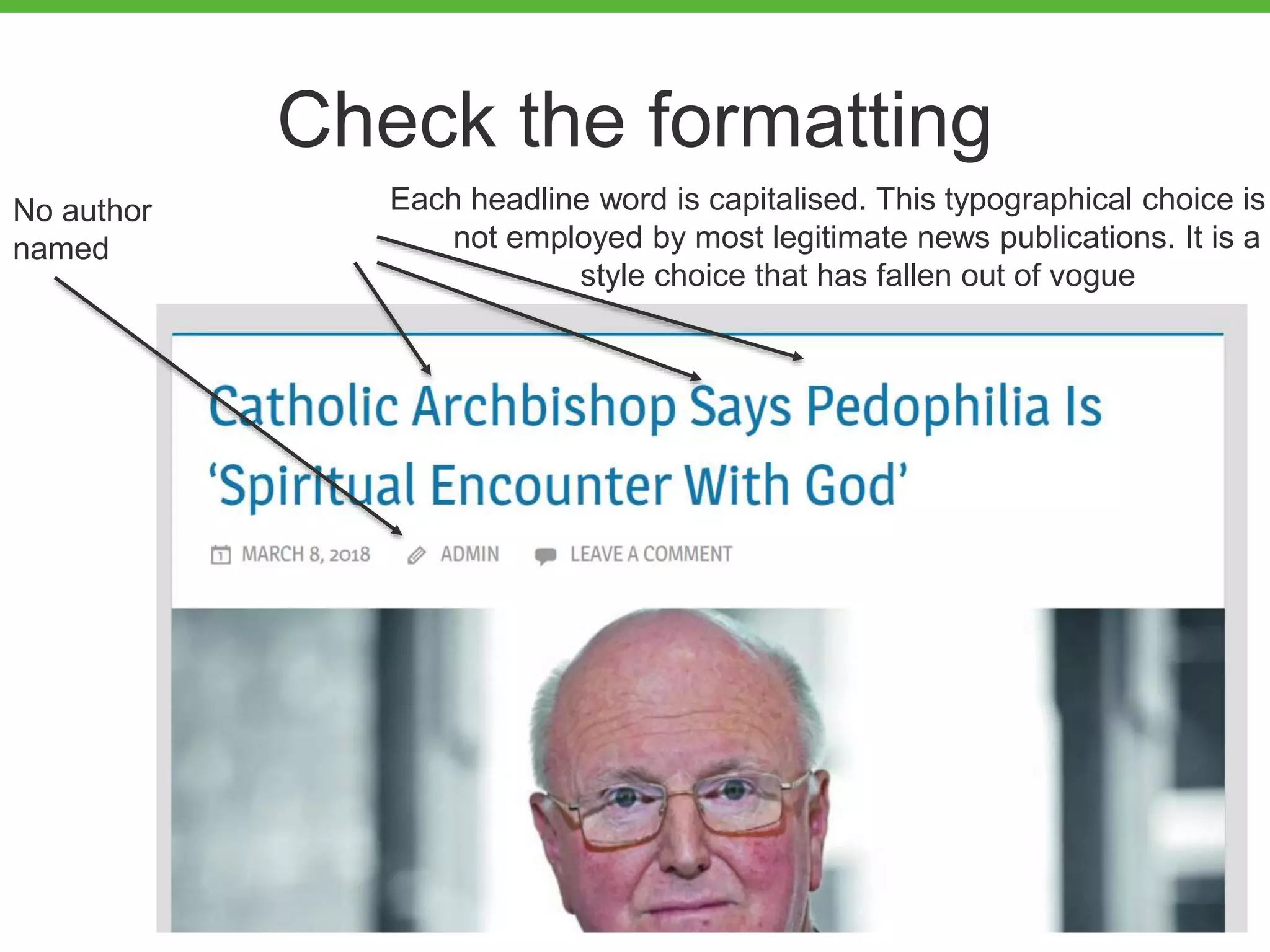
No author
named
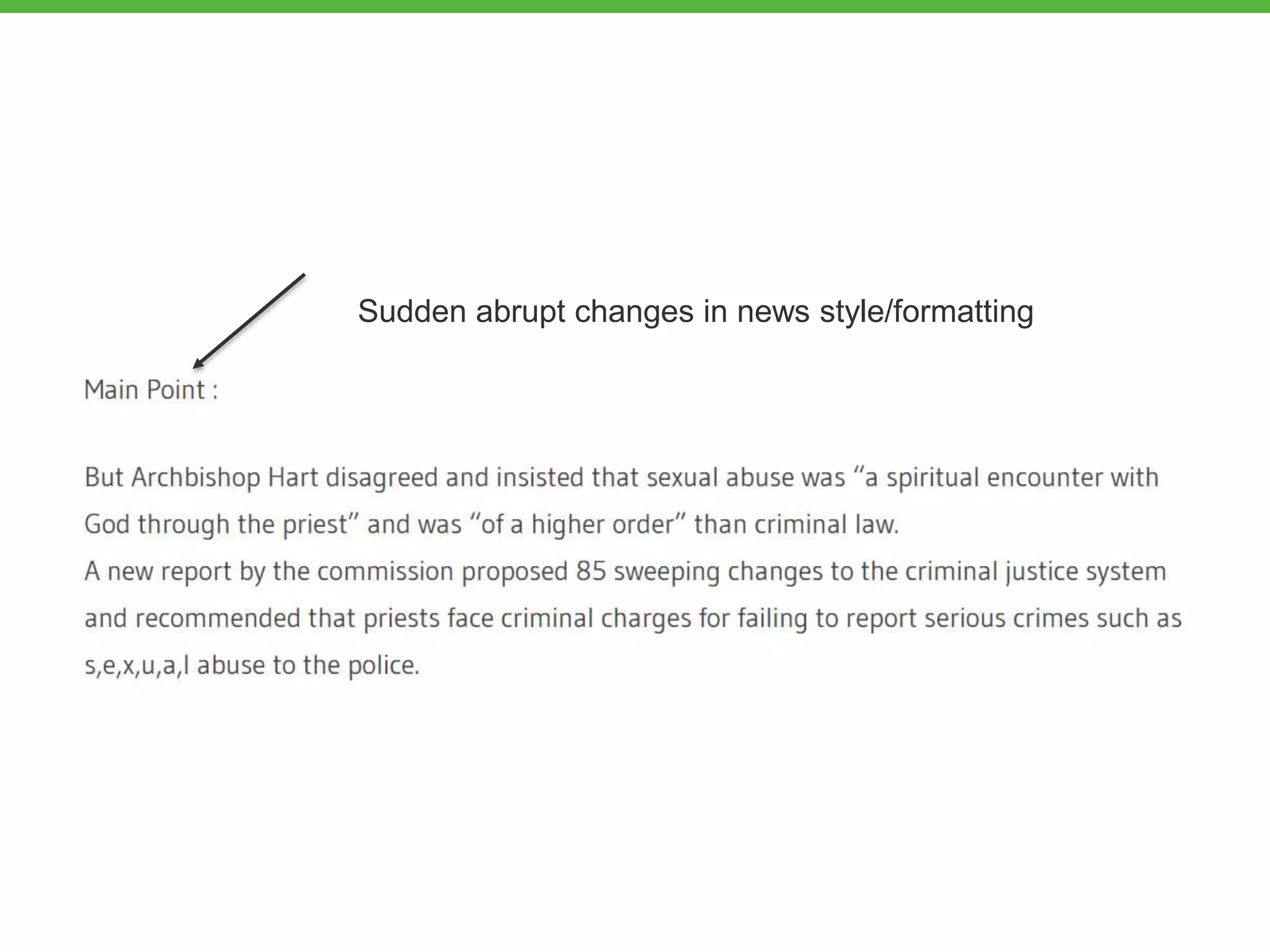
Each headlineword is capitalised. This typographical choice is
not employed by most legitimate news publications. It is a
style choice that has fallen out of vogue
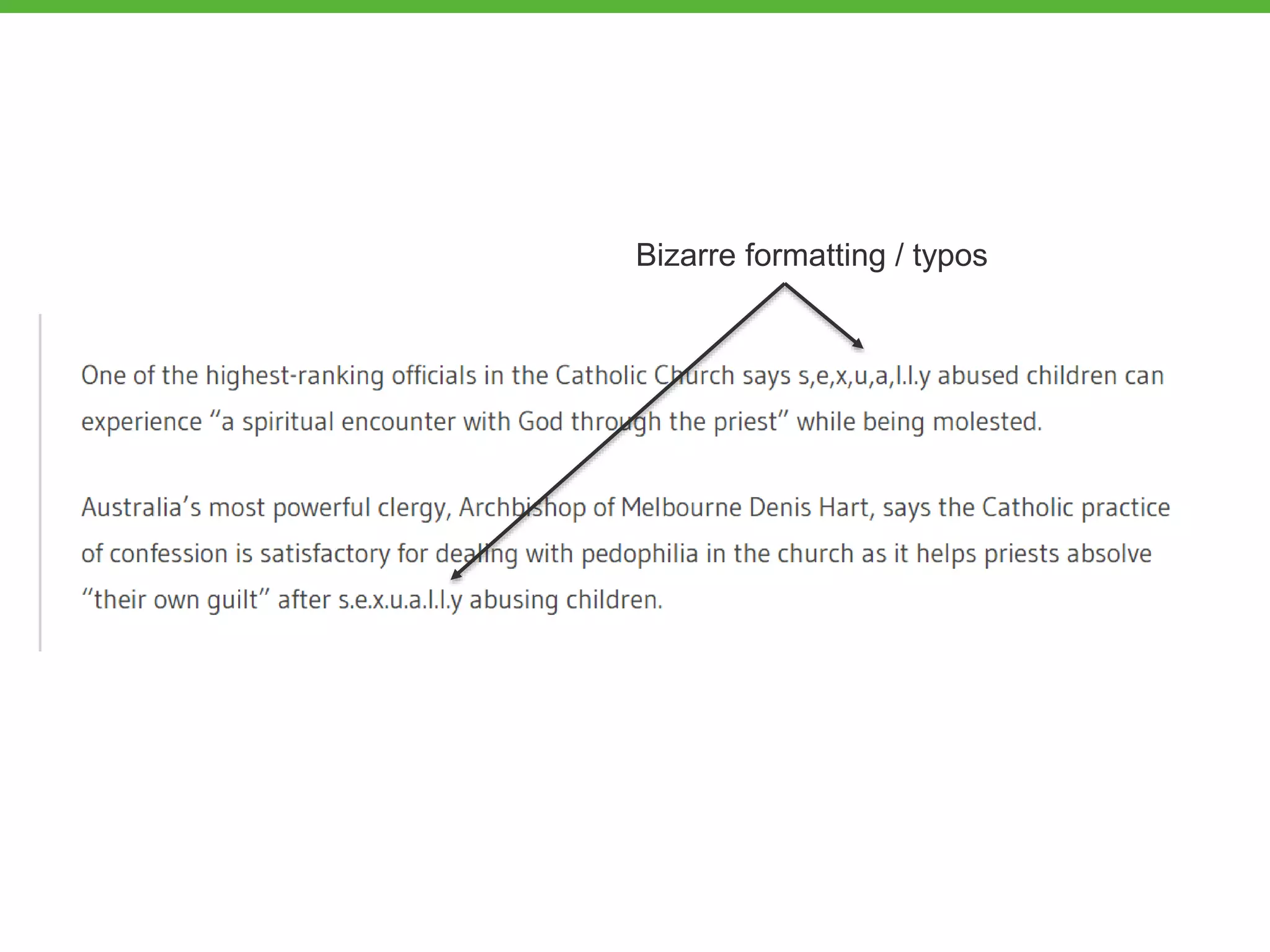
Check the formatting
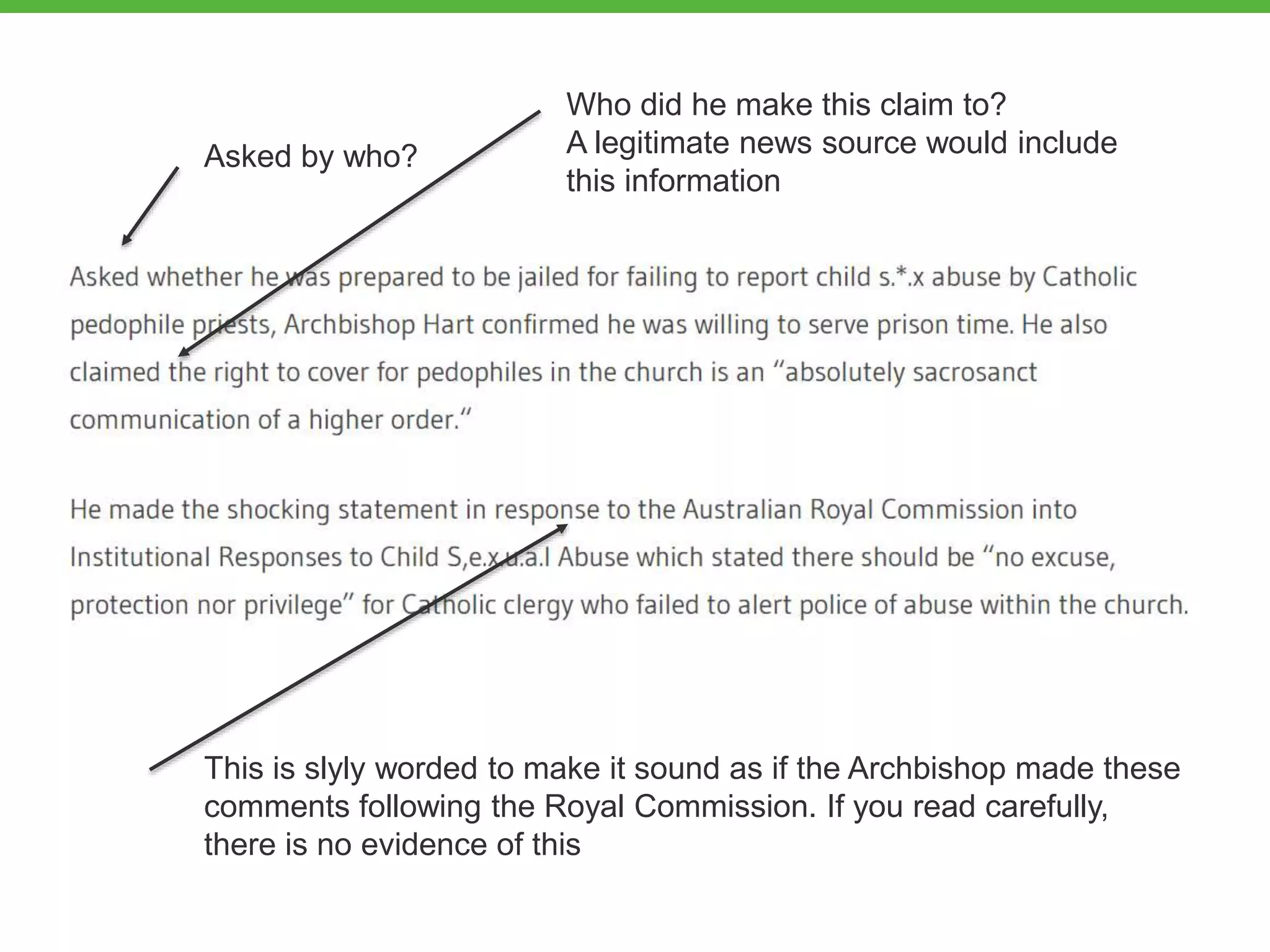
Asked by who?
Whodid he make this claim to?
A legitimate news source would include
this information
This is slyly worded to make it sound as if the Archbishop made these
comments following the Royal Commission. If you read carefully,
there is no evidence of this
9.
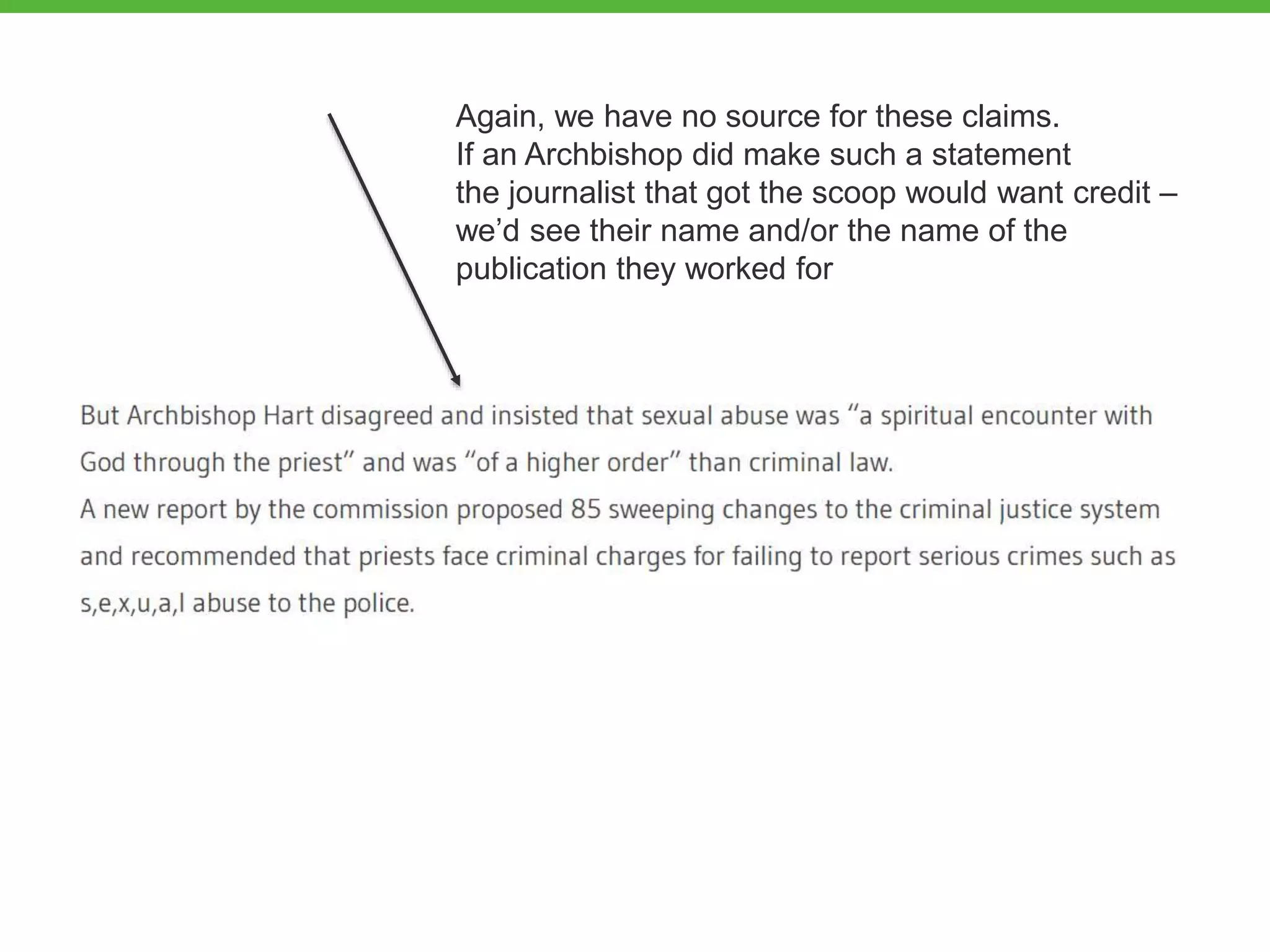
Again, we haveno source for these claims.
If an Archbishop did make such a statement
the journalist that got the scoop would want credit –
we’d see their name and/or the name of the
publication they worked for
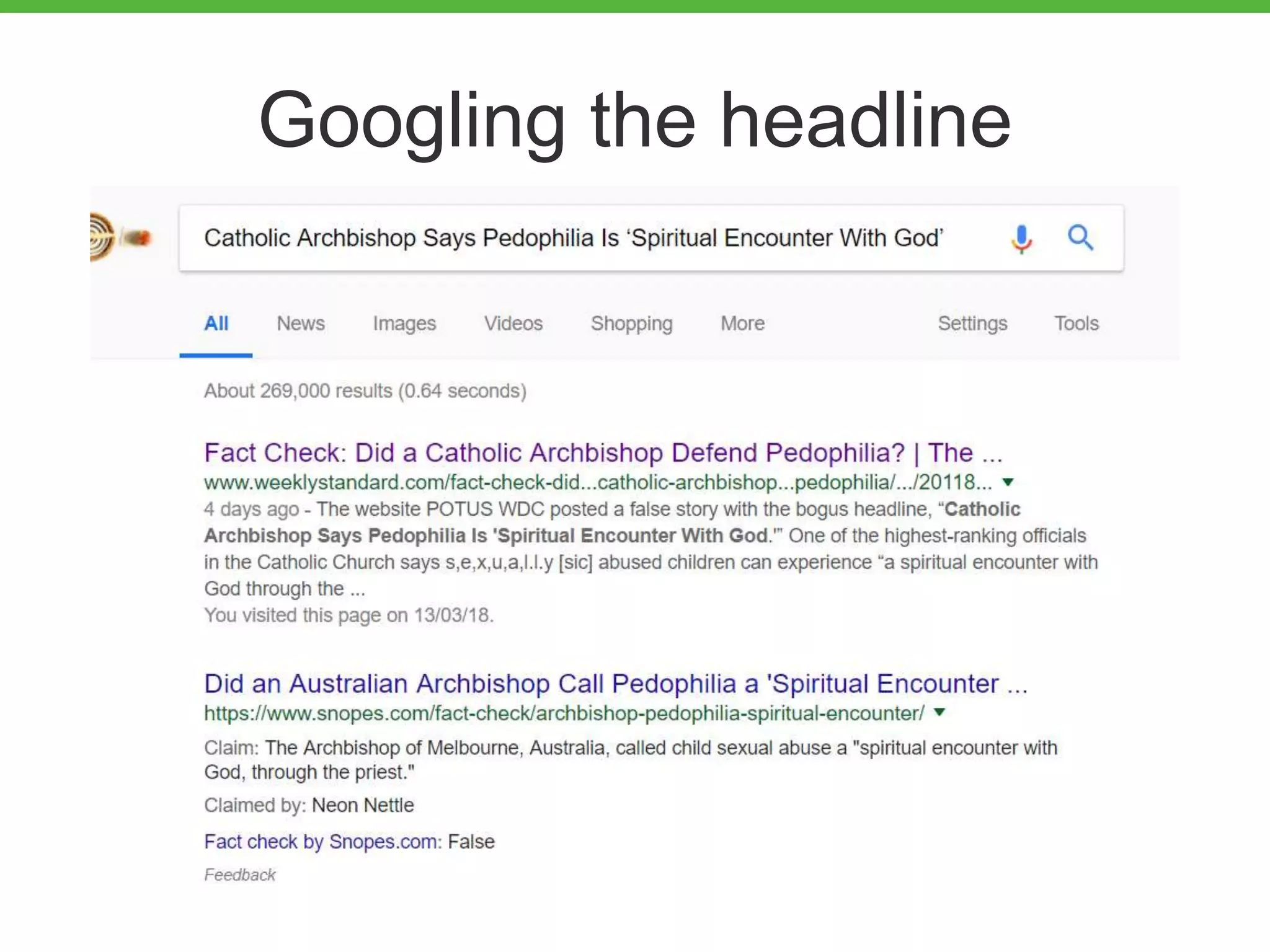
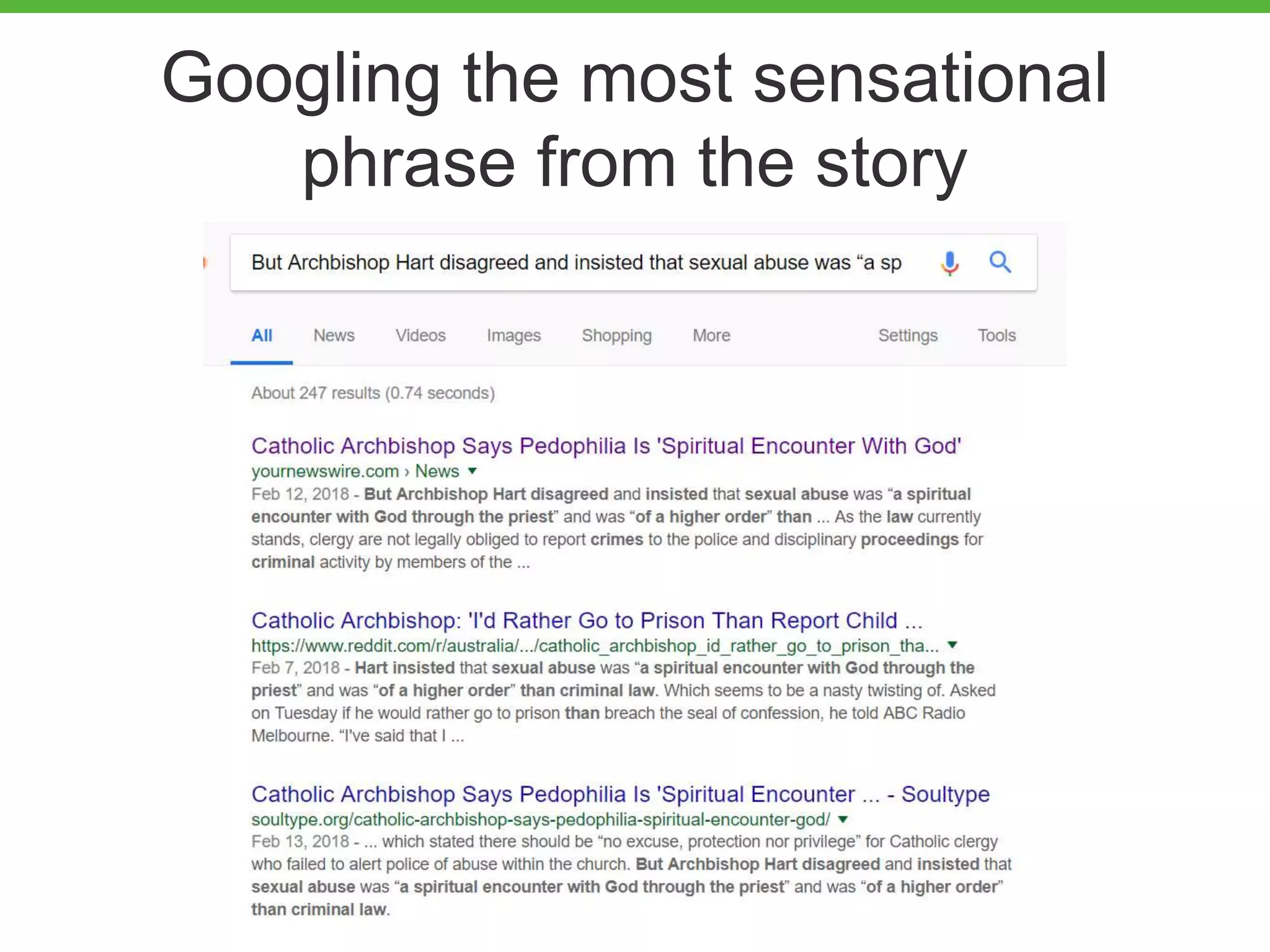
Google is yourfriend!
• One of the easiest ways to fact check an
article’s legitimacy is to Google it.
• I’m going to copy the headline and paste it into
Google.
• You may have to try selecting different
segments of text – different phrases may have
different results.
• Let’s see how my search results varied
depending on the phrase I entered:
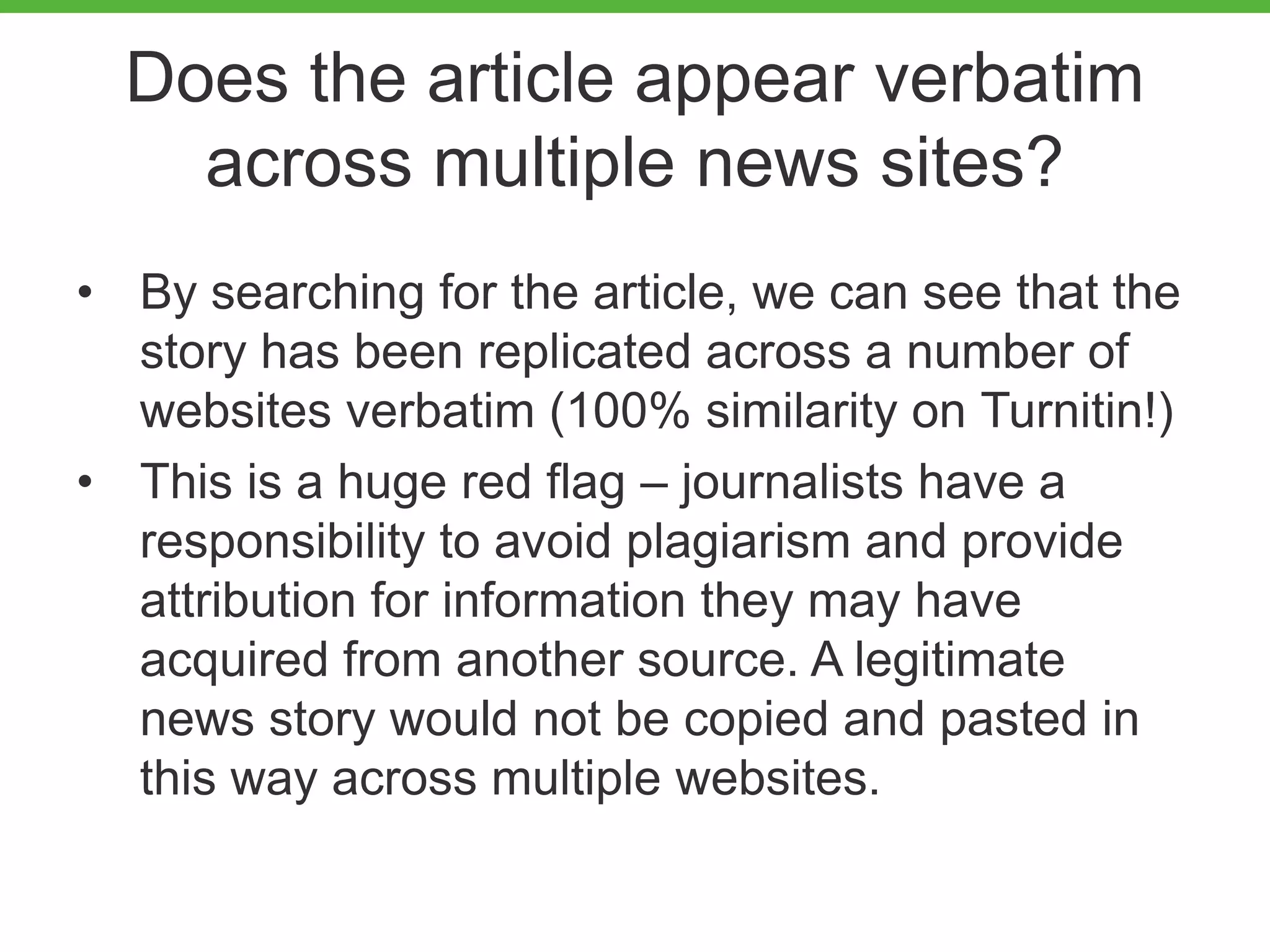
Does the articleappear verbatim
across multiple news sites?
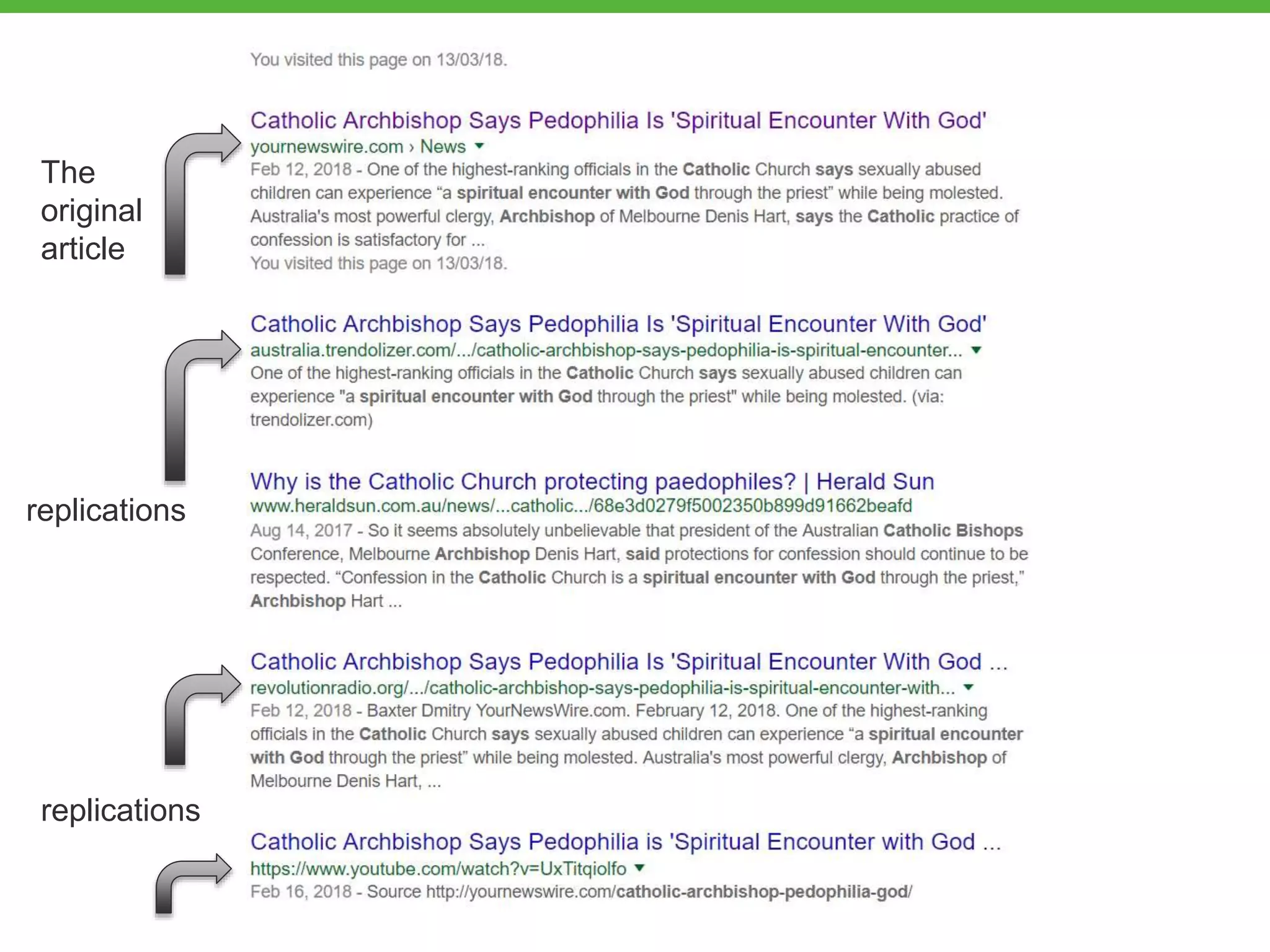
• By searching for the article, we can see that the
story has been replicated across a number of
websites verbatim (100% similarity on Turnitin!)
• This is a huge red flag – journalists have a
responsibility to avoid plagiarism and provide
attribution for information they may have
acquired from another source. A legitimate
news story would not be copied and pasted in
this way across multiple websites.
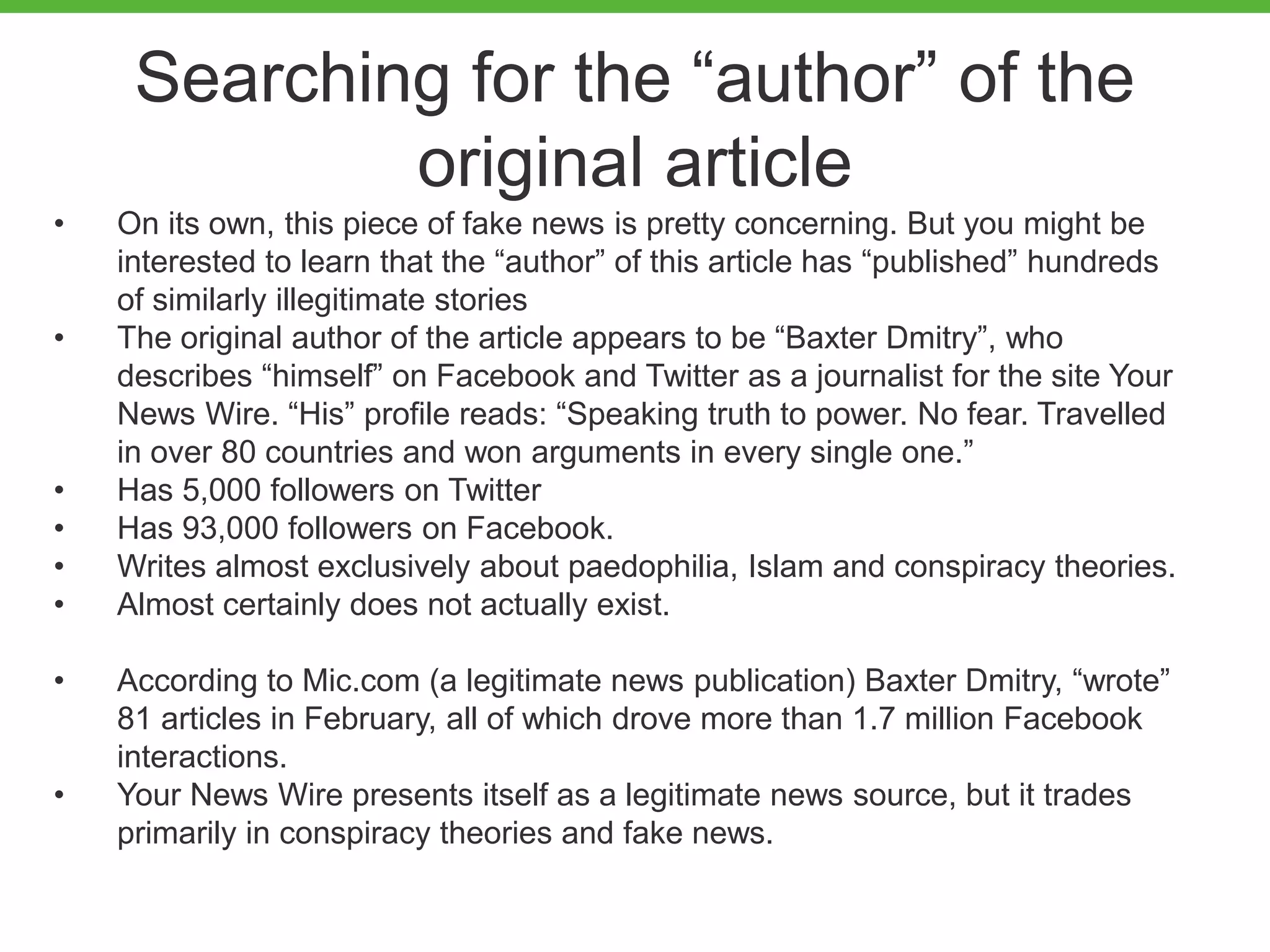
Searching for the“author” of the
original article
• On its own, this piece of fake news is pretty concerning. But you might be
interested to learn that the “author” of this article has “published” hundreds
of similarly illegitimate stories
• The original author of the article appears to be “Baxter Dmitry”, who
describes “himself” on Facebook and Twitter as a journalist for the site Your
News Wire. “His” profile reads: “Speaking truth to power. No fear. Travelled
in over 80 countries and won arguments in every single one.”
• Has 5,000 followers on Twitter
• Has 93,000 followers on Facebook.
• Writes almost exclusively about paedophilia, Islam and conspiracy theories.
• Almost certainly does not actually exist.
• According to Mic.com (a legitimate news publication) Baxter Dmitry, “wrote”
81 articles in February, all of which drove more than 1.7 million Facebook
interactions.
• Your News Wire presents itself as a legitimate news source, but it trades
primarily in conspiracy theories and fake news.
17.
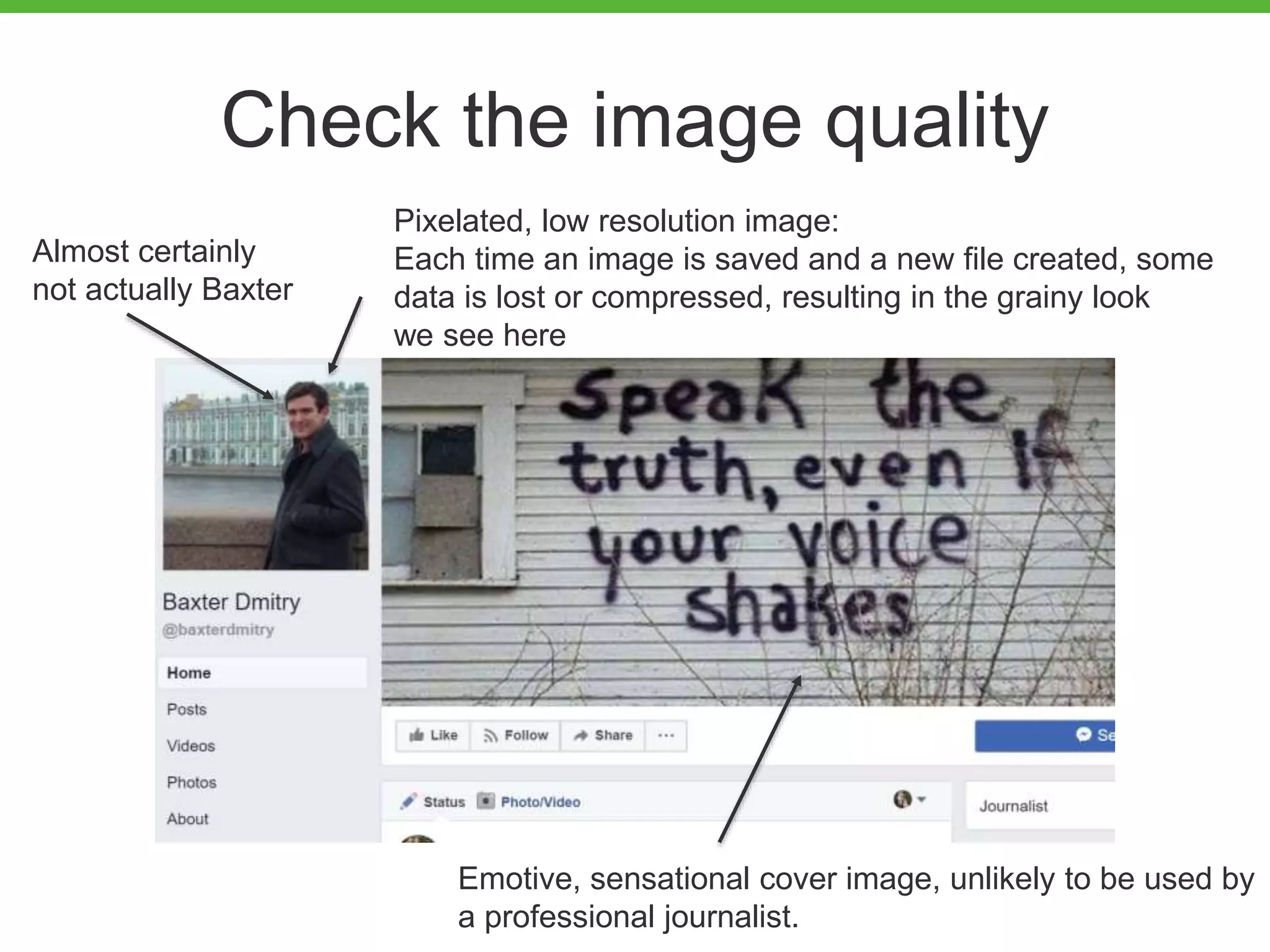
Check the imagequality
Pixelated, low resolution image:
Each time an image is saved and a new file created, some
data is lost or compressed, resulting in the grainy look
we see here
Almost certainly
not actually Baxter
Emotive, sensational cover image, unlikely to be used by
a professional journalist.
18.
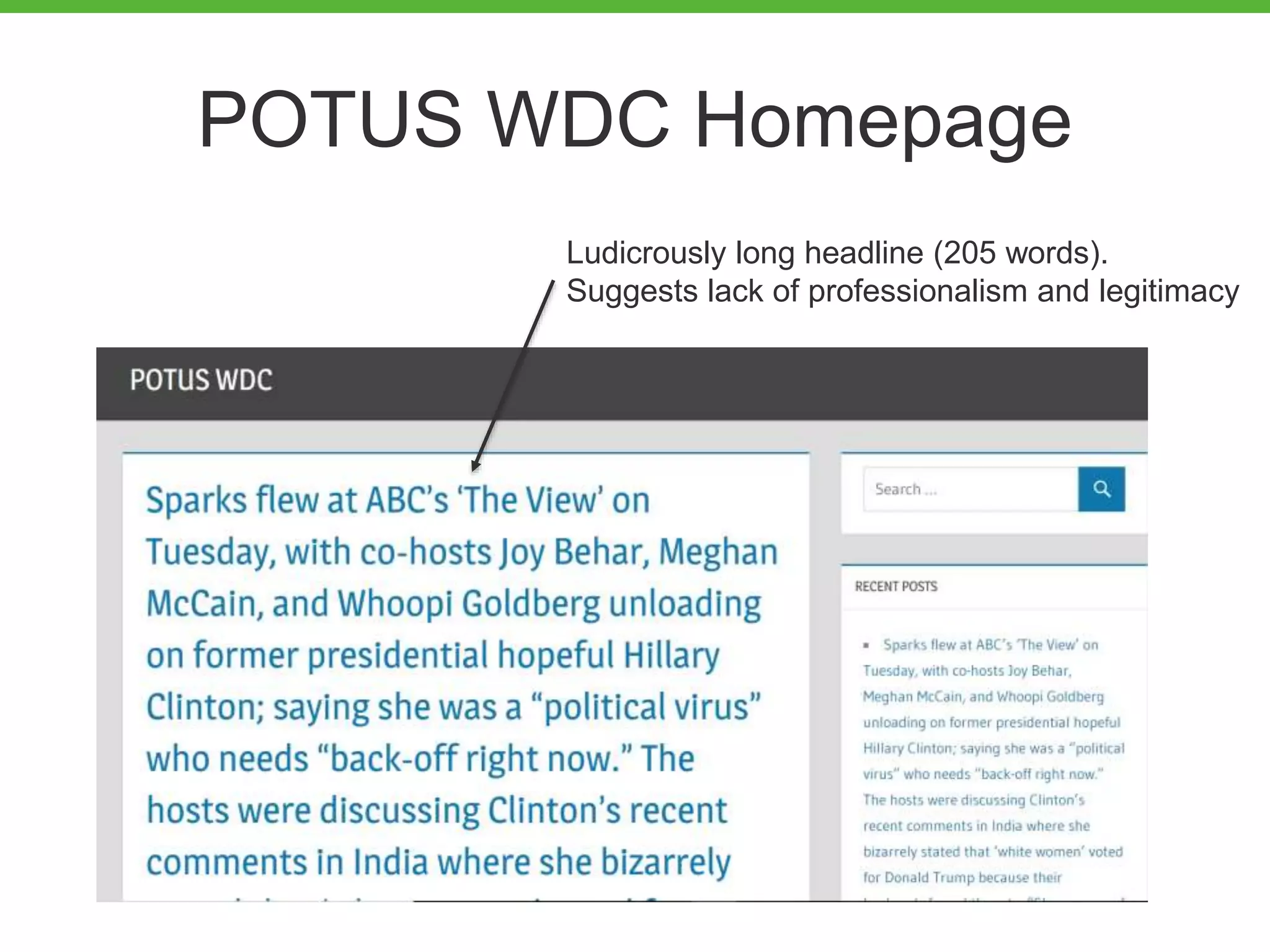
Looking at thePOTUS WDC
• The site that published the article that was shared by so
many of my Facebook friends calls itself POTUS WDC.
There is no further information provided about who
owns it, who writes for it, or what its agenda might be.
The WDC article is a replication of the original from Your
News Wire.
• I can only guess the acronym is intended to stand for
President of the United States: Washington, District of
Columbia Governmental.
• However, no official site run by a governmental
department would employ tacky, basic design like this,
nor would it provide no basic information.
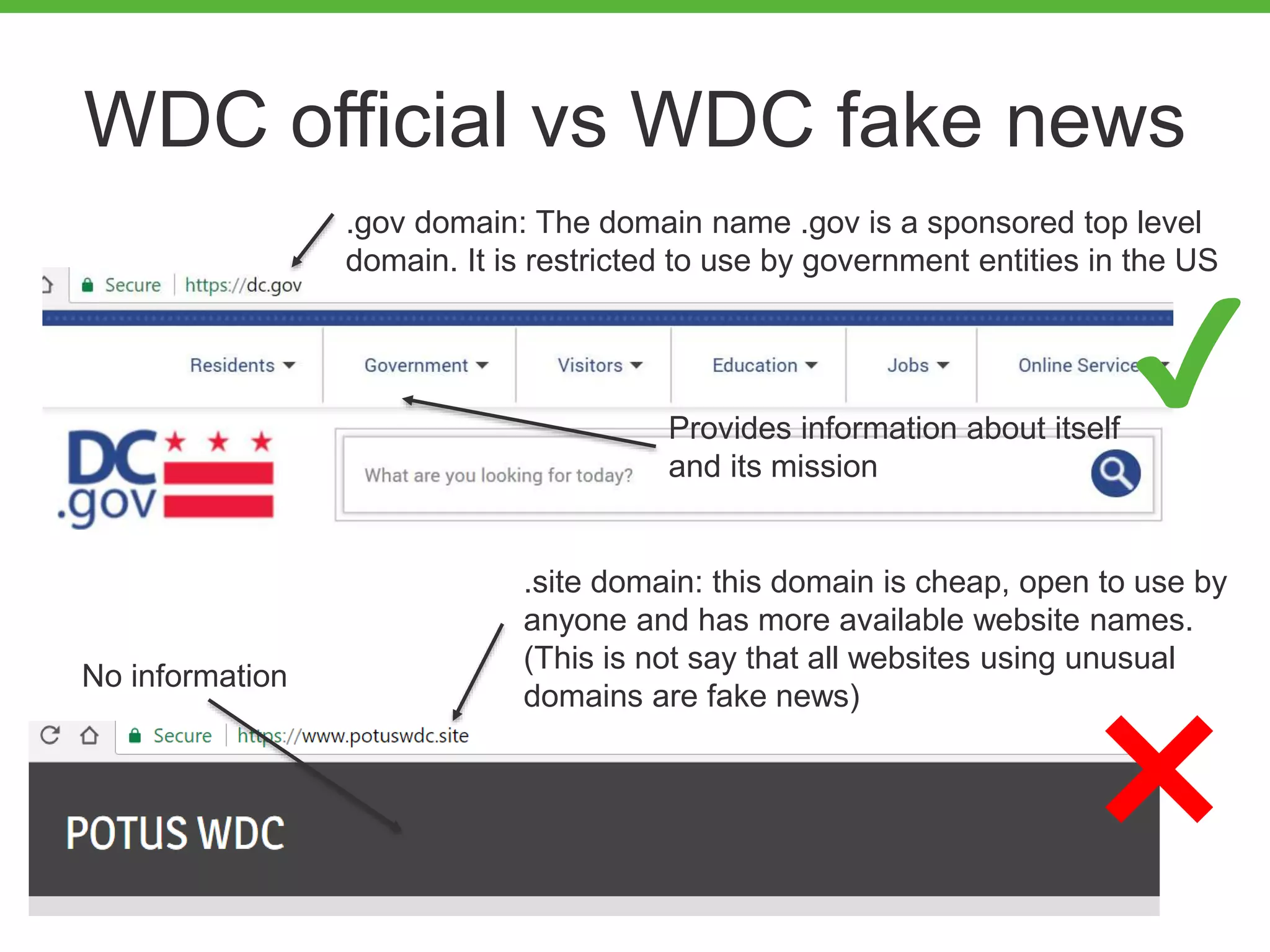
• You can make sure a site is government run by looking
for the domain .gov or .gov.au (.gov.uk, .gov.nz, etc)
WDC official vsWDC fake news
.gov domain: The domain name .gov is a sponsored top level
domain. It is restricted to use by government entities in the US
Provides information about itself
and its mission
.site domain: this domain is cheap, open to use by
anyone and has more available website names.
(This is not say that all websites using unusual
domains are fake news)
No information
✔
✖
21.
WDC.site
• WDC hasa long track record of publishing fake news. Among past
claims:
• “Shaquille O’Neal says: ‘Trump is possibly the best president of the
president of all times(sic) ever”
• “Fibromyalgia: Curable Despite What Your Doctors Says”
• It is important to note that these articles do not appear to be written
by anyone from WDC.site. Rather the site seems to curate articles
from other publications (often content factories of fake news).
• It might seem very obvious looking at the website homepage that
something is not quite right. But remember, many of us will
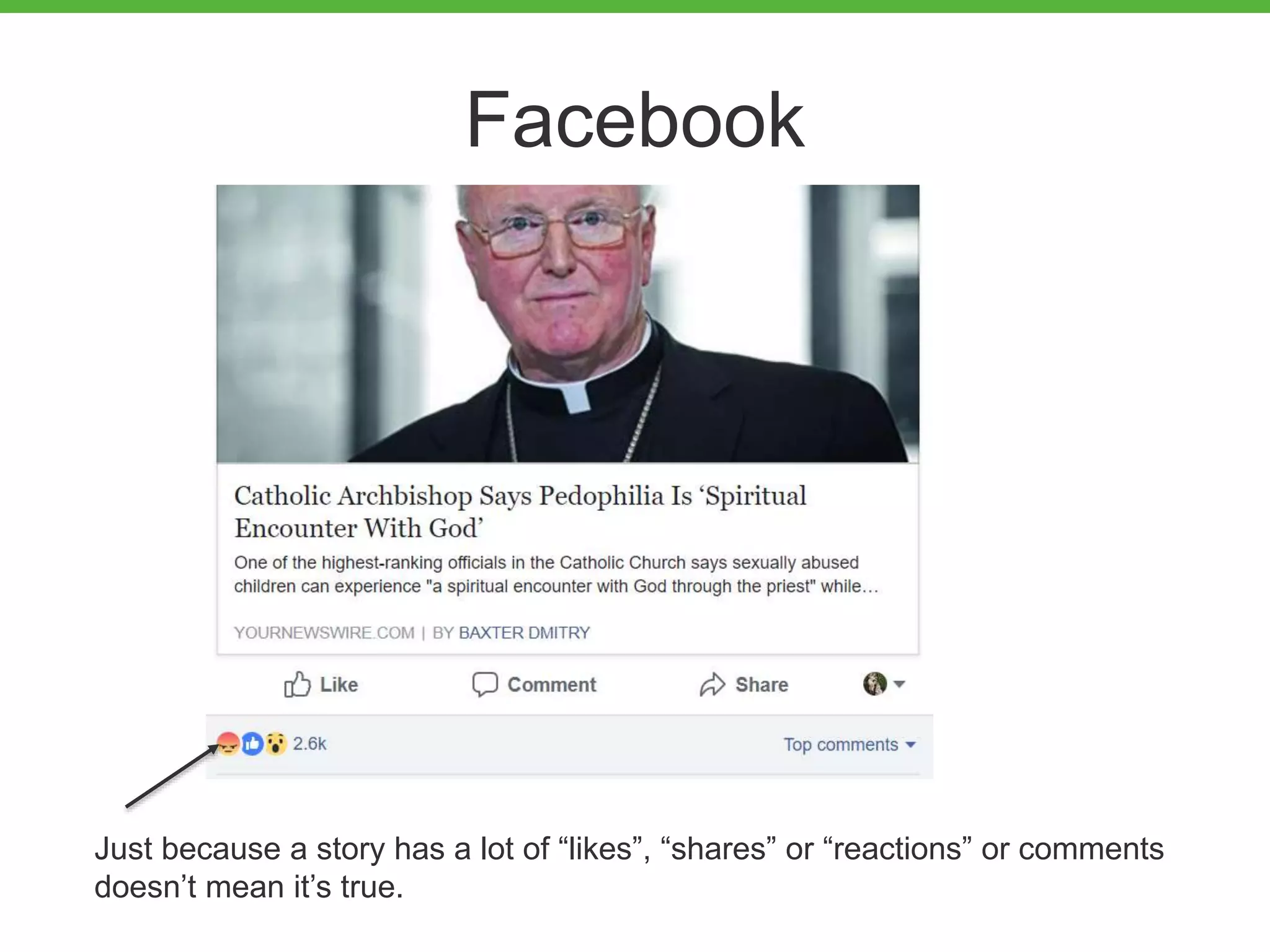
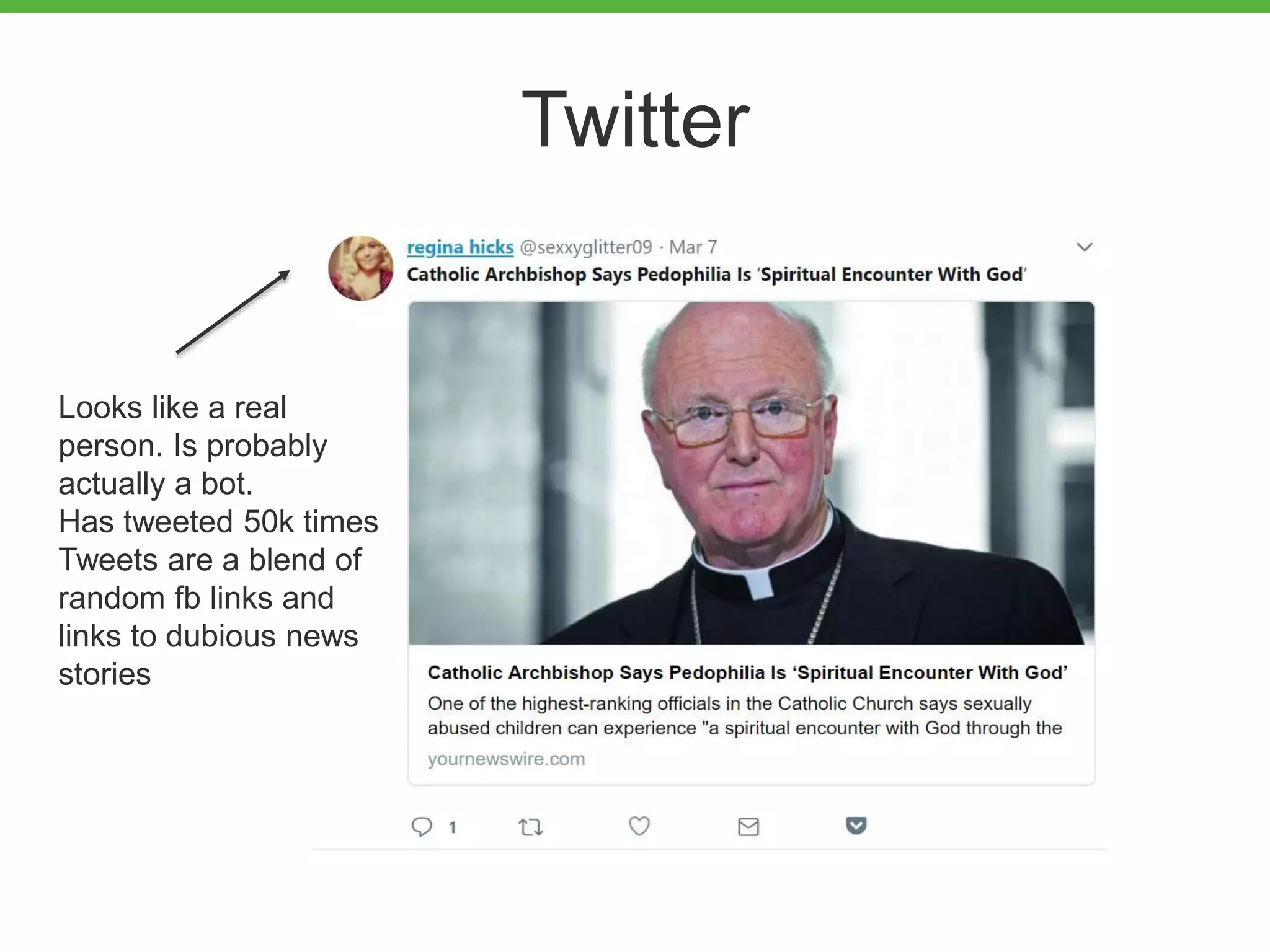
encounter fake news like this in the form of a social media link.
• For example:
22.
Just because astory has a lot of “likes”, “shares” or “reactions” or comments
doesn’t mean it’s true.
Facebook
23.
Twitter
Looks like areal
person. Is probably
actually a bot.
Has tweeted 50k times
Tweets are a blend of
random fb links and
links to dubious news
stories
24.
Fact-checking
• You canalso use a reputable fact checker to verify
news stories.
• There are numerous free fact checkers available
online.
• https://www.factcheck.org/
• http://www.politifact.com/
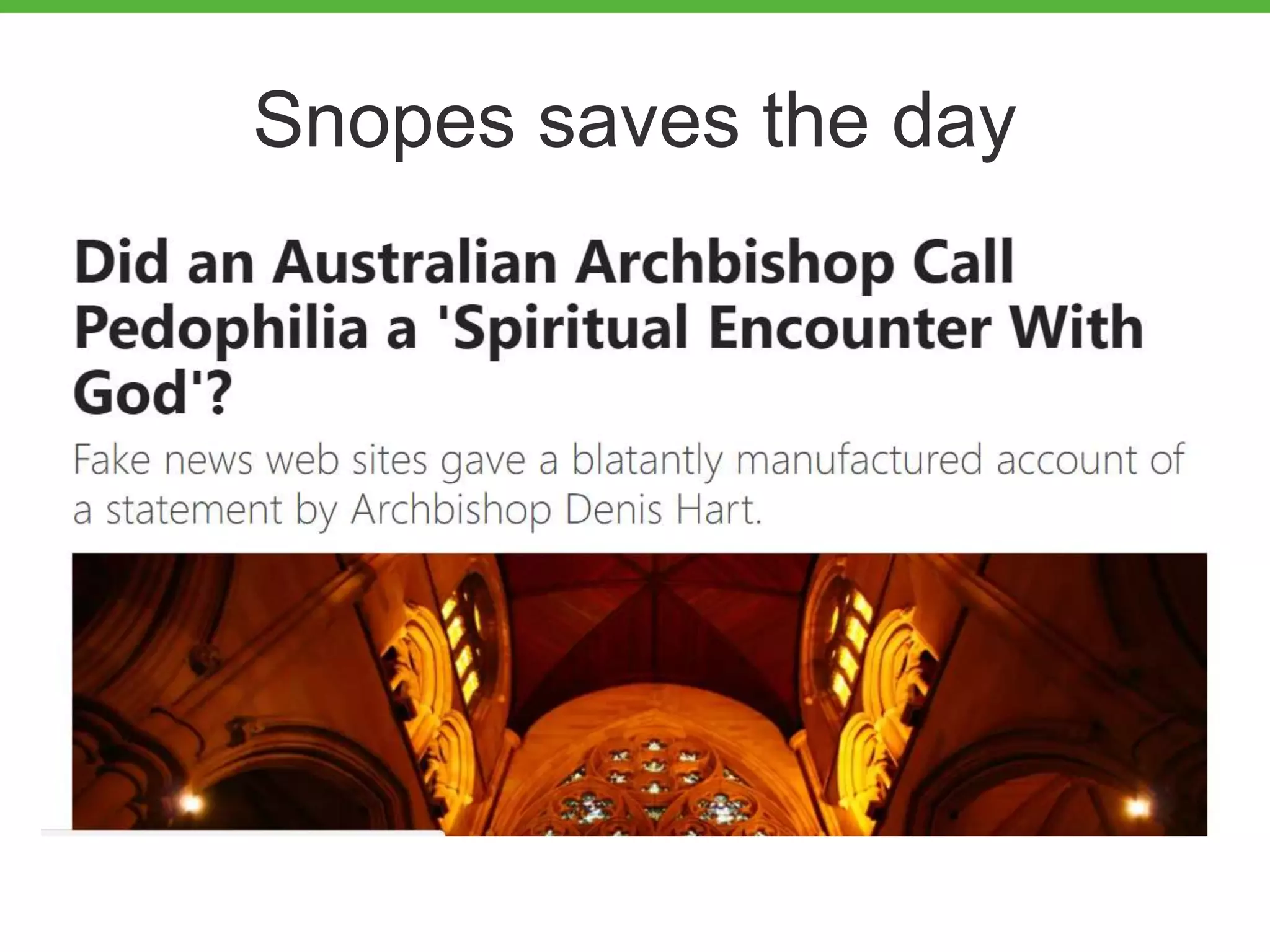
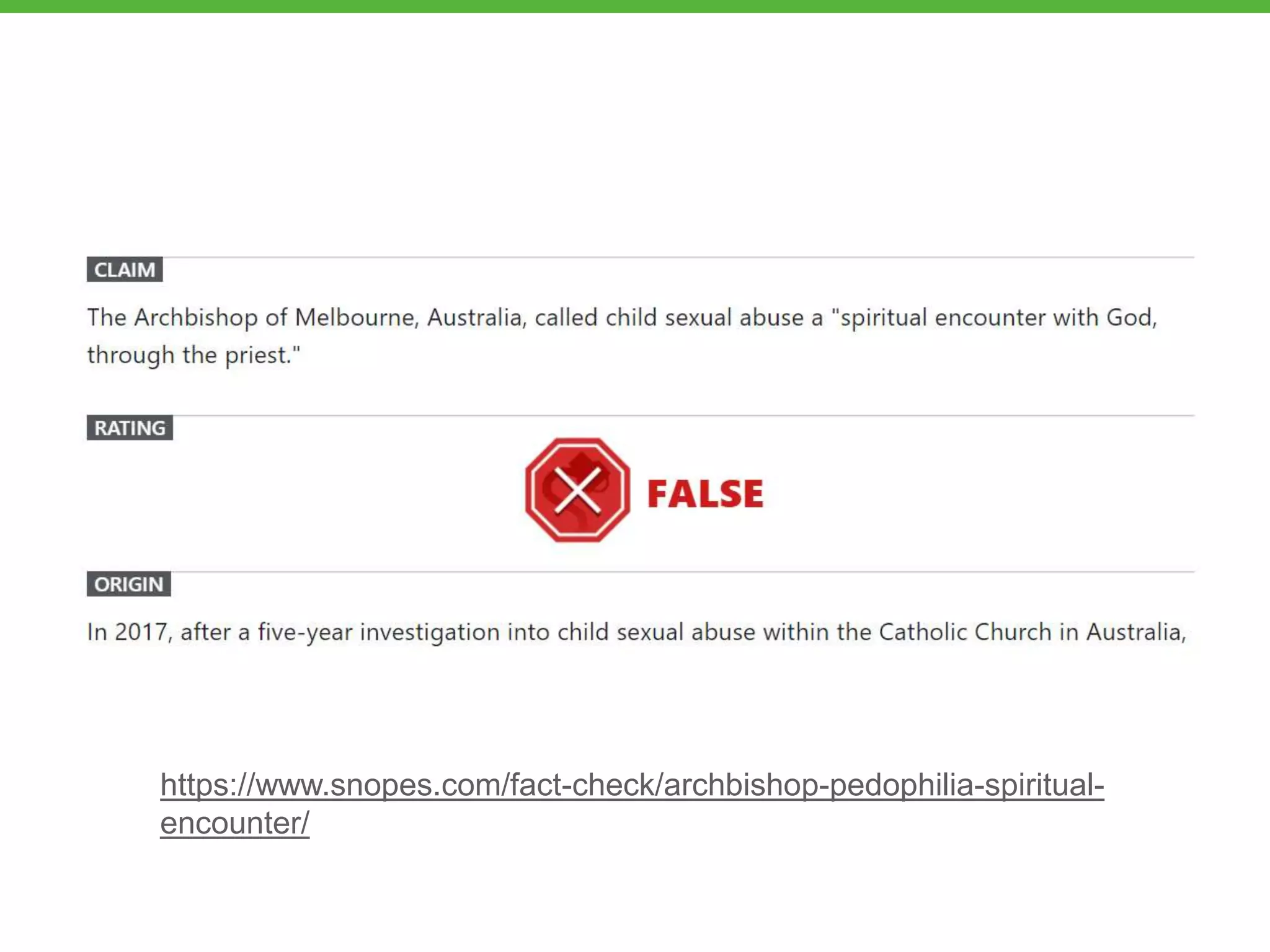
• https://www.snopes.com/
• Google reverse image search
• https://reverse.photos/
Talking to yourlearners about fake
news
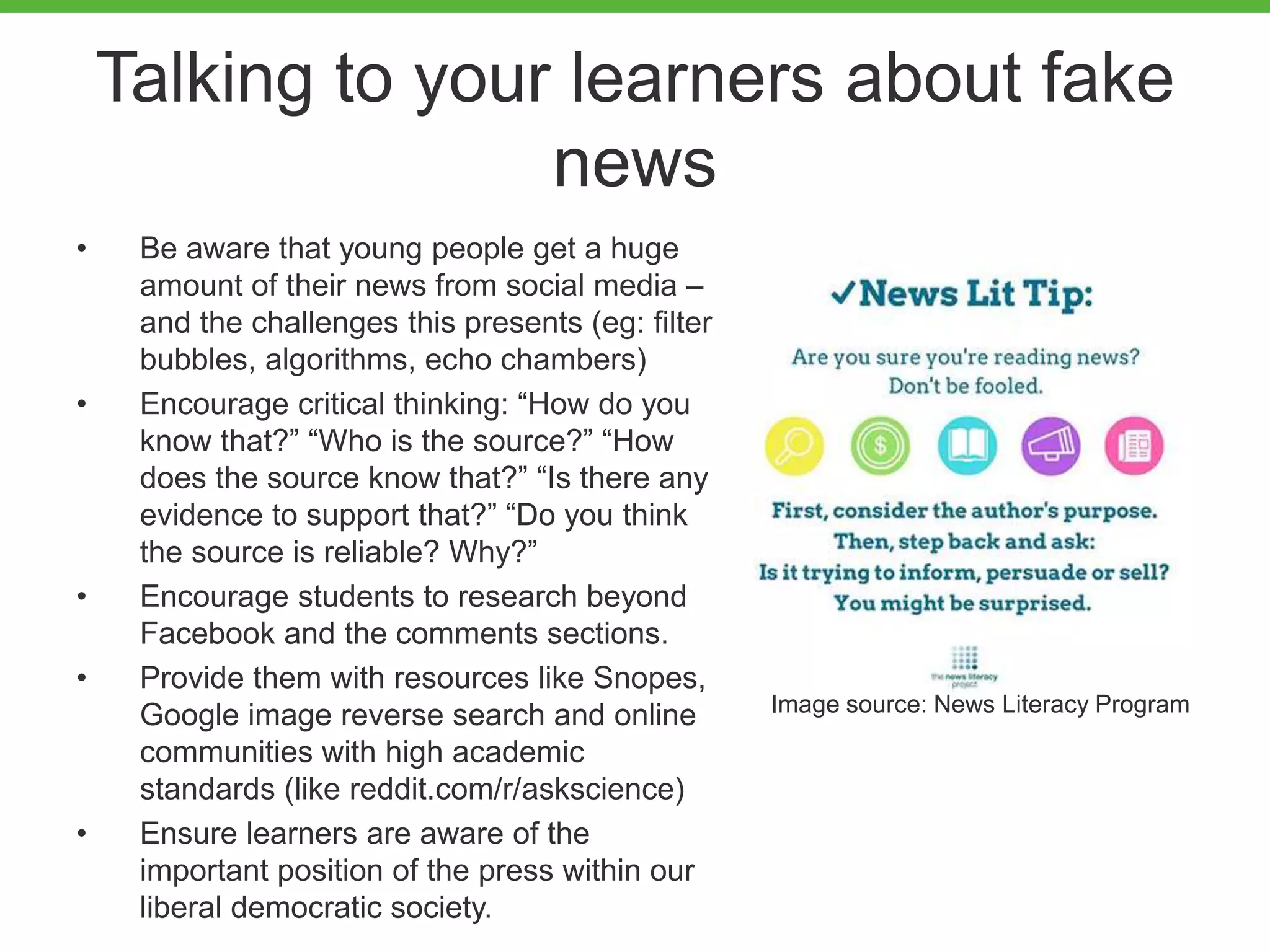
• Be aware that young people get a huge
amount of their news from social media –
and the challenges this presents (eg: filter
bubbles, algorithms, echo chambers)
• Encourage critical thinking: “How do you
know that?” “Who is the source?” “How
does the source know that?” “Is there any
evidence to support that?” “Do you think
the source is reliable? Why?”
• Encourage students to research beyond
Facebook and the comments sections.
• Provide them with resources like Snopes,
Google image reverse search and online
communities with high academic
standards (like reddit.com/r/askscience)
• Ensure learners are aware of the
important position of the press within our
liberal democratic society.
Image source: News Literacy Program


![Exploring Fake News and Alternative Facts [Revised & Expanded]](https://cdn.slidesharecdn.com/ss_thumbnails/fakenews-170803232013-thumbnail.jpg?width=640&height=640&fit=bounds)


