PROCESS ANALYTICAL
TECHNOLOGY
Vivekanandan.S
I M.Pharm
Regulatory Affairs
Process analytical technology—It’s not
rocket science, but it is science, math,
control, and IT
Definition
• According to FDA, Process Analytical Technology (PAT) is a
system for designing, analysing, and controlling
manufacturing process through timely measurements of
critical quality and performance attributes of raw materials,
in-process materials and processes with the goal of ensuring
final product quality.
• Process Analytical Technology or PAT, is intended to support
innovation and efficiency in pharmaceutical development,
manufacturing, and quality assurance.
• Unfortunately, the pharmaceutical industry generally has
been hesitant to introduce innovative systems into the
manufacturing sector for a number of reasons.
• One reason often cited is regulatory uncertainty, which may
result from the perception that our existing regulatory system
is rigid and unfavourable to the introduction of innovative
systems.
• The framework is founded on process understanding to
facilitate innovation and risk-based regulatory decisions by
industry and the Agency.
• The framework has two components:
(1) A set of scientific principles and tools supporting innovation
(2) A strategy for regulatory implementation that will
accommodate innovation
• The goal of PAT is to enhance understanding and control the
manufacturing process, which is consistent with our current
drug quality system: quality cannot be tested into products; it
should be built-in or should be by design.
• In 2004, the U.S. FDA published an aspirational guidance
for industry on process analytical technology (PAT).
Unfortunately, more than a decade later, the routine use of
PAT in an integrated manner to design, measure, and control
critical process quality and performance attributes through
timely and appropriate measurements remains largely
unrealized across the pharmaceutical industry.
• The “PAT umbrella” comprises a broad suite of tools,
including analytical, chemical, physical, microbiological,
mathematical, and risk analysis.
Understanding PAT!
• With solid oral drug products, for example, excipients and the drug
substance are blended until they are uniform. This is done to ensure, to
the individual tablet, composition is consistent.
In traditional approaches, blend samples are taken in various positions in the
blender to determine if the composition is homogeneous throughout. The act
of blend sampling itself, though, may sometimes cause segregation within the
sample and result in analysis bias.
In a PAT approach, a spectrometer is attached to the blender and spectra are
acquired in real time to monitor the mixing. Once the spectra do not change
any further, the blend is considered homogeneous.
Current blending process
• The CQA determined in laboratory are API
content% and homogenecity
• Manual processing and analysis in
laboratory implies a risk for HUMAN
ERRORS
PAT approach
• Using PAT based on NIR spectroscopy , in-process assessment of CQA
(API content and homogenicity) replaces the manual sampling and
laboratory analysis
• Thus not only the human factor is removed ,but CQA are acquired
instantaneously during the manufacturing process
• For success implantation technical issues to be resolved
• It also requires validation
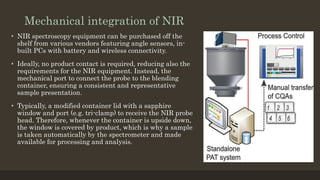
Mechanical integration of NIR
• NIR spectroscopy equipment can be purchased off the
shelf from various vendors featuring angle sensors, in-
built PCs with battery and wireless connectivity.
• Ideally, no product contact is required, reducing also the
requirements for the NIR equipment. Instead, the
mechanical port to connect the probe to the blending
container, ensuring a consistent and representative
sample presentation.
• Typically, a modified container lid with a sapphire
window and port (e.g. tri-clamp) to receive the NIR probe
head. Therefore, whenever the container is upside down,
the window is covered by product, which is why a sample
is taken automatically by the spectrometer and made
available for processing and analysis.
Software Integration and Data Processing
• In contrast to the selection of the analyzer
hardware and mechanical integration, the
data processing and software integration
implies a much higher customization. But
the raw data processing and MVA to extract
the CQAs can be separated from the
technical software integration.
• With a drug substance, for example, reactants A and B are combined to form product
C. The process is monitored for the disappearance of reactants A and B, and the
formation of product C and potential by products.
In traditional approaches, samples are periodically taken from the reactor, and brought to the
testing lab. The samples are often analyzed by chromatography, where the individual
components are separated from each other (in a time-dependent fashion) and quantified
individually ( This approach is analogous to “taking several snapshots, over time.”
In a PAT approach, for example, the analysis technique is interfaced with the reactor for real-
time analysis. Spectroscopic methods are often used, wherein a specific reactant, product, or by
product molecular functional group characteristic (such as vibrational frequency or photon
scatter frequency) can be monitored over time for disappearance (reactant) or appearance
(product or by product). This approach is analogous to “recording video.”
PAT regulatory approach
• Close communication between the manufacturer and the Agency’s PAT review and
inspection staff will be a key component in this approach.
• In general, PAT implementation plans should be risk based. FDA proposed the
following possible implementation plans, where appropriate:
• PAT can be implemented under the facility's own quality system. CGMP inspections
by the PAT Team or PAT certified Investigator can precede or follow PAT
implementation.
• A supplement (CBE, CBE-30 or PAS) can be submitted to the Agency prior to
implementation, and, if necessary, an inspection can be performed by a PAT Team or
PAT certified Investigator before implementation.
• A comparability protocol can be submitted to the Agency outlining PAT research,
validation and implementation strategies, and time lines. Following approval of this
comparability protocol by the Agency, one or a combination of the above regulatory
pathways can be adopted for implementation
Benefits from PAT
• In Pharmaceutical R&D
• A deeper scientific and engineering understanding of manufacturing processes
• Reduced product development times, more robust licensing packages, faster scale up,
and faster Time-to market for new products.
• Implementation of innovative manufacturing and quality strategies
In Pharmaceutical Manufacturing
• Reduced waste, right-first-time manufacturing, higher production asset utilization
• Real-time quality assurance and validation
• Movement toward real-time release of products
• Lean manufacturing practices for reduced raw material, work-in-progress, and
finished goods Inventories
• More robust product supply to the public
Reference
• http://globalresearchonline.net/journalcontents/v37-2/10.pdf
• http://www.ecv.de/suse_print.php?id=Z|tp|743
• Guidance for Industry PAT — A Framework for Innovative Pharmaceutical
Development, Manufacturing, and Quality Assurance.
Process analytical technology

Process analytical technology

  • 1.
  • 2.
    Process analytical technology—It’snot rocket science, but it is science, math, control, and IT
  • 3.
    Definition • According toFDA, Process Analytical Technology (PAT) is a system for designing, analysing, and controlling manufacturing process through timely measurements of critical quality and performance attributes of raw materials, in-process materials and processes with the goal of ensuring final product quality.
  • 4.
    • Process AnalyticalTechnology or PAT, is intended to support innovation and efficiency in pharmaceutical development, manufacturing, and quality assurance. • Unfortunately, the pharmaceutical industry generally has been hesitant to introduce innovative systems into the manufacturing sector for a number of reasons. • One reason often cited is regulatory uncertainty, which may result from the perception that our existing regulatory system is rigid and unfavourable to the introduction of innovative systems.
  • 5.
    • The frameworkis founded on process understanding to facilitate innovation and risk-based regulatory decisions by industry and the Agency. • The framework has two components: (1) A set of scientific principles and tools supporting innovation (2) A strategy for regulatory implementation that will accommodate innovation
  • 6.
    • The goalof PAT is to enhance understanding and control the manufacturing process, which is consistent with our current drug quality system: quality cannot be tested into products; it should be built-in or should be by design.
  • 7.
    • In 2004,the U.S. FDA published an aspirational guidance for industry on process analytical technology (PAT). Unfortunately, more than a decade later, the routine use of PAT in an integrated manner to design, measure, and control critical process quality and performance attributes through timely and appropriate measurements remains largely unrealized across the pharmaceutical industry. • The “PAT umbrella” comprises a broad suite of tools, including analytical, chemical, physical, microbiological, mathematical, and risk analysis.
  • 8.
    Understanding PAT! • Withsolid oral drug products, for example, excipients and the drug substance are blended until they are uniform. This is done to ensure, to the individual tablet, composition is consistent. In traditional approaches, blend samples are taken in various positions in the blender to determine if the composition is homogeneous throughout. The act of blend sampling itself, though, may sometimes cause segregation within the sample and result in analysis bias. In a PAT approach, a spectrometer is attached to the blender and spectra are acquired in real time to monitor the mixing. Once the spectra do not change any further, the blend is considered homogeneous.
  • 9.
    Current blending process •The CQA determined in laboratory are API content% and homogenecity • Manual processing and analysis in laboratory implies a risk for HUMAN ERRORS
  • 10.
    PAT approach • UsingPAT based on NIR spectroscopy , in-process assessment of CQA (API content and homogenicity) replaces the manual sampling and laboratory analysis • Thus not only the human factor is removed ,but CQA are acquired instantaneously during the manufacturing process • For success implantation technical issues to be resolved • It also requires validation
  • 11.
    Mechanical integration ofNIR • NIR spectroscopy equipment can be purchased off the shelf from various vendors featuring angle sensors, in- built PCs with battery and wireless connectivity. • Ideally, no product contact is required, reducing also the requirements for the NIR equipment. Instead, the mechanical port to connect the probe to the blending container, ensuring a consistent and representative sample presentation. • Typically, a modified container lid with a sapphire window and port (e.g. tri-clamp) to receive the NIR probe head. Therefore, whenever the container is upside down, the window is covered by product, which is why a sample is taken automatically by the spectrometer and made available for processing and analysis.
  • 12.
    Software Integration andData Processing • In contrast to the selection of the analyzer hardware and mechanical integration, the data processing and software integration implies a much higher customization. But the raw data processing and MVA to extract the CQAs can be separated from the technical software integration.
  • 14.
    • With adrug substance, for example, reactants A and B are combined to form product C. The process is monitored for the disappearance of reactants A and B, and the formation of product C and potential by products. In traditional approaches, samples are periodically taken from the reactor, and brought to the testing lab. The samples are often analyzed by chromatography, where the individual components are separated from each other (in a time-dependent fashion) and quantified individually ( This approach is analogous to “taking several snapshots, over time.” In a PAT approach, for example, the analysis technique is interfaced with the reactor for real- time analysis. Spectroscopic methods are often used, wherein a specific reactant, product, or by product molecular functional group characteristic (such as vibrational frequency or photon scatter frequency) can be monitored over time for disappearance (reactant) or appearance (product or by product). This approach is analogous to “recording video.”
  • 18.
    PAT regulatory approach •Close communication between the manufacturer and the Agency’s PAT review and inspection staff will be a key component in this approach. • In general, PAT implementation plans should be risk based. FDA proposed the following possible implementation plans, where appropriate: • PAT can be implemented under the facility's own quality system. CGMP inspections by the PAT Team or PAT certified Investigator can precede or follow PAT implementation. • A supplement (CBE, CBE-30 or PAS) can be submitted to the Agency prior to implementation, and, if necessary, an inspection can be performed by a PAT Team or PAT certified Investigator before implementation. • A comparability protocol can be submitted to the Agency outlining PAT research, validation and implementation strategies, and time lines. Following approval of this comparability protocol by the Agency, one or a combination of the above regulatory pathways can be adopted for implementation
  • 19.
    Benefits from PAT •In Pharmaceutical R&D • A deeper scientific and engineering understanding of manufacturing processes • Reduced product development times, more robust licensing packages, faster scale up, and faster Time-to market for new products. • Implementation of innovative manufacturing and quality strategies
  • 20.
    In Pharmaceutical Manufacturing •Reduced waste, right-first-time manufacturing, higher production asset utilization • Real-time quality assurance and validation • Movement toward real-time release of products • Lean manufacturing practices for reduced raw material, work-in-progress, and finished goods Inventories • More robust product supply to the public
  • 21.
    Reference • http://globalresearchonline.net/journalcontents/v37-2/10.pdf • http://www.ecv.de/suse_print.php?id=Z|tp|743 •Guidance for Industry PAT — A Framework for Innovative Pharmaceutical Development, Manufacturing, and Quality Assurance.