FACTORS AFFECTING MICROBIAL
GROWTH-
SALT CONCENTRATION
Ms Saajida Sultaaana Mahusook
• Sodium chloride (NaCl) is a nutrient that affects different
organisms in different ways.
• Obligate halophiles, are organisms which require salt to
survive and will lyse, or break open, if the salt level drops
to a low level.
• Halotolerant, organisms are those which don’t need salt
to survive but can tolerate moderately salty environments.
• Halophiles belong to a larger group called extremophiles
who thrive under extreme conditions.
• Slight halophiles thrive in environments that contain 1 - 6
% salt.
• Moderate halophiles prefer 6 - 15 % salt.
• Extreme halophiles enjoy the saltiest environments of all
at 15 - 30 % salt.
• Scientists use these categories to prepare culture medium
perfectly suited for the organisms they want to grow.
• Halotolerant organisms prefer salt-free environments but
can survive at slight or moderate salt levels.
• For non-halophiles, salt can be deadly. When scientists
want to inhibit the growth of non-halophiles in the
laboratory, they include salt in the culture medium to
prevent non-halophiles from growing. This is called a
selective medium.
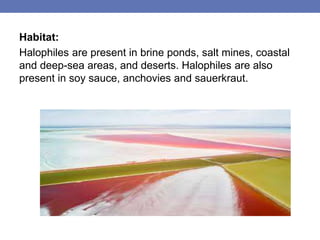
Habitat:
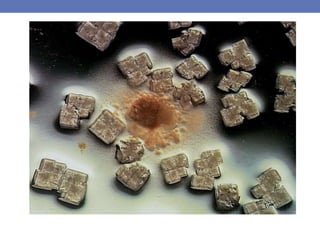
Halophiles are present in brine ponds, salt mines, coastal
and deep-sea areas, and deserts. Halophiles are also
present in soy sauce, anchovies and sauerkraut.
Mechanisms for Saline Resistance
Compatible Solutes
• One mechanism halophiles use to survive in high concentrations of
salt is the synthesis of osmoprotectants, which are also known as
compatible solutes.
• Compatible solutes are small-molecular weight molecules present in
microorganisms namely trehalose, glycine betaine and α-glutamate,
while others are restricted to a few organisms.
• These work by balancing the internal osmotic pressure with the
external osmotic pressure, making the two solutions isotonic, or close
to it.
Potassium Control
• This mechanism is performed by pumping in large amounts of K+
ions into the cytoplasm.
Applications:
• Halophilic bacteria have been found to perform
fermentation, acetogenesis, sulfate reduction,
phototrophy, and methanogenesis.
• Reference:
https://sciencing.com/effects-salt-concentration-bacterial-
growth-5924409.html
https://microbewiki.kenyon.edu/index.php/Halophiles
FACTORS AFFECTING MICROBIAL GROWTH-SALT CONCENTRATION

FACTORS AFFECTING MICROBIAL GROWTH-SALT CONCENTRATION

  • 1.
    FACTORS AFFECTING MICROBIAL GROWTH- SALTCONCENTRATION Ms Saajida Sultaaana Mahusook
  • 2.
    • Sodium chloride(NaCl) is a nutrient that affects different organisms in different ways. • Obligate halophiles, are organisms which require salt to survive and will lyse, or break open, if the salt level drops to a low level. • Halotolerant, organisms are those which don’t need salt to survive but can tolerate moderately salty environments. • Halophiles belong to a larger group called extremophiles who thrive under extreme conditions.
  • 4.
    • Slight halophilesthrive in environments that contain 1 - 6 % salt. • Moderate halophiles prefer 6 - 15 % salt. • Extreme halophiles enjoy the saltiest environments of all at 15 - 30 % salt. • Scientists use these categories to prepare culture medium perfectly suited for the organisms they want to grow. • Halotolerant organisms prefer salt-free environments but can survive at slight or moderate salt levels. • For non-halophiles, salt can be deadly. When scientists want to inhibit the growth of non-halophiles in the laboratory, they include salt in the culture medium to prevent non-halophiles from growing. This is called a selective medium.
  • 5.
    Habitat: Halophiles are presentin brine ponds, salt mines, coastal and deep-sea areas, and deserts. Halophiles are also present in soy sauce, anchovies and sauerkraut.
  • 6.
    Mechanisms for SalineResistance Compatible Solutes • One mechanism halophiles use to survive in high concentrations of salt is the synthesis of osmoprotectants, which are also known as compatible solutes. • Compatible solutes are small-molecular weight molecules present in microorganisms namely trehalose, glycine betaine and α-glutamate, while others are restricted to a few organisms. • These work by balancing the internal osmotic pressure with the external osmotic pressure, making the two solutions isotonic, or close to it. Potassium Control • This mechanism is performed by pumping in large amounts of K+ ions into the cytoplasm.
  • 7.
    Applications: • Halophilic bacteriahave been found to perform fermentation, acetogenesis, sulfate reduction, phototrophy, and methanogenesis.
  • 8.