1-1
Factors Affecting marketing
By Dr.G.Rajamani
Assistant Professor of BCOM-A&F
SRCAS
1-2
After studying this chapter you
should be able to:
• Understand the different characteristics
of a product mix.
• Recognize the stages and
characteristics of the product life cycle.
• Identify appropriate marketing strategies
for products in different life cycle stages.
1-3
• Describe the limitations of the product
life cycle concept.
• Discuss different product-mix and
product-line strategies.
After studying this chapter you
should be able to:
1-4
Product Mix
• Product Mix:
– The total assortment of products
and services marketed by a firm.
• Product Line:
– A group of individual products that
are closely related in some way.
• Individual Product:
– Any brand or variant of a brand in
a product line.
1-5
Product Mix Characteristics
• Product Mix Width:
– The number of product lines in the
product mix.
• Product Line Length:
– The number of products in a
product line.
• Product Mix Consistency:
– The relatedness of the different
product lines in a product mix.
1-6
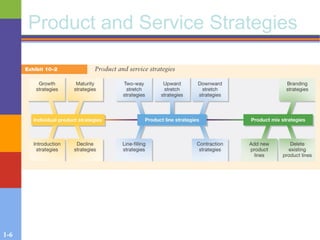
Product and Service Strategies
1-7
Individual Product Strategies
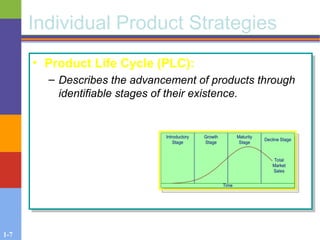
• Product Life Cycle (PLC):
– Describes the advancement of products through
identifiable stages of their existence.
Introductory
Stage
Growth
Stage
Maturity
Stage
Decline Stage
Total
Market
Sales
Time
1-8
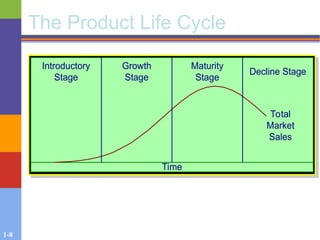
The Product Life Cycle
Introductory
Stage
Growth
Stage
Maturity
Stage
Decline Stage
Total
Market
Sales
Time
1-9
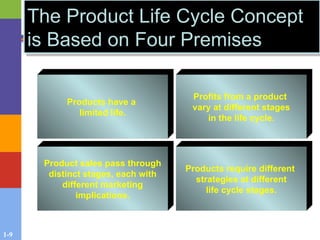
The Product Life Cycle Concept
is Based on Four Premises
Products have a
limited life.
Product sales pass through
distinct stages, each with
different marketing
implications.
Profits from a product
vary at different stages
in the life cycle.
Products require different
strategies at different
life cycle stages.
1-10
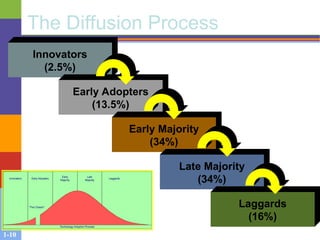
The Diffusion Process
Innovators
(2.5%)
Early Adopters
(13.5%)
Early Majority
(34%)
Late Majority
(34%)
Laggards
(16%)
Laggards
Late
Majority
Early
Majority
Early Adopters
Innovators
"The Chasm"
Technology Adoption Process
1-11
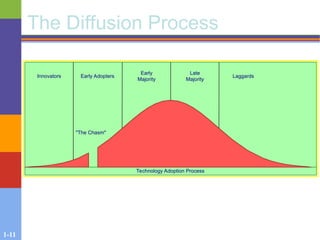
The Diffusion Process
Laggards
Late
Majority
Early
Majority
Early Adopters
Innovators
"The Chasm"
Technology Adoption Process
1-12
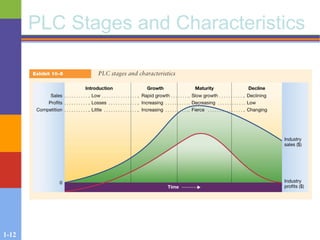
PLC Stages and Characteristics
1-13
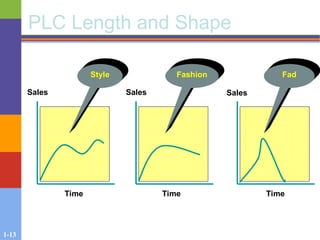
PLC Length and Shape
Sales Sales Sales
Time
Time Time
Style Fashion Fad
1-14
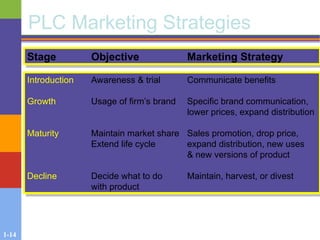
PLC Marketing Strategies
Stage Objective Marketing Strategy
Introduction Awareness & trial Communicate benefits
Growth Usage of firm’s brand Specific brand communication,
lower prices, expand distribution
Maturity Maintain market share Sales promotion, drop price,
Extend life cycle expand distribution, new uses
& new versions of product
Decline Decide what to do Maintain, harvest, or divest
with product
1-15
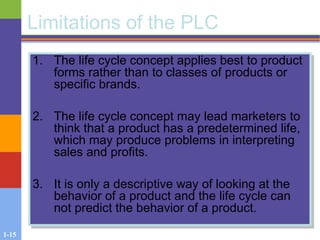
Limitations of the PLC
1. The life cycle concept applies best to product
forms rather than to classes of products or
specific brands.
2. The life cycle concept may lead marketers to
think that a product has a predetermined life,
which may produce problems in interpreting
sales and profits.
3. It is only a descriptive way of looking at the
behavior of a product and the life cycle can
not predict the behavior of a product.
1-16
Product-Line Strategies
• Strategic Alternatives:
1. To increase the length of a
product line.
2. To decrease the length of a
product line.
1-17
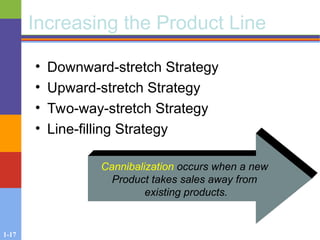
Increasing the Product Line
• Downward-stretch Strategy
• Upward-stretch Strategy
• Two-way-stretch Strategy
• Line-filling Strategy
Cannibalization occurs when a new
Product takes sales away from
existing products.
1-18
Decreasing the Product Line
• Product Line Contraction:
– Firms must consider deleting products
when:
• They are not successful.
• They reach the decline stage of PLC.
• Long product line marketing costs are
too high.
1-19
Product-Mix Strategies
The Product Mix consists of all
product lines and individual products
marketed by the firm.
1-20
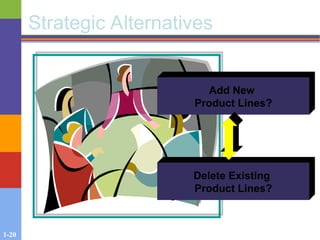
Strategic Alternatives
Add New
Product Lines?
Delete Existing
Product Lines?
1-21
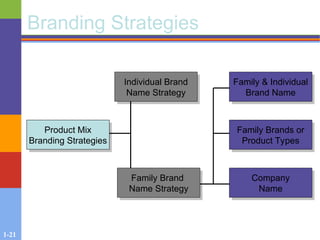
Branding Strategies
Product Mix
Branding Strategies
Family Brand
Name Strategy
Individual Brand
Name Strategy
Company
Name
Family Brands or
Product Types
Family & Individual
Brand Name
1-22
Ethical Issues in Product and
Service Strategies
• Is the product safe when
used as intended?
• Is the product safe when
misused in a way that is
foreseeable?
• Have any competitors’
patents or copyrights
been violated?
1-23
Ethical Issues in Product and
Service Strategies
• Is the product compatible with the
physical environment?
• Is the product environmentally
compatible when disposed of?
• Do any organizational
stakeholders object to the
product?

Factors Affecting marketing management.ppt

  • 1.
    1-1 Factors Affecting marketing ByDr.G.Rajamani Assistant Professor of BCOM-A&F SRCAS
  • 2.
    1-2 After studying thischapter you should be able to: • Understand the different characteristics of a product mix. • Recognize the stages and characteristics of the product life cycle. • Identify appropriate marketing strategies for products in different life cycle stages.
  • 3.
    1-3 • Describe thelimitations of the product life cycle concept. • Discuss different product-mix and product-line strategies. After studying this chapter you should be able to:
  • 4.
    1-4 Product Mix • ProductMix: – The total assortment of products and services marketed by a firm. • Product Line: – A group of individual products that are closely related in some way. • Individual Product: – Any brand or variant of a brand in a product line.
  • 5.
    1-5 Product Mix Characteristics •Product Mix Width: – The number of product lines in the product mix. • Product Line Length: – The number of products in a product line. • Product Mix Consistency: – The relatedness of the different product lines in a product mix.
  • 6.
  • 7.
    1-7 Individual Product Strategies •Product Life Cycle (PLC): – Describes the advancement of products through identifiable stages of their existence. Introductory Stage Growth Stage Maturity Stage Decline Stage Total Market Sales Time
  • 8.
    1-8 The Product LifeCycle Introductory Stage Growth Stage Maturity Stage Decline Stage Total Market Sales Time
  • 9.
    1-9 The Product LifeCycle Concept is Based on Four Premises Products have a limited life. Product sales pass through distinct stages, each with different marketing implications. Profits from a product vary at different stages in the life cycle. Products require different strategies at different life cycle stages.
  • 10.
    1-10 The Diffusion Process Innovators (2.5%) EarlyAdopters (13.5%) Early Majority (34%) Late Majority (34%) Laggards (16%) Laggards Late Majority Early Majority Early Adopters Innovators "The Chasm" Technology Adoption Process
  • 11.
    1-11 The Diffusion Process Laggards Late Majority Early Majority EarlyAdopters Innovators "The Chasm" Technology Adoption Process
  • 12.
    1-12 PLC Stages andCharacteristics
  • 13.
    1-13 PLC Length andShape Sales Sales Sales Time Time Time Style Fashion Fad
  • 14.
    1-14 PLC Marketing Strategies StageObjective Marketing Strategy Introduction Awareness & trial Communicate benefits Growth Usage of firm’s brand Specific brand communication, lower prices, expand distribution Maturity Maintain market share Sales promotion, drop price, Extend life cycle expand distribution, new uses & new versions of product Decline Decide what to do Maintain, harvest, or divest with product
  • 15.
    1-15 Limitations of thePLC 1. The life cycle concept applies best to product forms rather than to classes of products or specific brands. 2. The life cycle concept may lead marketers to think that a product has a predetermined life, which may produce problems in interpreting sales and profits. 3. It is only a descriptive way of looking at the behavior of a product and the life cycle can not predict the behavior of a product.
  • 16.
    1-16 Product-Line Strategies • StrategicAlternatives: 1. To increase the length of a product line. 2. To decrease the length of a product line.
  • 17.
    1-17 Increasing the ProductLine • Downward-stretch Strategy • Upward-stretch Strategy • Two-way-stretch Strategy • Line-filling Strategy Cannibalization occurs when a new Product takes sales away from existing products.
  • 18.
    1-18 Decreasing the ProductLine • Product Line Contraction: – Firms must consider deleting products when: • They are not successful. • They reach the decline stage of PLC. • Long product line marketing costs are too high.
  • 19.
    1-19 Product-Mix Strategies The ProductMix consists of all product lines and individual products marketed by the firm.
  • 20.
    1-20 Strategic Alternatives Add New ProductLines? Delete Existing Product Lines?
  • 21.
    1-21 Branding Strategies Product Mix BrandingStrategies Family Brand Name Strategy Individual Brand Name Strategy Company Name Family Brands or Product Types Family & Individual Brand Name
  • 22.
    1-22 Ethical Issues inProduct and Service Strategies • Is the product safe when used as intended? • Is the product safe when misused in a way that is foreseeable? • Have any competitors’ patents or copyrights been violated?
  • 23.
    1-23 Ethical Issues inProduct and Service Strategies • Is the product compatible with the physical environment? • Is the product environmentally compatible when disposed of? • Do any organizational stakeholders object to the product?