Income Statement:
Management Accounting
Thispresentation explores the income statement. We'll examine it from
a management accounting view. Join us as we decode financial
performance. Learn strategic decision-making insights.
by Dr.Rajamani G
Assistant Professor of BCOM-A&F
SRCAS
2.
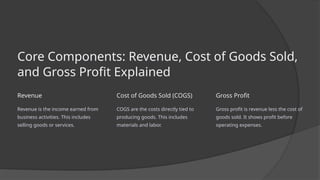
Core Components: Revenue,Cost of Goods Sold,
and Gross Profit Explained
Revenue
Revenue is the income earned from
business activities. This includes
selling goods or services.
Cost of Goods Sold (COGS)
COGS are the costs directly tied to
producing goods. This includes
materials and labor.
Gross Profit
Gross profit is revenue less the cost of
goods sold. It shows profit before
operating expenses.
3.
Diving Deeper: Operating
Expensesand Income
Operating Expenses
These are costs to run the
business day-to-day. This
includes salaries, rent, and
marketing.
Operating Income
Operating income is gross
profit minus operating
expenses. It reflects profit
from core operations.
EBIT
Earnings Before Interest and Taxes, a metric often used instead of
Operating Income.
4.
Non-Operating Activities:
Interest, Taxes,and Net
Income
Interest Expense
The cost of borrowing money.
Income Taxes
Taxes based on taxable income.
Net Income
The bottom line after all expenses. Revenue less all
expenses.
5.
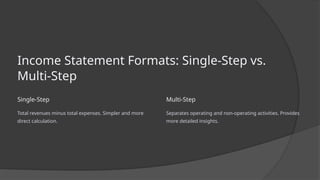
Income Statement Formats:Single-Step vs.
Multi-Step
Single-Step
Total revenues minus total expenses. Simpler and more
direct calculation.
Multi-Step
Separates operating and non-operating activities. Provides
more detailed insights.
6.
Importance of theIncome
Statement: Key
Performance Indicators
(KPIs) for Management
Profit Margins
How much profit is
generated per dollar
of revenue.
Revenue Growth
The rate at which
revenue is increasing
over time.
Expense Ratio
How much of revenue
is consumed by
expenses.
7.
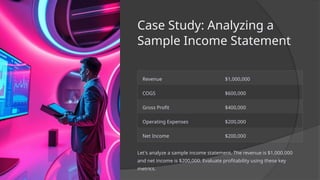
Case Study: Analyzinga
Sample Income Statement
Revenue $1,000,000
COGS $600,000
Gross Profit $400,000
Operating Expenses $200,000
Net Income $200,000
Let's analyze a sample income statement. The revenue is $1,000,000
and net income is $200,000. Evaluate profitability using these key
metrics.
8.
Conclusion: Using the
IncomeStatement for
Strategic Decision-Making
1 Performance
Evaluation
Assess company financial
health and profitability.
2 Trend Analysis
Identify patterns and
growth opportunities.
3 Resource Allocation
Make informed decisions about investments.