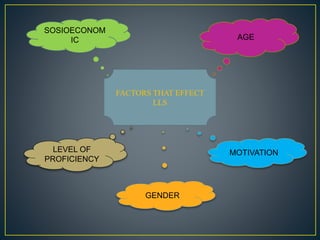
FACTORS THAT EFFECT
LLS
SOSIOECONOM
IC
GENDER
LEVEL OF
PROFICIENCY
MOTIVATION
AGE
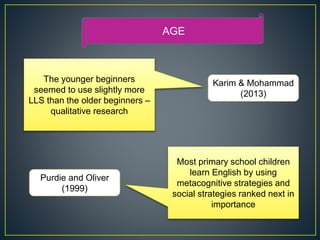
AGE
The younger beginners
seemed to use slightly more
LLS than the older beginners –
qualitative research
Most primary school children
learn English by using
metacognitive strategies and
social strategies ranked next in
importance
Karim & Mohammad
(2013)
Purdie and Oliver
(1999)
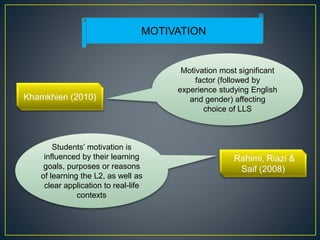
MOTIVATION
Motivation most significant
factor (followed by
experience studying English
and gender) affecting
choice of LLS
Students’ motivation is
influenced by their learning
goals, purposes or reasons
of learning the L2, as well as
clear application to real-life
contexts
Rahimi, Riazi &
Saif (2008)
Khamkhien (2010)
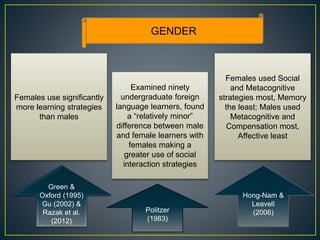
GENDER
Females use significantly
more learning strategies
than males
Females used Social
and Metacognitive
strategies most, Memory
the least; Males used
Metacognitive and
Compensation most,
Affective least
Examined ninety
undergraduate foreign
language learners, found
a “relatively minor”
difference between male
and female learners with
females making a
greater use of social
interaction strategies
Green &
Oxford (1995)
Gu (2002) &
Razak et al.
(2012)
Politzer
(1983)
Hong-Nam &
Leavell
(2006)
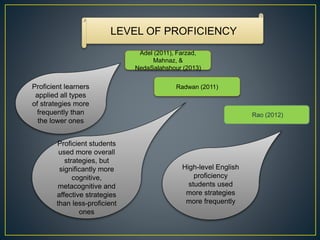
LEVEL OF PROFICIENCY
Proficient learners
applied all types
of strategies more
frequently than
the lower ones
Adel (2011), Farzad,
Mahnaz, &
NedaSalahshour (2013)
Proficient students
used more overall
strategies, but
significantly more
cognitive,
metacognitive and
affective strategies
than less-proficient
ones
Radwan (2011)
High-level English
proficiency
students used
more strategies
more frequently
Rao (2012)
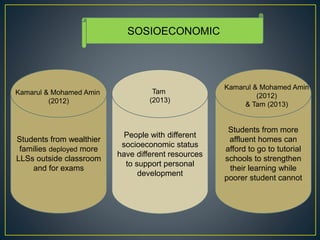
SOSIOECONOMIC
Students from wealthier
families deployed more
LLSs outside classroom
and for exams
Kamarul & Mohamed Amin
(2012)
People with different
socioeconomic status
have different resources
to support personal
development
Students from more
affluent homes can
afford to go to tutorial
schools to strengthen
their learning while
poorer student cannot
Tam
(2013)
Kamarul & Mohamed Amin
(2012)
& Tam (2013)
Adel, A. R. 2011. Effects of L2 proficiency and gender on choice of language
learning strategies by university students majoring in English. The Asian EFL
Journal Quarterly. 13 (1), 114-162. From http://www.asian-efl-
journal.com/PDF/March-2011.pdf#page=114 [March 25, 2014].
Hong-Nam, K. & Leavell, A.G. 2006. Language learning strategy use of ESL
students in an intensive Eng-lish learning context. System 34: 399–415
Kamarul Shukri Mat Teh & Mohamed Amin Embi. 2012. Variasi Penggunaan
Strategi Pembelajaran Bahasa. Dlm. Strategi Pembelajaran Bahasa, hlm. 79-
105. Kuala Lumpur: Penerbit Universiti Malaya
Karim Sadeghi & Mohammad Taghi Attar. 2013. The relationship between learning
strategy use and starting age of learning EFL. Procedia-Social and Behavioural
Sciences 70. 387- 396. From http://ac.els-cdn.com/S1877042813000773/1-s2.0-
S1877042813000773- main.pdf?_tid=36c013ce-b0a5-11e3-8861-
00000aab0f6b&acdnat=1395371118_c98afd0973232170bc0f6378edcf21d0
[March 20, 2014]
REFERENCES
Khamkhien, A. 2010. Factors affecting language learning strategy reported usage
by Thai and Vietnamese EFL students. Electronic Journal of Foreign Language
Teaching. 7(1), 66- 85. From http://e-flt.nus.edu.sg/v7n12010/khamkhien.pdf
[March 20, 2014]
Mohammad Rahimi, Abdolmehdi Riazi & Shahrzad Saif. 2008. An investigation into
the factors affecting the use of language learning strategies by Persian EFL
learners. Canadian Journal of Applied Linguistics (CJAL). 11(2), 31-60. From
http://journals.hil.unb.ca/index.php/CJAL/article/view/19915/21770 [March 20,
2014]
Paul, P. 2011. Use of language learning strategies: an investigation of the use
pattern of language learning strategies of Bangladeshi learners and its
correlation with the proficiency level. Thesis submitted to the Department of
English and Humanities of BRAC University In partial fulfillment of the
requirements for the degree of Master of Arts in Applied Linguistics and ELT
Tam, K. C. 2013. A study on Language Learning Strategies (LLSs) of university
students in Hong Kong. Taiwan Journal of Linguistics, 11(2), 1-42. From
http://tjl.nccu.edu.tw/volume11- 2/11.2.1.pdf [March 26, 2014]
Disediakan untuk:
Prof. Dr. Mohamed Amin Embi
Disediakn oleh:
Adibah binti Arshad

Factor that effect LLS prepared by Adibah Arshad

  • 2.
  • 3.
    AGE The younger beginners seemedto use slightly more LLS than the older beginners – qualitative research Most primary school children learn English by using metacognitive strategies and social strategies ranked next in importance Karim & Mohammad (2013) Purdie and Oliver (1999)
  • 4.
    MOTIVATION Motivation most significant factor(followed by experience studying English and gender) affecting choice of LLS Students’ motivation is influenced by their learning goals, purposes or reasons of learning the L2, as well as clear application to real-life contexts Rahimi, Riazi & Saif (2008) Khamkhien (2010)
  • 5.
    GENDER Females use significantly morelearning strategies than males Females used Social and Metacognitive strategies most, Memory the least; Males used Metacognitive and Compensation most, Affective least Examined ninety undergraduate foreign language learners, found a “relatively minor” difference between male and female learners with females making a greater use of social interaction strategies Green & Oxford (1995) Gu (2002) & Razak et al. (2012) Politzer (1983) Hong-Nam & Leavell (2006)
  • 6.
    LEVEL OF PROFICIENCY Proficientlearners applied all types of strategies more frequently than the lower ones Adel (2011), Farzad, Mahnaz, & NedaSalahshour (2013) Proficient students used more overall strategies, but significantly more cognitive, metacognitive and affective strategies than less-proficient ones Radwan (2011) High-level English proficiency students used more strategies more frequently Rao (2012)
  • 7.
    SOSIOECONOMIC Students from wealthier familiesdeployed more LLSs outside classroom and for exams Kamarul & Mohamed Amin (2012) People with different socioeconomic status have different resources to support personal development Students from more affluent homes can afford to go to tutorial schools to strengthen their learning while poorer student cannot Tam (2013) Kamarul & Mohamed Amin (2012) & Tam (2013)
  • 8.
    Adel, A. R.2011. Effects of L2 proficiency and gender on choice of language learning strategies by university students majoring in English. The Asian EFL Journal Quarterly. 13 (1), 114-162. From http://www.asian-efl- journal.com/PDF/March-2011.pdf#page=114 [March 25, 2014]. Hong-Nam, K. & Leavell, A.G. 2006. Language learning strategy use of ESL students in an intensive Eng-lish learning context. System 34: 399–415 Kamarul Shukri Mat Teh & Mohamed Amin Embi. 2012. Variasi Penggunaan Strategi Pembelajaran Bahasa. Dlm. Strategi Pembelajaran Bahasa, hlm. 79- 105. Kuala Lumpur: Penerbit Universiti Malaya Karim Sadeghi & Mohammad Taghi Attar. 2013. The relationship between learning strategy use and starting age of learning EFL. Procedia-Social and Behavioural Sciences 70. 387- 396. From http://ac.els-cdn.com/S1877042813000773/1-s2.0- S1877042813000773- main.pdf?_tid=36c013ce-b0a5-11e3-8861- 00000aab0f6b&acdnat=1395371118_c98afd0973232170bc0f6378edcf21d0 [March 20, 2014] REFERENCES
  • 9.
    Khamkhien, A. 2010.Factors affecting language learning strategy reported usage by Thai and Vietnamese EFL students. Electronic Journal of Foreign Language Teaching. 7(1), 66- 85. From http://e-flt.nus.edu.sg/v7n12010/khamkhien.pdf [March 20, 2014] Mohammad Rahimi, Abdolmehdi Riazi & Shahrzad Saif. 2008. An investigation into the factors affecting the use of language learning strategies by Persian EFL learners. Canadian Journal of Applied Linguistics (CJAL). 11(2), 31-60. From http://journals.hil.unb.ca/index.php/CJAL/article/view/19915/21770 [March 20, 2014] Paul, P. 2011. Use of language learning strategies: an investigation of the use pattern of language learning strategies of Bangladeshi learners and its correlation with the proficiency level. Thesis submitted to the Department of English and Humanities of BRAC University In partial fulfillment of the requirements for the degree of Master of Arts in Applied Linguistics and ELT Tam, K. C. 2013. A study on Language Learning Strategies (LLSs) of university students in Hong Kong. Taiwan Journal of Linguistics, 11(2), 1-42. From http://tjl.nccu.edu.tw/volume11- 2/11.2.1.pdf [March 26, 2014]
  • 10.
    Disediakan untuk: Prof. Dr.Mohamed Amin Embi Disediakn oleh: Adibah binti Arshad