CREDIT CARD
Use your
2
RESPONSIBLY
National Centre for Financial Education | 25
CREDIT CARDS
ARE A PARADOX.
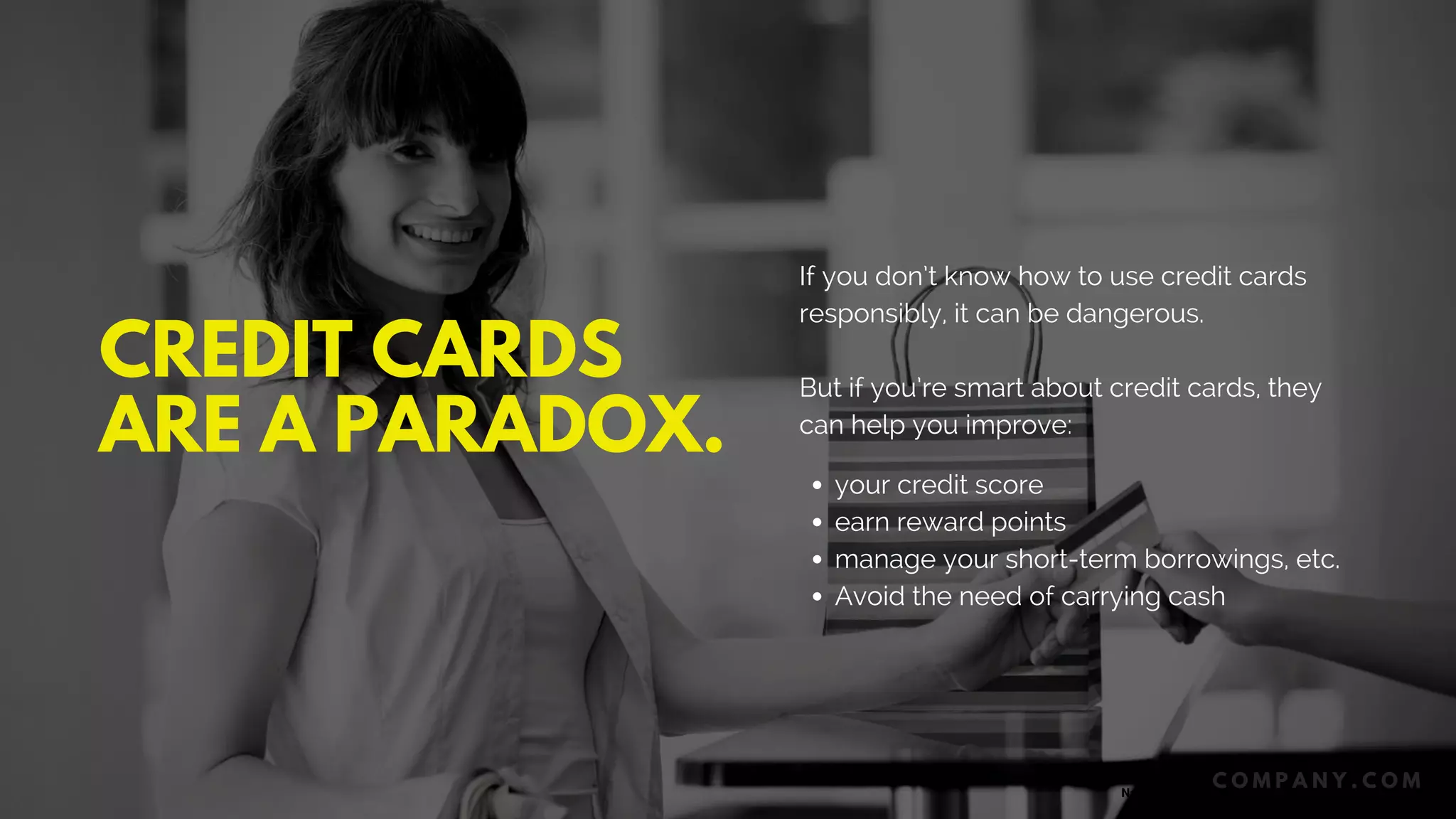
If you don’t know how to use credit cards
responsibly, it can be dangerous.
But if you’re smart about credit cards, they
can help you improve:
C O M P A N Y . C O M
your credit score
earn reward points
manage your short-term borrowings, etc.
Avoid the need of carrying cash 
National Centre for Financial Education | 26
CREDIT SCORE
Credit score shows the
creditworthiness of a person
and is the determining factor
for the approval of a loan or
credit card application.
National Centre for Financial Education | 27
YOUR LOAN
APPROVAL DEPENDS
ON YOUR CREDIT
SCORE.
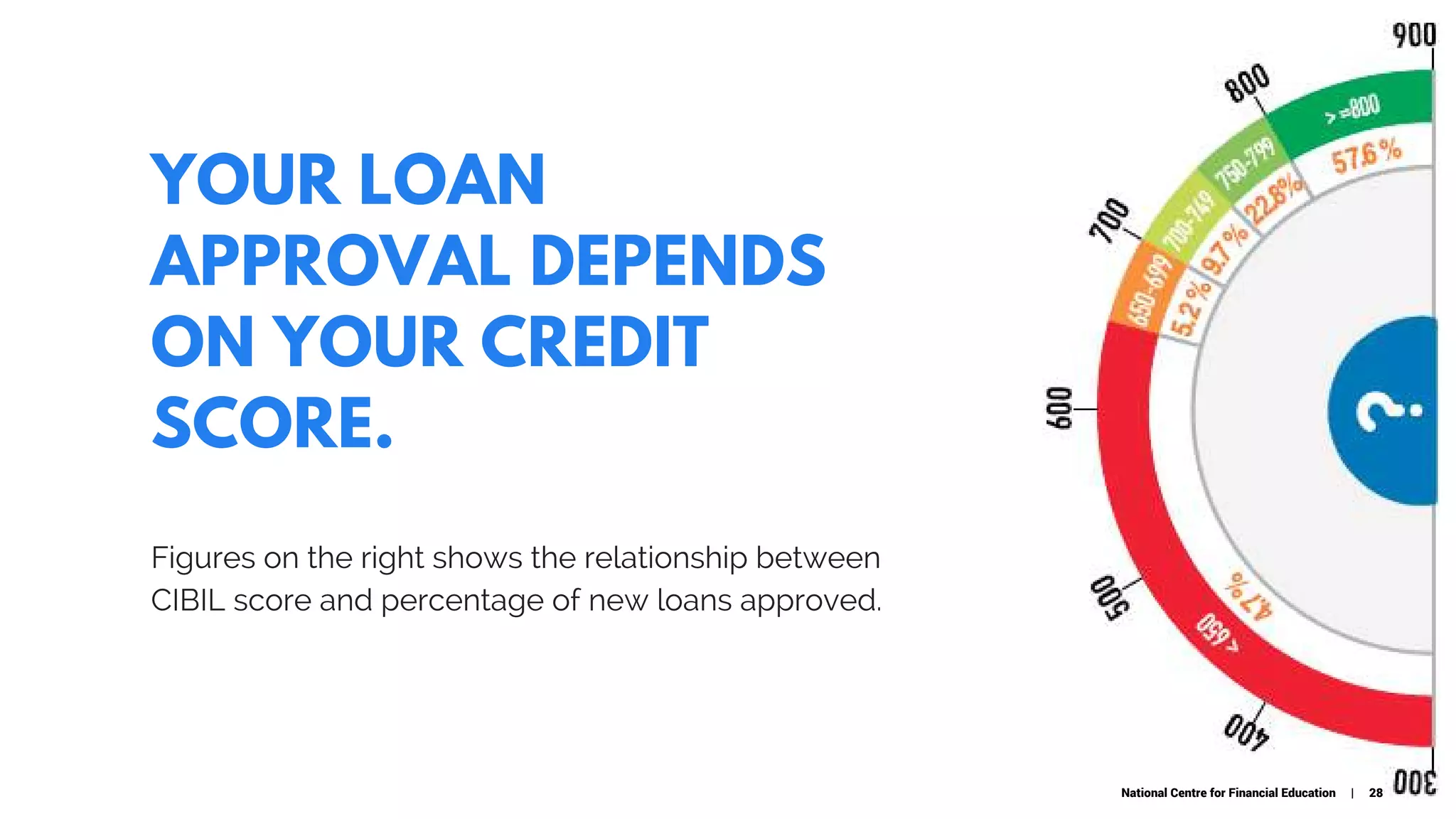
Figures on the right shows the relationship between
CIBIL score and percentage of new loans approved.
National Centre for Financial Education | 28
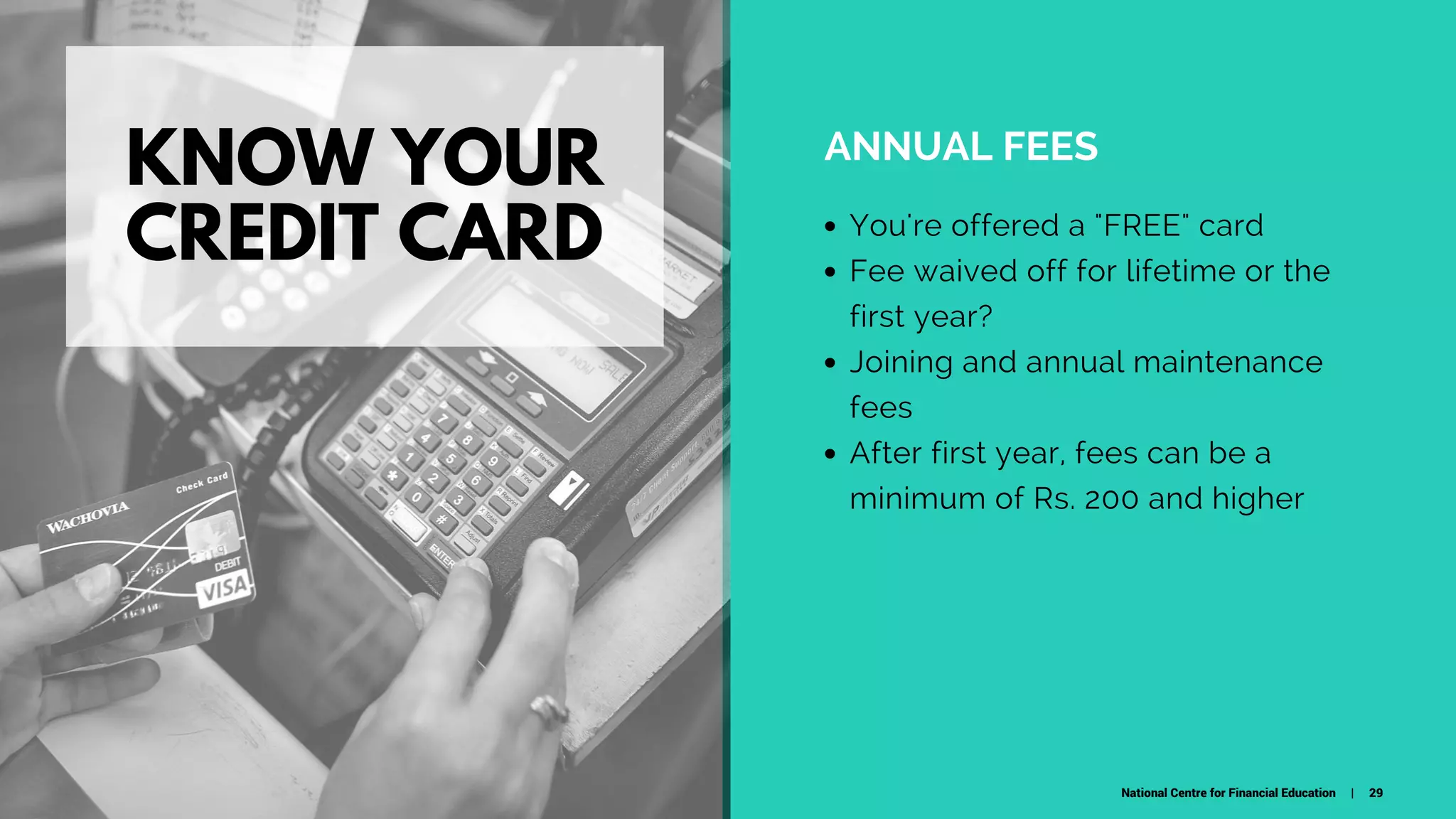
KNOW YOUR
CREDIT CARD
ANNUAL FEES
You're offered a "FREE" card
Fee waived off for lifetime or the
first year?
Joining and annual maintenance
fees
After first year, fees can be a
minimum of Rs. 200 and higher
National Centre for Financial Education | 29
KNOW YOUR
CREDIT CARD
INTEREST CHARGES
If outstanding bill is not paid within
due date
Monthly interest rate of 2 to 4
percent only
What is hidden is this rate is
annualized (24-48%)
 Understand APR (Annualized
Percentage Rate)
National Centre for Financial Education | 30
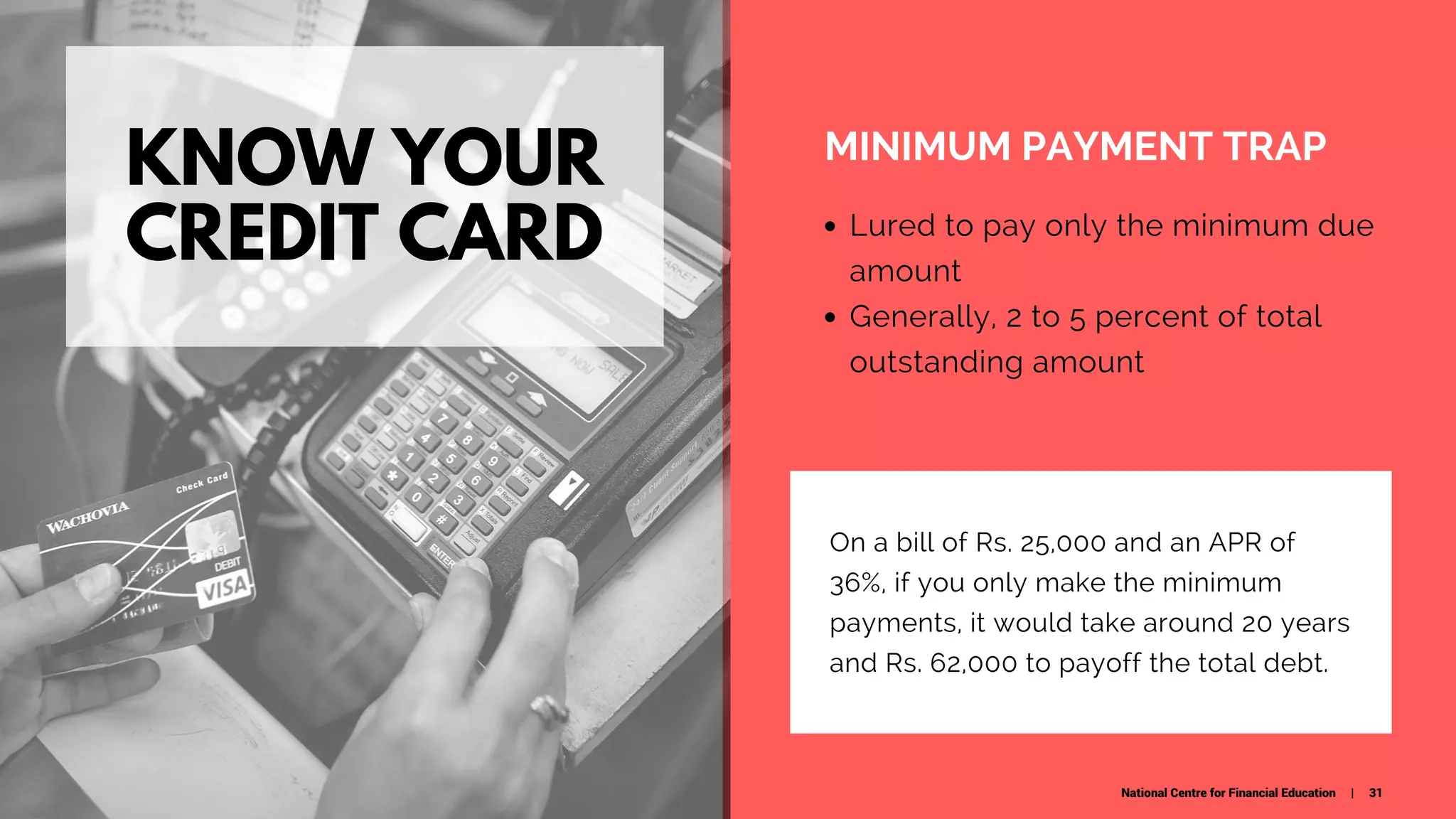
KNOW YOUR
CREDIT CARD
MINIMUM PAYMENT TRAP
Lured to pay only the minimum due
amount
Generally, 2 to 5 percent of total
outstanding amount
On a bill of Rs. 25,000 and an APR of
36%, if you only make the minimum
payments, it would take around 20 years
and Rs. 62,000 to payoff the total debt.
National Centre for Financial Education | 31
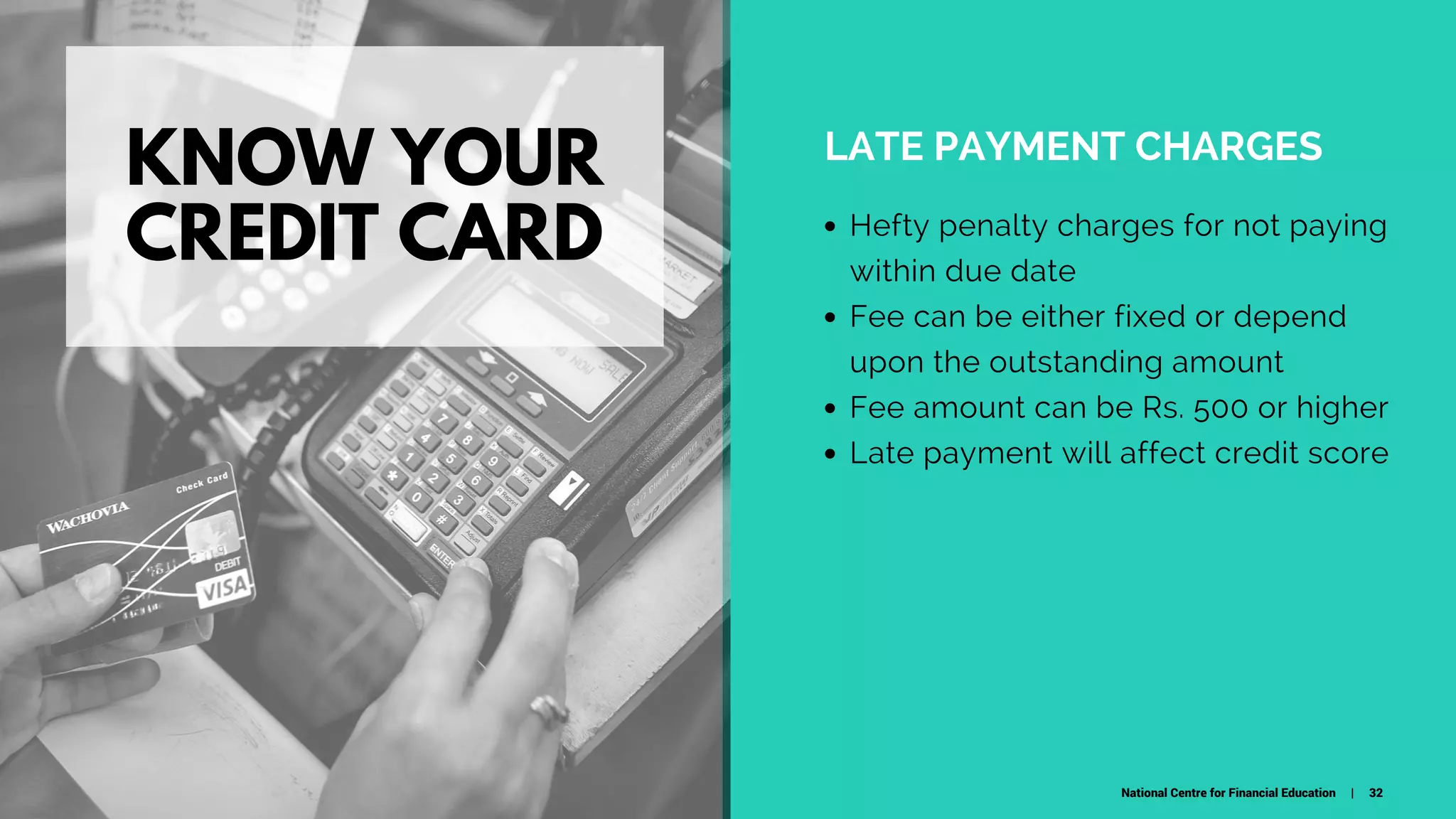
KNOW YOUR
CREDIT CARD
LATE PAYMENT CHARGES
Hefty penalty charges for not paying
within due date
Fee can be either fixed or depend
upon the outstanding amount
Fee amount can be Rs. 500 or higher
Late payment will affect credit score
National Centre for Financial Education | 32
KNOW YOUR
CREDIT CARD
CASH WITHDRAWAL 
Withdrawing cash from ATM has
both interest charges and a fee
Interest is charged from day 1
Fee is typically  Rs. 300 fixed or 2.5
percent whichever is higher
National Centre for Financial Education | 33
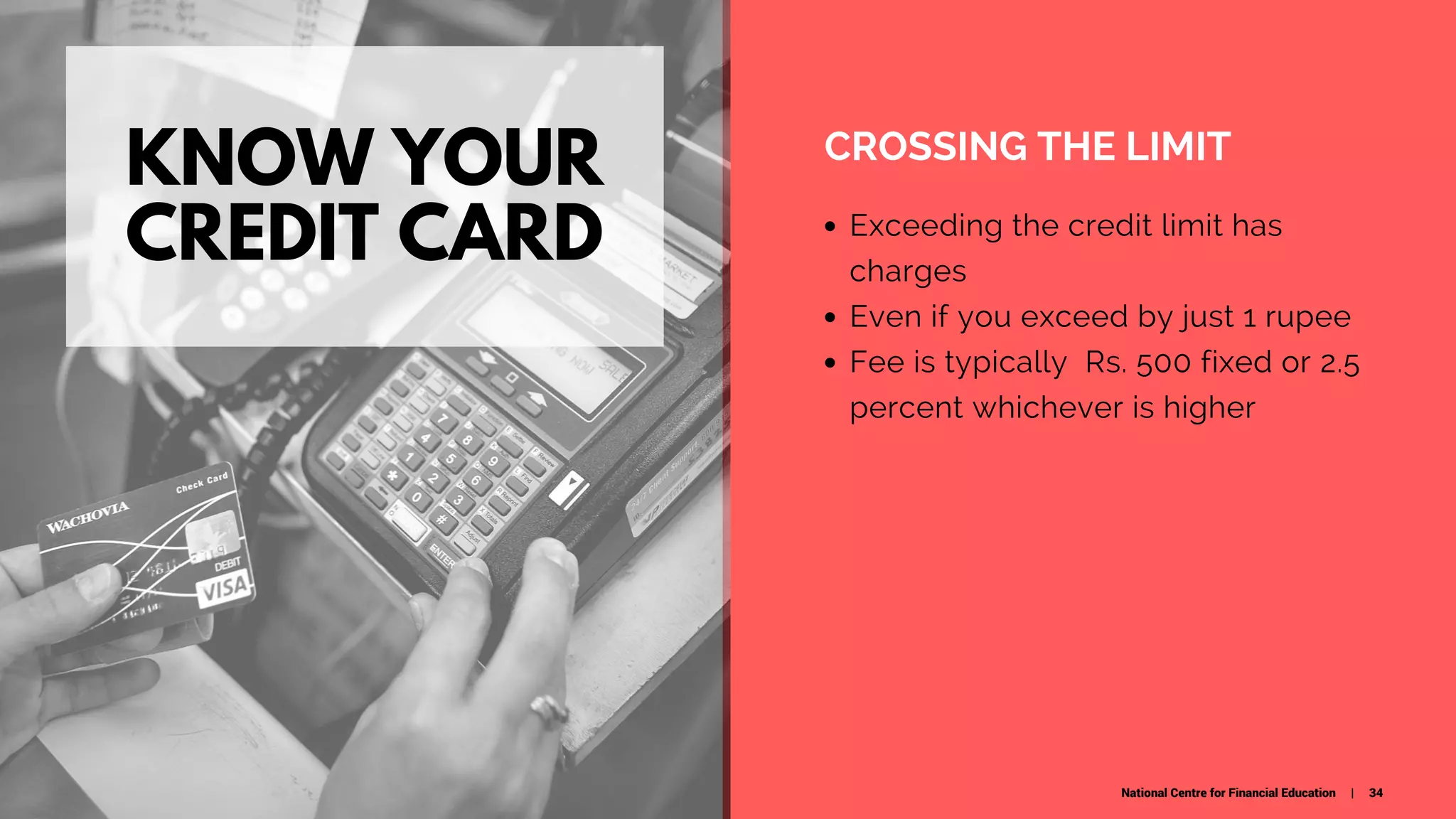
KNOW YOUR
CREDIT CARD
CROSSING THE LIMIT
Exceeding the credit limit has
charges
Even if you exceed by just 1 rupee
Fee is typically  Rs. 500 fixed or 2.5
percent whichever is higher
National Centre for Financial Education | 34
KNOW YOUR
CREDIT CARD
FOREIGN TRANSACTIONS
Buying something in Dollar or Euro
would cost you extra
Transaction is converted to INR
Transaction charge is typically 3.5
percent
National Centre for Financial Education | 35
HOW TO USE
YOUR CREDIT
CARD
RESPONSIBLY?
The 30% credit utilization rule.
Not using a credit card can be
as bad as overusing. 
Pay off your balance in full
before due date.
National Centre for Financial Education | 36
HOW TO USE
YOUR CREDIT
CARD
RESPONSIBLY?
Pay off your balance in full
before due date.
Track your discretionary
spending.
Get fraud and purchase
protection.
National Centre for Financial Education | 37
HOW TO USE
YOUR CREDIT
CARD
RESPONSIBLY?
Regularly check your account
activity online.
Be aware of the marketing
gimmicks.
Feel secure with access to an
emergency line of credit.
National Centre for Financial Education | 38

FACT - Session 2

  • 1.
    CREDIT CARD Use your 2 RESPONSIBLY NationalCentre for Financial Education | 25
  • 2.
    CREDIT CARDS ARE APARADOX. If you don’t know how to use credit cards responsibly, it can be dangerous. But if you’re smart about credit cards, they can help you improve: C O M P A N Y . C O M your credit score earn reward points manage your short-term borrowings, etc. Avoid the need of carrying cash  National Centre for Financial Education | 26
  • 3.
    CREDIT SCORE Credit scoreshows the creditworthiness of a person and is the determining factor for the approval of a loan or credit card application. National Centre for Financial Education | 27
  • 4.
    YOUR LOAN APPROVAL DEPENDS ONYOUR CREDIT SCORE. Figures on the right shows the relationship between CIBIL score and percentage of new loans approved. National Centre for Financial Education | 28
  • 5.
    KNOW YOUR CREDIT CARD ANNUALFEES You're offered a "FREE" card Fee waived off for lifetime or the first year? Joining and annual maintenance fees After first year, fees can be a minimum of Rs. 200 and higher National Centre for Financial Education | 29
  • 6.
    KNOW YOUR CREDIT CARD INTERESTCHARGES If outstanding bill is not paid within due date Monthly interest rate of 2 to 4 percent only What is hidden is this rate is annualized (24-48%)  Understand APR (Annualized Percentage Rate) National Centre for Financial Education | 30
  • 7.
    KNOW YOUR CREDIT CARD MINIMUMPAYMENT TRAP Lured to pay only the minimum due amount Generally, 2 to 5 percent of total outstanding amount On a bill of Rs. 25,000 and an APR of 36%, if you only make the minimum payments, it would take around 20 years and Rs. 62,000 to payoff the total debt. National Centre for Financial Education | 31
  • 8.
    KNOW YOUR CREDIT CARD LATEPAYMENT CHARGES Hefty penalty charges for not paying within due date Fee can be either fixed or depend upon the outstanding amount Fee amount can be Rs. 500 or higher Late payment will affect credit score National Centre for Financial Education | 32
  • 9.
    KNOW YOUR CREDIT CARD CASHWITHDRAWAL  Withdrawing cash from ATM has both interest charges and a fee Interest is charged from day 1 Fee is typically  Rs. 300 fixed or 2.5 percent whichever is higher National Centre for Financial Education | 33
  • 10.
    KNOW YOUR CREDIT CARD CROSSINGTHE LIMIT Exceeding the credit limit has charges Even if you exceed by just 1 rupee Fee is typically  Rs. 500 fixed or 2.5 percent whichever is higher National Centre for Financial Education | 34
  • 11.
    KNOW YOUR CREDIT CARD FOREIGNTRANSACTIONS Buying something in Dollar or Euro would cost you extra Transaction is converted to INR Transaction charge is typically 3.5 percent National Centre for Financial Education | 35
  • 12.
    HOW TO USE YOURCREDIT CARD RESPONSIBLY? The 30% credit utilization rule. Not using a credit card can be as bad as overusing.  Pay off your balance in full before due date. National Centre for Financial Education | 36
  • 13.
    HOW TO USE YOURCREDIT CARD RESPONSIBLY? Pay off your balance in full before due date. Track your discretionary spending. Get fraud and purchase protection. National Centre for Financial Education | 37
  • 14.
    HOW TO USE YOURCREDIT CARD RESPONSIBLY? Regularly check your account activity online. Be aware of the marketing gimmicks. Feel secure with access to an emergency line of credit. National Centre for Financial Education | 38