© Wiley 2010 1
What Is Layout Planning?
Layout planning is deciding the best physical arrangement of
all resources within a facility
 Facility resource arrangement can significantly affect
productivity
 Two broad categories of operations:
 Intermittent processing systems – low volume of many different
products
 Continuous processing systems – high volume of a few
standardized products
Location & Layout Planning
Submitted To: Submitted By:
Saurav Pandey sir Diksha Rana
Deepa Bisht
MBA 2sem.
© Wiley 2010 2
© Wiley 2010 3
Types of Layouts
 Four basic layout types consisting of:
 Process layouts - Group similar resources
together
 Product layouts - Designed to produce a specific
product efficiently
 Hybrid layouts - Combine aspects of both process
and product layouts
 Fixed-Position layouts - Product is two large to
move; e.g. a building
© Wiley 2010 4
Process Layouts
 Process layout unique characteristics include:
 Resources used are general purpose
 Facilities are less capital intensive
 Facilities are more labor intensive
 Resources have greater flexibility
 Processing rates are slower
 Material handling costs are higher
© Wiley 2010 5
Process Layouts – con’t
 Scheduling resources & work flow is more
complex
 Space requirements are higher
© Wiley 2010 6
Product Layouts
 Product layout unique characteristics are:
 Resources are specialized
 Facilities are capital intensive
 Processing rates are faster
 Material handling costs are lower
 Space requirements for inventory storage are
lower
 Flexibility is low relative to the market
© Wiley 2010 7
Hybrid Layouts
 Combine elements of both product &
process layouts
 Maintain some of the efficiencies of product
layouts
 Maintain some of the flexibility of process
layouts
 Examples:
 Group technology & manufacturing cells
 Grocery stores
© Wiley 2010 8
Fixed-Position Layout
 Used when product is large
 Product is difficult or impossible to move,
i.e. very large or fixed
 All resources must be brought to the site
 Scheduling of crews and resources is a
challenge
© Wiley 2010 9
Special Cases of Process
Layouts
A number of unique process layouts require
special attention. We will look at two of
these:
 Warehouse layouts
 Office Layouts
© Wiley 2010 10
Warehouse Layouts
Warehouse Layout Considerations:
 Primary decision is where to locate each
department relative to the dock
 Departments can be organized to minimize “ld”
totals
 Departments of unequal size require modification
of the typical ld calculations to include a
calculation of the “ratio of trips to area
needed”
 The usage of “Crossdocking” modifies the
traditional warehouse layouts; more docks, less
storage space, and less order picking
© Wiley 2010 11
Office Layouts
Office Layout Considerations:
 Almost half of US workforce works in an office
environment
 Human interaction and communication are the primary
factors in designing office layouts
 Layouts need to account for physical environment and
psychological needs of the organization
 One key layout trade-off is between proximity and
privacy
 Open concept offices promote understanding & trust
 Flexible layouts incorporating “office landscaping” help
to solve the privacy issue in open office environments
© Wiley 2010 12
Designing Product Layouts
 Designing product layouts requires
consideration of:
 Sequence of tasks to be performed by each
workstation
 Logical order
 Speed considerations – line balancing
© Wiley 2010 13
Group Technology (CELL)
Layouts
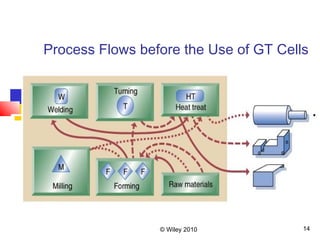
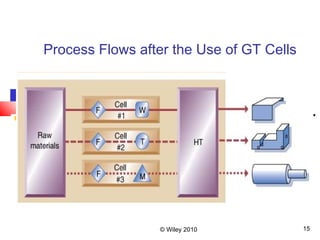
 One of the most popular hybrid layouts uses Group Technology (GT)
and a cellular layout
 GT has the advantage of bringing the efficiencies of a product layout
to a process layout environment
© Wiley 2010 14
Process Flows before the Use of GT Cells
© Wiley 2010 15
Process Flows after the Use of GT Cells
Thank you 
© Wiley 2010 16

Production & operation

  • 1.
    © Wiley 20101 What Is Layout Planning? Layout planning is deciding the best physical arrangement of all resources within a facility  Facility resource arrangement can significantly affect productivity  Two broad categories of operations:  Intermittent processing systems – low volume of many different products  Continuous processing systems – high volume of a few standardized products
  • 2.
    Location & LayoutPlanning Submitted To: Submitted By: Saurav Pandey sir Diksha Rana Deepa Bisht MBA 2sem. © Wiley 2010 2
  • 3.
    © Wiley 20103 Types of Layouts  Four basic layout types consisting of:  Process layouts - Group similar resources together  Product layouts - Designed to produce a specific product efficiently  Hybrid layouts - Combine aspects of both process and product layouts  Fixed-Position layouts - Product is two large to move; e.g. a building
  • 4.
    © Wiley 20104 Process Layouts  Process layout unique characteristics include:  Resources used are general purpose  Facilities are less capital intensive  Facilities are more labor intensive  Resources have greater flexibility  Processing rates are slower  Material handling costs are higher
  • 5.
    © Wiley 20105 Process Layouts – con’t  Scheduling resources & work flow is more complex  Space requirements are higher
  • 6.
    © Wiley 20106 Product Layouts  Product layout unique characteristics are:  Resources are specialized  Facilities are capital intensive  Processing rates are faster  Material handling costs are lower  Space requirements for inventory storage are lower  Flexibility is low relative to the market
  • 7.
    © Wiley 20107 Hybrid Layouts  Combine elements of both product & process layouts  Maintain some of the efficiencies of product layouts  Maintain some of the flexibility of process layouts  Examples:  Group technology & manufacturing cells  Grocery stores
  • 8.
    © Wiley 20108 Fixed-Position Layout  Used when product is large  Product is difficult or impossible to move, i.e. very large or fixed  All resources must be brought to the site  Scheduling of crews and resources is a challenge
  • 9.
    © Wiley 20109 Special Cases of Process Layouts A number of unique process layouts require special attention. We will look at two of these:  Warehouse layouts  Office Layouts
  • 10.
    © Wiley 201010 Warehouse Layouts Warehouse Layout Considerations:  Primary decision is where to locate each department relative to the dock  Departments can be organized to minimize “ld” totals  Departments of unequal size require modification of the typical ld calculations to include a calculation of the “ratio of trips to area needed”  The usage of “Crossdocking” modifies the traditional warehouse layouts; more docks, less storage space, and less order picking
  • 11.
    © Wiley 201011 Office Layouts Office Layout Considerations:  Almost half of US workforce works in an office environment  Human interaction and communication are the primary factors in designing office layouts  Layouts need to account for physical environment and psychological needs of the organization  One key layout trade-off is between proximity and privacy  Open concept offices promote understanding & trust  Flexible layouts incorporating “office landscaping” help to solve the privacy issue in open office environments
  • 12.
    © Wiley 201012 Designing Product Layouts  Designing product layouts requires consideration of:  Sequence of tasks to be performed by each workstation  Logical order  Speed considerations – line balancing
  • 13.
    © Wiley 201013 Group Technology (CELL) Layouts  One of the most popular hybrid layouts uses Group Technology (GT) and a cellular layout  GT has the advantage of bringing the efficiencies of a product layout to a process layout environment
  • 14.
    © Wiley 201014 Process Flows before the Use of GT Cells
  • 15.
    © Wiley 201015 Process Flows after the Use of GT Cells
  • 16.
    Thank you  ©Wiley 2010 16