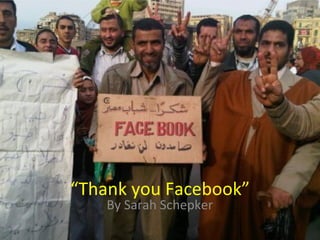
“Thank you Facebook”
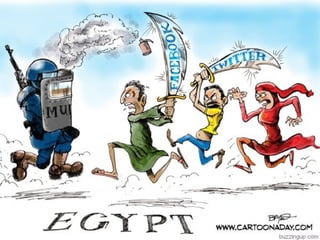
Move over
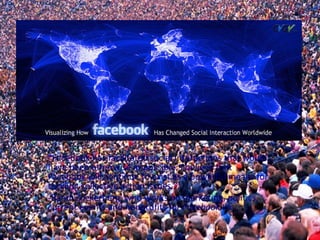
  Facebook changed the way we use the internet-the ability to connect to not just
                            “experts” but peers.


• Basic stats
   –   Founded in 2004
   –   More than 901 million monthly active users
   –   available in 70 languages
   –   approximately 80% of the monthly active users are outside the US and
       Canada
Facebook evolved from a way to connect to
childhood friends to a way to effect social change.
Even Uncle Sam got on
board…

James K. Glassman, a former
senior State Department official,
addressed a group of cyber
activists and stated, “You are the
best hope for us all,” Glassman
continued to say site like Facebook
“give the U.S. a significant
competitive advantage over
terrorists. Some time ago, I said
that Al Qaeda was ‘eating our
lunch on the Internet.’ That is no
longer the case. Al Qaeda is stuck
in Web 1.0. The Internet is now
about interactivity and
conversation.”
Facebook’s


“Facebook has facilitated social interactions that would
have been otherwise impossible. I believe that
Facebook will continue to exist as a powerful means for
tackling collective action issues.”
-Randi Zuckerberg, who works on marketing, politics,
current events and nonprofits for Facebook Inc ,
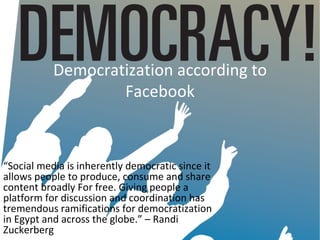
Democratization according to
                   Facebook


“Social media is inherently democratic since it
allows people to produce, consume and share
content broadly For free. Giving people a
platform for discussion and coordination has
tremendous ramifications for democratization
in Egypt and across the globe.” – Randi
Zuckerberg
Facebook’s Balancing Act

“We want Facebook to be a place where people can openly discuss
issues and express their views, while respecting the rights and feelings
of others. With more than 500 million people now around the world
with varying opinions and ideals using Facebook as a place to discuss
and share things that are important to them, we sometimes find
people discussing and posting about controversial topics. Direct
statements of hate against particular communities violate our
Statement of Rights and Responsibilities, the governing document for
our site. These are removed when reported to us.”
        -Randi Zuckerberg
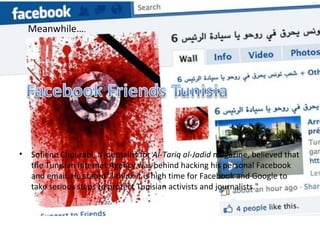
Meanwhile….


•   Sofiene Chourabi, a journalist for Al-Tariq al-Jadid magazine, believed that
    the Tunisian Internet Agency was behind hacking his personal Facebook
    and email. He stated "I think it is high time for Facebook and Google to
    take serious steps to protect Tunisian activists and journalists."
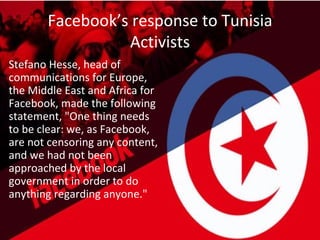
Facebook’s response to Tunisia
                 Activists
Stefano Hesse, head of
communications for Europe,
the Middle East and Africa for
Facebook, made the following
statement, "One thing needs
to be clear: we, as Facebook,
are not censoring any content,
and we had not been
approached by the local
government in order to do
anything regarding anyone."
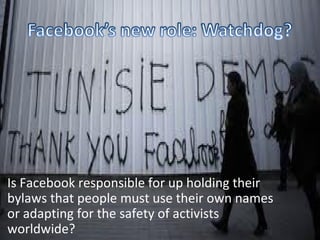
Is Facebook responsible for up holding their
bylaws that people must use their own names
or adapting for the safety of activists
worldwide?
And…
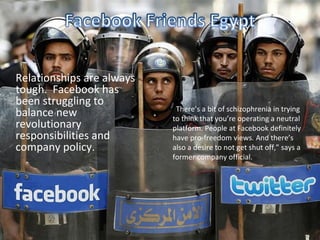
Relationships are always
tough. Facebook has
been struggling to
                           “There’s a bit of schizophrenia in trying
balance new                to think that you’re operating a neutral
revolutionary              platform. People at Facebook definitely
responsibilities and       have pro-freedom views. And there’s
company policy.            also a desire to not get shut off,” says a
                           former company official.
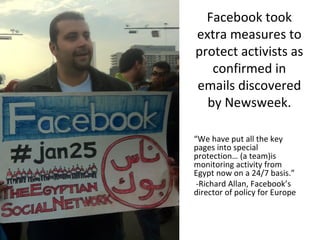
Facebook took
extra measures to
protect activists as
   confirmed in
emails discovered
  by Newsweek.

“We have put all the key
pages into special
protection… (a team)is
monitoring activity from
Egypt now on a 24/7 basis.”
 -Richard Allan, Facebook’s
director of policy for Europe
The idea of temporary activism
or slack-tivism, is that
participating in social media does
not always translate to physical
change. Arpit Mehta states,
“People claiming to care about
one issue or another will post
chain-status-updates on their
walls, or, "like" the Obama hope
poster, change their picture to
show their alliances, but fail to
follow through at the end of the
day.”
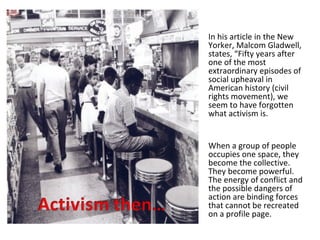
In his article in the New
Yorker, Malcom Gladwell,
states, “Fifty years after
one of the most
extraordinary episodes of
social upheaval in
American history (civil
rights movement), we
seem to have forgotten
what activism is.


When a group of people
occupies one space, they
become the collective.
They become powerful.
The energy of conflict and
the possible dangers of
action are binding forces
that cannot be recreated
on a profile page.
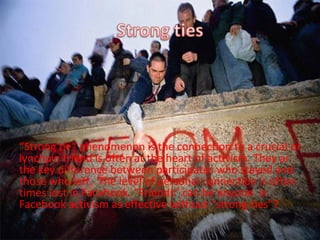
“Strong tie” phenomenon is the connection to a crucial or
lynchpin friend is often at the heart of activism. They ar
the key difference between participates who stayed and
those who left. The level of personal connection is often
times lost in Facebook. “Friends” can be anyone. Is
Facebook activism as effective without “strong-ties”?
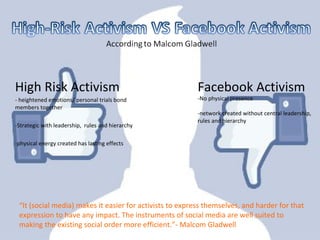
High Risk Activism                                        Facebook Activism
- heightened emotions/ personal trials bond               -No physical presence
members together
                                                          -network created without central leadership,
                                                          rules and hierarchy
-Strategic with leadership, rules and hierarchy

-physical energy created has lasting effects


 “It (social media) makes it easier for activists to express themselves, and harder for that
 expression to have any impact. The instruments of social media are well suited to
 making the existing social order more efficient.”- Malcom Gladwell
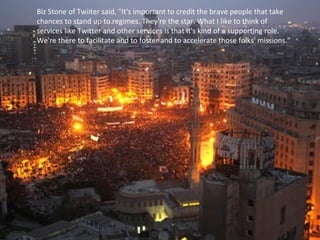
Biz Stone of Twiiter said, "It's important to credit the brave people that take
chances to stand up to regimes. They're the star. What I like to think of
services like Twitter and other services is that it's kind of a supporting role.
We're there to facilitate and to foster and to accelerate those folks' missions."
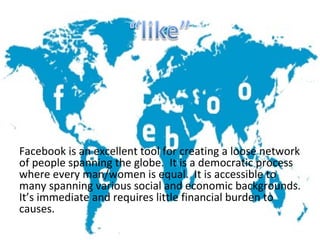
Facebook is an excellent tool for creating a loose network
of people spanning the globe. It is a democratic process
where every man/women is equal. It is accessible to
many spanning various social and economic backgrounds.
It’s immediate and requires little financial burden to
causes.
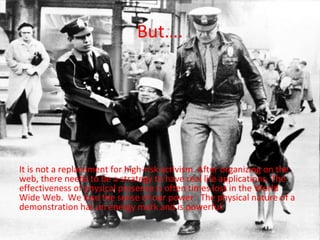
But….


It is not a replacement for high-risk activism. After organizing on the
web, there needs to be a strategy to have real life applications. The
effectiveness of physical presence is often times lost in the World
Wide Web. We lose the sense of our power. The physical nature of a
demonstration has an energy mark and is powerful.
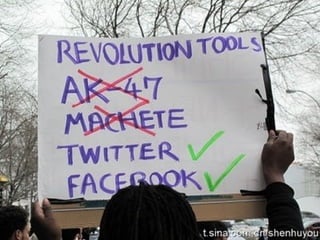
• Facebook is a tool.

Facebook - Tool For Social Change

  • 1.
  • 2.
    Move over Facebook changed the way we use the internet-the ability to connect to not just “experts” but peers. • Basic stats – Founded in 2004 – More than 901 million monthly active users – available in 70 languages – approximately 80% of the monthly active users are outside the US and Canada
  • 4.
    Facebook evolved froma way to connect to childhood friends to a way to effect social change.
  • 5.
    Even Uncle Samgot on board… James K. Glassman, a former senior State Department official, addressed a group of cyber activists and stated, “You are the best hope for us all,” Glassman continued to say site like Facebook “give the U.S. a significant competitive advantage over terrorists. Some time ago, I said that Al Qaeda was ‘eating our lunch on the Internet.’ That is no longer the case. Al Qaeda is stuck in Web 1.0. The Internet is now about interactivity and conversation.”
  • 6.
    Facebook’s “Facebook has facilitatedsocial interactions that would have been otherwise impossible. I believe that Facebook will continue to exist as a powerful means for tackling collective action issues.” -Randi Zuckerberg, who works on marketing, politics, current events and nonprofits for Facebook Inc ,
  • 7.
    Democratization according to Facebook “Social media is inherently democratic since it allows people to produce, consume and share content broadly For free. Giving people a platform for discussion and coordination has tremendous ramifications for democratization in Egypt and across the globe.” – Randi Zuckerberg
  • 8.
    Facebook’s Balancing Act “Wewant Facebook to be a place where people can openly discuss issues and express their views, while respecting the rights and feelings of others. With more than 500 million people now around the world with varying opinions and ideals using Facebook as a place to discuss and share things that are important to them, we sometimes find people discussing and posting about controversial topics. Direct statements of hate against particular communities violate our Statement of Rights and Responsibilities, the governing document for our site. These are removed when reported to us.” -Randi Zuckerberg
  • 9.
    Meanwhile…. • Sofiene Chourabi, a journalist for Al-Tariq al-Jadid magazine, believed that the Tunisian Internet Agency was behind hacking his personal Facebook and email. He stated "I think it is high time for Facebook and Google to take serious steps to protect Tunisian activists and journalists."
  • 10.
    Facebook’s response toTunisia Activists Stefano Hesse, head of communications for Europe, the Middle East and Africa for Facebook, made the following statement, "One thing needs to be clear: we, as Facebook, are not censoring any content, and we had not been approached by the local government in order to do anything regarding anyone."
  • 11.
    Is Facebook responsiblefor up holding their bylaws that people must use their own names or adapting for the safety of activists worldwide?
  • 12.
  • 13.
    Relationships are always tough.Facebook has been struggling to “There’s a bit of schizophrenia in trying balance new to think that you’re operating a neutral revolutionary platform. People at Facebook definitely responsibilities and have pro-freedom views. And there’s company policy. also a desire to not get shut off,” says a former company official.
  • 15.
    Facebook took extra measuresto protect activists as confirmed in emails discovered by Newsweek. “We have put all the key pages into special protection… (a team)is monitoring activity from Egypt now on a 24/7 basis.” -Richard Allan, Facebook’s director of policy for Europe
  • 16.
    The idea oftemporary activism or slack-tivism, is that participating in social media does not always translate to physical change. Arpit Mehta states, “People claiming to care about one issue or another will post chain-status-updates on their walls, or, "like" the Obama hope poster, change their picture to show their alliances, but fail to follow through at the end of the day.”
  • 18.
    In his articlein the New Yorker, Malcom Gladwell, states, “Fifty years after one of the most extraordinary episodes of social upheaval in American history (civil rights movement), we seem to have forgotten what activism is. When a group of people occupies one space, they become the collective. They become powerful. The energy of conflict and the possible dangers of action are binding forces that cannot be recreated on a profile page.
  • 19.
    “Strong tie” phenomenonis the connection to a crucial or lynchpin friend is often at the heart of activism. They ar the key difference between participates who stayed and those who left. The level of personal connection is often times lost in Facebook. “Friends” can be anyone. Is Facebook activism as effective without “strong-ties”?
  • 20.
    High Risk Activism Facebook Activism - heightened emotions/ personal trials bond -No physical presence members together -network created without central leadership, rules and hierarchy -Strategic with leadership, rules and hierarchy -physical energy created has lasting effects “It (social media) makes it easier for activists to express themselves, and harder for that expression to have any impact. The instruments of social media are well suited to making the existing social order more efficient.”- Malcom Gladwell
  • 22.
    Biz Stone ofTwiiter said, "It's important to credit the brave people that take chances to stand up to regimes. They're the star. What I like to think of services like Twitter and other services is that it's kind of a supporting role. We're there to facilitate and to foster and to accelerate those folks' missions."
  • 23.
    Facebook is anexcellent tool for creating a loose network of people spanning the globe. It is a democratic process where every man/women is equal. It is accessible to many spanning various social and economic backgrounds. It’s immediate and requires little financial burden to causes.
  • 24.
    But…. It is nota replacement for high-risk activism. After organizing on the web, there needs to be a strategy to have real life applications. The effectiveness of physical presence is often times lost in the World Wide Web. We lose the sense of our power. The physical nature of a demonstration has an energy mark and is powerful.
  • 25.