 32yo M presents after fall

from scafold
approximately 4 stories
onto sidewalk. +LOC.
+Headache. +Abdominal
and Back Pain.

 T98 HR 110 RR 20 PO2

98% NRB BP 110/70
 GEN:airway intact
 HEENT: instability of
midface, significant
edema, numbness of right
cheek, subconjunctival
hemorrhage b/l
 Neuro: GCS 10
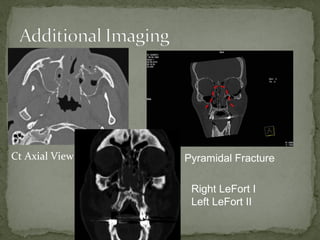
Open Arrows: inf orbit fx

Star:Inferior orbit fx

Closed Arrow: no fx to ant/lat nasal
margin=no lefort I fx

Arrow: B/l pterygoid fxs
Airway
 May Require early intubation
Trauma Assessment
 High Mechanism=risk for associated injuries
Optho C/S
Admission
 Open Reduction and Internal Fixation
 Observation for Other Trauma Injuries
Physical Exam
 Nose moves with tugging motion
Fracture Line
 Pyradmidal shape
 Nasal bridge->maxilla frontal process->lacrimal
bones/inf orbital floor->ant wall maxillary sinus>pterygoid plates
Exclusions
 anterolateral margins of the nasal fossa=Type I
excluded
 infraorbital rims are intact=Type 2 excluded
Ct Axial View

Pyramidal Fracture
Right LeFort I
Left LeFort II
Rhea JT, Novelline RA: How to simplify the

CT diagnosis of Le Fort fractures. AJR
2005;184:1700-1705
Moe, K. Maxillary and LeFort Fractures.
Medscape
http://radiopaedia.org/articles/le-fort-fractureclassification

 Tintanelli’s Emergency Medicine: A Comprehensive Study

Guide. Chapter 257 Maxillofacial Trauma
Akoglu, E. Heading the ball: a case of Le Fort II

fracture in football match. BMJ, 2011.

Lefort 2 Fracture

  • 2.
     32yo Mpresents after fall from scafold approximately 4 stories onto sidewalk. +LOC. +Headache. +Abdominal and Back Pain.  T98 HR 110 RR 20 PO2 98% NRB BP 110/70  GEN:airway intact  HEENT: instability of midface, significant edema, numbness of right cheek, subconjunctival hemorrhage b/l  Neuro: GCS 10
  • 4.
    Open Arrows: inforbit fx Star:Inferior orbit fx Closed Arrow: no fx to ant/lat nasal margin=no lefort I fx Arrow: B/l pterygoid fxs
  • 5.
    Airway  May Requireearly intubation Trauma Assessment  High Mechanism=risk for associated injuries Optho C/S Admission  Open Reduction and Internal Fixation  Observation for Other Trauma Injuries
  • 6.
    Physical Exam  Nosemoves with tugging motion Fracture Line  Pyradmidal shape  Nasal bridge->maxilla frontal process->lacrimal bones/inf orbital floor->ant wall maxillary sinus>pterygoid plates Exclusions  anterolateral margins of the nasal fossa=Type I excluded  infraorbital rims are intact=Type 2 excluded
  • 7.
    Ct Axial View PyramidalFracture Right LeFort I Left LeFort II
  • 8.
    Rhea JT, NovellineRA: How to simplify the CT diagnosis of Le Fort fractures. AJR 2005;184:1700-1705 Moe, K. Maxillary and LeFort Fractures. Medscape http://radiopaedia.org/articles/le-fort-fractureclassification  Tintanelli’s Emergency Medicine: A Comprehensive Study Guide. Chapter 257 Maxillofacial Trauma Akoglu, E. Heading the ball: a case of Le Fort II fracture in football match. BMJ, 2011.