Download to read offline
![IJRET: International Journal of Research in Engineering and Technology eISSN: 2319-1163 | pISSN: 2321-7308
__________________________________________________________________________________________
Volume: 03 Special Issue: 07 | May-2014, Available @ http://www.ijret.org 214
FABRICATION OF POLYMER BASED SCHOTTKY DIODE USING
PANI/Ag NANO COMPOSITE
Rohini Dhandapani1
, Senthil Kumar Kandasamy2
1
Pg Scholar, VLSI Design, Kongu Engineering College, Tamilnadu, India
2
Assistant Professor, Department of ECE, Kongu Engineering College, Tamilnadu, India
Abstract
Polyaniline nanoparticles were prepared via chemical oxidation method and Silver nanoparticles were chemically synthesized using
silver nitrate as major precursor. By using these nanoparticles and PVA, PANI/Ag nanocomposite gel was prepared. The PANI and
Ag nanoparticles were characterized separately by using uv-vis spectrophotometer. The prepared PANI/Ag nanocomposite gel was
applied on one side of the Al substrate and on the other side of Al substrate, Copper wire was soldered. The electrical
characterization of this PANI/Ag nanocomposite Schottky diode was analyzed.
Keywords: Absorption, Ag Nanoparticles, Al substrate, Composite, PANI, PVA, Schottky diode
-----------------------------------------------------------------------***-----------------------------------------------------------------------
1. INTRODUCTION
In recent years, Nanoelectronics seems to be the most
promising successor in the field of engineering and
electronics. Molecular-scale nanoelectronic devices including
diodes, bistable switches and nanowires have been fabricated
and characterized in chemistry laboratory. Among these
devices considerable attention is given to the fabrication and
characterization of Schottky diodes using polymer and metals
because Schottky diode offer several advantages over other
diodes such as low forward voltage drop, less heat, high
efficiency, high current density and low capacitance [1-
4].Among all conducting polymers, polyaniline (PANI) and its
derivatives are more attracted because of its chemical stability,
simple preparation, high conductivity and low cost [5-7]. Bulk
silver shows the highest electrical conductivity among metals
at room temperature and it is an adept for producing
conducting composites [8,9]. Schottky diode preparation using
PANI/Ag is another important subject and have great
technological importance for wide variety of applications such
as Photovoltaic systems, power supply, RF detector etc. [10,
11] Schottky diode invariably requires the use of thermally
conductive substrates to manage the heat produced for
photovoltaic applications [12, 13] and one of the most widely
selected materials for this application is aluminum substrate
[14]. Moreover, Aluminium is a low cost base material and
offer high efficiency [14].
In this work, we synthesized the PANI/Ag nanocomposite gel
and it was applied on one side of the Al substrate and on the
other side of Al substrate, Copper wire was soldered because
Schottky diode has a Schottky contact between a
semiconductor and some appropriate metal and at other end of
the semiconductor has an Ohmic contact, with a metal. Then
the electrical characterization of PANI/Ag nano composite
Schottky diode was analyzed.
2. EXPERIEMENTAL SECTION
2.1 Materials and Methods
Aniline and hydrated copper sulphate were obtained from
Merck, Germany were the major precursors to synthesize
polyaniline nanoparticles. Silver nitrate (AgNO3) and sodium
citrate were the major precursors to synthesize silver
nanoparticles in the range of 10 nm approximately. All
supplementary chemicals were of analytical grade and
solutions were prepared with mili-Q water.
2.2 Preparation of PANI Nanoparticles
Aniline (20 mL) was added in a 150 mL beaker containing 60
mL of methanol. The solution in a beaker was stirred on a
magnetic stirrer for 45 min to make a homogenous solution at
constant temperature. To this solution, 20 mL of 0.05 M
aqueous copper sulphate solution was added drop by drop with
constant stirring on magnetic stirrer at same temperature. After
30min opaque blue solution was obtained and at the end of the
reaction (after 45 min), the dark green color solution was
yielded. The solution was filtered and dried and at the end
dark green particles (polyaniline) were obtained [15].
2.3 Preparation of Ag Nanoparticles
Silver nanoparticles were prepared by a citrate reduction
method. 4.5 mg of silver nitrate was dissolved in 100 mL of
H2O and brought to boiling.2 mL of 1% sodium citrate
solution was added. The solution was kept on boiling for 1 hr.
During this process solution was mixed vigorously. Solution
was heated until color change was evident (light brown). Then
it was removed from the heating element and stirred until it](https://image.slidesharecdn.com/fabricationofpolymerbasedschottkydiodeusing-140824234047-phpapp01/75/Fabrication-of-polymer-based-schottky-diode-using-1-2048.jpg)
![IJRET: International Journal of Research in Engineering and Technology eISSN: 2319-1163 | pISSN: 2321-7308
__________________________________________________________________________________________
Volume: 03 Special Issue: 07 | May-2014, Available @ http://www.ijret.org 215
was cooled to room temperature. The obtained solution was
filtered and dried. At the end silver nanoparticles were
obtained [16].
2.4 Preparation of PANI/Ag Nano Composite gel
The PANI particles of 2.5mg and silver nanoparticles of
2.5mg was dissolved in 100mL of methanol and brought to
stirrer. Then the solution was stirred on the magnetic stirrer for
20min. At the end, PANI/Ag solution mixture was obtained.
The polyvinyl alcohol was added to the prepared PANI/Ag
mixture and stirred on the magnetic stirrer for 2 hours. At the
end of the reaction PANI/Ag nanocomposite gel was obtained
[7, 17].
2.5 Fabrication of a Schottky diode
The PANI/Ag nano composite was deposited at one side of the
Al substrate for Schottky contact and the wire drawn from the
PANI/Ag side was attached to it by PANI/Ag nano composite
gel. The Ohmic contact was to be made of copper wire solder.
The Schottky diode using PANI/Ag nano composite was
shown in Fig 1.
Fig -1: Schottky diode using PANI/Ag nanocomposite
3. RESULTS AND DISCUSSION
3.1 UV-VIS Spectra
UV-VIS characterization gives the absorption spectra in Ultra
Violet – Visible spectral and near infrared region. This
measurement gives the absorption spectra for the prepared
PANI nanoparticles and Silver nanoparticles. The absorption
spectra for the above two materials are shown in Fig 2 and Fig
3 respectively. Optical absorbance spectra in the regions (300
– 600 nm) were recorded at room temperature using UV-VIS
spectrophotometer 119. The absorption peak was occurred at
335 nm and 405 nm for PANI dispersed in methanol [9].
Similarly for silver nanoparticles the peak was occurred at 410
nm [9, 18,19].
Fig -2: Absorbance spectra for PANI
Fig -3: Absorbance spectra for Ag nanoparticles
4. ELECTRICAL CHARACTERIZATION
4.1 Current Voltage Characteristics
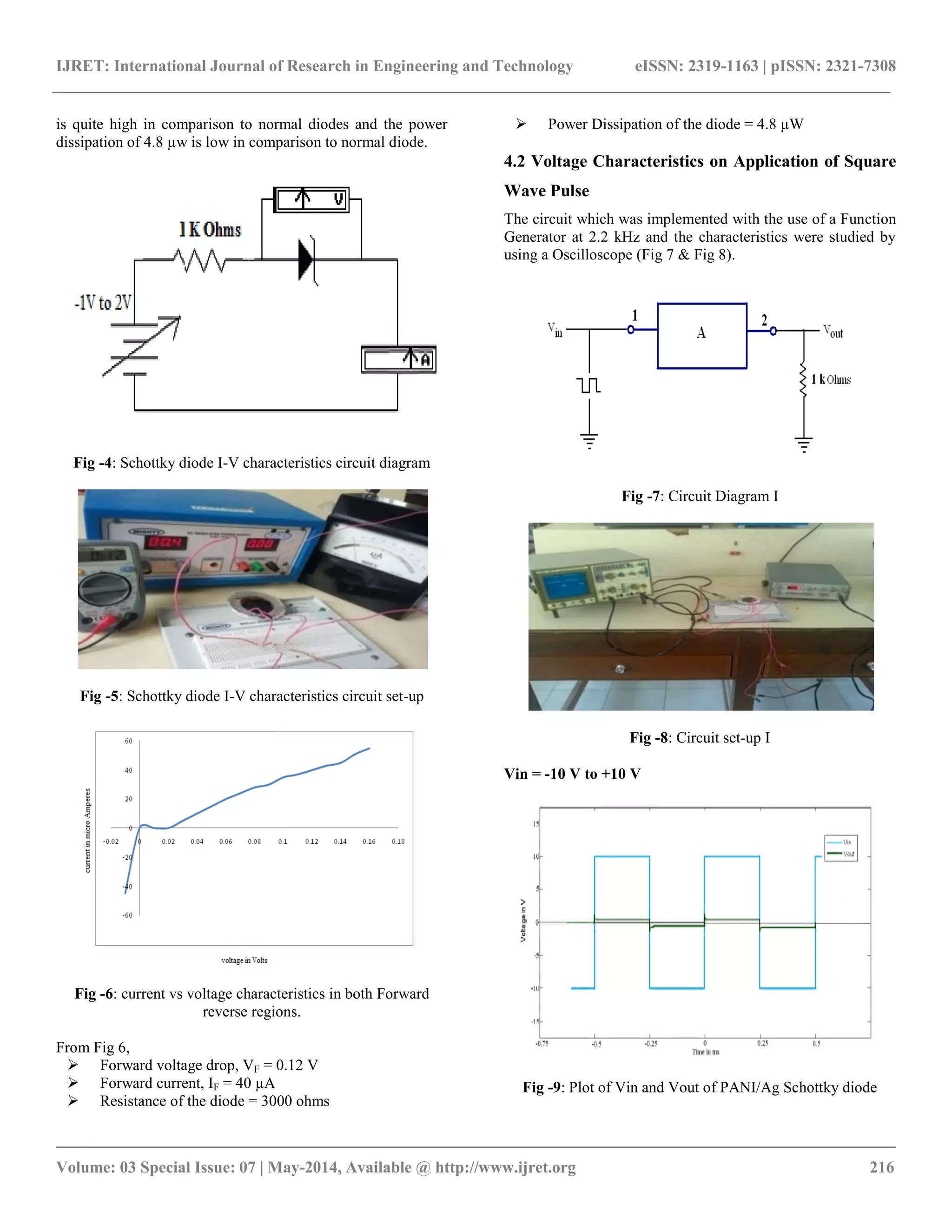
The circuit which was implemented for the current- voltage
characteristics of the Schottky diode is shown in Fig 4. The
circuit with the Schottky diode was made on the breadboard,
voltage source, Multimeter, Ammeter, wires, Resistor were the
other requirements shown in Fig 5.The I-V characteristics of
the PANI/Ag nano composite Schottky diode (Fig 6) shows
that current flow in one direction is definitely favoured over
the other. We can roughly say that sans the series resistance
the Voltage drop across the diode would have been 0.12 V.
The resistance changes with temperature. So at higher voltages
when there is substantial heating, the current reading gradually
goes up, for (>5 minutes at 5 V forward bias) indicating that
the resistance is lowered [20]. If the current is switched off for
some time, the resistance returns to its room temperature
value. So when switched on again, the current returns to its
low starting value. It is noted that the resistance of 3000 ohms](https://image.slidesharecdn.com/fabricationofpolymerbasedschottkydiodeusing-140824234047-phpapp01/75/Fabrication-of-polymer-based-schottky-diode-using-2-2048.jpg)
![IJRET: International Journal of Research in Engineering and Technology eISSN: 2319-1163 | pISSN: 2321-7308
__________________________________________________________________________________________
Volume: 03 Special Issue: 07 | May-2014, Available @ http://www.ijret.org 217
From Fig 9,
Voltage drop across the diode,
= 10 V – 0.005 V = 9.9 V.
Resistance of Diode in forward bias,
= (9.9/0.005)*1 k ohms = 1980 k ohms
It is to be noted that the resistance being higher, voltage drop
across the diode is more and that across the 1k ohms resistor is
more.
Fig -10: Possible simple equivalent circuit I
Fig -11: Possible simple equivalent circuit II
Vin = -9 V to +9 V
Fig -12: Plot of Vin and Vout of PANI/Ag Schottky diode
equivalent circuits
From Fig 12,
Voltage drop across diode = 9 V– 5 V = 4V
Thus, diode resistance in forward bias,
= (4/5)*1 k = 0.8 k ohms
Hence from the equivalent circuit I (in forward biased region),
we get
By circuit analysis,
Equivalent resistance = 1.8 k ohms
Capacitance C = τ/R =0.27 µF
Another equivalent circuit II (in forward biased region), is
given alongside.
From this,
By circuit analysis,
Equivalent resistance = (1*0.8)/(1+0.8)
= 0.44 k ohms
Capacitance C = τ/R = 1.125 µF
5. CONCLUSIONS
In brief, we prepared PANI/Ag nanocomposite and analyzed
its characteristics by using UV-VIS spectrophotometer. By
using this prepared PANI/Ag nano composite, Schottky diode
was fabricated. On the other hand, the electrical
characterization of Schottky diode using PANI/Ag nano
composite was analyzed. The results revealed that the diode
has high resistance, low capacitance and low power
dissipation. So, it could be used in photovoltaic applications.
REFERENCES
[1]. David L. Butler, “Low-voltage band gap reference design
utilizing Schottky diodes”, Boise State University, March,
2005
[2]. Elmansouri,N. Hadik, A. Outzourhit, A. Lachkar, A.
Abouelaoualim, M.E. Achour, A. Oueriagli, and E.L.
Ameziane, “Schottky Diodes and Thin Films Based on
Copolymer: Poly(aniline-co-toluidine)”, Hindawi
Publishing Corporation, Active and Passive Electronic
Components, Volume 2009, Article ID 378086,
doi:10.1155/2009/378086
[3]. Elmansouria, A. Malaouib, A. Outzourhita, A. Oueriaglia,
A. Lachkarc, N. Hadika, M. E. Achourd, Abouelaoualima,
and E. L. Ameziane, “Electrical Properties Of Schottky
Diodes Based On Poly(O-Toluidine) Deposited By
Spincoating”, The Moroccan Statistical Physical and
Condensed Matter Society, December 2010
[4]. N. Z. Yahaya, F. H. Ramle, “Simulation and Analysis of Si
Schottky Diode Family in DC-DC Converter”, International
Journal on Electrical Engineering and Informatics -Volume
1, Number 2, 2009
[5]. Mohammed Ahmed Ali, Elias Saion, Noorhana Yahya,
Anuar Kassim,Khairulzaman Mohd Dahlan, Shahri
Hashim, “Synthesis of conducting polyaniline](https://image.slidesharecdn.com/fabricationofpolymerbasedschottkydiodeusing-140824234047-phpapp01/75/Fabrication-of-polymer-based-schottky-diode-using-4-2048.jpg)
![IJRET: International Journal of Research in Engineering and Technology eISSN: 2319-1163 | pISSN: 2321-7308
__________________________________________________________________________________________
Volume: 03 Special Issue: 07 | May-2014, Available @ http://www.ijret.org 218
nanocomposites by radiation doping”, Journal of
Engineering Science and Technology Vol. 2, No. 1 (2007)
111-118
[6]. M.Angelopoulos, “Conducting polymers in
microelectronics”, IBM J. RES. & DEV. VOL. 45 NO. 1
January 2001
[7]. Sindhu Honmute, Sharanabasava V. Ganachari,
Ravishankar Bhat, HMP Naveen Kumar Do Sung Huh and
Abbaraju Venkataraman, “Studies on Polyaniline-Polyvinyl
Alcohol (PANI-PVA) Interpenetrating Polymer Network
(IPN) Thin Films”, International Journal of Science
Research Volume 01, Issue 02, September 2012, pp. 102-
106
[8]. Y. B. Wankhede, S. B. Kondawar, S. R. Thakare, P. S.
More, “Synthesis and characterization of silver
nanoparticles embedded in polyaniline nanocomposite”,
Adv. Mat. Lett. 2013, 4(1), 89-93
[9]. S. AbdulAlmohsin, S.M. AL-Mutoki and Z. Li, “Al/PANI-
MWNT/Au-Plastic Schottky Diode Solar Cells”, Journal of
the Arkansas Academy of Science, Vol. 66, 2012
[10]. Scott Milam, “Effects of Silver Nanoparticles on
Photochemical Processes Focusing on Luminol
Chemiluminescence”, Master's Theses and Doctoral
Dissertations, January 2010
[11]. Pronob Jyoti Saikia, Pratap Chandra Sarmah, “
Investigation of Polyaniline Thin Film and Schottky
Junction with Aluminium for Electrical and Optical
Characterization”, Materials Sciences and Application,
2011, 2, 1022-1026
[12]. L. Meier, P. Davis, A. Shibata, T. Abc, K. Kinoshita,C.
Bishop, S Mahajan, A. Rohatgi, P. Doshi, and M. Finnegan,
“Self-doping contacts and associated silicon solar cell
structures”, World conference and exhibition on
photovoltaic solar energy conversion 6-10 July 1998.
[13]. Arnab Dhabal, “Fabrication and Characterization of
Schottky Diode”, Thesis.
[14]. Eisermann, K. Holl, W. Smetana, W. Tusler, M. Unger, and
J. Whitmarsh, “ Comparison of low cost, insulated
aluminium substrates used as integrated heat sinks with
conventional technology”, IMAPS Nordic September 14,
2008
[15]. S.K. Shukla, Anand Bharadvaja, Ashutosh Tiwar, G.K.
Parashar, G.C. Dubey, “Synthesis and characterization of
highly crystalline polyaniline film promising for humid
sensor”, Adv. Mat. Lett. 2010, 1(2), 129-134
[16]. Basavaraj udapudi, Praveenkumar Naik, Sabiha Tabassum
Savadatti, Rupali Sharma, Samprita Balgi, “Synthesis and
characterization of silver nanoparticles”, International
Journal of Pharmacy and Biological Sciences, (e-ISSN:
2230-7605),2012
[17]. J.Bhadra and D. Sarkar, “Size variation of polyaniline
nanoparticles dispersed in polyvinyl alcohol matrix”, Bull.
Mater. Sci., Vol. 33, No. 5, October 2010, pp. 519–523
[18]. Maribel G. Guzman, Jean Dille, Stephan Godet., “Synthesis
of silver nanoparticles by chemical reduction method and
their antibacterial activity” ,International Journal of
Chemical and Biological Engineering 2:3 2009
[19]. K. Tikhomirov, V. D. Rodriguez, A. Kuznetsov, D.
Kirilenko,G. Van Tendeloo, and V. V. Moshchalkov,
“Preparation and luminescence of bulk oxyfluoride glasses
doped with Ag nanoclusters”, OPTICS EXPRESS 22040,
Vol. 18, No. 21, 11 October 2010
[20]. K. Zeljami, J. Gutierrez, J. P. Pascual, T. Fernandez,A.
Tazon, and M. Boussouis, “Characterization and modeling
of Schottky diodes up to 110ghz for use in both flipchip and
wire-bonded assembled environments”, Progress In
Electromagnetics Research, Vol. 131, 457-475, 2012
BIOGRAPHIES
Rohini Dhandapani is currently pursuing M.E
(VLSI DESIGN) in Kongu Engineering College,
India. She completed her B.E (ECE) at Info
Institute of Engineering, Anna University, India.
Her major interest is Nanoelectronics.
Senthil Kumar Kandasamy is currently working
as assistant professor in department of ECE,
Kongu engineering college, India. He completed
his M.Tech in Nanoscience and technology at
KSR College of Technology, Anna university. He
has published and presented 9 papers. His major
research interests are nanocomposite, supercapacitor and solar cell.](https://image.slidesharecdn.com/fabricationofpolymerbasedschottkydiodeusing-140824234047-phpapp01/75/Fabrication-of-polymer-based-schottky-diode-using-5-2048.jpg)

The document details the fabrication and electrical characterization of a polyaniline/silver (PANI/Ag) nanocomposite Schottky diode, synthesized through a chemical oxidation method and characterized using UV-Vis spectrophotometry. The study highlights the advantages of using the PANI/Ag nanocomposite due to its high resistance, low power dissipation, and potential application in photovoltaic systems. Electrical measurements, including current-voltage characteristics, were conducted to analyze the diode's performance, indicating its efficiency for various electronic applications.


