8/24/2015
Submitted To : Pranav Vohra
Submitted By : Ankit Kumar
Bittu Kumar Singh
Harsh Nandan Tripathi
Shubham Kumar
Shubham Singh
FABRIC SCIENCE
ASSIGNMENT
WOOL
ACKNOWLEDGEMENT
The completion of this assignment gives us much pleasure. We are much thankful to
Mr. Pranav Vohra, Course Instructor, NIFT Gandhinagar for guiding us
throughout the work. For a successful assignment as this one, we took help from
some people. We would also like to thank heartily all those who directly or indirectly
guided us in making this assignment. Many of our classmates and team members
gave valuable suggestions which inspire us to continuously improve our work.
Thank You
WOOL- AN INTRODUCTION
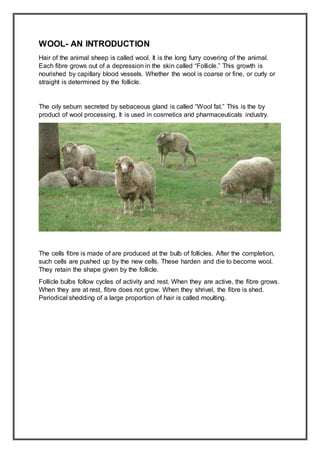
Hair of the animal sheep is called wool. It is the long furry covering of the animal.
Each fibre grows out of a depression in the skin called “Follicle.” This growth is
nourished by capillary blood vessels. Whether the wool is coarse or fine, or curly or
straight is determined by the follicle.
The oily sebum secreted by sebaceous gland is called “Wool fat.” This is the by
product of wool processing. It is used in cosmetics and pharmaceuticals industry.
The cells fibre is made of are produced at the bulb of follicles. After the completion,
such cells are pushed up by the new cells. These harden and die to become wool.
They retain the shape given by the follicle.
Follicle bulbs follow cycles of activity and rest. When they are active, the fibre grows.
When they are at rest, fibre does not grow. When they shrivel, the fibre is shed.
Periodical shedding of a large proportion of hair is called moulting.
PRODUCTION OF WOOL
In India, Pakistan and North Africa coarse wool is produced. Years of selective
breeding has helped sheep in being suited to an array of climate and fleece
characteristics.
Australia is the leading producer of wool. The main breed of its stock is the
Australian Merino. Its contribution stands at ¾ th of its total produce. This breed is
suited to dry conditions. It needs vast land to graze. Its wool is even finer during
drought times.
New Zealand and India are producers of excellent resilient carpet wools. The main
breed found in New Zealand is of English variety called Romney Marsh. This breed
is suited to wetter conditions of mountain pastures. The sheep of India are suited to
hot and dry conditions.
Lincoln is a breed of sheep know for its long wool. It needs open land to graze so
that it can avoid burrs and rubbish. This protects its long wool from harm.
TYPES OF WOOL
Long wool is produces when follicles are active for long periods. Short wool is
produced when follicles are active for relatively less time. Such wool is fine, dense
and curlier.
Fibres can be very fine in diameter (18 microns) to coarser (more than 40 microns).
Fine wools are shorter i.e. of 4 to 12 cm average length. Coarse wools are longer i.e.
up to 30cm in length.
Length of wool depends on:
 breed of sheep,
 part of fleece from which wool comes,
 how often a sheep is shorn.
Wool having diameter less than 17 microns is called super fine wool. It is so soft that
it can used for making babies’ under clothes.
Fine wool is harvested from Merino sheep and Scottish Blackface sheep. It is fine,
short and has small waves of crimps. Most woollen knits and finest worsteds are
made from this wool.
Blankets are made from medium diameter wools. Samples having more than 10%
coarse diameter fibres will feel scratchy and lead to irritation.
COARSE WOOLS
They are tough, resilient and stiff. They are lustrous due to canal like spaces called
Medulla. They have long waves of crimps. These are used in making tweeds and
carpets. Romney Marsh, Crossbred, Lincoln and Tukidale produce coarse wools.
MORPHOLOGY
Wools are chemically and structurally complex.
Central mass of the fibre is called Cortex. It is made up of two cigar shaped cells.
These cells may be evenly mixed or maybe not. All para cells can be arranged on
one side and ortho cells on the other sides. Such arrangements occur in fine fibres.
They are produced from curved follicles. Such a fibre is called a bilateral fibre. It is
distributed in two distinct halves. It is called helical fibre.
In coarser wools, cells are uniformly distributed. They have little or no crimps.
Scales are layers of cells surrounding the cortex. Generally there are 2 or 3 layers of
flat and overlapping cells. They are laid one above another. They always point in one
direction i.e. away from root of the fibre. Scales help in analysis of Directional
frictional effect.
Accordingly, it is easier to rub fibre in one direction than the other.
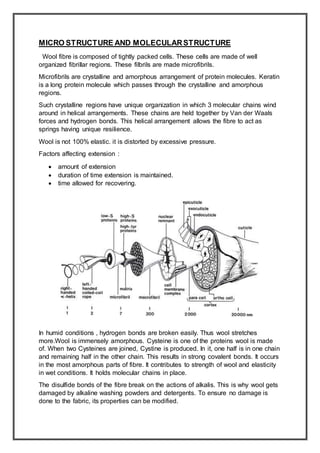
MICRO STRUCTURE AND MOLECULARSTRUCTURE
Wool fibre is composed of tightly packed cells. These cells are made of well
organized fibrillar regions. These filbrils are made microfibrils.
Microfibrils are crystalline and amorphous arrangement of protein molecules. Keratin
is a long protein molecule which passes through the crystalline and amorphous
regions.
Such crystalline regions have unique organization in which 3 molecular chains wind
around in helical arrangements. These chains are held together by Van der Waals
forces and hydrogen bonds. This helical arrangement allows the fibre to act as
springs having unique resilience.
Wool is not 100% elastic. it is distorted by excessive pressure.
Factors affecting extension :
 amount of extension
 duration of time extension is maintained.
 time allowed for recovering.
In humid conditions , hydrogen bonds are broken easily. Thus wool stretches
more.Wool is immensely amorphous. Cysteine is one of the proteins wool is made
of. When two Cysteines are joined, Cystine is produced. In it, one half is in one chain
and remaining half in the other chain. This results in strong covalent bonds. It occurs
in the most amorphous parts of fibre. It contributes to strength of wool and elasticity
in wet conditions. It holds molecular chains in place.
The disulfide bonds of the fibre break on the actions of alkalis. This is why wool gets
damaged by alkaline washing powders and detergents. To ensure no damage is
done to the fabric, its properties can be modified.
INDIAN WOOLEN MARKET
MarketSize
Fabric production by the mill sector accounted a rise of six per cent during April
2013-July 2014 and in hosiery sector it increased by eight per cent during April-July
2014. Total cloth production grew by two per cent during April-July 2014.
With consumerism and sale income on the rise, the retail sector has experienced a
enormous growth in the past decade with several international players like Marks &
Spencer, Guess and Next have introduced in the Indian market. The organised
apparel segment is expected to rise at a compound annual growth rate (CAGR) of
more than 13 per cent over a 10-year period.
The size of the Indian textiles and apparel industry is expected to reach US$223
billion by 2021, according to a report by Technopak Advisors.
Opportunities
India has witnessed an average GDP growth of approximately 7 per cent in the past
decade and forms one of the largest emerging economies of the world. The majority
stakeholder in this growth is the mass consuming population of the country.
Consumers today are much more evolved and their demands and needs are very
different from those of consumers a decade ago.
Apart from the demographic and economic changes, there have been many other
transformational changes that lead to a growth in the aspirations and wants of an
average consumer:
 Young population: The median age of the Indian consumer is 26 years with
maximum population lying in the age bracket of 15-60 years. It is expected
that India will add another 140 million people in this consuming age group by
2020. This is one of the lowest median ages among the developing countries.
This population has more aspiration, is more aware and has a higher
spending power and will consume a greater number of categories than their
parents.
 Higher disposable income: According to the Indian census report, the number
of households with an annual income of US$7000 or more is going to treble
from about 30 million today to 100 million by 2020. There will be
approximately 400 million individuals in the middle to high income bracket by
2020.
 Growing media influence/exposure: The role of technology has changed the
way people receive/share information. From social networking sites to
electronic channels, information travels at the speed of light. The changing
lifestyle and “western” culture has also influenced consumer demands and
aspirations. People are willing to consume and develop a lifestyle akin to a
developed world’s consumer.
GovernmentInitiatives
The Indian government has come up with a number of export promotion policies for
the textiles sector. It has also allowed 100 per cent FDI in the Indian textiles sector
and retail sector for single brands under the automatic route.
Some of initiatives taken by the government to further promote the industry are:
 The Ministry of Textiles will implement the scheme for in-situ upgradation of
plain powerlooms for SSI sector in Surat and Ahmedabad powerloom clusters
in Gujarat.
 The government has taken a number of initiatives for the welfare and
development of the weavers and the handloom sector. Under revival, reform
and restructuring (RRR) package, financial assistance to the tune of Rs 1,019
crore (US$164.72 million) has been approved and the Indian government has
released Rs 741 crore (US$119.78 million).
 Encouraged by the turnaround in textiles exports, the Government of India
plans to set up a US$60 billion target for the current financial year, a jump of
over 30 per cent from the previous financial year.
 The Cabinet Committee on Economic Affairs (CCEA) has approved an
Integrated Processing Development Scheme (IPDS) with a corpus of Rs 500
crore (US$80.82 million) to make textiles processing units more environment-
friendly and globally competitive.
Source: Ministry of textiles, India
The global textile and apparel industry at present is divided into distinct production
and consumption hubs. Production has been shifting from developed western
countries to China, India, Bangladesh, Pakistan, Turkey and other Southeast Asian
countries. The US, European Union and Japan contribute the most to total textiles
and apparel consumption of the world.
Consumption in India and China is also rising. Bilateral and multilateral trade
agreements will increasingly play an important role in shaping up global industry
structure. With change in business dynamics and global market environment the
industry is witnessing more inorganic growth.
India has always been a strong player in the global textiles and apparel industry.
With an integrated supply chain, political and economic stability, vast resource of
skilled manpower and entrepreneurial spirit.
Rising domestic market and increasing opportunities in global trade will create
enormous scope for Indian players. In addition to favourable demographic dividend
and relatively stable economic conditions, increasing disposable income, greater
media influence, higher brand consciousness is acting as growth drivers for India’s
domestic market. Kids-wear, inner-wear, work-wear & uniforms, online apparel
retailing and home textiles are evolving as promising segments for Indian players. To
tap the above opportunities and sustain businesses in this changing consumption
scenario, companies will need to align themselves with the market requirements and
develop required competencies. Without a doubt, there are ample opportunities that
exist in the textile and apparel space.
FAMOUS INDIAN WOOLEN TEXTILE BRANDS:
1) Raymond
2) Shri Dinesh Mill
3) Modella Woolen
4) OswalWoolen Mill (Monte Carlo)
5) Jay Shree Textiles
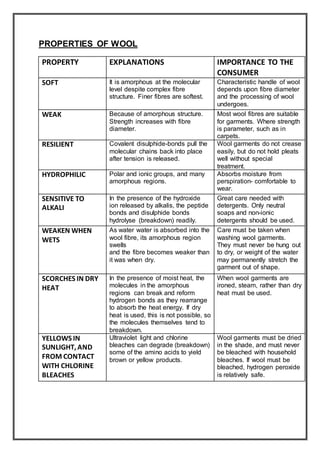
PROPERTIES OF WOOL
PROPERTY EXPLANATIONS IMPORTANCE TO THE
CONSUMER
SOFT It is amorphous at the molecular
level despite complex fibre
structure. Finer fibres are softest.
Characteristic handle of wool
depends upon fibre diameter
and the processing of wool
undergoes.
WEAK Because of amorphous structure.
Strength increases with fibre
diameter.
Most wool fibres are suitable
for garments. Where strength
is parameter, such as in
carpets.
RESILIENT Covalent disulphide-bonds pull the
molecular chains back into place
after tension is released.
Wool garments do not crease
easily, but do not hold pleats
well without special
treatment.
HYDROPHILIC Polar and ionic groups, and many
amorphous regions.
Absorbs moisture from
perspiration- comfortable to
wear.
SENSITIVE TO
ALKALI
In the presence of the hydroxide
ion released by alkalis, the peptide
bonds and disulphide bonds
hydrolyse (breakdown) readily.
Great care needed with
detergents. Only neutral
soaps and non-ionic
detergents should be used.
WEAKEN WHEN
WETS
As water water is absorbed into the
wool fibre, its amorphous region
swells
and the fibre becomes weaker than
it was when dry.
Care must be taken when
washing wool garments.
They must never be hung out
to dry, or weight of the water
may permanently stretch the
garment out of shape.
SCORCHES IN DRY
HEAT
In the presence of moist heat, the
molecules in the amorphous
regions can break and reform
hydrogen bonds as they rearrange
to absorb the heat energy. If dry
heat is used, this is not possible, so
the molecules themselves tend to
breakdown.
When wool garments are
ironed, steam, rather than dry
heat must be used.
YELLOWS IN
SUNLIGHT, AND
FROM CONTACT
WITH CHLORINE
BLEACHES
Ultraviolet light and chlorine
bleaches can degrade (breakdown)
some of the amino acids to yield
brown or yellow products.
Wool garments must be dried
in the shade, and must never
be bleached with household
bleaches. If wool must be
bleached, hydrogen peroxide
is relatively safe.
FIRERESISTANT This may be partly because wool
normally contains considerable
amounts of absorbed water.
However, all protein material are
relatively fire resistant, so the
tendency of wool to char rather
than burn, and its self-extinguishing
property, appears to be because of
its protein nature.
Wool is fibre recommended
for fire-fighting and other
uniform, for padding in
aeroplanes, and in other high
fire hazard. situations
Felts in The scales give rise to a directional
friction effect fibres migrate
towards root only.
Care is needed when
handing wet wool fabrics:
warm, wet, alkaline condition,
combined with string
agitation, produce maximum
felting and shrinkage.
The ability of wool to felt is
put to use in the manufacture
of strong nonwoven felt
materials.
Warm The amorphous fibre does not
transmit heat readily. Also, crimp
and scales can hold still, insulating
pockets of air. In addition, wool
gives off heat when it absorbs
moisture, which adds to its comfort
in cold, damp conditions.
Wool is reputed to be warmer
than other fibres processed
in identical ways.
GLOBAL WOOLEN MARKET
InternationalWool Market
In 2014 the woolen textile market has recorded diversified results compared to the
previous wool selling season. Around the world fine wool have struggled due to over-
production whereas medium crossed and coarser micron wools have fared better as
the year has progressed.
China continues to be the most dominant country in the world in terms of being a
producer, processor, exporter and consumer of textile fibers. Although the Chinese
economy is still quite tough at around 7% annual growth, they are facing many new
challenges. The Chinese government is transitioning the economy away from the
“old normal” which was based on high investment to build capacity, cheap labour
and exports, to the “new normal” which will feature developing domestic
consumption, focusing on quality, brands and technology with a shift from production
orientation to service orientation in their economy. One phase of this transition has
been a shrinking of access to credit and this is having an impact on many wool
textile mills in China and their ability to determine new business because of cash
flow questions. As a result China’s wool imports are down over 12% compared to the
previous year. Another distress for the wool textile industry in China is the new
environmental regulations that are being introduced. This will require significant
investment to develop surplus control systems that will meet these new standards.
As a result, this is taking away some capital from wool purchasing as factories invest
to upgrade their recycling and disposal methods to comply with the new regulations.
China is still by far the world’s major wool importer, processor and exporter of wool
goods, however Vietnam’s upright to the wool supply chain continues to raise. This
has been due to good circumstances for wool apparel manufacturing, a solid export
reputation and the ongoing Trans-Pacific Partnership (TPP) agreement debates.
Wool demand improvement continues to be contingent on the Chinese economy,
their export market and on global economic recovery. Although key economic
indicators for Europe and USA have been encouraging, other global occasions such
as the Ukraine disaster, ongoing tensions in the Middle East and the Ebola rampant
will not be helpful for the wool business and could undermine achieving global
economic stability. Despite struggle from other fibres, raw wool demand is projected
to improve in the approaching months as the economies of major wool overwhelming
countries continues to make positive progress, albeit at a slow pace. World wide
wool production will drop again this year in most major wool producing countries. In
Australia wool production is predicted to fall by 3.7% in the 2014/15 season due to
on going drought conditions and the subsequent reduction in sheep numbers.
FAMOUS GLOBAL WOOLEN TEXTILE BRANDS
1) WoolmarkBrands
2) Lion Brand
REFERRENCES :
Books :
Consumer Textiles ; by Anne Fritz & Jennifer Cant
Textiles : Fiber to Fabric ; by Bernard P. Corbman
Websites:
www.indiabrandequityfoundation.org
www.internationalwooltextileorganisation.org
www.quatr.us
Fabric Science - Wool

Fabric Science - Wool

  • 1.
    8/24/2015 Submitted To :Pranav Vohra Submitted By : Ankit Kumar Bittu Kumar Singh Harsh Nandan Tripathi Shubham Kumar Shubham Singh FABRIC SCIENCE ASSIGNMENT WOOL
  • 2.
    ACKNOWLEDGEMENT The completion ofthis assignment gives us much pleasure. We are much thankful to Mr. Pranav Vohra, Course Instructor, NIFT Gandhinagar for guiding us throughout the work. For a successful assignment as this one, we took help from some people. We would also like to thank heartily all those who directly or indirectly guided us in making this assignment. Many of our classmates and team members gave valuable suggestions which inspire us to continuously improve our work. Thank You
  • 3.
    WOOL- AN INTRODUCTION Hairof the animal sheep is called wool. It is the long furry covering of the animal. Each fibre grows out of a depression in the skin called “Follicle.” This growth is nourished by capillary blood vessels. Whether the wool is coarse or fine, or curly or straight is determined by the follicle. The oily sebum secreted by sebaceous gland is called “Wool fat.” This is the by product of wool processing. It is used in cosmetics and pharmaceuticals industry. The cells fibre is made of are produced at the bulb of follicles. After the completion, such cells are pushed up by the new cells. These harden and die to become wool. They retain the shape given by the follicle. Follicle bulbs follow cycles of activity and rest. When they are active, the fibre grows. When they are at rest, fibre does not grow. When they shrivel, the fibre is shed. Periodical shedding of a large proportion of hair is called moulting.
  • 4.
    PRODUCTION OF WOOL InIndia, Pakistan and North Africa coarse wool is produced. Years of selective breeding has helped sheep in being suited to an array of climate and fleece characteristics. Australia is the leading producer of wool. The main breed of its stock is the Australian Merino. Its contribution stands at ¾ th of its total produce. This breed is suited to dry conditions. It needs vast land to graze. Its wool is even finer during drought times. New Zealand and India are producers of excellent resilient carpet wools. The main breed found in New Zealand is of English variety called Romney Marsh. This breed is suited to wetter conditions of mountain pastures. The sheep of India are suited to hot and dry conditions. Lincoln is a breed of sheep know for its long wool. It needs open land to graze so that it can avoid burrs and rubbish. This protects its long wool from harm.
  • 5.
    TYPES OF WOOL Longwool is produces when follicles are active for long periods. Short wool is produced when follicles are active for relatively less time. Such wool is fine, dense and curlier. Fibres can be very fine in diameter (18 microns) to coarser (more than 40 microns). Fine wools are shorter i.e. of 4 to 12 cm average length. Coarse wools are longer i.e. up to 30cm in length. Length of wool depends on:  breed of sheep,  part of fleece from which wool comes,  how often a sheep is shorn. Wool having diameter less than 17 microns is called super fine wool. It is so soft that it can used for making babies’ under clothes. Fine wool is harvested from Merino sheep and Scottish Blackface sheep. It is fine, short and has small waves of crimps. Most woollen knits and finest worsteds are made from this wool. Blankets are made from medium diameter wools. Samples having more than 10% coarse diameter fibres will feel scratchy and lead to irritation. COARSE WOOLS They are tough, resilient and stiff. They are lustrous due to canal like spaces called Medulla. They have long waves of crimps. These are used in making tweeds and carpets. Romney Marsh, Crossbred, Lincoln and Tukidale produce coarse wools.
  • 6.
    MORPHOLOGY Wools are chemicallyand structurally complex. Central mass of the fibre is called Cortex. It is made up of two cigar shaped cells. These cells may be evenly mixed or maybe not. All para cells can be arranged on one side and ortho cells on the other sides. Such arrangements occur in fine fibres. They are produced from curved follicles. Such a fibre is called a bilateral fibre. It is distributed in two distinct halves. It is called helical fibre. In coarser wools, cells are uniformly distributed. They have little or no crimps. Scales are layers of cells surrounding the cortex. Generally there are 2 or 3 layers of flat and overlapping cells. They are laid one above another. They always point in one direction i.e. away from root of the fibre. Scales help in analysis of Directional frictional effect. Accordingly, it is easier to rub fibre in one direction than the other.
  • 7.
    MICRO STRUCTURE ANDMOLECULARSTRUCTURE Wool fibre is composed of tightly packed cells. These cells are made of well organized fibrillar regions. These filbrils are made microfibrils. Microfibrils are crystalline and amorphous arrangement of protein molecules. Keratin is a long protein molecule which passes through the crystalline and amorphous regions. Such crystalline regions have unique organization in which 3 molecular chains wind around in helical arrangements. These chains are held together by Van der Waals forces and hydrogen bonds. This helical arrangement allows the fibre to act as springs having unique resilience. Wool is not 100% elastic. it is distorted by excessive pressure. Factors affecting extension :  amount of extension  duration of time extension is maintained.  time allowed for recovering. In humid conditions , hydrogen bonds are broken easily. Thus wool stretches more.Wool is immensely amorphous. Cysteine is one of the proteins wool is made of. When two Cysteines are joined, Cystine is produced. In it, one half is in one chain and remaining half in the other chain. This results in strong covalent bonds. It occurs in the most amorphous parts of fibre. It contributes to strength of wool and elasticity in wet conditions. It holds molecular chains in place. The disulfide bonds of the fibre break on the actions of alkalis. This is why wool gets damaged by alkaline washing powders and detergents. To ensure no damage is done to the fabric, its properties can be modified.
  • 8.
    INDIAN WOOLEN MARKET MarketSize Fabricproduction by the mill sector accounted a rise of six per cent during April 2013-July 2014 and in hosiery sector it increased by eight per cent during April-July 2014. Total cloth production grew by two per cent during April-July 2014. With consumerism and sale income on the rise, the retail sector has experienced a enormous growth in the past decade with several international players like Marks & Spencer, Guess and Next have introduced in the Indian market. The organised apparel segment is expected to rise at a compound annual growth rate (CAGR) of more than 13 per cent over a 10-year period. The size of the Indian textiles and apparel industry is expected to reach US$223 billion by 2021, according to a report by Technopak Advisors. Opportunities India has witnessed an average GDP growth of approximately 7 per cent in the past decade and forms one of the largest emerging economies of the world. The majority stakeholder in this growth is the mass consuming population of the country. Consumers today are much more evolved and their demands and needs are very different from those of consumers a decade ago. Apart from the demographic and economic changes, there have been many other transformational changes that lead to a growth in the aspirations and wants of an average consumer:  Young population: The median age of the Indian consumer is 26 years with maximum population lying in the age bracket of 15-60 years. It is expected that India will add another 140 million people in this consuming age group by 2020. This is one of the lowest median ages among the developing countries. This population has more aspiration, is more aware and has a higher spending power and will consume a greater number of categories than their parents.  Higher disposable income: According to the Indian census report, the number of households with an annual income of US$7000 or more is going to treble from about 30 million today to 100 million by 2020. There will be approximately 400 million individuals in the middle to high income bracket by 2020.  Growing media influence/exposure: The role of technology has changed the way people receive/share information. From social networking sites to electronic channels, information travels at the speed of light. The changing lifestyle and “western” culture has also influenced consumer demands and aspirations. People are willing to consume and develop a lifestyle akin to a developed world’s consumer.
  • 9.
    GovernmentInitiatives The Indian governmenthas come up with a number of export promotion policies for the textiles sector. It has also allowed 100 per cent FDI in the Indian textiles sector and retail sector for single brands under the automatic route. Some of initiatives taken by the government to further promote the industry are:  The Ministry of Textiles will implement the scheme for in-situ upgradation of plain powerlooms for SSI sector in Surat and Ahmedabad powerloom clusters in Gujarat.  The government has taken a number of initiatives for the welfare and development of the weavers and the handloom sector. Under revival, reform and restructuring (RRR) package, financial assistance to the tune of Rs 1,019 crore (US$164.72 million) has been approved and the Indian government has released Rs 741 crore (US$119.78 million).  Encouraged by the turnaround in textiles exports, the Government of India plans to set up a US$60 billion target for the current financial year, a jump of over 30 per cent from the previous financial year.  The Cabinet Committee on Economic Affairs (CCEA) has approved an Integrated Processing Development Scheme (IPDS) with a corpus of Rs 500 crore (US$80.82 million) to make textiles processing units more environment- friendly and globally competitive. Source: Ministry of textiles, India The global textile and apparel industry at present is divided into distinct production and consumption hubs. Production has been shifting from developed western countries to China, India, Bangladesh, Pakistan, Turkey and other Southeast Asian countries. The US, European Union and Japan contribute the most to total textiles and apparel consumption of the world. Consumption in India and China is also rising. Bilateral and multilateral trade agreements will increasingly play an important role in shaping up global industry structure. With change in business dynamics and global market environment the industry is witnessing more inorganic growth. India has always been a strong player in the global textiles and apparel industry. With an integrated supply chain, political and economic stability, vast resource of skilled manpower and entrepreneurial spirit. Rising domestic market and increasing opportunities in global trade will create enormous scope for Indian players. In addition to favourable demographic dividend and relatively stable economic conditions, increasing disposable income, greater media influence, higher brand consciousness is acting as growth drivers for India’s domestic market. Kids-wear, inner-wear, work-wear & uniforms, online apparel retailing and home textiles are evolving as promising segments for Indian players. To tap the above opportunities and sustain businesses in this changing consumption scenario, companies will need to align themselves with the market requirements and develop required competencies. Without a doubt, there are ample opportunities that exist in the textile and apparel space.
  • 10.
    FAMOUS INDIAN WOOLENTEXTILE BRANDS: 1) Raymond 2) Shri Dinesh Mill 3) Modella Woolen 4) OswalWoolen Mill (Monte Carlo) 5) Jay Shree Textiles
  • 11.
    PROPERTIES OF WOOL PROPERTYEXPLANATIONS IMPORTANCE TO THE CONSUMER SOFT It is amorphous at the molecular level despite complex fibre structure. Finer fibres are softest. Characteristic handle of wool depends upon fibre diameter and the processing of wool undergoes. WEAK Because of amorphous structure. Strength increases with fibre diameter. Most wool fibres are suitable for garments. Where strength is parameter, such as in carpets. RESILIENT Covalent disulphide-bonds pull the molecular chains back into place after tension is released. Wool garments do not crease easily, but do not hold pleats well without special treatment. HYDROPHILIC Polar and ionic groups, and many amorphous regions. Absorbs moisture from perspiration- comfortable to wear. SENSITIVE TO ALKALI In the presence of the hydroxide ion released by alkalis, the peptide bonds and disulphide bonds hydrolyse (breakdown) readily. Great care needed with detergents. Only neutral soaps and non-ionic detergents should be used. WEAKEN WHEN WETS As water water is absorbed into the wool fibre, its amorphous region swells and the fibre becomes weaker than it was when dry. Care must be taken when washing wool garments. They must never be hung out to dry, or weight of the water may permanently stretch the garment out of shape. SCORCHES IN DRY HEAT In the presence of moist heat, the molecules in the amorphous regions can break and reform hydrogen bonds as they rearrange to absorb the heat energy. If dry heat is used, this is not possible, so the molecules themselves tend to breakdown. When wool garments are ironed, steam, rather than dry heat must be used. YELLOWS IN SUNLIGHT, AND FROM CONTACT WITH CHLORINE BLEACHES Ultraviolet light and chlorine bleaches can degrade (breakdown) some of the amino acids to yield brown or yellow products. Wool garments must be dried in the shade, and must never be bleached with household bleaches. If wool must be bleached, hydrogen peroxide is relatively safe.
  • 12.
    FIRERESISTANT This maybe partly because wool normally contains considerable amounts of absorbed water. However, all protein material are relatively fire resistant, so the tendency of wool to char rather than burn, and its self-extinguishing property, appears to be because of its protein nature. Wool is fibre recommended for fire-fighting and other uniform, for padding in aeroplanes, and in other high fire hazard. situations Felts in The scales give rise to a directional friction effect fibres migrate towards root only. Care is needed when handing wet wool fabrics: warm, wet, alkaline condition, combined with string agitation, produce maximum felting and shrinkage. The ability of wool to felt is put to use in the manufacture of strong nonwoven felt materials. Warm The amorphous fibre does not transmit heat readily. Also, crimp and scales can hold still, insulating pockets of air. In addition, wool gives off heat when it absorbs moisture, which adds to its comfort in cold, damp conditions. Wool is reputed to be warmer than other fibres processed in identical ways. GLOBAL WOOLEN MARKET InternationalWool Market In 2014 the woolen textile market has recorded diversified results compared to the previous wool selling season. Around the world fine wool have struggled due to over- production whereas medium crossed and coarser micron wools have fared better as the year has progressed. China continues to be the most dominant country in the world in terms of being a producer, processor, exporter and consumer of textile fibers. Although the Chinese economy is still quite tough at around 7% annual growth, they are facing many new challenges. The Chinese government is transitioning the economy away from the “old normal” which was based on high investment to build capacity, cheap labour and exports, to the “new normal” which will feature developing domestic
  • 13.
    consumption, focusing onquality, brands and technology with a shift from production orientation to service orientation in their economy. One phase of this transition has been a shrinking of access to credit and this is having an impact on many wool textile mills in China and their ability to determine new business because of cash flow questions. As a result China’s wool imports are down over 12% compared to the previous year. Another distress for the wool textile industry in China is the new environmental regulations that are being introduced. This will require significant investment to develop surplus control systems that will meet these new standards. As a result, this is taking away some capital from wool purchasing as factories invest to upgrade their recycling and disposal methods to comply with the new regulations. China is still by far the world’s major wool importer, processor and exporter of wool goods, however Vietnam’s upright to the wool supply chain continues to raise. This has been due to good circumstances for wool apparel manufacturing, a solid export reputation and the ongoing Trans-Pacific Partnership (TPP) agreement debates. Wool demand improvement continues to be contingent on the Chinese economy, their export market and on global economic recovery. Although key economic indicators for Europe and USA have been encouraging, other global occasions such as the Ukraine disaster, ongoing tensions in the Middle East and the Ebola rampant will not be helpful for the wool business and could undermine achieving global economic stability. Despite struggle from other fibres, raw wool demand is projected to improve in the approaching months as the economies of major wool overwhelming countries continues to make positive progress, albeit at a slow pace. World wide wool production will drop again this year in most major wool producing countries. In Australia wool production is predicted to fall by 3.7% in the 2014/15 season due to on going drought conditions and the subsequent reduction in sheep numbers. FAMOUS GLOBAL WOOLEN TEXTILE BRANDS 1) WoolmarkBrands 2) Lion Brand
  • 14.
    REFERRENCES : Books : ConsumerTextiles ; by Anne Fritz & Jennifer Cant Textiles : Fiber to Fabric ; by Bernard P. Corbman Websites: www.indiabrandequityfoundation.org www.internationalwooltextileorganisation.org www.quatr.us