
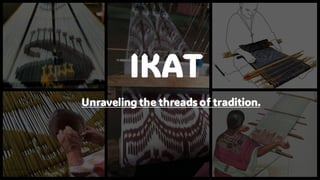
IKAT
Unraveling the threads of tradition.

INTRODUCTION
▪ The word Ikat is derived from the Malaysian word “Mengi ikat”
that means to ‘bind or knot’.
▪ It is a very ancient way of weaving that uses a resist dyeing
process similar to tie-dye on either the warp or weft before
the threads are woven to create a pattern or design.
▪ Place of origin is Turkey and Afghanistan.
▪ India "Ikat" is known as Bandha of Orissa, patola of Gujarat,
Pochampally in Andhra Pradesh.
▪ Highly priced textiles in the world.

HISTORICAL ANALYSIS
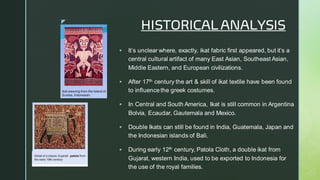
▪ It’s unclear where, exactly, ikat fabric first appeared, but it’s a
central cultural artifact of many East Asian, Southeast Asian,
Middle Eastern, and European civilizations.
▪ After 17th century the art & skill of ikat textile have been found
to influencethe greek costumes.
▪ In Central and South America, Ikat is still common in Argentina
Bolvia, Ecaudar, Gautemala and Mexico.
▪ Double Ikats can still be found in India, Guatemala, Japan and
the Indonesian islands of Bali.
▪ During early 12th century, Patola Cloth, a double ikat from
Gujarat, western India, used to be exported to Indonesia for
the use of the royal families.

CLASSIFICATION
1.
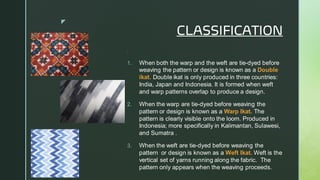
1. When both the warp and the weft are tie-dyed before
weaving the pattern or design is known as a Double
ikat. Double ikat is only produced in three countries:
India, Japan and Indonesia. It is formed when weft
and warp patterns overlap to produce a design.
2. When the warp are tie-dyed before weaving the
pattern or design is known as a Warp Ikat. The
pattern is clearly visible onto the loom. Produced in
Indonesia; more specifically in Kalimantan, Sulawesi,
and Sumatra .
3. When the weft are tie-dyed before weaving the
pattern or design is known as a Weft Ikat. Weft is the
vertical set of yarns running along the fabric. The
pattern only appears when the weaving proceeds.
 MOTIFS& PATTERNS OF IKAT
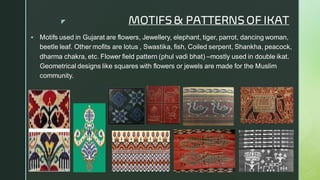
▪ Motifs used in Gujarat are flowers, Jewellery, elephant, tiger, parrot, dancing woman,
beetle leaf. Other mofits are lotus , Swastika, fish, Coiled serpent, Shankha, peacock,
dharma chakra, etc. Flower field pattern (phul vadi bhat) –mostly used in double ikat.
Geometrical designs like squares with flowers or jewels are made for the Muslim
community.

COLORS FOR IKAT TEXTILE
▪ The dyes used for ikat are extracted from variety of natural resources:-
▪ Red - cochineal insect or from madder
▪ Green - seedpods and flowers of the pagoda tree
▪ Yellow - delphinium, saffron or larkspur
▪ Pink - brazilwood
▪ Black - skins of pomegranates, the black mallow plant
▪ Indigo - indigo plant imported from India.

PLACE OF PRODUCTION
▪ The areas of production in INDIAare Patan, Surat and Rajkot in
Gujrat; Pochampalli, Guntur and Chirala in Andhra Pradesh;
Sambalpur, Cuttack and Balasore in Orissa.
▪ It is done in Asia-Pacific (China, Cambodia, India, Indonesia,
Japan, Malaysia, Philippines, Thailand, Tajikistan and
Uzbekistan ), WestAfrica and Europe (Italy and Spain).
▪ In western Orissa sub clusters like sambalpur, sonepur,
boudh,etc, ikat is produced by communities like Bhulia assisted
by kostha and kuli.

PROCESS
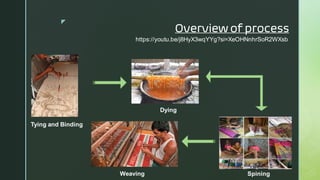
1. Preparing the yarn: prepare the yarn that will be used for weaving. The yarn is typically made from
natural fibers such as cotton, silk, or wool.
2. Marking the design: The design for the ikkat fabric is usually marked onto the yarn using a pencil or
other marking tool.
3. Binding the yarn: The next step is to bind or tie the parts of the yarn that will resist the dye. This is
typically done using a material such as wax, thread, or plastic.
4. Dyeing the yarn: The yarn is then immersed in a dye bath. The dye adheres to the exposed areas
of the yarn, creating the desired pattern.
5. Removing the binding material: After the yarn has been dyed, the binding material is removed to
reveal the pattern.
6. Weaving the fabric: The final step is to weave the dyed yarn into the final fabric. The weaving
process involves interlacing the dyed yarn with un-dyed yarn to create the finished product.

Overview of process
Tying and Binding
Dying
Spining
Weaving
https://youtu.be/j8HyX3wqYYg?si=XeOHNnhrSoR2WXsb

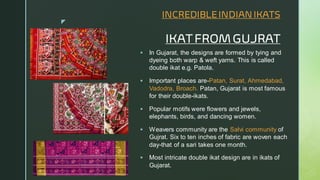
INCREDIBLEINDIAN IKATS
IKAT FROM GUJRAT
▪ In Gujarat, the designs are formed by tying and
dyeing both warp & weft yarns. This is called
double ikat e.g. Patola.
▪ Important places are-Patan, Surat, Ahmedabad,
Vadodra, Broach. Patan, Gujarat is most famous
for their double-ikats.
▪ Popular motifs were flowers and jewels,
elephants, birds, and dancing women.
▪ Weavers community are the Salvi community of
Gujrat. Six to ten inches of fabric are woven each
day-that of a sari takes one month.
▪ Most intricate double ikat design are in ikats of
Gujarat.

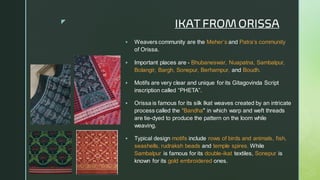
IKAT FROM ORISSA
▪ Weavers community are the Meher’s and Patra’s community
of Orissa.
▪ Important places are - Bhubaneswar, Nuapatna, Sambalpur,
Bolangir, Bargh, Sonepur, Berhampur, and Boudh.
▪ Motifs are very clear and unique for its Gitagovinda Script
inscription called “PHETA”.
▪ Orissa is famous for its silk Ikat weaves created by an intricate
process called the "Bandha" in which warp and weft threads
are tie-dyed to produce the pattern on the loom while
weaving.
▪ Typical design motifs include rows of birds and animals, fish,
seashells, rudraksh beads and temple spires. While
Sambalpur is famous for its double-ikat textiles, Sonepur is
known for its gold embroidered ones.

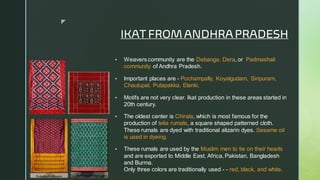
IKAT FROM ANDHRA PRADESH
▪ Weavers community are the Debanga, Dera, or Padmashali
community of Andhra Pradesh.
▪ Important places are - Pochampally, Koyalgudam, Siripuram,
Chautupal, Putapakka, Elanki.
▪ Motifs are not very clear. Ikat production in these areas started in
20th century.
▪ The oldest center is Chirala, which is most famous for the
production of telia rumals, a square shaped patterned cloth.
These rumals are dyed with traditional alizarin dyes. Sesame oil
is used in dyeing.
▪ These rumals are used by the Muslim men to tie on their heads
and are exported to Middle East, Africa, Pakistan, Bangladesh
and Burma.
Only three colors are traditionally used - - red, black, and white.

IKAT ARTICLES
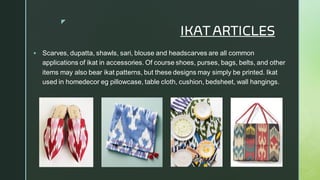
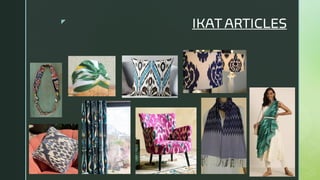
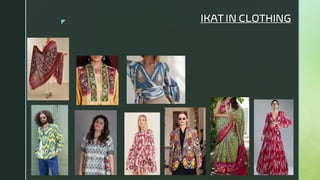
▪ Scarves, dupatta, shawls, sari, blouse and headscarves are all common
applications of ikat in accessories. Of course shoes, purses, bags, belts, and other
items may also bear ikat patterns, but these designs may simply be printed. Ikat
used in homedecor eg pillowcase, table cloth, cushion, bedsheet, wall hangings.

IKAT ARTICLES
 IKAT IN CLOTHING

NAME OF DESIGNERSWHO WORKED ON IKATTEXTILE.
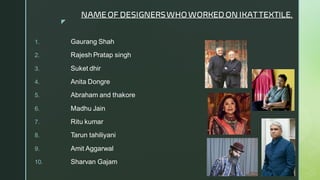
1. Gaurang Shah
2. Rajesh Pratap singh
3. Suket dhir
4. Anita Dongre
5. Abraham and thakore
6. Madhu Jain
7. Ritu kumar
8. Tarun tahiliyani
9. Amit Aggarwal
10. Sharvan Gajam

MADHU JAIN
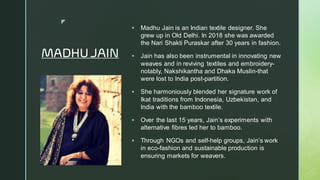
▪ Madhu Jain is an Indian textile designer. She
grew up in Old Delhi. In 2018 she was awarded
the Nari Shakti Puraskar after 30 years in fashion.
▪ Jain has also been instrumental in innovating new
weaves and in reviving textiles and embroidery-
notably, Nakshikantha and Dhaka Muslin-that
were lost to India post-partition.
▪ She harmoniously blended her signature work of
Ikat traditions from Indonesia, Uzbekistan, and
India with the bamboo textile.
▪ Over the last 15 years, Jain’s experiments with
alternative fibres led her to bamboo.
▪ Through NGOs and self-help groups, Jain’s work
in eco-fashion and sustainable production is
ensuring markets for weavers.

ABOUT HER COLLECTION
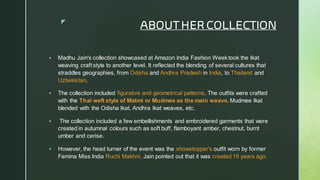
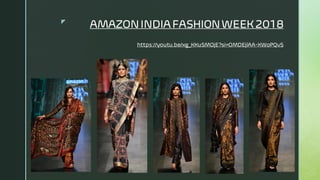
▪ Madhu Jain's collection showcased at Amazon India Fashion Week took the Ikat
weaving craft style to another level. It reflected the blending of several cultures that
straddles geographies, from Odisha and Andhra Pradesh in India, to Thailand and
Uzbekistan.
▪ The collection included figurative and geometrical patterns. The outfits were crafted
with the Thai weft style of Matmi or Mudmee as the main weave. Mudmee Ikat
blended with the Odisha Ikat, Andhra Ikat weaves, etc.
▪ The collection included a few embellishments and embroidered garments that were
created in autumnal colours such as soft buff, flamboyant amber, chestnut, burnt
umber and cerise.
▪ However, the head turner of the event was the showstopper's outfit worn by former
Femina Miss India Ruchi Makhni. Jain pointed out that it was created 15 years ago.

AMAZON INDIA FASHION WEEK 2018
https://youtu.be/xg_KKuSMOjE?si=OMDEjlAA-XWoPQv5

MADHU JAIN’S COLLECTION

Ikat weaving and textile presentation.pdf

  • 1.
  • 2.
     INTRODUCTION ▪ The wordIkat is derived from the Malaysian word “Mengi ikat” that means to ‘bind or knot’. ▪ It is a very ancient way of weaving that uses a resist dyeing process similar to tie-dye on either the warp or weft before the threads are woven to create a pattern or design. ▪ Place of origin is Turkey and Afghanistan. ▪ India "Ikat" is known as Bandha of Orissa, patola of Gujarat, Pochampally in Andhra Pradesh. ▪ Highly priced textiles in the world.
  • 3.
     HISTORICAL ANALYSIS ▪ It’sunclear where, exactly, ikat fabric first appeared, but it’s a central cultural artifact of many East Asian, Southeast Asian, Middle Eastern, and European civilizations. ▪ After 17th century the art & skill of ikat textile have been found to influencethe greek costumes. ▪ In Central and South America, Ikat is still common in Argentina Bolvia, Ecaudar, Gautemala and Mexico. ▪ Double Ikats can still be found in India, Guatemala, Japan and the Indonesian islands of Bali. ▪ During early 12th century, Patola Cloth, a double ikat from Gujarat, western India, used to be exported to Indonesia for the use of the royal families.
  • 4.
     CLASSIFICATION 1. 1. When boththe warp and the weft are tie-dyed before weaving the pattern or design is known as a Double ikat. Double ikat is only produced in three countries: India, Japan and Indonesia. It is formed when weft and warp patterns overlap to produce a design. 2. When the warp are tie-dyed before weaving the pattern or design is known as a Warp Ikat. The pattern is clearly visible onto the loom. Produced in Indonesia; more specifically in Kalimantan, Sulawesi, and Sumatra . 3. When the weft are tie-dyed before weaving the pattern or design is known as a Weft Ikat. Weft is the vertical set of yarns running along the fabric. The pattern only appears when the weaving proceeds.
  • 5.
     MOTIFS& PATTERNSOF IKAT ▪ Motifs used in Gujarat are flowers, Jewellery, elephant, tiger, parrot, dancing woman, beetle leaf. Other mofits are lotus , Swastika, fish, Coiled serpent, Shankha, peacock, dharma chakra, etc. Flower field pattern (phul vadi bhat) –mostly used in double ikat. Geometrical designs like squares with flowers or jewels are made for the Muslim community.
  • 6.
     COLORS FOR IKATTEXTILE ▪ The dyes used for ikat are extracted from variety of natural resources:- ▪ Red - cochineal insect or from madder ▪ Green - seedpods and flowers of the pagoda tree ▪ Yellow - delphinium, saffron or larkspur ▪ Pink - brazilwood ▪ Black - skins of pomegranates, the black mallow plant ▪ Indigo - indigo plant imported from India.
  • 7.
     PLACE OF PRODUCTION ▪The areas of production in INDIAare Patan, Surat and Rajkot in Gujrat; Pochampalli, Guntur and Chirala in Andhra Pradesh; Sambalpur, Cuttack and Balasore in Orissa. ▪ It is done in Asia-Pacific (China, Cambodia, India, Indonesia, Japan, Malaysia, Philippines, Thailand, Tajikistan and Uzbekistan ), WestAfrica and Europe (Italy and Spain). ▪ In western Orissa sub clusters like sambalpur, sonepur, boudh,etc, ikat is produced by communities like Bhulia assisted by kostha and kuli.
  • 8.
     PROCESS 1. Preparing theyarn: prepare the yarn that will be used for weaving. The yarn is typically made from natural fibers such as cotton, silk, or wool. 2. Marking the design: The design for the ikkat fabric is usually marked onto the yarn using a pencil or other marking tool. 3. Binding the yarn: The next step is to bind or tie the parts of the yarn that will resist the dye. This is typically done using a material such as wax, thread, or plastic. 4. Dyeing the yarn: The yarn is then immersed in a dye bath. The dye adheres to the exposed areas of the yarn, creating the desired pattern. 5. Removing the binding material: After the yarn has been dyed, the binding material is removed to reveal the pattern. 6. Weaving the fabric: The final step is to weave the dyed yarn into the final fabric. The weaving process involves interlacing the dyed yarn with un-dyed yarn to create the finished product.
  • 9.
     Overview of process Tyingand Binding Dying Spining Weaving https://youtu.be/j8HyX3wqYYg?si=XeOHNnhrSoR2WXsb
  • 10.
     INCREDIBLEINDIAN IKATS IKAT FROMGUJRAT ▪ In Gujarat, the designs are formed by tying and dyeing both warp & weft yarns. This is called double ikat e.g. Patola. ▪ Important places are-Patan, Surat, Ahmedabad, Vadodra, Broach. Patan, Gujarat is most famous for their double-ikats. ▪ Popular motifs were flowers and jewels, elephants, birds, and dancing women. ▪ Weavers community are the Salvi community of Gujrat. Six to ten inches of fabric are woven each day-that of a sari takes one month. ▪ Most intricate double ikat design are in ikats of Gujarat.
  • 11.
     IKAT FROM ORISSA ▪Weavers community are the Meher’s and Patra’s community of Orissa. ▪ Important places are - Bhubaneswar, Nuapatna, Sambalpur, Bolangir, Bargh, Sonepur, Berhampur, and Boudh. ▪ Motifs are very clear and unique for its Gitagovinda Script inscription called “PHETA”. ▪ Orissa is famous for its silk Ikat weaves created by an intricate process called the "Bandha" in which warp and weft threads are tie-dyed to produce the pattern on the loom while weaving. ▪ Typical design motifs include rows of birds and animals, fish, seashells, rudraksh beads and temple spires. While Sambalpur is famous for its double-ikat textiles, Sonepur is known for its gold embroidered ones.
  • 12.
     IKAT FROM ANDHRAPRADESH ▪ Weavers community are the Debanga, Dera, or Padmashali community of Andhra Pradesh. ▪ Important places are - Pochampally, Koyalgudam, Siripuram, Chautupal, Putapakka, Elanki. ▪ Motifs are not very clear. Ikat production in these areas started in 20th century. ▪ The oldest center is Chirala, which is most famous for the production of telia rumals, a square shaped patterned cloth. These rumals are dyed with traditional alizarin dyes. Sesame oil is used in dyeing. ▪ These rumals are used by the Muslim men to tie on their heads and are exported to Middle East, Africa, Pakistan, Bangladesh and Burma. Only three colors are traditionally used - - red, black, and white.
  • 13.
     IKAT ARTICLES ▪ Scarves,dupatta, shawls, sari, blouse and headscarves are all common applications of ikat in accessories. Of course shoes, purses, bags, belts, and other items may also bear ikat patterns, but these designs may simply be printed. Ikat used in homedecor eg pillowcase, table cloth, cushion, bedsheet, wall hangings.
  • 14.
  • 15.
     IKAT INCLOTHING
  • 16.
     NAME OF DESIGNERSWHOWORKED ON IKATTEXTILE. 1. Gaurang Shah 2. Rajesh Pratap singh 3. Suket dhir 4. Anita Dongre 5. Abraham and thakore 6. Madhu Jain 7. Ritu kumar 8. Tarun tahiliyani 9. Amit Aggarwal 10. Sharvan Gajam
  • 17.
     MADHU JAIN ▪ MadhuJain is an Indian textile designer. She grew up in Old Delhi. In 2018 she was awarded the Nari Shakti Puraskar after 30 years in fashion. ▪ Jain has also been instrumental in innovating new weaves and in reviving textiles and embroidery- notably, Nakshikantha and Dhaka Muslin-that were lost to India post-partition. ▪ She harmoniously blended her signature work of Ikat traditions from Indonesia, Uzbekistan, and India with the bamboo textile. ▪ Over the last 15 years, Jain’s experiments with alternative fibres led her to bamboo. ▪ Through NGOs and self-help groups, Jain’s work in eco-fashion and sustainable production is ensuring markets for weavers.
  • 18.
     ABOUT HER COLLECTION ▪Madhu Jain's collection showcased at Amazon India Fashion Week took the Ikat weaving craft style to another level. It reflected the blending of several cultures that straddles geographies, from Odisha and Andhra Pradesh in India, to Thailand and Uzbekistan. ▪ The collection included figurative and geometrical patterns. The outfits were crafted with the Thai weft style of Matmi or Mudmee as the main weave. Mudmee Ikat blended with the Odisha Ikat, Andhra Ikat weaves, etc. ▪ The collection included a few embellishments and embroidered garments that were created in autumnal colours such as soft buff, flamboyant amber, chestnut, burnt umber and cerise. ▪ However, the head turner of the event was the showstopper's outfit worn by former Femina Miss India Ruchi Makhni. Jain pointed out that it was created 15 years ago.
  • 19.
     AMAZON INDIA FASHIONWEEK 2018 https://youtu.be/xg_KKuSMOjE?si=OMDEjlAA-XWoPQv5
  • 20.